Floating balance no longer “floats”

Floating balance movements began appearing in mechanical clocks in the early 1950s. The floating balance has distinct advantages over pendulum clocks. It is robust, dependable and not susceptible to disturbance. It will tolerate being out of level unlike pendulum clocks which must be on a level surface.

clock movement
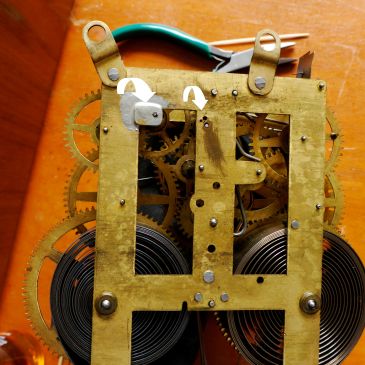
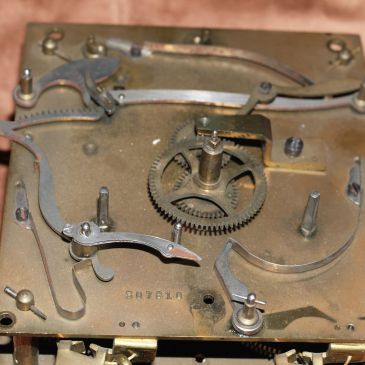
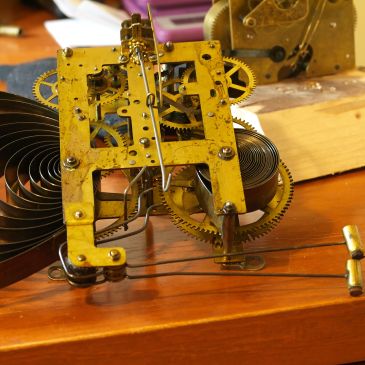
Hermle movement showing floating balance escapement

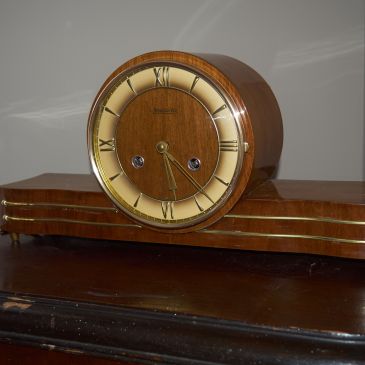
This Hermle movement was taken out of a Dugena 1960s vintage Mantel clock and is otherwise unmarked. The seller advised that it loses time and might just require a simple adjustment. This is code for, “it’s worn out”. The clock has been completely disassembled, cleaned, reassembled, oiled and tested. have I have eliminated friction loses in the trains. Not sure, but let’s see.

To function correctly the balance wheel rotates back and forth and maintains the steady beat of the clock through a pallet fork assembly. There is a speed adjustment and after adjusting it enough it becomes clear that the problem is within the balance wheel itself since it continues to run slowly.

The floating balance assembly consists of a balance wheel, 2 jeweled bearings on each end of a hollow tube riding on a pivot wire supported in a u-shaped frame.

mantel clock
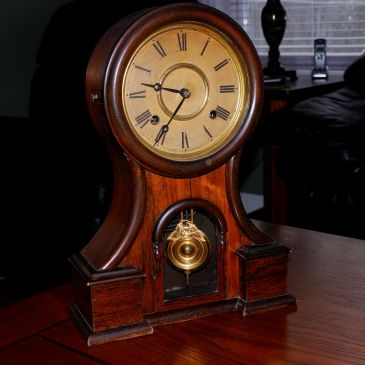
Dugena time and strike mantel clock

The most common reasons for sluggish balance performance are dirt, rust/pitting/roughness of the wire, bent or weak wire or excess oil on the wire & jewels.

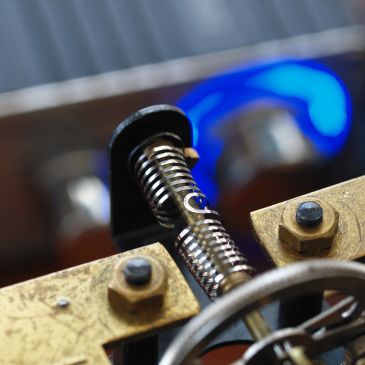
Removal is simple – take out two screws, tilt the balance to avoid bending the pallet fork and pull out. Here is the assembly removed from the movement. The bad news is that the helical hairspring appears to be distorted. Ideally it should enclose the balance shaft without bending.

clock part
Floating balance

The balance wheel should float on the wire that goes through the cylindrical shaft like the next photo. While in this position a push on the balance wheel should allow it to rotate freely for a minute or more. No more than a few seconds for this one, however.

clock part
Arrow shows a properly functioning floating balance

The thin wire is actually resting on the banking forks (or base). If the shaft rests on the base, additional friction slows the rotation of the balance wheel and will eventually slow the clock.

clock part
Cylindrical shaft is resting on the banking pins

In this case either the jewels are cracked or the spring has lost its strength. The solution is to either find a new helical torsion spring or find a replacement balance wheel assembly.

Given what I paid for it, it is probably not worth additional resources.

Call it a learning experience. Into the drawer it goes and perhaps someday it will provide parts for a better running movement.

Ridgeway Grandfather Clock

Should every clock collector have a Grandfather (tall case or long case) clock? No, but it was something I had always wanted.

RS Ridgeway clock_2
Ridgeway tall case clock

In 2012 I was perusing a local for-sale site and came upon this particular Ridgeway grandfather clock. The ad said that the clock was in excellent condition. When I called the seller and asked what he meant by “excellent” he said, “You have to see it to believe it”. He was right. The brass was bright and shiny and the only indication of its age (1996) is slight tarnishing of the column capitals.

Unfortunately, this type of clock takes a real hit on the used market. The smaller homes that many folks prefer today simply means there there is no room for a clock this size.

Clock face showing moon dial
Clock face showing moon dial and raised Arabic numerals

The clock has a graceful, regal look. It stands 83 inches tall, has a scalloped bonnet crown, functional blue moon dial with constellation, 5-rod Westminster chime with shut-off, stately columns with brass base and caps, raised Arabic numerals, oak solids and veneers, brass lyre pendulum with 10 5/8 polished bob and access panels on each side. It was made by the Pulsaski Furniture Company. The Pulaski company struggled financially in later years and was eventually bought out by the Howard Miller Clock Company in 2004. Howard Miller continues to offer the Ridgeway line.

clock face
Moon phase with constellation

And it came with the original cabinet key.

key
Original Ridgeway cabinet key

The seller advertised that it had a quality Keininger movement. Later ones did; this has a Hermle movement. In the 1990s the German clock company Hermle was the principle supplier.

clock movement
Hermle movement

In this case the ubiquitous 451-033, with 114 cm pendulum and 60 bps.

grandfather clock
Sussex model

The clock is very similar to the Sussex model as shown in this advertising brochure.

I have also seen the clock referred to as the Hamilton Country model. Nonetheless, it is impossible to verify since very little information about the original company exists to this day.

clock pendulum
Lyre pendulum with brass bob

The clock runs very well and to within a minute a week. When it fails it is more cost effective to replace the movement rather than bring someone in to repair it. I will simply swap the movement out with an identical one since Hermle continues to make this movement to this day.

Perhaps my only grandfather clock for now.

Gustav Becker March 2016 update part 2

As I mentioned in a previous post my Gustav Becker two weight regulator arrived with some issues. I was aware beforehand that there would be some problems as it was advertised as a ‘project” clock and that is what it has become, but not in an entirely negative way. It is all good learning.

Clock movement
New movement from Poland

My donor GB clock movement arrived from Poland this week. As mentioned previously the original movement came without a star wheel/snail (not disclosed by the seller), a hammer assembly and a couple of non-operational parts which necessitated the acquisition of another movement. The gathering pallet which I originally thought was bent on the original movement has a piece broken off as I discovered when I compared it with the newer movement.

At a glance the two movements look identical but I am learning that there are key differences between the movement made in 1902 and the donor movement, made in 1918. The “newer” movement has thinner plates. The centre arbor is thicker on the new movement but the star wheel/snail is an exact fit. The escape wheel is slightly smaller. The fan on the new movement created an obstruction when I tried to install it on the old movement so out it came and replaced by the old fan. I was also able to transfer the gathering pallet as well. This time it works correctly as it advances the rack. The escape wheel is smaller on the new movement and I gather that the pendulum for the newer movement is a little shorter i.e faster rate. I am also able to salvage the hammer and hammer rod on the replacement movement though I have not attached it as yet. It would need some adjustment.

Clock part
New star wheel
clock part
Broken gathering pallet

During the testing phase the clock is running without its dial face and hands. I am checking and calibrating the hour and half hour strike while observing the action of the strike side specifically the advance of the star and snail. All seems to be working as it should. The time and strike weights are also descending at the same rate so I am assuming that the clock is going through its correct cycle on the hour and half hour.

More testing in the next few days after which I will install the hammer assembly, the face and hands and string new cable for the weights.

Clocks of Cuba

During two vacation trips to Cuba in the last 4 months I managed to locate a few clocks in my travels. Though some clocks were very intriguing none that I saw save for the tower clocks were in working condition. Nonetheless it made me wonder about their provenance in a land that time seemingly forgot.

At Christmas time my family and I traveled to Trinidad of Cuba. We stayed overnight at Los Helechos Hotel in Topes de Collantes which is located about a half an hour bus ride from Trinidad of Cuba. The next day we spend our time exploring the wonders of Trinidad of Cuba.

I saw some interesting clocks in a couple of restaurants. The first is a Wm L. Gilbert time and strike wall clock with calendar dial from Winsted Conn., USA. It looked like a reasonably well preserved dark walnut regulator clock with an 8-day brass movement with pressed features dating to about the 1900s.

wall clock
Wm L. Gilbert clock found in a restaurant

The next is unknown to me. It is a Spanish clock. Whether or not Malaprade is the maker was difficult to determine as I could find no information on the internet. However, it is clear that this spring wound time-only clock with second hand feature was made in Barcelona. I would date it to pre-1930. It is a relatively short clock and might have been originally designed as a wall mounted clock as it stands less than 5 feet tall. I am not sure what the area around and below the keyhole represents. I cannot make out any sort of design if there is one.

Floor clock
Malaprade Floor or wall clock

Next is a floor clock. Again the maker is unknown. I do not see any winding arbors on the dial face and can only assume that it is weight driven (the weight was not attached) and that the weight (or weights) were pulled up by chain to reset the clock likely once every 8 days. This clock was clearly in meed of restoration as were most of the clocks that I saw.

Floor clock
Floor clock of unknown maker

In March we stayed at the Paradisus Rio de Oro in Holguin province located on Playa Esmeraldo near Guardelavaca. The resort is set on a beach next to Bahía de Naranjo Natural Park. In it are a number of interesting clocks.

Lobby clocks
Time only lobby clocks

There were a total of 4 of these lobby clocks which were originally intended to display time zones for the guests. They are time-only and the cases appeared to be in good shape but I do not think they have been running for quite a while. My thought is that there is nobody at the resort tasked with the responsibility of maintaining these and other fine clocks.

face of clock
Face of unknown floor clock, second hand is missing
RS Tall case clock (2)
Unknown floor clock

This clock actually works though it needs servicing. It is located in an ante-chamber adjacent to a Mediterranean themed restaurant. I opened the front door of the clock and found the rod gong impeding the pendulum. Once I dislodged the gong the clock happily began to function and it was in beat, surprisingly. Although it had two weights there were three winding arbors and I would be curious to see the internal workings of that movement. Inside the door was an official seal from the Ministerio de Cultura.

400 day clock
400 day clock

This 400 day clock was made in Germany. There were no other markings that I could determine. It could be a Kundo Kieninger & Obergfell dating to about the 1940s or so but that is just a guess. It needs a thorough servicing and clearly it has been neglected for some time.

Carriage style clock
Carriage or wall mounted clock

This is another an anniversary mantel clock but it appears to have a wall mounting bracket on the rear. Not sure why as these clocks are not meant for wall mounting. Again, an unknown maker but possibly German and in very poor condition. The front glass looks like it can be lifted up for adjustment purposes.

clock
Clock in a peasants home

While hiking through El Cubana National Forest we came across a small dwelling and we were able to briefly tour inside. In it I found an old quartz clock dating from the 1980s or earlier.

Tower clock
Tower clock at Peublo La Estrella tourist village
Tower clock
Tower clock in Holguin

The first tower clock is located in a tourist village in Cayo Santa Maria called Peublo la Estralla while the next is in a downtown principle square in the city of Holguin. The Olvera clock is a modern electric clock and I am assuming that the tower clock in Holguin might also be electric.

I am told that my next stop in Cuba (another time) should be the Paladar Decameron restaurant in Havana, a fixture in the paladar scene that’s located in the leafy residential district of Vedado. The restaurant is said to said have an old world charm with a collection of various collectibles including antique clocks of all shapes and sizes.

Cuba is a fascinating country and certainly worth exploring time and time again.

Girod movement in Canadian made case

Mantel clock
Mantel clock

This fairly non-descript mantel clock is a puzzler. It has a nicely constructed case with curved wood relief features and a westminster chime, hence the three winding arbors. It is in very good condition and required a simple de-greasing of the cabinet to bring it back to it’s former glory.

The clock was presumably made after the war years, perhaps the late 1940s and has a pendulum movement. Most mantel clocks beginning in the 1950s had balance wheel escapements so I am putting this in the late 1940s perhaps even the early 1950s. This particular mantel clock has a French Girod westminster chime movement.

Girod was a clock maker based in the Morbier-Jura region of France and produced clocks from the 1930’s into the 1960’s. The firm of Girod was founded in 1865 by brothers Leon and Auguste Girod. The clocks were made almost exclusively in the Art Deco style. This clock has Art Deco features particularly the formation of the dial numerals but I would not say it was sold as a Girod clock.

RS Girod mantel clock (8)
Dial face

Girod clocks (both mantel and tall case) often came with Westminster chimes, and often a second chime named Cloche de Jura, using the same notes as the Westminster chime. A handful of clocks were built with Ave Maria de Lourdes, and  St. Etienne chimes. This clock is westminster chime only; no double chime feature unfortunately. Girod cases usually featured carved walnut appliques and were very ornate, almost garish. Mine is very plain and as I said non-descript.

So, what is it? Well, from my research I have discovered that despite the fact that the clock movement is stamped Girod, it might be a German Kienzle movement. Girod movements had the distinctive feature of split plates, this one has solid one-piece plates. Again my research reveals that as a result of the post-war German reparation effort, Kienzle clock movements were brought from Germany into the Girod factory in France, assembled and stamped as a Girod movements for, it is my guess, export to Canada and other countries.

Another clue. The case has a stamp on the back. It is a little faded but it says, “Quality Cabinet Made in Canada”. There are three letters in the middle that I cannot make out. PHS or FHS perhaps?

RS Girod mantel clock (11)
Upside down stamp on back

There is no trademark on the dial face which would normally indicate the retail seller or manufacturer but my guess is that it was likely sold as a Forestville mantle clock (the Forestville Clock Company was based in Toronto). The logo (??) punched into the hour hand makes me wonder though.

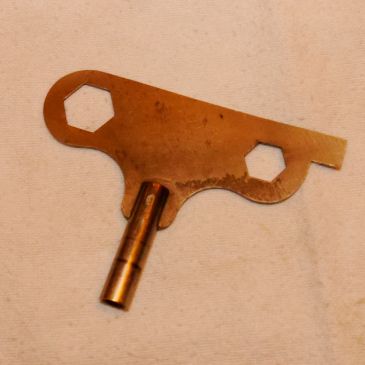
Look at the key. Why two wrench punch-outs and a screw driver end?

RS Girod mantel clock (1)
Key with screwdriver and wrench punch-outs
RS Girod mantel clock (4)
Girod movement showing chime rods and unusual pendulum

The above shot shows the movement. It has five strike hammers, 4 of which carry the Westminster chime and three hammers for the on-the-hour strike. The strike feature is quite loud. The rods appear to be differing lengths of copper and the pendulum has a relief of the Eiffel Tower that you can just make out. There is also a lever on the upper front of the movement which serves as a repeater. The movement appears to be very sturdily built and reflects German (??) quality.

Again my best guess is the Forestville Clock Company of Toronto but if you have other information or if you know more about the history of Girod clocks please drop a line.

Gustav Becker March update


Clock case and movement
Assembled clock

A few changes have taken place since I last posted but the clock is still not 100% correct.

Some changes to note. The bottom right finial was repaired.

clock piece
Broken finial tip

To the casual observer it looks impressive but a keen eye would reveal the repair. The middle finial is not attached as yet as there are still some minor cosmetic details that need to be addressed before I attach it to the base.

This past week I had contacted a local glass repair shop to make and install new 3 mm glass. Thicker than I thought but true to the original that is, if the glass that was broken was truly original. I say this because the glass shop noted that the previous glass was installed using finishing nails the shape, style and size of which would not have been available at the time (1902). So, putting new glass into the clock may not change the value since the glass that was broken during shipment was likely not original.

The movement was given a thorough cleaning and oiling including a nice polish to the plates. As all the striking levers are on the front plate they were very simple to re-attach. Re-assembly of the gears is quite easy compared to North American clocks I have worked on. No fiddling with levers and helper wires between the plates. Overall, the parts are of a very high quality as one would expect from the maker, Gustav Becker. There was no evidence of worn bushings or any other troubling areas and I did not see any other work required for this movement other than the obvious missing parts. Ultrasonic cleaning, pegging and polishing the pivots and cleaning the plates was all that was required. All parts are back in the clock save the star wheel lever and the hammer assembly which I do not have.

Clock Plate
The top plate, polished and presentable
Clock movement
Gustav Becker movement

The above image is pulled from an online source. My apologies to the author of the photo. This GB Braunau movement shows the star wheel / snail gear which I am missing on my movement.

clock part
Replacement star wheel top
clcok part
Repalcment star wheel bottom

The movement below shows mine without the star wheel (bottom centre),  and that is how I received it. I later received a “replacement” star wheel from the seller but unfortunately is does not fit. It might be from a later Braunau movement or a Silesia one, I am not sure. I am not going to force it, it really does not fit.  The Braunau movement that I ordered online has not arrived as of this date but my hope is that I can interchange the parts that I am missing. We will see.

Clock movement
Braunau movement form GB clock

There are several other issues with this movement. As mentioned, there is no rod and hammer which is an obvious problem because without it the clock will not strike. It is my hope that the replacement movement will have one that I can adapt to my clock.

clock part
Gather pallet

The next issue is the pin on the gathering pallet. The gathering pallet rotates to advance the strike rack. Despite straightening the pin on the pallet it still does not want to engage. My thinking is that the pin is either too short for whatever reason or that a piece of it likely snapped off at some point in the clock’s life. Again, I might be able to take a good one off of the replacement movement.

I also received a replacement dial bezel in the mail which is a definite improvement over the one that was dented in shipment. You can see the damage on the original bezel below.

clock bezel
damaged bezel

Lastly, I have ordered 0.80 mm brass cable to replace the cat gut and a number 1 regulator crank which also did not come with the clock.

At this moment the time gears are working fine, the clock is ticking away and it actually tells the time.

All in all it has been an interesting project so far and some very good learning on my part.


Forestville mantel clock

If you’re expecting a post about clocks from the Black Forest region of Germany, I apologize for the mix-up. This article is actually focused on the Forestville Clock Company of Canada.

Forestville clocks were assembled in Canada with foreign movements in local and foreign-made cases through the late 1920s to the mid-1970s. Forestville mantel clock

This particular Forestville mantel clock is not particularly special but it comes with a story.

In 2013, during a visit to the Thousand Islands, my wife and I stopped by an antique store in Gananoque, Ontario. While browsing, I was drawn to a clock that caught my attention. I was somewhat familiar with the Forestville name, as the Forestville Clock Company of Toronto had assembled thousands of these clocks. The price tag on the back was $175, which seemed a bit high to me. We stayed overnight in the area and decided to return to the store the next day. When we did, a different clerk was on duty. Although I knew the price listed, I asked him what the clock was priced at, just out of curiosity. Without checking, he replied, “It’s $75,” and I bought it. Afterward, he noticed the price tag on the back and said, “You got a good deal.” I think he learned something that day.

History of the Blackforest Clock Company of Toronto

The Blackforest Clock Company of Toronto, Ontario was founded by Leopold and Sara Stossel in 1928.  Both clock movements and complete clocks were imported from Germany and sold through department and jewelry stores across Canada. Their son Ed Stossel started working part-time with his parents’ company in the 1930s and later became a full-time employee in the late 1940s.

Some assembly work was carried out in their Wellington Street East factory. Initially, imported mantel clocks and grandfather clock movements were installed in cases made in Kitchener, but later the complete mantel clocks were imported from Germany. This arrangement was interrupted by the Second World War, which also led to a name change to the Forestville Clock Company in 1941. During the war years, this company imported its clock movements from England, the United States, and even France. However, starting in the mid-1950s German factories again became the source of most Forestville clocks, with Mauthe being a major supplier. (source: The Canadian Clock museum)

The Forestville Clock Company was very successful during the middle decades of the twentieth century. Ed Stossel retired in 1979 and unfortunately, the company survived just a few more years under new leadership.

Dial of clock
closeup of the dial

Both the movement and case were imported from Germany probably in the late 1960s or the early 1970s and the style reflects that period. There is a serial number on the backplate but it is not much help in dating the exact year the clock was made.

Movement of clock
Movement showing evidence of over-oiling

As clock manufacturers were searching for efficiencies, lever escapements replaced floating balances and pendulums in the 1960s and 1970s. I much prefer a pendulum clock but clocks such as this have the advantage of operating on surfaces that are not level.

Balance wheel and hairspring escapement
Lever escapement with speed regulator

This is a closeup of the strike lever mechanism.

inside of mechanical clock
Lever mechanism for strike
strike mechanism
Lifting mechanism for strike function

The three strike rods give the clock a “bim-bam” sound on the half-hour. Not unique but disctinctive.

This mantel clock is a handsome piece with great lines and makes a wonderful addition to my growing collection of antique and vintage clocks. However, it is quite dirty and will need a thorough cleaning. I’ll save that task for another post.

Gustav Becker update

OLYMPUS DIGITAL CAMERA
GB movement before dis-assembly

I got a lead through a email a few days ago on a Braunau movement that was up for sale on EBay and I am happy to say that I purchased it today. It should arrive by post in the next few days.

My plan is to either take the parts out of the replacement movement or use it if it is in better condition. My inclination is to keep the movement that came with the clock rather than create a “Franken-clock”.  It is preferable to keep the clock as true to the original as possible.

However, I am sure that over the years many clocks have benefited from replacement parts and after 114 years clocks such as this probably had repairs that might have included the odd part replaced. On my movement there have been 4 new bushings installed and one lever post repaired. Who knows what other parts might have been added over the years. The top plate is the only real indication I have that the clock was made in late 1902 and the clock case certainly fits that period.

This movement has one other issue that I can see. There is a lever with a pin that rotates and advances the rack. It is the gathering pallet. In the photo below you can see the pallet, indicated by the black arrow. In the photo that follows you will see that the pin that is attached to the pallet is bent. The bent pin does not allow the pallet to advance the rack. Hence the strike train does not work. So, it must be unbent or replaced.

clock movement
Black arrow showing the location of the pin

bent lever pin
Bent pin on lever

The risk is snapping the pin off if I make an attempt to straighten it. I will wait to see if the replacement movement has a pallet that is in better condition and if so, a straight swap.

clock movement
Movement is nearly dis-assembled

The last photo shows the movement almost apart and prior to cleaning and polishing.

This Gustav Becker came to me as a project clock and I am determined to get it running.  In the meantime I have installed the time side gears to check the time train and the clock is running and keeping proper time. Obviously it does not strike but in time that will be rectified.


Waterbury “Arion” Small Octagon Short Drop wall clock

RS_1080437
Waterbury Arion wall clock

A diminutive size, this clock was made around 1930 just a couple of years before the Waterbury Clock Company was placed in receivership. It is a solid oak case measuring 19 inches long by 12 inches wide, with a paper dial marked Waterbury, a black and gold pendulum aperture, and 8-day time-only movement. The bottom of the dial says, ” Made in the USA by Waterbury Clock Company”, Connecticut.

While the clock is a strong runner there are obvious issues concerning the paper dial and the lack of a brass bezel. The dial plate does not have to be changed out but the clock is in need of a brass bezel, hinge and convex glass. Although the style might be slightly different on a replacement bezel, it is clearly required to complete the look. I have decided to retain the paper dial as an exact replacement is impossible or so I have found so far in my research. Half of the paper dial has become unglued from the dial pan. Two-sided tape in three locations was the fix. I may touch up the numbers 7, 8, and 9. We`ll see.

RS Waterbury Octogon short drop (10)
Pendulum bob

The Waterbury Clock Company was incorporated in the city of Waterbury, Connecticut, on March 5, 1857. Up until the Great Depression Waterbury had been quite prosperous. But like so many companies, most of the profits lined the pockets of its Directors instead of being reinvested in new equipment and updated facilities thus hastening its rapid decline. In 1932 the company was bought and re-organized under the name Ingersoll-Waterbury.and in later years the company morphed into the Timex Corporation. If you peruse the Timex site today you will see a line of Timex watches called the Waterbury collection. Timex is certainly acknowledging a link to its past.

RS Waterbury Octogon short drop (8)
Instructions for the clock

The instructions came with the clock and I smiled when I read them.  “The long hand is the minute hand and the short hand is the hour hand”.

A inexpensive acquisition and only a few dollars to add glass and a bezel to complete the clock.


Request for assistance – attention Gustav Becker afficionados

RSa GB movement in no weights (1)
Gustav Becker with Braunau movement

As you know from reading my last post concerning this fine timepiece I am appealing to anyone who knows anything about these particular clocks to assist me in finding a critical part for the strike side. The part is called the “star wheel / snail”. Without it the strike side will not function. The time side will happily run without it.

The photo that follows is a movement with the star wheel intact (my apologies, it is a grab from EBay). Look closely towards the bottom just off centre you will see a wheel shaped like a star with a snail type assembly on top, hence the name. That is the one I am missing. Why it was taken off my clock movement is a mystery to me but it is what it is. A couple of guesses; someone did not want the clock to strike for whatever reason or two, it was a donor clock for another.

If you look closely in the next photo towards the bottom centre it shows my clock without the star wheel. Both of these are Braunau movements.

gb2
Showing the star wheel and snail which are one piece


OLYMPUS DIGITAL CAMERA
My clock showing missing star wheel and snail


Gustav Becker clocks of that era were essentially made in two factories, the Frieberg Works and the later Braunau Works.  My clock is from the Braunau factory. The star wheel must be from a Braunau clock as the design of that wheel was slightly different than ones from Silesia clocks.

If you know of a source or you happen to have one lying around (LOL) please email me.

Oh, and one more thing. If you happen to know the size suspension spring I need that would be great.  I am missing that too.

advertized on EBay (6)
Pendulum rod near suspension spring mount. The strike rod is just to the left

There is no prize for assisting me but if you do I will give you digital hug!

Thanks for reading my blog.

Gustav Becker Vienna Regulator Braunau factory circa 1902

RS GB movement in no weights (5)
Gustav Becker Vienna Regulator

This is a Gustav Becker 2 weight “Vienna Regulator” made at the Braunau factory in 1902. The serial number is a confirmed match for the numbered series built during that period. The clock was made in the Gustav Becker Braunau works in Bohemia (now Broumov, Czech Repulic), in mid-1902. The Braunau operation started up in February 1888 and would have been producing clocks up until 1925. Bohemia is a province in the Habsburg Austrian Empire hence the reference to clocks during that period referred to as Vienna Regulator style. The definition of a Vienna Regulator is a debatable point and I will leave that up to the reader to decide.

Some notable features are the inverted keyhole movement mount, rod gong and a wood pendulum rod with brass covered zinc. There are intricately carved trim pieces, certainly a common feature of the craftsmanship found in higher end clocks of that period. The clock is 51 inches tall and is a commanding presence on any wall and certainly a great addition to our living room.

What is missing in the photo are the two weights which at this point are not attached; the condition of the cables are suspect. Replacement cables are on the list. There is also a small part of the right bottom finial which has to be reattached (glued).

The bottom middle finial is also not attached. The bottom middle finial is in the freezer right now because I noticed that it was the only part of the clock with woodworm holes. I inspected the finial carefully, banged it on white paper and not a bit of dust or dead insects. This is a good sign and one indication that the worms and their larvae have been long gone but as an extra precaution a few days in the freezer won’t hurt and once it gets to -30C here in Nova Scotia a little time outside won’t do any harm either. I am not at the point where I will introduce it to chemicals as my best guess is that the problem insects have simply left their mark and have since departed. There is no indication of any worm holes on the clock itself which leads me to believe that the bottom middle finial may not be original. Chemical eradication appears to be the only course of action it seems as freezing does nothing.

RS the case (5)
some pieces had to be reattached

At the moment this clock is not working. The clock needs a very good cleaning and possible bushing work. I have not opened it up yet to investigate further but my first inspection of the moment is that it has not seen maintenance in some time. This will be one of my first steps.

This is a good project and from time to time I will detail my progress on this fine European clock.

Sessions Beveled Number 2 Re-assembly

OLYMPUS DIGITAL CAMERA
Refinished clock case

This clock has been sitting on my workbench for a couple of months. It is an attractive little Sessions tambour style mantel clock, very popular in the 1930s. I spent a little time refurbishing the case, have had good success making it look presentable compared to when it first arrived. The case was marred and it looked like it had been kicking around in a basement or a busy street (LOL) for a number of years. After a thorough ultrasonic cleaning and polishing of the pivots it is time to re-assemble the movement.

It was very inexpensive clock and a great one to hone my skills in clock repair and case restoration. One of my tasks was to use it for bushing practice but my Bergeon bushing machine is back ordered and it does not look like it will arrive until April. I really do not want to learn how to hand bush, I will leave that to the traditionalists. The bushings are in good shape and I am confident it will run but eventually it will need bushing work.

The first challenge after dis-assembly was to clean the movement and the springs. When I first pulled it out of the case, the time spring had completely let go as a result of a click failure. You can see the retracted spring in the photo below. Click failures are a common problem with Sessions movements. In fact, I have another Sessions Westminster chime clock with the same issue.

I cleaned and lubricated both springs. Everything went well until I tried to hook one of the springs to the winding arbor. After many tries I managed to massage the spring around the arbor with needle-nosed pliers and it finally hooked. The other spring was fine. Let’s hope it stays put and lets hope my click repair is successful.

OLYMPUS DIGITAL CAMERA
Click failed and time side will not wind

The next photo shows everything in place on the bottom plate. You will see some strange looking wires which appear to be added to the movement but they are actually helper wires installed at the time the clock was made, essential to allow retraction / movement of some of the levers.

OLYMPUS DIGITAL CAMERA
All gears in place and ready for the top plate

Getting the top plate on can be frustrating without the proper tool. One such tool is a pivot locator. It is a hooked device about 8 inches long that allows one to position the pivots into the bushings with minimal fuss.

Here is the assembled movement with the springs clamped for safety. You will notice the top plate appears to be dirty. In fact, this is some kind of lacquer residue. I am not into aesthetics and have chosen not to buff out the plates.  A repair shop might for appearance-sake. The important things is that the mechanism is clean, which, of course, it is.

OLYMPUS DIGITAL CAMERA
Assembled movement

As I have others things on the go I have not tested this movement yet though I checked the action of the time side and the count wheel and they seem to be moving without restriction.

The next phase is testing and if necessary, minor adjustments.

Leave a comment if you wish.


Gustav Becker 2-weight regulator wall clock

3Clock Cake1 [3086218]
This takes the cake
My wife bought me a Gustav Becker 2-weight regulator at a popular auction site and while I haven’t received it just yet she had to show me what it looked like in a most unusual way.  She thought that a photo would not do so she had someone make a cake from the auction site photo so that I could enjoy it before it came. That someone has a cake making business and as you can see she is very talented. It was awful hard to cut into it though.

The Gustav Becker clock which should be here in the next few days was advertised as a “project” clock so I am not expecting a perfect clock. According to the seller the strike hammer is missing although the crown, movement, weights, base, dial and pendulum are said to be original. We’ll see what else is missing when it arrives.

You can see the real clock in the following images.

$_57
Seller’s photo of Gustav Becker wall clock

$_57e
Regulator weights

$_57a
Movement and cables

Clock collectors usually pride themselves in having at least one Gustav Becker (GB) clock in their collection with earlier clocks commanding high prices. Indeed, Gustav Becker is one of the better known clock companies of the mid 1800s to 1930. In 1850 Gustav Becker opened workshops in Freiburg and Silesia, Germany.  At first, Becker struggled with untrained help, but won the “Medaille d’Or” for design at the 1852 Silesia Trade Exposition. Becker incorporated that first medal and his initials, G.B., into his trademark and into many components of his clocks, from movement, mounts to wall standoffs to beat-plates and pulleys.

Once he received the award he was able to attract skilled craftsmen to his various workshops. Until 1880 most Becker clocks were weight driven regulators but spring driven clocks followed.

Becker clocks are not too difficult to identify. Serial numbers on the clocks identify the year of manufacture. The cases of these clocks reflect the ornate furniture trends of the day and range from very simple to elaborately constructed. The casework is extraordinarily well done and often incorporates hand carving. Germany has never lacked for skilled carvers and the talent of the region’s artisans is evidenced in the Becker clock cases.

In 1926 the brand as well as the later acquisitions of Lenzkirch and Thomas Haller were absorbed by Junghans. Junghans continued to produce clocks under the Gustav Becker name until the early 1930s. While GB clocks are relatively easy to identify by their serial numbers, one way to identify a GB under the Junghans name is the serial number which was restarted at 0001 after the take over.

Does frustration await me? We`ll see. I will be posting updates on this fine timepiece as I progress through the restoration process.

A detail can make all the difference

on display (3)
Horse Crown Mauthe wall clock on display

I acquired this beautiful Mauthe Horse Crown Vienna style wall clock in the fall. I inspected it carefully enough before the purchase but it was not until I got it home that I discovered a finial or perhaps a trim piece missing from the base area on the bottom.

OLYMPUS DIGITAL CAMERA
Missing trim or finial

Once hung the clock did not look as balanced as it should. It did not look quite right and there was clear evidence of a piece missing when I inspected the bottom more closely.

I went to the usual clock parts sites to look for a finial or piece that would best fit the design of this turn of the century wall clock. There were a number of choices but I decided to get the base piece finial you see here. It is flat on one side and comes without a peg. It complements the style of the clock without making it look awkward and I think I struck the right balance. It may not be exactly like the original but it looks good enough to fool the casual observer or even an expert.

The trim piece came unfinished. I determined that the clock had an original walnut finish so proceeded to apply enough coats of stain on the trim piece to match the rest of the clock.

Here is the result.

RS Finial added (1)
Trim piece added to base of clock

Here is a shot of the clock from a couple of meters away. You can see that it is more “balanced” than before. it might even be period-correct judging from what I have seen on other Vienna style clocks.

RS Finial added (3)
A small detail makes a difference

72.9703-300
From Perrin Canada

This cost me $6.70 for the trim piece / finial I purchased from Perrin Canada, $4.99 for the dark walnut stain and $.79 for a length of 5/16 dowel. This small detail makes a huge difference.

Let me know what you think.

Sessions Tambour – Beveled Number 2

OLYMPUS DIGITAL CAMERA
Sessions Beveled Number 2 case

This is a Sessions Tambour style clock that I have been working on for the past two months. I bought it as a non-working clock. As I said in a previous post it is a fairly attractive mantel clock featuring a mahogany finish with faux inlay just south of the dial. It was made in the late 1920s or early 1930s. The case is finsihed and now for the re-assembly of the movement after a good cleaning.

The clock has a few issues aside from the missing pendulum bob. Once the movement was out I inspected the click on the time side and sure enough it had slipped off the teeth. These clicks were poorly designed and often fail. However I think one for the reasons why the click failed was because the arbor hook detached from the spring somehow, I don’t know for sure. I feel that two are connected. I filed the click, gave the rivet a gentle bang with a hammer to set it more firmly in place and now it seems to work as it should.

I recently bought an Ollie Baker spring winder and this was it’s first test. I had a heck of a time getting the main wheel arbor to hook onto the spring and really had to muscle with the inner part of the spring to get the curvature just right so that it could hook. At first I thought that the hook was the problem but as you can see the hook looks fine. Then I thought the spring was the problem but as I said, perseverance paid off. User interface error I suppose.

OLYMPUS DIGITAL CAMERA
Mainspring arbor and hook

As others have said that is one of the common frustrations of working with clocks. But in the end I managed to get it to hook. The two springs are coiled and secured and are now waiting to be put back onto the movement. But not today! One victory today is enough. I will keep the reader informed as to my further progress with this clock which I am determined to get working.

OLYMPUS DIGITAL CAMERA
Top plate and springs are missing in photo

It all seems to be coming together although like most things worth doing, it takes time. Let me know what you think and if you have a chance I have a poll that you can respond to. Thanks.

Clock Repair Tools

RS Brandon
Arthur Pequegnat Brandon time only wall clock

It is time to buy the tools I need for clock repair. I already have a number of basic tools to get me started; pliers, letdown chucks, screwdrivers, etc.

However, my first significant tool is an Ollie Baker Mainspring Winder which arrived from the USA today. It is pictured below. The Ollie Baker comes with an assortment of collars for every size of mainspring.

Olie Baker spring winder

The spring winder will enable me to inspect, clean, and re-install barreled or open springs on all the clocks I will be servicing. My first impression is that it is a robust and well-machined tool that will give years of service. Indeed, one of the most important tools for clock repair enthusiasts is the spring-winder.

I also ordered bushing kit #5488 from Perrins today which will enable me to have the bushings I need in order to use the Bergeon Bushing Machine that I will purchase later on this year.

The Bergeon Bushing tool is “Swiss made” and exudes quality. In every clock, due to considerable wear, the plates have to be bushed from time to time. This tool allows the bushing of plates of various sizes. The kit includes driving punches, centering bit, stakes, and reamers.  I can bush by hand which some folks do by using appropriate reamers and files but I know that a bushing machine is a must-have. The first photo shows a clock movement that I had professionally bushed. It required 5 bushings in all in addition to cleaning and oiling and it runs very well.

With these tools, I can progress more seriously into this most interesting hobby.

Maple Leaf clock is sent off for repairs

RS Complete so far and on display (1)
The case is about 90% restored

December 18th marks the day that my Arthur Pequegnat Maple Leaf fan-top is off to repair.

Sadly this is a repair that I cannot perform myself at this stage of my learning. The problem is essentially a clutch plate off the centre arbor that is not engaging the gear for the strike side. The result is that the hour and minute hand do not move at all thus the centre arbor is quite loose. In the meantime I might as well have some bushing work and a thorough cleaning done.

Typically gingerbread clocks go for almost nothing on the for-sale sites. The fact that this is a Pequegnat means something special however and in my view it is worth preserving for years to come.

Here is the problem area.

view of the clutch cup on the centre arbour
Clutch cup is loose

Although it is difficult to visualize from this photo, the cup clutch plate is very loose and needs to be reattached to allow a firm connection to the gear beneath. As such I am prepared to put a little money into this clock and keep it in my collection.

Mauthe Horse Crown Century-old Wall Clock

Another wall clock has joined my collection, so let’s take a closer look at what I’ve acquired and whether it was worth the price I paid.

Time and strike movement, 116 BPM

The clock was advertised locally in the Truro, Nova Scotia area. The seller knew little about it beyond its provenance, but what he did share was an interesting, albeit brief, story.

In the early 1980s, his wife brought the clock over from Holland, where it had been in her family for several generations. Sadly, his wife passed away three years ago. Had she been alive, I’m sure I would have learned much more about the clock’s history. The seller was understandably hesitant to part with it, as it served as a happy reminder of his past life. However, he was entering a new phase of his life with a new partner, which meant letting go of furniture and other possessions. Like him, I also view life as a series of phases. The clock was priced at $100, firm and non-negotiable.

This two-train (time and strike) spring-wound clock could be described as being in the style of a Vienna Regulator. As expected, the movement is quite dirty—a common issue for clocks like this that have often never been serviced. However, there are signs that adjustments were made at some point, evidenced by marks on several screws in the movement.

The clock is largely intact, except for a missing finial at the center of the bottom base. Why this particular part? According to the seller, the clock was brought over in a suitcase, and to make it fit, the bottom finial was snapped off and lost forever.

OLYMPUS DIGITAL CAMERA
Movement showing FMS Mauthe trademark

The clock is over 100 years old, with my research indicating it was made between 1895 and 1914, though the exact year of manufacture remains uncertain. The trademark—a Friedrich Mauthe of Schwenningen (FMS) emblem featuring three spokes with an eagle on top—is distinctive, as Mauthe trademarks are known to reflect the specific period during which the clock was produced.

Despite some benign neglect, the case is in good condition, and everything appears to be original, including the winding key.

OLYMPUS DIGITAL CAMERA
The crown

The crown fits into a slot at the top of the clock and can be easily removed if the clock needs to be relocated. The crown is made of wood, while the horse appears to be crafted from a casting material of some kind.

OLYMPUS DIGITAL CAMERA
The face

The dial is made of celluloid and has darkened with age. Inside the dial surround, there is a leaf-like emblem, a common design feature from this period.

OLYMPUS DIGITAL CAMERA
The base and bottom finials

The base is fairly plain, though the bottom center finial is missing. I plan to replace it.

OLYMPUS DIGITAL CAMERA
The coil gong

The coil gong and block with attached movement rails are characteristic of the period.

History of FMS Mauthe

Mauthe clocks have a long and distinguished history in Germany. In 1844, Friedrich Mauthe and his wife Marie founded the company in Schwenningen to produce watch parts. By the late 1860s, Mauthe began manufacturing its own wall clocks and movements. In 1876, Friedrich’s sons Christian (1845-1909) and James (1847-1915) took over the company. In 1886, Mauthe began producing its own springs. Around 1900, the company expanded its offerings to include alarm clocks, pendulum wall clocks, grandfather clocks, office clocks, and the so-called “Buffet Uhren” or “Buffet clocks.” In 1904, the third generation took charge: Eugene Schreiber (1877-1939), son of Christian Mauthe; Dr. Fritz Mauthe (1875-1951), son of Jacob Mauthe; and Alfred Mauthe (1879-1911), son of Jacob Mauthe, helped build upon the foundation of the company.

In 1925, Mauthe introduced a new trademark featuring a right-facing eagle with outstretched wings, clutching a three-part round plate inscribed with the letters F, M, and S. By the 1930s, the company was producing around 45,000 clocks per week, with approximately 60% destined for export markets like England. In the mid-1930s, Mauthe began manufacturing its first wristwatches, some of which were supplied to the German Army (“Wehrmacht”). After 1946, Mauthe resumed wristwatch production, but the company eventually entered a period of decline.

Was it worth $100? I would say yes, but it’s on the higher end of what I would typically pay for a clock like this.

Now, it’s time to clean the clock, install a new bottom middle finial, and add it to the queue for servicing.

Maple Leaf case restoration Part 2

I have had this Arthur Pequegnat Maple Leaf fan-top clock for several weeks now and have decided to keep it in my collection. I was not satisfied with the condition of the case when I first saw it and knew that something had to be done. After several hours of work on the case I can finally say that the results have been very good…not excellent because there are one or two things I would have done differently. For example, I originally used a cotton cloth to bring down the finish and ended up rubbing too aggressively in some sections. Looking back I would use 0000 steel wool from start to finish.

This shot is a comparison between the original finish and taken after hours of restoration.

RS Pequegnat fan top (6)
Condition of clock when first brought home

RS fantop
After hours of rubbing and scrubbing

As you can see in the second photo the oak grain is natural and pronounced; the mottling has disappeared. As mentioned there were one or two spots where I was a little too aggressive with the steel wool which I may address later on but for the moment I am going to live with it.

I applied four coats of Amber Shellac and between coats I rubbed the finish with 0000 steel wool. Shellac is the proper approach for case restoration as that product would have been used at that time. The clock now looks very close to what it would have looked like at the time it was made which would be about 1910. The next photo shows the clock fully re-assembled and on display and the next, how it looked when I brought it home.

RS on display
Ready to be brought to the clock shop for repair

RS Pequegnat fan top (3)
Just brought home

Although I am able to dis-assemble, clean and oil a clock mechanism there is a problem with the center arbor not engaging the strike side of the clock. It is off to Doctor Clock in Halifax for repair and cleaning of the movement.

Maple Leaf case restoration Part 1

RS Pequegnat fan top (3)
The clock had just arrived

Although my newest Arthur Pequegnat kitchen clock was complete in every way the case looked like something pretty dire happened to the finish.

I mentioned before that the clock was likely in a very warm environment for a long period (an attic perhaps) and while there are no cracks or breaks in the wood there was a lot of what I called mottling. RS Pequegnat fan top (6)

What you see in the first photo is the condition of the case when I first got it. Some might like it that way, I don’t. The seller thought it added “character”. Hmm!

I sought some advice on the NAWCC forum site by asking a few questions and was informed that a member had put together a recipe for this kind of situation. The recipe included turpentine, alcohol, vinegar, boiled linseed oil and 000 steel wool. I found that it worked to a point but the mottling was quite pronounced and I finally had to resort to lacquer thinner and steel wool to take the stubborn stuff off.

OLYMPUS DIGITAL CAMERA
Ingredients for restoration

In some small spots I made the mistake of rubbing too enthusiastically and got down down to the bare wood but I will cover those areas later with tinted shellac a wood covering which was used at the time (circa 1910).

OLYMPUS DIGITAL CAMERA
One step closer to the finished product

The photos might show the case as darker than it is but it is a golden oak which will be close to the final product . I may have to do a little research on shellac from this point onward but I will report on my findings. Thus far a lot of the grunt work has been done.

This is taken at the final stage after the first treatment with steel wool and lacquer thinner and the mixture described above. As you can see the case has undergone a dramatic change although it is far from finished. The carved detailing is also beginning to show through.

OLYMPUS DIGITAL CAMERA
Door is reattached and first stage is complete

Any suggestions or advice would be appreciated.

Maple Leaf clock motion works issue

Pequegnat Maple Leaf (2)
The movement in its case

I knew this Arthur Pequegnat clock had issues when I bought it but I felt that I just had to have a gingerbread clock for my collection. It is a beautiful clock and once fully restored it will be a show piece.

After taking the clock out of its case and investigating further I think I have located the problem and it appears that a previous owner had attempted a fix. Perhaps the repair attempt was made by the owner himself since it looks like a poor effort because of scratch and dent marks on a particular washer that can be seen in the next photo.

The photo below shows the hour cannon and minute arbor. There is a brass washer located near a toothed gear that is very loose. The washer is not secured to the post. Because the washer is very loose there is no firm connection between the gear and the one immediately beneath it. The hour pinion should have a tight fit on the centre arbor. As a result of the slippage the time side works but does not engage the centre arbor.

The movement obviously needs to be taken apart. However, the problem is twofold. First I am able to dis-assemble the movement but I do not have the skills to fix the centre arbor issue.  Secondly, the plates are steel (with nickel plating) with brass bushing inserts which are not likely to be easily knocked out and they do not match modern bushings from today’s suppliers. It would take special reaming tools to install new bushings, tools I do not have. However, I can see that it needs at least 6 new bushings.

OLYMPUS DIGITAL CAMERA
Centre  arbor

OLYMPUS DIGITAL CAMERA
Closer view of the arbor showing a hole that has no purpose

In the meantime I can get to work on the case. The case was likely subjected to heat (stored in hot location like an attic for a long period) and the shellac finish has melted into the alligatored finish you see here.RS Pequegnat fan top (6)

The solution is a special mix of alcohol, boiled linseed oil, turpentine, lacquer and vinegar. It will require time and patience but I believe I can restore the case to its original condition. There are no cracks, nicks or gouges in the finish so I have a very good starting point, I think.

If you have any comments on this fine classic feel free to post.

Arthur Pequegnat Maple Leaf Kitchen Clock

In November 2015, I added an Arthur Pequegnat Maple Leaf “fan top” to my collection. The clock was advertised as non-running, and the seller’s description was accurate—it had its share of challenges. While gingerbread-style kitchen clocks don’t typically appeal to me, I felt that, as a Canadian, if I were to own one, it should be a Pequegnat.

This clock dates back to the Berlin era (before 1917, when Berlin was renamed Kitchener, Ontario) and features the signature nickel-plated steel plates with brass bushings, characteristic of most time-and-strike Pequegnat clocks.

RS Pequegnat fan top (3)
Arthur Pequegnat Maple Leaf Kitchen Clock

The clock is complete with its Maple Leaf bob, an original untouched dial, most of its label, and a remarkably well-preserved maple leaf decal on the front glass.

RS Pequegnat fan top (8)
Berlin Ontario label, mostly intact
RS Pequegnat fan top (18)
Maple Leaf bob
RS Pequegnat fan top (15)
Maple Leaf decal

I managed to get the clock in beat by adjusting the verge, but the minute arbor is quite loose, causing the minute and hour hands to stay stationary. Instead of attempting a full repair on my own, I’m considering having the clock professionally serviced. In the meantime, I plan to remove the movement from the case to examine the issue further. It could be a simple fix—or something more complex.

RS Pequegnat fan top (5)
The mottled finish on the entire case

The case poses another challenge. While it has no chips, cracks, or missing pieces, the seller believed the mottled finish added character. I strongly disagree—it’s far from appealing.

To gather restoration ideas, I shared this clock on the NAWCC forum site. Although the finish might be original, it appears the clock was stored in a hot environment, causing the finish to degrade. As one forum member explained, “The case was likely subjected to heat (stored in the attic), and the shellac finish has melted into the alligatored appearance you see now.” When shellac softens, it attracts airborne dirt, further compromising the surface.

Although I’m capable of refinishing the case, the movement also requires repair. After inspecting it, I’ve realized the cost of professional repairs is currently beyond my budget. However, I plan to educate myself on servicing antique clocks and intend to handle the repairs myself.

Repair and Cleaning of Sessions Beveled Number 2

I did not pay much for this Sessions tambour style clock (circa 1927) though my first thought when I picked it up was that I paid a little too much, such was the work that awaited me. This was obviously a non-working clock when I received it and it did not take much to discover why. It also came without a key and a pendulum bob. Not a problem since I have an extra bob and a universal key set.

OLYMPUS DIGITAL CAMERA
Refinished clock case

I suspected a problem when I first saw it advertised. When I finally picked it up I noticed that the strike side spring was fully wound while the time side was completely unwound.

OLYMPUS DIGITAL CAMERA
Spring is in good shape

OLYMPUS DIGITAL CAMERA
a clamp is holding the strike side spring in place

A turn of the key on the time side told me that nothing was engaging . I suspected three things; a broken spring, broken click or unhooked spring. It turned out to be a broken click. Here it how I found the time side mainspring wheel (see photo below).  The click engaged very poorly and ultimately slipped quite a bit making it impossible to wind. Sessions are great clocks but they have a dubious reputation for their click design and the clicks quite often fail over time.

OLYMPUS DIGITAL CAMERA
click is loose and worn

and the repair.

OLYMPUS DIGITAL CAMERA
Click is filed and tapped firmly into place

The click was filed down and the rivet was made secure by tapping the back lightly with a ball pean hammer on a vice. Brass is pretty soft and easy to work with.

The clock was disassembled and the parts were first cleaned by hand and then placed in an ultrasonic cleaner. The bushing holes were pegged and the pivots were polished. I did not detect any serious bushing wear though at some time in the next year or two the clock will probably require some bushing work.

I test fit the movement but have not put on the top plate just yet since I am waiting for my spring winder to arrive.

OLYMPUS DIGITAL CAMERA
Test fitting of wheels and parts

The case was in poor shape and as mentioned in a previous post I stained, used steel wool and applied 3 clear coats to bring the case back to a presentable condition. I am pretty confident that once everything is all back together the clock should run nicely and be a fine addition to my collection.

Sessions Tambour Style clock

OLYMPUS DIGITAL CAMERA
Session Tambour clock, movement out of case

This is a Sessions Tambour style clock that, according to the label on the inside back access door is a Beveled Number 2. Seems like an odd name for a clock. It is a fairly attractive mantel clock featuring a mahogany finish with faux inlay just below the dial. It is a time and strike clock, two hammers striking on rods.  I would put the date of manufacture at the late 1930s or early 1940s. I have 2 other Sessions clocks with a very similar movement so it looks very familiar. This one came without a pendulum bob so I will have to order one from Timesavers. I am not sure at this point whether the bob is a 2.3 oz or 3 oz so I will order both.

The clock has a few issues aside from the missing pendulum bob. I noticed right away that the time side arbor turned freely and therefore it was impossible to wind the time arbor as the click was not engaging the time spring teeth properly. Once the movement was out I inspected the click on the time side and sure enough it had slipped off the teeth.

OLYMPUS DIGITAL CAMERA
The time side click is barely engaged

This is a common problem with this type of movement and a repair is definitely in order. The movement itself is very oily and dirty having been sprayed with some sort of lubricant at one point in its life. There was back gunk  (old caked oil) on some of the pivots but there was not as much play in the bushing holes than I would have expected. The spring issue probably arose early in its life. One thing which I first thought was an issue turns out not to be. As the photo shows there are helper wires between the escapement and the fly.

OLYMPUS DIGITAL CAMERA
Helper wires

They keep the strike levers from bouncing and assure better operation of the striking mechanism. They are in factory installed condition.

OLYMPUS DIGITAL CAMERA
Very dirty movement, time side on left

The case was a little banged up. I did a little sanding with 0000 steel wool, removed dozens upon dozens of white paint drops, filled gouges in the veneer with a red chestnut stain and applied the same stain over the entire finish and it seems to pass for mahogany.

OLYMPUS DIGITAL CAMERA
Case refresh

A little Brasso metal polish was applied to bring the shine up on the bezel and I Windexed the dial glass inside and out. The results, I think, are impressive. As a final stage I will apply a clear coat on the case.

Can I get this clock to work? I am convinced that if I can fix the time side click, give it a thorough cleaning, this clock will run fine for a long time.

Ansonia Octagonal Short drop “schoolhouse” clock

Ansonia Schoolhouse ClockClock
Ansonia Schoolhouse Clock

I have been thinking of expanding my collection of wall clocks lately after acquiring a good sampling of mantle and shelf clocks.

I picked up this clock not far from where I live. It is an Ansonia octagonal short drop commonly known as a schoolhouse clock. I am putting the date of manufacture at around the turn of the 20th century though I cannot quite pin down the year. The number 12 is stamped on the movement which could refer to the year “1912”, or even the month of a year. The letters “TT” are also on the movement. This is my first Ansonia clock.

The gentleman I bought it from told me that this clock has been in his family for over 50 years and “I never saw it running”, he says. He was in the process of liquidating his mother’s estate and was loath to give it up as it had been a favorite of hers. He also said that it came out of a schoolhouse in Ontario, Canada; where, he did not know. The case is in great shape though there are other minor issues. One, the face has had some paint applied around the minute / hour pipe presumably to hide stains incurred from years of oily fingers winding and adjusting the clock.

OLYMPUS DIGITAL CAMERA
Paint applied to the clock face

You can just barely make out the Ansonia trademark. The second issue is a missing bushing for the hour hand.

OLYMPUS DIGITAL CAMERA
Missing bushing for 4 inch hour hand

The bushing inserts into the hour hand hole to friction fit with the hour pipe / cannon. I suspect that the clock was not running was for this very reason. Someone thought the clock was broken. It is an easy fix and requires buying or fashioning a new bushing.

Curiously, there were pieces of rotted elastic band on the pendulum rod just below the suspension spring. I have no clue why. You can still see a bit of it in this photo.

OLYMPUS DIGITAL CAMERA
Time only Ansonia movement

Otherwise except for a little adjusting (bending of the crutch to get the beat right} the clock works well and has been ticking away for a day now. There is very little wear on the clock and no obvious bushing issues that I can see although I will have to take the movement out of its case for a further inspection and a thorough cleaning to determine what if anything needs fixing.

Much has been written about the Ansonia clock company. The company history can be found here. The Ansonia Clock Company went into receivership just before the stock market crashed in 1929, a foretelling of things to come, perhaps. The machinery and dies were sold to a Russian Company. A sad end to a glorious American company.

Postscript: I took the movement out of it’s case and found that the clock does indeed need 2-3 new bushings. The wear is not terrible and the clock runs fairly well but bushing work is in order. Once the new hour and minute hands arrive I will clean the movement, re-assemble the clock and display it until my bushing machine comes in the new year.

Nov 10th; new hands arrive in the mail. The hour hand has the required bushing and was an easy friction fit. Now looks and runs as it should.

Website Powered by WordPress.com.

Up ↑

Antique and Vintage Mechanical Clocks

Collecting, Repairing and Restoring Antique/Vintage Clocks

Skip to content ↓