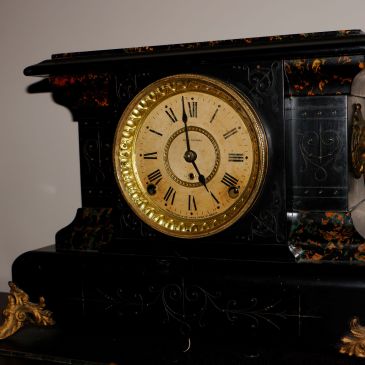
Once the Sessions Clock Co acquired E. N. Welch assets in 1902 (for more on the history of E. N. Welch Clock Co. go here) the company was well on its way to becoming one of the biggest clock producers in America. Production began in 1903 and between that time and 1933 Sessions produced 52 models of mechanical clocks, ranging from Advertisers, large and small clocks with logos of various businesses, to wall, or regulator clocks, and shelf or mantel clocks, designed for the home.
The vast majority of Sessions clocks are generic types that have limited value today. I do not know one particular clock made by Sessions that is highly sought after by collectors today although if there is one, please let me know. Found in many homes across North America, they were robust and strong runners despite being inexpensive and plentiful. You might call them the Chevrolet of American clocks.
Of those, I have worked on, the one Achilles heel is the flimsy click design.
I did not have a Mission-style clock in my collection so, this is a long overdue acquisition. Items missing on this clock are the winding key, a #6, and a label which is normally affixed to the backboard. Hence I do not know the model’s name.
In the below photo, the minute hand is missing. I have it but it snapped in two when I attempted to set the time and it will need to be repaired.
Sessions Mission style wall clock
The mainsprings were wound tight. Rather than let the springs down I ran the time side of the clock during the summer. The time side appeared to be fine, a small matter of putting it in beat but the strike side was erratic and struck either at will or incessantly. Something is amiss on the strike side and that means servicing is in order.
I noticed almost immediately that there is what looks like homemade bushing on the second wheel strike side much like a Rathburn bushing but obviously done by a home handyman. It likely works okay but I will remove it to see what issues I find.
Looking over the movement I can see that it has been serviced several times. The pillar nuts are chewed up and there are X marks besides most of the bushing holes and of course one or two bushings with punch marks. I also see a bit of soft solder on the movements in various places such as the third wheel strike side, and time side main wheel arbor which tells me that the repairs were not professional.
I will have a more detailed description of the movement when I dive deep into cleaning and repairing it in the days to come.
Seven clocks in my collection have family connections, not necessarily with my own family but clocks that I am able to trace back through families mostly in Nova Scotia (Canada). No names are mentioned. The stories are sad in some cases but interesting nonetheless.
Let’s begin.
Waterbury wall clock
When I was a child back in the 1950s my grandparents had one clock in their home, a Waterbury drop octagon located in the kitchen above the sink. It was the only mechanical devcie that made a sound in their home.
Waterbury shot dropwall clock, homemade case
My grandfather was a veteran of the First World War and suffered from shell shock (PTSD) long after the war. His home had to be stone quiet with the exception of the time and strike Waterbury clock in the kitchen.
Not knowing much if anything about case constructionmy cousin decided to screw the bezel into the case
After he died my grandmother sold the house and moved in with one of my aunts. The clock went to one of my uncle’s kids. The original case was painted yellow to match my grandfather’s kitchen walls and either it was in poor condition or broken, and a new case was constructed by my cousin. He knew almost nothing about case construction but did the best he could. Because he did not know how to repair the movement the clock was stored in a barn for a number of years (chicken pecks on the dial face!). In 2020, he gave the clock to another cousin who was breaking up their home and asked if I would have it.
Rather than take the movement out of its homemade case and put it into something more appropriate I decided to leave it as is as the case with all its warts is part of the history of the clock.
Sawin Banjo clock from a collector in Wolfville NS
My wife found this weight drive time-only banjo clock on Facebook Marketplace. The photos were quite poor and I imagine the seller was not getting much traction on the ad. Knowing that it might be something special I made an offer, sight unseen.
Banjo clockby John Sawin or one of his associates
It had a few minor issues such as broken glass, and veneer losses but otherwise, the clock was intact including the original acorn finial.
Timepiece
I always ask the seller about a clock’s origin and in this case, the clock was from a collector in Wolfville, Nova Scotia. The seller said that her uncle had this clock as well as a number of quality clocks for as long as she could remember, perhaps 60 years or so but could not recall where the clock originally came from.
After researching this clock I discovered that it was made in or around 1840, in Boston and although unsigned has all the markings of a clock made by John Sawin (or one of his associates) an apprentice to the famous inventor of the banjo timepiece, Simon Willard.
Gilbert mantel clock Shawville
What attracted me to this clock was the condition of the case. For a 100+-year-old clock, it is in remarkably good condition.
Gilbert time and strike mantel clock
The design is simple but graceful and of course, it would have been one of the cheaper clocks in the Gilbert line.
Gilbert movement
Despite the pandemic, people were still engaged in the buying and selling of clocks. This was another Facebook ad. The price was very reasonable. The clock was bought from a family in Shawville Quebec. A family member had passed away and all household items were sold off. The seller said her mother loved the clock and polished it weekly though it had not run for years.
Because the seller did not wish to have physical contact with me the clock was placed in a recycle container on the side of the highway for me to pick up.
Mauthe Horse crown
Most would call this a Vienna-style springer. Made in or about 1885 it had been in a family since I bought it from a former superintendent of schools about 6 years ago.
In the early 1980s, his wife brought the family clock over from Holland in a suitcase. It had been in his wife’s family for several generations previously. The gentleman’s wife passed away 10 years ago and had she been alive today I would certainly have learned a lot more about its history.
Mauthe Horse Crown with replacement bottom center finial
The seller was reluctant to let this clock go since it was a happy reminder of his past life. But he was moving into the next phase of his life with a new partner and that meant divesting of furniture and other items. Like him, I think of life in phases.
Mauthe Horse Crown movement
The only issue was a missing bottom finial. I can only imagine that the finial had to be removed so the clock could fit in the suitcase.
Junghans wall clock Crispi
What happens when you get a clock in a box? Call it a collection of parts, pieces, and dust. To some, a box of clock pieces is discouraging but to me, it was a challenge.
Junghans clock in pieces
This is an antique German Junghans time and strike spring-driven clock made in the style of a Vienna Regulator. There is no serial number on the movement which dates the clock to 1899 or earlier (in 1900 Junghans began to number their movements).
Fully restored Junghans Crispi wall clock
This clock is a witness to the day of the Halifax Explosion in 1917. The result of the explosion from a munitions ship in the Bedford basin was apocalyptical.
This clock, owned by the seller’s wife’s mother caught the brunt of the blast.
Catalog photo of the Crispi, second from left
The blast not only shattered the glass panels but heavily damaged the box frame. Most of the parts sat in a box for 100 years. Since the box frame was damaged beyond repair, the seller, an amateur woodworker, built a new frame made of oak some 35 years ago. He was at a loss as to how to repair the movement, put the project aside, and lost interest.
Wag on a wall
The style of the clock is a “wag on the wall”. It is a strange name but basically, it is a clock with the movement enclosed in a small case and with a pendulum and weights exposed. It is so named because the pendulum appears to wag on the wall like a dog’s tail.
Wag on a wall, unknown maker
My wife’s uncle was an internist (internal medicine specialist) in Newfoundland and practiced for many years but dementia and its attendant complications finally got the best of him. He spent the last 5 or so years in a locked ward of a residential facility for the elderly.
The pendulum wags like a dog’s tail
As part of his practice, he set up a home office where he would receive patients and consult with colleagues. In his office was a wall clock given to him by a former patient.
When he passed away his possessions were distributed among his family members with the clock going to his brother who, himself passed away this past year. Unfortunately, there was not much interest in the clock and it spent 15+ years in a Rubbermaid container in the basement of his brother’s home.
His wife is currently in the process of moving to a smaller home, giving away what she could and since I have a keen interest in antique and vintage clocks she determined that the best place for the clock was in the hands of someone who would appreciate it.
Ingraham Huron
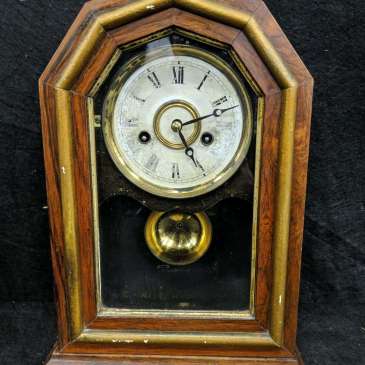
The clock is Rosewood “Huron” Shelf Clock, by E. Ingraham & Co., Bristol, Connecticut circa 1878.
Rare E Ingraham Huron found on a local online for-sale site
It has a paper-on zinc dial with a round glazed door and a lower glass access panel. It is a brass eight-day spring-powered movement, with a height of just under 41 centimeters.
Ingraham Huron balloon-style shelf clock
I asked the seller who was about 70 years old at the time, “what do you know about this clock?”. He extended his hand palm down out to about a meter from the floor and said, “I was this tall when I can first remember it in my grandmother’s home”. There is a penciled marking just inside the case indicating that it had been serviced by a person by the name of Hebb in 1944. The seller recalls a Hebb family who at one time lived in the Bridgewater area of Nova Scotia near where I purchased the clock.
He and his wife were in the process of dissolving their marriage and were selling off everything they own including many sentimental items.
Conclusion
I always make it a point to ask about the history of any clock I purchase. Sometimes, in the cases above I learn interesting things about the clock. In other cases, the seller knows nothing.
I wish I knew more about other clocks in my collection. Unfortunately many were passed on from seller to buyer and the history has been lost forever, but what stories some of them could tell.
I often get letters from my readers that begin with something like, “I picked this up in a thrift store” and marvel at what they find for next to nothing. Quite often the item they snagged at an unbelievable price needs a little love but that is to be expected.
Sessions wall clock
While on our summer jaunts my wife occasionally drags me into the odd thrift store because as she says, you’ll never know what we’ll find” and quite often she’s right. Over the past two or three years, we have bought a few jazz and classical CDs for next to nothing (yes, CDs are back).
Recently we stopped in a small town in an adjacent province to look around. We found a couple of classical CDs and were content to leave when my wife pointed out a mission-style clock hanging behind the cash.
“What’s the price on that? “, I asked. “I don’t know, the boss is in the back” I found him throwing items into a dumpster, obviously things that could not even be given away. “I’m interested in a clock”. “Show me”, he said. We both walked to the front of the store, he looked up at the clock, rubbed his chin, and said, “how about 10 bucks”. I mean, why dicker!
I don’t have a Mission-style clock in my collection and hoped that it was a Canadian-made Arthur Pequegnat, but I knew the hands were not the type used on Pequegnat clocks. Upon first inspection, the only things missing are the winding key and a label which is normally affixed to the backboard.
Sessions time and strike movement
I thought perhaps it was an Ingraham or Sessions. Once back at home I unscrewed the back panel and identified it immediately as a Sessions movement. Still a good deal. It also tells me that it was made after 1903 the year the sessions Clock Company was formed after a group of investors bought out the assets of the EN Welch Clock Co.
The mainsprings were wound tight. Rather than let the springs down I ran the clock. The time side was fine, a small matter of putting it in beat but the strike side needs a little work. There is nothing wrong with the passing strike on the half-hour but complete silence on the hour. Something is amiss on the strike side. I‘ll give it a nudge and see what happens.
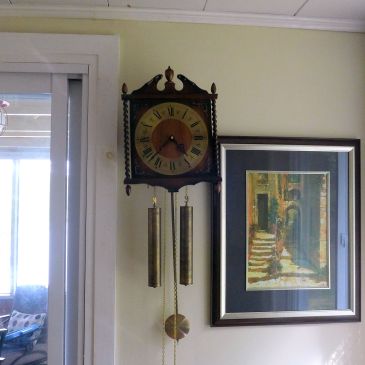
This wall clock was gifted to me in the spring of 2022. I have no idea who made the clock, there are no markings on the case or the movement. It was likely sold by the Forestville Clock Company of Toronto in the 1960s and my guess, a Hermle movement. I could find nothing else about it online. I wrote an article in August with first impressions.
Wag on a wall time and strike clock
The style of the clock is a “wag on the wall”. It is a strange name but basically describes what it looks like it is doing, wagging its tail. A Wag on a wall clock is a clock with the movement enclosed in a small case with a pendulum and weights exposed.
From 1660 to about 1870, the wag-on-the-wall was a very common clock style. It is so named because the pendulum appears to wag on the wall like a dog’s tail. It is also a derivative of the English lantern clock (more closely to a converted one with a pendulum). It was eventually deemed not attractive enough to hang on the wall in many upscale homes, so wooden or glass and wooden cases were added. The long-case or grandfather clock evolved from this early wags-on-the-wall. Wooden cases were used to hide the unsightly weights and cast-iron pendulum.
The style did not disappear as many manufacturers continued making the wag-on-a-wall style clock to this day.
There were several clock assemblers operating in Canada up to the mid-1970s, and it was likely imported and assembled by the Forestville Clock Company of Toronto.
It is a rack and snail movement possibly made by Hermle. The second wheel teeth are larger than one would expect so, a lot of thought went into the design of this movement. I have worked on similar movements in the past though this one is a bit different, specifically the arrangement of the hammer assembly, one main wheel is the reverse of the other, and of course, it is a weight-driven time and strike clock.
Hammer assemblyReverse chain wheels
Based on my initial observations the movement looks fairly clean despite the tarnished brass but I am expecting minor wear issues commensurate with a 60-year-old mechanical clock.
Disassembly
I took a number of photos prior to disassembly. This is my regular practice and although I have worked on many similar movements though there are always minor intricacies that differ from manufacturer to manufacturer.
To remove the movement from its case, two slotted screws holding the movement to the seat board are released plus, the weight chains must be pulled out. To release the chains the weight hooks must be removed.
The rack and snail assembly, minute wheel, hammer assembly, escapement, and pendulum leader were removed initially and placed in a collection tray. What remained were the wheels and the lifting lever between the plates secured by four pillar nuts.
The gathering pallet arbour and the main arbour are pressure fit. So, when I separated the plates most of the wheels fell out, of course. It can be a challenge for first-time clock repairers but when one works on a few there is a certain logic to the placement and orientation of the wheels.
Assessment of the movement
Because there was generally little wear, I made three decisions. I elected not to separate the central arbour and did not pull the gathering pallet from its arbour. As a result, the plate with two arbours attached was placed in the ultrasonic. I did not disassemble the main wheels which were held together with pressure washers. The main wheel ratchets and chain teeth are in very good condition and the ratchet assembly worked as it should and there was no need to take them apart.
I cleaned up residual oil and dirt around the pivot holes, removed excess oil from the pates, inspected the pivots for wear, and placed all parts in the ultrasonic cleaner. Since I was using a smaller machine than my regular US cleaner, the parts were cleaned in three batches which took a little longer.
Older, less efficient ultrasonic cleaner
I took special care drying the main wheels assemblies and ensured they were operating correctly after they were completely free of any moisture
My wife’s hair dryer came in handy but after cleaning and drying all the parts it fell off the table and broke. Sigh!
The pivots, which are in very good condition, are polished, the pivot holes pegged out and the next step is bushing work. Two bushings are required, the second wheel front plate and the centre wheel, back plate. There is minor wear on those two holes but why not address them while the movement is apart.
Reassembly
As with many rack and snail movements, most adjustments are made after the wheels are installed within the plates but three minor adjustments make the job easier and that is ensuring the gathering pallet is free of the rack, the stop wheel is in the 12 o’clock position and the hammer actuators are free of the star wheel. They must be between the star tips, if not, one of the hammers will catch on a star tip and stall the strike.
Time and strike movement
Testing
Once fully assembled the next step is installing the chains, weights, pendulum, and testing/adjustment. A small adjustment to the height of the pallets was made after which the clock ran well and continued to run well after 5 days. It is keeping very good time, as expected of a weight-driven movement as any clock that is powered by weights releases its power uniformly through its rated cycle.
Yes, it is a very plain-looking clock that reflects the style of the time (the 1960s) but it might grow on me.
Tick-Talk Tuesday is about the letters and comments I have received from readers concerning clock issues, challenges faced, a clock you would profiled or advice on your particular clock concern. For those comments and questions that stump even me, I consult within my clock circles for the best possible answer
CC writes:
Hi Ron, are you still answering questions about antique clocks? I came across this (Sessions Westminster A mantel clock) at a garage sale last weekend. I need to get a replacement key, and I need to know if it is worth having it cleaned and does it need to be repaired. I think it’s really beautiful and I would love to hear how it strikes and if it has a chime. I have attached some photos, hopefully, they can help. Thank you for your time I really enjoyed reading your articles online. Sincerely, Carla. Ps, yes I have the weight I only removed it because I’ve been moving it around to clean it up and polish the wood but I have not touched the mechanisms.
Sessions Westminster chime circa 1931
My reply:
I had some difficulty downloading all the images but I saw enough to tell you that what you have is a Sessions Westminster C made in the early 1930s. Chiming clocks usually have three winding points but although yours has only two winding points it is a chiming clock since one mainspring controls the striking and chiming functions of your clock while the other operates the time train. It would take a #6 key.
Because of the complexity of the movement and you may find that some repairers will not accept this clock for repair. Be prepared to pay more than this clock is worth for a repair. You also may have a part or two missing on the pin drum which might be problematic.
When working correctly they are a nice sounding clock.
Sessions Westminster chime drum on writer’s clock
CC replies:
Hey Ron I cannot tell you how excited I am to know that this clock is working thanks to you! I ordered the size 6 key and wound it up and it just took off. My next question is how do I or what do I need to get the chime to work there is another hole a small one at the very bottom of the face and I don’t know how to turn it off or on. Any suggestions.? I hope my video comes through… The scratchy sound in the background is my pug sorry about that but this SOB is ticking and I love it!
My reply:
Clocks such as yours came with double-ended keys. One end for winding the arbors and the other for the speed regulator, at 12 o’clock and for silencing the chimes. The “silence” may be in the off position and to turn it on one would require the small end of the double-ended key.
The other more serious issue is that the chimes/strike require servicing which is not fun because these clocks are a challenge to work on.
Sessions clock face
CC replies:
Thank you, Ron. I don’t think I’m gonna be able to have it repaired I couldn’t afford it this time. And it didn’t take very long maybe a couple days. Oh well, at least it’s pretty. I know you don’t sell or hook people up with sellers but if you know anyone who might be interested in buying it… Or where I might be able to sell it, other than eBay let me know, please. If not that’s OK and thank you for your time and expertise. Sincerely CC.
My wife’s uncle was an internist (internal medicine specialist) in Newfoundland and practiced for many years but dementia and its attendant complications finally got the best of him. He spent the last 5 or so years in a locked ward of a residential facility for the elderly.
As part of his practice, he set up a home office where he would receive patients and consult with colleagues. In his office was a wall clock given to him by a former patient.
When he passed away his possessions were distributed among his family members with the clock going to his brother who, himself passed away this past year. Unfortunately, there was not much interest in the clock and it spent 15+ years in a Rubbermaid container in the basement of his brother’s home.
His wife is currently in the process of moving to a smaller home, giving away what she could and since I have a keen interest in antique and vintage clocks she determined that the best place for the clock was in the hands of someone who could have it working once again. I did not have a clear idea of what she was giving me though I knew that it was a mechanical wall clock.
Quickly mounted on the wall to check things out
The style of the clock is a “wag on the wall”. It is a strange name but basically, it is a clock with the movement enclosed in a small case and with a pendulum and weights exposed.
In the years between 1660 and 1870, the wag-on-the-wall was a very common clock. It is so named because the pendulum appears to wag on the wall like a dog’s tail. It was eventually deemed not attractive enough to hang on the wall in many upscale homes, so wooden or glass and wooden cases were added. The long-case or grandfather clock actually evolved from early wags-on-the-wall clocks. Wooden cases were used to hide the unsightly weights and cast-iron pendulum.
The style did not totally disappear as many manufacturers continued making the wag-on-a-wall style clock to this day.
There are no maker’s marks on the dial or the movement but it appears to have a Canadian connection. There were several clock assemblers operating in Canada up to the mid-1970s, and it was likely assembled by the Forestville Clock Company of Toronto from parts sourced from West Germany but I will learn more as I continue my research.
The only markings on the movement are a serial or production number ending with 65 behind the pendulum leader and UW 7/29 (a date or other measurement) just above the aforementioned number. The year 1965 seems about right judging from the two-tone case tinting popular in the 1960s, The clock case is not particularly attractive today but such was the style at the time. I don’t think it will ever be my favorite wall clock.
It is a weight-driven rack and snail time and strike movement possibly made by Hermle, Mauthe or Urgos. I have worked on similar movements in the past though this one is a bit different, specifically the arrangement of the hammer assembly and the main wheels are reversed from each other.
The weights and pendulum are polished
It is not apparent upon first inspection if the movement has ever been serviced. Rather than run the risk of further wear I plan to test it briefly before servicing the movement. The movement looks robust and well made but I am expecting minor wear issues commensurate with age when I open it up.
While it is largely intact the bottom middle finial is missing. Otherwise, the case is in very good condition for its age. I mounted it on the wall to check things out and yes, it does wag!
In an upcoming article, I will go over the steps in servicing this movement.
Like a car engine, oil is the lifeblood of a clock. A correctly oiled clock will ensure a long life. Oil is the “lifeblood” of the car engine; the same applies to a clock. Just as a car engine relies on quality oil to keep its moving parts running smoothly and efficiently, a clock depends on oil to reduce friction and wear between its delicate components, such as gears, pivots, and arbors.
Lubrication is essential to the efficient running of any mechanical clock movement.
German time and strike clock movement
The primary purpose of lubrication is to reduce wear. Forming a protective film between moving parts enables them to glide smoothly against each other, thereby reducing resistance, improving efficiency, and minimizing energy loss.
Proper lubrication ensures smoother component operation, helping maintain accurate timekeeping by preventing irregular behaviour caused by increased friction. Additionally, it prolongs the lifespan of gears, pivots, and other moving parts by minimizing stress and wear.
A Quick Guide Including Some Dos and Don’ts
Avoid using spray lubricants like WD-40 on clocks, as they are unsuitable for precision mechanisms. WD-40 is a water displacement agent, not a true lubricant, and for that matter, spraying any kind of lubricant can harm the clock, especially since some parts, such as wheel teeth, pinions, and levers, must remain dry. Instead, use a specialized product like Keystone clock oil, specifically designed for clock mechanisms.
Keystone clock pivot oil
When applying oil, use a small amount—about the size of a pinhead—at each lubrication point. Tools such as a toothpick, small wire, needle dipper, or a clock oiler are ideal for precise application. Avoid over-oiling, as excess oil attracts dust, which can mix with the lubricant to form a paste that increases wear. Less is more, which means less of something—a smaller amount of it—can at times be better than a large amount of it.
clock oiler
Focus on oiling the following areas:
The pivots of all wheels and the anchor or lever arbor on both front and back plates. In clockmaking, a pivot is the slender, polished tip of a wheel or arbor (the shaft that supports and drives the wheel) that rotates within a hole or bearing in the clock’s plate. Pivots are critical components in the mechanism as they allow wheels and arbors to spin smoothly and with minimal friction.
The crutch loop where it contacts the pendulum rod. The crutch loop is a part of the clock’s crutch, a thin, typically metal component connected to the escapement mechanism. The crutch transfers the motion from the escapement to the pendulum, keeping it swinging back and forth.
The escapement pallets. The escapement regulates the release of energy from the clock’s power source (mainspring or weights) to drive the gear train and maintain the pendulum’s motion.
Escapement pallet
The clicks. The clicks are small, rotating components in a clock’s winding mechanism. They play a vital role in ensuring that the clock’s mainspring or weight-driven system remains securely wound and does not unwind uncontrollably.
Pulley axles on weight-driven clocks. In weight-driven clocks, the pulley axles are the central shafts around which the pulleys rotate. These pulleys are part of the weight system that powers the clock.
When to Oil
Oiling a movement without first disassembling and cleaning is not recommended unless, following a visual inspection, the mechanism is free of black oil and the pivot holes are simply dry. Otherwise, the addition of new lubricant to old will mix with the dirt and grime to form a grinding paste which acts as an abrasive, hastening pivot and pivot hole wear.
In short, if the pivots are dry and show no residue, a small amount of oil can be applied without the need for disassembly.
During servicing, ensure the mainsprings are oiled with specialized mainspring oil. Apply the oil by drizzling it along the sides of the coiled spring, allowing it to wick between the coils, and wipe away any excess.
When oiling, avoid dipping directly into the oil bottle; pour a small amount into an oil cup for easier application and to prevent contamination of the oil in the bottle.
Don’t leave the oil in a sunny window. UV rays will break down the oil and degrade its chemical structure over time. UV rays cause a process called photo-oxidation, where the oil reacts with light and oxygen. The degraded oil may become thicker, stickier, or form a residue, making it unsuitable for precise lubrication.
Cover the oil when not in use.
Routine Clock Inspection and Oiling
I inspect my clocks every 2-3 years if they run on a daily basis. If the movement is free of dust and the pivot holes are dry, I will apply fresh oil. If there is blackened oil around any pivot hole, it is time to disassemble the movement, clean it, and apply new oil once reassembled.
In the end, proper lubrication is less about how much oil you use and more about how—and when—you use it. A careful eye, a light touch, and the right product will do far more good than overzealous application. Clocks are remarkably durable when treated with respect, and with just a bit of routine attention, they will continue to keep reliable time for decades. As with most things in horology, patience and restraint are your best tools.
In our quest to have our antique mechanical clocks run accurately the immediate response is to regulate the clock, but have you thought about calibrating your mechanical clock? It is not as difficult as it sounds.
This is not the same as regulating your clock. A properly regulated Anerican-made spring-driven clock will show the correct time at the beginning of the week but will run fast through the week and may gain as much as 3 or 4 minutes mid-week and lose time at the end of the week.
Seth Thomas spring driven round top 8-day clock
Let’s use a spring-driven mantel clock with an 8-day cycle for our example.
Mainsprings release their peak power at the beginning of their cycle. As the mainspring winds down power is gradually released until the spring unwinds completely and the clock stops.
Gilbert spring driven wall clock
On some antique clocks, one might find “stop works” (otherwise called a Geneva stop) which is a clever star-shaped brass add-on to the main wheel that reduces the full release of power initially by flattening the mainspring’s power curve over its rated cycle (8-days) and thus maintain some level of accuracy through the week.
Geneva stops as indicated by the white arrows
But most clocks I have come across don’t have this ingenious device.
Weight-driven clocks are a different kettle of fish because the release of power is constant throughout the week. Once a weight-driven clock is regulated it should not require calibration.
Gustav Becker Vienna Regulator with weights
Calibration makes the assumption that your spring-driven clock will never accurately tell the time at any one given point in its cycle and essentially means setting your clock so that it loses no more than a couple of minutes at any given time through the week.
Sessions mainsprings, one for the time train and the other for the strike train
According to the Canadian Oxford dictionary to calibrate means “to correlate readings of an instrument with a standard”. If the standard is plus or minus two minutes per week, without the use of “stops” or other means to flatten the power curve, setting the clock two minutes slow at the beginning of the week will ensure that it is never off by more than a minute or two through the week.
According to noted horologist Robert H. Croswell, “If the clock is regulated such that it has a zero net gain or loss of time from the start to the end of the week, then take ½ the maximum fast error during the week and set the clock that many minutes “slow” when the clock is wound.” If the maximum is 6 minutes, then, half would be three minutes.
One could use a complex mathematical formula to determine the precise amount of time to set the clock at the beginning of the week but setting it two minutes slow for a clock that loses 4 minutes each week should suffice for most purposes.
The example is a Fleet time and strike mantel clock from the 1930s. Fleet Time Company of Montreal, a company that was operating four short years, sourced movements from Germany prior to the Second World War. It was a very common mantel clock sold through department stores across Canada.
I like the step side design and the general simplicity of the clock.
Fleet Time case, refinished
The case was in need of refreshing but the movement looked to be in reasonably good condition and required a good cleaning and I was expecting some wear.
The movement was completely serviced with several new bushings installed. The mainsprings were removed, cleaned, and returned to their barrels.
Fleet time movement
In this movement, the mainsprings can be removed without disassembling the movement, handy for such things as replacing a broken mainspring assuming, of course that nothing else has been damaged.
During the testing phase, the mainsprings were partially wound. The intent was to see if the clock would run well. Once satisfied that the movement was running as it should I returned it to its case.
I wound the strike side fully and then wound the time side. Just as I was feeling resistance, CLUNK, the arbour turned freely. If it was a broken click or broken mainspring, either one could easily be replaced.
It has nothing to do with the force of winding a movement. Having a mainspring go bad with winding force from a key is rare, in my view.
But mainspring barrel teeth do not simply fall off.
Fleet time barrel
At times it is a mainspring but sometimes something far worse occurs.
It is not uncommon to find secondary damage to the movement, secondary or collateral damage due to the extreme shock that broke or bent the teeth and teeth cannot be straightened.
The main problem area beyond the barrel itself will be the second wheel and possibly the third wheel arbors, leaf pinions and pivots and/or damaged or missing teeth on the second and third wheels and bent or broken pinions.
Fleet second wheel, a bent leaf cannot be unbent
Is it fixable? Yes, but weighed against the value of the clock, it is just not worth it. It is much more cost effective to harvest parts from another movement.
Given the right equipment, it can be repaired. Once repaired a mainspring must be sourced and although the barrels may be identical, the mainsprings will likely be different.
The solution is locate a donor movement. In the meantime the clock has been put aside.
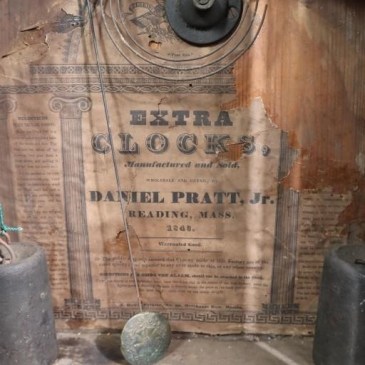
Won at auction this spring is a Daniel Pratt Jr. reverse ogee with splat although this one is missing the splat, the decorative piece on top of the case.
According to the label it was made in or after 1843.
It was also missing the suspension spring and pendulum rod and the wire with regulating screw for the pendulum bob.
Daniel Pratt Jr reverse ogee clock
There are a few other things that are not quite right. The green banding that frames the upper and lower glass looks a little strange and likely added later and the card stock which would have replaced either a mirror or reverse painted tablet looks out of place. The picture of a young soldier holding a sabre and an American flag looks quite old.
But it actually works and works well.
It has a time and strike 30-hour woodworks movement. Wood-works movements were introduced in American at the end of the 18th century and the high point of woodworks movement production was prior to the depression of 1837. During the depression most clock production was shut down and small companies began to consolidate into larger ones.
Wood-works movement
With the invention of the 30-hour brass movement by Noble Jerome, clock making began to boom again in 1838. Inexpensive woodworks movements continued to be made but by the mid 1840s the woodworks movement production had begun to phase out.
Count wheel on left, escape wheel in the middle
This movement works
The weight cord on the right side looks like it would let go at any time but what the heck, let’s see if this thing works. The green one for the strike side looks sturdy. I will restring the clock later.
I removed the verge and determined there was no power getting to the escape wheel. I felt underneath and although the weight had been wound to the top of the case the cord was binding on the main wheel. It took a little encouragement to bring the weight further down but the adjustment did the trick. I then fashioned a new suspension rod/spring from my supplies along with a pendulum wire, gave the pendulum a gentle push and success!
About 3 hours later as the weight on the time side was descending I noticed the cable had broken at some point and a past owner had simple tied the two ends together. I believe the knot was causing the power issue.
I had already tested the strike side and it was working perfectly.
I have one other Daniel Pratt Jr. clock in much better condition but the movement will not run for more than a few minutes. This one has a splat.
So, one Pratt with a not-so-good case and a working movement and the other with a stunning case but a non-working movement. Should I do a swap?
Daniel Pratt Jr with woodworks movement
I have never disassembled a woodworks movement in my years of clock repair and I doubt that many clock repairers have much experience with one. It is one of the few movement types I have zero experience with but I may have to bite the bullet some day because this clock will not run forever.
I knew when I first laid eyes on the clock that it was missing something, the crown.
It’s too bad because it is very attractive Hamburg American Company or HAC 8-day time and strike mantel or parlour clock.
HAC mantel clock
The little plaque on the base references 1926 the year it was presented to a pastor in England presumably for years of faithful service. I think the clock was made a few years earlier. Back in those days clocks like this might have sat on a Merchant’s shelf for years.
The chap I bought it from said it was an English clock but I knew right away that it was German. It has that distinctive German look and style of a clock made after 1900. Since he was a clock collector he should have known by looking at the trademark on the back of the movement. Oh well!
Time and strike movement
Okay, back to the crown. I have another HAC time and strike with a crown.
HAC mantel clock
I am willing to bet that the crown on my new acquisition was either very similar or exactly like the one on a HAC I bought a year ago. It fits exactly into the slot on the top.
Now with a crown
A crown makes a difference. You can see that adding a crown transforms the clock. It made be subtle but there is a difference. The problem I have now is, should I leave on this clock or the other?
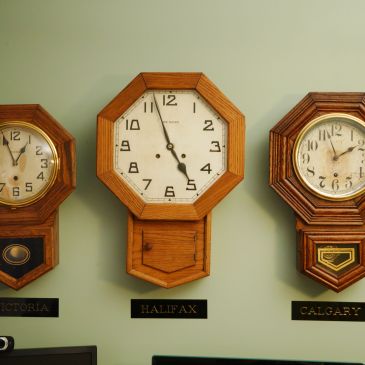
Some years ago I had this brainy idea that I would have a trio of time zone clocks above our main computer in the kitchen so, when one of our children called, all we had to do was glance at the wall to see what local time it was in their region.
Back then we had a daughter in Victoria, British Columbia, another in Calgary, Alberta, and a son in Halifax, Nova Scotia. Our daughter has since moved to Ottawa, Ontario.
It was a great idea but not perfect.
Trio of clocks representing 3 time zones
The New Haven time and strike clock (the middle one in the photo above) was not as small as I wanted but it was all I had at the time. The New Haven clock was eventually gifted and replaced by an Ansonia time-only which was also still too large.
Ansonia time-only clock
The search was on for a third 14-inch drop octagon time-only clock to complete the trio. It did not matter who the maker was. It took a while but as luck would have I saw one on an online auction in the spring of this year.
It is a Sessions time-only drop octagon and identical in dimensions to the two others.
The trouble was I was not going to pay a reserve auction bid of $100CDN (79US, 63GBP). As much as I wanted the clock the price was too high though some of you may disagree.
It appeared to be in very good condition judging from the auction photos and there was nothing much wrong with it except for incorrect minute and hour hands (it would have had longer and thicker closed spade hands).
Sessions time-only clock
We had already purchased 4 clocks at this particular online auction and elected to pick them up instead of having them shipped.
When my wife called to ensure someone was there when we arrived at the auction house she was told that all unsold clocks would be individually priced and sold without tax and buyer’s premium. Luckily the Sessions was one of few unsold clocks but the price was half the reserve. So, we bought it and now it graces our wall.
The newest(middle)in our trio of clocks, from left to right, Sessions, Sessions, Waterbury
Two Sessions and a Waterbury clock. They all look great!
I never actually went to this auction but participated online. It is not quite the same as the rush of bidding in a live auction hall but exciting in its own way.
This particular auction had quite a number of clocks but I would say that most were in rough or what I would call “hobby-ready” condition.
I was looking at one particular clock but three more grabbed my attention. A total of four clocks, two shelf clocks, and two wall clocks.
My budget was $300CDN and I stuck to it. I set the maximum I would pay for each item and placed all bids within the last minute of the auction and walked away from the computer. For two of the clocks, I was prepared to let them go if bidding got too high but at the end of the day I won all four. With fees and taxes, the final invoice was $379 (a little over $300US and 240BP).
Bidding online is always a gamble. What the photos reveal does not always tell you what you are getting and I have been surprised more than once. I have a number of other photos from the auction but these are a good representation.
Hamilton Clock Co.
30-hour Ogee clock
Clock number one is a 30-hour weight-driven ogee made by the Hamilton Clock Co. based in Hamilton, Ontario in the late 19th century. This was a clock I was anxious to have since I am in the process of building a small collection of Canadian-made clocks.
I have one other clock from The Hamilton Clock Co., a 30-hour time and strike steeple clock, and one from the Canada Clock Co., a 30-hour time and strike cottage clock.
I am grouping the two companies together because one essentially grew from the other and made clocks within the same factory and with the same machinery.
Those two have etched lower tablets as on this new acquisition.
Canada Clock Co. Hamilton Cottage Extra
Hamilton Clock Co Gothic steeple clock
The Hamilton Clock Co was formed in 1876 and went out of business in 1880, a very short run for a clock company, unfortunately. The exact year of manufacture is unknown but I may know more when I receive the clock.
This clock looks like every 30-hour ogee ever made and that was the original intent, a familiar clock style that appeals to the masses. The dimensions of this Canadian-made ogee are very similar to American-made ogees and the movements, though made in Canada, are essentially indistinguishable (minor differences aside) from 30-hour ogee time and strike movements made by a number of American manufacturers of the time.
The clock appears to be intact, has its own weights and the lower etched glass tablet seems to be in fine shape judging from the auction photos but the case will need a thorough cleaning and some veneer work.
Daniel Pratt Jr
Clock number two is a Daniel Pratt Jr which I’d like to call a reverse ogee with a splat top but the splat top is missing.
I have just one Daniel Pratt Jr clock in my collection and it has an early woodworks movement. The older Pratt clock shows what the splat should look like.
Daniel Pratt Jr with woodworks movement
Reverse ogee and “splat“
According to the label on which the date 1843 is inscribed, one can assume that this is the date of manufacture, approximately.
In any event, it may have a woodworks movement. There were still a few companies who continued with the cost-effective woodworks movement but by that time the rolled brass plate movements were becoming more common.
The loss of the splat top certainly makes the clock less desirable but it was one of the cheaper clocks in this grouping and, who knows, I might have a splat made, we’ll see.
Label, weights and pendulum bob
The green banding on the upper and lower glass sections looks somewhat suspicious and could have been added later. This clock also comes with weights and what looks to be an authentic-looking pendulum bob.
The lower tablet might just be a card-stock image, again, likely not original but old nonetheless. The dial has some losses but what there is of the case looks good.
Unknown gallery clock
Clock number three is an unknown gallery clock. I have no idea of the maker and cannot even guess. I took a chance and I hope the gamble pays off.
Gallery clock
The auction information describes it as 14 inches in diameter so I am assuming the clock face is about 10 inches or so. The hands look very interesting, the case looks well-made (mahogany?) and the clock definitely has a mid to late 1800s English look.
The centrally located winding arbour tells me that it has a time-only mechanical movement.
Back of the clock
The dial looks to have been redone but I am more curious about the movement inside.
A shot of the movement from the bottom
I am not sure what I am seeing in the photo above. Certainly, a homemade door catch on the left and a large gear (perhaps a mainspring barrel), and cylinder-shaped pendulum bob. Fusee movement? I doubt it. I think it has a conventional spring-driven time-only movement but I will know in a few days.
Six-inch gallery or ships style clock
The last is a smaller gallery, ships, or marine-style clock which is spring-driven with a balance wheel. The speed adjsutment lever below the 12 is the give-away.
It is 8 1/2 inches in diameter (6-inch dial), key wound time-only 30-hour clock with a seconds bit. I cannot even guess who the maker is but could be a Waterbury, E N Welch, or some other American manufacturer.
The chunky oak case needs some attention but with a good cleaning and a coat or two of shellac, it should show nicely. Apparently, it is in working order.
Okay, so, two clock makers I am familiar with and two unknowns. I wonder what surprises await me when I open up the two unknown clocks.
In a day or so we shall see what we get. We are driving down to the auction house in the next couple of days but we will make something of our 3+ hour journey and enjoy the sites, have lunch in Annapolis Royal (Nova Scotia) and do some antiquing along the way.
The Grand Assortment was sold “six in a case” to retailers who then sold them separately. The name “Assortment” seems appropriate and I am not surprised that some collectors refer to them simply as the Grand. So, was the “Assortment” a choice among a number of Grands (Grand 1, Grand 2, etc.)?
Auction Photo
Selling clocks in lots of 6 was a fairly common practice in the early part of the 20th century. An individual might order one of the clocks either directly from Sessions or working through a retailer but would normally select one from the retailer’s shelf.
This clock was bought at auction in the spring (of 2022). The plan is to fix it up and sell it to offset a recent equipment acquisition. I am not normally in the business of selling clocks but will sell the odd one locally to keep my collection manageable.
The clock case needs quite a bit of work which I will address in a future article.
The movement looks good but it is very grimy, no surprise there. We’ll get to that later in this post.
The Sessions dial
The dial, however, may not be salvageable. One option is a new paper dial, and another is a replacement with a suitable and period-correct alternative. I have the same size Arabic dial from an Ingraham gingerbread that I might use. Manufacturers interchanged Roman Numerals and Arabic dials on some models and I have seen at least one Grand Assortment on the internet with an Arabic dial so, an Arabic dial may be a good look.
These Sessions models were around for a number of years up to 1915 or so and like everything else the gingerbread clock fell out of style. I imagine this one sat on a shelf as a decoration for a good number of years after that.
The movement
Apart from having an even coating of dirt and grime all over the movement, there is surprisingly little wear.
A very dirty movement
Most Sessions movements I have come across have had a hard life and usually require a fair bit of intervention in terms of repairs including numerous new bushings. This movement may not need any as far as I can determine during my initial assessment. As a matter of fact, this is probably the least worn Sessions movement I have ever worked on. It is not without issues, however.
Judging from pivot scratch marks, wrench marks on the plate around the pillar nuts, mangled helper wires, and a replacement spring for the click on the time side it certainly has been worked on in the past, likely cleaned more than once.
A coating of dirt all over the movement
There was a film of rust on the mainsprings, not enough to write them off and they still have plenty of power left in them.
Trademark
Clicks are a documented weakness in Sessions’ movements. Both sides were in good condition although I had to re-attach the click spring on the time side. A past repairer had attempted a fix and replaced the original wire with a steel replacement wire that looks homemade, but it works. It just needed tightening.
The helper springs were evidently broken at some point and shortened. One was wrapped around the top pillar post and the lifting lever was wrapped around the count lever. Both should be attached to a pillar. I was able to reuse one but the other had to be replaced.
Helper springs top center
Most, but not all, American time and strike clocks have helper springs to maintain tension on lifting and locking levers. Springs are occasionally removed from a movement either because they are broken and/or repairers do not understand their function.
New helper spring
The mainsprings are in good condition. They were cleaned and oiled.
Mainspring retention clip to restrain the power of the springs
No bushing work is required for this movement which is a rarity for old American clocks I have come across. All pivots were polished, pivot holes pegged out and now for reassembly.
This is a fairly easy movement to reassemble but the strike side count and drop levers must be in the correct position in order for the strike side to function correctly. That means the drop lever is in the slot of the cam and the count lever is in the deep slot of the count wheel. The lock pin on the wheel just below the fan must also be next to the locking lever.
Sometimes I get it right the first time but often I must separate the plates on the top corner and re-adjust the locking wheel.
Everything in place but the escape wheel
Once re-assembled it is placed on the test stand for several cycles.
On the test stand
The next step is addressing the clock case finish.
The clock case needs quite a bit of work and may require stripping, not something I do as a matter of routine but in its present condition, it will never attract a buyer.
Can this gingerbread clock made by E. Ingraham be saved? Possibly, but this clock is destined to become a parts clock and I will explain why in this post. In the spring of this year (2022) 4 clocks were bought at auction. I can save three of them but not this one.
Gingerbread clock
Gingerbread clocks often called “kitchen clocks”, were introduced after the American Civil War and remained popular until the end of World War I.
The term is derived from the tradition of making decorated gingerbread houses which began in Germany in the early 1800s. The broad application of the gingerbread style applied to almost anything including clocks.
Auction photo
The gingerbread design is polarizing. Collectors either love them or hate them. I am not particularly fond of the design generally, with certain exceptions, but I can see how some collectors are attracted to the style.
The cases were steam-pressed oak and occasionally other hardwoods were used. Various designs were pressed by a heat-bond process which was quite advanced for the time. It was a time-saver, spectacular designs were pressed within seconds and it saved on labour costs. Hundreds of thousands of these steam-pressed oak-cased clocks were made and all are now well over 100+ years old.
So, what is off putting about this clock?
It came with no glass and to me that is the deciding factor. I do not have the time or inclination to look for an appropriate tablet for this clock and obtaining one will not increase its value appreciably will not make it more desirable.
Auction photo
The case may look good but the auction photo does not tell the entire story. There are newer screws and nails in various places in the rear of the case that were used to keep the case from falling apart and not a very professional job at that. It would have to be taken apart and re-glued.
On top of everything I don’t like this clock enough to spend any time on it.
I can use the dial for a Sessions clock I am working on and will keep the case, harvesting what wood I need for future projects.
I will inspect the movement and if things look good, service it and sell it separately.
Call this an obituary. The reality is this clock has been around for over 100 years, has served its purpose and has now come to the end of its life.
This is not the first Grand Assortment clock from the Sessions Clock Co. that I have worked on. In June 2019 I repaired a family member’s clock. It is exactly the same model.
Auction photo
The Grand Assortment was sold “six in a case” to retailers who then sold them separately. The name “assortment” seems appropriate and I am not surprised that some collectors refer to them simply as the Grand. Selling clocks in lots of 6 was a fairly common practice in the early part of the 20th century. An individual could probably order one of the clocks either directly from Sessions or working through a retailer but would normally select one from a retailer’s shelf.
Styles of Grand Assortment
Tran Duy Lyshows this Assortment model from the 1915 catalogue. It was likely made earlier but this style of clock was well on its way out by about 1915. This is Grand No. 3 and the price was $4.00, a day’s salary for a working man. All were eight-day runners but could be ordered with alarm (45 cents extra), cathedral bell (45 cents more), or standard wire bell.
This one was purchased at auction for $35 and listed as “not-tested”. “Not-tested” is an interesting auction term for “it may or may not work and it probably doesn’t”.
The note came with the clock(1903 is the year Sessions began making clocks)
Gingerbread clocks also called “kitchen clocks” were introduced after the American Civil War and remained popular until the end of World War I. The term is derived from the tradition of making decorated gingerbread houses which began in Germany in the early 1800s. The broad application of the gingerbread style applied to almost anything including clocks.
However, gingerbread clocks have polarizing designs. Collectors either love them or hate them. I am not particularly fond of the design of this one but I can see how many at the time were attracted to the style.
The clocks’ cases were steam-pressed oak and occasionally other hardwoods were used. Various designs were pressed by a heat-bond process which was quite advanced for the time. It was a time-saver, spectacular designs were pressed within seconds and it saved on labour costs. Hundreds of thousands of these steam-pressed oak-cased clocks were made and all are now well over 100+ years old.
The clock is 22 inches tall, ten inches wide with a 6-inch dial. It is a time-and-strike movement striking the hour and half-hour on a coiled wire gong.
I am not a huge fan of Sessions’ movements, particularly from this vintage. Too many helper springs, frustrating to re-assemble, and setting up the strike side is always finicky plus the poorly designed weak clicks are prone to failure (yet they’ve lasted this long!). Set up properly they will run reliably for years and are reasonably good time-keepers for a spring-driven clock.
Is it worth fixing? Certainly, there is nothing fundamentally wrong with the movement but the case is in rough shape and will require considerable intervention. The paper dial on tin is also in poor condition. Quite often the crown is broken, pieces missing or cracked which is the case for this one and unfortunately, it is not very well glued back together.
The Plan
The movement should be fairly easy to service. I don’t see a lot wrong with it upon initial inspection. As expected it is quite dirty but I don’t see a lot of wear. I won’t know conclusively until I take it apart. The plan is to put the movement in proper running order.
A dirty movement but there does not seem to be a lot of wear
The finish is badly aligorated and will need a lot of work. “Aligorated” means that over time the surface of the case was exposed to heat and high humidity causing the shellac to coagulate in clumps resulting in a mottled finish. I will attempt to renew the finish which might involve stripping the finish. That may sound extreme but it may be the only solution.
The dial is in poor condition
Rust has bled through the paper dial and as such it is beyond hope and will be impossible to restore. I may change out the Roman numeral dial with an Arabic dial from an E. Ingraham gingerbread clock from the same period. The dial size is exactly the same and the centre canon and winding arbours fit perfectly. Checking on the internet I note that there are several Grand Assortments with Arabic dials.
Once the movement is serviced and the case is redone, there should be a dramatic improvement. I have already decided that I will not be keeping it as it will be resold to offset equipment costs.
This attractive little clock was bought at auction earlier this spring.
The walnut case is actually in good shape and the tablet looks not only original but is in decent condition as well. I expected a well-cared-for movement but to my surprise, it was in deplorable condition, a prime example of a clock that saw little servicing and was destined to fail.
Thanks to reader JC who identified the clock as the “Canada” found in Ansonia’s 1886 catalogue.
Auction photo
After installing 7 bushings and two pivots it now running as it should.
The case
It is missing a few top pieces but surprisingly the pieces came with the clock. They are in front of the Sessions gingerbread clock in the photo below. The glue let go and of course, it is a matter of gluing them back in place.
I blame it on rough handling on the part of the auction house otherwise why would the parts come with it.
Sessions and Ansonia clocks were bought as a lot.The case after a coating of shellac
Once the parts were re-glued it was an opportunity to clean the case and apply one coat of traditional shellac.
The dial looks too new, though it looks great and was no doubt replaced at some point in the clock’s life. The spade hands look correct for the clock.
The case was surprisingly well preserved but it is unfortunate that the movement was in such poor condition but now has a new lease on life.
Here is the final result. The movement and alarm mechanism have been reinstalled back into its case. After several days it is running well and keeping good time.
A handsome clock that is even better after a refresh and minor repairs.
This 30-hour shelf clock (hour strike) was manufactured by American clock-maker E. Ingraham and Co. in the 1870s. There are various iterations of the name over the maker’s history but this was the one the company used from 1861 to 1880.
The clock was bought at auction in mid-March 2022 along with 3 other clocks. In this post, I will take the reader through the process of refreshing the case.
Auction photo
This is an excellent example of a tired case that needs attention. When I look at a clock case such as this I assume the movement is well worn but a pleasant surprise awaited.
The movement is in surprisingly good condition as a result of regular (somewhat) servicing over the years. It has been in the shop at least three times, 1879, 1916, and 1994 according to dates found on the back of the case and perhaps more occasions that are not recorded.
Analysis of the caseand plan of action
The gold banding on the front face of the “octagon top” and the inside frame of the access door has some losses and the goal is to hide the nicks with gold artist’s paint matched to the trim. First of all, it is not a true octagon but half of one, but that is how these clocks are described.
The overall finish is in fair condition. Numerous cosmetic issues such as scratches and nicks here and there over the rosewood case are evident, but a good cleaning with soap and water followed by a fresh coat of shellac should fill in the scratches and improve things dramatically.
Auction photo showing nicks and scratches
The dial shows considerable wear after years of daily use and this is a situation where a replacement paper dial might be considered but I am always hesitant because replacement dials take a certain something away from and antique clock.
However, I am going to see what I can do by attempting to bring the numbers back with black acrylic paint while retaining some of the patina.
The moon hands look correct for the period of the clock.
As a collector who has seen a good number of these styles of clocks, I first thought the access door glass was a replacement since many clocks from the early to late 19th century had reverse painted tablets.
Because of the decorative pendulum and the bright brass bell both meant to be seen, the stylized panel that serves as the base for the dial, the total absence of any paint remnants, the glass panel with its waviness and various imperfections plus the putty-like material that is used to mount the glass to the door, the glass appears to be original to the case. A pleasant surprise!
It is always a bit of a disappointment when something is lost or changed on an antique clock especially one that is close to 150 years old and when replacement parts are difficult to source.
No doubt some of the scratches on the case, dents, etc. (not all, of course) are the result of rough handling either when transporting the item to the auction house or during its stay.
Addressing issues with the case
The very first step is a good cleaning. Cleaning a clock will generally result in the removal of some of its protective finish but it is inevitable given that it has been on the clock a long time.
Auctionphoto
For old American clocks I generally use traditional shellac made by combining shellac lacquer with shellac flakes. Amber Shellac adds a certain hue to the case and the cut is light enough that it dries to the touch in less than a minute which is my preference.
When there are large flat surfaces I will use a “french polish” but for this project, a broad artist’s brush is best. I apply the shellac in long strokes completing each section at a time.
The decorative black wood panel that serves as the dial mount is also shellacked allowing for small scratches to fill in very nicely.
The original paper dial is well worn and presents significant challenges as all the numbers on the dial are either partially worn off or completely erased. This was a well-used clock!
Top and bottom lines of the numerals are filled in
Using an artist’s fine-tipped brush, black multi-surface acrylic paint, and a steady hand I filled in as much as I could. The numbers around the winding arbours were the worst because I had little to work with and they were the most difficult to reproduce.
Once all the Roman numerals were completed and thoroughly dry, I used a Sharpie fine-tip “artist’s permanent marker” and a straight edge to clean up the lines. I decided not to touch up the chapter ring other than the 5-minute markers. I am not entirely happy with the number 4 on the dial but that’s as far I am going.
Closer view of the dial
As for the gold trim on the face, I did not want to mess with the patina, nor did I wish to cover the gold which would have completely taken away from the antique look. I mixed acrylic multi-surface gold paint and a very small dab of black paint for an “aged” effect and used a fine-tipped artist’s brush to carefully dab the bare areas.
Finally, the brass bezel and inner ring were given a polishing.
The clock is complete
The clock has been transformed. The dial has been rejuvenated, the movement serviced and reinstalled, the bell gong attached, the case given its many touch-ups, and the decorative pendulum is attached. Now to regulate the clock.
In the final analysis, I believe that I have struck the balance every collector and restorer seeks and that is maintaining the original patina of the clock while not taking away its antique look. It is 145 year old antique that has seen good use over the years but applying modern techniques that are minimally invasive have brought it back to life.
I have one more decision to make. I acquired this and three other clocks to sell in order to offset the cost of new equipment but now that I have seen the final result I wonder!
The case might be a lost cause but I can certainly save the movement of this Ingraham Ocean series gingerbread clock. The clock came to me in fair condition but it was missing a key element, the glass tablet and for that reason, I am not inclined to source a replacement, the clock is just not worth it.
There were several shards of glass at the bottom of the case and I suspect the glass was broken during its journey to the auction house or at the auction house itself which is unfortunate. I could substitute with clear glass but that would diminish the value of a clock that is not worth much, to begin with.
Ingraham OceanLine, pieces of another clock in foreground of auction photo
However, I can save the movement and the dial as well as a door catch, perhaps use it for future projects or for spare parts.
It was dirty as one would expect and it has not seen the inside of a professional repair shop judging from a rather sloppy click repair. The repair appears to have held and I will tidy it up and leave it.
The movement is interesting and clearly late manufacture. The number 11 is stamped on the movement which might indicate that it was made or about in 1911. Regardless, it is from the pre-war period. I also see steel pieces such as the intermediate wheel, the centre cannon, the fly and the count-wheel hub.
All the parts were placed in the ultrasonic and cleaned following which I replaced the wheels between the plates to recheck for wear. It looks like 5 new bushings on the front plate, 2 on the strike side and on the time side, and all the upper wheels in the trains. On the back, the third wheel requires a new bushing as does the second wheel and the escape wheel.
Black dots mark where new bushings will go.
Eight bushings in all, which is fairly standard for a movement with this degree of wear.
Mainsprings are cleaned and oiled
I have not worked on an Ingraham movement in some time but recall that the strike side is set up quite differently.
The count wheel is mounted on the second arbour (unlike most which mount on the main wheel arbour) and advances by means of two pins that extend from the third wheel lantern pinion. The third wheel is a combined locking wheel and pin wheel. There is no cam on the arbour, instead, there is a space between two pins that allows the lever to drop at the same time the paddle drops into the deep slot on the count wheel. The fourth wheel is just used for warning and not for locking.
Reassembly and testing
All went well. A couple of adjustments had to be made but otherwise, it is running well. I will leave it on the test stand for a week or two.
The movement will go into a bag and be stored for a future project. I already have plans for the harvested clock parts but if I find another Ingraham gingerbread in the Ocean series, I might consider resurrecting this one if the tablet is intact.
I acquired a number of clocks at auction this past winter (2022). All were antiques and all were in poor to fair condition but each one had potential. The auction notes simply said the movements were untested which can mean just about anything from a failed, irreparable movement to something that might have been serviced recently.
One of the four from the auction is an attractive clock with nice clean lines and from the look of the case, which is in decent shape, I would have expected a well-cared-for movement which turned out not to be the case when I removed it.
Those with a keen eye will notice something missing on the case – the topper or crown, but no worries, I have all the pieces, it is just a matter of gluing them back on.
Auction photo
I located a clock exactly like it online with a description that was no help at all other than the fact that it was made by the Ansonia Clock Co. However, the design of the base is identical to the “Alaska” found in the 1886 Ansonia catalog so, I would estimate the clock was made around that time, give or take a year or two.
Beyond a well-worn movement is that it has a 30-hour run time. A clock with a 30-hour movement is a tough sell based on my experiences these past 10 years. The alarm feature might attract some buyers or others might be simply looking for a decorative piece.
The movement
The one-day or 30-hour movement with alarm is made by the Ansonia Clock Co. The date June 13, 1882, is stamped on the front plate and refers to a patent date. Digging a little deeper I found Letters Patent No. 259,505 by W.D. Davies for a striking mechanism for clocks, registered in Brooklyn, New York January 31, 1882. Naturally, the clock could not have been made before that date.
Davies patent
The patent has a unique lifting lever, called a “turn back” (fig 4) that allows the hands to be turned back past the hours eliminating a second spindle that would otherwise be used by other manufacturers to allow the hands to be turned back.
The movement
It is a run-of-the-mill 30-hour movement. It is as small as one would expect for the run time. It has been worked on in the past as there are plenty of punch marks around the pivot holes, more so on the time side than the strike side which I will explain later.
I have spring retention clamps for all sizes of mainsprings but none that would fit this movement exactly. My smallest would not fit because there is a steel post in the way on the strike side but wire works just as well though I was able to get a clamp around the mainspring on the time side.
Strike side wheels, a wire holds the mainspring
As it is a 30-hour movement the mainsprings are not as powerful as one would find in an 8-day clock although I always use care when working with mainsprings and wear thick work gloves.
Every pivot on the strike side looked like the one below. Dirty yes, but very little wear.
Strike side pivot before polishing
The time side was an entirely different matter.
Every pivot was in very poor condition, the worst is shown below.
The escape wheel pivot is too thin to be salvageable
The worst pivots were both ends of the escape wheel and the third wheel. I was able to grind down most of the pivots, including the 3rd wheel since there was enough usable steel to carry the load through the train. Not so for the escape wheel.
New escape wheel pivot,front plate
It required re-pivoting.
The third wheel pivot on the time side,this one is salvageable
A sizable portion of the brass was chewed away on the escape wheel bushing, backplate. As wear accelerates over time, the clock would eventually “grind” to a halt.
Escape wheel pivot hole backplate
As for the difference in wear on both sides, there are two possible reasons. Some folks do not like the sound of a striking clock in a home. The clock will still run with only the time side wound but the result is disproportionate wear. The second is that the patented design does not allow room for error during setup and perhaps it was too frustrating getting the strike side to run reliably.
The new pivot
Using a mini lathe I began with a centering bit and then with high-speed bits drilled holes in both ends of the escape wheel to a sufficient depth to anchor the pivot wire. I have a good supply of pivot wire and it was a matter of selecting the correct size, which in this case is 1.35mm wire.
The shot above shows the new escape wheel pivot supported in place and it will remain on the lathe in this position until the Permatex Threadlocker Red has cured (24 hours).
Bushing the escape wheel bridge
With that kind of wear, I am surprised the clock ran as well as it did although American clocks will typically continue to run despite being well worn, wear that would certainly stop a German or French clock.
Assembly and testing
The strike side wheels are left out for testing (beat timer is attached)
Normally I would assemble the entire movement after completing the bushing work but since I installed two brand new pivots I realized that I would have to make minor escape wheel/pallet adjustments and having fewer wheels to deal with makes it less frustrating taking it apart again. A new suspension spring and leader also replaced the original one.
After 30 hours the movement continues to run strongly. I tested the movement a day or two more before installing the remaining wheels and levers.
Tick-Talk Tuesday is about the letters and comments I have received from readers concerning clock issues, challenges faced, a clock you would profiled or advice on your particular clock concern. For those comments and questions that stump even me, I consult within my clock circles for the best possible answer
PN writes:
We bought this wall clock about 30 years ago at an auction. We would like to sell it. Can you tell me anything about it and/or it’s value? I appreciate your time.
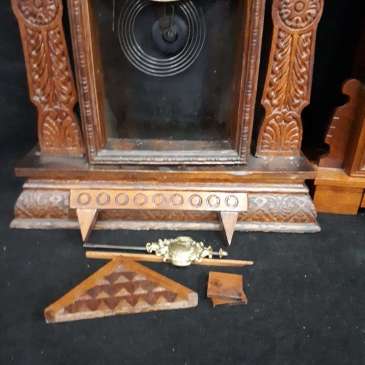
Unknown wall clockUnknown wall clock
My reply:
How is the movement mounted in the clock? Is it mounted to rails (so that it can be removed easily by loosening 2 thumb screws) or by screws on the backboard. If it is mounted by screws to the backboard it is not German, French or British. It could be American but I doubt it.
I do not believe your clock is an antique. The ornate carved design is very much a feature of Oriental clocks and possibly Korean from about the 1960s or 1970s. There were some nicely carved antique American clocks but nothing this extensive. I have not seen one exactly like it but ones that are very similar.
These clocks show well and are sought after by some people looking for a unique decorative item but as to value, perhaps two or three hundred dollars or so.
PN writes back:
It is mounted to the backboard with screws. We paid $250 30 years ago and it kept great time. Thank you so much for your time and knowledge.
Note; I have not seen one like it, do not know the maker and if anyone reading this knows more about it, kindly leave a message.
The movement was pulled out of a 30-hour shelf clock made by American clock-maker E. Ingraham and Co. in the 1870s (the name the company used from 1861 to 1880). The clock was bought at auction in mid-March 2022 along with 3 other clocks.
E Ingraham 30-hour movement
This is one of those situations where the case looks distressed whereas the movement looks like it has been well cared for over the years. It has seen service at least three times.
The three dates, two on the back panel and one on the rear of the dial, are all presumably service dates. The inscription, Bridges Bros, Woodstock, New Brunswick, 1879 is the earliest and on the back panel are the dates January 31, 1916 (barely readable) and October 1994.
Auction photo
The case
The gold band on the front face of the “octagon top” has some losses. I intend to hide the nicks with gold artist paint matched to the case. There are a few scratches over the rosewood case which will be hidden by a fresh coat of shellac following cleaning with soap and water.
5% of a label remains on the back. The inside label is interesting since most of the back panel is covered in black paper with E Ingraham Co. inscribed in gilt on the bottom section.
Dull dark blue paper labelwith gilt lettering
The dial shows considerable wear following years of daily use and the plan is to enhance the numbers with multi-surface black acrylic paint.
Auction photo
As a collector who has seen many of these styles of clocks, I initially assumed the access door glass was a replacement since many from this period had reverse painted tablets. Due to the decorative pendulum, the bright brass bell, the stylized wood panel that is the base for the dial, the glass panel with its waviness and various imperfections plus the putty-like material that is used to mount the glass, the total absence of any sign that it was painted, the clear glass appears to be original to the case.
It is always a bit of a disappointment when something is lost or changed in a clock’s history but the case looks reasonably good despite the minor wear.
Some of the scratches, dents, etc. found on a case (not all of course) are no doubt the result of rough handling either when transporting the item to the auction house or during its stay.
This is certainly not an example of a case that requires refinishing. The minor touch-ups and enhancements will dramatically improve the appearance of this clock while not changing its character or value in any way (but may even increase it marginally).
The movement
Now to the movement. The movement looks surprisingly good for its age and from my first inspection, it does not need much to put it right.
The front plate and escape wheel removed
Every time-side pivot and bushing is in very good condition and there is an old replacement bushing, 3rd wheel back-plate.
The strike side requires a new bushing second wheel back-plate. There are two old replacement bushings on the front plate and two on the backplate, all on 3rd wheels. The bushings are nice to see but it is not encouraging when one pops out while pegging the movement. It will be replaced. Not the best of workmanship.
There are punch marks around four bushing holes, front, and back. All pivots on the strike side are in very good condition.
It also appears the time side mainspring has been shortened a bit, not a concern since these clocks when properly serviced will run well past 30 hours.
All in all, it should be a quick project. Now that I have a clear idea of what needs to be done I will get to work on the case. Expect a post on the case itself in the next few weeks.
Honestly, an entire book could be devoted to the topic of dating clocks. Some time ago, I published an article titled “How to Date an Antique or Vintage Clock – Part I,” in which I used specific examples from my own collection.
I’d like to explore this topic further, and this post will discuss additional methods for dating an antique or vintage mechanical clock. While there is no one definitive method for dating an antique or vintage clock, there are often clear clues in some cases and more subtle hints in others that can help pinpoint when a clock was made.
Occasionally, the exact month and year are displayed somewhere on the case, and in other instances, the clock by way of serial numbers, date stamps on the movement, style of hands, spandrels, dial design, case design, and so on, establishes the date to within a certain period.
After 1896 foreign clocks (Europe, England) were mandated to have the country of origin on the case, usually on the dial. Any clock made after that date will have the country of origin.
Duration of manufacture
A bit of research into the history of a clockmaker can help you narrow down the timeframe for dating your clock. For instance, the E.N. Welch Clock Company, an American manufacturer, produced clocks until 1903, when it was acquired by the Sessions Clock Company, which continued making clocks until 1970. The E.N. Welch Clock Company made clocks for a 50-year period until its acquisition by Sessions in 1903.
By 1903 German-based clock manufacturer Junghans was the largest clock maker in the world and continued in its quest to bring more companies into the fold. Gustav Becker, founded in the 1860s, and Hamburg American Clock Company, founded in 1883 were absorbed by Junghans in the late 1920s. Although those companies were folded into Junghans in 1926 the Gustav Becker name lived on for another 9 years.
Gustav Becker regulator C.1907, Braunau factory
Clocks with Steel vs Brass platesvs Woodworks movements
Smaller shelf clocks with 1-day (30-hour) wooden movements were produced in fairly large quantities from around 1810 to 1845, after which most clockmakers changed over to brass movements. Wood dials were also popular during this period.
Daniel Pratt woodworks movement with dial removedC.1832-38
By 1860 iron weights were being replaced by springs as the power source, and smaller clocks, many of them 8-day, were becoming increasingly popular. Early American spring-driven clocks used brass springs (late 1830s) until steel became cost-effective.
This information is important for dating a clock because it highlights key transitions in clockmaking technology and design, which can help pinpoint the era in which a clock was made. For example, the use of wooden movements and wood dials can indicate a clock was produced between 1810 and 1845. The shift from iron weights to springs by 1860 helps us understand why spring-driven clocks became popular, which is crucial for narrowing the period of manufacture. Additionally, the switch from brass springs to steel in the early 1840s can provide a more precise date range for early spring-driven clocks.
Understanding these technological changes allows you to make more informed judgments about a clock’s age based on its features.
Brass mainsprings from a Manross steeple clock C.1837
During periods when brass was in short supply such as the World Wars (WWI and WWII), makers often made steel plate movements with brass bushing inserts. However, some companies such as Arthur Pequegnat used either steel plates or brass-plated steel plates throughout their operating years (1902 to 1941).
Steel plates on a Pequegnat time and strike clock
Other clock companies switched to steel as a cost-cutting measure when brass prices were high, not necessarily during wartime.
Screws and nails, chime rods, coiled gongs
In older clocks, nails, and screws were made of iron and hand-forged, with screw heads being slotted. Hand-forged nails can be found in clock cases dating from the earliest examples up to the mid-19th century, after which machined screws and nails started to replace them.
An ogee clock, like this example made by George H. Clark in 1865, was constructed with hand-forged nails.
George H Clark 30-hour Ogee shelf clock
Robertson and Phillips head screws were introduced in the first part of the twentieth century. Since the Robertson head was invented in 1906 and Phillips screw heads only began to be widely used in the 1930s screws of these types found in older antique clocks are later additions.
Since these screw types were introduced in the early 20th century, their use in a clock that dates from an earlier period suggests that the screws were likely replaced or added during a later restoration or repair. Recognizing these screws helps refine the clock’s dating and can provide insight into its history and any modifications it may have undergone.
The first rod gong, a single striking rod, dates back to patent designation DRGM 108469, granted to Johann Obergfell on December 23rd, 1899. The introduction of the rod gong, as opposed to earlier bell or strike systems, represents a key development in the evolution of mechanical clocks, especially in terms of sound quality and the technology used.
Understanding when this innovation occurred can help date a clock more accurately, particularly those with rod gongs, as it indicates they were likely made after 1899. Rod gongs are typically made from a copper or nickel alloy and are press-fitted into a block.
Thick coiled gong
There are two types of coils: the thick coils, which spiral only a few times and produce a deep, rich tone, and the thinner coils, which spiral many times and often have a higher-pitched, tin-like sound. Thick coils were used well before the mid-1800s. These coils are typically mounted onto a fitting, which is then attached to an iron block. Smaller, thicker coils became more common towards the end of the 19th century.
On the American front, thin wire coils were very common. Some examples had the coil mounted to a dome-shaped base which was said to improve the tone considerately.
Commemorative plaques
Commemorative plaques which display dates are often a good indicator of the age of a clock. However, the clock may have been on a seller’s shelf for years before the date on the plaque. This nevertheless places the clock within a certain range of dates. This photo shows a plaque on a HAC (Hamburg American Clock Co.) time and strike shelf clock.
HAC shelf clock with the date 1926 on a plaque
Type of escapement
Recoil (anchor), half deadbeat, Graham deadbeat, pinwheel, Brocot types are found in older antique clocks while, hairspring, floating balance, lever type escapements are found in newer vintage (less than 100 years old) clocks.
For example, floating balance movementsbegan appearing in mechanical clocks in the early 1950s. The floating balance will tolerate being out of level, unlike pendulum clocks which must be on a level surface, an attractive marketing feature.
This is important because the type of escapement mechanism used in a clock can provide key insights into its age and technological development. Older clocks with recoil (anchor), half deadbeat, Graham deadbeat, pinwheel, or Brocot escapements reflect the horological practices of earlier periods, while newer clocks featuring hairspring, floating balance, or lever type escapements indicate a more modern design, typically found in clocks less than 70 years old.
For example, the introduction of the floating balance in the 1950s was a signifcant advance because it allows for clocks that are less sensitive to being off-level, a feature that made them more convenient for consumers. Recognizing these mechanisms helps in accurately dating a clock and understanding the technological shifts over time.
floating balance escapementC. 1950
Style of case
The style of the case, such as ogee, box clock, steeple, cottage, or gingerbread, can help date the clock to a specific period.
The style of a clock case can offer valuable clues about its age, as different case styles were popular during specific periods in history. Here’s a breakdown of some common clock case styles and their associated timeframes:
Ogee Clocks: These clocks, named for the distinctive curved, “S”-shaped design of their cases, were popular from the early 19th century, especially between 1825 and 1850 but continued to be made into the 1880s. They typically have a simple, symmetrical shape, often with a painted or paper dial, and were mostly made with wooden movements in the early years.
Box Clocks: This style features a simple, rectangular or square case, often with a hinged door or glass front. Box clocks were common in the early to mid-19th century (1920s to 1940s), with their plain, functional design making them relatively inexpensive to produce.
Steeple Clocks: Steeple clocks are characterized by their pointed, “steeple” shape at the top of the case. This design became particularly popular from the 1840s through the 1870s. Steeple clocks were typically more decorative and were often used in homes and churches, with some having more ornate carvings or decorative elements.
Cottage Clocks: Cottage clocks, with their simple and rustic designs, emerged in the mid-19th century, around the 1840s and 1850s. Often smaller in size, these inexpensive clocks were popular in rural homes. They are sometimes characterized by a more casual, handcrafted appearance, with wooden cases and floral or geometric motifs.
Gingerbread Clocks: This style, which features intricate carvings and decorative elements like scalloped edges, ornate moldings, and small, detailed pieces, gained popularity in the mid- to late-19th century (around 1860 to 1880). Gingerbread clocks are often associated with the Victorian era and were typically mass-produced.
The case style is a strong indicator of the clock’s approximate age because clockmakers and manufacturers often adapted their designs to reflect contemporary tastes. By identifying the specific features of a clock’s case—such as the materials used, shape, and any distinctive decorative elements—you can narrow down the period in which it was made, which can then aid in dating the clock more precisely.
E Ingraham Huron C.1878
Knowing the period when a case was made provides a reliable indicator of the clock’s age. Although there are earlier patent dates stamped on the movement of this E. Ingraham Huron time and strike 8-day shelf clock, this style of case was made for only 2 years, 1878 to 1880.
Date stamps on movements or cases& searchable databases
Some makers stamp date their movements or display the date elsewhere on the clock case. The Gilbert Clock Company often date-stamped their movements. Sessions put dates on the door labels.
Some makers such as Junghans stamp a date code on their movements. For example, B19 stamped on the back plate of a Junghans movement refers to a movement made in the latter half of 1919.
Serial numbers stamped on movements can be compared to a database to determine the exact year the clock was made. The Ridgeway clock company used 4-digit codes. For example, serial number 4981 refers to a Ridgeway clock made in 1981.
Gustav Becker clocks were made in both Silesia and Braunau factories, both of which produced clocks but each had a unique serial number convention. The serial number on a Gustav Becker clock will give the exact year of production assuming you know where it was made, Silesia or Braunau.
An online databases such as ClockHistory.com provides invaluable information on companies and models made by them, the years the clock company was in business, and how long the company was in operation.
Searchable databases like Mikrolisk, the horological trademark index help date a clock by comparing a trademark. Some companies revise or restyle their trademarks over the years allowing one to date a clock within a certain period.
At Antique-horology.org keywords or text can be used to search trademarks and identify years they were used.
Scottish tall case clock C.1848
The date 1848 is attributed to the clock above. I arrived at this date because it was made by William McLachlan of Newton Stewart, Scotland. According to an English clock database, Mr. McLachlan was a clock assembler and ran a clock-making business in Newton Stewart until his death in 1848. While the clock could have been assembled as early as 10 years prior, 1848 serves as a conservative estimate.
Other miscellaneous indicators
Plywood began to be used in clock cases starting in 1905. One of the clocks in my collection, a Junghans bracket clock, made around 1913, features a plywood back access door.
Seth Thomas made clocks in marble cases for a short time, from 1887 to about 1895. They also made clocks in iron cases finished in black enamel, from 1892 to about 1895.
Adamantine clocks were most popular through to 1915. Seth Thomas is best known for their “Adamantine” black mantel clocks, which were made starting in 1882. Adamantine is a celluloid veneer, glued to the wood case. Adamantine veneer was made in black and white, and in coloured patterns such as wood grain, onyx, and marble.
Seth ThomasAdamantine clock circa 1911
Final thoughts
My goal for this two-part article was to provide a broad, generalized overview. Each of the sub-topics mentioned above could be explored in much greater detail, and I hope this serves as a useful reference for some of you. I welcome any corrections to the dates, and if there’s anything I’ve missed or other information that should have been included, please feel free to leave a comment.
As I’ve outlined, there are many ways to date a clock—some methods are quite obvious, while others are more subtle and require a bit of research to pinpoint.
For some collectors and clock fans, dating a clock is crucial, as it adds historical context and value to the piece. For others, however, it may not be as important, especially if the clock serves primarily as a decorative item rather than a functional or collectible piece. In such cases, the aesthetic appeal might take precedence over its exact age.
Those of you who work on mechanical clocks regularly must have run into this situation at least once. Everything went perfectly until the very end.
Sessions time and strike movements are very common and I have worked on quite a few over the years. They are reasonably well constructed with the exception of a well-documented poorly designed click.
Worn click on a Sessions movement
The other day I was working on a movement that I had originally serviced 5 1/2 years ago. Back in 2016, I installed 10 bushings, quite a number for any clock but it was very worn. It has run exceptionally well since then but now it was time for an inspection, cleaning, oiling, and correcting any possible issues.
Sessions movement in a wall clock
I took the movement apart, cleaned the plates, wheels, and levers in my ultrasonic cleaner (which I did not have back in 2016), and reassembled the movement. As expected the movement is much shinier than before and looks like it came off the factory floor.
During my inspection, I found minor wear but the only location where a bushing was required was the second wheel backplate. I could have left it but it was worn enough to need a new bushing.
Backward count wheel
It’s back together and being tested. Okay, I had to open up the strike side to reposition the stop wheel to correct warning but that’s about it.
It now runs perfectly and a nice pat on the back for me but oh! oh! wait…..it is not quite perfect, because I don’t think three o’clock follows four.
Dang, the count wheel is on backward. Why didn’t I see that?
You probably expected me to express a few choice words but I looked at it and said, ha, that’s too funny!
5 minutes was all it required to put it right and now it sounds great. Four o’clock now follows three o’clock. Yes!
Tick-Talk Tuesday is about the letters and comments I have received from readers concerning clock issues, challenges faced, a clock you would profiled or advice on your particular clock concern. For those comments and questions that stump even me, I consult within my clock circles for the best possible answer
S. writes;
This clock was in My grandparent’s home since the 30’s (I think). My dad (he’s 96) seems to recall my grandfather winding the clock every day, but I just want to make sure. Can you tell me anything about the clock? Thanks for any info you can provide.
My reply:
It looks like a Junghans 8-day Westminster chime bracket style clock, made in Germany. If you open up the back door do you see a trademark on the back of the movement. Take a photo if you can and send it to me. You do not have to take anything apart to see the trademark. Does the gong have a name on it?
Perhaps he wound it every day because it was part of his ritual but it only requires winding once per week.
S. writes back:
Wow! I didn’t see it before!
Junghans trademarkBack of Junghans movement
S. writes back:
How do I see when it was made?
My reply:
The number below the trademark is A20 which means that it was made in the first 6 months of 1920.
You must be logged in to post a comment.