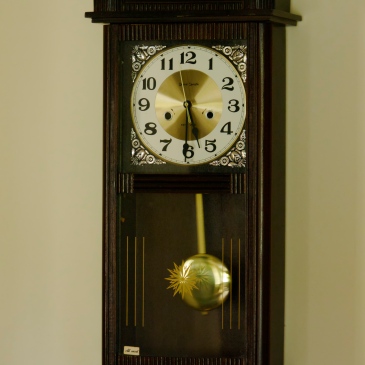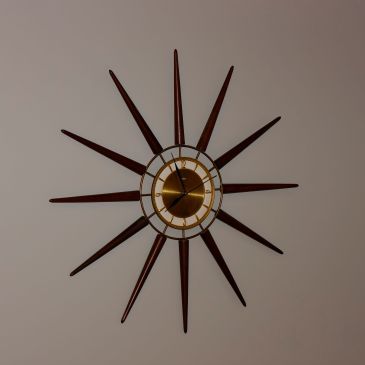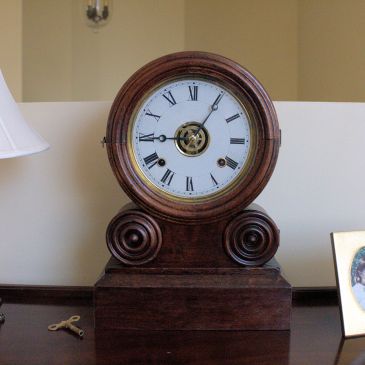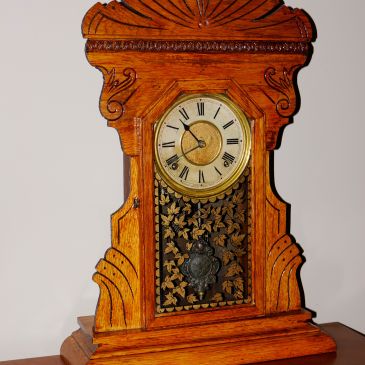
Several clocks bought at auction this spring

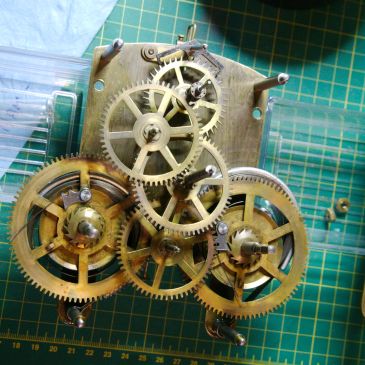
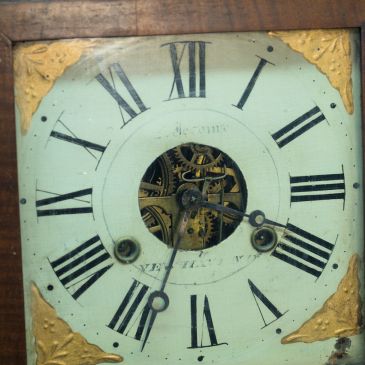
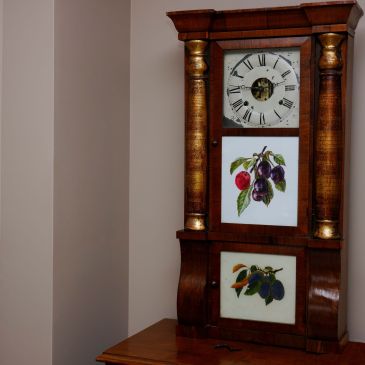
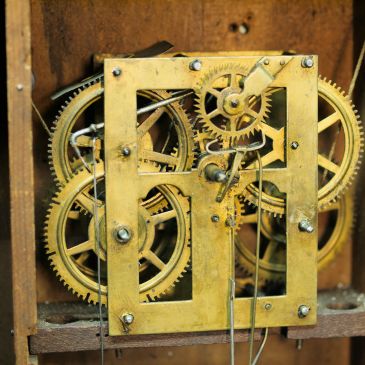
I am an avid collector of antique and vintage clocks which means I cruise the online auction sites regularly, about once or twice a week. This spring I checked out offerings from a local online auction site that deals with estate items, placed bids on 4 clocks (actually 5 since one lot had two clocks). The one I did not win was a 6 column Sessions mantel clock but no real loss there.

I won the bids on four clocks. CDN110 was the total though with buyers’ premium and taxes the price jumped to CDN147, still not bad for a small collection of antique clocks.

I do not have these clocks as of this writing since they are sitting at the auction house but I think can make a preliminary judgment based on what I see in the auction photos.

Although I am normally not in the business of selling clocks I will sell the odd one to keep my collection manageable. The plan is to fix these clocks and sell them to offset clock equipment purchases most notably an Adams Brown Timetrax 185, an electric clock timer, an amplifier that measures the rate of mechanical clocks by sensing escapement action and mechanical sounds of the escapement which I recently purchased. Here they are.

Unknown cottage clock

In no particular order of importance let’s start with an octagon cottage clock from the 1870s or 80s. It is a 30-hour clock judging from the placement of the winding points.

With pendulum and key

From the style of the pendulum bob and the case itself, I would say an E. Ingraham & Co. time and strike cottage clock. Some would have come with an alarm. This one does not.

Side view

It is in fair shape. The dial appears to have serious losses and there are nicks and scratches over a good portion of the case from what I see in the photos. I wonder if the tablet is a replacement and the original reverse painted?

It is difficult to tell with the harsh auction light but the case might be made of rosewood.

Decorative pendulum

It will be a good candidate for a mild refresh and should look very nice when completed.

Sessions Grand Assortment #3

Next is a Sessions Grand Assortment #3. I have worked on one in the past. There are three models in the Grand Assortment series and despite the fact that it is a lowly gingerbread clock and thousands of similarly styled clocks were sold by every major American clock manufacturer, this model is surprisingly collectible.

It is an 8-day clock with a steam-pressed oak case. The case looks very “aligorated” a term applied to a shellac finish that has coagulated as a result of being stored in a hot, humid environment such as an attic or a garage.

The dial is in poor condition

The tablet looks good but the dial is very degraded. This is a paper-on-metal dial and when the metal below the paper rusts the stain bleeds through to the front. This is called “foxing”. These stains are very difficult to remove and cost-prohibitive for most clocks. This is a cheap clock and a dial replacement is the only option and as such, I am not sure what to do about it.

A note is attached to the key and it says 1903. It is doubtful it was actually made in that year and I am sure the previous owner went by the year Sessions Clock Co. acquired clock-maker E.N. Welch Co. though the clock is certainly from around that period.

With a note from the previous owner

Reconditioning the case might be a challenge. Is it a candidate for stripping down to the bare wood? I suspect it is but we’ll see. I also see a small crack just above the top of the dial, so it might have been broken off at one point and re-glued.

I am not sure about the pendulum bob which does not look quite right for this clock. More research should provide me with the answer.

E Ingraham Ocean and Ansonia kitchen/parlour clock

Next is a two-for-one deal.

A duo of clocks

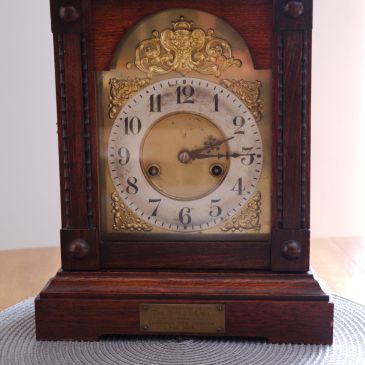
The one on the left is an E. Ingraham steam-pressed 8-day gingerbread possibly from the Ocean series. Unfortunately, it is missing its decorative tablet and that will certainly affect its resale value.

The pendulum looks right for the clock and the case itself looks to be in decent shape but as I said, it is very unfortunate that the tablet is missing.

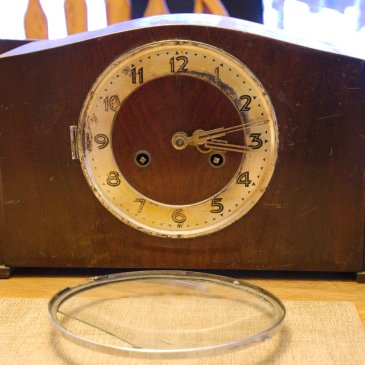
Pieces of a clock

The pieces at the foot of the gingerbread clock belong to the clock on the right. Usually, when I see pieces like this it tells me that it was handled roughly by the auction house.

What I like about this clock is its timeless design, almost Art Deco but made long before the Art Deco period.

So who is the maker of the clock on the right?

Unknown parlour clock

The auction description simply says, “unknown clock”. I believe it is an Ansonia 30-hour (position of the winding arbours) kitchen clock in Walnut from about the early 1880s. The tablet is bright and vivid, not a design I have seen before but likely original. Attaching the top pieces should be a fairly simple process and thorough cleaning of the clock case clock and movement should make it an ideal candidate for resale.

Of the four, two are 30-hour clocks. I have found that 30-hour clocks are a tough sell. Most casual collectors are looking for an 8-day clock since 1-day clocks are a hassle to wind but I think I can make both presentable enough to attract some buyers.

The auction notes do not say whether any of these are in working order. They are all “untested” which is typical auction-speak for “they may or may not work – the risk is yours!”.

American clocks are very tough and often work well despite being very worn. I suspect with a little encouragement I can get all of these clocks working again.

Now, to pick them up from the auction house.

Check for upcoming articles on each of these clocks.

Tempus Fugit Time Company announces expanded capacity

I am very excited and I hope you are as well to learn that the Tempus Fugit Time Company is pleased to announce the opening of its latest factory in Gackle, North Dakota.

The factory in Shanghai China was unable to meet the increased demand for clocks which inevitably meant expansion into North America.

The decision to switch from quartz clocks back to mechanical clocks was a difficult one for the Tempus Fugit Time Company but necessary in view of the pent-up demand for clocks with gears, springs, levers, and other noises.

Tempus Fugit Clock Co.
Timeville, Ontario factory and company headquarters

The new and yet-to-be-released Tempest line of clocks will represent the highest quality of clocks made by Tempus Fugit and they will be crafted by noted case designers Woody Bezel and Ben Doolum.

Unfortunately, the Fugit Battery Factory, a major supplier of quartz batteries is a victim of the expansion and will be shut down permanently, however, there will be no reduction in staffing as a result.

Daniel Dakota wall clock, one of Tempus Fugits more popular models
Tempus Fugit Clock Company grandmother wall clock

The factory and company headquarters in Timeville, Ontario will continue in operation producing the Grandnephew Clock (shown above) so popular among young people. Although the Timeville factory is managed by founders Seth Wheeler and Thomas Dealer they will shift their efforts to the expansion into North Dakota.

“It is time for a change and not a minute too soon”, said Mr. Wheeler. “Although it is April Fools Day we believe expansion into North America is the right decision for our company as we move into the 22nd century”, added Mr. Dealer.

Tick Talk Tuesday #39 – Mauthe box clock

Tick-Talk Tuesday

Tick-Talk Tuesday is about the letters and comments I have received from readers concerning clock issues, challenges faced, a clock you would profiled or advice on your particular clock concern. For those comments and questions that stump even me, I consult within my clock circles for the best possible answer

Mauthe box clock

NT writes:

I was wondering if you could take a look a this clock for me. It belonged to my great grandmothers mothers. My great grandma recently passed at 108. I can only imagine the age and value of this clock. I know it’s called Mauthe.

My reply:

Hi and thanks for your email.

The clock looks to be in fair condition although I would remove the cement/putty(??) on the door frame. These clocks do not have a lot of value, probably the $100-150 range. It looks to be from the 1920s, or 1930s. Some were quite large and ornate with intricate wood carvings but your appears to be at the lower end of a model range.

They are known as box clocks because of their style. Mauthe and other makers made literally thousands of them and they sold very well but the company eventually went out of business in 1976.

The movements are quite robust and they will last for years and are easily repairable unless there are serious problems as parts for them cannot be sourced.

If it has sentimental value I would keep it, have it cleaned and serviced and displayed in a prominent location. Most Mauthe clocks have wonderful sounding strike gongs but are not loud tickers.

Hope this helps.

Tick Talk Tuesday #38 – Swigart replacement dial

Tick-Talk Tuesday

Tick-Talk Tuesday is about the letters and comments I have received from readers concerning clock issues, challenges faced, a clock you would profiled or advice on your particular clock concern. For those comments and questions that stump even me, I consult within my clock circles for the best possible answer

GB writes:

Yesterday I pick up another strange clock and the dial has a monogram/mark: EJS, after searching it turns out to stand for E. J. Swigart but that company, from what I read, didn’t make clocks, just replacement parts so am I to assume the clock, images below, has a replacement dial/face? Does it diminish its esthetic value? I was told it is 1840 ogee. Miraculously enough it works!

Ogee clock
Swigart replacement dial

My reply:

You are correct. E. J. Swigart made parts for jewelers and watchmakers but they are best known for their replacement dials. Their logo is often confused with the Sessions Clock Co. or Seth Thomas. Swigart are respected for their dials and their commitment to making them as original as possible. They operated into the 1970s (the trademark was registered in 1896). I don’t believe it would diminish the value of your clock, after all, the replacement dial might be over 100 years old!

GB writes back;

Splendid! Thank you again. Your help and advice are priceless. 

A Sessions clock is on the bench 5 years later – what needs to be done?

A mechanical clock is a machine and all machines require periodic maintenance. Five years might be considered a long time since the movement on a Sessions time and strike mantel clock was first worked on when 2-3 years is the norm between service intervals but let’s agree that it has not been an easy time these past two years and priorities have shifted.

I have not opened this clock up since 2016 and I wonder if any surprises await me. I worked on this clock in 2016, so, it is a judgment on my own workmanship.

Sessions Beveled #2

It was purchased locally from a person who knew absolutely nothing about clocks, making a few bucks on whatever he could get his hands on. He could not tell me one darn thing about it only that it was not working. The case was in rough shape and it was less than $40, so, I bought it.

Although I had worked on several clocks prior to this one, it was an important part of my journey in clock repair because I was now able to put my newly acquired Bergeon bushing machine to the test.

Bergeon Bushing Machine
Bergeon Bushing Machine purchased in 2016

Back then I installed 10 bushings, replaced the pendulum bob and suspension spring, oiled the movement, reinstalled it, and refreshed the case. Not the best timekeeper in the world but that is the nature of spring-driven American clocks of that era (the 1920s).

Disassembly and Inspection

I always approach the inspection and servicing of a clock that I have serviced in the past in much the same way I would service a clock that has just come into my collection. The steps are identical; inspect, restrain mainsprings, clean all parts, peg out bushing holes, polish pivots, address wear issues, assemble, oil and test. This clock is no different.

Backplate off and showing the helper springs

First, remove the hour and minute hands. Next, put the clock on its face and remove the 4 screws that hold the movement in place. Pull the movement out of the case, place the case aside, and let the mainsprings down into the mainspring retention clamps.

Mainsprings are removed

Never attempt to take apart a spring-driven movement without first restraining the mainsprings. This is a very important first step in clock repair and it is obvious for safety reasons.

Mainspring contained in a clamp
Mainspring contained in a retention clamp

During the servicing, as I usually do, I will check all pivots and bushings but most particularly the mainspring clicks which is a well-documented weakness in Sessions movements.

As I began taking the movement apart I noticed a badly kinked suspension spring which will have to be replaced. This usually occurs when a clock is moved without removing the pendulum bob. We have had some home renovations this past two years and the clock has been moved about the house. My fault, actually.

I generally take many photos during servicing but there is no requirement this time since I have kept the photos I took from 2016. However, if anything is noteworthy at this juncture, I will record it.

One item I did not own five years ago was a high-quality ultrasonic cleaning machine. The movement is dirtier than I expected and there is blackish oil around some (not all) of the pivots. I was probably a little overzealous with oiling and perhaps not as careful as I should have been polishing the pivots. It definitely requires a good cleaning and my American-made L&R Quantrex 140 with internal heater will be put to good use.

Ultrasonic cleaner by L&R

I have been working with so many German movements lately I can’t remember the last time I worked on an American one, let alone a Sessions clock. It has been months, so, here we go!

I pulled the plates apart and inspected the movement for wear. There is more blackened oil up the train (mentioned above) than I was expecting which tells me that if not addressed now it will lead to accelerated wear of the pivots and bushing holes and eventual stoppage of the clock. There is the tiniest bit of wear on the 4th wheel back-plate but not enough to justify replacing at this time.

The second wheels, front, and back, which were not attended to then, may now need attention. The good news is that all the replacement bushings from 2016 remain in very good condition.

It looks like at least one new bushing on the strike side wheel, not surprising since it bears the brunt of mainspring power. While there is some wear on the other three I can live with it but the fourth on the strike side back-plate is somewhat oval-shaped as you can see in this photo.

Worn pivot hole on the strike side

Though not as bad as others I’ve seen in American clocks that are well worn, there is enough play in this wheel to justify a new bushing.

The New bushing

The click and rivet design are a special problem on Sessions clocks, and I am happy to see that both clicks are in good condition after 5 years. It might be unfair to criticize parts that are nearly 100 years old. The photo shows what a worn click would look like.

Worn click on another Sessions movement

After the parts are cleaned in the ultrasonic and thoroughly dried, the bushing holes are pegged and the pivots polished. Now for the new bushing.

The pivot measured 1.62mm and I chose one with an inside diameter of 1.60mm. After broaching (cutting followed by a smoothing broach) it was a perfect fit.

Now for reassembly. The strike side levers with helper springs under tension can often be a challenge to stay in place during reassembly but the key is patience. Oiling and testing are next.

What did the movement look like after 5 1/2 years? The blackish oil was a little concerning but overall the movement is in great shape. It is certainly cleaner and shinier than before.

And it runs like a charm.

Not ready for prime time – incorrect posting

This morning I posted an article that was not quite ready for publication. Some of you might have seen it and it certainly looked like a lot of gibberish. I had been working on a number of other articles and just forgot to do my final edits for this one. My apologies. The article has been corrected and there will now be a Part II.

Dating an antique or vintage clock – Part I

There is no single method of dating an antique or vintage clock but there are some strong clues in some cases and subtle inferences in others that help determine when a clock was manufactured. Occasionally, the exact month and year is displayed somewhere on the case, and in other instances the clock by way of serial numbers, date stamps on the movement, style of hands, spandrels, dial design, case design, and so on, establishes the date to within a certain period.

This is by no means an exhaustive reference but my thoughts on how to date a clock. I will therefore rely on various examples in my collection.

This is the first part of a two-part article. In the second part, I will explore additional clues for determining a clock’s age.

Elisha Manross steeple clock

This Elisha Manross clock is an attractive steeple design. Steeple clocks were made in the thousands from the early 1830s to the end of the century. A steeple clock is a type of mantel or shelf clock characterized by its pointed, spire-like top, which resembles the steeple of a church. These clocks were particularly popular in the mid-19th century and were produced by various American and Canadian clockmakers, including Seth Thomas, Chauncey Jerome, and others.

Elisha Manross steeple clock

Elisha Manross was an important pioneer of the Connecticut clock and lived from 1792 to 1856 and he was the maker of the steeple clock pictured above. A distinctive feature of this particular clock is brass mainsprings.

Brass mainsprings for Manross clock
Brass mainsprings, Manross clock

From 1836 to 1850 brass mainsprings were used in clocks because steel was considered very expensive. It was not until 1847 that the tempered steel mainspring developed for everyday clocks was introduced and with it, the brass mainspring faded into clock history.

This provides an important clue when dating this clock, that it was made before 1850. The second clue is the label located inside the case. Elihu Gere, the printer was in business at 10 State Street Hartford Conn. The printer’s name and address are located on the bottom of the label And this tells us that the printer was at this location until 1847. Armed with these pieces of information one can date the clock from about 1845 to 1847.

Daniel Pratt Jr reverse ogee columns with splat top

Next, is a Daniel Pratt Jr. shelf clock. A distinctive feature of this clock is that it has a woodworks movement. A woodworks movement is a type of clock mechanism/movement made predominantly from wood rather than metal. These movements were commonly produced in the early 19th century, particularly in the United States, during a time when wood was more affordable and readily available than brass or steel. Woodworks movements were very common before 1840 and were considered the first mass-produced clocks.

Daniel Pratt Jr.

Daniel Pratt (1797-1871), Jr., clock-maker, banker, town clerk, and legislator, lived in the town of Reading, Massachusetts, in the 1800s. Pratt did not contribute much to clock-making and was widely regarded as an entrepreneur rather than an innovator.

This particular Daniel Pratt Jr. reverse Ogee shelf clock was made in Reading, Massachusetts, c. 1832-38, within that six-year period. It has a splat-top mahogany case with half reverse Ogee moldings flanking the door, painted wooden Roman numeral dial, mirrored lower tablet, and wood dial face. The mirrored tablet was considered a luxury at the time.

Woodworks movement

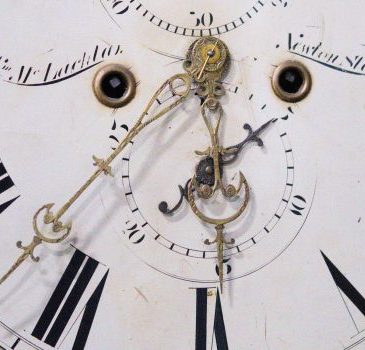
McLachlan tall case clock

It is a classic Scottish design from the mid-1800s. The removable bonnet is 23 inches at its widest point, the waist is 15 3/4 inches wide and the base is 20 inches wide. The bonnet has tapered columns on either side. The dial access door which covers the entire bonnet swings to the right. The solid wood access door on the waist measures 9 X 24.

McLachlan Scottish Clock

The well-preserved sheet iron white dial has painted spandrels, each one depicting an ewe with a lamb and a painted arch top showing a man resting on a rock with two working horses directly behind.

English Bell strike movement

The robust movement is made in the Guild style and movements contained in these clocks are commonly called “English bell strikes” with anchor escapements.

McLachlan was not a clock-maker in the true sense of the word but rather an assembler, bringing the dial, clock case, and movement together to assemble into a tall case clock for a particular customer. Signatures on a clock dial may or may not refer to someone other than the clock-maker. 19th-century retailers and distributors often put their own names on clocks in an attempt to ‘brand’ their products. The actual movement may have been made by someone else likely in Birmingham England. 19th-century clock cases were almost always made separately from the movement and are rarely signed.

The name Wm McLachlan, of Newton and Stewart, is inscribed on the dial. In his book, Clock-makers & Watchmakers of Scotland 1453 to 1900 David Whyte lists McLachlan, William, clock & watchmaker in Newton-Stewart, Wigtownshire as a business advertised for sale on 25 May 1852. McLachlan either retired or passed away before the sale date. Newton-Stewart is a former burgh town in the historical county of Wigtownshire in Dumfries and Galloway, southwest Scotland.

This clock was therefore made between 1848 and 1852. The painted dial which originated in or around 1810, the style of the hands, the style of spandrels, the shape of the arched dial, and the shape of the case are other clues that it was made within that period.

Sessions Beveled #2 tambour style mantel clock

This Sessions tambour style clock represents a very popular style of clock sold in the 1920s and 1930s in the USA.

Sessions Beveled #2

It is a fairly attractive mantel clock featuring a toned mahogany finish with faux inlay below the dial face. Faux inlay was an affordable way to enhance a clock’s decorative details and a common feature of clocks of this type in the 1920s.

Label on the inside of the access door

Sometimes, the exact date of manufacture can be pinpointed down to the year and month, making dating straightforward. In this instance, the clock was produced in September 1927.

Arthur Pequegnat kitchen clock

Dating a clock can sometimes be challenging, and unfortunately, this particular clock is difficult to date with precision.

Arthur Pequegnat kichen clock
Arthur Pequegnat kitchen clock

In Canada, the Arthur Pequegnat Clock Company produced clocks from 1903 to 1941. Before the First World War, the company operated in Berlin, Canada. During the war, the city’s name was changed to Kitchener in 1917 due to anti-German sentiment at the time. This small piece of information helps to approximate the date of a Pequegnat clock.

Below the six on the dial is the inscription “The Arthur Pequegnat Clock Co. Berlin, Canada,” but neither the case nor the movement provides any clues to narrow the date beyond the period between 1904 and 1917.

I hope the examples I’ve shared provide some helpful insights into dating a clock. This is the first part of a two-part article; in the second part, I will discuss additional clues for determining a clock’s age.

Having a professional service your clock

Is it worth the time and expense to have a clock professionally serviced?

That is the question of the day.

I receive many letters from people who ask whether a clock handed down to them is worth repairing/preserving. It is not an easy question to answer. Shared history and stories connected with the clock can be passed down from generation to generation and it is fond memories that keep it alive and consequently, there is a desire to have a clock in running condition. Sometimes it is better to do nothing and simply remember the stories associated with the clock.

If the decision is made to do something, the first consideration is whether or not the cost of preserving or restoring the clock is worth it. If the clock has deep sentimental value, the cost of repair cannot be compared to its resale value.

In the early days of clock collecting, I sent out clocks to be serviced and happily absorbed the cost. I knew then that some clocks cost more to repair than they are worth but I wanted to preserve some and have them operate daily, so, professional repairs were necessary.

Junghans clock in pieces
Junghans clock before restoration

A case in point

In January 2017 I bought a box of old clock parts (above photo). I was determined to make my German-made circa 1895 Junghans Crispi wall clock into what it is today. It was my first huge restoration challenge. It was a steep learning curve for me but in the end, I was pretty happy with the results.

During the course of restoration, I attempted to repair the movement, which hadn’t run in over a hundred years and made some rookie errors. I had no other course of action than to bring it to a professional in order to correct my mistakes. At the end of the day, the total cost was $475 for the initial purchase plus the servicing.

Last year, after 4 years of reliable running the clock developed an errant strike which required investigation and disassembly (and a good cleaning while I was at it) but I would not blame that on the professional repair. Perhaps it is the nature of that particular Junghans movement requiring the odd adjustment every now and then.

Junghans Crispi wall clock

In the years since then, I have acquired the skills and necessary equipment to perform my own repairs.

Twenty-three of the clocks in my collection are daily runners, all serviced from time to time by myself over the years. I am not a professionally trained clock-maker and some procedures are clearly beyond my capabilities, things such as teeth replacement and repair and fashioning new parts from stock brass. 95% of repairs I can comfortably handle on my own.

Rare Ingraham Huron found on a local online for-sale site
Rare E Ingraham Huron professionally repaired

Should you bring your clock to a professional? This is a decision you will have to make after weighing all factors. Know that by relying on a professional you can be assured that years of knowledge and experience go into the repair of your precious clock which becomes part of the cost.

Reputable repairers have the correct equipment to tackle just about any repair, offer a warranty period, and will correct any problems that arise after servicing, often without an additional fee.

Clocks are machines and machines do not last forever, parts will wear and from time to time they, like any machine, require attention. If, after some years, the clock that you had professionally repaired stops, I would have no hesitation suggesting that you return to the same repairer for servicing unless, of course, you had a negative experience.

Traditional shellac may provide the ideal finish for your antique clock

Traditional shellac may provide the ideal finish you are looking for when deciding whether or not to finish that newly acquired antique clock.

A modern polyurethane finish is not a substitute for traditional shellac. Polyurethane is tough and easy to work with but not reversible. Unfortunately, many people resort to using modern finishes on antique and vintage clocks because they are easily available, simple to apply, and cost-effective. However, in order to preserve the authenticity of a clock when the finish must be addressed, traditional methods are the best course of action.

Modern vintage clocks will often have a lacquer finish but for much older clocks shellac is the finish that would have been used at the time it was made. It is the best finish for most antique clocks. Shellac has been around for ages, began to be used extensively in the early 19th century, and remains a preferred wood finish to this day.

What is traditional shellac and how is it made?

What is it, exactly? Shellac is a resin secreted by the female lac bug on trees in the forests of India and Thailand. It is processed and sold as dry flakes and dissolved in alcohol to make liquid shellac, which is used as a wood finish.

Shellac flakes

Traditional shellac is preferred over canned shellac. Canned Shellac does not produce the same results and has a limited shelf life. Traditional shellac also has a limited shelf life but you need only prepare a little at a time. If you have no access to shellac flakes, check the expiry date on the liquid shellac can before using it.

Instructions for making shellac

Advantages

Shellac is non-toxic with no fumes, and it’s safe for surfaces children and pets will be exposed to. It is easy to work with because it dries very quickly and can be applied by spraying or brushing. Intervals between coats can be a little as 15 minutes or less depending on the cut. Shellac also provides a hard finish and doesn’t yellow like varnish. If you must make repairs on shellac, you can simply apply a new topcoat of shellac over the old finish to get rid of scratches or blemishes. It comes in a variety of colors and can be stripped off wood surfaces with alcohol. Shellac does start to deteriorate after it sits in the alcohol mixture for a period of time.

Disadvantages

Heat softens the shellac, so it is best if you avoid putting anything hot on or near the surface. If someone sets a glass down, the condensation may leave a white ring especially if the finish has a higher wax content. Having said that I don’t think many would put anything hot on a clock case although it is best to avoid heat sources, radiators, space heaters, etc.

Preparation and application

I use a 1 lb cut which is an 8 to 1 mixture, that is, 1 oz of flakes to 8 oz of denatured alcohol or commercially sold Shellac/Lacquer thinner. The instructions on the photo above describe the different cuts. The shellac dries very quickly and many coats can be applied in a relatively short period of time. I generally allow about an hour between coats, again depending on the cut.

Shellac comes in a number of shades but amber shellac, which I prefer, employs a warm glow to the finish. I will use either a broad artist’s brush or a French polish to apply the shellac. Each has its advantages. A ball fashioned out of terry cloth is the most effective method of applying shellac. French polishing consists of building up layers of shellac. Moisten the pad in shellac, wipe off the excess and apply in long strokes. A brush, on the other hand, is better when getting into tight spaces and wood cases with a lot of detail. Either way results in a glossy surface, with a deep colour.

Shellac thinner from Lee Valley

400 grit sandpaper is used for rougher sections prior to the first application of shellac. A damp cloth is then used to clean off the residue from sanding. Allow drying. After the first and subsequent application of shellac, 0000 steel wool is all that is required to rub out any imperfections.  Repeat the process two times and allow for drying time between coats.

Three coats are more than enough. More coats will produce a darker finish if that is your objective. If the finished result is too glossy and unnatural, dull it down with 0000 steel wool until you have the effect you want. However, there may be some situations where one coat is sufficient.

How long does it last?

Shellac in its liquid form has a limited shelf life of about 6 months much like canned shellac. In flake form, and stored properly in a cool dark place, shellac has a shelf life of about 3 to 5 years. I store leftover liquid shellac in a sealed glass container. I would advise against a metal container as the alcohol will react to the metal.

Let’s use my ogee clock as an example

This ogee clock is a fairly recent acquisition. The veneer is in remarkably good shape although the finish was dirty, dull, and lifeless. Many 150+-year-old clocks have missing veneer usually on four corners of the case and the door frame as a result of years of wear and tear but this clock is a rare exception. Veneer repairs must be completed before the finish coat is applied.

Ogee clock as found

Once the movement is out of the case I lay the case on its back to begin the process of cleaning.

After cleaning the case and one application of shellac

Murphy’s Soap is an excellent cleaner. Some may react to Murphy’s soap and a suitable alternative is Dawn or similar dish detergent. I use a light coloured cloth so that I can visualize how much dirt is being removed. Quite often the old shellac finish has worn off but if there is old shellac left there is a good chance it will be removed during the cleaning process. This is unavoidable particularly if the objective is deep cleaning.

Following the cleaning, 400 grit sandpaper is used for rougher sections. Clean off any residue with a damp cloth and wait for the finish to dry. Sandpaper is optional as I find it unnecessary in some situations.

Shellac is applied to the clock case while on its back using long broad strokes from an artist’s brush or a French polish pad. To avoid an overly glossy finish and maintain the light tone of the case one coat is all that is required as in the case of this ogee. Finally, 0000 steel wool is used to lightly “sand” out any imperfections.

To complete the effect Minwax Finishing Paste Wax is applied. It is a quality furniture paste wax that will protect the finish.

Dating a Hamburg Amerikanische Uhrenfabrik (HAU) shelf clock

During the Christmas season, we split our time between Calgary, Alberta, and Ottawa, Ontario to see our 2 daughters. While in Calgary my wife spotted an interesting item on an Ottawa Facebook Marketplace, an English time and strike clock.

HAU shelf clock

She showed me the photo and I said, “that does not look like any English clock I am familiar with. The style is definitely German”. There is a commemorative plaque on the front base section which references an English church so, I am assuming the seller thought it was English.

When we picked it up from his home outside Ottawa I was surprised to learn that the seller is a clock collector and had no idea the clock he was selling was German. Occasionally I sell clocks to manage my collection and when advertising one for sale I make it a point to know the maker.

But, no matter, it was in very good condition and in working order.

The movement showing the single strike rod and pendulum bob

The maker is HAU or HAC. The familiar cross arrows trademark of the maker is stamped on the movement, in the middle of the backplate.

HAC was formed in Germany in 1873 by Paul Landenberger and Phillipp Lang and was originally called Landenberger & Lang Uhrenfabrik. The company changed its name to Hamburg Amerikanische Uhrenfabrik (HAU)/Hamburg American Clock Company (HAC) in 1883. The famous crossed-arrows

Crossed arrows trademark

became their trademark in 1892. In 1926 the company went into a cooperative with Junghans and in 1930 they finally merged with Junghans.

The date on the plaque says 1926. However, HAC/HAU clocks are difficult to date prior to Junghans acquisition of HAC/HAU in 1930. Once Junghans and HAC began their collaboration in 1926 some of the movements were date coded.

Plaques are a good but not foolproof method of dating a clock. A clock purchased as a gift in 1926 could very well have been sitting on the retailer’s shelf for two or more years.

Catalogs are another good but hardly foolproof method of dating a clock. A catalog confirms that a model was made in a particular year, but that same model was probably offered 5 years +/- from the year of the catalog.

I will probably not determine a more reliable date for my new clock than circa 1926. The movement, compared to an earlier model (below), also has many cutouts and additional holes that indicate that it was a late production model and confirms that is closer to the 1926 date.

HAC clock movement
Solid plates of an early HAC clock movement CA. 1895

The clock runs for a while and stops. It is in need of a service but I expected to clean it as many of these old clocks have rarely seen the inside of a clockmakers’ shop.

Fleet Time replacement movement needed – calling all clock parts collectors

This Fleet Time mantel clock is a generic mantel clock with a walnut finish, flat front, a slightly domed top, and step-side features. Simple but attractive. Fleet assembled clocks sourced from German parts in the Montreal area for 4 years prior to WWII.

While the case looks great after refinishing, I was oh so close to having a fully functioning clock when disaster struck.

This is a call-out for anyone who can sell me or donate a replacement movement or otherwise direct me to where I can locate one. I am in need of a mainspring barrel and second wheel on the time side. As much as possible I would like it to be exactly the style of movement that came with the clock.

Fleet Time case
Fleet Time case, refinished

My clock passion is collecting clocks made or assembled in Canada and I would love to see this clock in working order

Fleet second time wheel
Fleet second wheel, a bent leaf cannot be unbent

Here is my story

The movement looked to be in reasonably good condition but needed a good cleaning.

Fleet time barrel
Fleet time barrel
Fleet time movement
Fleet time movement

The mainsprings can be removed without disassembling the movement, handy for such things as replacing a broken mainspring.

The movement was completely serviced with several new bushings installed. The mainsprings were removed, cleaned, and returned to their barrels.

Through the testing phase, the mainsprings were partially wound. Once I was satisfied that the movement was running well I installed it back into its case. I then wound the strike side fully and then wound the time side. Just as I was feeling resistance, CLUNK, and then the arbour turned freely.

Hoping it was only a broken mainspring I was not prepared for what I discovered when I opened up the movement. There were three broken/bent teeth on the mainspring barrel, a broken mainspring, and a damaged leaf pinion on the second wheel.

Broken mainspring

When a mainspring breaks at the teeth end of the barrel it tries to unwind but the loose end provides sufficient resistance, that is, a slower release of the energy, and is less likely to cause major damage. A broken mainspring results. A break at the winding arbour end or close to it as in this case results in the sudden release of energy and the result is damage not only to the mainspring but clock parts up the train; this is known as collateral damage.

A clock colleague advised me that although the barrel teeth and leaf pinion can be fixed it is usually not cost-effective because the process is so time-consuming. His solution is to collect movements that are used as donors for times such as this.

The plan, at this point, is to source a donor movement and harvest parts for what I hope would result in a successful repair.

So, here I am asking if anyone has a spare movement they can part with.

My clock passion is collecting clocks made or assembled in Canada and I would love to see this clock in working order.

A custom test stand for weight driven ogee style clocks

A few weeks back I published an article on clock testing stands. While a single clock stand would be ideal for all movement testing purposes there are so many different types and styles of movements that one size does not fit all.

The one stand I was missing was for testing weight-driven ogee style clocks whether they be 30-hour or 8-day or select clocks that would require a pulley system for the weights.

Aside from an easy setup and quick mounting of a movement for testing it allows me to inspect the movement from all sides

Tall case clock stand

Rather than construct a stand-alone ogee test stand I decided to make it a companion to my tall-case clock stand. Mounting atop the tall-case stand means that it is at the optimum height for making adjustments.

I also wanted something I could easily remove if I needed the long-case stand for testing and it is simple to set up.

Salvaging case parts from an old ogee simplifies the construction of the stand. It can be done without ogee case parts but it means devising a pulley system and making rails with slots for the movement seat board.

The ogee clock was purchased along with three others for $20 but the ogee clock case was in such poor condition it could not be restored.

A movement came with the case which I use for spare parts. The veneer has been harvested and used for other projects. The remaining wood pieces are stored and ready for use in future projects.

The tall-case stand is 48 inches high and will accommodate more than one movement although I generally work on one movement at a time. It is square-shaped and very stable though when used to test grandfather clock movements it is anchored to a wall to eliminate or reduce sympathetic vibration.

The tall-case stand is braced on all sides and the framing around the 4 legs adds additional stability and strength.

Clock stand two rails off
Taking the rails out

The rails, made of yellow oak, a hardwood, chosen for their strength.

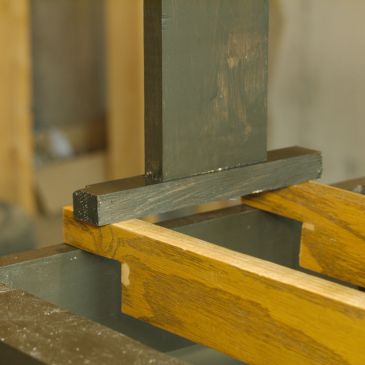
The two pieces I am holding are the oak rails that are designed to fit into the top of the stand and are fully adjustable width-wise depending on the size of the movement.

Close-up of the top

The ogee stand is 10 inches high and has stabilizing rails under each side that rest on the oak rails. There is a cross brace in the front and back to give it strength and lateral stability. The top from an old ogee case is ideal because the pulleys are in the correct position for the weights.

The rails easily take the weight of a 30-hour movement which is about 7 1/2 lbs total. Will it take the 13 lb+ weight of an 8-day ogee? Yes. There is no need to screw or nail the ogee stand to the oak rails as the combined weight of the movement plus weights are enough to anchor the stand in place.

Test stand rest on the two rails

I painted the stand to match the tall-case stand.

I chose Espresso latex paint because it does a great job of hiding my carpentry errors.

Testing the time side of a Waterbury ogee movement

Aside from an easy setup and quick mounting of a movement for testing purposes it allows me to inspect the movement from all sides.

It works as expected and now I can use the stand instead of the case for testing.

I know there is another ogee clock in my future!

Where do our readers come from?

Ingraham Grecian 8-day time and strike shelf clock

WordPress comes with an interesting dashboard. The dashboard provides me as author and developer with a back-end tool that provides a wealth of statistical information. The information allows me to track viewership and tailor my articles according to interest as shown by the number of clicks which is a measure of the level of interest.

In 2021 there were 68,095 visitors with 124,708 views at 1.83 views per visitor. Visitors came from 162 countries but let’s look at the top ten.

The top ten countries in 2021 are:

  1. USA
  2. Canada
  3. United Kingdom
  4. Australia
  5. New Zealand
  6. India
  7. South Africa
  8. Ireland
  9. Netherlands
  10. Italy

Since antiquevintageclock.com originates from the beautiful province of Nova Scotia, Canada it is not surprising that most of its visitors are from English-speaking countries.

All visitors are encouraged to explore the world of antique and vintage clocks and to that end, there is a handy applet on the front page for those of you who wish to translate in the language of your choice.

Readers pick for the best clock of 2021

The results are in. By a small margin, your pick for the best clock of the year is the Sawin banjo clock.

Sawin banjo clock

A great choice and one I would have picked had I not been frustrated with it during the restoration process but at the end of the day, my favorite is the Gilbert Shawville clock.

The Gilbert is an excellent example of a non-descript mantel clock found in thousands of homes in Canada and the USA in the 1920s. Seth Thomas, Sessions, and others made similarly styled models to appeal to those who could not afford the fancier, optioned-out upper range clocks that were offered by most manufacturers, including Gilbert, at the time.

I did not actually see the clock until we got home

The clock was offered on Facebook Marketplace in Quebec, Canada for $40 and had no takers over a three-month period. When the price was reduced, I snagged it. It was described as a non-running clock but the key, pendulum bob, and the movement are intact and I suspected I could get it running in a few minutes.

As an interesting aside, I found the clock in a recycle container by the side of the road, all prearranged, and never actually met the seller. It was boxed, sealed and wrapped in plastic, such is the fear the pandemic has produced.

Normally I stay away from American mantel clocks of the 1920s and 30s as I have had so many but for some reason, I was attracted to this clock because it looked like it had not been messed with.

There are no exotic veneers, appliques, fancy trim pieces, or finials, just a plain two-column, square-boxed-shaped, tinted mahogany lacquer hardwood case measuring 10 inches high by 5 ½ inches deep by 10 ½ inches wide at the base.

Gilbert shelf clock

The enamelled 5-inch dial with spade hands has Arabic numerals. On the top of the dial, within the number 12 is a regulating arbour used to adjust the speed of the clock.

On the front plate of the movement is the Gilbert trademark, a capital G within a diamond, and Wm Gilbert Clock Co, Winstead Conn. stamped on the right. The number 17 is in the lower centre, 1917 when the movement was made. The movement has steel plates with brass bushing inserts as brass was in short supply during the period of the First World War, 1914-1918.

A simple clock for the common folk and made by Gilbert is my pick for 2021.

Best clock acquisition of 2021

The time has come to determine the best clock acquisition of the past year. As a clock hobbyist, I have had little difficulty locating interesting clocks over the years, and despite the seemingly never-ending pandemic, I have scored a few in 2021 though the past year has been leaner than most.

In the early days of collecting, simple time and strike vintage mantel clocks were my principal focus so that I could take them apart, repair them if necessary, and generally advance my learning. Many of those clocks have been either sold or gifted. For the past three years, I have shifted my focus toward collecting interesting clocks, rare clocks, or clocks that have a special provenance that even includes the odd mantel clock.

My wife is my best clock finder. Our discussions often go something like this; “did you see that wall clock on Facebook?”. “Let me see. Yeah, it looks good, what do you think? Make an offer?” and off we go. Sometimes I will accept the offer from the seller without negotiating because I feel it is a fair price and other times there is some wheeling and dealing prior to firming the sale.

At the end of the post, you will have an opportunity to vote on what you think is the best in 2021.

In no particular order, here are my finds for 2021.

Sawin banjo clock

This is a garage sale find and even though it was purchased in the spring of 2021 it is still a work in progress. The clock is over 180 years old and in pretty decent shape.

Sawin weight driven banjo clock

It is a weight-driven banjo but it has no markings. An educated guess is that it was made by John Sawin of Boston or one of his associates on or close to 1840. I have completed minor veneer work on the case and have replaced the broken glass dial. The movement has been serviced but I am now looking at clock parts supply sources to replace a badly bent suspension spring. I want to avoid paying an outrageous price for the complete assembly; suspension spring, leader and spike.

Gilbert mantel or Shawville clock

I call this the Shawville clock because it spent most of its life in Shawville, Quebec (Canada).

It was a family clock for many years and following a death in the family, all possessions were either sold off or given away, a very common practice today. It has a time-and-strike Gilbert movement in a mahogany tinted case that has led a kind life since its manufacture in 1917. It is simple and unadorned and that’s what I love about it. I serviced the movement, cleaned the case, replaced a broken hour hand and now it is on prominent display in our home.

Gilbert time and strike

New Haven tall-case clock

An interesting $90 acquisition is this New Haven tall-case clock with a secret. Wow, a tall-case clock for $90, you say. Despite the look of a weight-driven clock, it is, in fact, a spring-driven clock. I was unaware of this until I walked through the door of the seller. I bought it anyway.

New Haven tall case clock

The weight cans are empty shells and they are simply there for show. The movement is quite large, eight-day, of course, and looks to be very robust. Despite my best efforts to determine if it was originally weight driven it had to have been spring-driven from the start, in other words, no evidence of a seat board or any additional holes for mounting the movement to the case. This appears to be an early “kit clock”, i.e. movement, dial face, hands, pendulum, “weights”, and ladder chains bought from the New Haven Clock Company and fitted to a pre-made case.

The case was very dark from years of accumulated dirt and grime and vigorous scrubbing revealed a wonderful red oak finish.

Waterbury Wren mantel clock

Ansonia Syria

Another clock with a secret is actually a disappointment. I found it in an antique store and it reminded me of an Ansonia Syria I had worked on for a friend last year, so, I was drawn to it.

Waterbury Wren mantel clock

It has a Waterbury case and what I thought was a Waterbury movement, but no.

It is missing the brass bezel and glass which is easily replaced but what is most disappointing is the mismatched movement, a Seth Thomas time and strike, which obviously replaced the original movement presumably because it was worn out. The movement is well-made and runs well but at the end of the day, the clock is destined to be sold.

Schatz Schatz carriage clock

This is a Schatz carriage clock made by August Schatz and Sohne of Germany. Thousands of these were sold and given as gifts through the 60s and 70s. It has an interesting lower visible escapement and an exposed movement.

Schatz carriage clock

Although it is working and keeping time it runs for about 4 days and stops. A cleaning is called for (on my list). It has a wind-up key in the back much like a typical alarm clock. It says West Germany on the dial and made, I would say, in the 1970s. August Schatz and Sohne closed in 1985, a victim of slow sales and a shift to quartz clocks by other makers.

Chauncey Jerome ogee clock

This clock is original in many ways, with a nearly flawless case made of mahogany veneer over softwood, moon hands, a wood dial, and a movement that matches when the case was made. Even the pendulum bob looks original. It was missing the suspension spring and rod and a wooden movement block, all easily sourced.

Chauncey Jerome 30-hour ogee clock

It cleaned up nicely and was a good candidate for a fresh coat of traditionally prepared shellac. I have three other 30-hour ogee clocks and this one is the most original of the bunch.

E. Ingraham Grecian shelf clock

This is a very nice shelf clock from an estate auction. It is an Ingraham Grecian clock with an alarm feature. If you have ever used the alarm on an old antique clock your first impulse is to throw it through a window, it is so loud and it goes on and on till the spring winds down.

Ingraham Grecian
Ingraham Grecian 8-day shelf clock

It came with incorrect hands and I had the darnedest time sourcing them but searching various suppliers in Canada and the US paid off. The case has been cleaned and the movement serviced including the infuriating alarm.

Fleet Time Co. mantel clock

An inexpensive clock that had huge potential but left me frustrated. Fleet Time Co. of Montreal had a short life of 4 years before the Second World war when they lost their source of German movements.

Fleet Time case
Fleet Time clock

I stripped the case and re-glued some sections, applied a walnut stain and I was very pleased with the final result. I serviced the movement, wound the time side completely, and BAM, kerplunk! the sound of a mainspring exploding. Sometimes you can get away with just replacing a mainspring and other times, like this, it took out the barrel teeth and a leaf pinon on the second wheel. I placed it in a plastic bag and it is now on a shelf in the basement awaiting donor parts.

Hamburg American Clock Company. (HAC) mantel clock

This German-made mantel clock has an interesting 14-day movement, an early production type from HAC. HAC is short for the Hamburg American Clock Company, a German company which had a long history up to the time it was absorbed by Junghans in the late 1920s. This clock was made in or around 1895.

HAC mantel clock
HAC 14-day mantel clock

It was another estate sale find. The case is nondescript and nothing special, but quite elegant.

So…..

Tell me what you think and I will reveal what I believe is my best acquisition this year in the next post. Let’s see if we agree.

Traditional shellac improves the appearance of an ogee clock case

This Chauncey Jerome 30-hour or one-day clock from about 1844-1845 is the example that I am using to illustrate the advantages of using traditional shellac as a finish coat.

The mahogany veneer is in very good condition and it is evident that the clock was not subject to the abuse one would expect of a 180-year-old clock. There is a small dent in the upper left corner but it is hardly noticeable. There are a few scratches here and there consistent with age but all in all the veneer is in great shape.

As found, a dull and lifeless case

First, is cleaning the case. My go-to cleaner for clock cases is Murphy’s Soap. It does a great job of lifting years of grime and dirt from the veneer. The tradeoff is that once you remove the dirt it reveals shellac loss. It was my intention to apply a coat of shellac in the first place so, when I got through layers of dirt and discovered some of the finish gone, I was not too concerned.

Since there are no veneer repairs, refreshing the case was pretty easy. I am not a big believer in maintaining the patina of a clock. if pt is dirty it needs to be cleaned!

I use traditional shellac consisting of flakes mixed with shellac lacquer. I use a wide artist’s brush to apply the shellac and it always produces a superior finish.

One coat of amber shellac

I have decided to leave the lower tablet as-is and as for the dial, I haven’t yet decided on whether or not to address the faded chapter ring though I am also leaning towards leaving it as-is.

The movement has been serviced, the clock is running and striking as it should and I think it looks great after the case refresh.

Veneer repairs on an 8-day Seth Thomas column and cornice clock

This 8-day Seth Thomas column and cornice time and strike shelf clock with sleigh front needed a little love. It has a Plymouth Lyre movement with a Thomaston Conn. label. The clock was made in the 1870s. and purchased five years ago and has been running since.

I will take you through my early days of veneer repair. It is probably not my best work but it was a fun and challenging project plus, there was good learning.

The Seth Thomas clock as found

A previous owner had applied brown paint on areas of veneer loss, it looked ugly and when I saw that I decided the case could use a little tender loving care. Many of these clocks are in decent condition for their age but if you are shopping for column and cornice clock from this era take note of veneer losses. You may want to reconsider your decision to purchase if you feel it is not worth the time, effort and expense or if there us so much loss that it is unsightly.

Of course, there is always the school of thought that advocates leaving things as-is and that is perfectly fine. But, a little veneer work is minimally invasive, in my view.

Veneer issues

The most troublesome sections were the top and bottom of the case and the column base, not surprising since those are the prime targets of wear and tear over the years. Most of the cornice veneer is in good shape as are the door sections, door surrounds, and the sleighs just above the feet. Although there is work to be done, I have seen worse.

The veneer used at the time was Brazilian Rosewood, an exotic wood. Rosewood would have been used extensively by clock-makers of that era and replacement Rosewood veneer would be the correct choice. I have two 7 X 8 inch pieces of Rosewood veneer, more than enough for this project.

Veneer losses on the base

Prep-work and other case issues

The cornice on the left side was missing a section and that had to be attended to before the veneer work began.

Losses on the cornice and its base

Using scrap softwood I made a small piece and trimmed it roughly to fit. In this photo, I am testing the piece and making minor adjustments for a snug fit. The section is then glued in place and allowed to dry for 24 hours.

Cornice trim piece
Cornice trim piece

The top area of the front cornice is now ready to be faced with veneer.

The sections with brown paint had to be sanded down to the bare wood to improve adhesion before gluing the new veneer.

Repairs made to left cornice

In selected areas, small sections of old veneer were removed to make way for larger replacement pieces.

I have decided not to tackle the columns. There are some losses but from a reasonable distance, they are fine.

Hide glue and Bloom strength

The one true adhesive for antique clock case applications is hide glue. Hide glue would have been utilized at the time the clock was manufactured.

I chose pearl hide glue which is rated at 150g Bloom strength (500g Bloom strength, the maximum, is not necessary for this type of repair). 150g hide glue takes a little longer to gel and adhere but with the slightly longer working time moving pieces around for best fit is easy.

Home-made double boiler

To ready the adhesive place the container with the gelatinous glue in a bath of water in a pot specially designed for hide glue or a double boiler which worked equally well for me. Heat to approximately 140°F (60°C), using a candy thermometer and maintain the temperature throughout. Heating the wood surface with a hair dryer before applying the glue is an option. Full strength is reached when it’s dry, and that can take 24 hours.

An excellent article on hide glue and its strength properties can e found here.

It is best to start with a small batch. Put 2 tablespoons (30ml) of glue in a glass container and cover with 1 tablespoon (15ml) of cold water and let soak for about an hour or until the glue softens and becomes gelatinous. To make a larger batch simply follow the 2 to one rule. I recommend making small quantities, to begin with. If there is glue left over I find that it can be frozen and reused later with no ill effect.

Tools

Clamps, weights, tweezers, wax paper, a sharp knife, a metal straight-edge, painter’s tape, a micrometer, sandpaper, palm sander, and whatever you choose to use as a double boiler complete the list of tools.

Clamps used for veneer work

A micrometer is an indispensable tool for accurate measurements. Accurate measurements ensure a good fit, minimize the use of fillers and lessen waste.

Cutting, trimming & clamping

The cutting of veneer can be tricky. Veneer is brittle, and can easily tear. Veneer today is quite different than veneer used 100+ years ago as it is very thin. On some clocks you must double-up or layer the veneer to approach the height of the original veneer. Another alternative, and a better option, is to harvest veneer from old clock cases. Old veneer is thicker, is very close to the look and feel of the original finish but just as brittle.

If old veneer is hard to work with, softening it with water will have a small and short-lived effect on a veneer’s flexibility. Another option is a product called Super-Soft 2, said to be ideal for softening veneer. For the little veneer work that I do I cannot justify the cost of a commercial softener and water is satisfactory for my purposes.

Painters tape easily peels off

The next photo shows a veneer section glued and clamped into place. Wax paper is used to prevent the glue from sticking to the clamp. Clamps are essential for veneer repair but when clamps do not work other methods such as weights can be employed. Leave the clamp on for 24 hours for maximum adhesion.

Clamping cornice veneer

Cutting can be a challenge since you must follow the grain and narrow strips can break very easily. Painters tape prevents tearing and is easily removed from the veneer prior to or after the application.

The most challenging areas were the very top and very bottom of the case and the column bases but after many hours the veneer work is now complete. The next step is colour matching the new to the existing veneer.

Top of cornice veneer with new veneer

Rosewood Minwax Gel stain is a close match to the older veneer but I would recommend experimenting with a coat of shellac first before applying a stain, in fact, a stain should be a last resort.

The base section is finished

There is always good learning resulting from each project and in retrospect, I should have replaced the entire section under the left sleigh rather than cut two pieces of veneer to fit either side of the existing piece.

The completed case includes a repainted dial and replacement upper tablet

As with any other project, there will always be a slight colour variance between old and new veneer and the goal, as always, is to come as close as possible to the original finish.

The last photo shows the completed clock with a repainted dial and a new middle tablet.

Chauncey Jerome 30-hour movement – two unusual issues during servicing

I was not really looking for an ogee clock to add to my collection. But there it was sitting in a lonely corner of an antique shop calling me, “buy me”; and I did.

It is probably the oldest one in my collection of 4 other ogee clocks. It was made in or about 1845. Now, being old does not necessarily make it valuable. In fact, millions of these clocks were produced and many found their way to online auction sites in recent years contributing to a huge drop in value. You can find them online for a little more than I paid for mine but they are pretty cheap nonetheless. This one was $54.

As found

The case label located on the backboard inside the clock case was printed by John Benham in 1845. Comparing the movement in this case with one found on a popular Jerome database site tells me that it is a type 1.311 Jerome movement. Jerome movements were typically marked though some, like this one, were unmarked which is not unusual.

So, the case and the movement are near enough in time to tell me that the movement is very likely original to the case. That is always a good sign as many ogee cases had worn movements replaced over the years. In some cases, there was little intertest in matching the maker of the case to the movement especially if a customer’s only wish is to have a working clock and since the movements were interchangeable it made it that much easier. Many of these clocks are over 180 years old and one can expect some subtle and not-so-subtle changes over the years.

While very attractive and running well this clock (below), a “marriage”, is an EN Welch case with a Waterbury movement. When considering the purchase of an ogee clock, if it is important to you, check that the movement and case are from the same maker though that is not an absolute guarantee they started their lives together.

EN Welch and Waterbury marriage

What is original and what has been replaced?

Typically parts that have been lost/damaged or replaced over the years include the verge, suspension spring/leader, the pendulum bob, the weights, the hands, and case parts like pulley dust caps. In some cases, the lower tablets have been removed altogether because of breakage or severe paint loss, replaced by a clear glass panel, a mirror, a photograph, or a picture (often from a discarded calendar).

The leader and suspension spring are missing. The verge appears to be a replacement, the weights look original as do the hands and pendulum bob. There is a missing top movement block that secures the movement to the backboard and that is about it.

I am reserving judgment on the frosted glass tablet; it may or may not be original. It would be pretty exciting if it were a Fenn design but I doubt it. William Fenn was one of the more prolific tablet-makers of the mid-19th century. The dabs of red paint are certainly added later.

The clock dial, likely original, is signed C. Jerome below the twelve o’clock.

Assessment of the movement

This is a typical 30-hour or one-day time and strike movement.

I found some wear and I was expecting some past repairs. There is a repair date of 1863 on the inside of the access door but I can’t make out what was done at that time.

There are two bushings installed on the front plate, the second wheel, and the hour gear. On the back, there are four replacement bushings, evidence that it has had acceptable servicing. One seldom finds replacement bushings on an ogee clock. Most movements I have come across have punch marks around the bushing holes, a common practice by past clock repairers to close elongated holes.

Type 1.311 Jerome movement

Three of the replacement bushings will have to be redone and new bushings are required for the back-plate time side main wheel and the strike side back-plate main wheel for a total of five.

The pressure washer for the time side main wheel is completely worn out. Had I not separated the wheel and ratchet for cleaning I would not have discovered the problem but it tells me that it could fail at some future point.

To the right is the pressure washer with centre worn through

I have a donor New Haven 30-hour movement that will provide the replacement washer.

The lantern pinions have some wear but are quite acceptable. One trundle is loose on the escape wheel. Rather than take it apart and re-seat the troublesome trundle, a dab of Loctite Red should fix it in place.

These are two unusual issues but not insurmountable.

A lantern pinion with a loose trundle

Because the movement was so oily and dirty I pre-cleaned the parts prior to putting them in my ultrasonic. This helps extend the life of the solution. I used a medium bristle nylon brush to clean the stubborn areas.

After cleaning and drying the parts, the pivots are polished and I was pleased to find almost no wear on any of them.

Next is the bushing work. My only concern was pushing out what remained of the bushing material in the replacement bushings after drilling. I went slowly and did not apply pressure on the cutter, letting it do its work. As I suspected the Bergeon bushings are marginally smaller but each bushing fit snugly. Although I planned on five bushings, I installed six, adding a bushing for the second wheel on the time side front plate which was a little more worn than I thought. I left the escape wheel as-is, the wear is acceptable.

Next is restringing the weights, re-assembly, and testing. All went as expected.

I have worked on a few of these movements over the years but unique issues always seem to come up. Nonetheless, they are fun to work on.

Following the movement servicing, I will move on to refreshing the case.

Would you buy a “Cucuko” clock?

I frequently cruise the online for-sale sites for interesting clocks and I could not help but chuckle at this one.

Would you buy a Cucuko clock?

Online ad

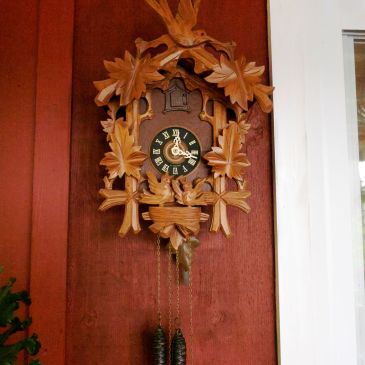
If you are going to sell a cute Black Forest clock take a little time to find out how to spell the darn word. It is not choochoo or cucko, or CooCoo, or Coockoo, or Cucuko, it’s Cuckoo!

The word is Cuckoo and the Cuckoo is actually a bird found commonly in Europe. That little birdie that comes through the top hatch door the hour and half-hour on so-called clocks is a Cuckoo, plain and simple and they are a real thing.

Dave's cuckoo clock
Dave’s cuckoo clock

I don’t know how many times I have seen the word misspelled. How much more would a seller know about the clock if they can’t even spell the name correctly?

The name is not the only thing to snicker at, look at the price.

I got mine for free. I call it Dave’s clock, the name of the previous owner. It is a lot nicer than the one offered for sale and I’d sell it for a whole lot less than $300…… if I sold it!

Over 108,000 views so far this year – thank you

Thank you, viewers and subscribers.

It is always a thrill to reach a milestone. Six years ago I attended a WordPress workshop and after the instructor assisted us in setting up a rudimentary site, I thought, I can do this. I can talk about clocks! WordPress 101 certainly made it sound so easy but it wasn’t as easy as I thought as I began my journey.

It has taken time to build a following, more than I ever imagined. It takes planning, commitment, an investment of energy, and, finally, perseverance but at the end of the day, it has been worth it.

My office about two years ago

I began by following other blogs and making notes on what made them successful and eventually found a natural style that was best for me. Unfortunately, I have seen a lot of blogs come and go in the past six years, bloggers that ran out of ideas, lost interest in their blog, or for whatever reason, life got in the way. And some of those blogs were pretty darned good. But I wasn’t going to let that affect me.

The first two years were frustrating, to say the least, and I don’t know how many times I thought of quitting, but I hung in even though the number of views was, well, disappointing. I knew my content was interesting, certainly to me and I knew there were people out there who had a yearning to read and learn about mechanical clocks, so, I stuck with it. And, I am glad I did.

Case repair and restoration work area

As I have said elsewhere if you regularly use a lathe to cut gear teeth, re-pivot arbours, bush mainspring barrels on a weekly basis, fashion new wheels from raw stock or make advanced repairs on complicated movements and cases, this is probably not the place for you but you are welcome to leave any comments or suggestions or simply read one of my blog articles over a cup of coffee in the morning.

Seth Thomas #2
Seth Thomas #2 c. 1922

After six years I still consider myself a clock repair generalist though there is no denying that I continue to build my repertoire of clock repair and restoration skill. Judging from my mail I seem to appeal to those who are like-minded. I appreciate those who have stumbled onto my site looking for advice and guidance on a particular clock or clock repair issue.

HAC mantel clock
Hamburg American Clock Co (HAC) mantel clock c.1908

But I especially appreciate comments and suggestions from regular viewers. And, yes, there is fan mail, most of it sent privately and I take great pleasure in responding to each and every query.

Ingraham Grecian
Ingraham Grecian c.1875

As I review articles that have the greatest number of views it seems clear to me that most of my visitors are looking for how-to and general information articles. That suits me just fine.

These have become the most popular.

After six years I have developed an understanding of my audience and have managed to produce blog articles that seem to appeal to a wide range of people with an interest in horology.

Will I continue? Darn right, and as they say, the best is yet to come.

Antique or Vintage Clocks: The Perfect Unique Gift Ideas

Ah, the holiday season is upon us, what to buy? Are you are looking for a unique gift for a friend or family member. An antique clock may not be anything you have considered but wouldn’t it make a terrific gift.

Mauthe time and strike wall clock from 1895

If you know a little about antique or vintage clocks or you know nothing at all, you may need some help finding the right clock for that special person. I will give you a few pointers plus an explanation of some of the terms you may come across.

Why buy an antique or vintage clock?

A year ago I sold a clock to a young woman who was looking for a unique gift for her father. She responded to my advertisement by saying that it was exactly the clock she was looking for because it reminded her of the family clock when she was young.

Sentimental reasons, satisfying the need to acquire anything antique, or the uniqueness of an old mechanical clock top the list for reasons to buy an old clock.

What is the difference between antique and vintage?

It is not easy to tell the age of a clock, or, for that matter, anything in an antique store and, ads for clocks seldom tell the year it was produced although it might hint at the period it was made, for example, “mid-century”. A quick trip through the world of Google will give you a general sense of how old something is give or take a few years.

Vintage Kienzle wall clock from the 1930s

An antique is anything over 100 years old and vintage is less than 100 years but more than 30 years old. Anything that is less than 30 years old may be considered vintage but more often called collectible.

Mechanical or something else

This article focuses on mechanical clocks but there are a lot of different types of clocks out there and online auction sites are filled with every type imaginable. It can be confusing to the shopper.

As a general rule quartz clocks have limited value and very few would be considered collectible.

Electro-mechanical clocks have a traditional mechanical movement, which keeps time with an oscillating pendulum or balance wheel powered through a gear train by a mainspring but uses electricity to rewind the mainspring with an electric motor or electromagnet. Something quite different is the electro-magnetic clock, popular in the 1950s. Both types can be highly desirable but leave that to the professional collector who knows specifically what they are looking for.

In the 1930s electric shelf, desk and wall clocks were introduced into homes everywhere. Some have value but most are not worth the trouble.

Sessions 3W electric table clock
Sessions 3W electric table clock 1927

They are great timekeepers but are often quite worn, dangerous to work on, and can be difficult to repair. I would not give one as a gift unless you know that it was serviced by a competent professional.

My advice is to stick to an antique or vintage mechanical clock.

One last note; beware of conversions, clocks where the mechanical movement was taken out for whatever reason and replaced by a quartz movement. They are worthless but some people fall for this sinful and deceptive practice.

Type of clock and placement

Space is the biggest consideration.

Seth Thomas alarm clock
Antique Seth Thomas alarm clock from around 1910

In the trend towards smaller homes, there is not always space for a clock. Mantel clocks require a shelf or table to put them on.

Simple time-only or time and strike clocks can be quite small but others may have more a complicated Westminster chime movement in a larger case. Alarm and desk clocks occupy the least space.

This 1917 Gustav Becker Vienna Regulator is 51 inches long

Wall clocks are easier to place. Wall clocks come in all shapes and sizes from the diminutive cuckoo clocks to large box clocks and Vienna regulators.

Floor clocks, otherwise called grandfather or grandmother clocks, tall case, long case or hall clocks are the most difficult to place. Unless the person in mind would appreciate one and has sufficient floor space I would not recommend one.

Working or non-working clock?

A working clock that has been recently serviced by a competent clock repairer is the most desirable. However, if the clock will be a decoration or part of the decor and a working clock is unimportant, you might find them less expensive to purchase. Perhaps one with a replacement quartz movement might be okay as long as you know that’s what you are getting.

Clock buying tips

1990s Ridgeway grandfather clock takes up space
  1. Look for a working clock over a non-working one. Chances are it has been better cared-for over its life span.
  2. Facebook Marketplace, eBay, your local online for-sale site (we have kijiji in Nova Scotia), reputable estate auction sites, antique stores and word of mouth are among the best sources.
  3. Most common clocks are priced reasonably. Clock prices have generally fallen over the last 5 years but expect to pay more for rare clocks or those with a special provenance.
  4. Stay away from Chinese made or Korean clocks or most anything that has directional arrows around the winding points. They have very powerful mainsprings and will potentially harm the user if the springs break.
  5. The maker of the clock is largely unimportant. For example, all American clock producers made cheaper and more expensive lines of clocks.
  6. A little research is always helpful before you make the purchase. A little knowledge might be a dangerous thing but knowing nothing is worse.
  7. It may or may not be important to you if the clock has been altered in any way but it is nice to know. For example, many old ogee clocks are attractive but have had a replacement movement installed when the old one failed. In the clock world these are called marriages and it makes a difference to some people.
  8. Try to inspect the clock in person before you buy. Surprises are never nice when you discover something sent to you is not what you expected.

Well, if you are looking for a clock for that special person I hope I have given you something to think about before you put your money down.

I should say that I am not in the business of selling clocks but will sell the odd one locally to keep my collection manageable.

Circa 1845 Chauncey Jerome Ogee Clock

An ogee clock is so-called because it is a 19th century U.S. shelf clock with a distinctive S-curve (convex above and concave below) molding.

30-hour ogee clocks were very popular from the early 1840s to as late as the 1890s, a good run for a distinctive style of clock. Before the days of the Internet, these clocks fetched hundreds of dollars at auctions houses and antique stores. Along came eBay and prospective buyers quickly learned that large numbers of these clocks were produced in their day and the supply of clocks flooded the net and prices dropped accordingly. I have 5 ogee clocks among my collection of over 100 clocks and have never paid more than $60 for any of them.

Of course, there are exceptions to the rule. The distinctive case has housed movements other than the 30-hour time and strike commonly found and some are quite desirable. Fusee, single weight 8-day time-only, calendar models, minis, Gesso fronts, 8-day time and strike clocks, and a few unusual ones have good value.

As found

30-hour clocks are worth collecting and if you a new to clock repair, they are a great clock to begin your journey.

This is a Chauncey Jerome 30-hour or one-day clock from about 1844-1845 and based on my research, the movement is from the same period. So, an excellent chance that the case and movement started life together. The pendulum bob looks very old and hard to say if original as pendulums often go missing during a clock’s life. But I’m not sure a modern pendulum bob would have similar detail.

Original (?) bob cleaned with Brasso

The dial is in good condition with attractive Gesso spandrels although the Jerome name under the twelve is barely readable and the chapter ring has faded. The moon hands also look original and the clock came with the correct weights. The mahogany veneer, while very dirty is almost flawless.

The name Jerome is just readable

Not original is the strike bell as the clock would have had a coil gong. The suspension spring and leader are missing. A top wooden block that attaches the movement to the case is also missing and the label, printed by John Benham, though readable, has some losses. The suspension spring and leader can be easily sourced, the block fashioned from old stock and I have a spare Jerome style coiled gong in my parts bin.

30-hour unmarked Jerome movement

The tablet design did not look original at first glance but after removing a piece of cardboard (first photo) and Christmas wrapping paper behind the glass I discovered a frosted tablet with thistles and flowers. The red paint might have been added and it is very possible that it was not painted originally.

Original tablet?

The plan is to service the movement, source missing parts, and refresh the case.

I am not a strong believer in maintaining the original patina which one reader opined is just another word for dirt. The case will be cleaned with Murphy’s Soap and a coat of shellac will be applied.

Original materials and techniques will be used when working on the case. This includes the use of traditional shellac (flakes mixed with shellac lacquer), and fasteners like old slot head screws, old wood, and square nails. The replacement coil gong is very similar to other Jeromes I have seen and will come out of a donor ogee case. There are a few stray pieces of label at the bottom of the case that will be glued back in place.

John Benham label is in rough shape

There is not a lot of demand for ogee clocks today as reflected in their asking price. Perhaps the 30-hour ones are considered a hassle for some as they must be wound once per day, nevertheless, I find them very appealing.

Coming soon will be an article on servicing the movement and later on, refreshing the case.

Gilbert mantel clock movement servicing

Let me say that I am not a huge fan of clocks with steel plates. Although most have brass bushing inserts punched into the steel, I am always fearful that there is not enough brass in the insert to prevent cutting into the steel plate and ruining a cutter. But in this case, my worries were unfounded and this clock presented no such headaches.

The mahogany tinted case shows well

The movement is stamped 17 which was Gilbert’s way of identifying the year the movement was made, which in this case is 1917. The case design is somewhat reminiscent of clocks made in the early 1920s but Gilbert no doubt made a run of these movements and put them into various clocks some years after the Great War.

Not a lot of dirt and grime

It is a time and strike with a passing strike on a bell on the half-hour.

I was not really looking for a mantel clock but I saw it online during the summer of 2021 and I thought it would be a good summer cottage project to keep me busy. I didn’t have the right tools for bushing work so I cleaned the case, replaced a broken hour hand, inspected it for wear, oiled it, and ran it through the summer.

It certainly needed cleaning but a month of running would do no appreciable harm. It was reliable and it kept reasonably good time, or as reasonable as one could expect of American clocks of this period.

Plenty of levers and helper springs

It looks like one of those clocks that had a few years of running, was disassembled and cleaned at least once but spent most of its life sitting prettily on a shelf.

There are a number of scratch marks on the movement which tells me that it has been worked on before. No bushing work was done but I see punch marks around the escape wheel bushing rear plate and that’s about it.

Pivots and lantern pinions are all in great shape

There is minimal wear; the lantern pinions are in very good shape as are all the pivots. As for bushing work, based on my initial assessment at least 4 bushings are required; second wheel strike-side backplate; third wheel time-side backplate; second, third, and fourth wheel strike-side rear plate. But, the wear is consistent with a clock that has reasonably good care during its life. There was plenty of brass material for the inserts and bushing went easily.

The movement has more than its fair share of helper springs, two in the upper part of the movement for the striking levers and two in the bottom, one for the half-hour strike on a bell and one for the hour strike. Getting all these helper springs to wrap around their respective posts is frustrating but doable although it is probably helpful attaching the lower springs while assembling the movement rather than wrestle with the springs after the movement is put together.

I have worked on a few Gilbert time and strike movements over the years and this one was no different. It is midway through the second 8-day test cycle and running well.

Other than some new bushings and a replacement hour hand, that is all there is to it.

I like this clock. It has simple lines, looks good and I think I will keep it.

Gilbert shelf clock

I am always on the lookout for clocks to add to my collection, and one of the places where bargains can often be found is Facebook Marketplace. While browsing the listings, we came across an intriguing clock from a small village in Quebec. It was my wife who pointed it out, thinking it would make an interesting addition to our collection.

From our summer cottage in Quebec, we made the short trip—about half an hour—to a nearby town to see the clock. We learned it had spent its entire life in this quaint village. Due to the pandemic, we arranged the purchase in an unusual way: the agreed-upon amount was sent to the seller via eTransfer, and they left the clock in a recycling bin outside their home for us to pick up. The entire transaction took place without any in-person contact, making it one of the more unique methods I’ve used to acquire a clock.

The clock was wrapped in a plastic bag with a note attached that said, “Thank you.” As we drove away, I wondered if a clock purchased sight unseen would be what we expected.

A pleasant surprise

It is a very simple clock, but we were pleasantly surprised by its condition—it has clearly had a good life. This clock is an excellent example of a nondescript mantel clock that could be found in thousands of homes across Canada and the USA during the 1920s. Companies like Seth Thomas, Sessions, and others produced similar styles to appeal to those who could not afford the more elaborate, feature-rich upper-range mantel clocks offered by most manufacturers of the time.

The clock had been listed on Facebook Marketplace for $40 but had no takers for over three months. When the price was reduced, we decided to buy it.

It was described as a non-running clock, but the key, pendulum bob, and all parts of the movement were intact. The only flaw is the hour hand—the spade end has been snapped off. While the clock is nothing extraordinary, once cleaned up and put in running order, it should look presentable and run well for years to come.

Normally, I avoid American mantel clocks from the 1920s and ’30s, as I’ve owned several in the past. However, I found myself drawn to this clock, largely because it appeared to be untouched and well-preserved. I expect some wear consistent with its age, but at first glance, it looks promising.

This clock was made by Gilbert, a well-regarded American clock manufacturer with a long history of producing clocks from 1841 to 1957.

The clock features no exotic veneers, appliqués, fancy trim pieces, or finials—just a plain, two-column, square-shaped, tinted mahogany lacquer hardwood case measuring 10 inches high, 5 ½ inches deep, and 10 ½ inches wide at the base. The enameled 5-inch dial with spade hands displays Arabic numerals. At the top of the dial, within the number 12, is a regulating arbor for adjusting the clock’s speed.

There is no identifying stamp on the rear plate, and the seller was unaware of the maker. However, once the movement was removed from the case, the markings became visible. The front plate bears the Gilbert trademark—a capital “G” within a diamond—along with “Wm Gilbert Clock Co., Winsted, Conn.” stamped on the right. At the lower center is the number 17, indicating the year (1917) when the movement was designed. The movement features steel plates with brass bushing inserts, which is not surprising given the brass shortages during the First World War (1914–1918), prompting manufacturers to use steel for clock plates.

Gilbert movement

The case has an austere 1920s look. The movement date of 1917 suggests Gilbert might have used the same movement for a number of years following the war. The entire case, especially the molded base is free of gouges, dents, and other calamities associated with the rough handling and careless storage of old clocks. The case was cleaned with Murphy’s soap revealing a beautiful mahogany finish underneath layers of dirt.

If the movement is complete, I can usually get the clock running within a few minutes with a few adjustments here and there. However, despite oiling the movement, checking the gap in the crutch loop, releasing the tension on the mainsprings, and adjusting the beat, the clock would stop after just a few seconds. It wasn’t until I removed the suspension spring that I discovered a kink, which was enough to prevent the clock from running. The suspension spring will be replaced during servicing, but after I smoothed out the kink, the clock began to run. The strike side required no adjustments and works well.

While oiling and basic adjustments like these are no substitute for proper cleaning, they help me identify the issues I’m dealing with. Minor wear will be addressed by installing a few bushings. For now, the clock is running as well as can be expected.

Judging from cobwebs within and around the movement, a couple of dead houseflies plus dirt and grime on the movement itself, I doubt this clock has been running for many years though it likely gave years of reliable service before it stopped.

The previous owner says the clock has been in the family for a long time. It had been his grandmother’s clock passed on to his mother. It was dusted and cared for but, “she got tired of dusting it”, he said and it ended up stored in a barn for the last number of years.

I don’t mind dusting it!

New Haven hall clock – Restoring the case

I found the clock on an online for sale site in the spring of 2021 and contacted the seller the same day. When I saw the sellers photos my first thought was that it was pretty reasonably priced for a hall clock, known by many as a grandfather clock. I decided to take a chance, arranged a meeting with the seller and arrived to pick up the clock.

During our brief discussion I learned that the clock is inexpensive for a good reason – it is not quite what I thought it was.

Seller’s photo

Missing are the door handles, otherwise it is complete. It has a mechanical movement with a pendulum but what I was not expecting was a spring-driven movement. Almost all hall clocks are weight-driven.

Is it a conversion? Was the old movement worn out and a new movement installed in its place. I don’t think so. There was never a seat board in the case as seat boards are almost always present on a clock driven by weights. So it seems that from day one this was never intended to be a weight-driven clock.

The case was likely made by someone other than The New Haven Clock Company and the dial, hands, pendulum rod and bob, weight chains, weights, acorn chain pull knobs and the wood dial face were purchased together as a package from New Haven and installed in the case.

Fakes weight chains below the movement

Okay, that’s different!

Cleaning or stripping?

The decision to clean or strip is made easy by a good cleaning. After a good cleaning it is better to assess whether or not it requires stripping. What was revealed was a very nice red oak case.

All cleaned except the base

In the photo above the base, which was the last section to be cleaned, is almost black.

Base section

What is truly remarkable is the weight of the case and no wonder, the base sides are two inches thick. The top and base can be removed but the middle section alone cannot be lilted by one person, it is that heavy!

I left the cleaning aside to work on the hands and brass (fake) weights.

Clean weight on left
Brass hands and Brasso

The brass hands might looks flimsy but they are surprisingly heavy. Brasso was used on all brass pieces except the dial numbers. They appeared to have been lacquered either from the factory or sometime later.

A very light coat of red oak stain accentuated the grain. I considered shellac for the final finish but opted for Wipe-on Poly, an amber tinted polyurethane.

Finally complete

Yes, there are flaws, nicks and scratches that are consistent with age but given that it is over 100 years old some of the flaws add character. The fake weights went back into the clock to complete the look of a weight-driven clock.

I like it!

Website Powered by WordPress.com.

Up ↑