Lessons learned from antique mall clock buying
While touring through the United States we had an opportunity to explore the “magic” of antique malls. Antique malls are typically located in former department stores such as Macys or JC Penny found in commercial areas of a town or city. Antique malls are an American cultural experience. They are not a unique experience for me as I have been in much smaller antique malls in Canada but this one was very BIG!

Dozens of vendor stalls

A particular example I will use is the Maumee Antique Mall located north of Toledo, Ohio. For the antique shopper the first impression is of a giant smorgasbord of antiques. Could I find a bargain given the huge selection of antique items? The Maumee Mall would have about 200 vendors or more. Each vendor would occupy a small 12X12 stall though some might have more than one stall.

It was a weekday and we did not expect to see a lot of shoppers; that was certainly the case on that particular Thursday. The mall is organized into aisles with plenty of antiques with no particular organization. If one were looking for crystal, for example, some stalls would have crystal and others a slightly better selection but there is no specific area of the mall that would have a concentration of any particular item. Front end staff in a check out area handle all the transactions. The mall is filled with security cameras so you are being watched at all times. There are also security staff disguised as shoppers who are present throughout the complex. A small snack bar invites the shopper to have a bite while finding that special item.

Always and I mean always ask for a discount

There are no discounts on items below a certain fixed value ($20 for instance). Some malls are authorized to offer a %10 discount without contacting the seller. Any further negotiation on price requires the mall staff to contact the vendor who may or may not be immediately available. If contacted, the sellers normally do not offer much more than the standard 10% discount. A bit of advice; in malls such as Maumee or any antique store for that matter, always and I mean always ask for a discount.

On this particular Thursday I was shopping for antique clocks. I found nothing that I would consider a “deal” that day. A typical gingerbread clock was in the US$175 to US$200 range, a mantel clock US$100 or more.

Gingerbread needs work
Appears to be a deal  but this Gingerbread needs a lot of work
Interesting clocks
Interesting clocks but pricey

A Mauthe German box clock that was not in the best of shape was selling for US$299. In general, most clocks had serious issues such as missing hands, no pendulum, scuffed up or cracked cases and unreadable dials. Clock prices were 30% to 50% higher than you would find on eBay, any other auction site or your local mom and pop antique store. My wife was shopping for glassware & crystal and also found higher than average prices but managed to find a couple of nice items.

$299 Mauthe wall clock
US$299 Mauthe time and strike wall clock

Why? High overhead is most certainly a factor. Staffing, security, and steep rental rates force the vendor to charge higher than normal prices. Malls such as this most certainly attract a customer base though I suspect not many are highly educated antique shoppers.

For the bargain shopper there are much better options in my opinion. The best bargains for clocks can be found on local community online for-sale sites where you can negotiate directly with the seller electronically or in person.

Call it a cultural experience but in my view you will not find great bargains at an antique mall. Your mileage may differ!


Profile My Clock: Seth Thomas Column and Cornice clock

Carole Ann Bennett of Ottawa, Canada asked me to profile her latest clock acquisition which was bought at auction and advertised as a triple-decker clock. It is, in fact, a column and cornice clock.

Seth Thomas column and cornice

This lovely Seth Thomas time and strike eight-day weight-driven column and cornice clock with hour strike features a mahogany veneer case with cove molded crest, ¾ columns in painted gold and two reverse painted doors opening to the interior clock works which reveals a tin painted dial and the original printed and illustrated Seth Thomas clock makers label. It is 32″ tall, 18″ wide and 5“ deep.

The painted tin Roman Numeral dial has hand-decorated flower spandrels in all four corners with the centre portion of the brass lyre movement visible though the dial.

Brass lyre movment
Brass lyre movment

There is a small amount of chipping around the winding holes and face mounts. The hour and minute hands are in an Ogee style and original to the clock. The movement is clean and running well.

Painted tine dial face

The upper tablet has a hand-painted fruit bowl framed within a clear rectangular section with an onion top surround by a gold laurel design. The lower tablet shows a headless eagle framed in an clear oval centre with clustered gold berry spandrels in all 4 corners and encircling the oval section is a gold wreath made of berries and leaves. The headless eagle has clawed feet, one holding a sheaf of arrows while the other holds what appears to be a holly bush. There are 13 stars above the wings presumably representing the original 13 colonies. There is the expected amount of flaking consistent with the age of the clock which seems to disappear when the doors are closed. The missing paint areas blend into the remaining design and look good in spite of the minor issues.  A red banner runs through the centre. It appears to be a very loose interpretation of the eagle on the presidential seal.

Upper tablet
Upper tablet
Lower tablet

My first impression is that the top and bottom tablets are not a match because of the different themes on each panel however the blue paint is identical.

It has a very good interior label with the name J. M. Paterson, Hamilton, Canada West which appears to have been pasted over an original label.

Canada West, previously known as Upper Canada, formed one-half of the British colony of the Province of Canada. The region was governed jointly along with Canada East (formerly Lower Canada) from 1841 to 1867, when Canada West became the province of Ontario under Confederation. This would put the clock between 1841 and 1867.

More research is required. Below the added label are instructions for the operation of the clock. It has newer 6 ¾ lb cast iron replacement weights which are correct for an eight-day clock. The pendulum is a replacement as the original would have had a rate adjustment screw as per the last line of the instructions.

Clock instructions and label

Minor areas of paint around the main designs on the top and lower tablets are beginning to flake, however most of the original paintwork shows very well. The case has some scuffs and a little veneer chipping as one would expect. The deep grained mahogany veneer adds to the overall look of this big and beautiful shelf clock.

There are newer softwood strips attached by Robertson screws on the top and very bottom of the back of the case which appear to have been added either as a repair or to strengthen the case. There are 4 holes on the backboard just below the movement which may indicate the presence of an alarm mechanism at one time.

All in all it is a good looking clock that reflects the period and a fine acquisition.


Timezone clocks – keeping track of family across the country


Trio of clocks
Trio of clocks

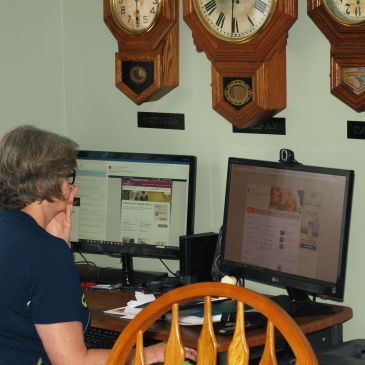
It this day and age it is very common to have family scattered to the four winds. What time is it is such and such? Why not create timezone clocks? I live in Canada and I have one daughter in Calgary, Alberta, one of our mid-western provinces and one in Victoria, BC, on the west coast of Canada. We keep in touch with Skype and telephone and as I am working on my computer in the kitchen area of my home all it takes is one glance upwards to see what time it is in Calgary or Victoria.

This is my trio of clocks. The two on either side are eight inch while the centre clock has a 12 inch dial. The centre clock is a New Haven time and strike from the 1930s taken out of a decommissioned school house in Saskatchewan in the 1950s. My aim is to have three 8 inch dial clocks. Once I find another 8 inch time-only clock the New Haven will be replaced.

New Haven time and strike clock
Waterbury Arion drop octagon
I later painted three numerals

The clock on the left is a Waterbury Arion. It came to me without glazing and bezel but ordering a replacement was easy enough through a clock supplier, Perrin in Canada. While writing this blog I decided to touch-up the 7, 8, and 9 numerals. It is the quietest of the three clocks.

The one on the right is Sessions Drop Octagon. The dial face is in rough shape but I decided to leave it as-is. The clock came from a decommissioned schoolhouse in Springhill, Nova Scotia in the 1960s.

Sessions Drop Octagon

It is by far the noisiest of the three but you get used to the sound. All three will be time-only clocks, preferred if you are looking for the dedicated function of simply telling the time. Of the three my favorite is the Waterbury. Even with the “messed-up” dial face, it is the most accurate of the three and will run for 12-15 days on a single wind.

Keeping track of family all over the country is part of being a normal modern family and timezone clocks certainly help.


9 reasons why clock collecting and is a great hobby and why it might be a fit for you

Hobbies are a great way of finding comfort through stepping off the roller coaster of life

In this increasingly complex and chaotic world where many of us seek ways of exploring constructive activities & pastimes a hobby is one such escape. Hobbies are a great way of finding comfort, stepping off the roller coaster of life and rising to the surface after seeming to drown in life’s problems. A hobby allows one to disconnect briefly or longer from the social media universe that seems to consume us every day. Pursuing and maintaining a hobby, whether it is for casual leisure or serious pursuit, is a regular activity that should be done for pure enjoyment. It is healthy for mind, body and soul!

The more you know, the more you grow

There are 9 Reasons why clock collecting/repair hobby works for me and might even work for you.

  1. I meet people. This hobby requires that I come into contact with other people when I purchase clocks, have clocks repaired or ask for advice.

    rs-annapolis-royal-oct-16_21-42
    A clock repair shop in Nova Scotia
  2. Builds my self-esteem. Developing and maintaining a clock hobby is important because the small successes I have from day to day or week to week are enough to sustain me while other pressures are occurring in my life and it is the one solid thing to feel good about. It gives me renewed energy to tackle other challenges in life.
  3. Avoid boredom. I have zero scientific evidence of this but I really believe that boredom is responsible for a lot of society’s ills and destructive behaviours. How many people come home after a challenging work day to watch TV for hours on end when they could be doing something constructive and rewarding?
  4. My Hobby is a point of connection with other people. It gives me common ground with a small, select portion of the population, the people who collect, repair antique and vintage clocks, the people who share my passion. They are from all over the world. Every week I get inquiries from clock enthusiasts from all corners of the earth asking for advice on their particular clock.
  5. Clock collecting enriches my perspective. I remember an old adage: “The more you know, the more you grow”.  Any opportunity to learn something new, to be challenged anew, is great for character-building by seeing the world through refreshed eyes. Clock collecting and repair helps me differentiate myself from others and provides me with key examples of where I have overcome adversity or tackled a difficult situation and emerged on the other side.
  6. It keeps me stay youthful. Establishing and maintaining a hobby is a very healthy habit to form for later years. Hobbies are excellent for brain health especially if you are looking for something to stave off cognitive decline. The older you get the more trouble you will have struggling to fill your time with meaningful activities. Starting a hobby early in life pays dividends in the long run, much like an interest bearing investment.
  7. Clock collecting combines with other interests. Photography and traveling are two other interests in my life. Blog writing is another, of course. This hobby allows me to combine all of those interests and as a side benefit my wife, who is also my travel partner and clock locator, encourages me every day.
  8. My hobby makes me interesting. At a party, you can only talk about your occupation or your grandchild for so long before people’s eyes begin to glaze. But if I mention that I have a clock that fell off a wall during the Halifax Explosion, a clock that hung in a railway station near where I live, a rare clock I bought for almost nothing, their ears perk up.
    final look
    Halifax Explosion clock, Junghans Crispi wall clock

    OLYMPUS DIGITAL CAMERA
    Pictou rail station clock, Arthur Pequegnat, Canadian Time circa 1930
  9. A way to relieve stress. My hobby provides stress relief simply because it is an oasis from the rest of my life. You can immerse yourself in a totally different world when you are focused on getting that darned strike side to work correctly on a troublesome clock movement.
    Okay maybe clock collecting and repair is not a hobby for you but you can insert whatever hobby you wish to have or already have and I'll bet the 9 reasons above are pretty much on your list.

Servicing a Well Worn New Haven Schoolhouse Clock

The clock is a “Canadian made” New Haven Octagonal short drop wall clock. It was assembled at The New Haven Clock Co. of Canada plant established at Brantford, Ontario (Canada) in 1906.

New Haven schoolhouse clock

The New Haven Clock Company of Canada was a subsidiary of the New Haven Clock Company of America. Both mantel and wall clocks were made in the Brantford plant with Canadian wood cases, but the spring-driven pendulum movements were brought in from the U.S. The Canadian arm of the New Haven Clock Company closed in 1956. More information about The New Haven Clock Company can be found here. This clock was probably made in the 1940s.

The clock was removed from a schoolhouse in Saskatchewan, Alberta (Canada) in the 1960s. The previous owner said that he ran the clock for a couple of years, got tired of it and put it in storage. I hung it up on my kitchen wall for a couple of months and while it ran immediately and kept good time I considered putting off servicing with other projects on the go. However, if I ran it long enough without proper attention any wear would be exacerbated. Now is the time to service this clock.

Day One

The movement was mounted with what looked like the 4 original screws. I wondered if this movement had ever been serviced. Clues began to reveal themselves as I took the movement out for a closer inspection.

OLYMPUS DIGITAL CAMERA
New Haven movement #304

The centre cannon arbour was very loose which is not uncommon. A bushing might be required. The pivots were in good shape and had minimal wear but most bushing holes on both the time and the strike side, front and back plates were so enlarged that there was considerable lateral movement of the wheels in both trains but not enough to stop the clock. Not the worst I have seen but clearly a clock that is in dire need of servicing. The clock ran for many years and appeared to have received not much more than basic servicing during that time.

Day Two

The movement was very dirty. The cleaning solution in the ultrasonic cleaner was dark brown in colour and large pieces of crud floated on top, a build up of dried oil and dust over the years.

An obvious example of a previous repair was the drop lever that had been soldered in two places as you can see in the photo below.

Top view of movement indicating solder points

The lever looks strong and should hold for years to come.

Strike side maintenance lever
Strike side maintenance / drop lever

I took special care to resist bending any parts of the lever to adjust it for fear of breaking it. The helper wire/spring on the drop lever also seemed to have been replaced at some point because it looked crudely made, not something you would see in a factory installed movement. A piece of the helper wire broke off during dis-assembly which meant that I had to make a new wire/spring.

I polished the pivots and then proceeded with the bushing work prior to cleaning the movement.

Bergeon Bushing Machine

15 bushings were installed, 7 on the front plate and 8 on the rear plate. The centre cannon arbour required one bushing, a much larger one, on the rear plate.

To completely eliminate any issues with the time side I took all the strike train wheels out

Movement on test stand without strike side wheels
Without strike side wheels

Day Three to day Five

All went well while test fitting the wheels on both trains; they moved as smoothly as they should. I re-assembled the movement and attempted to align the levers on the strike side as best as I could with little success. I ran the movement on the test stand even though the drop lever was not positioned correctly. Unfortunately, the clock stopped every few hours. My suspicion was an incorrectly aligned lever somehow stopping the strike side.

To completely eliminate any issues with the time side I took all the strike train wheels out and ran the time side for 3 trouble-free days eliminating any issues with the motion works.

I  consulted Steven Conover’s excellent book on strike clock movements (Striking Clock Repair Guide) to work through a solution. He devotes one chapter to the New Haven movement and  clear instructions for setting up the strike side.

Day 6

After studying Steven’s manual, I reinstalled the strike side and proceeded with the necessary adjustments as follows.

The positioning of the levers are critical.

The 3 levers of the New Haven movement

There are 3 levers in this clock. Knowing how the levers function is key to getting this clock to run. The hammer strike lever (Lever number 1) performs a very simple task and installs on the bottom of the clock and is activated by the hammer lifting pins on the cam wheel. The drop and paddle lever (Lever number 2) does several jobs in unison. It pushes the unlocking lever or the lift lever (Lever number 3) down to release the warning pin to prepare the strike. The top arm of the lever number 2 rotates through the 2 – 180 degree slots of the cam while the bottom arm forms the paddle that enters the deep slots of the count wheel to indicate the strike on both the hour and half hour. The upper arm of this lever must be on the upper rear part of the slot on the cam to work correctly. I found this through trial and error. Needless to say, the positioning of the levers are critical. Once the levers were positioned correctly, the clock ran beautifully.

Post assembly testing

The clock went through it’s full 8-day cycle without any issues striking as it should. The movement was mounted back into it’s case, is being regulated and is now on display in our living room.

This very ordinary clock reflects its utilitarian role as a schoolhouse clock; it is not the best looking or the best sounding clock in the world but like a faithful servant it should run without issues for years to come.


Arthur Pequegnat Canadian Time – a service is long overdue

Hallway clock
Hallway clock – Arthur Pequegnat Canadian Time

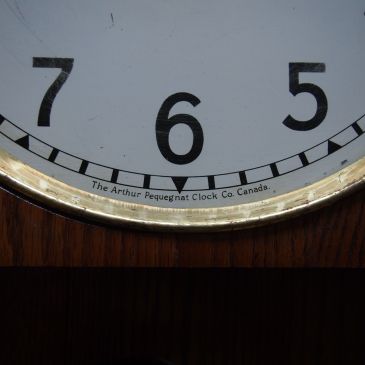
I wrote about this clock in 2015. The Canadian Time clock was made by the Arthur Pequegnat Clock company of Kitchener, Ontario. The Arthur Pequegnat Clock Company (1904–1941) is notable as the longest lasting Canadian-based clock manufacturer. Pequegnat clocks are sought after by Canadian collectors and often command high prices on online for-sale sites.

Former railway clock from a station in Pictou County, Nova Scotia
Former railway clock from a station in Pictou County, Nova Scotia (Canada)
Label on back board

The clock was made after 1917 in Kitchener, Ontario (Canada). Clocks made before 1917 had the word “Berlin” on the dial face. Kitchener was known as Berlin prior to and during the first World War. It was the town of Berlin from 1854 until 1912 and the City of Berlin from 1912 until 1916. Because the name Berlin was associated with the war against Germany the decision was made to change the name to Kitchener midway through the First World War. Kitchener is the present seat of the Regional Municipality of Waterloo, Ontario. Though it is impossible to determine the exact year this clock was made my guess is just prior to 1941 before the company closed it’s doors.

It is always disconcerting to open a clock up to discover punch marks on a movement

The clock was purchased in Sept 2013 and after 3 1/2 years it is overdue for servicing.

Movement showing punch marks as indicated by arrows
Movement showing punch marks (arrows)

It is always disconcerting to open a clock up to discover punch marks on a movement, specifically around the pivot holes as one would expect. I am one of those who believe that a punch should never be used on a clock movement. Most, including myself, would consider it a quick and easy shortcut that is not designed to extent the life of the clock in any appreciable manner. Because punching weakens the side wall of the pivot hole those two pivot holes in particular are prime examples of the need for bushings. In total the clock required 5 bushings. The second wheel pivot hole was worn the most. One back plate bushing was required for the escape wheel arbour.

Time only movement
Time only movement

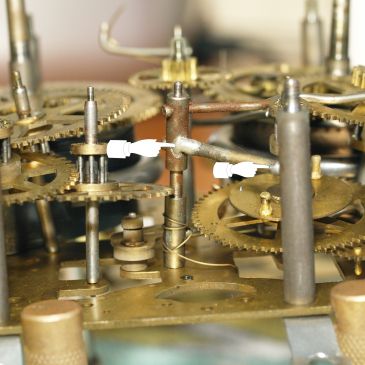
Time only movement are relatively simple to work on and for the novice this is the first kind of movement you should tackle. Whenever working on a clock be sure to take as many photos as you can; you will need them if you get stuck re-assembling the movement. On this clock the 3rd and 4th wheels look exactly the same but in fact differ slightly in height. Photos taken at the right angles will easily confirm the difference.

Mainspring cleaned and inspected

A strange anomaly that I did not notice when I first bought the clock; additional screw holes

The mainspring is in excellent condition and might have been a replacement at some point in the clock’s life. I had some difficulty re-hooking the arbour to the spring and had to use pliers to bend it, but just a little.

I found one strange anomaly that I did not notice when I first bought the clock. There are additional screw holes in the back board leading me to believe that the clock might have had another type of Pequegnat movement which would mean that the current movement is a replacement. Possible reasons, a catastrophic failure of the original movement, a conversion from a time and strike movement to a time-only clock (requiring a new dial) – it is anyone’s guess. A mystery nonetheless.

Servicing this clock took less than a day. Testing takes a couple of weeks. With new bushings in place and an oiling this clock should run reliably for years to come.

I began keeping a detailed log of clock repairs noting, in particular, when the movement was last oiled so that I do not wait too long between inspection and oiling.


Tick-Talk Tuesday #3 – question about Arthur Pequegnat clocks

Tick-Talk Tuesday is about the letters and comments I have received from you, the reader, concerning your clocks, issues you might have had and challenges you face and my responses to your questions with advice on your  particular clock concern(s). For those comments and questions that stump even me, I consult within my clock circles for the best possible answer.

Arthur Pequegnat clocks were made between 1908 and 1941 in Berlin (now Kitchener), Ontario. Those produced before 1917 had “Berlin” inscribed on the dial face. The town of Berlin from 1854 until 1912 became the City of Berlin from 1912 until 1916. The name Berlin was associated with the war against Germany consequently the decision was made by city officials to change the name to Kitchener midway through the First World War. Kitchener is the present seat of the Regional Municipality of Waterloo, Ontario (Canada). Arthur Pequegnat clocks were the only wholly made Canadian clocks (aside from a short run of clocks made by the Canada Clock Company and later the Hamilton Clock Company in the 1870s) and are particularly sought after by Canadian collectors.

AO from Ontario writes, “Good Morning Ron, I live in Ontario (Canada) and have two Pequegnat clocks I am thinking of selling. Could you give me an idea of how much they are worth? The mantel clock is an Oxford. Thank you.

The clocks she mentions in her email are the Arthur Pequegnat Oxford mantel clock (time and strike) and the King Edward time-only wall clock missing the King Edward lower drop decal.

Pequegnat Oxford mantel clock
Pequegnat Oxford mantel clock from the Canadian Clock Museum in Deep River, Ontario
King Edward with 15 day Moncton movement
King Edward with 15 day Moncton movement showing decal from the Canadian Clock Museum in Deep River, Ontario

I replied. “I looked at your photos and have some comments. The time-only wall clock is known as the King Edward. From the photo yours seems to look intact save for the missing decal in the lower drop. A King Edward decal should be in the middle of the glass panel. It appears to be replacement glass which will certainly affect the value. However you should be able to get in the $600 to $1000 range for your King Edward clock. If you are selling in Canada where collectors are attracted to Pequegnat clocks because they are wholly Canadian made you should do reasonably well. If the clock has been recently serviced you can expect to price it a little higher.

Mantel clocks always command lower prices but your Oxford should easily sell in the $400 range. I would price both slightly higher and see what responses you get.”

AOs reply, ” Hi again Ron, A dealer has offered me $750.00 for both clocks. Is that reasonable knowing that he has to resell them?”

I advised AO that they should dicker a bit and that the dealer certainly knows the value. I suggested that she could also try to sell it on an online for-sale site.

AO replied later and said they posted the clock on a for-sale site and the same dealer offered $650 for the King Edward.

I emailed her again asking how they made out with the sale. AO replied and said the dealer backed out and the clocks are still for sale.

UPDATE: AO wrote 1 week later and said she has sold them both for $350 more that the first offer. She is very pleased.


New Haven Short Drop Octagon – two curious features

I recently purchased a vintage Canadian made New Haven 8-day short drop octagon time and strike clock. It is in the familiar style of a schoolhouse clock.

The New Haven Clock Company lasted just over 100 years.

Sadly, The New Haven Clock Company lasted just over 100 years. Much of the history of the New Haven Clock Company comes from this informative site.

In 1853 the Haven Clock Company was founded in New Haven, Connecticut by Hiram Camp (1811‑1892) and other clock-makers. The company’s mission was to mass produce inexpensive brass clock movements for use in clocks. In April, 1856 The New Haven Clock Company buys out a competitor’s company, the Jerome Clock Company. They move their production to the former Jerome factory and New Haven begins making clocks under their own trademark. In 1870 some of New Haven’s clocks are marketed under the Jerome & Co. brand.

In 1885 the company stopped selling clocks other than their own New Haven brand. In 1890 the company developed serious financial problems and efforts were made to keep it solvent until 1897 at which time the company emerges from reorganization. In 1902 Walter Chauncey Camp (1859-1925) began to turn the company around. In 1923 Walter Camp steps down as head of the company and is succeeded by Edwin P. Root.

In 1929 Richard H. Whitehead replaces Root as president of the company but by this time New Haven is again facing financial difficulties which is compounded when the Great Depression hits in November, 1929. Whitehead is able to keep the company afloat during these troubled times and the firm becomes profitable once again. From 1943 to 1945 the company uses its manufacturing plant to aid in the war effort, producing products almost exclusively for military use. In March of 1946 The New Haven Clock and Watch Company becomes the new name of the firm after it reorganizes once again. It returns to what it did best before the War, once again making clocks and watches.

The 1946 reorganization eventually leaves the company vulnerable to foreign investors and it loses control to a consortium of Swiss watchmakers. The man who had successfully shepherded the company through the hard times of the Depression years, resigns as president. In 1956 the New Haven Clock and Watch Company files Chapter 10 bankruptcy in a U.S. court. Its fortunes have declined precipitously since Whitehead’s departure and it never recovers. In 1960 the company goes out of business and the production lines are closed. The facilities are sold through a combination of public auction and private negotiation in March of 1960.

The New Haven Clock Co. of Canada was established at Brantford, Ontario (Canada) in 1906. The New Haven Clock Company of Canada was a subsidiary of the New Haven Clock Company of America. Both mantel and wall clocks were made in the Brantford plant with Canadian wood cases, but the spring-driven pendulum movements were brought in from the U.S. The Canadian arm of the New Haven Clock Company closed in 1956.

This clock was made in the 1930s and taken out of a decommissioned one-room schoolhouse in 1963.

New Haven schoolhouse clock

I am always fascinated by a clock’s history and I always ask a seller how much they know about it

I am always fascinated by a clock’s history and I always ask a seller how much they know about it. I believe a clock’s provenance is almost as important as the clock itself. The seller, a man in this seventies, related in great detail how he acquired the clock from the Lone Spruce School in Invermay Saskatchewan in 1963 when the municipality was selling off school assets. Saskatchewan is a western province of Canada. Invermay Sask is a village in the east-central region of Saskatchewan, Canada with a population of 247 in 2011. Invermay is about 75 km west of Canora or about 50 km east of Wadena on Highway 5.

New Haven clock instructions

Lone Spruce school was built between 1913 to 1915 on the west side of section 1 township 34 range 8 west of the second meridian, and it is noted by local historian Caroline McDonald, that the school was 1/2 mile north from each of the north and south corners of the section of land. Classes opened under Mr. Oliver, during World War 1. A new school was needed around 1950-1951, and the new school yard chosen was section 8 township 34 range 7 west of the second meridian, the old school yard having been two miles to the west of the new school. The old school house sat empty for 10 years and was removed in 1959-60. When the new school closed for classes, the Lone Spruce school house was re-located into Hazel Dell around 1959-1960 and decommissioned in 1963 at which time its assets were sold.

Why a school board would order time and strike clocks is an interesting question.

#331 appears on the inside access door. The number 331 was likely an inventory number that referred to one of a lot purchased by the municipality in the 1930s. Why a school board would order time and strike clocks is an interesting question. My other schoolhouse clocks are time-only. Why the access door is a solid sash rather than glazed is another curious question. The combination of the solid sash and time & strike movement must have hit a particular price point for the school board at that time. The teachers were likely instructed not to wind the strike side.

Time zone clocks
Time zone clocks

The New Haven clock is now one of three “time zone” clocks on our kitchen wall. I have a daughter in Victoria BC, and a daughter in Calgary, Alberta and at a glance I can see the time in those two regions of Canada. The New Haven clock is our local time; the Victoria clock is a Waterbury and the Calgary clock is a Sessions.

This clock is on my calendar for servicing which I will cover in an upcoming article.


Stubborn little plate clock movement

I prefer time-only clocks above anything else. They are simple to work on and because they are less complex they tend to be more accurate, relatively speaking. Most are easy to service but this little guy has me stumped.

Thousands of these relatively small German movements were made and some found their way into small shelf clocks like the ones I will be talking about in this article.

RS Blackforest mantel clock (64)
Time-only movement, German

Let’s not confuse these inexpensive clocks with better known and highly regarded Black Forest clocks of Germany

I acquired a couple of Blackforest shelf clocks about a year ago. Let’s not confuse these inexpensive clocks with better known and highly regarded Black Forest clocks of Germany. The clocks I will be discussing here were made by the Blackforest Clock Co. of Canada in the 1930s. Later on, during the war years (1941) the company felt compelled to change it’s name to the Forestville Clock Company of Canada. They sourced their movements from England during the war years and Germany prior to (and after) World War II. They are German time-only “plate-clock” movements. They are called plate clock movements because they were made to be placed behind decorative plates, commonly called delft porcelain wall clocks designed primarily for the kitchen. Many delft clocks had time-only movements just like the ones in these shelf clocks.

RS Refinished case (7)
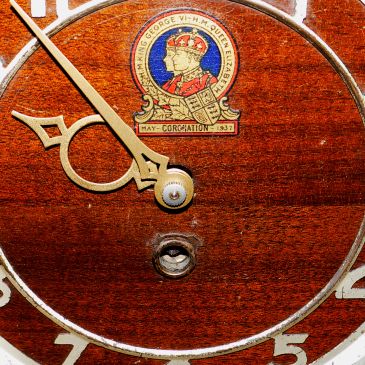
King George VI Commemorative visit 1937
RS together but not working (2)
Blackforest Shelf (mantel) clock circa 1935

They are easy to find. Antique stores, junk shops, and thrift stores all have them. They are very cheap, usually quite stressed having spent most of their lives in basements, attics and garages and probably the last clock to leave the store shelf. They are always passed over for the “better” clocks. I buy them because they are cheap and relatively easy to bring back to life. The pictures you see here are clock cases that have been significantly refreshed. Here’s a before shot.

rs-blackforest-mantel-clock-48
This is one very homely clock

 Those who are familiar with time-only movements know they are relatively simple to work on

Since the mainspring in one clock snapped in two places I have combined the best parts of each one in an attempt to have a working movement for the most attractive looking clock which for me is the 1937 commemorative edition King George VI clock. I might just throw in a quartz movement for the other clock unless I find another plate clock movement. For those who are familiar with time-only movements they are relatively simple to work on. You might call them fun and a good challenge for those new to clock repair. The gears are small and the pivots are tiny but they are easy to dissemble and put back together. No helper springs and levers to worry about. Here are some shots of the movement.

RS shelf clock number 2 (2)
Movement inside the case
rs-plate-clock-movement
Parts of two movements are combined to make a working one, back plate is off
rs-plate-clock-movement_5
All shined up and on the test stand
rs-plate-clock-movement_6
Showing unique one piece pallet, verge and pendulum assembly
OLYMPUS DIGITAL CAMERA
All in one pallets, verge and pendulum rod and bob.

I have been testing the movement with mixed results. I installed one bushing on T3 after which the movement ran better. It is in beat and will run but not for as long as I would like. Why can’t this little guy run a full eight days? The best it can do is 4 days. Perhaps a mainspring issue; too weak to give me a full eight day cycle? A pity because I truly wanted to have this thing running strong and reliably. Being a glutton for punishment I have another plate clock coming in the mail. I am not absolutely sure if it has the same movement but I am willing to bet that it does since it is another Forestville, this time a true delft clock.

These often neglected clocks are great fun to work on. Total outlay for all three clocks – $55. Not bad!

Antiquing on a Sunday afternoon

Carriage clock with Jeweler's inscription
Carriage clock with Jeweler’s inscription

Sadly the number of antique shops in Nova Scotia is dwindling. We were antiquing in the city of Halifax (Nova Scotia, Canada) this past spring and one of the store owners remarked that there used to be dozens of antique shops in the city, now only a few remain. There are still a few antique shops left in the rural areas and one of our favorites is located in Great Village, Nova Scotia. We decided on a little drive to Great village on a sunny fall Sunday. We were not disappointed in the variety of clocks we discovered. Although I saw all the following clocks during our day of antiquing I bought only one, the Kern “diamond face” 400 day clock (see photo below).

rs-great-village-antiques_3
Window display
Unknown French clock

I want to give readers a sense of what is out there if you are collector like myself  or you are new to collecting. Now is an excellent time to buy. There are certainly deals to be found and plenty of clocks in the shops. My personal experience is that the antique stores are great places to buy clocks but it can be bit of a gamble. For example, the Kern 400 day clock was advertised for a very fair price complete with glass dome. I asked the store owner if they knew anything about clocks and they said “no, nothing at all”. Sometimes that is a very good answer! The tag on the clock said “as is”. The owner evidently thought the pendulum balls were seized. Prior to the purchase I discovered, that they were, in fact, in their locked position. I got the clock home, unlocked it, gave a little push and it has been running for the past week.

Stamps for sale
Stamps for sale

You can get a “steal” of a deal, a clunker or something in between in an antique shop. In this same shop two years ago I bought an Arthur Pequegnat Brandon wall clock for under $200. The case is in excellent shape as is the dial but the movement, though barely running, required servicing. Even though I had to put a little more money into the clock I still consider it a great deal!

Having some knowledge of clock models, styles and types in particular is an advantage. Or, perhaps you might have a good sense that what you are looking at is a good deal. In the case of the Kern 400 day clock I inspected it beforehand and found that it was not only complete but in excellent condition. The $58 Garrard time and strike (photo below) might be a good deal but if it is missing the pendulum you are going to have to search long and hard for a replacement or buy one which adds to the cost. You might ask yourself, what else is missing and how much more money would I have to put into it? The Garrard was missing the front glass and I could not figure out how it was attached so I passed on it. Those are some of the factors to consider when you see something at an attractive price.

A doomed Ogee
A doomed Ogee

In the case of the carriage clock (first photo) the seller wants $120 but the day I was there they were offering a 20% discount which works out to $96. There is a jewelers inscription on the front which says Ryrie Bros. Toronto. Ryrie Bros was a jeweler in Toronto and was incorporated in 1905 with James Ryrie as president and W.M. Birks as vice president. In 1924 the firm changed it’s name to Ryrie Birks and finally in 1933 became Birks. As any Canadian knows Birks (Maison Birk) is one of the premier jewelers in this country. One could comfortably date this clock at between 1905 and 1924. Although the tag says that it is French it is likely American. It might be desirable however there are two bothersome issues that I could see right away with this carriage clock. One, the left side beveled glass panel has a chip in the lower back corner and two, there are noticeable hairline cracks in the upper two corners of the face. The tag said it was in working order. $96 may not be a bad price when you consider that comparable clocks fetch upwards of $130 or more + shipping on Ebay. If it is still there before Christmas I might take a second look.

Unknown "marble" desk clock
Unknown “marble” desk clock

This unknown “marble” desk clock was very interesting and quite heavy. It had an alarm clock style movement with a key wind and an adjustment for the time, and what appears to be brass bird (duck?) on it’s right side.

Kern diamond face 400 day clock

As I mentioned I bought this Kern 400 day “diamond face” clock. It is in excellent condition; unlocked the pendulum, oiled the movement, gave it a gentle push of the pendulum and now running very well.

Could be Session, Ingraham, Ansonia
Could be Sessions, Ingraham, Ansonia

In decent shape, 1873 it said on the label, but the seller wanted too much, $450 if I recall. The seller claims it is running, according the tag. Is it a Sessions, Ingraham, Ansonia or …..?

Sessions shelf clock
Sessions shelf clock in oak case

This clock looked to be in decent shape, the strike side appeared to be working properly. The case is oak but when I picked it up to examine it more closely, the construction, fit and finish had a cheap feel. There was a card inside describing a servicing performed in 1994. $68 – a little high, I thought but there may not be a lot wrong with it.

20161120_1451511416

I like this clock but know very little about crystal regulators. What I do know is that most American companies made them, from simple brass and glass cases to elaborate cases with cast and gilt ornaments. Equivalent French examples seem to be more valuable than American ones. They can be highly expensive. Generally, the more elaborate the case, the more expensive the clock, even though the simple cases could easily be considered more tasteful. I remember seeing a very ornate one on Antique Roadshow which was valued at $8000. Condition is very important with these clocks, including the condition of the beveled glass, dials, and original finish (generally gilt) on the case ornaments. Is the pendulum supposed to be filled with anything? Mercury? These cylinders looked empty. The seller claims the clock is running and wants $365. A fair price? I don’t know. It needs a thorough cleaning though.

Garrard mantel clock

This English Garrard clock had a well constructed case and appeared to have a well-made, robust movement but was missing its front glass. I have been to this particular shop several times and nobody seems to be interested in the clock though the price has not changed.

rs-great-village-antiques_6
Seth Thomas made by Talley Industries

I noticed a Seth Thomas mantel clock in a dark corner. This particular example is one that I would not recommend to anyone unless you are a fan of Talley Industries. It is a Seth Thomas Westminster chime mantel clock made by Talley Industries, Peterborough, Ontario in the early seventies with what appears to be an imported West German Hermle movement. This clock was cheaply constructed (corners were chipped), likely has the dreaded plated pivot problem and has absolutely no collector value. Those in the clock collecting world familiar with Seth Thomas know that it was a reputable clock maker for many years and produced many fine clocks but the Talley Industries era must have been a very dark period for the company!

rs-great-village-antiques_8
A unique clock design

I hope this blog article gives the reader some ideas when it comes to antique shop clock shopping. It certainly pays to do your research. Although I love browsing the shops I do not limit my shopping to them. I acquire many of my clocks from a variety of sources including Ebay, Kijiji, and word of mouth but I like browsing through antique shops because there are always other interesting items that catch the eye.

Ingersoll Waterbury mantel clock servicing and a little mystery thrown in for good measure

OLYMPUS DIGITAL CAMERA
Ingersoll-Waterbury time and strike mantel clock

When I bought my Ingersoll-Waterbury clock a year ago I knew that it had not been serviced but the price was reasonable and it was running. I  got a lot of other projects out of the way and have finally gotten around to giving this clock a little care and attention.

Ingersoll-Waterbury clocks were sold in Canada; had Canadian made cases using American made Waterbury movements and were sold in department stores across Canada. This clock was distributed by the G. R. L’Esperance Co. from Montreal, Quebec. The label on the inside of the back access door says “Ingersoll-Waterbury Co. a division of Waterbury Clock Co.”. Ingersoll-Waterbury was the Canadian arm of the Waterbury Clock Co. Year of manufacture, I am estimating was somewhere between 1940-1944 when brass was in short supply.

The case is in very good shape though it was likely inexpensive to make. Some cost savings are evident in the use of a paper dial, flimsy clock hands and a plastic bezel with flat glass. However, I was impressed with the well designed and sturdily built movement and surprised that it did not take much to service this clock.

OLYMPUS DIGITAL CAMERA
The front of the case has a swinging door

One unique feature is a swinging door with plastic bezel and flat glazing attached to the case by two hinges that open up to reveal the clock face and hands.

OLYMPUS DIGITAL CAMERA
Brass bushing punched into a steel plate

The clock has a steel frame with a brass electro-plating as a rust inhibitor and brass bushings punched into drilled holes in the steel. Steel plates are not unusual as there were a number of manufacturers which used steel as a cost savings measure, for additional strength or because brass was in short supply. The plates were often plated with nickle as in the case of Arthur Pequegnat clocks or brass as in the case of this clock. One of the first things I noticed when I dis-assembled the clock were the number of punch marks adjacent to the bushings an example of which can be seen in the next photo. It must have been difficult to achieve a tight fit for the brass bushings; factory punching ensured that the bushings remained in place.

punch mark next to a bushing

I have just completed the servicing. The clock required three new bushings. Punching new brass bushings into the factory bushings took a little more care and attention than usual as I did not want to loosen the existing bushings.

OLYMPUS DIGITAL CAMERA
8-day time and strike movement

Dis-assembly, cleaning, servicing the mainsprings, installing new bushings are no different than any other American movement. Re-assembly of the strike side requires the synchronizing of the strike side by aligning the levers and wheels correctly which usually takes several attempts for me.

The one real challenge I had was aligning the strike hammer so that it would actually strike the gong. I must have bent it when I took the clock apart. What was I thinking?  I could not see the solution so I put it aside until I came up with the fix. I ended up bending it back to its correct position.

While re-installing the movement into it’s case I noticed something strange on the bottom of the clock, a mysterious hatch. On the bottom right hand side of the clock (indicated by the arrow) there is a hatch that measures 2 3/8 inches by 2 3/8 inches. On it there is an inscription which reads

“FRONT, if you know what this hatch is for, you know more than I do” signed J.H.Ross May 24, 1967.

“Front” refers to the orientation of the hatch. What is it for? I posted this on the NAWCC discussion board site and so far no-one has come up with the answer.

Arrow showing where hatch is located

Why would anyone put a hatch on the bottom of this mantel clock?

Where hatch is located

Was the hatch added later on? There is a lighter colouring of the wood to the left of the green felt which seems to indicate that a hole was cut out later to accommodate the hatch.

The hatch is open
The hatch is open

A clasp on the other side of the hatch secures it in place and allows it to be removed.

Bottom left side
Bottom left side

Was the trap door a chamber to hide items? Why, when it simply opens up into the case interior.

View of bottom of case

And there’s more! Here is a view of the entire bottom showing a second cutout (see arrow) on the left side. Why go through all this trouble?

The clock is all back together and in the process of being regulated but I sure would like to solve this mystery. It has taught me one thing, always look at the bottom of a case.

Clock repair in days gone by

rs-annapolis-royal-oct-16_21-42
Clock shop in rural Nova Scotia

I had a discussion with David, a horologist acquaintance who is currently working on my 138 year old Ingraham Huron mantel clock (pictured above) about clock repairs in days gone by. He said he had happened to have a conversation a few days ago with an 82 year friend who had been in the clock repair business most of his life who said that times were very different in the “olden days”.

Imagine a Canadian home in the 1920s or the 1930s. In those days a clock was like a refrigerator or a washing machine; it was an appliance. The clock was generally inexpensive and purchased for one reason, to tell the time. Quite often it was the only timekeeping device in the home for common folk. Despite the fact that they were relatively poor timekeepers, people in those days did not demand accuracy in a clock, not like today. If it was correct within a minute or two a week that was just fine. Not only was the clock cheap, it was sturdy, functional and withstood a certain amount of abuse. My Arthur Pequegnat kitchen clock, for instance, sold for $5 when it was new in 1912. Five dollars was a lot of money when the average person such as a a railway employee might have made $662 a year or about $12.75 per week, but the home had to have a clock.

Arthur Pequegnat kichen clock
This Arthur Pequegnat kitchen clock sold for $5 in 1912

There was always someone in the community that tinkered with clocks and for very little money, or a trade for services, the “appliance” was repaired and promptly returned to it’s owner. The tinkerer was usually someone who fixed things in their spare time rather than fix clocks as a profession. In larger urban centres clock repair persons (trained horologists) set up professional shops but in rural Nova Scotia those services were expensive and few and far between.

When the day came and the clock stopped running, it had to be fixed, and quickly. Often the request was, “just make it work”. The repair did not have to be pretty so long as the clock functioned and the cost of the repair was reasonable. Specialized clock tools were expensive and difficult to acquire so the tinkerer relied on tools they had lying around in the garage or the basement; a hammer, a pair of pliers, a punch, a file, a screwdriver and so on. The self-trained tinkerer did the best he could to make his neighbours’ clocks run often using questionable methods. Since brass bushings were not available the tinkerer would use a punch to close a pivot hole. In the 1940s when the soldering gun was commercially available and inexpensive, it too was added to the toolkit and often a piece of brass was soldered (or riveted) to the plate to accommodate a new pivot hole.  They might also soak the movement in a bucket of gasoline overnight and then oil it with something like 3-in-1 oil. Sometimes this would be enough to clean out the gunk and allow the clock to run again, the costumer would be happy because their clock came back working and the tinkerer would charge very little for their “services”. The clock was not worth a great deal and the customer would not have had the money to pay a professional anyway. Common short-term solutions such as these often led to more frequent repairs and eventually replacement of the clock.

In the 1930s the synchronous electric clock began to replace the mechanical clock. Yet, homeowners in the rural areas who had no electricity hung on to them and kept them running, but eventually the electric clock gradually replaced the mechanical clock. Although, many of those old clocks were trashed, sent to the garage, the basement, or the attic, some were passed down to family members and are cherished keepsakes to this day. Not long after, the tinkerers in many communities began to disappear.

Today we covet our prized antique and vintage clocks that adorn our homes. When they are ticking away we marvel at the inventors and innovators of the past and when we want that certain clock, cost is no object. To repair them we employ all manner of modern technology; bushing machines, broaches, special files, clamps, spring winders and lathes to ensure that the “job is done right”, the clocks end up lasting years and are “better than ever”. But it was not always like that.

We look down upon those tinkerers of the past and the repairs they made without really understanding what it was like during those times. “What butcher worked on this?” I hear some people saying. Well, I have said it myself, but after talking to David I now have a better understanding of the clock tinkerers of past and the important work they did for their communities.

So, my sister also loves clocks

After not having visited my sister in some time I was surprised to find that she is an avid clock collector. I must stress the word collector because although she appreciates the beauty of each clock she has acquired over the years how they run is somewhat of a mystery to her and that is just fine. While visiting her this summer three of her clocks were out of adjustment and it took no time (no pun intended) at all to get them running again. No sense paying someone to do it, that`s what brothers are for.

In my opinion the most interesting clock she has is a French time and strike bracket clock that has no visible markings yet appears to be over 100 years old. It is in beautiful condition with only a slight patina on the finish. I would love to have found out more about this clock but my stay was brief. Perhaps next time.

French bracket clock

The next clock is one my sister absolutely loves and it is a great sounding Westminster chime grandmother clock she bought some 20+ years ago. This quarter chime clock made by Craftline Industries in the early 1990s has a Canadian made case with a German movement, likely by Hermle.

Craftline grandmother clock

Next is a curiosity. When I saw the Sessions name on the dial I wondered why I had not seen this particular style of Sessions clock. Further investigation revealed it to be a six pillar Adamantine Seth Thomas case. The movement was clearly marked ST and as I said the case is certainly a Seth Thomas. So, why the Sessions clock face? Likely the original dial face was so badly marred as to be unreadable that the owner many years ago simply told the clock repair person to find another face, which he did. Since the replacement was a Sessions electric clock face he had to drills the holes to accommodate the winding arbors. Who would know! To those less knowledgeable it looks great.

Session Seth Thomas mantel clock
Sessions / Seth Thomas mantel clock

I found this little antique time-only Hamilton and Co. French-style carriage clock made in India (Calcutta) to be very interesting and so diminutive. Hamilton and Co. is probably the best known and most celebrated British clock maker in India. I would put this clock at around the 1890s. It probably needs a good cleaning since it is not in working order.

Hamilton and Co Calcutta
Hamilton and Co. Calcutta

I am not a huge fan of steeple clocks but this Waterbury clock is in very good condition save for a damaged right steeple tip. The Waterbury Clock Company is one of many 19th century Connecticut-based clock firms with a history going back to the 1850s though it closed is doors for good in 1944. More memorable are Waterbury wall and mantel clocks but like many makers of the day they had a successful line of steeple clocks.

Waterbury steeple clock

Next is a New Haven time and strike tambour style mantel clock from about the late 1920s or early 1930s. Aside from the grandmother clock which my sister bought new the New Haven mantel clock was a wedding gift of her late husband’s parents and has been in the family ever since.

New Haven Mantel clock

Lastly, this Chelsea ship’s bell clock is a polished beauty. A ship’s bell is used to indicate the time aboard a ship and hence to regulate the sailors’ duty watches. Unlike normal clock bells, the strikes of the bell do not correspond to the number of the hour. Instead, there are eight bells, one for each half-hour of a four-hour watch. Three bells, for example, would mean that a sailor would be 1 1/2 hours into a 4 hour watch. Each watch would take its turn with the essential activities of manning the ship’s helm, navigating and keeping a lookout.

Chelsea ship's bell cloc
Chelsea ship’s bell clock

I was quite impressed with my sister`s collection and each clock occupies a special place in her home. I find it facinating going into peoples homes and discovering the joy they experience in collecting, be it clocks in this case or anything for that matter. Collectors are truly unique people!


Taking a little time off

RS Peggy doing some research (2)
Researching clocks at the Canadian Clock Museum in Deep River, Ontario, Canada.

Taking a little time off seems like an amusing title for a clock blog. It just struck me (there I go again).

In the next few weeks you will see fewer posts as I am spending some quality time with friends and family at our summer get-away in central Canada. While in that area I intend to make my third visit to the Canadian Clock Museum in Deep River, Ontario. It is always exciting to see the newly added pieces to the museum collection and to chat with it’s knowledgeable curator.

Regular readers have no doubt observed that my usual practice in the past year is to post at least one article per week in an effort to keep readers interested and of course help me, the writer, offer the kind of content that appeals to a broad spectrum of clock enthusiasts. I typically profile my own clock collection and the trials and tribulations of maintaining and repairing my clocks plus some articles of interest based on observations in my travels and general interest clock subjects as I navigate through the fascinating world of horology.

From time to time (pun unintended) you will also find special interest articles that I write to give a broader perspective of the world of horology and I hope you enjoy reading them as much as I enjoy the research side of the equation. Even though I will be away I will try to maintain a presence on my blog by posting every two weeks or so which means you can still come back regularly. I also invite you to browse through my archive, there’s bound to something that will interest you if you are clock lover like myself.

In the weeks to come I am planning articles on Bracket clocks, how to oil and maintain your clock between servicings, a historical piece on a most interesting 17th century French cabinet maker and his contribution to horology and thoughts on the pros and cons of converting a clock from a mechanical movement to quartz.

Converted from a mechanical clock

If you have a comment on any of my posts please feel free to leave one though it may take some additional time for me to respond, so, a little patience would be appreciated.

In September I will resume my weekly posting schedule. As they say in the show business world – stay tuned!

Update to my clock museum post

Canadian clock museum
The Canadian Clock Museum

The curator of The Canadian Clock museum was kind enough to respond to an email I sent concerning the absence of Martin Cheney clocks as well as provide further information on the collection.

First of all, Mr. Symons explained that the museum profiles two centuries of Canadian clocks, which include many Canadian manufacturers that represent 90% of the collection of over 2600 examples. The problem, he says, with Martin Cheney clocks is the cost. He is most certainly correct; most I have seen have been in the $5000-10,000.00 ballpark. The museum always considers donations, and if anyone out there feels they can part with their Martin Cheney wall or tall case clock, I am sure that Allan Symons would graciously accept it.

Mr. Symons notes one clarification. “The Seth Thomas Clock Company in the U.S. (dating back to the early 1800’s) became part of a larger company that owned Westclox in the early 1930s.  Starting then, Seth Thomas “brand” mantel, alarm, and wall models were made in part of the existing Westclox Canada factory in Peterborough. Ontario, Canada.  That new factory had opened in 1923 to produce Westclox clocks for the Canadian market, after about three years in rented space in Peterborough.”

Westclox collection
Westclox collection at the museum

The reference library now has over 500 titles on all aspects of horology, and visitors are welcome to sit down and conduct research on clock companies in general or a specific family clock.

RS Peggy doing some research (1)
Conducting research on a Forestville mantel clock
RS Peggy doing some research (2)
Catalog of Canadian makers

Thanks for an email from a reader in Romania who provided information on the Clock Museum in Ploiesti, Romania. This museum recently reopened after undergoing some renovation work and profiles European clocks from the 18th century. From their website, “Those who visit the museum have the occasion to follow the way in which the means of measuring the time had developed, from the first “clocks”- the sun dial, the burning clocks, the clocks with water (the outline of the clock with water being taken over from d’Horologerie Ancienne) or the clocks with sand; up to the “ancient” mechanical and modern ones.”

“Muzeul Ceasului from Ploiesti shows us such “folk clocks”, some with simple or double ringing with flute players, some others quite monumental, with rich ornamental design, dated in the 18th and the 19th centuries. The folk influence inspired the creation of the wall clocks in straight cases, made by lathering. Some of them are created in Romania, having German or Austrian mechanismes.”

For more information please visit this fine museum at http://www.cimec.ro/muzee/Ceasuri/ceas_eng.htm

Sounds like a very interesting museum and one that I will put on my “must see” list.


Why you should visit a clock museum

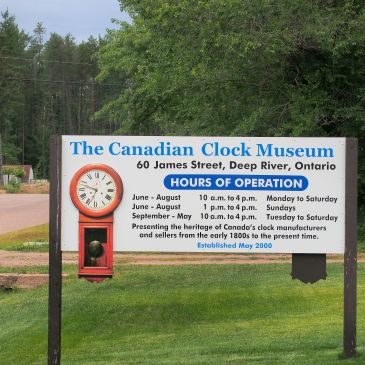
Every museum I have ever been to has allowed me to walk away with the feeling that I have learned something new. All museums document interesting histories that are intended to educate and inspire visitors. The Canadian Clock Museum at 60 James Street, Deep River, Ontario, operated by curator Allan Symons is one such example.

RS outside shots (2)
The Canadian Clock Museum

The Canadian Clock Museum in Deep River, Ontario is a 2 1/2 hour drive from the nation’s capital, Ottawa, Ontario. I have visited it twice and I found myself learning even more on my second tour. It has a fascinating collection of clocks that are largely from North America. However, it has the most extensive collection of Arthur Pequegnat clocks that I know of outside a private collection.

RS Pequegnat mantel clocks (3)
A collection of Pequegnat mantel clocks found at the museum

The Arthur Pequegnat Clock Company made clocks in Kitchener, Ontario (called Berlin, Ontario up to 1917) to 1941 when the company ceased production. Pequegnat clocks were wholly made in Canada while their counterparts built and assembled cases in Canada and imported movements from the US, England, France and Germany. The Canada Clock Company and Hamilton Clock Company had a 12 year span also made both cases and movements but not at the volume of Arthur Pequegnat.

I have written about Arthur Pequegnat clocks in previous posts and I have been slowly building a modest collection for myself.

RS Prince of Wales Canada Clock Co (2)
Prince of Wales parlour clock, Canada Clock Company circa 1880

RS pequegnat tall case clocks
Three tall case Arthur Pequegnat clocks

Many manufacturers are represented at this museum and even if you have only a passing interest in clocks you would no doubt find the displays both interesting and thought provoking. Companies represented are the Western Clock Company, Walter Clocks, the Snider Clock Corporation, Seth Thomas that operated a factory in Peterborough from the 1930’s to the 80’s, Breslin Industries, the Hammond Company of Canada Ltd to name just a few. Canadian Clock Maker Martin Cheney who briefly made high quality wall and floor clocks in Montreal in the early 1800’s is not represented, unfortunately.

Twiss long case clock
Twiss tall case early 1800’s

There are even some special clocks such as this Synchronome electrical impulse master clock from the 1930’s.

OLYMPUS DIGITAL CAMERA
Master clock mechanism

Clock
Master clock with slave clock at top

So, spend time at the museum talking to its knowledgeable curator or avail yourself of the manuals and documents at hand and conduct your own research into a specific clock.

This museum is modest by museum standards and not quite up to the scope and scale of the National Association of Watch and Clock Collectors Museum located in Columbia, Penn, USA but don’t let its compact size fool you. There is plenty to see.

If you have any interest in clocks I strongly urge you visit this one if you are at or near the Deep River area. Outside Canada? I encourage you to seek out clock museums in your own country and take the time to understand the history of clocks from around the world. Its about time!

What is my clock worth?

Every clock owner wants to know what their clock is worth and every clock seller wants to know what price they can ask for. This article will provide a guide to buying or selling an antique or vintage clock.

I will attempt to answer the following questions beginning with comments about the unpredictable clock market.

  • What factors are considered when assessing the value of a clock?
    • Is it original?
    • What type or style of clock is it?
    • Does the clock have a label, trademark, or prominent name?
    • Is it from the correct period or is it a “knock-off” or “re-issue”?
    • Does the clock have provenance?
    • What is the age and condition?
    • Is the clock collectible?
    • What is the mechanism type?
  • It all comes down to research

The unpredictable clock market

Unfortunately, in this unpredictable market, it is almost impossible to determine the value of a clock. What you think your clock may be worth today may not align with what the experts say and what others are willing to pay. What has value today may not have value tomorrow. Many factors influence the buying and selling of clocks and the clock market can be a battlefield with many casualties.

Recently, I saw a mid-1990s Howard Miller grandfather clock listed for sale on a Facebook site. I tracked the ad over the course of several days. The owner originally wanted $3000 but later stated they would take “no less than $1500” when it became obvious to them that the ad was not attracting attention. Personal value tends to be subjective and while the owner might have paid $3000 or more for a beautifully carved oak grandfather clock, its present value is not anywhere near what he thinks it is worth. I stopped following the ad but the seller likely withdrew it from sale.

Even an appraised value is the subjective opinion of an expert assessment based on condition and collectibility which is always subject to shifts in the market. My Ridgeway grandfather clock is in excellent condition, runs well, and has a command presence in my home but it is not worth much in today’s market.

Ridgeway Grandfather clock, Hamilton Country

What factors are considered when assessing the value of a clock?

Is it original? Original clocks attract buyers. The value of a clock decreases if some or many parts have been changed out. Determining whether or not a clock is original can often be difficult to determine unless viewed by an expert. The many “Vienna Regulator” clocks found on eBay and other online for-sale sites are missing parts, have had parts added such as crowns, finials, dial faces, hands, and even movements, and have weights that are not original to the clock. Back in the 1960s, many Vienna Regulators came to America in wooden crates consisting of loose movements and cases which were then married, assembled, and sold.

Would you expect a 100% original clock when the seller suggests that it is complete and original while at the same time admitting that they know nothing about clocks? Reputable auction houses have more accurate descriptions of the clocks they offer for sale when they describe condition and state if parts are missing or questionable. Moreover, they do not exaggerate the condition of a clock if they value their reputation.

Check out this article on my experience with a clock that did not have original parts

OLYMPUS DIGITAL CAMERA
Gustav Becker 2 weight regulator clock. It looks good but many parts have been replaced over the years.

What type or style of clock is it? Many mantel clocks in my collection are worth almost nothing since thousands were made and few good ones have survived. That said, some American mantel clocks are desirable and command high prices such as the Patti line of clocks from E N Welch or Sonora clocks from Seth Thomas. An 18th-century English bracket clock, an ornate French Cartel clock, or an American jeweler’s regulator are styles and types that are sought after by collectors and have retained their value over the years. On the other hand, tall-case or grandfather clocks, some as old as 200 years, can be had for a fraction of their value. Wall clocks tend to command higher prices than mantel clocks.

Does the clock have a label, trademark, or prominent name? Clocks that have an identifying label or trademark are more desirable than those that do not. Collectors often ask if the label is intact or if the movement is marked. Replacement labels are frowned upon by collectors and unmarked movements are less desirable as they may be replacements. Clocks made by prominent clock-makers add value. Old English bracket clocks with subsidiary dials, made by prominent clockmakers come to mind. A marked E. Howard or an authentic Willard banjo clock has more value than an un-named/unmarked clock similar in style and age.

RS Pequegnat fan top (8)
The rear panel of an Arthur Pequegnat kitchen clock showing the label

Is it from the correct period or a “knock-off”? Is it original or a reproduction? There are excellent examples of reproduction wall clocks that look very much like period clocks from the early 1900s that are no more than 30-40 years old. Seth Thomas made a reissue of the iconic Regulator #2 in the 1970s which is not as desirable as the original #2. Often the differences are very obvious and sometimes quite subtle.

Does the clock have provenance? Does the clock have a story or does it have historical significance or can it be placed within a historical context? This Arthur Pequegnat Canadian Time clock spent most of it’s life in a train station waiting room not 30 minutes drive from my home. In the early nineties when the station was decommissioned it was purchased by a collector and was in his hands until I bought it from him about a few years ago. This is a key selling point and may add value. The history of the clock may be an important element in a sale.

OLYMPUS DIGITAL CAMERA
Canadian Time clock by Pequgnat C.1929

The Ingraham Huron shelf clock (below) had been with a Bridgewater, Nova Scotia family since the 1890s. Balloon clocks, as they are called, seldom come up for auction and are valued by collectors because of their interesting design and limited production. In the case of this clock, This model was made between 1878 to 1880.

RS April 12th
Ingraham Huron shelf clock C.1878

What is the age and condition? Many people think their clock is worth a lot of money when they see a similar clock by the same maker sell for a high price at auction. If their clock is missing case pieces, large sections of veneer, the hands are broken and so on, the value will be adversely affected. If the dial has been badly repainted or there have been poor repairs, the clock is not considered as valuable.

The age of a clock does not always mean that it has more value. A clock may be a style, or by a maker, who, regardless of age is not popular with collectors. Sperry and Shaw 4-column New York-style 30-hour clocks, while attractive, and over 125 years old, are not sought after by collectors as Sperry and Shaw, retailers rather than clock-makers, were clock merchants who used questionable assembling methods and dishonest selling practices.

Sperry & Shaw 4 column clock
172-year-old Sperry & Shaw 4 column clock

Thousands of gingerbread or kitchen clocks were made during the period 1885 to 1915. Despite their age, few have any value.

Is the clock collectible? Rare clocks are rare because few exist or rare because few owners want to sell them. OG (Ogee) clocks are clearly antiques, some more than 150 years old, but because thousands were made they are not as collectible as a one-of-a-kind 17th century English lantern clock. 30-hour Ogee clocks are also tough to sell because of the hassle of winding them every day.

Desirability is also region-specific. Of the many parlour clocks made in Canada, those made by the Hamilton Clock Company in the 1880s (Hamilton, Ontario, Canada) are very desirable by Canadian collectors. Arthur Pequegnat clocks, wall clocks, hall clocks, mantel clocks, or kitchen clocks fetch higher prices than similarly styled clocks because they are actively sought after by collectors in Canada. Outside of Canada, they are worth far less.

Martin Cheney clocks (1810) made in Montreal (Canada) are highly collectible, of exceptional quality, and are very rare. True Vienna Regulator clocks such as those from the Biedermeier period made prior to 1850 and authenticated as original are very desirable, reflect high asking prices, and are valued more than contemporary versions.

The key is research. Check eBay, reputable auction houses, local buy-and-sell sites, clock shops, antique stores and online message boards to get a feel for the range of prices and bear in mind that markets are very volatile

Cartel clocks are exceptional 18th-century French clocks and those fabricated by clock-makers such as Joseph de Saint-Germain or Duponchel à Paris command prices in the many thousands of dollars.

What is the mechanism type? Generally, three train clocks (time, strike, and chime) are mechanically more complex and are normally valued higher than two trains (time and strike) clocks. Three-weight Vienna Regulator Grande Sonnerie clocks generally command higher prices than a single or two-weight Vienna Regulator.

American clock company Sessions sold inexpensive clocks for the masses and produced many thousands. The Sessions Westminster-A tambour style clock has an unusual 2-train chime movement (chiming clocks generally have three trains) and fetch higher prices on auction sites than other Sessions mantel clocks.

Weight-driven clocks generally command higher prices than spring-driven varieties.

RS Sessions Westminster chime circa 1931 (12)
Sessions Westminster A mantel clock, C.1927

It all comes down to research

Do your research: Check eBay, reputable auction houses, your local buy-and-sell sites, clock shops, antique stores, and online message boards to get a feel for prices. Keep in mind that markets are extremely volatile. Do your homework prior to making any purchase. What may have sold for several hundred dollars years ago (30-hour Ogee clocks) are worth much less today.

Ask questions before you purchase your next clock and if you are a seller, provide an honest description of your clock and disclosures (new pendulum, new mainsprings, etc.). Chinese, Korean, and most Japanese clocks are not particularly collectible or desirable. If you firmly believe your prized Chinese-made Daniel Dakota family heirloom is worth over $150, potential buyers may not be beating down your door but a fair price of $40-50 might result in a quick sale.

Converted Daniel Dakota
This 1960s vintage Daniel Dakota wall clock is worth almost nothing

Clock prices are all over the map and we will not see a stabilization of prices any time soon. With the advent of the internet, many clocks thought to be rare have flooded the market depressing prices. The law of supply and demand applies. As demand increases, supply decreases, and prices rise. As supply increases and demand decreases, prices drop. The only constant is high-end clocks, sought after by serious collectors that have managed to retain their value. But how many of us can afford them?

Now is a good time for that special clock. There are certainly bargains to be had if you search carefully, learn as much as you can along the way, and tread lightly into the buyers arena or if you are placing a value on your clock to prepare it for sale.

Who the heck is Martin Cheney?

A Martin Cheney clock is on my wish list though I doubt I will ever see one let alone buy one, they are that rare. So who is this clock-maker from Montreal, Quebec?

RS weekend at the Haliburton (17)
Could this be a Martin Cheney tall-case clock?

My wife and I were staying at an historic Inn in downtown Halifax (Nova Scotia, Canada) in the spring of 2016.  We discovered a fully restored long-case clock in the front room of the inn. The inscription “Canterbury” on the dial face suggested that is was an English clock or would it be a Canadian clock made by Montreal clock-maker Martin Cheney almost 200 years ago? I should have asked.

Upon returning home I did some research. I posed the question on a clock forum site and the response was “who is Martin Cheney?” In clock collecting circles the name is not exactly commonplace. Not a lot is written about this man despite many of his clocks surviving to this day.

Barely readable numerals

Martin Cheney – an American born clock-maker

In 1778, Martin Cheney was born into a well-known and established American clock-making family. He was one of four clock-makers born to Benjamin Cheney 1725-1815 and Elizabeth Long Cheney in East Hartford, Connecticut. Benjamin most likely trained all four of his boys in the art of clock-making. Asahel was the oldest and was born in 1759. He then moved to Vermont. Elisha was born in 1770 and died in 1847. He settled in Berlin, Connecticut. Russell was the youngest. It appears he moved north to Putney, Vermont. Martin also had an uncle, Timothy 1731-1795. He became a well-known clock-maker in East Hartford and worked closely with Benjamin. By 1803, Martin Cheney moved up the Connecticut River to Windsor, Vermont. While in Vermont he advertised that he has fine English Watches, watch keys, chains and seals for sale.

Political events in the United States sent a group of families to the British territory (as Canada was known prior to 1867) in the early 1800s. Martin moved to Montreal in 1809. He remained in Montreal for some twenty years.  In 1817 he formed a partnership with J. A. Dwight and advertised this business as Cheney & Dwight at 104 St Paul Street, Montreal (now a show-bar!). He made both movements and cases, wall and tall case clocks and banjo clocks. The partnership with Dwight lasted until 1830. In 1827, Martin placed an advertisement in Burlington, Vermont newspaper for a journeyman clock-maker to work with him in Montreal. Although Cheney continued to make clocks into the 1830s there is no information on Cheney beyond 1830, however, it appears that he spent the remainder of his days in Montreal.

What is a Cheney clock?

What is intriguing about a Martin Cheney clock? His clocks featured outstanding inlaid mahogany reflecting both high style and workmanship. The cases were well proportioned; this long-case clock has a long and narrow waist and a large rectangular waist door that is fitted with an applied molding. The center of this door also features a selection of mahogany veneer. Open this door and one can access the inside of the case. The sides of the waist are fitted with quarter round columns. These terminate in brass quarter capitals. The bonnet features a New England style raised centre brass inlay top piece. It is surmounted by three brass balls and spiked finials. The molded arch is supported by fully turned and fluted bonnet columns. They are mounted in brass capitals. These columns flank the sides of the arched bonnet door. This door is line inlaid and it opens to access the dial of the clock. Had I  looked at the movement it would have confirmed the fine craftsmanship of this 19th century timepiece.

This clock at the historic inn I described above certainly fits the style and detail of a Martin Cheney clock, so is it a Cheney clock? Some day I will have to find that out!

The shelf clock – what is it, exactly?

What is a shelf clock? If you have a number of clocks as I do it can be quite confusing to describe each specific type to the average person but it is really quite simple. Let me explain how you can identify the clock you might be looking at. The term shelf clock is a broad category but I believe it can be classified in the following ways.

Some 180 years ago the first shelf clocks were OG (Ogee) clocks. These were the first mass-produced American clocks, were inexpensive, and were made up to about the late 1870s. They represented the early years of American clock-making and the transition from more expensively produced wood movements to cheaper brass movement clocks. OG clocks are so named because of the double-curved molding on the front of the clock. The curved molding was designed to hide the weights. Many of these clocks were weight driven with 30-hour or 8-day movements and had mirrored or painted tablets. OG clocks were usually 25 inches in height and 15 inches wide and had hardwood veneers covering a softwood frame. They were surprisingly accurate and reliable.

Clocks
Spring-driven and weight driven 30 hour OG (Ogee) clocks, made by the Canada Clock Company, circa 1872-76 (Canadian Clock Museum)

Later, more stylish clocks could be found. These are called Column clocks because they would either have a half-column or full column on the left and right or even stacked half or full columns such as the one pictured below. Moldings on the top and bottom would be brought together by columns on each side of the clock with mirrored or painted tablets. Column clocks were almost exclusively weight driven with 30-hour or 8-day movements.

Column clock
Stacked Column clock, circa 1870 (Canadian Clock Museum)

At around 1840 Steeple clocks were introduced. They had a peaked centre section bordered by columns topped with finials and a peaked sash with a decorated (often hand-painted) lower tablet. They were spring driven with 8-day movements. Steeple clocks are very distinctive, stood about 15 inches high with veneered hardwood over softwood, often with reverse-painted scenes and are made by a number of well-known companies.

RS on display
Arthur Pequegnat Maple Leaf “fan top” Kitchen clock, circa 1905

Kitchen clocks (Gingerbread) were simple or ornate with carved or steam-pressed patterns made by quick-saws and heavy steel presses, stood 22-24 inches in height and about 15 inches wide, and had a decorated sash which could be a very simple design as you see here or a much fancier reverse-painted glass scene. These inexpensive, visually pleasing timepieces sat in the kitchens of lower and middle-class homes and were produced by the thousands. They were so named because of their likeness to the design of gingerbread houses at the time (early 1900s). They are usually made of oak, walnut or even walnut trimmings on oak with a metal clock face and many had a simple alarm mechanism. The Gingerbread clock you see here is the Maple Leaf “fan top” by Arthur Pequegnat. The Maple Leaf came in 4 unique styles all characterized by the maple leaf decal on the glass door.

Some kitchen clocks had beautifully carved features and figurines such as this stunning clock made by the Hamilton Clock Company (Canada), though a clock such as this might be found elsewhere in the home and considered a parlor clock.

RS City of Hamilton Canada Clock Co
City of Hamilton, made by the Hamilton Clock Company, circa 1880 (Canadian Clock Museum)

When spring-driven clocks were introduced the Parlor clocks like this Hamilton Clock Company model became popular. They tended to be narrower than column clocks because they had spring-driven movements. These clocks mirrored the furniture styles of the time. This one reflected the Victorian era with its bold figurines, carved finials, elaborate patterns etched into its wooden frame, and the hand-painted floral design of the sash.

RS 45-175
Seth Thomas round top cottage clock, circa 1930

Cottage clocks are less than 15 inches high and typically 8 inches wide are small, simple in design, and take up very little space. Many have basic alarm mechanisms but have one feature that distinguishes them from other pendulum clocks. They have a clip or a clasp that secures the pendulum rod for travel. The “round top” you see here was sold by Henry Birks and Sons an upscale Canadian jeweler. Others had “beehive” tops, flat tops, or octagon tops.

Pendulum rod clip
Pendulum rod clip for Seth Thomas round top

Smaller clocks are often referred to as desk clocks. They are usually mainspring driven with a flat dial. This Kundo 400-day anniversary German clock is an example of a desk clock but it might also be described more specifically as a torsion clock. This one stands less than ten inches tall and has a glass dome, a weighted wheel with 4 balls suspended by a ribbon called a torsion spring, and an exposed movement. It was typically given as a wedding gift.

RS Kundo
Kundo 400 day anniversary clock, circa 1970

Finally, the mantel clock.

Mantel clocks can be ornate, larger, and the centerpiece in a room. This particular clock, a Mauthe pendulum mantel clock offers a precision-built sophisticated German Westminster chime movement in a relatively non-descript but attractive and well-built cabinet that is simple yet elegant.

RS Mauthe mantle clock (30)
Mauthe time. strike and chime, circa 1970

ASIDE: Is it mantel or mantle? I have always considered a mantle as something you wear, a garment or a part of the earth’s crust. A mantel on the other hand is a shelf above, say, a fireplace. I see this word interchanged so often when clocks are advertised or described that either word is universally accepted. I prefer the word “mantel”.

RS April 12th
Ingraham Huron shelf clock, circa 1878

Mantel clocks were inexpensive to make, occupied very little space, and were part decoration and part practical timepieces. Mantel clocks were made with brass, wood, porcelain, slate, Bakelite, and metal though for the most part they were designed to be lightweight (slate clocks and cast iron clocks would be the exception), simple in basic design, and very practical. Mantel clocks have lasted so long, over two centuries, because they are dependable, versatile, and work so well in many domestic situations.

The categories of shelf clocks also include carriage clocks and lantern clocks. One of the first clocks whose movement and external structure was made predominantly from brass instead of iron or wood was the lantern clock. Although the shape of the clock looks somewhat like a lantern, the derivation of the name probably stems from the French word “laiton”, meaning brass. The earliest lantern clocks had striking mechanisms; later in the 17th-century alarms were sometimes added. Some lantern clocks had pendulums and could be hung on the wall.

Carriage clocks were spring-driven clocks developed in 19th century France and are made of plain or gilt brass. They are often no more than 8 inches tall, designed to be portable, and are characterized by a rectangular shape, glass or porcelain panels, and a carrying handle on the top. If you have a Breguet carriage clock as part of your collection you are very lucky indeed!

This is by no means an exhaustive description of the types of shelf clocks. There are others such as swinging clocks, tambour clocks, pillar and scroll, and so on. Whether you are shopping for a clock as a gift or adding one to your collection or even describing what you have seen to a friend, it is important to understand the distinctions between one type and another.

A curious little Blackforest shelf clock

RS shelf clock number 2 (6)
Black Forest Clock Company of Toronto, clock in as found condition

Shelf clocks such as the one pictured have always been hard to find though I did stumble upon this one very recently (April 2016) at an antique store in Great Village, Nova Scotia. Why, because of their cheap construction and inexpensive movements, not many of these clocks have survived over the years.

This one might have had a special meaning to someone at one time because it is a memento of the King George VI coronation of 1937 which nicely dates the clock. He became King George VI of England in December 1936 following the death of his father George V and the abdication of his brother. He had been a heavy smoker and in 1951 had his left lung removed then died suddenly in the winter of 1952. Elizabeth became queen later that year.

RS Refinished case (6)
Black Forest shelf clock after case restoration

RS Refinished case (7)
Another view of refinished case

This Blackforest shelf clock is only slightly larger than the first Blackforest clock I picked up last summer (2015) and like the other, is time-only.

RS shelf clock number 2 (4)
Company plate on rear of clock

The time-only movement is very simple in design. The pendulum rod, bob and pallets are one piece.

Pendulum
One piece pendulum assembly

To adjust the beat rate you either rotate the bob left for slower rate or right to make the clock run faster or slower. Outside the back plate sits the mainspring which is housed in an open barrel and there are 5 gear wheels plus the escape wheel between two solid plates. This is an identical movement as found in my other Blackforest shelf clock  but unlike this clock it was in very poor condition. The movement is German and could have been made by a number of companies at the time; Keinzle, Mauthe, Hermle or Junghans. There are no stamps or markings on this so-called “plate” movement to give any indication of the maker. Typically many Canadian companies such as the Blackforest Clock Company of Toronto (the Forestville Clock Company after the war) imported German movements before the Second World War and installed them in Canadian made cases.

RS shelf clock number 2 (2)
Plate clock movement

RS shelf clock number 2 (12)
Commemorative Edition – 1937 Coronation of King George VI

To refinish the case I cleaned it thoroughly using Murphy’s Soap, applied three coats of dark walnut stain taking care to wipe the stain with a cotton cloth 5-10 minutes after each application. My intent was to fill in the scratches and abrasions rather than radically alter the colour. I then rubbed the cabinet with 0000 steel wool between coats and applied two top coats of clear polyurethane satin finish. I cleaned the numerals but decided against repainting rather preserving the original patina, though I applied Brasso to bring back the finish on the key wind bushing. In the end the case is a little darker but likely closer to its original finish.

shelf clock number 2 (10)
Original winding key

I haven’t quite figured this out yet but I think the winding key has a “bottle opener” design to allow the pendulum to be locked during travel. Ideas?

This clock would make a great addition to a any bedroom. It is small enough for a dresser or even a side table, quiet enough (for a mechanical clock) and is still attractive in design after all these years. Heck, you can even wind the clock in the 6 o’clock position.

My clock and Mickey Mouse are related!

Anyone who collects clocks knows that Waterbury clocks have had a long and illustrious history but did you know that the modern day Timex watch can trace it’s roots all the way back to the Waterbury Clock Company?

Let’s start with my Ingersoll-Waterbury time and strike mantel clock that I picked up late last year (2015) and following which we will explore this most interesting company.

Mantel clock
Ingersoll-Waterbury mantel clock

This mantel clock was sold to retail outlets by the G.R. L’Èsperance Company of Montreal, Canada who advertised themselves as the sole distributor. “Made in Canada” it says on the case but as is typical of clocks sold in Canada before and during the Second World War the movements were made in the USA, assembled and shipped to Canada to be installed in cases that were sold in many stores across the country. Other clock companies such as Seth Thomas established a similar practice. Aside from the very rare Martin Cheney clocks made in Montreal in the mid 18th century, the only clock company that made their own movements and built their own cases was the Arthur Pequegnat Clock Company based in Kitchener, Ontario in the early 1900s to 1941.

This Ingersoll-Waterbury mantel clock was made in 1943 and likely very popular at the time.

clock face
Clock face showing somewhat flimsy hands

It has a conventional pendulum adjusted by a small arbor under the “12” and the company logo “W” in raised relief on the bob. It has a common recoil escapement. The clock face is paper with the inscription “Waterbury” on top of the “6” and”Made in Canada” below it.

operating instructions
Label showing instructions for operating the clock

The label is a generic one found on a wide variety of clocks to save printing costs. The swinging front panel door is unique to this clock and there is a small catch underneath the right hand side to secure it.

The hands may look very ornate but they are in fact quite cheap looking. A quick search on the net reveals that are, in fact, original. The inexpensively made hands and paper face are not unexpected for a mass produced clock.

clock movement
Time and strike movement

The veneers on either side of the back panel were split open when I first received the clock but clamping and carpenter`s glue tightened things up. It is very common for clocks of this vintage to have chipped or missing pieces of veneer which unfortunately reflects their cheap construction. However, this clock presents well and is free of serious flaws on the case itself.

clock door
Swinging front panel door

The Waterbury name has been around since 1857. From my research I found that in 1922, the Waterbury Clock Company purchased the Ingersoll operation whose business had begun to decline after 1910 and had gone bankrupt two years previously due to poor management. Waterbury’s operation was particularly hard hit by the Great Depression of the 1930s. Clocks were considered luxury items and many could ill afford a timepiece for the home.
By 1932, their huge factory complex was almost idle when demand was so low. The company avoided bankruptcy and the firm was reorganized as the Ingersoll-Waterbury Company with investors raising half a million dollars in new capital. During this period (1933) the popular “Mickey Mouse” character watch was made and electric clocks were added to the line which revived the company. The Mickey Mouse watch was known as the “mouse that saved the day”. Draw any conclusion you wish.
After the USA entered World War II, the Ingersoll-Waterbury Company switched almost entirely to manufacturing war products though a small number of clocks were still produced. However, in 1942, the company was purchased by a group of Norwegian investors and a new factory was built at Middlebury, CT. Two years later, in 1944, the firm changed its name and became known as the United States Time Corporation. They introduced the widely popular “Timex” watch a year later. In November, 1969, U.S. Time was succeeded by Timex Corporation (now Timex Group), whose corporate headquarters are located in Middlebury, CT. to this day. The Timex museum, located in Waterbury, Connecticut, USA, is said to be “both the birthplace of Timex, and of modern timekeeping”.
So there you have it. My clock and Mickey Mouse are indeed related!

Maple Leaf clock is sent off for repairs

RS Complete so far and on display (1)
The case is about 90% restored

December 18th marks the day that my Arthur Pequegnat Maple Leaf fan-top is off to repair.

Sadly this is a repair that I cannot perform myself at this stage of my learning. The problem is essentially a clutch plate off the centre arbor that is not engaging the gear for the strike side. The result is that the hour and minute hand do not move at all thus the centre arbor is quite loose. In the meantime I might as well have some bushing work and a thorough cleaning done.

Typically gingerbread clocks go for almost nothing on the for-sale sites. The fact that this is a Pequegnat means something special however and in my view it is worth preserving for years to come.

Here is the problem area.

view of the clutch cup on the centre arbour
Clutch cup is loose

Although it is difficult to visualize from this photo, the cup clutch plate is very loose and needs to be reattached to allow a firm connection to the gear beneath. As such I am prepared to put a little money into this clock and keep it in my collection.

Maple Leaf case restoration Part 2

I have had this Arthur Pequegnat Maple Leaf fan-top clock for several weeks now and have decided to keep it in my collection. I was not satisfied with the condition of the case when I first saw it and knew that something had to be done. After several hours of work on the case I can finally say that the results have been very good…not excellent because there are one or two things I would have done differently. For example, I originally used a cotton cloth to bring down the finish and ended up rubbing too aggressively in some sections. Looking back I would use 0000 steel wool from start to finish.

This shot is a comparison between the original finish and taken after hours of restoration.

RS Pequegnat fan top (6)
Condition of clock when first brought home

RS fantop
After hours of rubbing and scrubbing

As you can see in the second photo the oak grain is natural and pronounced; the mottling has disappeared. As mentioned there were one or two spots where I was a little too aggressive with the steel wool which I may address later on but for the moment I am going to live with it.

I applied four coats of Amber Shellac and between coats I rubbed the finish with 0000 steel wool. Shellac is the proper approach for case restoration as that product would have been used at that time. The clock now looks very close to what it would have looked like at the time it was made which would be about 1910. The next photo shows the clock fully re-assembled and on display and the next, how it looked when I brought it home.

RS on display
Ready to be brought to the clock shop for repair

RS Pequegnat fan top (3)
Just brought home

Although I am able to dis-assemble, clean and oil a clock mechanism there is a problem with the center arbor not engaging the strike side of the clock. It is off to Doctor Clock in Halifax for repair and cleaning of the movement.

Maple Leaf case restoration Part 1

RS Pequegnat fan top (3)
The clock had just arrived

Although my newest Arthur Pequegnat kitchen clock was complete in every way the case looked like something pretty dire happened to the finish.

I mentioned before that the clock was likely in a very warm environment for a long period (an attic perhaps) and while there are no cracks or breaks in the wood there was a lot of what I called mottling. RS Pequegnat fan top (6)

What you see in the first photo is the condition of the case when I first got it. Some might like it that way, I don’t. The seller thought it added “character”. Hmm!

I sought some advice on the NAWCC forum site by asking a few questions and was informed that a member had put together a recipe for this kind of situation. The recipe included turpentine, alcohol, vinegar, boiled linseed oil and 000 steel wool. I found that it worked to a point but the mottling was quite pronounced and I finally had to resort to lacquer thinner and steel wool to take the stubborn stuff off.

OLYMPUS DIGITAL CAMERA
Ingredients for restoration

In some small spots I made the mistake of rubbing too enthusiastically and got down down to the bare wood but I will cover those areas later with tinted shellac a wood covering which was used at the time (circa 1910).

OLYMPUS DIGITAL CAMERA
One step closer to the finished product

The photos might show the case as darker than it is but it is a golden oak which will be close to the final product . I may have to do a little research on shellac from this point onward but I will report on my findings. Thus far a lot of the grunt work has been done.

This is taken at the final stage after the first treatment with steel wool and lacquer thinner and the mixture described above. As you can see the case has undergone a dramatic change although it is far from finished. The carved detailing is also beginning to show through.

OLYMPUS DIGITAL CAMERA
Door is reattached and first stage is complete

Any suggestions or advice would be appreciated.

Maple Leaf clock motion works issue

Pequegnat Maple Leaf (2)
The movement in its case

I knew this Arthur Pequegnat clock had issues when I bought it but I felt that I just had to have a gingerbread clock for my collection. It is a beautiful clock and once fully restored it will be a show piece.

After taking the clock out of its case and investigating further I think I have located the problem and it appears that a previous owner had attempted a fix. Perhaps the repair attempt was made by the owner himself since it looks like a poor effort because of scratch and dent marks on a particular washer that can be seen in the next photo.

The photo below shows the hour cannon and minute arbor. There is a brass washer located near a toothed gear that is very loose. The washer is not secured to the post. Because the washer is very loose there is no firm connection between the gear and the one immediately beneath it. The hour pinion should have a tight fit on the centre arbor. As a result of the slippage the time side works but does not engage the centre arbor.

The movement obviously needs to be taken apart. However, the problem is twofold. First I am able to dis-assemble the movement but I do not have the skills to fix the centre arbor issue.  Secondly, the plates are steel (with nickel plating) with brass bushing inserts which are not likely to be easily knocked out and they do not match modern bushings from today’s suppliers. It would take special reaming tools to install new bushings, tools I do not have. However, I can see that it needs at least 6 new bushings.

OLYMPUS DIGITAL CAMERA
Centre  arbor

OLYMPUS DIGITAL CAMERA
Closer view of the arbor showing a hole that has no purpose

In the meantime I can get to work on the case. The case was likely subjected to heat (stored in hot location like an attic for a long period) and the shellac finish has melted into the alligatored finish you see here.RS Pequegnat fan top (6)

The solution is a special mix of alcohol, boiled linseed oil, turpentine, lacquer and vinegar. It will require time and patience but I believe I can restore the case to its original condition. There are no cracks, nicks or gouges in the finish so I have a very good starting point, I think.

If you have any comments on this fine classic feel free to post.

Website Powered by WordPress.com.

Up ↑