Arthur Pequegnat Bedford – bringing a handsome mantel clock back to life – Part II
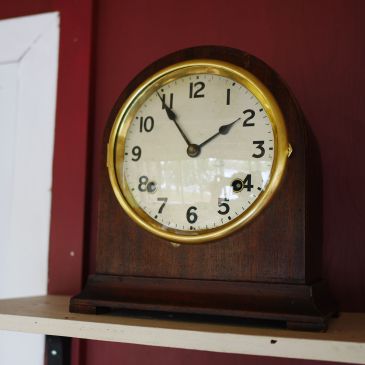
This is Part II of a two part series in which I describe the final finishing of an Arthur Pequegnat Bedford clock case.

In Part I I described the challenges of repairing the clock case and the minor repairs to the movement.

In the first part of the series I also described how I acquired this Arthur Pequegnat mantel/shelf clock during my travels to Quebec this spring.

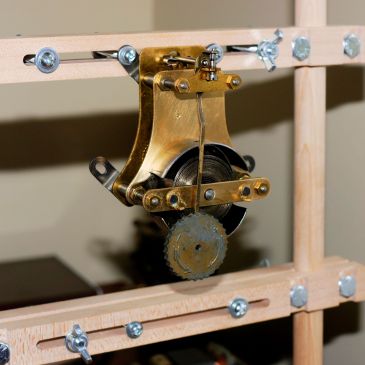
The red oak veneered clock is complete with pendulum bob, a good label on the inside back of the access panel, coil gong and of course, the signature time and strike Arthur Pequegnat movement with nickel-plated steel plates.

Nickle-plated plates with brass bushings

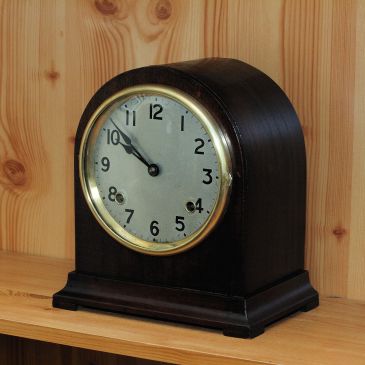
It is the “Bedford” model. Online research informs me that two Bedford models were produced. This one, which is the later version, measures 9 ¾ inches high by 8 ¾ inches wide by 5 ½ inches deep. It has a silvered 6 inch dial with Arabic numerals with no Pequegnat inscription on the bottom of the dial face, spade hands surrounded by a thick brass bezel and concave base moulding. It has a passing ½ hour strike on a coiled gong.

The earlier model has a 5 inch enameled dial with stylized Arabic numerals and Pequegnat inscription on the dial face, spade hands, oak veneered case, a thinner brass bezel and convex base moulding. The case measurements are identical. The time and strike movement differs from the later model by having a ½ hour passing strike on a bell.

If the dial is a replacement, it is a Pequegnat and someone took the trouble to install larger (and correct) spade hands

I initially thought that the larger dial might make this a one-of clock but after working on the case I am inclined to believe that the dial might be a replacement. I observed two sets of screw holes, one for the larger dial and one presumably for a smaller one. A factory switch or perhaps a clock-maker replaced the dial at a later time for whatever reason. After looking at a photo of the Bedford taken at the Canadian Clock Museum in Deep River, Ontario (Canada) you can easily see the smaller dial and thinner bezel.

Bedford clock on display at the Canadian Clock Museum
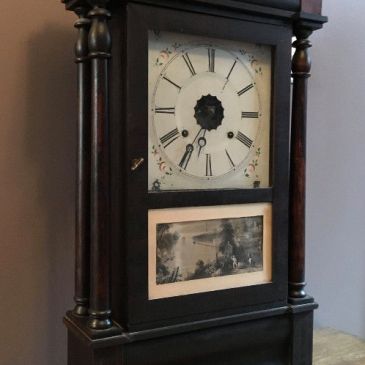
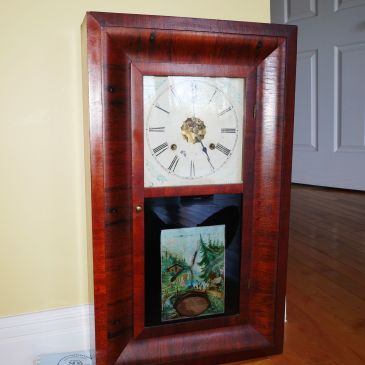
Arthur Pequegnat Bedford mantel clock, assembled, cleaned and working but before case refinishing

I do not think the larger dial overpowers the look of the clock, in fact, it gives it a more contemporary presence. If the dial is a replacement, it is a Pequegnat and someone took the trouble to install correctly sized spade hands. Unfortunately, the previous owner is unaware of the difference.

The task of clamping and gluing the case took several days as each section of the case required attention. And now to the final finish.

Gluing and clamping took time

Before the case restoration. Yes, the clock was in sad shape.

Dirty case
Very dirty case with years of grime and no grain visible

After giving the case a good cleaning I applied one thin coat of Minwax red oak stain to hide the bare areas and rough edges. I let the stain sit for 5 minutes and wiped off the excess with a cotton cloth. I allowed the case to thoroughly dry for 24 hours before the first sanding. For the final finish I chose Minwax PolyWipe for two reasons, one, it is simple to apply since it is easily wiped on and secondly, I wanted to avoid the amber tone of a lacquer which might result in concealing the grain. I applied six coats of PolyWipe and used 400 grit emery paper between each coat.

After cleaning, sanding and two coats of PolyWipe this is the result.

PolyWipe applications
After two PolyWipe applications

I am pleased that the grain came up very nicely, reminding me of what it must have looked like many years ago.

Finished clock
Finished clock, after 6 coats of PolyWipe

After six thin coats of PolyWipe the result is a revitalized finish that is durable, attractive and will last for years.

The brass door has me puzzled. What I thought was a broken hinge was actually folded into the bezel and soldered.

7/8 inch hinge is soldered back into the bezel

Why? I am reluctant to remove the solder because I risk breaking the glass by bending the retaining tabs. They are in very tight. As it stands the glass door will friction fit onto the dial bezel. Not the best but it will do for now. I will give it a second look, perhaps I can de-solder that hinge without removing the glass.

A project that is well worth the time and effort. It is always satisfying saving an old clock and bringing it back to life.

Arthur Pequegnat Bedford – bringing a handsome mantel clock back to life – Part I

I acquired an Arthur Pequegnat mantel/shelf clock during my travels to Quebec this spring. The red oak veneered clock is complete with original hands, pendulum bob, a good label on the inside back of the access panel, coil gong and of course, the signature time and strike Arthur Pequegnat movement with nickel-plated steel plates.

Signature Pequegnat nickle-plated steel plates

It is known as the “Bedford” model. Online research tells me that two Bedford models were produced. This one, which I believe is the later edition, measures 9 ¾ inches high by 8 ¾ inches wide by 5 ½ inches deep. It has a silvered 6 inch dial with Arabic numerals with no Pequegnat inscription on the bottom of the dial face, spade hands surrounded by a thick brass bezel and concave base moulding. It has a passing ½ hour strike on a coiled gong. The earlier model has a 5 inch enameled dial with more stylized Arabic numerals and Pequegnat inscription on the dial face, spade hands, oak veneered case, a thinner brass bezel and convex base moulding. The case measurements are identical. The time and strike movement differs from the later model by having a ½ hour passing strike on a bell.

Bedford clock on display at the Canadian Clock Museum
Pequegnat “Bedford” clock on display at the Canadian Clock Museum

There is a good label on the inside of the access door which says, “Bedford, eight-day mantel clock, The Arthur Pequegnat Clock Co., Kitchener, Ontario, Canada”.

The label is in good condition

The movement is not marked. Though many Arthur Pequegnat movements were stamped with the maker’s mark it is not unusual to find one without one. This edition was likely manufactured in the Kitchener, Ontario (Canada) plant between 1925 and 1930.

With click fixed the clock is tested

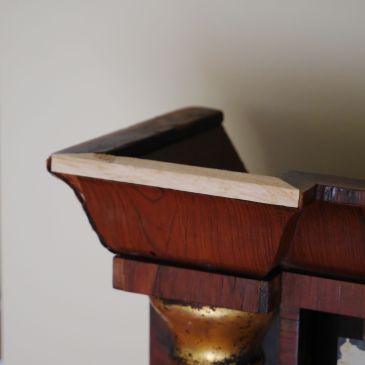
The only issue with the movement is the time side mainspring function which, as the previous owner explained, could not be wound with a key. Damaged top veneer and split-open side trim pieces tell me that the clock had accidentally fallen. The impact point appears to be the very top front of the clock. As a result of the impact the front panel had separated from the main part of the case, leaving a gap of about 1/8th of an inch. It also had a broken access door catch.

Damaged veneer sustained during a fall
Damaged veneer sustained during a fall, veneer was later pushed back in place

At first I focused my attention on the movement and why the time side mainspring would not wind. It was, as I suspected, a missing click spring. The click is a pawl which engages the ratchet wheel to hold the power of the mainspring or the weight. It is moveable and connected to the mainspring by means of a rivet. The click spring is a piece of steel or brass wire which is connected to the click and seats the click in the ratchet wheel.

I had a supply of steel click springs and fashioned one to fit the click. The click, rivet and the ratchet wheel were in otherwise good condition. While the mainsprings was restrained with clamps I postioned the click spring in place applying a little solder to ensure that it remained fixed. An older similar repair occurred on the strike side with solder holding that click in place. A weak point of the movement, perhaps.

A little solder to keep the click spring in place

I inspected the movement for wear and discovered that it had been serviced previously. The solder on the strike side click was certainly a clue but I also noticed that some bushings had been replaced, not unusual given the age of the clock. Brass bushings were punched into the steel plates at the factory. I could see that newer bushings were installed in at least three locations.

There is no lateral movement in the gears as such lateral movement would indicate bushing or pivot wear. There is no evidence of ovalized, enlarged or mis-shapen bushing holes and the gears are meshing well. The movement is clean and free of dirt and debris and I do not feel that a full cleaning is warranted at this point. There is no excess blackened oil; the oil in the bushing holes had simply dried up. I applied clock oil to the bushings, wound both mainsprings and after days of running the movement is keeping excellent time.

With the movement out of the case, repaired and in the testing phase, I focused next on the condition of the oak veneered case. Many of the joints had separated due to the impact I mentioned earlier. Hide glue would have been used originally and could be used for case repair. I have medium strength pearl hide glue, not strong enough for this application. High strength is required to bring the trim pieces together to ensure a good long-lasting and tight fit. This is one of those occasions when a modern glue is an acceptable alternative. Yellow carpenters glue has a bonding power of two tons and I chose this type of glue for the repairs.

Each section had to be clamped for 24 hours and only one section could be worked on at a time. The result is a very time-consuming and complicated process lasting several days.

I used three clamps for one repair. Because the impact point was at the very top I had to push the sides in with a clamp while at the same time bring the front panel into the main part of the case using two clamps adjacent to each other. You can see the clamping method I employed in the next photo.

Using three clamps to bring the sides together and the front section into the case

The side base trim pieces were also split open and had to be clamped in place as you can see in the next photo.

Side trim pieces clamped

Bringing the sides of the case together resulted in raising the damaged veneer, consequently several small pieces of top veneer had to be pushed back into place. Using carpenters glue combined with an “elaborate” weight system I went about with the repair. Using a toothpick I applied carpenters glue under the veneer pieces, wiped off the excess with a wet cloth and used a block with a hole drilled to accommodate a toothpick employing enough pressure to push the small veneer pieces into place. It looks odd but it works.

Toothpick and wood piece to push the veneer in

A degreaser was used to strip years of blackened dirt/grease/grime on the case and once cleaned the original grain in the red oak veneer is now exposed to its former beauty. The case will either need a layer or two of lacquer or a more modern finish such as PolyWipe. I will cover this aspect of the restoration/repair in Part II.

Using Brasso I cleaned up years of tarnish on the brass bezel giving it a new life. I also polished the arbour grommets. The silvered dial face is in very good condition and I left that as-is.

Bezel cleaned up
Bezel cleaned up

I fashioned a new door catch out of a worn Sessions click.

A new door catch made from a worn Sessions click
Broken door catch was repaired using an old worn Sessions click

With the movement repaired and the successful clamping and gluing of the case the next phase is the final finishing. I am pleased that I am inching closer to bringing this clock back to life and can add it to my modest collection of Arthur Pequegnat clocks.

Stay tuned for Part II on July 30th.

The Arthur Pequegnat Clock Company – a brief history

Most knowledgeable clock enthusiasts in Canada instantly recognize the Arthur Pequegnat Clock Company as one of Canada’s premier clock companies. Although the company went out of business over 75 years ago the Arthur Pequegnat name is still respected as a quality clock-maker.

The Arthur Pequegnat Clock Company had an illustrious albeit short life. Watchmaker Arthur Pequegnat was born in Switzerland in 1851. Arthur immigrated to Berlin, Ontario Canada in 1874 with his wife, parents, brothers and sisters; a grand total of 18 family members.

Tall case clocks made by Arthur Pequegnat

By the late 1870’s Arthur was operating a jewelry store and watch repair in Southern Ontario. By the middle 1880’s Arthur and his brother Paul were operating a shop in Berlin, Ontario (now Kitchener). After about ten years the brothers went their own way, both operating successful jewelry shops in Southern Ontario.

Mantel clocks in all shapes and sizes

In 1897 Arthur expanded his Berlin Jewelry shop to include the manufacture of bicycles. However, by 1904, with the decrease in the demand for bicycles, Arthur began to re-focus on the clock industry, by manufacturing his own clock movements at his Berlin Bicycle Manufacturing plant. At first the wooden clock cases were made by local furniture makers, however in time he manufactured his own clock cases.

The Regulator #1, Pequegnats most accurate clock

Berlin, Ontario was re-named Kitchener Ontario in 1916, due to anti-German backlash during WW I. This becomes a useful tool when dating Pequegnat clocks as labels, movements or dials marked “Berlin” date the clock to 1916 or earlier and those marked “Kitchener” are 1916 or later. Having said that, many clocks had a long production life and it is difficult to date any Arthur Pequegnat clock precisely.

The company closed it doors in 1941. Although brass was in short supply as a result of the war effort, sagging sales reflected the demand for modern electric clocks.

Yes, a brief history but as any Canadian clock collector knows Arthur Pequegnat is still a “Big” name in the clock business.

Taking a summer clock break

The lake
The lake

It is time to take a little break.

As regular readers know I publish between 7 and 9 articles per month. I have been spending considerable time this spring putting ideas together and getting articles ready for the summer months so that there will be NO interruption in activity on this blog.

Since I spend quality time with friends and family and decompress at our summer get-away in central Canada I might be a tad slow getting back to you if you have questions about your clock or comments on any of my posts. I therefore apologize in advance.

Canada Clock Company Hamilton Cottage Extra
Canada Clock Company Hamilton Cottage Extra, circa 1880, an interesting find in a junk shop

On my blog I typically profile my own clock collection, the challenges of maintaining and repairing clocks in my collection plus many articles of general interest. I often write about my personal observations during my travels and I always look for unique and interesting clocks as I navigate through the fascinating world of horology.

I hope you enjoy reading them as much as I enjoy the researching each article. I invite you to browse through my archive; there is always something that will interest clock lovers of all ages.

Over the next two months you will find exciting new articles and some helpful information on various clock issues. No doubt my summer adventures will produce new clock stories that will be the source of future articles. So, stay tuned as they say and if you like what you see let me know.

The Macdonald Museum – if you are a clock fan, or even if you are not, this small museum may surprise you

I have been to Middleton, Nova Scotia many times. I have even passed the Macdonald Consolidated School where the clock museum is located without realizing what treasures lay inside. The clock museum represents a small section of the museum, the remainder of which is dedicated to the history of the area.

In the Spring of 2018 my wife and I set off on one of our many mini staycations. On my agenda was a visit to this museum and I was not disappointed.

MacDonald Museum main exhibit area
Macdonald Museum main clock exhibit area
Tallcase clock
Holbeck made tall-case clock
It certainly ranks as the best exhibit in Atlantic Canada

Off highway 1 on School Street, Middleton, Nova Scotia stands the Macdonald museum. I had some expectations because I had been to two well respected clock museums, the NAWCC museum in Columbia PA. and the Canadian Clock Museum in Deep River, Ontario. Though not on the same scale as these two, it certainly ranks as the best exhibit in Atlantic Canada.

According to the web site

The Annapolis Valley Macdonald Museum is home to the Nova Scotia Museum’s collection of over 150 antique clocks and watches. This permanent exhibit showcases items collected by the late Norman Phinney and was one of the primary reasons for establishing the Macdonald Museum. Many of the clocks are in working condition. There are a wide variety of clocks and watches on display, with some dating back to the late 17th century. Anyone interested in clocks would do well to see this exhibit – one of the best in Eastern Canada.

The museum is well laid out with enough information on each of the clocks on display to satisfy the general public and clock enthusiasts alike. Each display highlights its significance as an important development in horological history. We were alone as we walked though the main exhibit area and an adjacent room which contained a fascinating old clock-maker’s shop and a well laid out and informative interactive display on how mechanical clocks work.

Clockmaker's shop
Clock-maker’s shop
How mechanical clocks work

At least one example from the Baird Clock Co. of Montreal and five examples from the Arthur Pequegnat Clock Co. of Berlin (now Kitchener) Ontario were on display including the Arthur Pequegnat Regulator #1, that the company once advertised as “The finest clock made in America”.

Baird clock from Montreal
Arthur Pequegnat Regulator #1

None of the clocks were running, however. Though the clocks appeared to be in excellent condition, the sound of ticking clocks make for a more authentic experience. All other clock museums make a practice of running some clocks on a rotating basis at any given time.

At the entrance to the clock collection there is a simple plaque dedicated to Norman D. Phinney. Learning more about Norman D. Phinney, his contribution to the Macdonald Museum and the story of how the museum received his clock collection would add to the experience.

Norman D Phinney
Norman D Phinney

If you are a clock fan or even if you only have a casual interest in the world of horology, this small clock museum may surprise you

Though perhaps not within the scope of Phinney’s original collection, examples from the Canada Clock Co. and the Hamilton Clock Co. or more peddlers clocks from Nova Scotia and New Brunswick would have provided an enhanced Canadian horological perspective.

Steeple or sharp Gothic clocks

However, these are minor quibbles and should not detract you from appreciating the high quality of the exhibits which contained British, American, French and Canadian examples or the many styles that included Pillar and Scroll, tall-case, shelf, beehive, steeple, drop octagons, mantel, alarm clocks and Ogee clocks, all of which were well represented.

If you are a clock fan or even if you only have a casual interest in the world of horology, this small clock museum may surprise you.

Oh, and while there, visit the rest of this fascinating museum.

Sperry and Shaw 30 hour 4 column New York Style shelf clock circa 1846-47

4 column Sperry and Shaw 30 hour shelf clock

I have the 30-hour clock bug and my collection of them is steadily growing, but where to put them all? I have not decided where to put this one and for the moment it is on the floor of my work room.

Sperry and Shaw were not thought of as a high end clock company but some models like this 4 column New York style were quite attractive

This is a New York-styled Sperry and Shaw 30 hour time and strike, 4 column shelf hour strike clock, measuring 25 1/2 inches in height by 14 inches in width. The 4 free-standing turned columns first drew my attention as I had never seen anything quite like it. While researching the NAWCC site I discovered that this clock was made in or about 1846-47. The label, of which 98% is intact inside the backboard says 10 Courtlandt (not a misspell, there is a second”t”) Street, the company headquarters during the aforementioned period. Sperry and Shaw were business partners and were regarded as distributors and assemblers rather than clock-makers.


Sperry and Shaw's label showing 10 Cortlandt St.
Sperry and Shaw’s label showing 10 Cortlandt St.

They sourced cases and movements, affixed their own stamp on the movement and placed their labels (sometimes over other makers labels) inside the case, a common practice at the time as clocks for the home and workplace both locally and abroad were in great demand.

Not everyone in the clock business was happy with Sperry and Shaw. Consider this excerpt from Chauncey Jerome’s book, History of the American Clock Business.

“These New York men would say that they were agents for Jerome and that they would have a plenty in a few days, and make a sale to these merchants of Jerome clocks. They would then go to the Printers and have a lot of labels struck off and put into their cheap clocks, and palm them off as mine. This fraud carried on for several years. I finally sued some of these blackleg parties, Samuels & Dunn and Sperry & Shaw, and found out to my satisfaction that they had used more than two hundred thousand of my labels. They had probably sent about one hundred thousand to Europe.”

Chauncey Jerome had a few clock-makers/assemblers on his hit list that included Sperry and Shaw and at least managed to sue some successfully.

Sperry and Shaw were not thought of as a high-end clock company but some models like this 4 column New York style were quite attractive, sold well at the time and are sought after today by collectors.

The movement is Jerome-like (Counterfeit perhaps?) and stamped Sperry and Shaw, New Jersey. I measured the plate thickness and compared it to a Jerome in my collection and the plates in this clock are a little thinner.

The narrow brick-shaped weights (4  3/4 inches X 1 inch) fit neatly into channels on the left and right. When I first communicated with the seller, he was not sure if the weights were in the clock. He later emailed to say that it did indeed have weights. I would have passed on the clock had it not come with the weights because the narrow bricks are the only type that will fit into the channels and they would have been almost impossible to source. The weight cords, clearly not original, are old and frayed and will be replaced with simulated gut. How old, well on the first night I raised the strike weight up about halfway and about 20 minutes later I heard a loud BANG. I knew exactly what happened; the cord had snapped and the weight had dropped. Luckily there was no damage.

The open moon steel hands are original.

The upper glass appears original and has the waviness you would expect from a clock over 172 years old.

The lower tablet has a cropped image of the Bay of Quinte (Ontario, Canada) taped to the inside – not original but old. The original 18X12 cm steel engraving was drawn by W. H. Bartlett and engraved by J. C. Armytage in 1840; the image can be found here. Since the image is from 1840 and appropriate to the period of the clock, I might just leave it there. It also tells me that the clock likely spent most of its life in Ontario, Canada.

Sperry and Shaw clock showing dial and lower tablet
Sperry and Shaw clock showing dial and lower tablet print

The zinc dial is old though not as old as the clock itself since there is a patent stamp on the back of the dial dated Dec 1, 1863.

Dial patent date of 1863
Dial patent date of 1863, a later addition to the clock

There is also a clock-makers inscription that says, “cleaned by Felo Bros, March XX 1901”. Obviously this particular dial would not have been on the clock at the time it was made. A wood dial would have been appropriate for the period.

Clock-makers inscription in pencil

The case looks good…from a distance. The veneer looks like mahogany or walnut, I am really not sure. There are a few small pieces of veneer missing at various places and mostly on the corners, a common issue. It has a two-tone appearance though the case might have been all one colour when made (??). There is a lot of grime on the darker surfaces and I have to decide whether to leave as-is or take it down a little bit to see what’s there. Attending to the veneer issues should be a fairly straightforward process. The break in the right corner of the base is a crude repair and that will have to be redone.

One of several areas of minor veneer loss

The movement is dirty but should clean up nicely. There is not a lot of pivot wear on the front plate of the movement but I will learn more once it is out of its case.

There are a number of other clocks in the queue but I am eager to tackle this one.

Arthur Pequegnat Bedford mantel clock – an interesting find

As regular readers know I am a fan of Arthur Pequegnat clocks not just because they were made in Kitchener, Ontario, Canada but they are attractive, well made and hold their value well (in Canada!).

Eddy's photo of the clock
Eddy’s photo of the clock

I have had clocks given to me in the past but this was a rather unusual situation. As readers know I publish at least seven or eight articles a month in order to provide interesting content on all aspects of mechanical clocks. I publish a regular feature called Tick Talk Tuesday in which I profile the mail I receive from readers. The mail is private email and not comments after a blog article. I receive many emails you will not find on my blog. Some people prefer writing to me privately and that is perfectly fine.

I received one such email some time ago from Eddy who lives in the Quebec City area (Province of Quebec, Canada). Eddy was researching my blog and discovered that I admired and collected Canadian-made Arthur Pequegnat clocks. He wondered if I would have an Arthur Pequegnat clock added to my collection.

Because it was an Arthur Pequegnat I was immediately interested but I did not expect a reply. To my surprise Eddy answered with five photos of the clock from various angles. It was a mantel clock in pretty rough shape and after seeing his photos I was still curious even though it likely required a lot of work to restore it.

Top of the clock
Top of the clock

In his email Eddy explained that he was having serious health issues and was taking stock of his life. He had a number of antique and vintage items that his father and grandfather had left him and he felt they should be passed on to someone who would appreciate having them. As Eddy explained, “My father had that clock as a trade against work done for people he helps with their house and lawn chores. He gave it to me since he’s got too many, just like my grand-father did. He was okay with me parting with it.”

I wrote back and told him that a meeting was indeed possible. We would be passing through the Quebec City area in the next few days on our way to our cottage in Quebec to open it up for the summer. We (my wife and I) had even planned to stay in that area for the night. We could stop by to have a look at the clock. Eddy then provided me with his address and telephone number. A meeting day and time was set up.

After nine hours of driving we arrived at his door. He invited us in and we spent a very pleasant two hours getting to know each other, discussing my collection of clocks, talking about the clock in question, his fathers hobby of searching out old antiques and finally, matters related to his struggle with a serious illness.

broken brass hinge
broken brass hinge

I was a little confused. Was he was actually giving me the clock or did he expect money in return so I decided to ask him straight out. No, he said, you can have it. he then brought out three other clocks to the kitchen table, a cottage clock, a steeple clock and a swinger. He asked me if I wanted those as well and I thanked him for the offer but declined. While they were very nice clocks I felt awkward taking all of them for nothing. So, we left with just one clock.

We walked out the door with clock in hand and for the next hour of our drive we talked about Eddy and his gift of an Arthur Pequegnat clock.

The clock was complete with original hands, pendulum bob, coil gong and of course, the signature Arthur Pequegnat movement with nickel-plated steel plates. The only visible sign of an issue with the movement was the time side mainspring which, as Eddy explained, could not be wound with a key. Damaged veneer, side trim pieces splitting open was clear evidence that at some point the clock had been dropped or fallen hard. The impact point was the very top of the  clock. Yes, it was in rough shape!

A challenge to repair? Yes, but I graciously accepted the clock knowing that I would have to spend several hours putting it right.

The sides and front were coming apart
Both sides and the trim front were coming apart

Thanks to Eddy I am now the new owner of an Arthur Pequegnat, Bedford model that I will add to my collection of four other Pequegnat clocks. In a later post I will detail the repairs to this fine Canadian made clock.

Eddy suggested that instead of offering him money that we donate to a charity and so a cheque went to the Canadian Cancer Society. I have never given names to my clocks but this one will always be called Eddy in honour of a individual who felt strongly that a family treasure should go to an appreciative owner.

Tick Talk Tuesday #14 – Can you tell me something about my Forestville clock

Tick-Talk Tuesday is about the letters and comments I have received from you, the reader, concerning your clock, issues you might have had, challenges you face or a clock you would like me to profile and my responses to your questions with advice on your particular clock concern. For those comments and questions that stump even me, I consult within my clock circles for the best possible answer.

GGs Forestville Mantel clock

GG writes: “Hello there,,,I was wondering if you know much about my mantle clock and maybe it’s value?

I have attached some photos!”

My reply: “Thanks for coming to my blog. That is one of the nicest mantel clock cases I have seen on a Forestville and it appears to be in good shape.

Forestville is a Canadian Company based out of Toronto. They went out of business in 1979. They did not make their own movements instead sourcing them from England, France, the US and Germany though they made their own clock cases.

GGs clock showing German made movement and pendulum bob

You may or may not know that Forestville was called the Blackforest Clock company prior to WWII. So, you have a post war clock made in the late 1940s or early 50s. Later on In the 1950s Forestville went from using pendulums in their clocks to balance wheels (no pendulum). Forestville also sourced German movements exclusively after the war. Your movement (the brass works) was likely made by Mauthe or Hermle, both well known and well respected German companies.

You have what is known as a time and strike Bim-Bam clock. It strikes the respective hour and once on the half hour but makes a distinctive “Bim-Bam” sound as a result of one hammer striking one rod while the other two strikes two rods simultaneously.

Unfortunately there are thousands of similar clocks and Forestville clocks are not particularly distinctive but a clock such as this in good running condition might fetch about $100.”

GG writes back to explain that the movement is an Enfield from England which stands to reason if it was made immediately after the Second War.

Interesting steeple clock from the short-lived Hamilton Clock Co. (Canada)

Hamilton Clock Co Gothic steeple clock

I wasn’t on the lookout for another steeple clock but when I discovered this on a local online for-sale site I just could not pass it up.
Let’s clear something up from the outset. The Hamilton Clock Co in the United States and the Hamilton Watch Co were probably associated with each other in some way but the Hamilton Clock Co. located in Hamilton Ontario, Canada which operated between 1876 and 1880 was not in any way affiliated with the American company.
I bought his Hamilton Clock Co. 30-hour time and strike steeple clock from a local seller. I am sure the seller thought he did well with the sale as he did not budge from the 100CDN he was asking. However, I consider this a win-win situation. We were both pleased because clocks from the Hamilton Clock Co. are sought after by Canadian collectors and this example would easily fetch much more than the price I paid. I was particularly intrigued by the etched tablet with, “Cling to the Cross” a religious phrase that was popular at the time. It is the larger of two versions at 19 ¼”. The Hamilton Clock company made the only true steeple clocks and very few survive.

The 30-hour time and strike movement is appropriately stamped HAMILTON CLOCK CO. HAMILTON ONT. The suspension spring is mounted higher up than a photo I saw on the Canadian Clock Museum site which shows the suspension spring mounted below the hour cannon. There is also a pin through what looks like the intermediate gear on this movement. There had to be some variations over the period the movement was made.

The clock is not without issues, after all, it was made between 1876 and 1880 and some wear and tear is expected for a 140-year-old clock. Everything seems to be there and it is in good shape including the “Cling to the Cross” inscription on the tablet. The etched glass tablet was the result of an association with glass factories in the Hamilton area and unlike anything offered by other companies. There were a whole series of clocks made with similar religious messages.

30-hour time and strike movement with clock company inscription on the bottom of the front plate

The original dial face is faded/worn, the hands are original and the 30-hour movement has the correct pendulum. There are minor veneer losses here and there consisting mostly of chips. The right steeple is also missing its tip.

Veneer chips on left side of base
Veneer chips on the left side of the double-curved base

The label is not complete but is quite readable.

Loss on the clock label

Half the label is missing but enough to identify the clock.
Half the label is missing but enough to clearly identify the clock-maker

A complete label should look like this better example

The clock runs surprisingly well but requires a thorough cleaning and repair work on the time side ratchet click which slips when the arbour is wound. Generally, the clock appears to be in reasonably good shape.
I am always intrigued by clocks made entirely in Canada. The following information is taken from the Canadian Clock Museum located in Deep River Ontario (Canada). A must visit if you are in Canada, love clocks and are especially interested in Canadian makers.
“This company was established in 1876, after the failure of the Canada Clock Company in Whitby, Ontario.
The machinery and other tools and equipment were purchased and moved to Hamilton by two business men, James Simpson and George Lee.  Simpson, born in Scotland, had been active in Hamilton for years as a partner in a wholesale grocery business.  He assumed the title of President of the clock company.  Lee, born in Ireland, was also active in food wholesaling, and the operation of hotels, and restaurants.  He became the Business Manager.  Neither man had any prior experience with factory operations or clock making.
Technical expertise was provided by John F. Collins, who had previously acted as Manager of the Canada Clock Company in Whitby and had been instrumental in equipping and operating that enterprise.  He was brought from Whitby along with the equipment and given the title of Mechanical Superintendent.
Collins utilized tools, dies and designs he had created at Whitby, so the Hamilton company was really a continuation of his previous efforts. He was able to broaden the range of movements and case styles, and hence to offer a more complete line of merchandise.  Unfortunately, after a few years, he appears to have fallen out with the new owners and left the company in 1879.
George Lee, in turn, suffered health problems and was obliged to leave around 1880.
This left James Simpson as sole proprietor.  He ended production under the name Hamilton Clock Company and proceeded to make major changes.  The factory and equipment were retained, but a completely updated product line was developed.  Simpson found new investors and incorporated the firm as a public company that was renamed The Canada Clock Company Limited.
The Hamilton Clock Company appears to have made a valiant effort to provide clocks for the Canadian market, in competition with the huge U.S. clock factories that already dominated the market.  Hamilton clocks matched competitive products in appearance and their quality was quite adequate.  The volume achieved, however, was never very large and the product line was simple and limited.  No catalogs or printed material have ever been found from the company and our opinions can only be based on an examination of surviving clocks.  Perhaps, like the attempt in Whitby, the available capital and ‘know-how’ were insufficient to ensure a major success.”
There is nothing novel or unusual about Hamilton Clock Co. clocks. They had movements and cases similar to American made clocks but since the production was limited to 4 years, fewer were made, they are rare and therefore more desirable for collectors.
Overall I am pleased with this acquisition.

Blackforest shelf clock (Canadian made) gives me grief but decides to run again

Blackforest shelf clock

The clock is a 1937 Blackforest Royal Tour commemorative edition shelf clock with an 8-day time-only “plate” clock movement. Plate clock movements are so-called because they were typically used on kitchen clocks with Dutch Delft plates such as this one in the next photo.

Delft Clock from Forestville
Delft Plate Clock from Forestville

The movement is likely German and could have been made by a number of companies. There are no stamps or markings on the movement to give any indication of the maker. Canadian companies such as the Blackforest Clock Company of Toronto (the Forestville Clock Company after the war) imported German movements before the Second World War and installed them in Canadian made cases.

Grimy movement prior to cleaning

This clock had been happily running for about a year and then last week it suddenly stopped after a winding. I nudged the pendulum in an effort to make it go, checked to see if it was in beat and level but no luck. I nudged the pendulum a few more times, left it for a day or so, tried it again and still no luck. I was at the point of disassembling the movement to investigate the problem. Two days later I wound it tight and gave the pendulum a push and it sprang to life. I think I know what happened.

I thought I did a good job of servicing the movement including the mainspring over a year ago but apparently not well enough. You may have heard the expression, “you overwound the clock so that’s why it stopped”. There is a grain of truth in the expression because if you wind the spring till it winds no further the mainspring is at it tightest. If there are dirt, grime and rust on the mainspring the mainspring will actually cease in place, hence the clock stops. I believe this is what occurred in this case. Although it is running now it will need to be properly cleaned. In the meantime, I will let it run and see if it completes its full 8-day cycle.

I have good luck finding a great deal on a clock

I seem to be one of those people who manage to find a great clock deal. I don’t think it takes a special talent but patience, research, and timing are three key elements in finding a bargain.

I often cruise the online for-sale sites for interesting clocks. In Canada, we have something called Kijiji. In the States Craig’s List is quite popular and I am sure other countries have something very similar.

What makes Kijiji (and similar sites) interesting and fun is that you can connect with people locally or in my case our province of Nova Scotia. There are a wide variety of sellers. Some know what they are selling and price items accordingly. Some have really no idea and either price items clearly for much more than they are worth or conversely for far less than their actual value.

It is nice to be able to meet the seller, find out the history of the clock, learn something about the seller, and their motivation for selling, negotiate a price, and bring the item home. There is no post office or courier service to “screw” things up. No “oh crap” sigh when you open the package. With online auction sites, you often get a “pig in a poke” which means that something is sold or bought without the buyer knowing its true nature or value, especially when buying without inspecting the item beforehand. This does not happen with Kijiji. You find the item advertised, connect with the seller several times electronically or personally if necessary, see the item beforehand, ask questions about it, inspect it for any immediate issues or potential problems and you have the choice to walk away if you are not completely satisfied. All transactions are cash with no pesky sales tax.

Clocks are interesting items to collect and prices are all over the map as you would expect. However, I have found a few gems in the last few years. Let me tell you about my latest experience.

A few weeks ago I saw this clock advertised on Kijiji (photo below). Now, this looks like any ordinary Gothic steeple clock but what grabbed my attention was the unique tablet inscription. The acid-etched glass tablet says “Cling to the Cross”, a religious expression not often found on this style of clock. I knew immediately that this was a very special Canadian-made clock.

Seller's photo
Seller’s photo

Why, because several months ago I watched a video presentation by Jim Connell. Jim Connell is well known in Canadian clock circles. According to the introductory remarks found at the aforementioned site “He has amassed a large collection of clocks of all types with an emphasis on those with a Canadian origin. As his collection and knowledge grew, Jim prepared and presented numerous articles, talks, and displays on Canadian clocks and their history.  He is the respected author of the Charlton Standard Catalogue of Canadian Clocks and he co-authored Early Canadian Timekeepers and The Canada and Hamilton Clock Companies with Jane Varkaris.”

In his presentation, he described this exact clock and mentioned in his presentation that there were very few copies left, a very rare Canadian clock indeed.

I wanted to confirm that this was the clock I thought it was and asked the seller to photograph the label. He did so and sent this to me.

Seller's photo of the label affixed on the back of the clock
Seller’s photo of the label affixed on the back of the clock

I attempted to negotiate a price. The seller wanted 100CDN and I offered 80CDN. He replied that he would not accept anything less than 100CDN. In the meantime, I checked with the curator of The Canadian Clock Museum to confirm its authenticity. Upon discovering that this was a Hamilton Clock Co. clock made between 1876 and 1880 I decided that, yes, this was a good find and in my email reply to the seller I said, “100CDN it is”.

It is what I would consider one of those happy win-win situations. The seller got more than he thought the clock was worth and I got a clock that is worth much more than I paid for it. My motivation, however, was not to celebrate a great deal at a great price but to acquire a piece of significant Canadian horological history at an affordable price.

Hamilton Clock Co Gothic steeple clock
Hamilton Clock Co. Gothic steeple clock
30-hour time and strike movement with clock company inscription on the bottom of the front plate
30-hour time and strike movement with company inscription on the bottom of the front plate

We met and settled the deal. I am now the owner of a Canadian-made 30-hour time-and-strike Hamilton Clock Co. Gothic steeple clock.

In a later blog article, I will profile this clock and describe my strategy to address some of its issues.

Addressing an upper tablet replacement on a Seth Thomas column and cornice clock

This is a fine example of a Seth Thomas column and cornice clock with sleigh front made prior to 1867 and sold by the R.W. Paterson Company of Canada West. Both the lower and upper tablets appear to be original and are in very good condition. Unfortunately this antique American column and cornice time and strike Seth Thomas clock is not mine and if it were I would proudly display it.

My clock, though similar is missing its upper tablet and a few other items that I wish to address in stages.

Missing upper tablet
Missing upper tablet on an American Seth Thomas clock

This blog article concerns one aspect of the clock, it upper and lower tablets. The lower tablet appears to be original and shows a cluster of fruit. Not as stately or ornate as the one in the first photo but quite appropriate for this style of clock. A quick online search shows that there were an endless number of reverse tablet painting designs ranging from birds, flowers, pastoral scenes, stately structures, eagles, parrots, berries, flags, drapery, crests and the list goes on.

Because there is a missing top tablet, the clock does not look complete. The clear glass is certainly not correct. As is typical for most clocks this age, things go missing over the years.

To address the missing upper tablet there are a number of options to consider;

  • Do nothing,
  • Attempt to find a decent quality reverse painted set from the same period,
  • Try my hand at painting a new tablet,
  • Buy a photo reproduction set online
  • Find a complimentary design and reproduce it on my home photo printer.

Finding a decent quality reverse painted set from that era is quite difficult and a search would take a long time. I am no artist, so, painting a tablet is out of the question. Buying a reproduction set online is a possibility but how much am I prepared to spend on something I could potentially do myself. After analyzing the options my first thought was to explore the possibility of buying a reproduction set online.

A search on EBay revealed sellers who make reproductions of the original tablets. They are essentially a “replacement picture set” of the clock tablets. They are as one ad put, “Exact copies of a set of Seth Thomas 8 day “Column” model sleigh front clock ca. 1880. They are printed on photo stock and mounted on mat-board that when put behind antique glass they are very hard to tell from the original and make a Seth Thomas column clock with plain or damaged pictures into a super looking clock.” I have seen them offered from 15USD to 45USD + shipping.

Hmm, I can do this myself!

Following a search of my photo collection I found a cluster of hanging fruit that complimented the lower tablet. Using PaintShopPro X6 by Corel I chose a water-colour effect, removed some fruit, changed the orientation of the image, adjusted the back lighting to match the tone of the lower tablet, cloned the deleted areas and darkened the stem and black-berries.

The first photo shows the source photo converted to a water-colour. The next shows the adjustments made to the “water-colour”. The third shows my first attempt without back-light darkening.

Using my wide carriage Epson Stylus 1400, here is my first attempt.

First attempt, a little lighter than what I was looking for
First attempt, a little brighter than what I was looking for but close

Colour-matching the lower tablet is a real challenge. More adjustments are required to get the right effect but I think I am on the right track.

If you have any suggestions on how I can improve my workflow I would love to hear from you.


Crazy clock ads – needs guts

Red color wood, in nice shape, not working, needs guts. $5.

Maybe I’d get it just for the case!

The art of veneering – Part II – veneer work

This is Part II of a three part series on my first venture into veneer repair on an antique clock. Prior to beginning this project I spent many hours researching veneer repair, watching YouTube videos and seeking advice from my knowledgeable colleagues at NAWCC.

This is an 8-day Seth Thomas column and cornice time and strike shelf clock with sleigh front. It has a Plymouth Lyre movement with a Thomaston Conn. label. The clock was made in the early 1870s.

Part I explores the steps in preparation for veneer repair.

The focus of this, Part II, is the selection of the correct veneer, working with hide glue, as well as cutting, applying and trimming the veneer.

Although one is tempted to use readily available yellow or white carpenters glue the only authentic product to use is hide glue

The veneer

I am not an expert in wood finishes and determining the type of veneer was my first major task. To do this I had to rely on expertise to tell me that I had Rosewood veneer. Once I discovered the type of veneer, I had to determine the quantity and the specific repairs that are required for this clock. My research revealed that the veneer used at the time was Brazilian Rosewood. An exotic wood, Rosewood would have been used extensively by clock-makers of that era and it is the correct veneer for this project. A clock friend (thanks JC) sent me two 7 X 8 inch pieces of Rosewood veneer, more than enough for the job.

The very worst sections were the top and bottom of the case and the column bases as one would expect given wear and tear over the years. Most of the cornice veneer is in good shape as are the door sections, door surrounds and the sleighs just above the feet.

Hide glue

One is tempted to use readily available yellow or white carpenters glue but the only authentic adhesive for clock case applications is hide glue. Hide glue is the glue of choice and it would have been utilized at the time the clock was manufactured. I chose pearl hide glue which is a type of hide glue rated at 150g Bloom strength. It takes takes a little longer to gel and with the longer working time it is better for applications like this when you need time to fit, but where high strength is not absolutely essential.

If you have never worked with hide glue, it is best to start with a small batch. My first batch was larger than I needed and too thin. Simply put 2 tablespoons (30ml) of glue in a heat-resistant glass container, cover with 1 tablespoons (15ml) of cold water and let soak for about an hour or until the glue softens and becomes gelatinous. Less is more and I recommend making small quantities. For about 20CDN you can buy a supply that will last a long time.

Place the container with the gelatinous glue in a bath of water in a pot especially designed for hide glue or a double boiler which I found worked just as well. Heat to approximately 140°F (60°C) and maintain the temperature. A candy thermometer is ideal to keep the glue at an even temperature.

Home-made double boiler with temperature maintained on a hot plate

Tools

Clamps, weights, tweezers, wax paper, a sharp knife, a metal straight-edge, painter’s tape, a micrometer, sand paper, palm sander and whatever you choose to use as a double boiler complete the list of tools.

A micrometer is an indispensable tool for accurate measurements. Accurate measurements ensure a good fit, minimize the use of fillers and lessen waste.

A micrometer ensures an accurate cut

Cutting, trimming & clamping

Cutting veneer can be tricky. Veneer is thin, brittle and can easily tear. Veneer today is different than veneer used 100+ years ago, it is very thin. On some clocks you may need to double-up, that is layer the veneer to approach the height of the original veneer.

Cutting can be a challenge since you must follow the grain and those narrow strips can break very easily. Painters tape is a true friend since it prevents tearing and it is easily removed from the veneer prior to application.

Painters tape ensure a rip free cut

Painters tape easily peels off

You will never have enough clamps

I chose to work one area at a time moving from the bottom of the case to the top. The next photos shows veneer sections glued and clamped into place. Clamps are essential for veneer repair but when clamps do not work other methods such as weights can be employed. You will never have enough clamps! Although a clamp need only be in place for a few hours, having it on for a 24 hours is best for maximum adhesion.

Clamping cornice veneer

Door piece and corner base piece is clamped

The upper left cornice presented a unique challenge. A section was missing just above the cornice. Fashioned out of softwood it was glued in place.

A piece of pine was cut to fit

strip of veneer applied
Strip of veneer glued in place;  prior to trimming and sanding

In this photo the piece for the curved part of the veneer is applied. The top area of the front cornice is now ready for staining and finishing.

Small angular cornice piece on left is glued in place

Top section almost complete and ready for staining
Top section is almost complete except for a left side cornice section (not visible in this shot)

As with any other project there will always be a slight colour variance as one would expect over the course of a century or more but the goal is to come as close to the original finish as possible

As mentioned the worst areas were the very top and very bottom of the case, expected after years of wear and tear. Another area which had veneer loss were the column bases. When possible I used old veneer to repair small areas but I found it very brittle and hard to work with. From my research I discovered that there are methods of softening old veneer but that can wait until the next project.

Right column base
Right column base, prior to sanding and trimming

After many hours the veneer work is now complete The next step is colour matching the new to the existing veneer. As you can see in the following photo the chip held by green tape shows that Rosewood Minwax Gel stain is a close match to the older veneer. My experimentation did not end. Part III explores other finishing options.

As with any other project such as this there will always be a slight colour variance as one would expect over the course of a century or more. The goal is to be as close as possible to the original finish.

Colour matching test: the green tape is holding a chip that has one coat of Rosewood stain

Now that the veneer work has been applied the next and final stage is finishing. Stay tuned for Part III in a few days time.

Arthur Pequegnat Simcoe mantel clock

Canadian clock collectors are passionate about Arthur Pequegnat clocks. In private sales and online for-sale sites most sellers are knowledgeable enough to know that they are very desirable. A Pequegnat will sell for many times more than a comparable mantel clock, that is, in Canada.

Arthur Pequegnat Simcoe mantel clock
Arthur Pequegnat Simcoe model mantel clock


The Arthur Pequegnat clock company had an illustrious albeit short history

The Simcoe is my fourth Arthur Pequegnat clock. It is very similar in dimensions and style to the Jewel. Whereas the Jewel is basically a unadorned box the Simcoe has a piecrust dial bezel, claw feet on each corner and lions head handles on each side. It has a coil gong for the hour strike and a bell for the half-hour passing strike.

To collectors it is referred to as a”Berlin” clock. Although it is impossible to date Pequegnat clocks precisely the name Berlin distinguishes clocks made before 1917 and those made after and up to 1941 when the factory finally shut its doors. Clocks made prior to 1917 were inscribed “Berlin”, Ontario on the dial face since Kitchener was known as Berlin until midway through World War I. From 1854 until 1912 it was the town of Berlin and City of Berlin from 1912 until 1916. Because the name Berlin had a negative association with the war against Germany the city administration chose the name Kitchener. Kitchener is the present seat of the Regional Municipality of Waterloo, Ontario (Canada).

Time and strike movement with steel plates
Time and strike movement with steel plates, a common feature with Pequegnat clocks

The Arthur Pequegnat clock company had an illustrious albeit short history. Arthur Pequegnat, a watchmaker by training, was born in Switzerland in 1851. Arthur immigrated to Berlin, Ontario Canada in 1874 with his wife, parents, brothers and sisters; a grand total of 18 family members.

Arthur Pequegnat clocks such as a simple mantel clock you see here can command hundred of dollars in Canada

By the late 1870’s Arthur was operating a jewelry store and watch repair in Southern Ontario. By the middle 1880’s Arthur and his brother Paul were operating a shop in Berlin, Ontario. After ten years the brothers went their separate ways, both operating successful jewelry shops in Southern Ontario.

In 1897 Arthur expanded his Berlin jewelry shop to include the manufacture of Bicycles. However, by 1904, with the decrease in the demand for Bicycles, Arthur began to re-focus on the clock industry, by manufacturing his own clock movements at his Berlin Bicycle Manufacturing plant. Arthur obviously visualized a profit in clock making as many clocks at the time were imported from the United States. At first the wooden clock cases were made by local furniture makers, however in time he manufactured his own clock cases. Although the Arthur Pequegnat Clock Company was widely regarded as the only true Canadian clock company, lesser known companies such as the Hamilton Clock Company and the Canada Clock Company, though not as successful, predated it.

The Simcoe is a relatively nondescript clock. I passed by it in the antique store without realizing that it was a Pequegnat. My wife spotted it and I returned to take a second look. Sure enough, a Pequegnat!

The yellow oak case is in very good condition with one or two small scratches and a chip just above the top of the bezel. The dial pan has had an ugly repair, there are two brass tabs at 12 o’clock and 6 o’clock protruding though the front of the dial.

Piecrust bezel
Piecrust bezel

The dial face has some crackling but is otherwise in good condition. The piecrust bezel is in very nice shape as are the claw feet and lions heads.

Lions head on case side

The movement looks very clean with little evidence of wear. There is an inscription on the back dated Jan 10, 1970. It was likely serviced on that date. In any event it does not appear to have had much running since then. Unfortunately, there is no label.

Ornate front feet
Ornate front feet

The movement was taken out of its case, inspected for wear and found to be in very good condition. The movement was oiled, returned it to its case, the  beat was set and it is running strongly. The clock will be inspected in one years time to determine if servicing is required.

Westclox alarm clock – made in China….sigh!

You can still buy a brand new Westclox today and few people realize that the company was a pioneer alarm clock manufacturer.

Baby Ben alarm clock

This is a nondescript Baby Ben clock; thousands were sold but unlike older alarm clocks made in the USA and made and/or assembled at the Peterborough plant in Ontario (Canada), this one was made in China.

The Baby Ben has had a long and interesting history. The Baby Ben movement was originally marketed in 1910 and first nationally advertised in 1915. The 5-year delay occurred because the company was going through organizational changes and it took 3 years to improve the reliability of the Baby Ben movement.

Westclox LaSalle alarm clock
An early Baby Ben, the Westclox LaSalle alarm clock

In 1912 Westclox opened a sales office in Toronto, Canada as part of its policy to establish world markets. Between 1920 and 1922 production began at the plant in Peterborough, Canada. At that time parts were shipped from the LaSalle-Peru plant for final assembly in Canada. Unfortunately, there is no information on which clock parts were made in Canada and which parts were manufactured in the Peterborough plant through the years.

Thousands of Baby Ben alarm clocks were manufactured and sold through the 1920s to the 1970s. In the early 1980s production in Canada ceased. “Westclox” and “Big Ben” trademarks were acquired by Salton Inc. in 2001. In October 2007, Salton sold its entire time products business, including the Westclox and Ingraham trademarks, to NYL Holdings LLC, which, to this day sell clocks under the Westclox name. In addition to clocks the company’s line of business also includes the wholesale distribution of jewelry, precious stones and metals, costume jewelry, watches, and silverware.

Baby Ben alarm clock with second hand

Back controls
Back controls

I have not had the chance to look inside this alarm clock but from its style and other design elements it is from about 2001 when production shifted to China under General Time Corporation, parent company of Westclox, just prior to the sale to Salton and before quartz clocks entered the mainstream. It is the Style 10 Baby Ben with radial numerals and a sweep second hand.

This example is still working and keeping good time. I bought it to study the Baby Ben movement.

Though every bit as reliable as the older American and Canadian alarm clocks it is unfortunate that we lost this segment of the industry to the Chinese. For more information on the history of Big Ben and Baby Ben clocks you can go here called appropriately enough, Westclox History.

Crazy clock ads – its a blur

Antique Clock Case Converted to a Display Case.Great Way to Display Your Favourite Treasure. Brooch not Included. $25.00

Fuzzy photo in ad

Mmm, wonder what happened to the movement? At least they spelt “brooch” correctly.

Waterbury Ogee (OG) 30 hour weight driven clock and why they are so undervalued

Why are these clocks so cheap? Discounting the wild prices some seem to be asking on online for-sale sites, a good example can be had for almost nothing. Why? Allow me to explain.

This 30 hour time and strike Waterbury Ogee clock was discovered at an antique store an hour’s drive away. The store has a well-deserved reputation for pricing items for a quick sale and each time we visit there is always a new selection of interesting clocks as well as plenty of other fascinating antiques.

Ogee clock showing replacement pendulum bob
30-hour Ogee clock by Waterbury

Ogee clock, clock design that originated in the United States in the 1830s, distinguished by a case (usually pine) the front outer edges of which are curved into an S-shape (ogee). This shape is formed by the union of a convex and a concave line. A mass-produced variant of the shelf clock, the ogee clock stands about 30 inches (75 cm) high and is usually weight-driven. The movements were usually made of brass and were made to run for 30 hours or eight days. (Brittanica.com)

The Ogee clock – the beginning

In 1839 the first prototype movement was produced for Chauncey Jerome by his brother Noble in Connecticut, USA. Jerome thought that a simple one-day clock could be produced far more cheaply than those with wooden movements at the time. Brass movements were more robust, could be transported easily and were unaffected by humidity. The simple case added to the movement was the Ogee named for its “S” shaped moldings. The success of the Ogee clock convinced other makers that there was a lot of money to be made in clock production.

My new acquisition

The seller knew nothing about clocks and his only interest was to move the item. The proprietor said it was not working. Just as well, I bought the clock for almost nothing. In my opinion these clocks are terribly undervalued.

It came with a winding crank and both weights but no pendulum. A 2.2oz pendulum bob was later fitted to the movement.

The dimensions are 4 1/4 deep X 15 1/4 wide X 25 3/4 inches high. The clock strikes on the hour to conserve the weight drop. The coiled gong on the Waterbury stamped base is loud, and the striking is frantic.

The movement will run and stay in beat (relatively!) but stops after about 15 minutes. That is to be expected and a thorough servicing is in order. Stake and punch marks throughout the movement tell me that the movement has been worked on more than once.

Ogee clock label
Ogee clock label shown with a 2.7 oz pendulum, also testing with a 1.7 oz pendulum

The Rosewood veneer is in remarkably good condition though the outside four corners have been compromised. The label is in very good condition with two small pieces missing at the bottom edge and water staining on the right side. The painted zinc dial with Roman Numerals has some flaking and the numbers are somewhat faded but it otherwise looks very good for the age of the clock. Both spade hands and Ogee hands are on similar dials I have seen so I do not know if these are correct/original. The lower reverse painted tablet is silk screened, looks to be marred around the centre area and the entire scene has minor crackling but it is vivid and largely intact.

Veneer in excellent condition


This is a Type 2.411 movement introduced by the Waterbury Clock Co. when Chauncey Jerome worked for them briefly in 1856-1857 after he went bankrupt. Found in Chauncey Jerome-labeled clocks with movement stamped, “C JEROME.” and also stamped “Waterbury Clock Co. CT” in later (1870) Waterbury clocks. This movement has the Waterbury stamp.

Waterbury clock movement

There is a Canadian connection to this movement. The Canada Clock Co. of Whitby, Ontario 1872-76 made 30 hour weight driven, time and strike movements based on an American design. Research indicates that the Collins Brothers (there were three: William, John, and Edward Collins) made a close copy of the OG movement used by the Waterbury Clock Company in Connecticut, a testament to the excellent design of this movement.

Ogee clock top showing cable pulleys

Why are these clocks so undervalued?

  • The economic collapse of 2008-09 prompted many to sell their clocks and glut the market.
  • The generation of folks who cherished these clocks are dying off.
  • The newer generation consider them irrelevant and are not interested in them.
  • 30 hour clocks are a tough sell because of the hassle of winding them daily.
  • Winding them daily means that most have considerable wear and the cost of repair exceeds the value of the clock
  • Lastly, many tens of thousands were made so they are not especially rare.

Ten years ago an Ogee in good condition would easily sell for $200 to $300. Today I see prices all over the map but none close to the prices they once commanded.

Expect a report on the servicing of this 30 hour Waterbury Ogee in the weeks to come.

So you want to fix a mechanical clock – Part II – advanced tools

tools are essential for clock repair because they enable precision and accuracy, which are critical when working with delicate mechanisms and intricate components. Let’s identify the key reasons.

Antique and vintage clocks can lose significant value if repaired improperly. Using the right tools minimizes the risk of damage, preserving their historical and monetary worth. The right allows you to handle small parts without causing damage. Specialized tools ensure components are handled carefully and correctly.

Proper tools make the repair process faster and more straightforward. Having the right tools helps build confidence and competence. They allow you to focus on understanding clock mechanisms without being hindered by improper equipment.

This article will describe some of the more advanced tools required to tackle the repair and/or cleaning of mechanical clocks.

Based on years of clock repair experience, I recommend the following tools for those ready to advance their skills in clock restoration and repair. Most specialty items will need to be ordered from clock supply companies such as Timesavers (USA), Perrin (Canada), or Meadows and Passmore (UK). Other items such as an ultrasonic cleaner can be ordered through online merchants.

Part I of this two-part series describes the basic tools for those just starting out. The tools/equipment described here are for the more advanced hobbyist/amateur horologist.

A Suggested List of Items

Ultrasonic Cleaner: This Harbor Freight special will do for now but it is so low-powered that a newer, more powerful machine is on the horizon. It does not perform as well as better quality machines and it has a limited load capacity. An eight-minute limit for each cycle means that several cycles are required to properly clean clock parts. It is a start.

Ultrasonic cleaner
Ultrasonic cleaner

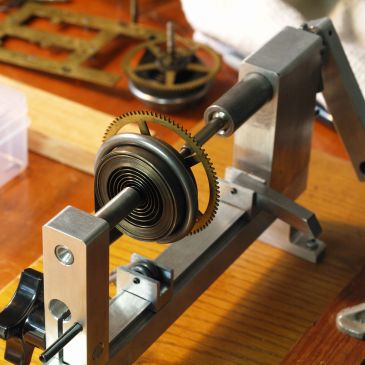
Spring winder: An essential tool. Disassembling clock movement also includes servicing the mainsprings. Mainsprings must be inspected for breaks, cracks and splits, cleaned of old oil and rust (as long as there is not too much rust) and lubricated prior to re-installing them into the movement. Too much rust and they should be discarded.  I generally do not replace springs in a movement unless they are quite set, or have breaks or cracks. I have found that the steel in the original movement is better quality than can be found today. Mounting the spring winder on a piece of hardwood provides a stable tool and allows it to be clamped to a work-desk.

Although there are other types of spring winders, the Olie Baker winder is one of the better choices in my view. It is well made and should last for years. If you can find a used one you will save a little.

Joe Collins has plans for a homemade spring winder that you can find on the National Association of Watch and Clock Collectors site.

Mainspring contained in a clamp
Mainspring servicing
Mainspring servicing; taking the clamp off to inspect and service the mainspring
Mainspring barrel
Mainspring barrels require collars supplied with the Olie Baker spring winder

Bergeon 6200 Bushing Machine: Some bush by hand and they are to be applauded for their patience and skill. I chose a bushing machine for the delicate work of installing bushings. This is the Bergeon 6200 which is made in Switzerland. It is exceptionally well made and relatively simple to use.

Chucks and reamers
Chucks and reamers

The machine can be bought separately or with a set of cutters and other hardware (above). The cutters can last 15 years or more. Of course, you must also have an assortment of correctly sized brass bushings that are purchased separately from any clock supply house.

To operate, a correct size cutter is placed in the bottom end of the steel shaft, holes are cut after which the new bushings are punched in place with a hammer head fitted to the shaft.

Bergeon Bushing Machine
Punching the bushing home
Pressing a brass bushing into the drilled pivot hole
Six bushings on back plate
Six new bushings on the back plate of a mantel clock

Lathe: Good quality mini lathe are available from Sherline, Taig and others. A cost effective option is the Taig Miniature Lathe for metal. The Taig lathe was originally designed for precision machining of watch and clock parts; ideal for clock repair applications. The small office space in my home means that its compactness, portability and relative simplicity are attractive features.

Taig lathe with 1/4 hp motor
Taig lathe with 1/4 hp Marathon motor

Reference/Reading material: I recommend the Steven Conover series of repair manuals. The manuals are well-written, and detailed and are great resources for the beginner or the advanced amateur.

  • Steven G. Conover; Clock Repair Basics
  • Steven G. Conover; Striking Clock Repair Guide
  • Steven G. Conover; Chime Clock Repair

The acquisition of clock supplies and equipment has been a personal journey for me. I started with a few basic tools for disassembling movements, gradually learning what additional tools were necessary and steadily expanding my collection over time.

Several years ago, my first major purchase was the Olie Baker spring winder. A few months later, I added a Bergeon bushing machine, complete with cutters and a supply of bushings. Most recently, I acquired a Taig mini lathe with accessories. This mini lathe will enable me to advance my clock repair skills by allowing me to polish and burnish pivots properly, replace worn or damaged pivots, and perform other specialized repairs. As new challenges arise, I plan to seek out additional specialized tools and equipment to further enhance my capabilities.

And finally

Set a specific goal, research your requirements, and build your collection of tools and equipment gradually while sticking to a reasonable budget. Clock repair can be more affordable than you might expect, especially when costs are spread out over time and some tools can be sourced from the used market.

I hope you found this helpful! If there’s a tool or piece of equipment you consider absolutely indispensable, I’d love to hear about it.

Using a macro lens to photograph your clock

Clock collecting and repair allows me to combine my other hobby, photography with the world of horology.

I have seen so many poor photos of clocks that I thought I would cover one small aspect of photography, macro photography. The following is a generalist approach to macro photography that is intended to allow the hobbyist to take more interesting photos of their clocks.  You can make macro photography as basic or as complex as you wish it to be. Here we are talking about normal macro as opposed to true macro when you are creating an extreme close-up image of an insect, for example. Normal macro is a sharp image of a tiny object requiring the lens to be positioned much closer to the object. You do not have to be a studio pro to take macro images but you should have a macro capable lens.

Most photos on my blog are taken with an 8 megapixel Olympus E330 SLR which I have had for about 10 years. It is coupled to a 50mm F2 lens macro lens purchased around the same time (equivalent 35mm focal distance of 100mm). For photo enthusiasts the lens has has 11 elements in 10 groups with a minimum focusing distance of 0.2m. In 2008 DPReview called the 50mm a “Superb image quality (lens) even wide open – sharp, distortion-free with no lateral Chromatic Aberration”.

I do not use a cellphone when taking clock pictures. Simply put, it is NOT the resolution, it is the lens

The 50mm lens is a true macro and it permits shots that would be otherwise impossible to take on a typical cellphone camera. I do not use a cellphone when taking clock pictures. It is NOT the resolution, it is the lens. There are occasions when I will use a more up-to-date camera such as my Panasonic G85 when taking some clock shots and all videos as the E330 is not video capable.

8 megapixel E330 with 50mm F2 lens, introduced in 2006; first DSLR with "Liveview"
8 megapixel E330 with 50mm F2 lens, introduced in 2006; first DSLR with “Liveview”

In some of the shots you will notice a purposely blurred out background. This is known as Bokeh. The degree of blurriness or Bokeh is an indicator of the quality of the lens but more importantly Bokeh allows the viewer to concentrate on the object in question without the distraction of a background. The decrease in sharpness is gradual on each side of the focused distance. This is accomplished by setting your camera lens to the widest possible setting (lower F stop, F2 for instance) and then focusing on one particular part of the frame. The contrast between in and out of focus portions of the frame concentrating around the subject and relative distance to other things in the frame creates a deeply enriched image.

E330 back view
E330 back view

A flash attachment like the Olympus FL-36 allows you to tailor the light for the scene. Make sure your camera has a hot-shoe for an external flash. Invest in an external flash unit with a 90 degree swivel (bounce) head. Buy the flash that is correct for your camera. You don’t need to spend a lot of money, external flash attachments can be very inexpensive.

When taking a flash picture indoors, turn off the camera’s built-in flash. Point the bounce flash head at the ceiling (rather than at the object) and take the picture. This will provide a soft, diffused light and it will cut down on reflections. Bouncing light creates a more natural effect rather a direct flash on an object which can be harsh and unattractive. Bouncing also works best with light coloured ceilings, white being the preferred colour. When there is no light to bounce off, a diffuser works well. The photo below shows the FL-35 with a diffuser (white rectangular shaped plastic top) attached.

E330 with Olympus flash

The top photo (Westclox LaSalle alarm clock) was shot with a white cloth background and a bounce flash.

Use auto white balance (AWB) in your camera settings. Shooting in JPEG is perfectly fine but for more control over the final result, shoot in RAW to correct colour temperature and exposure in post processing.

Rather than explain each shot I will allow the photos speak for themselves.

Floating balance from a Dugena mantel clock

Company name stamped on the movement
Company name stamped on an Arthur Pequegnat Brandon wall clock movement

Pendulum lock on a type 89 Seth Thomas Cottage clock movement

Brocot patented speed adjsutment
Brocot patented speed adjustment on French table clock

Centre shaft cam
Centre shaft cam, Sessions Westminster A mantel clock

Close-up of bushing wear
Close-up  showing extent of bushing wear on an American time and strike

Centre wheel
Centre wheel on a German time and strike mantel clock

Patent date of 1877 on back of an Ingraham Huron pendulum

Centre canon repair
Centre canon teeth repair on an Ingersoll Waterbury mantel clock

Reverse side of punched bushing
Reverse side of factory pressed bushing oil sinks

Bad trundles on a 30 hour Ogee
Bad trundles on a 30 hour Ogee lantern pinion

Star wheel on a Gustav Becker Vienna weight drive regulator

Worn click on Sessions Beveled No. 2 time and strike movement; narrow focus range. Only the centre is in focus.

Having a capable camera with a high quality macro lens is essential to clock repair.

In a future article I will explore lighting, exposure and other techniques to enhance your clock photos. If you have any questions please leave a comment.

Spring forward – fall back

At 2:00am Sunday morning!

If your country uses Daylight Saving Time (DST), you have to change your clocks twice a year.

Set your clocks forward 1 hour in the spring at the start of DST (Daylight Saving Time), and 1 hour back in the fall when DST ends. In North America the word “fall” is used to denote the season, while other English-speaking countries usually call it autumn. “Spring Forward – Fall Back” is therefore a phrase most often heard in the USA and Canada.

Records show that the phrase “spring forward, fall back” has been in use at least as far back as the early 20th century. It is the practice of advancing clocks during summer months so that evening daylight lasts longer, while sacrificing normal sunrise times.

Westclox alarm clock – non luminous LaSalle

The Westclox Clock Company is better known for various versions of Big Ben and Baby Ben windup alarm clocks produced from 1900 to the mid 1980s. But there were other windup models one of which is the Art Deco styled LaSalle series. This is the model 61-C (401) otherwise known as a Dura clock because they have nickel-plated, die-cast zinc cases made by The Dura Casting Corporation in the United States. There are 6 models in the LaSalle series and all use the Westclox type 61 Baby Ben, one day movement.

Westclox alarm
Westclox LaSalle alarm clock

Gee that old LaSalle ran great….those were the days! (a line borrowed from the theme song to All in the Family)

I have a modest collection of alarm clocks and if something interests me I will buy it. My wife found this Westclox Alarm clock at an antique store in Halifax (Nova Scotia, Canada). At $20 the price was right. It is solid, well made, attractive and partially assembled in Canada.

There is no information on which clock parts were made in Canada and which parts were manufactured in the Peterborough plant through the years

Westclox alarm back of clock
Westclox alarm back of clock showing winding mechanism; oftentimes knobs are missing on these old clocks

The LaSalle 400 series ran from 1930 to 1934. This is model 61C. The clock measures 3 1/8 inches high. The base is 3 1/4 inches and the depth is 1 3/4 inches.

Patent dates
Bottom of clock showing Patent dates & “Case made in USA by Dura”

Inside is a Baby Ben movement. The Baby Ben movement was first marketed in 1910 and first nationally advertised in 1915. The 5-year delay occurred because the company was going through organizational changes and it took 3 years to improve the reliability of the Baby Ben. The patent date on this clock is 1914.

In 1912 Westclox opened a sales office in Toronto, Canada as part of its policy to establish world markets. Somewhere between 1920 and 1922 production began at the plant in Peterborough, Canada. At that time parts were shipped from the LaSalle-Peru plant for final assembly in Canada. Unfortunately, there is no information on which clock parts were made in Canada and which parts were manufactured in the Peterborough plant through the years. Thousands of Big Ben and Baby Ben alarm clocks were manufactured and sold through the 1920s to the 1970s. In the early 1980s production in Canada stopped.

I avoid clocks with radium dials. Since radium has a half-life of hundreds of years even old radium dials are very hazardous. If working on a clock with a radium dial care should be taken to prevent the inhalation or ingestion of flakes or dust which may contain radioactive materials. In the past several years radium dials have largely been replaced by phosphorescent – or occasionally tritium-based light sources.

Side of alarm clock
Side view of alarm clock

I took the back cover off and found an inscription indicating that it was last serviced in 1955. The markings are unusual because alarm clocks rarely see servicing and once they stop they are simply discarded or used as paper weights.

That LaSalle may have run great at one time but not now. I can hear it ticking but once set down it abruptly stops. A thorough cleaning is required.

It is a nice piece of Canadian Horological history.

Happy Halloween

Halloween is a contraction of All Hallows Eve. It is a celebration which is observed in a number of countries and begins the 3 day observance of Allhallotide, a time to remember the dead and the faithfully departed.

Halloween includes trick or treating, going home to home in a guise or costume dressed up as ghosts, witches, skeletons or other characters, attending Halloween parties, carving pumpkins, lighting bonfires, visiting haunted attractions and watching horror films.

Halloween occurs a single night of the year and is spooky fun for both kids and adults alike.

A display of pumpkins

Having no clocks that would represent Halloween I did find a Steampunk clock here that I found quite fascinating.

Have a safe Halloween.

Canada Clock Co. – a cottage clock from the early 1880s

Case is in fair condition, dial face has some flaking
Case is in fair condition, dial face has some flaking, piece broken on left side of base

We have a couple of antique stores in our small town. Calling them antique stores is a bit of a stretch because there is usually more junk inside than actual antiques. We were shopping in the area of one of those “antique” stores and my wife turned to me and said, “Let’s go in”. I replied, “You know, all they have is junk”.

I thought, I might have found something important

I acquiesced. While she continued her shopping I went on ahead to look around the store and in the very back I saw a very sad looking clock that at I took for an old Sessions or a Waterbury.  As I neared the clock it piqued my interest and I began to see that it was quite old. I picked it up, looked for any markings on the dial face, found none then checked the back of the clock and discovered most of an intact label revealing a what I consider to be a significant find.

Back label in good condition for the age of the clock

It is a clock from the Canada Clock Company. The Hamilton Cottage Extra was one of a range of clocks in their Metropolitan line.

This is an important discovery. The owner of the store knew nothing about clocks. He was asking $99 but after a bit of haggling, we settled on $40. I knew that it was worth much more.

Here is an excerpt on the Canada Clock Co. found at the Canadian Clock Museum in Deep River Ontario (Canada).

This company was the last of three sequential attempts to produce clocks by factory methods in Canada during the 1872 – 1884 period.  The original effort by the Canada Clock Company in Whitby, Ontario was basically unsuccessful and only limited production was achieved.
 
In 1876, the equipment was relocated to Hamilton, Ontario to begin a second attempt as the Hamilton Clock Company, with new investors.  This attempt was more successful and a fairly wide range of clocks was produced.  However, sales were not very large and some of the investors left the company by 1879.  At that point the president, James Simpson, ended production and proceeded with a major reorganization.
The company subsequently became the Canada Clock Company using the old Hamilton Clock Company factory and resumed production in 1880 but as a result of poor sales closed its doors in 1884.
For more go to this page at the museum site.
Clocks from the Canada Clock Co.are sought after by collectors. For international readers this represents a rare find because the 1870s to the mid 1880s was a very important period for clock production in Canada. Apart from several independent clock-makers in Quebec and eastern Canada two notable companies made wholly Canadian clocks, The Arthur Pequegnat Clock Co. of Kitchener Ontario made clocks up to 1941 and Martin Cheney of Montreal made finely crafted clocks in the early 1820s. This clock was made at the Hamilton, Ontario factory which produced clocks from 1880 to 1884.

Original time and strike 30 hour movement
Original count wheel time and strike 30 hour movement

The 30-hour time and (bell) strike movement is in remarkably good condition and fairly clean. The back label in good condition for the age of the clock and there is a stamp on the top of the label which says, “…A Hill &Co.”. If any Hamiltonians are reading this I would be grateful if you could make inquires about this small retailer.
My preliminary examination reveals that this clock has had very few repairs over the years. I have not taken the movement out of its case to check bushing/gear wear and other issues but I am initially encouraged. The case reflects the age of the clock but I would judge the clock to be in just fair condition. There is a wooden piece that needs to be re-attached on the right side of the base. Fortunately that piece was tucked inside the clock case.

Right side needs work

Left side looks good

100+ years of grime came off easily
100+ years of grime came off easily; etched glass on the bottom part of the tablet is distinctive

The crudely made case is not overly decorative and reflects a muted Victorian style of the times. The lower part of the tablet has an etched glass floral design typically found in Canada Clock Company clocks. The door clasp is original. The dial face is flaked in places and not in the best of condition though the 2 floral designs on each bottom corner are nicely preserved. The hands are original. The case is not heavy and made of pine with a deep walnut stained finish. It was grimy and dirty as expected. It cleaned it up nicely with Murphy’s soap and a sharp hobby knife was used to remove the numerous paint drops on the clock. Why folks do not put something over the clock when painting a room amazes me.

I will put the clock aside until I can determine my next steps. Do I pursue a full restoration including renewing the dial face or leave the clock largely in as-found condition? In the meantime I will re-attach the wood piece on the left side of the base.

What would you do?


Tick Talk Tuesday #12 – Arthur Pequegnat Nelson hall clock

Tick-Talk Tuesday is about the letters and comments I have received from you, the reader, concerning your clock, issues you might have had and challenges you face and my responses to your questions with advice on your  particular clock concern and of course, my general comments. For those comments and questions that stump even me, I consult within my clock circle for the best possible answer.

NV writes about her Arthur Pequegnat Nelson hall (tall-case) clock.

“I have an antique, oak ‘hall’ clock that’s been handed down in my family. I read in an article you wrote that you collect them.

This clock was in my home growing up and my grandmother, now 96, reminds me of its history and knows whose home it was originally from in our family.(my grandfather’s grandparents, I believe). I’ve started to look into the history of these clocks.  I’m interested to know what your thoughts are if you are interested in sharing them.

I can tell you that it’s in beautiful condition, however although it had always worked and sounded well (still sounds beautiful) when it was shipped here to BC in the 90s, it was never restarted and the finial became dislodged, but it is not cracked or broken.  So it’d since been stored at my grandmother’s but she never got it going after it arrived and needs to ‘be started’ as the weights are still off (or possibly a repair?)  Also the key was lost.

I’ve just recently brought it to my apartment (Gramma wanted the space!) And she supports me in whether I decide to keep it or not.Please contact me if you are interested as I am considering selling but regardless I will need to determine value/appraisal if I do keep it, at least for insurance. ”

My reply.

“You have a real Canadian treasure. Though it is called a hall clock it’s actual name is the “Nelson”. There is one on display at the Canadian Clock Museum in Deep River Ontario. Unlike many tall case clocks that decline in value yours is actually increasing since it is continually sought after by collectors.  If it says Berlin on the lower part of the dial it was made before 1917. Clocks made after that simply said, “The Arthur Pequegnat Clock Company of Canada”. The Arthur Pequegnat Clock Company closed its doors in 1941.

The Nelson is in the middle

You can easily find a replacement key. Perrins would have the key although off hand I do not know the correct size. The finial on top is a friction fit.

It would be in the neighbourhood of $2000. You should keep it not only because it has strong sentimental value but it is an important part of Canadian history. It would also be worth repairing.

NV cannot keep the clock and has plans to sell it.

Website Powered by WordPress.com.

Up ↑