Smiths Enfield Art Deco mantel clock


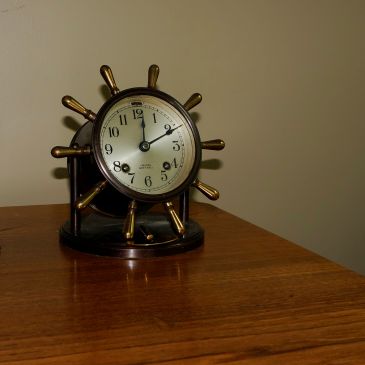
Smiths Enfield time and strike clock

I absolutely love Art Deco clocks. They are understated, elegant, have great collector value and are timeless, of course (!).

Although we tend to throw the term around loosely Art Deco is actually derived from the phrase Arts Décoratifs which was a dominant decorative art style of the 1920s and 1930s, it’s heyday. This unique form is characterized by precise, bold geometric shapes and strong contrasting colors, used most notably in household objects, and, of course, in clock design as we see here. Style Moderne (as Art Deco was otherwise known) originated in France and was centered in Paris, just before World War I and became very popular after the Great War (World War I). Perhaps the most visible example of Art Deco architecture is the Chrysler Building in New York City in this photo taken from the Empire State Building in 2014.

Chrysler Tower
Chrysler Tower, New York City

The Art Deco style had a far reaching influence and permanency that went far beyond the 20s and 30s through to articles, objects, architecture, furniture and yes, even clocks to this very day.

This is a Smiths Enfield Art Deco style clock. The Enfield Clock company was started by two German brothers in Enfield, North London, in the early twentieth century. During the Second World War (1939-1945) they were the major UK supplier for essential aircraft clocks and instruments. After the war the company vigorously resumed clock and watch production. No doubt most homes in Britain at that time had a Smiths clock. The Smiths Clock Co. became Smiths Enfield in 1949 and the Smiths Enfield name first appeared in catalogs from 1950 onward.

Smiths Enfield
Smiths Enfield clock
Smiths Enfield shelf clock
Smiths Enfield clock on a shelf

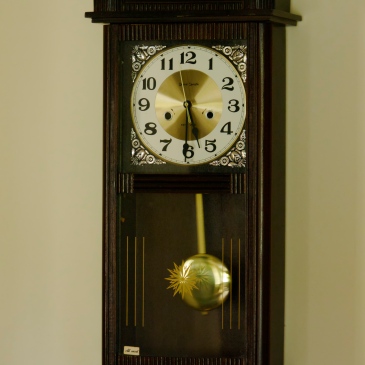
This elegant Smiths Enfield oak case time and strike shelf clock was made somewhere between 1949 and 1955. I know little of the provenance of this particular clock suffice to say that it came from overseas where it likely spent it’s life in someone’s home prior to coming to Canada about a year or two ago. The clerk at the antique shop located in Halliburton, Ontario this past summer (2016) told me that the owner of the shop purchases the bulk of his antiques from Ireland and judging from the store contents he imports a quite a lot of antiques and a lot of clocks.

The oak cabinet is made up of veneers and solids and is well constructed. The case is in excellent condition with nary a nick or scratch; required a soap and water cleaning and a little lemon-based furniture polish to bring the shine up. The clock runs well and keeps relatively good time although it certainly requires a thorough cleaning.

Floating balances were introduced by Smiths Enfield in 1956. Since this clock has a pendulum it was manufactured during the period I mentioned above (1949 to 1955). The inverted numbers on the lower clock face, which at first look strange, are actually very common on clocks with Roman Numerals.

OLYMPUS DIGITAL CAMERA
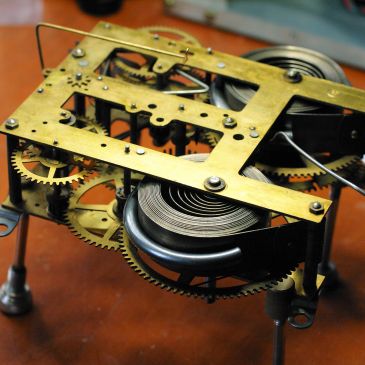
Movement showing coiled gong

It has a coiled gong and a nice pleasant strike if I can get the hammer to strike the gong as it should. A trial and error approach ensuring that the hammer is above but not quite touching the gong or replacement of the hammer leather are two possible solutions.

This is one of two cottage clocks I have. By that I mean they are literally at my summer cottage, and since it remains at my cottage a cleaning will have to wait until next summer.


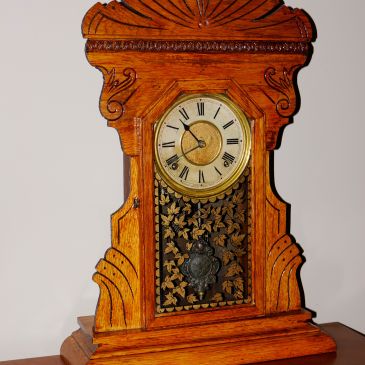
Ingersoll-Waterbury time and strike mantel clock

Ingersoll-Waterbury mantel clock

My next project is this vintage Ingersoll-Waterbury time and strike mantel clock. Ingersoll-Waterbury clocks were sold in Canada and had Canadian made cases using American made Waterbury movements. G.R. L’Esperance of Montreal were the sole distributors of Ingersoll-Waterbury clocks in Canada.

Waterbury has a long history going back to 1857. Like many American clock companies the Waterbury clock company had its boom periods (late 1800s) and its low period (1930s).  In 1942 a Norwegian company ended up buying the Ingersoll-Waterbury Company. They built a brand new factory in the nearby town of Middlebury, CT.  and in 1944 the company name was changed to United States Time Corporation; this clock was made prior to that year.

What makes this clock interesting is that it actually has a steel frame with a brass electro-plating. The plating was evidently used to stave off rust. It is very likely that this clock was made at some point through the war years (1941-44) when brass was in high demand hence the use of steel for the plates. To accommodate the pivots, brass bushings which were pressed into the steel pivot holes at the factory. My only other experience with steel plates is my Arthur Pequegnat Maple Leaf kitchen clock which has nickle-plated steel plates. The Maple Leaf by Arthur Pequegnat is shown in this next photo.

Arthur Pequegnat Maple Leaf kitchen clock
Arthur Pequegnat Maple Leaf kitchen clock with nickle-plated movement
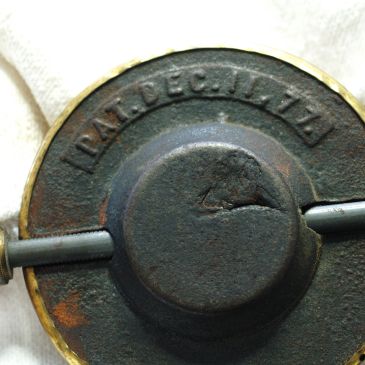
Waterbury back plate

As you can see the movement is quite dirty and will require a thorough cleaning which can only be accomplished by a complete dis-assembly. Once disassembled comes the inspection and servicing.

Centre canon repair
Centre canon repair
Punch mark adjacent to bushing
Reverse side of punched bushing
Reverse side of punched bushing showing oil cup

This clock has never been bushed. The punch marks found adjacent to three of the bushings were likely factory made to set the bushings in place. There is one tooth repair (fourth photo) on the centre canon gear which appears to be the only evidence of work performed on this clock after it left the factory and the only indication that this clock was ever serviced.

The case is in very good condition requiring only a cleaning and polishing. I may touch up the clock hands with a little white paint.

I have determined that only 5 bushings need to be “replaced”, so time to get started. I will report on my progress with this clock in an upcoming article.

Copyright, what does it mean for you and me?

The other day, I was browsing through a local online for-sale site looking for antique and vintage clocks and saw a Mauthe Westminster chime mantel clock for sale. From the photo it looked great. But wait!

Here is one photo from the ad.

RS Mauthe mantle clock (11)
Mauthe mantel clock

Why would I post a photo from the ad? Simple. It is my photo. The seller had the identical clock for sale and thought he would use my image to promote the offering. In my view he committed two fundamental errors. First he used a protected image without permission and second he was misrepresenting the ad by using my image for a clock he was promoting.

I corresponded with the seller, told him that he could not use my photos because they are copyright protected. He argued that unless it expressly states that it is copy-protected he is free to use any image he wants. After I threatened to advise the site administrators of his use of my photos he took the photos down. Copyright law regarding photos can be vague though the simple rule of thumb is that it you have any doubts about the use of a photo don’t use it. Had the seller contacted me and asked for permission, that would have been a different story and at least I would have been able to exercise my right to grant permission or not.

From the time it is created, a photo or other image is automatically protected by copyright. Infringement can include the use of whole or part of a photo without permission as in this particular case. Just because an image is on the internet, it doesn’t mean the image is free to use. Many people do not fully realize this. If the image is free to use it will say “in the public domain”. The law is very clear on this.

Needless to say all images on this blog are owned by me and for good reason!

A Pig in a Poke

“A pig in a poke” is an old expression but it still has relevance in the clock world today. What does it mean? It means something that is bought or accepted without knowing its value or seeing it first. Or, another way of putting it, a deal that is foolishly accepted without being examined first. If you have been to a live auction you might have experienced winning a bid on that seemingly expensive hall table, for example, only to find it was made in Indonesia.

My own personal example. I bought an antique wall clock (100+ years old) on EBay a year ago and from the write-up it looked great. I was eager to see it. When it arrived I began to notice a few things right away and little details later on despite the description that it was “all original”. The glass on all three sides was said to be original, clearly it was not. The clock hands were off of an Ogee clock and poorly attached, The movement was made during the same period the clock was made however the pendulum sits very low in the case leading me to believe that it (the movement) may not be original. The rod gong was probably added later. Normally the gong is in back of the pendulum. There are two different styles of weights though the differences are almost imperceptible. I could go on but the point is this: do not trust any seller absolutely in your online dealings. Luckily for me the clock works and shows well.

Gustav Becker two weight regulator
Gustav Becker two weight “Vienna Regulator”

Typically sellers will describe just about everything they feel the buyer needs to know but leave out essential details. This is called omission. It means that something in the description is deliberately left out for whatever reason. Is it unethical? Perhaps. However, sellers do not have an obligation to tell you everything about an item you are interested in since there are no disclosure laws in online dealing. That is why it is important to ask questions, lots of questions prior to any purchase.

The other day I followed postings on Facebook regarding a clock purchase. The person was quite proud of the fact that he had an attractive Art Deco clock coming in the mail. He provided only one photo of the clock showing its face and base. The style was similar to this clock.

Kienzle World Time clock

It was the only photo provided by the seller and with good reason. It was advertised as an 8-day clock because that is what it said on the clock face. It arrived several days later. This individual thought he was getting a mechanical clock but discovered when it arrived that the original movement had been taken out and replaced with a cheap quartz movement. Naturally he was dismayed. Caveat Emptor some would say but in this case the seller could have been more forthright. However, let me reiterate, the time to ask key questions is before the purchase.

The other day, again on Facebook, a fellow had bought a German box clock very similar to this one from my collection. When it arrived he proudly showed off his new acquisition.

after a good cleaning (4)
U M Muller German “box clock”, time and strike

The clock was keeping great time though the pendulum was very high up in the box and could barely be seen through the front glazing. It looked very odd. When he presented a photo of the inside of the clock it was clear that the seat board was handmade and it was obvious that the movement was originally mounted within a much smaller case.

Some weeks ago I was looking for banjo clock and I saw a couple on a local for-sale site. One was very intriguing. The only photo was of the outside of the clock; nothing showing the movement. I thought if it is weight driven it would be an excellent deal. I contacted the seller by email and  I asked if it were weight driven and he said he thought so but he also mentioned that it came with a winding key for the spring. Thanks I said.

Let the buyer beware. If you buy something you take responsibility to make sure it is what you intended to buy. Ask enough questions so that you are absolutely satisfied you know what you are getting otherwise you may be getting a pig in a poke.

Let me know if you have had similar experiences.

Servicing a Sessions American No. 2 mantel clock Part IV

In this fourth and final entry of the series I will discuss bushing work, re-assembly and finally, testing and mounting the movement back into it’s case. Part I of this series can be found here, Part II here and Part III here,

Once the pivots are inspected, cleaned and polished it is now time to install any bushings required as result of careful inspection.

Bergeon Bushing Machine

I acquired a Bergeon Bushing Machine in the spring of this year (2016). As I mentioned in Part III, some may prefer to bush by hand which I think is commendable but I have decided to go the bushing machine route. In the last few months I have been using and learning its many tools. It comes with a set of chucks and reamers some of which (right side rear) are a bit of a mystery to me. I cannot see using any of the large reamers any time soon though I assume that if I am working on tall-case clocks which have larger movements they would come in handy.

Chucks and reamers
Chucks and reamers

First is selecting the correct bushing using a micrometer to measure the diameter of the pivot. Then, I select the proper bushing from my Bergeon assortment kit.

Using a micrometer to check pivot
Using a micrometer to check pivot diameter on the escape wheel

The bushing I have selected for the escape wheel pivot (measured at 1.46 mm) has a depth of 2 mm, an outside diameter of 3.5 mm and a pivot hole of 1.5 mm.  In the next photo I am positioning it on top of the 3.47 mm. hole that I have just just “drilled” using one of the reamers. The outside diameter of the bushing is slightly larger allowing for a tight friction fit.

Punching the bushing home
Positioning the bushing on the Bergeon Bushing Machine

OLYMPUS DIGITAL CAMERA
Bushing installed

Once I have selected the correct bushing I test it on the pivot for fit and then I position it over the pivot hole and use a small hammer with it’s nylon end to tap the top of the bushing machine centre shaft lightly until the bushing is properly seated and level with the plate ensuring that the oil sink faces the outside of the plate.

New bushing installed
New bushing installed with oil sink on the outside of the plate

To check proper fitment of the motion works bushings/pivots, I assemble all the wheels on that side (both plates), check for a smooth action and determine if any additional reaming/smoothing is required. I do the same for the strike side.

Once all the bushing work is completed and I am satisfied that each bushing fits correctly and operates smoothly, I re-assemble the mainsprings, wheels and levers and then re-attach the back plate using the five plate screws. We each have our own method of re-attaching the back plate but I work from the bottom up, that is, from the mainsprings. Once I have the mainsprings in place I immediately install the bottom 2 plate screws (loosely) and then work from the motion works side to the strike side using a pivot locator tool, if necessary, to coax the pivots into their respective holes.

Trains and levers ready for the front plate

Positioning the various levers can be a bit frustrating because those that have helper springs seem to slip out of their pivot holes easily as you are putting the plates together. Perseverance is certainly the key.

The one difficulty I had was adjusting the synchronization of the count and drop levers, that is, getting the drop lever to sit in the cam while I adjusted the locking lever position. The clock must be completely assembled at this point and once together loosen or take off the nearest pillar nut and pry the plates apart to take out both the flywheel and the locking wheel. Once out, the locking wheel can be re-positioned by moving the pin on the wheel so it rests on the locking lever. Once this is completed, re-install the flywheel. This is basically a trial and error process and I never seem to get it right the first time.

My only error in the first go-around was not restraining the strike mainspring during this procedure. While spinning wildly the strike mainspring flattened the protrusions off the cam that allows the hammer strike. Momentary panic! Once bent back into shape everything was fine. Naturally, I secured the mainspring for my second successful attempt.

My reference for these adjustments is Steven Conover’s Striking Clock Repair Guide which is an invaluable guide to striking American clocks.

Once the parts are re-assembled it is on to the final testing phase which takes days (and weeks, perhaps) as the clock is being carefully regulated. The following video shows the movement on a test stand (in this case, Gene’s Test Movement Stand). The sound of the pallet on the escape wheel is very quiet; you are hearing other clocks in this room. The clock is in beat and in the video you can see the movement of the escape wheel from various perspectives.

Sessions American No. 2
The movement is returned to it’s case

Once testing and regulating is completed and I am satisfied the clock will run reliably for 8 days I return it to it’s case. There are only 4 mounting screws. You may have to re-position the coil gong by loosening the adjustment nut on bottom of case to get that satisfying strike sound.

This attractive little Sessions American No. 2 time and strike mantel clock has now been serviced. It required 5 bushings and should run reliably for the next 3-5 years.

Servicing a Sessions American No. 2 mantel clock Part III

Sessions American No. 2

The movement is disassembled and now it is time for further inspection, cleaning, servicing the mainsprings, pegging the pivot holes, polishing the pivots and installing bushings where needed. In this, Part III we will cover cleaning and mainspring servicing.

Ultrasonic cleaner
Ultrasonic cleaner

I have a small ultrasonic cleaner so I tend to clean parts in batches since this one does not have a large capacity. An ultrasonic cleaner is not an absolute must as you can easily clean by hand but having one certainly helps.

Front and back plates

Old toothbrushes are great for getting into the crevices and I use one especially for the lantern pinions as a lot of dirt and old oil tend to accumulate in those particular areas.

indicating wjehere bushings will be installed
indicating where bushings will be installed

This photo shows a couple of bushings that I will install. I realize that some prefer to install bushings by hand and I applaud them as it does take considerable skill but I use a Bergeon Bushing Machine which I believe simplifies the task (for me, at least). More on bushing in the next part of this series.

Olie Baker spring winder

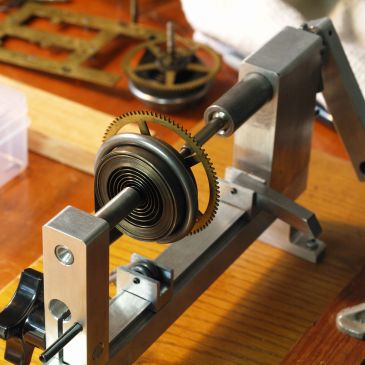
An Olie Baker spring winder is an indispensable tool. You can easily make one of your own to save a little money if you are handy with building things. A spring winder permits you to inspect for cracks or breaks, clean and oil the springs before reinstalling them. The photo shows a C-clamp securing the mainspring prior to cleaning.

OLYMPUS DIGITAL CAMERA
leather gloves are used to secure the spring on the winder

I have never lost an eye or a finger but I believe in safety first especially when working with mainsprings. Always wear leather gloves and eye protection. You never know when a 100 year old spring will break and fly across the room.

Click replaced
Click replaced

I discovered that one click had to be replaced as it was almost slipping off the ratchet. As some clock repair folks know, Sessions clocks have a reputation for bad clicks. I had a Sessions click in my supply box, fortunately. It is an easy job; just take the old one out with pliers, secure the new click and bang the rivet (supplied) into the existing hole with a ball peen hammer.

Serviced springs
Serviced springs

The springs have been cleaned and oiled with Keystone Mainspring Oil and are completely serviced including the installation of one new click. Now comes the bushing work, re-assembly and testing. Stay tuned to Part IV of this series.

Kienzle World Time clock – a second look

Kienzle World Time clock

I put a quick article together on my newly acquired modern Art Deco brass Kienzle World desk clock in August and with only one photo in my post I really did not do this fine looking timepiece any justice. I hope the following  photos will show that this clock really impresses. As I mentioned in my last post regarding this clock, this is one of many clocks conceived by renounced German designer Heinrich Moeller. Moeller, who was trained as a cabinet maker, began working with Kienzle as chief designer in 1931 and through to about 1970.

On display
On display with Ingraham Huron

This vintage clock is from the period 1950 to 1960 judging from the many offerings on EBay. I noticed that this style is occasionally advertised as a 1960s clock but judging from others I have seen I am fairly confident that this is from 1950 give or take a year. This style seems to be the most desirable of the series. Later ones had quartz movements and were in less demand, judging from the lower prices. The weight is very substantial and it measures 13 and 3/4″H X 10″W X,  2 and 1/2″D.

Back of Kienzle clock
Back showing winding key, speed adjustment access port and time adjustment knob
OLYMPUS DIGITAL CAMERA
Brass bezel

This clock is in excellent condition with minimal wear and tarnish. In fact, observe the front and side views for an appreciation of the pristine condition of this clock.  The case was grimy as one might expect and a little polish brought up the finish very nicely.

Quite often small parts are missing in clocks such as this, for example, the time adjustment knob or the cover for the speed control needle. In this case  everything is completely intact. It is in very good working order and will run for a full 8 days.

Brass base
Decorative brass base

Will I service it? I am not sure. According to comments on the NAWCC message board some members have not had much luck working with this clock. Given that it seems to have had minimal wear and tear it may not have had a lot of use over the years so it might be wise to leave well enough alone, for now. I would like to oil it, however!

Winding crank
Winding crank
Time sequencer
Aperture for the 24-hour day and night indication

I am very pleased with this acquisition. The clock is certainly a singular work of elegance, magnificence, style and a stand-out in any room.

Servicing a Sessions American No. 2 mantel clock Part II

Sessions American No. 2
Sessions American No. 2 time and strike

Top plate is off
Top plate is off

This is  Part II of the Sessions American No. 2 servicing. As I mentioned in my last blog entry (Part I) this clock was running but is in need of a little attention. This is a fairly simple clock to work on for an American time and strike movement. I cannot stress enough that photos are so important when working on clocks! They are a valuable reference which take a lot of the guessing out of re-assembly.

The clock is now ready for the parts to be taken off, organized in a parts container, inspected, cleaned and serviced.

Time side spring is removed
Motion works mainspring is removed

X marks pivot holes that need to be bushed

This the back plate. No bushings have been installed but following my inspection a number of bushings are required, three in this particular corner. The topmost “X” is the location of the escape wheel. I always mark the suspect pivot holes with a marker so that I know what work needs to be performed on those specific pivot holes.

Dis-assembly is rarely an issue when working on these clocks. However, the helper springs (see arrow below) can be damaged and although they look like they might have been added by later clock repair they are indeed part of the original design and assembly of the movement and perform a vital function.  Be very careful with them though if broken they can be replaced. The helper springs and levers can be frustrating to work with particularly when lining up the levers correctly and re-positioning the helper springs upon re-assembly.

Removing lever with helper spring
Removing count wheel lever/helper spring

Removing the count wheel

The count wheel is secured by this washer. make sure it goes back in the same way it came out.

Marking the count wheel

Putting the count wheel in backwards will not stop the clock but it will count down the hours, not good! Not making the same mistake again I mark the count wheel so that I know that it goes in right the first time.

Time and strike parts
Motion works and strike parts separated

We each have our own way of doing things but I find it very helpful to separate the time and strike sides prior to re-assembly. It avoids confusion and makes for a more simplified process when working on your clock.

Now that the clock is disassembled it now time for further inspection, cleaning, installing bushings, and polishing the pivots which you will find in Part III.

Servicing a Sessions American No. 2 mantel clock, Part I

Sessions American No. 2

I am going to take you, the reader, through the process I follow when servicing a clock. There will be several posts in this series. I am not a trained expert in clock repair, nor do I do this for profit and have learned most of what I know through trial and error, careful study and of course, listening to the advice of many experts and newfound friends on the forum site at NAWCC.

If you into clock collecting you’ve probably seen one of these mantel clocks at one time or another in your travels. Literally thousands were made. This attractive little mission styled oak-cased time and strike mantel clock is a Sessions “American No. 2” dating from 1921 according to Trans Sessions book, page 121.

When I opened the back access panel to service the movement I discovered an inscription which reads, “Jim A. Kennedy, Nov 3/63, a clear, cold nite”. One can only imagine that on that particular clear, cold night, Jim A. Kennedy was doing some work on this lovely clock. It does not say where Jim lived but Jim, wherever you are and if you are still with us, your clock lives on.

Although this clock has been running steadily since I acquired it about two years ago, the time is right to put it on the workbench. American made clocks like this tend to run on and on despite requiring much needed bushing work and this one is no exception, but now it needs some loving.

I took the movement out of it’s case and examined it closely. Fortunately it has not been botched by poor repairs over the years that one sees from time to time. Things looked good, no surprises. Although no bushings have been installed on the top (back) plate there were five bushings that were installed on the bottom (front) plate at some point in this clock’s life, perhaps on that cold, clear evening in November. My initial inspection reveals that there is wear in some pivot holes and that six bushings must be installed on the back plate and of the five previously installed bushings on the front plate, two need to be replaced and at least one new bushing is required on the pallet arbor.

Although the movement appears clean at first glance it really is very dirty. This is an example of the sludge (indicated by the arrow) that has built up in this particular pivot over the years. There are other such examples on this movement.

top plate showing a build-up of dirt around a pivot hole
Top plate showing a build-up of dirt around a pivot hole

Once I tear it down completely I will be able to determine the condition of the pivots and other moving parts. I intend to clean the entire clock and clean/oil the springs as well as replace/install the aforementioned bushings. My first impression is that the mainsprings are in good condition. The clock easily ran eight days on a wind. The clicks are another matter. At least one looks like it needs replacement. Sessions clocks are notorious for their bad clicks but to put things in perspective the clicks have been in this clock likely since it was made (or perhaps 1961).

Time and strike movement with single hammer strike on a coiled gong

The escape wheel teeth may need to be filed but I will determine if filing is required once I inspect it more thoroughly.

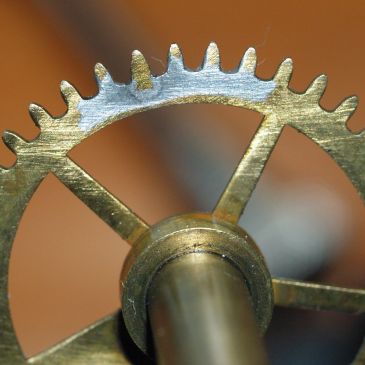
escape wheel tooth tips
Escape wheel tooth tips

Safety first. The first task other than taking the suspension spring/rod/bob off the movement is to secure the mainsprings using mainspring clamps that are available at any clock supply store. Mainsprings can be very dangerous and it is important to contain their power when working on a clock. I always wear eye protection and leather work gloves before I let the mainsprings down with a let down key. Once you’ve released the clock from the ratchet by moving the retaining spring out of the way, the power of the spring is transferred to the let down key which allows one to gently release it until it is contained in the C-clamp. After the springs are restrained you can safely disassemble the clock.

Let down key and C-clamp

.

Movement on stands
Movement on stands

The clock is now ready to be disassembled. Tune into Part II where I will post photos of the complete disassembly stage and report on what further work needs to be done.

So, my sister also loves clocks

After not having visited my sister in some time I was surprised to find that she is an avid clock collector. I must stress the word collector because although she appreciates the beauty of each clock she has acquired over the years how they run is somewhat of a mystery to her and that is just fine. While visiting her this summer three of her clocks were out of adjustment and it took no time (no pun intended) at all to get them running again. No sense paying someone to do it, that`s what brothers are for.

In my opinion the most interesting clock she has is a French time and strike bracket clock that has no visible markings yet appears to be over 100 years old. It is in beautiful condition with only a slight patina on the finish. I would love to have found out more about this clock but my stay was brief. Perhaps next time.

French bracket clock

The next clock is one my sister absolutely loves and it is a great sounding Westminster chime grandmother clock she bought some 20+ years ago. This quarter chime clock made by Craftline Industries in the early 1990s has a Canadian made case with a German movement, likely by Hermle.

Craftline grandmother clock

Next is a curiosity. When I saw the Sessions name on the dial I wondered why I had not seen this particular style of Sessions clock. Further investigation revealed it to be a six pillar Adamantine Seth Thomas case. The movement was clearly marked ST and as I said the case is certainly a Seth Thomas. So, why the Sessions clock face? Likely the original dial face was so badly marred as to be unreadable that the owner many years ago simply told the clock repair person to find another face, which he did. Since the replacement was a Sessions electric clock face he had to drills the holes to accommodate the winding arbors. Who would know! To those less knowledgeable it looks great.

Session Seth Thomas mantel clock
Sessions / Seth Thomas mantel clock

I found this little antique time-only Hamilton and Co. French-style carriage clock made in India (Calcutta) to be very interesting and so diminutive. Hamilton and Co. is probably the best known and most celebrated British clock maker in India. I would put this clock at around the 1890s. It probably needs a good cleaning since it is not in working order.

Hamilton and Co Calcutta
Hamilton and Co. Calcutta

I am not a huge fan of steeple clocks but this Waterbury clock is in very good condition save for a damaged right steeple tip. The Waterbury Clock Company is one of many 19th century Connecticut-based clock firms with a history going back to the 1850s though it closed is doors for good in 1944. More memorable are Waterbury wall and mantel clocks but like many makers of the day they had a successful line of steeple clocks.

Waterbury steeple clock

Next is a New Haven time and strike tambour style mantel clock from about the late 1920s or early 1930s. Aside from the grandmother clock which my sister bought new the New Haven mantel clock was a wedding gift of her late husband’s parents and has been in the family ever since.

New Haven Mantel clock

Lastly, this Chelsea ship’s bell clock is a polished beauty. A ship’s bell is used to indicate the time aboard a ship and hence to regulate the sailors’ duty watches. Unlike normal clock bells, the strikes of the bell do not correspond to the number of the hour. Instead, there are eight bells, one for each half-hour of a four-hour watch. Three bells, for example, would mean that a sailor would be 1 1/2 hours into a 4 hour watch. Each watch would take its turn with the essential activities of manning the ship’s helm, navigating and keeping a lookout.

Chelsea ship's bell cloc
Chelsea ship’s bell clock

I was quite impressed with my sister`s collection and each clock occupies a special place in her home. I find it facinating going into peoples homes and discovering the joy they experience in collecting, be it clocks in this case or anything for that matter. Collectors are truly unique people!


Hugh Gordon longcase clock

Hugh Gordon, clock-maker worked in Aberdeen, Scotland from 1748-90. He had previously worked in Edinburgh and London. Although a very proficient maker little of his work seems to have survived.

Hugh Gordon throat
Hugh Gordon tall-case clock

This is a friend’s clock and I was asked to research it. Unfortunately, I have discovered very little so far.

Hugh Gordon clock
Hugh Gordon tall-case clock

This time and strike clock is an excellent example of Scottish style and was likely made between 1760 to 1770 judging by the design of the spandrels.

Hugh Gordon face, hands and spandrels

Hugh Gordon bonnet and face
Hugh Gordon pagoda hood and face

It features a second hand just below the 12 o’clock position and a single date aperture just beneath the hour pipe. It is a nicely proportioned clock with a tall centre throat and pagoda-styled top bonnet; the centre engraving is a typical feature of the Scottish clocks of the latter part of the 18th century as is the box calendar opening (date aperture), side glass on either side of the hood and doped canvas top cover. These clocks are not overly tall at about 7′.

It is missing three finials; one on top and on the left and right front corners. The mounting holes were evidently covered up by a later canvas re-application. The chapter ring and dial centre would have been silvered at one time and rubbed clean by over-polishing through the years. The hour hand looks correct but the original minute hand would have had a serpentine design in keeping with the hour hand.

Hugh Gordon face and hands

This clock has been in my friend’s family since 1850 having been brought over by ship when his ancestors immigrated to Canada. It has survived quite well and it has been well taken care of.

It is not in running order. I suggested that my friend seek a clock repair person (horologist) who is knowledgeable in the repair of antique tall-case clocks particularly with clocks of this era as special care and attention is required if parts need to be rebuilt/repaired to remain consistent with the period.

Upcoming clock articles

Now that I am back on my regular schedule I can begin work on some upcoming articles. In the days and weeks to come I will be reporting on a visit to my sister’s home and talk about her small collection of interesting clocks and a friend’s most interesting antique tall-case clock that came all the way from Scotland.

I will report further on some interesting aspects of my Kienzle World Time shelf clock as well as my newly acquired Smith Enfield Art Deco mantel clock.

I will also begin repairing a Sessions American No. 2 that I will report on in a multi-part article.

In addition I will have an article about the various clocks I discovered in my travels throughout the province of Quebec (Canada) this past summer. Due to time constraints I was unable to make my annual visit to the Canadian Clock Museum in Deep River, Ontario but I am back to that area in October so I will give it another try.

I am looking froward to returning into my regular routine. Please let me know if you have any thoughts or comments about future articles of interest.

Kienzle World Clock

Kienzle World Clock
Kienzle World Clock

I acquired this mechanical Kienzle World Time clock recently from an antique shop in Quebec.

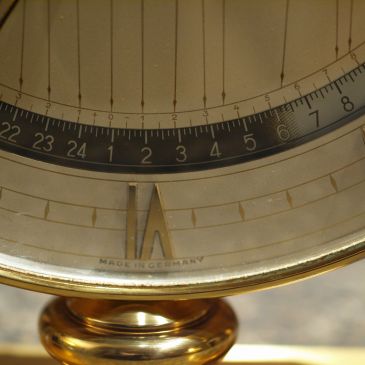
No matter where you are in the world this clock will tell you the local time. Quite ingenious! This is accomplished through a rotating hour indicator in the lower half of the clock. As the time advances the indicator moves along with it thus enabling the user to line up the distant hour according to where you are in the world. This is one of many clocks conceived by renounced German designer Heinrich Moeller. Moeller, who was trained as a cabinet maker, began working with Kienzle in 1931 and presumably through to the mid century. This vintage clock probably originates from the early 1950s.

This clock is in excellent condition as the brass seems well preserved. I would imagine it as a stunning clock in any environment. I would assume that it might have been sold as a promotional item or could have found it way into many executive office milieus. One can just imagine an import/export dealer 60 years ago who would need to know the time in many parts of the world.

I found an excellent description from this site. The clock is described as “circular, brushed brass, moulded and rectangular base, convex glass. Brushed silvered with applied gilt brass radial Roman numerals, outer minute track, the center with world planisphere and the names of 42 world cities and countries, aperture for the 24-hour day and night indication, scale above to calculate the world time. Gilt brass tapered baton hands. Lever escapement, three-arm balance, index regulator. Diam. 26 cm.” Curiously, the number 4 is expressed as IV rather than IIII found typically on Roman Numeral clocks.

Sessions clock final thoughts

Sessions movement
Sessions movement in the process of repair

Regular readers have followed my progress on this 1927 Sessions tambour style clock.

Better news this time. After installing 10 bushings, repairing the strike click, replacing the pendulum bob and suspension spring and reassembling and oiling the clock and the springs I am having excellent success regulating this fine old clock. On a full wind I am getting upwards of 9 days and typically eight days through the summer. Though it sits inside our cottage in Quebec it has suffered through all manner of outside weather including high humidity and cool nights and despite these conditions it has performed admirably.

Although originally intended as a cottage clock I will be taking this clock back with me and placing it in a prominent place in my home.

All in all a great learning experience and a satisfying result.

How to oil your mechanical clock

Oiling your mechanical clock is an essential part of its maintenance, ensuring smooth operation and longevity. Proper lubrication reduces friction between moving parts, preventing wear and tear while keeping the movement running smoothly over time.

During the summer of 2016, my wife and I were traveling through the Muskoka area of the province of Ontario and stopped at a quaint village called Halliburton where we happened upon the only antique shop in town. There were a large number of clocks in the store that the proprietor had brought over from Ireland and each one was interesting.

Though there were plenty to choose from we settled on a Smiths Enfield Art Deco style oak cased mantel clock pictured below.

Smiths Enfield
Smiths Enfield time and strike

It was sold as-is and non-working, with the clerk noting that the pendulum bob was missing, which explained a lower price. However, when I got the clock home, I discovered the bob wrapped in brown paper along with the key, tucked inside the clock. After attaching the pendulum bob to the rod and a bit of adjustment, I found the correct beat, and the clock started running.

At my summer place, I do not have the necessary tools to service clocks but decided to take the movement out to oil it.

Once out of the case, I discovered that someone had oiled the movement by spraying it with an unknown lubricant. Spraying a clock with any lubricant is a bad practice. Indiscriminate oiling attracts dust and grime that will accelerate wear and eventually lead to stoppage.

Given the indiscriminate use of oil, there was no sense in operating the clock so I decided to put it aside until I got home where I could disassemble, clean, and properly service the movement.

Oiling Your Mechanical Clock

Lubrication is essential to the good running of any clock movement. Oiling a movement without first dissembling and cleaning it is normally a bad practice. The addition of new lubricant to old will mix with the dirt and grime to form a paste which acts as an abrasive that will hasten pivot and pivot hole wear.

The purpose of lubrication is to reduce wear, and applying the correct amount of oil is crucial. The only exception to this is when the oil sinks are dry— in such cases, oiling the movement without disassembling it is acceptable.

Apply only as much oil as required, a tiny drop goes a long way. Clock oil should occupy about one-half the capacity of the oil reservoir. Use an approved clock oil and a pin-type oiler to apply the oil.

Clock pivot oil
Clock pivot oil

Key Points Regarding Oiling

Lubricant: clock oil has the correct viscosity and has a low tendency to evaporate, spread or react adversely to various metals. Pivot oil is for pivots and spring oil is for springs; there is a difference! Clock suppliers such as Timesavers or Perrin will shave the correct oil for your clock. Do not uses household lubricants and especially WD 40 which is not a lubricant but a water dispersing agent. Synthetic oil is preferred since it retains its properties for a longer period but I work with mineral oil which is cheaper and just as effective.

When to oil: Some say that one should apply oil only after disassembling and cleaning. Others say that a clock’s service cycle might be an average of 5 years or more and oiling every two or three years without a thorough cleaning is acceptable. If there is a visible build-up of black, contaminated oily sludge in the pivot holes, a disassembly and thorough cleaning is necessary prior to oiling. A clock’s the environment will play a significant role since dusty, smoky environments contribute to accelerated wear. A sealed case will also keep out dust and lengthen the cycles between oiling.

How much oil: After oiling there should be a visible presence of oil in the oil sinks around the pivot holes. Oil running down the plates is to be avoided and is a indication that too much oil has been applied. I use a clock oiler with dispenser. Oil cup reservoirs are also very helpful as they prevent any foreign material from getting into the oil bottle when dipping with a pin type applicator. Long case clocks with larger pivot holes will require more oil than a small carriage clock.

clock oiler with dispenser

What to oil: While looking at a clock plate (front or back) work from the top to the bottom. First and foremost are the pivot holes in the plate, then the points of contact between the pendulum and the crutch, escapement pallets faces and centre and motion works arbours. I generally do not apply lubricant to the mainsprings unless I have unwound them. Once out of the clock and assessed as to their condition and cleaned, I apply Keystone mainspring oil prior to re-installation. Do not oil the gear teeth.

Mainspring winder

This short primer on oiling your clock is not meant to be a definitive guide but will give you enough information to get you started if you have just found that mechanical clock you have always wanted.

In conclusion, a properly oiled clock, combined with regular servicing, is key to maintaining its functionality and extending its lifespan. Regular lubrication helps reduce friction between the moving parts, ensuring smooth operation and minimizing wear and tear. By performing periodic maintenance, such as cleaning and oiling, you can keep the clock running efficiently for many years, preserving both its accuracy and its value.

For more information on clock lubrication, I suggest the forum site at the National Association of Watch and Clock Collectors where you can find many expert opinions.

8500 views and climbing

Clock hands Vienna Regulator
Clock hands for a Gustav Becker wall clock

In the year or so I have been running this blog I never imagined that it would have achieved so much. It is at 8500 and climbing page-views.

In the late spring of 2015 I attended a workshop on WordPress blogging. I was impressed how a powerful blog tool it is. I had already had some experience blogging and still maintain my Blogspot site though it was always intended to be a general interest blog only. However, I had been collecting antique and vintage clocks for about 4 years and I wanted to narrow the focus to clock collecting / repair so this was a good time to start a brand new blog and explore something more in line with my current interests.

Like any blog the first 2-3 months was a little discouraging. I was getting very few page-views, struggled with the content and tried to improve my writing style. I am sure that many out there become frustrated to the point of quitting but I was determined to press on.

Things began to pick up in the fall of 2015 with a steady increase in daily page-views. Obviously someone out there in cyberspace was interested in what I had to say. It is a lot of work and I also discovered that to improve traction to the site I had to reach a wider audience and use social media more effectively. I slowly learned that I had to not only appeal to those with a modest interest in antique clocks but those with a deeper knowledge thereby striking what I think is a comfortable balance.

Because my own knowledge about clocks was expanding I was more at ease with the content and I was developing a writing style that felt more like me. I also learned that in writing one has to edit often to ensure that the message is exactly what you intend it to be. I often save up to 20+ drafts before I publish (yes, WordPress has a really nice “save draft” feature.

I have received many comments in the last few months. Some offer suggestions and advice on projects I am working on while others are looking for direction on their particular clock problem. As for for advice given to me, I do what I can within the limits of my knowledge. Even those readers with more extensive knowledge graciously comment which I appreciate. Suggestions and the critiquing my work is all part of my learning.

As for some of my stats. My best day was in February of this year when I hit 109 page-views. On a good day I receive 45 or more page-views while the average is 32 per day with roughly 257 per week. Monday is my most active day. I have 259 followers and a few who comment regularly. I have been viewed in 88 countries.  The top 6 are; USA, Canada, United Kingdom, Australia, Romania and South Africa. I am sure that there are a great many sites which do far better but I am encouraged by the steady rise in interest from those from around the world from month to month as I make continued improvements.

Since I am an amateur photographer, clocks and photography have become a happy marriage, especially the area of macro photography. Below is an example of a floating balance from a Dugena mantel clock taken with a 50mm Olympus Zuiko lens. I am using a 10 year old (old by digital standards) Olympus E330 as my go-to clock camera.

Dugena floating balance
Floating balance from a Dugena mantel clock

I am also producing short YouTube videos with a Panasonic G6 which you can see on this blog from time to time.

G6
Panasonic G6 interchangeable lens camera

Is blogging fun? Of course it is, but it is also a lot of hard work.

Let me know what blog experiences you have had that have been positive or negative


The Bracket Clock

Let me take you on a brief journey as we explore the history of the bracket clock. If you’re already familiar with them, perhaps I can offer some additional insights into what exactly defines a bracket clock.

RS Hermle bracket clock (4)
Hermle Bracket clock, circa 1990

So, what exactly is a bracket clock? A bracket clock is a type of shelf or mantel clock.

Bracket clocks date back to the 1600s, with the earliest examples being weight-driven clocks crafted by skilled artisans. These clocks were designed to hang on wall brackets, allowing the weights to descend freely. The movement was typically plated, meaning it consisted of plates with bearing or pivot holes, connected by horizontal pillars. Early bracket clocks used verge escapements, a mechanism dating back to the 13th century, which remained in use until the late 17th century, when the recoil anchor escapement was introduced.

As time progressed, bracket clocks transitioned to spring-driven movements, making them portable and easier for homeowners to move from room to room. Given their high cost, their portability was highly valued, as most owners could not afford to have multiple clocks in their homes.

These clocks were often striking clocks, with many featuring silencers that allowed the owner to turn off the striking mechanism at night, especially in the bedroom. Additionally, bracket clocks were commonly repeaters, meaning they could repeat the last hour with the pull of a chord or lever. As spring-driven movements became more common in the 1700s, the term “bracket” continued to be associated with this style of clock.

RS Hermle bracket clock (9)
Bracket clock with ornate dial face, cast feet, and carrying handle

Bracket clocks were a reflection of the design trends of their time, often featuring intricate and ornate details. These clocks typically had wood cases, with finishes like oak or mahogany burl and walnut, adorned with floral decorations. The dials were often engraved, cast, or silvered, and many featured subsidiary dials, spandrels around the main dial, molded bases, and sculpted brass feet, adding to their visual appeal.

Antique bracket clocks are among the most elegant timepieces you can find for a home. The first two photographs showcase a modern Hermle bracket clock with Westminster chimes and a moon phase feature. Although this clock is 20 years old, a similar model from Hermle, called the Debden, is still available for purchase. The Debden includes side windows (which mine does not) and offers additional details, all for under $800.00.

Bracket clocks are timeless pieces that blend functionality with exquisite craftsmanship, reflecting the design styles of their eras. Whether antique or modern, these clocks remain a beautiful and elegant addition to any home, offering both aesthetic appeal and the charm of fine clockmaking.

Taking a little time off

RS Peggy doing some research (2)
Researching clocks at the Canadian Clock Museum in Deep River, Ontario, Canada.

Taking a little time off seems like an amusing title for a clock blog. It just struck me (there I go again).

In the next few weeks you will see fewer posts as I am spending some quality time with friends and family at our summer get-away in central Canada. While in that area I intend to make my third visit to the Canadian Clock Museum in Deep River, Ontario. It is always exciting to see the newly added pieces to the museum collection and to chat with it’s knowledgeable curator.

Regular readers have no doubt observed that my usual practice in the past year is to post at least one article per week in an effort to keep readers interested and of course help me, the writer, offer the kind of content that appeals to a broad spectrum of clock enthusiasts. I typically profile my own clock collection and the trials and tribulations of maintaining and repairing my clocks plus some articles of interest based on observations in my travels and general interest clock subjects as I navigate through the fascinating world of horology.

From time to time (pun unintended) you will also find special interest articles that I write to give a broader perspective of the world of horology and I hope you enjoy reading them as much as I enjoy the research side of the equation. Even though I will be away I will try to maintain a presence on my blog by posting every two weeks or so which means you can still come back regularly. I also invite you to browse through my archive, there’s bound to something that will interest you if you are clock lover like myself.

In the weeks to come I am planning articles on Bracket clocks, how to oil and maintain your clock between servicings, a historical piece on a most interesting 17th century French cabinet maker and his contribution to horology and thoughts on the pros and cons of converting a clock from a mechanical movement to quartz.

Converted from a mechanical clock

If you have a comment on any of my posts please feel free to leave one though it may take some additional time for me to respond, so, a little patience would be appreciated.

In September I will resume my weekly posting schedule. As they say in the show business world – stay tuned!

Inns and B&Bs – why don’t the clocks work?

Have you ever stayed at an inn or B&B? If you have you might have noticed those that have some sort of historical significance with furniture dating back a 100 years or more, have the odd antique or vintage clock. However, it frustrates me to no end to see them not running.

In the summer of 2014 my wife and I stayed at a beautiful century-old inn in Ganonoque, Ontario, Canada. There were at least 8 clocks in various locations within the inn. They were quite nice and appeared to be in good shape but none were running. A shame! Perhaps there are a number of reasons; clock(s) need(s) servicing / does not run, broken for whatever reason, laziness; staff cannot be bothered to keep them running, unsure how they work or fear of breaking the clock if staff attempt to wind or regulate it (them). I did not inquire.

I’m going to tell you about a pleasant exception we found on our travels. My wife and I were in Bar Harbor, Maine, USA in early June (2016) and I am delighted to say that I discovered that at the Bar Harbor Inn which is, I might add, a beautiful and stately inn prominently located on the village harbor(!), antique and vintage clocks inside the front room of the inn that were actually running.

RS June 2016 (23)
Bar Harbor Inn, Bar Harbor, Maine

I was so amazed that I stopped to examine the clocks without touching them, of course, and while doing so was approached by an elderly gentleman who identified himself as the bell captain. At the time (pun unintended) I was looking at what might be a German Mauthe long case round top, time and strike clock (please tell me if you know otherwise). He mentioned that it was brought over at the end of the Second World War by an American serviceman. Despite working at the inn for over 30 years and maintaining the clock on a weekly basis, he could not tell me the maker. He was no doubt enamored with the clock and obviously not concerned who made it.

RS June 2016 (128)
Possibly Mauthe tall case

He showed me another clock, a Seth Thomas time and strike which for some strange reason he was not permitted to wind or even touch for that matter. That duty was obviously left to a specially designated person since the clock must have had some particular relevance. Now, it doesn’t take much to wind a clock but some familiarity with how these old clocks work certainly goes a long way to preserving them.

RS June 2016 (129)
American Seth Thomas time and strike tambour style shelf clock

If you are, like myself, a clock person, the next time you are in an inn or B&B praise the owner / staff if the antique and vintage clocks are running or politely question why they are not. They deserve to be running.

Clocks in their natural surroundings

I noticed this topic in a well frequented clock forum site and it prompted me to write this article.

Many clock collectors realize that presentation is everything. I have about 25 clocks on display in my home and in each case I try as much as possible to situate the clock so that it catches the eye, enhances the room and stimulates conversation from friends and family.

I try not to place more than one clock in one particular location. However, I also recognize that some collectors wish to display their entire collection by having multiple clocks in one particular spot. If this is your choice, it makes perfect sense to group your clocks into types. They may be according to maker, style, type, vintage / age, or country of origin. For example, a collection might have wall clocks in one area or room, shelf clocks in another area or room, European clocks in one area, North American clocks in another and so on. I have observed that some presentations are very well thought out with a distinct theme running through while I have seen other collections that are haphazard and confusing. It takes a little care and attention when arranging your collection.

Some collectors place limits on how many clocks are displayed at one time and how many are actually running at one time. Most of the clocks I have on display are running continually but I tend to allow some clocks to stop for a “break”. Occasionally I will change the location of some clocks for a little variety keeping in mind that some are quite sensitive to being moved.

Let me show you some examples of my arrangements. You can see just three clocks in the following photo. There are in fact 7 clocks in this room but since it is a fairly large room the clocks can be nicely spread out. The most prominent is a 2-weight Gustav Becker circa 1902 which I have written about in several posts. It is 51 inches in height and certainly commands the room. At the bottom centre is a Seth Thomas time and strike round-top cottage clock made in the 1930`s and to the right is an Ansonia time-only short drop octagon, circa 1895.

clocks in a living room
Clocks in a front room

If you prefer your collection confined to one room rather than spreading the clocks throughout the house, that is certainly another option. While some prefer to consolidate their collection in one area of the house others, like myself, prefer to have clocks in almost every room. It is a matter of choice and of course, what your partner can tolerate.

RS Ridgeway clock_2
Ridgeway tall case clock

In another example my Ridgeway tall case (or grandfather clock) is one of two clocks in an entrance hallway. Unfortunately, this tall case clock is the only one I have room for. If I find another, this one would have to go. The other clock in the entrance hallway is an Arthur Pequegnat Canadian Time wall clock seen here.

RS Pequegnat
Arthur Pequegnat Canadian Time clock

RS AP repaired_5
Arthur Pequegnat Brandon schoolhouse clock

This schoolhouse clock is on the second floor of my home. We have a very simple rule; no striking clocks on the second floor for obvious reasons. The sound of a striking clock tends to keep some folks awake.

This U.M. Muller time and strike wall clock is our go-to kitchen clock.

RS Kitchen clock
U M Muller wall clock

And finally here is a Mauthe Westminster chime mantel clock appropriately placed on top of a 1947 Stromberg Carlson console radio in our dining room.

RS Mauthe mantle clock (28)
Mauthe mantel clock

It does not take much to carefully place clocks in the home but it does require some amount of thoughtfulness, care and attention. Let me know what you think about arranging your collection.

Clock collectors understand the importance of presentation when displaying their collection. While it’s generally recommended to avoid placing multiple clocks in one location, some collectors choose to showcase their entire collection together. In such cases, grouping the clocks based on maker, style, type, vintage/age, or country of origin can create a cohesive and visually appealing arrangement. Thoughtful and well-planned presentations with a distinct theme running through them tend to be more successful than haphazard and confusing displays.

It’s common for collectors to set limits on the number of clocks displayed and running at any given time. Some clocks may be allowed to stop for a “break” while others continue to run continuously. Occasionally changing the location of clocks can add variety, but it’s important to consider the sensitivity of certain clocks to being moved.

For example, in one photo, there are three prominently displayed clocks in a large room, including a 2-weight Gustav Becker clock from 1902, a Seth Thomas round-top cottage clock, and an Ansonia short drop octagon clock. The arrangement allows the clocks to command attention without overcrowding the space.

Another option is to confine the collection to one room, while others prefer to have clocks distributed throughout the house. The choice depends on personal preference and the tolerance of one’s partner.

In an entrance hallway, the Ridgeway tall case clock shares space with an Arthur Pequegnat Canadian Time wall clock. The limitations of the hallway restrict the number of clocks displayed.

A schoolhouse clock is placed on the second floor, following the rule of avoiding striking clocks in upper-level rooms to prevent disturbing sleep.

The kitchen features a U.M. Muller time and strike wall clock, which serves as a reliable timepiece for the household.

Lastly, a Mauthe Westminster chime mantel clock sits atop a 1947 Stromberg Carlson console radio in the dining room, adding a touch of elegance to the space.

Arranging a clock collection requires thoughtful consideration, care, and attention. It’s essential to find a balance between showcasing the clocks and maintaining a visually pleasing and harmonious environment. Each placement decision contributes to the overall aesthetic and impact of the collection within the home.

Searching for a donor movement pays off

Last summer (2015) I bought a Blackforest time-only shelf clock for $10 at a small antique store in Kazabazua, Quebec which you see pictured below. To be fair it did not look like this when I bought it. It was quite beaten up and a case refresh was sorely needed which included stripping and re-staining.

RS together but not working (2)
Blackforest shelf clock #1

It’s a relatively simple 8-day time-only movement commonly known as a “plate clock” movement. To avoid any confusion let me say this shelf clock is Canadian made by the Blackforest Clock Company of Toronto (known as the Forestville Clock Company after the second war). The movement is likely German; the clock was made in the mid 1930’s when Canadian companies imported German movements for a variety of mantel and long case clocks.

Despite my best efforts I could not get Blackforest shelf clock #1 to run reliably. It would typically run 5-10 minutes and stop. The movement had a couple of bad teeth on the escape wheel; not an easy fix and I assume the source of the stoppage. I decided that I would wait until I found a donor movement to scavenge any parts I needed so I put #1 aside.

I scoured the net looking for an identical movement. I found one from a clock parts company in Ontario but sadly the company, despite having an online presence, was no longer in business. My numerous emails were not answered. I was getting a little discouraged until February 2016 when my wife and I were making our regular pilgrimage to a popular antique store in Great Village, Nova Scotia. I came upon Blackforest shelf clock #2, a clock not much different from the one I found in 2015 but more importantly it had an identical movement. I particularly like this one because it commemorates King George VI and Queen Elizabeth’s Royal Visit in 1939 (the coronation was in May 1937) making this vintage clock almost 78 years old.

RS shelf clock number 2 (12)
Royal Visit to Canada1937

RS Refinished case (7)
Blackforest shelf clock #2 circa 1938-39

No problem I thought. Between the two of them I should get one clock running reliably. I paid $20.00 for the newer one with a total of $30.00 for two clocks; a minimal outlay for the total project.

Blackforest shelf clock #2 ran for a while but I could not get it to run much past two days without it stopping. The sudden stop seemed like a power issue or perhaps it was just plain gummed up and dirty. A thorough cleaning was one solution to the stoppage. This was also a good opportunity to decide which clock was worth salvaging. In the end the newer one won out. However, two parts had to come from the older movement, the pendulum bob (the newer one had a cracked bob) and the spring / click / ratchet assembly which I will now discuss further.

Blackforest shelf clock #2 had a partially stripped ratchet (see photo with white arrow) which I thought was rather unusual; not very surprising since brass is a very soft metal and does not stand up to much abuse, a product of rough treatment in the past I suspect. While winding it I could feel the click slipping on the ratchet and feared that it would let go if I was not careful enough. This critical issue could have led to a unpleasant outcome at some point in the future so I determined that it was only prudent to replace the spring / click / ratchet assembly.

RS Blackforest mantel clock (63)
White arrow is pointing to a stripped ratchet

Pendulum
Pendulum assembly with rotating bob adjustment

Spring barrel
Open spring barrel, ratchet and click assembly

clock gears
Gears assembled on the front plate

The two replacement parts fit perfectly. Now for a thorough cleaning. All the parts were put into an ultrasonic cleaner, dried, inspected and polished. The pivots were inspected and polished. The pivot holes which were in very good condition were pegged out and once re-assembled the movement was oiled and briefly tested. As any clock enthusiast who has had experience with time-only movements, they are certainly the easiest to work on.

The final step is the long-term testing phase to see how it runs on a full wind.

Postscript: five days later there is no stoppage. It will take a little longer to regulate the clock but so far so good.

Blackforest shelf clock #2 now has a replacement spring, click and ratchet as well as a new pendulum bob. Does it make it original? Considering that it has parts from a clock that was likely made at the same time it is original enough as far as I am concerned.

Update to my clock museum post

Canadian clock museum
The Canadian Clock Museum

The curator of The Canadian Clock museum was kind enough to respond to an email I sent concerning the absence of Martin Cheney clocks as well as provide further information on the collection.

First of all, Mr. Symons explained that the museum profiles two centuries of Canadian clocks, which include many Canadian manufacturers that represent 90% of the collection of over 2600 examples. The problem, he says, with Martin Cheney clocks is the cost. He is most certainly correct; most I have seen have been in the $5000-10,000.00 ballpark. The museum always considers donations, and if anyone out there feels they can part with their Martin Cheney wall or tall case clock, I am sure that Allan Symons would graciously accept it.

Mr. Symons notes one clarification. “The Seth Thomas Clock Company in the U.S. (dating back to the early 1800’s) became part of a larger company that owned Westclox in the early 1930s.  Starting then, Seth Thomas “brand” mantel, alarm, and wall models were made in part of the existing Westclox Canada factory in Peterborough. Ontario, Canada.  That new factory had opened in 1923 to produce Westclox clocks for the Canadian market, after about three years in rented space in Peterborough.”

Westclox collection
Westclox collection at the museum

The reference library now has over 500 titles on all aspects of horology, and visitors are welcome to sit down and conduct research on clock companies in general or a specific family clock.

RS Peggy doing some research (1)
Conducting research on a Forestville mantel clock
RS Peggy doing some research (2)
Catalog of Canadian makers

Thanks for an email from a reader in Romania who provided information on the Clock Museum in Ploiesti, Romania. This museum recently reopened after undergoing some renovation work and profiles European clocks from the 18th century. From their website, “Those who visit the museum have the occasion to follow the way in which the means of measuring the time had developed, from the first “clocks”- the sun dial, the burning clocks, the clocks with water (the outline of the clock with water being taken over from d’Horologerie Ancienne) or the clocks with sand; up to the “ancient” mechanical and modern ones.”

“Muzeul Ceasului from Ploiesti shows us such “folk clocks”, some with simple or double ringing with flute players, some others quite monumental, with rich ornamental design, dated in the 18th and the 19th centuries. The folk influence inspired the creation of the wall clocks in straight cases, made by lathering. Some of them are created in Romania, having German or Austrian mechanismes.”

For more information please visit this fine museum at http://www.cimec.ro/muzee/Ceasuri/ceas_eng.htm

Sounds like a very interesting museum and one that I will put on my “must see” list.


Why you should visit a clock museum

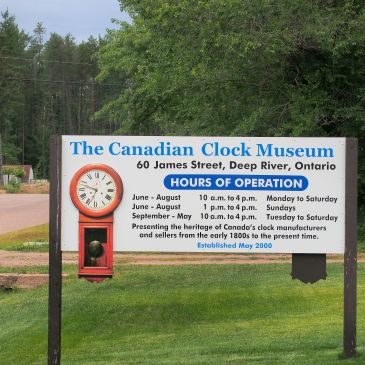
Every museum I have ever been to has allowed me to walk away with the feeling that I have learned something new. All museums document interesting histories that are intended to educate and inspire visitors. The Canadian Clock Museum at 60 James Street, Deep River, Ontario, operated by curator Allan Symons is one such example.

RS outside shots (2)
The Canadian Clock Museum

The Canadian Clock Museum in Deep River, Ontario is a 2 1/2 hour drive from the nation’s capital, Ottawa, Ontario. I have visited it twice and I found myself learning even more on my second tour. It has a fascinating collection of clocks that are largely from North America. However, it has the most extensive collection of Arthur Pequegnat clocks that I know of outside a private collection.

RS Pequegnat mantel clocks (3)
A collection of Pequegnat mantel clocks found at the museum

The Arthur Pequegnat Clock Company made clocks in Kitchener, Ontario (called Berlin, Ontario up to 1917) to 1941 when the company ceased production. Pequegnat clocks were wholly made in Canada while their counterparts built and assembled cases in Canada and imported movements from the US, England, France and Germany. The Canada Clock Company and Hamilton Clock Company had a 12 year span also made both cases and movements but not at the volume of Arthur Pequegnat.

I have written about Arthur Pequegnat clocks in previous posts and I have been slowly building a modest collection for myself.

RS Prince of Wales Canada Clock Co (2)
Prince of Wales parlour clock, Canada Clock Company circa 1880

RS pequegnat tall case clocks
Three tall case Arthur Pequegnat clocks

Many manufacturers are represented at this museum and even if you have only a passing interest in clocks you would no doubt find the displays both interesting and thought provoking. Companies represented are the Western Clock Company, Walter Clocks, the Snider Clock Corporation, Seth Thomas that operated a factory in Peterborough from the 1930’s to the 80’s, Breslin Industries, the Hammond Company of Canada Ltd to name just a few. Canadian Clock Maker Martin Cheney who briefly made high quality wall and floor clocks in Montreal in the early 1800’s is not represented, unfortunately.

Twiss long case clock
Twiss tall case early 1800’s

There are even some special clocks such as this Synchronome electrical impulse master clock from the 1930’s.

OLYMPUS DIGITAL CAMERA
Master clock mechanism

Clock
Master clock with slave clock at top

So, spend time at the museum talking to its knowledgeable curator or avail yourself of the manuals and documents at hand and conduct your own research into a specific clock.

This museum is modest by museum standards and not quite up to the scope and scale of the National Association of Watch and Clock Collectors Museum located in Columbia, Penn, USA but don’t let its compact size fool you. There is plenty to see.

If you have any interest in clocks I strongly urge you visit this one if you are at or near the Deep River area. Outside Canada? I encourage you to seek out clock museums in your own country and take the time to understand the history of clocks from around the world. Its about time!

What is my clock worth?

Every clock owner wants to know what their clock is worth and every clock seller wants to know what price they can ask for. This article will provide a guide to buying or selling an antique or vintage clock.

I will attempt to answer the following questions beginning with comments about the unpredictable clock market.

  • What factors are considered when assessing the value of a clock?
    • Is it original?
    • What type or style of clock is it?
    • Does the clock have a label, trademark, or prominent name?
    • Is it from the correct period or is it a “knock-off” or “re-issue”?
    • Does the clock have provenance?
    • What is the age and condition?
    • Is the clock collectible?
    • What is the mechanism type?
  • It all comes down to research

The unpredictable clock market

Unfortunately, in this unpredictable market, it is almost impossible to determine the value of a clock. What you think your clock may be worth today may not align with what the experts say and what others are willing to pay. What has value today may not have value tomorrow. Many factors influence the buying and selling of clocks and the clock market can be a battlefield with many casualties.

Recently, I saw a mid-1990s Howard Miller grandfather clock listed for sale on a Facebook site. I tracked the ad over the course of several days. The owner originally wanted $3000 but later stated they would take “no less than $1500” when it became obvious to them that the ad was not attracting attention. Personal value tends to be subjective and while the owner might have paid $3000 or more for a beautifully carved oak grandfather clock, its present value is not anywhere near what he thinks it is worth. I stopped following the ad but the seller likely withdrew it from sale.

Even an appraised value is the subjective opinion of an expert assessment based on condition and collectibility which is always subject to shifts in the market. My Ridgeway grandfather clock is in excellent condition, runs well, and has a command presence in my home but it is not worth much in today’s market.

Ridgeway Grandfather clock, Hamilton Country

What factors are considered when assessing the value of a clock?

Is it original? Original clocks attract buyers. The value of a clock decreases if some or many parts have been changed out. Determining whether or not a clock is original can often be difficult to determine unless viewed by an expert. The many “Vienna Regulator” clocks found on eBay and other online for-sale sites are missing parts, have had parts added such as crowns, finials, dial faces, hands, and even movements, and have weights that are not original to the clock. Back in the 1960s, many Vienna Regulators came to America in wooden crates consisting of loose movements and cases which were then married, assembled, and sold.

Would you expect a 100% original clock when the seller suggests that it is complete and original while at the same time admitting that they know nothing about clocks? Reputable auction houses have more accurate descriptions of the clocks they offer for sale when they describe condition and state if parts are missing or questionable. Moreover, they do not exaggerate the condition of a clock if they value their reputation.

Check out this article on my experience with a clock that did not have original parts

OLYMPUS DIGITAL CAMERA
Gustav Becker 2 weight regulator clock. It looks good but many parts have been replaced over the years.

What type or style of clock is it? Many mantel clocks in my collection are worth almost nothing since thousands were made and few good ones have survived. That said, some American mantel clocks are desirable and command high prices such as the Patti line of clocks from E N Welch or Sonora clocks from Seth Thomas. An 18th-century English bracket clock, an ornate French Cartel clock, or an American jeweler’s regulator are styles and types that are sought after by collectors and have retained their value over the years. On the other hand, tall-case or grandfather clocks, some as old as 200 years, can be had for a fraction of their value. Wall clocks tend to command higher prices than mantel clocks.

Does the clock have a label, trademark, or prominent name? Clocks that have an identifying label or trademark are more desirable than those that do not. Collectors often ask if the label is intact or if the movement is marked. Replacement labels are frowned upon by collectors and unmarked movements are less desirable as they may be replacements. Clocks made by prominent clock-makers add value. Old English bracket clocks with subsidiary dials, made by prominent clockmakers come to mind. A marked E. Howard or an authentic Willard banjo clock has more value than an un-named/unmarked clock similar in style and age.

RS Pequegnat fan top (8)
The rear panel of an Arthur Pequegnat kitchen clock showing the label

Is it from the correct period or a “knock-off”? Is it original or a reproduction? There are excellent examples of reproduction wall clocks that look very much like period clocks from the early 1900s that are no more than 30-40 years old. Seth Thomas made a reissue of the iconic Regulator #2 in the 1970s which is not as desirable as the original #2. Often the differences are very obvious and sometimes quite subtle.

Does the clock have provenance? Does the clock have a story or does it have historical significance or can it be placed within a historical context? This Arthur Pequegnat Canadian Time clock spent most of it’s life in a train station waiting room not 30 minutes drive from my home. In the early nineties when the station was decommissioned it was purchased by a collector and was in his hands until I bought it from him about a few years ago. This is a key selling point and may add value. The history of the clock may be an important element in a sale.

OLYMPUS DIGITAL CAMERA
Canadian Time clock by Pequgnat C.1929

The Ingraham Huron shelf clock (below) had been with a Bridgewater, Nova Scotia family since the 1890s. Balloon clocks, as they are called, seldom come up for auction and are valued by collectors because of their interesting design and limited production. In the case of this clock, This model was made between 1878 to 1880.

RS April 12th
Ingraham Huron shelf clock C.1878

What is the age and condition? Many people think their clock is worth a lot of money when they see a similar clock by the same maker sell for a high price at auction. If their clock is missing case pieces, large sections of veneer, the hands are broken and so on, the value will be adversely affected. If the dial has been badly repainted or there have been poor repairs, the clock is not considered as valuable.

The age of a clock does not always mean that it has more value. A clock may be a style, or by a maker, who, regardless of age is not popular with collectors. Sperry and Shaw 4-column New York-style 30-hour clocks, while attractive, and over 125 years old, are not sought after by collectors as Sperry and Shaw, retailers rather than clock-makers, were clock merchants who used questionable assembling methods and dishonest selling practices.

Sperry & Shaw 4 column clock
172-year-old Sperry & Shaw 4 column clock

Thousands of gingerbread or kitchen clocks were made during the period 1885 to 1915. Despite their age, few have any value.

Is the clock collectible? Rare clocks are rare because few exist or rare because few owners want to sell them. OG (Ogee) clocks are clearly antiques, some more than 150 years old, but because thousands were made they are not as collectible as a one-of-a-kind 17th century English lantern clock. 30-hour Ogee clocks are also tough to sell because of the hassle of winding them every day.

Desirability is also region-specific. Of the many parlour clocks made in Canada, those made by the Hamilton Clock Company in the 1880s (Hamilton, Ontario, Canada) are very desirable by Canadian collectors. Arthur Pequegnat clocks, wall clocks, hall clocks, mantel clocks, or kitchen clocks fetch higher prices than similarly styled clocks because they are actively sought after by collectors in Canada. Outside of Canada, they are worth far less.

Martin Cheney clocks (1810) made in Montreal (Canada) are highly collectible, of exceptional quality, and are very rare. True Vienna Regulator clocks such as those from the Biedermeier period made prior to 1850 and authenticated as original are very desirable, reflect high asking prices, and are valued more than contemporary versions.

The key is research. Check eBay, reputable auction houses, local buy-and-sell sites, clock shops, antique stores and online message boards to get a feel for the range of prices and bear in mind that markets are very volatile

Cartel clocks are exceptional 18th-century French clocks and those fabricated by clock-makers such as Joseph de Saint-Germain or Duponchel à Paris command prices in the many thousands of dollars.

What is the mechanism type? Generally, three train clocks (time, strike, and chime) are mechanically more complex and are normally valued higher than two trains (time and strike) clocks. Three-weight Vienna Regulator Grande Sonnerie clocks generally command higher prices than a single or two-weight Vienna Regulator.

American clock company Sessions sold inexpensive clocks for the masses and produced many thousands. The Sessions Westminster-A tambour style clock has an unusual 2-train chime movement (chiming clocks generally have three trains) and fetch higher prices on auction sites than other Sessions mantel clocks.

Weight-driven clocks generally command higher prices than spring-driven varieties.

RS Sessions Westminster chime circa 1931 (12)
Sessions Westminster A mantel clock, C.1927

It all comes down to research

Do your research: Check eBay, reputable auction houses, your local buy-and-sell sites, clock shops, antique stores, and online message boards to get a feel for prices. Keep in mind that markets are extremely volatile. Do your homework prior to making any purchase. What may have sold for several hundred dollars years ago (30-hour Ogee clocks) are worth much less today.

Ask questions before you purchase your next clock and if you are a seller, provide an honest description of your clock and disclosures (new pendulum, new mainsprings, etc.). Chinese, Korean, and most Japanese clocks are not particularly collectible or desirable. If you firmly believe your prized Chinese-made Daniel Dakota family heirloom is worth over $150, potential buyers may not be beating down your door but a fair price of $40-50 might result in a quick sale.

Converted Daniel Dakota
This 1960s vintage Daniel Dakota wall clock is worth almost nothing

Clock prices are all over the map and we will not see a stabilization of prices any time soon. With the advent of the internet, many clocks thought to be rare have flooded the market depressing prices. The law of supply and demand applies. As demand increases, supply decreases, and prices rise. As supply increases and demand decreases, prices drop. The only constant is high-end clocks, sought after by serious collectors that have managed to retain their value. But how many of us can afford them?

Now is a good time for that special clock. There are certainly bargains to be had if you search carefully, learn as much as you can along the way, and tread lightly into the buyers arena or if you are placing a value on your clock to prepare it for sale.

Website Powered by WordPress.com.

Up ↑