Carole Ann Bennett of Ottawa, Canada asked me to profile her latest clock acquisition which was bought at auction and advertised as a triple-decker clock. It is, in fact, a column and cornice clock.
Seth Thomas column and cornice
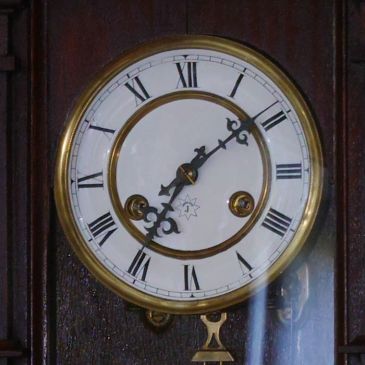
This lovely Seth Thomas time and strike eight-day weight-driven column and cornice clock with hour strike features a mahogany veneer case with cove molded crest, ¾ columns in painted gold and two reverse painted doors opening to the interior clock works which reveals a tin painted dial and the original printed and illustrated Seth Thomas clock makers label. It is 32″ tall, 18″ wide and 5“ deep.
The painted tin Roman Numeral dial has hand-decorated flower spandrels in all four corners with the centre portion of the brass lyre movement visible though the dial.
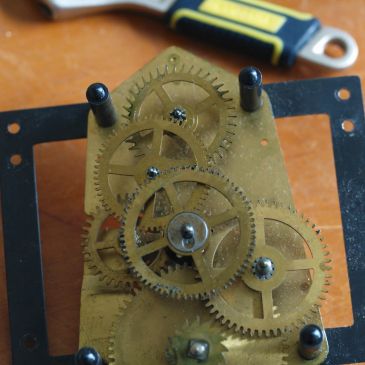
Brass lyre movment
There is a small amount of chipping around the winding holes and face mounts. The hour and minute hands are in an Ogee style and original to the clock. The movement is clean and running well.
Painted tine dial face
The upper tablet has a hand-painted fruit bowl framed within a clear rectangular section with an onion top surround by a gold laurel design. The lower tablet shows a headless eagle framed in an clear oval centre with clustered gold berry spandrels in all 4 corners and encircling the oval section is a gold wreath made of berries and leaves. The headless eagle has clawed feet, one holding a sheaf of arrows while the other holds what appears to be a holly bush. There are 13 stars above the wings presumably representing the original 13 colonies. There is the expected amount of flaking consistent with the age of the clock which seems to disappear when the doors are closed. The missing paint areas blend into the remaining design and look good in spite of the minor issues. A red banner runs through the centre. It appears to be a very loose interpretation of the eagle on the presidential seal.
Upper tabletLower tablet
My first impression is that the top and bottom tablets are not a match because of the different themes on each panel however the blue paint is identical.
It has a very good interior label with the name J. M. Paterson, Hamilton, Canada West which appears to have been pasted over an original label.
Canada West, previously known as Upper Canada, formed one-half of the British colony of the Province of Canada. The region was governed jointly along with Canada East (formerly Lower Canada) from 1841 to 1867, when Canada West became the province of Ontario under Confederation. This would put the clock between 1841 and 1867.
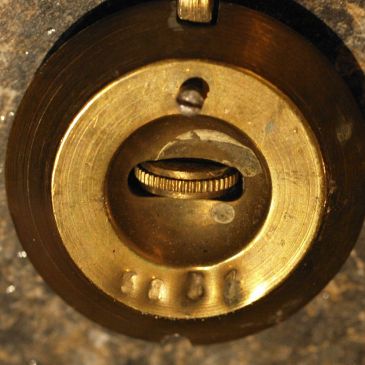
More research is required. Below the added label are instructions for the operation of the clock. It has newer 6 ¾ lb cast iron replacement weights which are correct for an eight-day clock. The pendulum is a replacement as the original would have had a rate adjustment screw as per the last line of the instructions.
Clock instructions and label
Minor areas of paint around the main designs on the top and lower tablets are beginning to flake, however most of the original paintwork shows very well. The case has some scuffs and a little veneer chipping as one would expect. The deep grained mahogany veneer adds to the overall look of this big and beautiful shelf clock.
There are newer softwood strips attached by Robertson screws on the top and very bottom of the back of the case which appear to have been added either as a repair or to strengthen the case. There are 4 holes on the backboard just below the movement which may indicate the presence of an alarm mechanism at one time.
All in all it is a good looking clock that reflects the period and a fine acquisition.
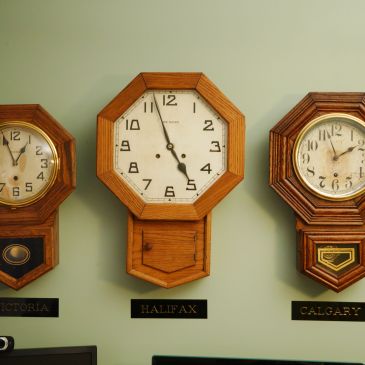
It this day and age it is very common to have family scattered to the four winds. What time is it is such and such? Why not create timezone clocks? I live in Canada and I have one daughter in Calgary, Alberta, one of our mid-western provinces and one in Victoria, BC, on the west coast of Canada. We keep in touch with Skype and telephone and as I am working on my computer in the kitchen area of my home all it takes is one glance upwards to see what time it is in Calgary or Victoria.
This is my trio of clocks. The two on either side are eight inch while the centre clock has a 12 inch dial. The centre clock is a New Haven time and strike from the 1930s taken out of a decommissioned school house in Saskatchewan in the 1950s. My aim is to have three 8 inch dial clocks. Once I find another 8 inch time-only clock the New Haven will be replaced.
New Haven time and strike clockWaterbury Arion drop octagonI later painted three numerals
The clock on the left is a Waterbury Arion. It came to me without glazing and bezel but ordering a replacement was easy enough through a clock supplier, Perrin in Canada. While writing this blog I decided to touch-up the 7, 8, and 9 numerals. It is the quietest of the three clocks.
The one on the right is Sessions Drop Octagon. The dial face is in rough shape but I decided to leave it as-is. The clock came from a decommissioned schoolhouse in Springhill, Nova Scotia in the 1960s.
Sessions Drop Octagon
It is by far the noisiest of the three but you get used to the sound. All three will be time-only clocks, preferred if you are looking for the dedicated function of simply telling the time. Of the three my favorite is the Waterbury. Even with the “messed-up” dial face, it is the most accurate of the three and will run for 12-15 days on a single wind.
Keeping track of family all over the country is part of being a normal modern family and timezone clocks certainly help.
This post describes the final detail work on my Junghans clock.
My winter (2017) project was an antique German Junghans Crispi time and strike spring driven wall clock made in the style of a Vienna Regulator. It was manufactured in Schwenningen, Germany in 1899. It came to me as a box of parts. To some a box of clock parts and pieces is discouraging but to me it was the challenge I was waiting for.
A clock in a box, how it came
I wrote a multi-part series on the restoration of this clock. Use the search feature on this site to find past articles. I discovered this antique clock from a seller on an online for-sale site in January (2017) and was intrigued with its incredible history as a survivor of the Halifax Explosion on Dec 6, 1917.
On the morning of 6 December 1917 the SS Mont Blanc a French cargo ship laden with high explosives and Benzol collided with the Norwegian vessel SS Imo in the Narrows, a strait connecting the upper Halifax harbour to Bedford Basin. A fire on board the French ship ignited her cargo, causing a large explosion that devastated the Richmond District of Halifax. Approximately 2,000 people were killed by blast, debris, fires and collapsed buildings, and an estimated 9,000 others were injured……and a Junghans clock fell off the wall in a house on Princess court, North End Halifax
At first I was not sure how far I would go with this project but I decided I must go all the way towards restoring this clock to its former 19th century glory.
Most of the clock is original; the movement, the pendulum, coil gong and movement bracket as are the bottom base and top part of the case plus the crown, the backboard, the vertical columns and most of the decorative trim. What has been replaced is the box frame, the front piece that supports the right and left columns. I can only assume that parts of the clock were destroyed beyond repair on that fateful day.
Thirty years ago the previous owner used contemporary materials and techniques to reconstruct the frame and front piece. Although not authentic, I have no objection for two reasons; much of what he has done is unseen and care was taken to replicate period woodworking techniques to reconstruct the case except for the Robertson screws. During the restoration process I have added or in some cases made:
Front glass and 2 side glass panels,
3 glass support rails,
3 top replacement finals,
2 newly constructed top finial bases,
2 brass door hinges,
2 brass door catches,
2 brass case stabilizers,
2 hardwood trim pieces and
6 decorative buttons.
Original 1899 catalog image
I disassembled the movement and in the process made two errors. In my attempt to re-position the star wheel paddle by bending it just a little bit, I managed to snap it off. Although I might have been able to fix it I do not have the tools, yet! I also managed to snap off the paddle wheel arbor spring which is essentially a thin steel rod. Again, I could have fixed it if I had the tools. As a result the strike side did not function. I cleaned and re-assembled the movement, got the movement running and thought, what is my next move?
Very dirty movement; after all it had not been running in years
I might have been content with a time-only clock but I decided that my mission was to have it fully restored. I decided to bring the clock to a horologist that I have used in the past. While it was in the shop, why not have it serviced completely. The horologist did a great job and when I picked it up she remarked that it was the first style of clock she had ever worked on.
What remains? There are two trim item on the left side just below one of the buttons as you can see in the photo below and a corner piece on the right side of the case in the same area.
Let’s see if my skill with router can address these issues.
Missing trim piece, not quite finished!
I took out my vintage Black & Decker router and managed to find the correct bit. Since it is a very small trim piece birch rather than oak would do. I made the measurements using my micrometer. The dimensions had to be precise in order to duplicate the trim piece exactly. I am very pleased with the result. Now for the right side.
Last trim piece, left bottom sidematching trim pieces
I made a corner piece out of birch and glued it in place. In the next two photos you can see the very small piece that fits into the corner trim.
Corner piece is missingHardwood replacement pieceCorner piece is glued into place
I am very pleased with the repair.
I posted a reference to this clock in one of my blogs and received a curious letter from someone who thought it was a Chinese clock. I fully understand the comment because the clock is so “blingy”. The many brass buttons and trim items might make one think that it was made in China. It simply reflects the Victorian era, a grand excess of ornament and an eclectic revival of historic styles mixed with middle east and Asian influences in furniture design. A Chinese clock? No, but an understandable error.
Garish Victorian excess but I like it!
It is a clock that will be in our family for years to come
Was it worth the hours of toil and the money to bring this Victorian style clock back to its former glory? Absolutely, without question! The clock works perfectly. The coil gong on the hour and half hour sounds terrific and resonates throughout the house. Visitors to my home are immediately drawn to the clock because of its unique Victorian style. Indeed, it is a clock that will be in our family for years to come.
Tick-Talk Tuesday is about the letters and comments I have received from you, the reader, concerning your clocks, issues you might have had and challenges you face and my responses to your questions with advice on your particular clock concern(s). For those comments and questions that stump even me, I consult within my clock circles for the best possible answer.
DP writes, “Hello Ron: I have a clock I bought recently at an auction.The clock is from Pictou County Nova Scotia. It has Canadian Time On the glass. I live about 50 kms from Truro. I would like to take the clock over to you and find out if it is a Pequegnat clock. The clock keeps good time. It is made out of birds eye maple. It measures 29 inches high, 15.5 inches wide and 5 inches deep. My technology skills are not very good and I am not able to send you a picture. My name is DP and I would be pleased to hear from you.”
Arthur Pequegnat Canadian Time clock
My response to DP
“Yes you are pretty close to where I am. We can meet but you can also save yourself some trouble by doing a little investigating yourself. Regarding the dimensions, are you measuring the whole clock from top to bottom. The Canadian Time is 36 inches high by 15.5 by 5 inches deep. If the entire height of yours is 29 inches you are likely missing the top piece (crown) and the bottom section or both. Most were made of quarter sawn oak. I have never seen one in Bird’s Eye maple. And the words “Canadian Time are stenciled in gold on the glass door.
Next, on the bottom part of the dial face you should find the inscription, “Arthur Pequegnat Clock Company”. If not, it is a replacement dial.
Company name under the chapter ring
If you are adventurous enough, you can unscrew the minute hand nut, take off the minute hand and pull off the hour hand underneath which is a friction fit. Next, you can unscrew the square wood panel the dial pan is mounted on. There should be 3 screws, one on top and one on either side. Once you unscrew those you can take the piece that holds the dial pan out. You can then check to see if the company name is stamped on the lower right hand side of the movement. Obviously if it says Arthur Pequegnat, that is what you have. I have included photos showing what you should see when you open it up.
Movement after taking off the dial pan.Company name stamped on the movement
Let me know how you make out.”
DP writes back.
“Hello Ron, I am not really comfortable taking the clock apart. I did take it over to DG in BH about a week or two ago. He repairs watches and clocks. He did a repair to a thin strip or band of metal (punched a new hole through it) and then reconnected it to the movement. DP is referring to the suspension spring. When it was apart the only thing I could see written on the movement was (no jewel and I think not adjustable or unadjustable). It looks like the movement might have been replaced because there are two extra holes on the back. The dial face has been put back in place incorrectly and has nothing printed on the face. I would like to take the clock to you and just get your views and opinions on where or who might have it or any other information you can give me. I would be pleased to hear from you.”
DP, “An Arthur Pequegnat movement would never have “no jewels” or “non-adjustable”on the movement. The company name would clearly be there. What you have is what some collectors would term to be a “marriage”, that is a case with another, more modern movement. If your case is 29 inches high then something is clearly missing. If you still want me to look at it, I will. Give me a call at (phone) and we’ll meet.
Folk art version of Canadian Time
DP arrived with the clock that he won at a local auction for CDN$25. Underneath the folk art and all the modifications is, indeed, a Canadian Time Clock. What appears to be maple finish is painted Birds Eye maple; underneath is oak. The base and crown are missing; the dial is a replacement and whoever replaced it mounted the dial in the wrong position. The decals are on the outside of the glass and were added later probably the same time as the Birds eye maple finish. The pendulum bob, painted some sort of brass or gold colour, is original but the pendulum rod is a replacement with a home-made leader hook. The only thing in good shape and original is the Canadian Time reverse decal.
DP attaches the pendulum
The movement is a replacement, an Indian made reproduction time-only movement exactly like this one at Timesavers.
Found on the back of the dial pan is this inscription.
Inscription on folk art clock
REPAIRED SEPT 18, 2013
REPAIRS BY JAMES xxxxxx
12C PLEASANT ST STELLERTON NS
CLOCK AND xxxxxx CLOCKMAKER SINCE 1956
In short, it is a very modern interpretation of a classic clock. If it were my clock I would not do a thing to return it to its original condition; there are just too much things that would need to be addressed. However, it might be appealing to some people as a piece of folk art. As a piece of folk art DP should be pleased that he got a good deal.
We have a seasonal cottage that is used primarily in the summer and at times during Thanksgiving in October. While I have a number of clocks at my residence in Nova Scotia the cottage is a great place for displaying a small selection of my clocks.
Our first clock at the cottage was a Danial Dakota time and strike that we had converted to a quartz movement. The clock is from the 1960s and reflected Chinese design elements copied from American clocks at the time. It requires very little maintenance and is as accurate as one would expect. It requires a “C” cell battery to operate. It is a chiming clock with Westminster and Whittington chimes and my wife and I much prefer the Whittington chime. I still have the original mechanical movement and may someday use it in another case.
Converted from a mechanical clock
The clocks do not run during the winter but oiling once per year addresses the issue of dried pivot holes
Last summer (2016) we were travelling through an Ontario town of Halliburton and stopped by an antique shop. The owner brought in a number of clocks from Ireland, all British made. They were in very good condition though some were a bit on the pricey side. My eye was drawn to this simple but attractive Smiths Enfield time and strike Art Deco style clock. It has a chromed square bezel and Roman Numerals on a slivered background. The ornate brass coloured hands compliment the square dial face. The squared off dark oak case with half height side shoulders is in excellent condition. I placed this clock on a shelf between our kitchen and family room.
Smiths Enfield time and strike, circa, 1950
Our kitchen has a Delft style, triangle shaped front-wind 8-day time-only porcelain clock with a lever escapement similar to those found in marine movements. It is an estate auction purchase. On the dial is the name Forestville. The Forestville Clock Company of Toronto operated from 1928 to the late 1970s. Though wholly Canadian owned the company had cases made in its early days (from Kitchener, Ontario) but later imported cases and movements from Germany then France and England during the War years and Germany again, after the Second World War. The clock has a Dutch motif which reflected a popular trend in the 1950s and 1960s but also recognized Canada’s close relationship with the Dutch people since the war years.
Delft Clock from Forestville
The clocks do not run during the winter but oiling once per year addresses the issue of dried pivot holes. We also take the battery out of the quartz clock.
There is nothing like the sound of mechanical clocks at the cottage particularly on a cold, quiet night when the only other sound is the melancholic cry of the whippoorwill.
You will see fewer posts over the next 2 months as I spend quality time with friends and family and decompress at our summer get-away in central Canada. I intend to make my third visit to the Canadian Clock Museum in Deep River, Ontario while in the region.
Regular readers know that I typically profile my own clock collection, the challenges of maintaining and repairing clocks in my collection plus articles of interest based on observations in my travels including general interest clock subjects as I navigate through the fascinating world of horology.
I hope you enjoy reading them as much as I enjoy the researching each article. I will maintain a presence on my blog by posting regularly though it means that there might be some delay in answering letters. I invite you to browse through my archive; there is always something that will interest clock lovers at all levels.
Over the next 8 weeks you will find articles on a little Delft kitchen clock I discovered, my thoughts on a Aug Schatz movement I found, final detail improvements on my Junghans Crispi wall clock, some helpful information on clock keys, how to live with all the clocks in my house and notes on clock therapy. So, stay tuned as they say and if you like what you see let me know.
Tick-Talk Tuesday is about the letters and comments I have received from you, the reader, concerning your clocks, issues you might have had and challenges you face and my responses to your questions with advice on your particular clock concern(s) and of course, general comments. For those comments and questions that stump even me, I consult within my clock circles for the best possible answer.
On my trip to Cuba in March of 2016 I happen to capture a number of interesting clocks. The two pictured below prompted a comment from JC.
Wm Gilbert clock found in a restarantMalaprade Floor clock
The first two clocks are the most interesting to me. The Gilbert looks fairly standard (often called a “Store Regulator”) but I think it’s been painted black. Normally these are in oak cases, occasionally (but rarely) in walnut. The colour would have matched the interior back.
The second clock looks like a fine and expensive Jeweler’s Pinwheel Regulator. I’m wondering if you’re wrong about it being spring driven. These are normally always weight driven. The weight normally hangs behind the pendulum. Is it possible you didn’t see the weight? The movements from these are almost always Swiss made (near the Jura region of France), with pinwheel escapements. They are VERY EXPENSIVE clocks. The movement alone would fetch around 1000$. I have no idea what that circle is on the dial. I’ve seen some with inlaid marble dials, but most have enameled dials like this one. Cases can range from plain to extremely elaborate, and from 5 feet to 9-10 feet.
The name and place on the dial is the retailer where the clock was sold. It is never the manufacturer (this is typical on all French and some Swiss clocks of this type/vintage – the same is true of Comtoise clocks and French mantle clocks).
The rest of the clocks (with the exception of the 2 figure 8 wall clocks) seem to be imported German clocks from 1930 and later. These include both tall clocks and all the 400 day clocks shown. The figure 8 clocks are either American or Asian made copies (likely from Japan) from the early 1900s.
We often cruise the HiBid sites. While they may be wholly Canadian I am sure there are similar sites in the US. HiBid are a hosting service for antique online auction companies and from time to time clocks come up on estate sales.
One day in early February 2017 we were on a Nova Scotia HiBid auction site and noticed a Jauch drop octagon with a PL42 movement. I made what I thought was a reasonably good bid. We had errands to run that day so I just left the bid, got home later and realized and surprised that I had won. It was a good purchase. After running for several weeks I opened the case up and discovered its hidden secret.
Time-only Jauch movement
The clock easily runs a full 8-day cycle but it gains about 5-7 minutes at the beginning of the cycle and loses the same at the end of the cycle. A dramatic difference! A properly functioning clock is designed to run at an acceptable rate of + or- 1 minute per week but this depends on adequate power to the escapement with very little fluctuation in that power.
Scored pivots and worn barrel arbor holes are real issues for this movement. The pivots are small, a light touch with a buff stick and a minimal polish along with pegging and round broaching the holes should be the first steps in reviving this clock. Bushing work is also quite possible. The barrels are another matter. If worn, they require bushing. The cap is too thin to bush without making a thin flange or leaving the bush a bit proud and peening both sides. The barrel is narrow and it is said that they really get the wobbles when worn.
This is an inexpensive German movement but finely made and well engineered. An overhaul should result in a good long run.
I took the movement apart and discovered two things. One, it needs at least 3, perhaps 4 bushings and secondly, there is a significant gap in the barrel cap as seen in the photo below.
Barrel cap showing a wide gap caused by wear around the arbour, weak point of this movementFront plate is removed showing going train
The real issue for me is the barrel cap. I can attempt to bush the cap but the bushing would likely not hold unless it is peened. The gap is causing an unbalance in power transmitted through the gears as a result of the wear. The soft brass barrel cap is definitely a weakness of this movement. The result is the erratic running described above and a wobble in the pendulum. I contacted a gentleman in Arizona who would be prepared to correct the wear by installing two new bushings on the gear side and cap of the barrel. The cost is 1 1/2 times the value of the clock so I have decided against that option. It is just not worth it!
1 Day Later
I installed 3 bushings. The front side of the escape wheel arbour, the front side of the second wheel and the minute shaft. I re-assembled the movement, oiled it, adjusted the pallets, reinstalled the worn barrel and have put the movement back into its case. It is now running and in the next week or two I will see what effect new bushings will have on the running of the clock. My hope is a marginal improvement given the worn barrel.
A barrel repair will have to wait until I have the proper tools.
Would you like to tell the world about your special clock?
Would you like to tell the world about your special clock? Is it a clock you have had for years or was it handed down to you or you did you win it an an auction or find it in a dark corner of an antique store?
Is it a favorite clock you would like to see profiled on this blog? It could be one of the clocks in my collection or it could be one of your own (or several that you own). If you would like to profile your own clock(s) send me as many photos as you can (1 meg each is fine) but include shots of the movement as well. If I use your photos I have your permission to post them. If you are using photos that someone else took (Google or eBay for example) it becomes more problematic from a copyright perspective.
Circa 1890 French Black Marble time and strike desk clock
I will keep your name and location private
Provide me with a history of the clock and/or some interesting details that I could include in the blog article and let me know if you want your name included. If not I can assign an identifier, the first and last letters of your name and of course I will keep your location private.
Regular reader and contributor JC suggested a few more clock terms I thought readers and fellow horologists might find interesting.
My source for this article is the Watch and Clock Encyclopedia by Donald de Clarke, published by Bonanza Books (1984) which is still available on Amazon.
Gridiron pendulum: A pendulum consisting of alternating steels and brass rods coupled together to compensate for downward expansion so that the centre of oscillation of the pendulum remains consistent with changes in temperature, invented by John Harrison in 1725.
Gridiron pendulum on a Junghans Crispi wall clock
Broaches: To broach is to open and enlarge a hole. A Broach is a steel cutting or smoothing tool with a tapered or parallel sided edge used to cut or “finish” holes in a clock plate. Used to enlarge and then finish (smooth) a newly installed bushing on a clock plate.
A set of Swiss made smoothing (or finishing) broaches
Motion Works: The train or wheels of a clock directly connected with the hour and minute hand.
Great wheel: The teeth that form part of the barrel of the going barrel. It is also the wheel to which the mainspring is attached.
The motion works of a clock; the largest wheel on this movement is the great wheel (Pequegnat Clock Co.)
Maintaining Power: A method to maintain the driving power while the weight is being lifted or mainspring with fusee is being wound. In effect keeping the mechanism going while winding.
Weight driven movement with maintaining power, (unmarked Vienna Regulator)
Huygens Endless Rope Drive: It is a method of providing maintaining power to drive the clock while the weight was being raised. The endless cord passes over pulley A which is attached to the great wheel and supports the driving weight B, it then passes over pulley C which has a ratchet to support small weight D. As cord E is pulled down to wind the clock ratchet C turns under it’s click to raise weight B which continues to drive the clock as it supplies torque to wheel A. This ingenious system is found in some 18th century long-case clocks.
Huygens endless rope
Locking Wheel (or Count Wheel): A count wheel is the wheel that determines the number of blows to be struck in striking mechanisms.
The left wheel with notches is the count wheel
Ratchet wheel: A toothed wheel into which a click engages permitting the wheel to revolve in one direction only.
Toothed ratchet wheel and click
Cam: Usually a disk so that upon revolving it transmits movement to or exerts pressure upon a connecting unit.
Arrow showing location of a cam, the fly is located in the upper right
Fly: Often called the governor or controller of a chime or strike train. It is the last piece in a train of wheels.
The language of the clock world always amazes me. There are a plethora of other clock terms that I will be happy to explore in future blogs.
Tick-Talk Tuesday is about the letters and comments I have received from you, the reader, concerning your clocks, issues you might have had and challenges you face and my responses to your questions with advice on your particular clock concern(s). For those comments and questions that stump even me, I consult within my clock circles for the best possible answer.
This an antique (circa 1895) Mauthe Horse Crown Clock. Some would say it is ugly but I disagree – it is a beautiful clock. Some would even say it is a Vienna Regulator style of clock. PS has a different opinion.
PS says. “Happy to see this – my parents in law had exactly the same clock ! The wood was brighter and the horse stood (a bit loose) on the roof directly, so most likely a part was missing. We have destroyed (yes! yes!) the wooden case – quite a tough job, German quality. We found it sooo ugly, sooo old-fashioned! We left the the metal parts alive, though. The clock needs maintenance, because it does not continue to tick. I could send it for free to a clock-lover for a build-in somewhere. Any hints? Greetings from Brussels, Belgium”.
This why it is called Horse Crown clock
My reply. “Beauty is in the eye of the beholder. I think it is a good looking clock but it is only my opinion. If it has the same movement as my Mauthe you could send it to me for use as parts should my Mauthe decide to stop.”
German box clocks are quite common. Prices for these clocks are all over the map, some ask hundreds of dollars but they can be had for very little money like this Mauthe box clock I picked up in a flea market outside Peterborough Ontario. The hands were faded and the case was in rough shape but I knew it was a good deal.
Mauthe box clock, as found
Thousands of German “box clocks” were made in the first third of the 20th century and even to the middle of the century. The box clock replaced the classic “Vienna Regulator” after the First World War and reflected a minimalist approach to clock design. Most, if not all, were made in Germany. Despite the absence of markings, I have no doubt that this clock was made in Germany by Mauthe.
This vintage clock is 29 inches long by 13 inches wide and 7 inches deep. It has a 7-inch silvered Arabic dial with a spade hour hand and speared minute hand. The lower section of the case door has 5 beveled glass panels (middle one is arched) with brass connecting strips. There are two fluted columns that frame either side of the door and circular glazed viewing panels on each side. The movement is mounted and secured by thumbscrews on a seat board. The clock case is in fair to good condition with no gouges, deep scratches or missing pieces. Refinishing at some point in its life combined with environment factors has resulted in a darker walnut shade. The case is made of cheaper pine rather than the more expensive oak found in higher end box clocks.
The door has its original glass, catches, hinges and swings very easily. There are no case stabilizers (stand-offs) which I found curious given the height and weight of the clock. It has a rod gong twist locking feature about one third up from the longest rod to secure the rods during transport. Rods are brittle and can easily snap off if unsecured when moving the clock.
Rod twist lock to secure the rods during transport
I would comfortably date the clock to the 1930s
The dial face has been “messed with” in some fashion. I suspect someone tried to clean the face with an abrasive cleaner as there are scratches on the numerals. The numbers were touched up with flat black acrylic metal paint. Evidence that it was distributed by a Canadian clock company is a maple leaf applique on the crown.
Maple leaf applique and Divina gong
The five-point maple leaf is a common symbol for Canada. There are two possibilities. It might have been sold by the Forestville Clock Company of Toronto or Eaton’s department store under the Solar (Soler?) brand name. I would date the clock to the 1930s.
The price was right so I bought it
The rack and snail, time and strike, spring powered movement with recoil escapement has no markings but for the numbers 42 (pendulum length in cm) and 105 (beats per minute), the letters C,A, with numbers, 79/9 engraved in the lower right of the front plate, presumably a clock-makers mark for servicing in September of 1979 and a serial number, 25226. The back plate is solid brass while the front plate is open. It also has a repeater function on the strike side.
Mauthe movement front plate
This is an antique mall find and the seller left a note saying that the clock required servicing (code for not running). While on the wall in the store the clock ran for a few seconds and then stopped. So, yes, it needs servicing. The price was right so I bought it.
Mauthe movement back plate
I took the movement out of its case, inspected it and found it very clean. I looked for any obvious signs of wear or damage such as bent arbors or broken teeth and found nothing. The pivots holes were dry though absent of the tale-tell signs of thick black or green oil indicating wear. The mainsprings were wound tight as I would have expected. I oiled the movement, ran it outside the case for a few hours, returned it to its case, re-positioned the 3 strike hammers for the rod gongs and it ran strong, striking as it should on the hour and half hour.
The 3-rod “Divina gong” was, according to the standard German reference, Hans-Heinrich Schmid’s (2005) Lexikon der Deutschen Uhrenindustrie 1850-1980, a Mauthe trade-name registered in 1912. I compared the movement to similar Mauthe movements online and but for minor details it is the same. The case design is plain and free of decoration and is quite unremarkable save for the aforementioned beveled glass panels.
Divina rod gong, patented by Mauthe in 1912
I refreshed the case by first giving it a good cleaning with Murphy’s Soap. The cleaning revealed some light and dark patches so I opted to give the case a light coat of walnut stain followed by Poly Wipe Satin clear coat.
Box clock after case cleaning and refresh
There is not much I could do with the unsightly black smudges on the dial without lifting the silvering so I left that untouched but it still retains that vintage look.
Repainted numerals and hands
There were a number of unsightly black marks on the pendulum bob that I cleaned up using Brasso. Brasso was also used to clean up the brass bezel. The beveled glass and the brass strips were cleaned as well.
The Divina rod gong bim-bam strike has an especially pleasing resonance that echos through the house.
For a 50CDN investment the result after a refresh, is remarkable. It shows very well and it is a welcome addition to my growing clock collection.
Tick-Talk Tuesday is about the letters and comments I have received from you, the reader, concerning your clocks, issues you might have had and challenges you face and my responses to your questions with advice on your particular clock concern(s). For those comments and questions that stump even me, I consult within my clock circles for the best possible answer.
From JG.
“Hi, Ron ! I’m a clock lover (and small time collector) based in Gurgaon, just outside the capital city of New Delhi, India. My surname suggests that my ancestors were clock and watch sellers but the family lost it’s business due to a profligate great-grandfather, or so family lore says.
About four years ago I picked up a Mauthe wall clock with a quarterly self-correcting Westminster chime with an art deco exterior and it has given me trouble free service subsequently. Minor adjustments are needed to keep time, particularly since the climate in our part of India can get fiercely hot (usually dry heat but humid in monsoons) and bitterly cold in winter. A bit of tweaking on the pendulum bob keeps the clock going well. Like your mantel piece, the chime gets a bit sluggish after 5 days, so I need to wind it up twice a week.
The dial has the Mauthe trademark and name, but there’s another separate mark on the dial stating “Gani and Sons, Madras”. This firm still exists and they were formerly importers of quality watches and clocks into India. They still assemble German movement long-case clocks and install tower clocks to this day.
Last month, I picked up my second Mauthe from Zurich – again a Westminster quarterly chime wall clock – but this is a much larger clock. It travelled as checked-in luggage padded in bubble wrap and surrounded by clothes as further padding (I had no choice !), zipped into a rather large soft bag bought specially for the purpose – I couldnt find a hard bag large enough. Thankfully, it survived three flights and several baggage belts without any damage, and took up poisition immediately. It took about a week of pendulum adustments and now keeps great time.
This clock, too, has a Mauthe trademark, but it seems to be an older variant.
I am aware that Mauthe changed their trademark a few times (thrice ?) but I’m unable to gather accurate and authentic information on the years in which these were changed. I’d be able to date my clocks if could get get this, and I was wondering if you would be able to assist me in this.
I could email or “whatsapp” you pics of both these clocks and specifically the logos if you’re in a position to help.
For your information, some of the other clocks in my collection, some of which are heirlooms, are two Beaumonts (one is a mantel piece from around 1920, unfortunately this one has a crudely replaced dial and a new case, but retains the original movement, and the second is a wall clock, completely original, from 1915 or so); an Ansonia wall clock with a calendar (1905); another Ansonia (probably earlier than 1900) which stands on a low cabinet but can also be placed on a wall; a new grandfather cased in India and a couple of pocket watches.”
I was fascinated with JG and his family history as well as his appreciation for Mauthe clocks. He send me photos of his clocks with photos of trademarks. My reply.
“Not much success determining the trademark dates you are looking for but I wonder if you have tried http://www.antiqueclockspriceguide.com/identifytrademarks.php
There is also a forum (discussion board) connected with this site that might lead you to more information.
I posted on the http://mb.nawcc.org/forum.php discussion site but I gather there are not many Mauthe collectors however if anything comes up I will let you know.”
Hobbies are a great way of finding comfort through stepping off the roller coaster of life
In this increasingly complex and chaotic world where many of us seek ways of exploring constructive activities & pastimes a hobby is one such escape. Hobbies are a great way of finding comfort, stepping off the roller coaster of life and rising to the surface after seeming to drown in life’s problems. A hobby allows one to disconnect briefly or longer from the social media universe that seems to consume us every day. Pursuing and maintaining a hobby, whether it is for casual leisure or serious pursuit, is a regular activity that should be done for pure enjoyment. It is healthy for mind, body and soul!
The more you know, the more you grow
There are 9 Reasons why clock collecting/repair hobby works for me and might even work for you.
I meet people. This hobby requires that I come into contact with other people when I purchase clocks, have clocks repaired or ask for advice.
A clock repair shop in Nova Scotia
Builds my self-esteem. Developing and maintaining a clock hobby is important because the small successes I have from day to day or week to week are enough to sustain me while other pressures are occurring in my life and it is the one solid thing to feel good about. It gives me renewed energy to tackle other challenges in life.
Avoid boredom. I have zero scientific evidence of this but I really believe that boredom is responsible for a lot of society’s ills and destructive behaviours. How many people come home after a challenging work day to watch TV for hours on end when they could be doing something constructive and rewarding?
My Hobby is a point of connection with other people. It gives me common ground with a small, select portion of the population, the people who collect, repair antique and vintage clocks, the people who share my passion. They are from all over the world. Every week I get inquiries from clock enthusiasts from all corners of the earth asking for advice on their particular clock.
Clock collecting enriches my perspective. I remember an old adage: “The more you know, the more you grow”. Any opportunity to learn something new, to be challenged anew, is great for character-building by seeing the world through refreshed eyes. Clock collecting and repair helps me differentiate myself from others and provides me with key examples of where I have overcome adversity or tackled a difficult situation and emerged on the other side.
It keeps me stay youthful. Establishing and maintaining a hobby is a very healthy habit to form for later years. Hobbies are excellent for brain health especially if you are looking for something to stave off cognitive decline. The older you get the more trouble you will have struggling to fill your time with meaningful activities. Starting a hobby early in life pays dividends in the long run, much like an interest bearing investment.
Clock collecting combines with other interests. Photography and traveling are two other interests in my life. Blog writing is another, of course. This hobby allows me to combine all of those interests and as a side benefit my wife, who is also my travel partner and clock locator, encourages me every day.
My hobby makes me interesting. At a party, you can only talk about your occupation or your grandchild for so long before people’s eyes begin to glaze. But if I mention that I have a clock that fell off a wall during the Halifax Explosion, a clock that hung in a railway station near where I live, a rare clock I bought for almost nothing, their ears perk up.
Halifax Explosion clock, Junghans Crispi wall clock
Pictou rail station clock, Arthur Pequegnat, Canadian Time circa 1930
A way to relieve stress. My hobby provides stress relief simply because it is an oasis from the rest of my life. You can immerse yourself in a totally different world when you are focused on getting that darned strike side to work correctly on a troublesome clock movement.
Okay maybe clock collecting and repair is not a hobby for you but you can insert whatever hobby you wish to have or already have and I'll bet the 9 reasons above are pretty much on your list.
I did not have a banjo clock in my collection and my latest acquisition is certainly a banjo styled clock but not in the tradition of a true weight-driven American banjo clock which continues to allude me.
There is no scarcity of spring driven recoil escapement (lever escapement) banjo clocks. This particular clock has a balance wheel/hairspring escapement which Ingraham calls a “marine” movement.
Balance wheel/hairspring movement
This is the Nordic, one of a series of small, hairspring banjos that Ingraham produced in the late 1920s and 1930s. The Nordic is one of three that Ingraham introduced during the aforementioned period, the others being the Norfolk and The Norway. In the mid 1920s it would have cost about $11.00.
Nordics come up occasionally on EBay and seem to be very desirable if in very good condition. Often the throat or bottom tablet is cracked or missing and the clock face is distressed in some fashion. This particular clock is in exceptional condition for its age and shows very well. It is both diminutive and attractive.
Marine movements were (and are) very accurate eight day lever movements which are key wound and key regulated. It is wound from the front unlike Gilberts and others that must be taken down from the wall to be wound. The movements are constructed with extra heavy brass plates, steel cut pinions, a double roller escapement and are made to last.
Reverse glass nautical scene
The case is described by Ingraham as having a “fine rubbed mahogany finish”. Fake done nicely!
These movements are not commonly found outside the confines of a case. They were also used in other Ingraham wall clocks. Tran Duy Ly’s book on Ingraham Banjo marine movement clocks shows them from the 1927 catalog.
Clock face showing silvered dial and press-fit handsA Handsome Ingraham Banjo Clock
Both the hour and the minute hand are “pressed-on” friction fit. It has solid brass side arms, brassed eagle and a circular finish silver-plated dial with a non-tarnish-able gilt sash. Framed glass panels with coloured ship scene and floral throat complete the look. It is 26 inches in length. It lacks a label which would normally be affixed to the back of the clock.
As the most inexpensive of banjo clocks many homes could have one to avoid the higher cost (though higher quality) of a weight driven banjo clock.
Do you like the challenge of working on a mechanical clock? This one might have you ripping your hair out. These are not the best clocks to start on and can be a headache for the experienced clock-maker.
You will find Part I of this project here and Part II, here.
#1 Refinishing the case while movement is on the test bench
In August 2015 I wrote, “This a good project clock that is not for the inexperienced. As I gain more knowledge I will tackle this fascinating clock.” Well the time is now
With a little experience under my belt it time to tackle this vintage circa 1931 Sessions Westminster A chiming clock.
I had removed the movement from it’s case in 2015 to replace a bad click since the mainsprings can be easily removed without dis-assembly. The click holds the tension or power of the mainspring and is identified by a clicking sound when the key is turned on the winding arbour. Although I have not run the clock much since then the click is holding up well.
#2 Six bushings on back plate, 7 total (one not shown)
The movement required a total of 17 bushings. There was some movement of the pivots in the pallet arbour bushing holes, not enough to be overly concerning but they were addressed during servicing.
I was unable to pull the centre cam off because I do not have a puller which was unfortunate as the hole might have called for a bushing.
#3 Centre shaft cam#4 Gathering pallet pins, also showing two racks
I was also unable to pull the arbour for the gathering pallet pins. It also might have needed a bushing though luckily I was able to bush one end. I mentioned in Part II that parts that are pressure fit on any movement are frustrating when said parts cannot be removed without special tools. Fortunately I was able to hand pull other chiming/striking parts off this movement.
#5 All parts in except the minute / hour canon#6 Old spring on rack and new brass spring ready for the second rack.
There are two racks on this clock (see photo #4). One rack was missing it’s retaining spring. I made a new one out of brass wire. The clock was not striking properly and this small, seemingly inconsequential part might be the reason.
It shows very well for a vintage 86 year old clock
Between re-assembling the movement and testing of the time side I had an opportunity to address the finish on the case. I used a wood stain to hide scuffs and nicks, applied 5 coats of Minwax Satin Wipe-on Poly using 1500 grit emery cloth between coats to bring up the finish. Although not quite the deep luster of a clock coming out of the factory it shows very well for a vintage 86 year old clock. Purists might argue that I am using a modern finish on a classic clock but I don’t mind since the clock was found in a dusty old barn and cost me only $25.00.
Robert Croswell’s guide for the Sessions Westminster A clocks is excellent
The dial bezel was polished using Brasso.
#7 Re-finished case
Five Days Later
The clock has been running for a few days and I am satisfied that the time side is functioning well. I can now proceed with the strike and chime side, following Robert Croswell’s excellent manual.
One Week Later
The time is running well and I am getting a full cycle (8 days+) however I am still having issues with the strike side. It manages the quarter hours as it should, 4 strikes on the quarter, 8 on the half, 12 on the three quarter and 16 on the top of the hour. However it is obvious (to me) that I do not have the hour strike sequence set up properly. Robert Croswell’s guide for the Sessions Westminster A clocks is excellent but I am having difficulty understanding how the racks, and there are two, and the snails, again two, are set up.
Stay tuned, I know I will solve this little annoyance eventually.
Kienzle Weltzeituhr clock presented to Adolf Hitler in 1939
Tick-Talk Tuesday is about the letters and comments I have received from you, the reader, concerning your clocks, issues you might have had and challenges you face and my responses to your questions with advice on your particular clock concern(s). For those comments and questions that stump even me, I consult within my clock circles for the best possible answer.
On display in an antique store in Quebec Canada
Weltzeituhr is German for “World clock”.
The first Kienzle World Time clock was presented to Adolf Hitler on his 50th birthday in 1939 by the government of Würthemberg. The classical design with the world map in the “Mercator” style (cylindrical map projection presented by Gerardus Mercator in 1569) and the moving narrow scale with the time in the denoted cities came from the Heinrich Johannes Möller hired at age 27 and Kienzle’s principle designer from 1931 til about 1970.
The original clock had a bulky “foot” or base (first photo) and was decorated with swastika patterns on the edge. After the war, the decoration was necessarily altered, the base became smaller but the general layout of the dial was preserved through all permutations of the clock, from the early mechanical versions to the electro-mechanical versions and finally the quartz movements in the 80s. A unique feature of this clock is that it shows Germany to be the centre of the world.
24 hour time sequencer
SP writes, “One way to narrow down date of one of these clocks is to look at the names of the cities. For example, mine has Jakarta, Indonesia as ‘Batavia’ which was the name given by the Dutch who ruled until the Japanese took over in WWII. The name was officially changed Dec. 27, 1949.”
Side view of World Time Clock showing substantial brass surround
Your clock says ‘Germany’ and has ‘Djakarta’. It could have been made between 1942 and 1949
SP wrote further, “I got to thinking and I suspect that further sleuthing may be in order. If you go to the Wikipedia article on ‘Batavia’, you’ll see that the name was changed when the Japanese took over in 1942. It also says that the name change from ‘Batavia’ to ‘Djakarta’ was ‘internationally recognized’ on Dec. 27, 1949 so that there was a seven year period when it was called ‘Djakarta’ by part of the world and ‘Batavia’ by another (Keep in mind that the Germans, allies with Japan, would have been partial to seeing things the Japanese way). Then, at the ‘West Germany’ Wikipedia, I see that ‘West Germany’ was declared on May 23, 1949. Your clock says ‘Germany’ and has ‘Djakarta’. It could have been made between 1942 and 1949 if the names on the dial were determined by Kienzle in strict conformity with official names. Of course, whether or not they were strict in that way would be hard to pin down but it seems to me that an earlier date for your clock’s manufacture seems just as plausible as a later one. It does seem to me, however, that, if it was made in 1950 or later, it would very likely say ‘West Germany’ given the 7-month lead time and the earth-shaking importance of the name change at the time.
Is it a clock or a work of art? Both it would seem
I replied that the clock was likely not produced during the war years when many German plants turned their attention to the war effort. My clock was either made in 1942 or close to 1949.
Kienzle World Time clock, circa 1942-49
SP wrote back some time later and shared this with me, “I was also thinking that the war years are unlikely for the same reason. I was just doing a little exercise in marking rough parameters. Another rough parameter: mine has no country of origin as in ‘Made in Germany’ or ‘Made in West Germany’ — perhaps an indicator that it was made for the domestic market. I came here originally to learn how to calibrate the ‘world time zone’ scale. Then I took the clock to my local clock maker to have it serviced and he explained that, on my model at least, you have to take the back cover off and manipulate the metal disk inside with your finger. I see that some clocks, including yours, have a little button or knob on the back half-way down from the center knob that controls the hands and I assume that it controls the time zone scale. Anyway, if you are a visitor to this site looking for the same information, now you have my report.”
Winding crank
On my clock the tiny knob controls both the hands and the zone scale. As I rotate the knob the zone advances incrementally.
I am certainly on the lookout for more Art Deco styled Heinrich Johannes Möller clocks to add to my collection and when I come across another I will be sure to write about it.
Thank you, SP, for sharing your knowledge and experiences concerning this wonderful clock.
So, it seems that my Kienzle was made between 1942 and 1949.
Is it a clock or a work of art? The latter I would submit. Thanks to Heinrich Johannes Möller and his ability to turn a timepiece into a true work of art.
I acquired this elegant antique French mantel/shelf clock online in March of 2017 and it is the only French clock in my collection. Not many come up on Nova Scotia online for-sale sites.
French time and strike mantel clock
I felt somewhat guilty leaving the home of the man I bought it from because he told me that he was selling off his possessions to provide for his wife after his passing as he was in the final stages of a terminal illness.
Clock face showing the two winding arbours
The elderly gentleman said that the low price reflected the fact that the strike side was not functioning and it had been like that since shortly after the last servicing. When inserting the key in the strike side arbour I immediately noticed that the spring had tension but it would not click. It could be a simple fix.
There was nothing on the inside of the case that would tell me anything about the maker
It is a time and strike clock of French origin from the turn of the 20th Century. The clock is 11 inches high by 8 1/4 inches wide by 5 1/4 inches deep, jet black, either slate or Belgian marble with lighter reddish brown rectangular accents and serpentine scrolling. It is quite heavy! The dial has a brass centre cup with enamel surround, delicate hands and painted Arabic numerals.
It is in the Grecian architectural style popular during the late 19th century both here and in France. But for a large chip on the bottom right of the case and a smaller chip on on the bottom left it is in very good condition. Unfortunately chips on the corners of these old French marble clocks are quite common. The movement is an exquisitely crafted French time and strike mechanism with a pleasant sounding but subdued coiled gong. It is unsigned.
The only markings are the word Brocot on the speed adjustment gear and another marking on the back plate. This patented Brocot speed adjustment was invented by French clock maker and inventor Louis-Gabriel Brocot in the 1800s.
Brocot patented speed adjustment
Stamped on the rear plate is Marque Deposee which means registered trademark in French. EBay sellers often mistakenly refer to it as the maker’s stamp. Careful examination of the movement revealed that there was nothing on the inside of the case or the movement that would give me a clue about the maker. A mystery, but not surprising as many French clocks are similarly unsigned.
Time and strike movement
The previous owner advised that the clock had been serviced but I decided to take the movement out of it’s case to inspect it more closely, re-oil if necessary and determine why the strike side was not functioning. The movement is relatively simple to remove. To extract it from it’s case undo the two slotted screws (rear) that hold the straps and pull the movement out from the front.
Side view of movement showing brass straps
A very nice acquisition though I keep thinking about that old fellow
I discovered that for whatever reason the click screw was very loose, and not engaging the ratchet. After screwing it down tightly the click engaged the ratchet as it should. I can only assume that during it’s last servicing the click screw was not tightened securely.
The strike side click screw was very looseNumbers on bob correspond with those on the movementPendulum bob with rate adjustment screw
I re-oiled the movement, returned it to its case and wound both sides. There are two speed adjustments on the clock, one on the bob and a finer speed adjustment arbour just above the number 12 on the dial. At the moment the clock is running a little slow and will take weeks to regulate. A one-ended key came with the clock, the original would have been double-ended.
It is a very quiet ticker with a pleasant strike and perhaps the perfect clock for those who might be bothered by the sound of a mechanical clock in any room.
A very nice acquisition though I keep thinking about that old fellow.
In 2014 during a visit to Portugal I had a chance to visit one of the country`s premier museums in Lisbon.
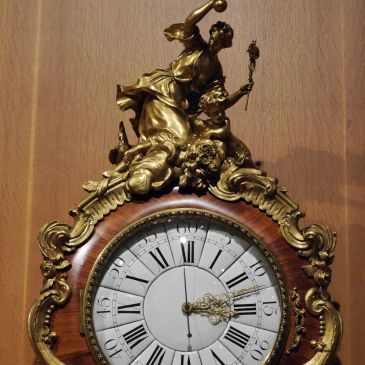
They had a magnificent collection of antique clocks but this particular clock attracted my attention. This weight driven “Regulador” was made by Burgh, Bernard (II) van Risenburgh in Paris between 1745-50. It is made of oak with exotic woods and bronze. The style is Rococo or late baroque, very ornate with elaborate though balanced and a less angular asymmetrical design.
French Rococo style floor or tall-case clockIntricate detail of the clock face
In a precious article I wrote about my frustrations getting this clock to run reliably. No matter what adjustments I made it ran poorly.
“You’ve got to be very careful if you don’t know where you are going, because you might not get there”, Yogi Berra
This time and strike movement (Hermle?) has been out of its case and lying in drawer for the past year or so. When I met the seller in a parking lot some time ago as I handed him $20 for this Dugena mantel clock he climbed into his car he said, “I hope you don’t expect much for $20; it’s not perfect”. Well, it’s not perfect.
It was keeping poor time, losing an hour or so a day but I thought, what a great clock to practice on and practice I did.
Oiling the movement had no effect. Issues? A weak spiral spring, a worn jewel on the floating balance, a power issue associated with a weak mainspring or perhaps pivot wear. I disassembled the movement several times and serviced the mainsprings. I had an issue re-hooking the strike side mainspring and so, discouraged, I put it aside.
Dugena time and strike German made mantel clock
Dugena – is it a clock company?
Dugena was a German retail clock name only, a marketing name, not a maker of movements or cases. Dugena was a registered cooperative society, a “Genossenschaft”, that bought clocks from other makers to sell them under their own brand. A brand name for a retail chain more or less.
Dugena floating balanceThe clock runs slow, this bent spiral spring does not help
Floating balance clocks are much more accurate and above all, they do not have have the disadvantage of the pendulum; these clocks work even when the case is at an oblique angle
A great invention – the floating balance
The floating balance movement in this clock could have been made by anyone; Urgos, Jauch or Hermle perhaps. Hermle is likely since it was one of the leading companies using the floating balance escapement. The floating balance was invented in the 1930s but it took till 1941 for the patent application to be registered. It took another 10 years after that for the patent to be granted slowed by the war years and the challenges of industry recovery following the Second World War.
The floating balance was a great invention. Floating balance clocks are generally more accurate and above all, they do not have have the main disadvantage of the pendulum; they will work even when the clock case is at an oblique angle.
Time and strike movement, maker unknown
Back to the the clock
Months passed. I took the movement out, looked at the strike side barrel a second time, popped the barrel cap off and using pliers gave the inner part of the mainspring a turn and it hooked onto the catch. Success at last. The mainspring barrels can be removed without dis-assembly of the movement, so, in it went. Despite my minor triumph with the strike-side mainspring, straightening the spiral spring and adjusting the balance wheel to its fastest set point, the clock ran only marginally better. The only consolation is that although it runs 5 minutes slower per day it runs a full eight day cycle.
Despite the minor disappointment it has been a productive learning experience but I am inclined to put it aside as I have other projects on the go. Every time I think about the issues I am having with this clock it always comes back to the balance wheel.
In this age of everything electronic, it may surprise some people that a newly acquired mechanical clock bought at the local garage sale, flea market or antique store needs to be wound on a regular basis. Winding a mechanical clock takes a level of care but a few simple guidelines should have you on your way.
Here’s how to wind an antique or vintage mechanical clock correctly. By following these tips and guidance, you’ll gain the skill and confidence needed to wind your clock properly and maintain its functionality.
Let’s begin by discussing some basic terms.
Winding Arbours or Winding Points and Their Function
On your clock’s dial (excluding cable-driven tall case clocks or any clock that has pull-up weights), you will notice one, two, or three holes, known as “winding arbours” or winding points.
A typical German mantel clock
For example, a clock with one winding hole is a time-only clock. Two winding holes typically indicate a time-and-strike clock. These clocks strike the hour on the hour and may also strike on the half-hour, either on a bell or gong.
Each arbour serves a specific purpose, and the number of winding arbours indicates the number of gear trains (or sets of gears) in the clock.
Clocks with three winding arbours chime on the quarter-hour, producing a musical tone. On such clocks, the center arbour winds the time train, the left arbour winds the strike train, and the right arbour winds the chime train.
On some clocks, there is a smaller hole on the clock face near or above the 12 o’clock position. It is also an arbour, but a smaller one used for regulating the speed of your clock. If you have a double-ended key, the small end fits that arbour. Some clocks will have the regulating arbour located under the centre cannon where the hands are attached.
The Difference Between the Terms Strike and Chime
A strike or a chime is simply the clock sounding the time. An antique or vintage “time and strike” clock indicates the hour by striking once for each hour or using a two-tone strike, such as a Normandy or “Bim-Bam” strike.
On the other hand, a chime is a musical tone, and a typical musical tone found on most clocks with three winding points is the Westminster chime. Some clocks provide more choices, such as the Schatz W3 bracket clock, which has 3 musical tones: St Michael’s, Whittington, and Westminster.
On older clocks, there may or may not be an additional strike on the half-hour. Older antique clocks from the mid-1800s, for example, typically do not strike on the half-hour to preserve the wind on the strike side.
Typically, striking clocks have two winding points, while chiming clocks have three.
Where Winding Points Are Located
On this spring-driven, Seth Thomas mantel clock (photo below), the left arbour, indicated by an arrow, winds the strike side, and the right arbour, the right arrow winds the time side. The smaller hole just below the centre cannon is for regulating the clock using a double-ended key.
Winding arbours on an antique Seth Thomas mantel clock
On the Ingraham clock (photo below), there is only one set (or train of gears) that indicates it is a time-only clock, hence the single arbour or winding point. The barely visible, smaller hole in the loop end of the “2” on the number 12 is for regulating the clock.
Winding arbour on an Ingraham Nordic banjo clock
If the striking sound is bothersome or disruptive to guests, you can simply wind the time side only—the clock will continue to run normally without engaging the strike mechanism.
However, to ensure even wear and proper maintenance, it is advisable to wind both sides of a striking clock.
The Running Time or Cycle of a Clock
Most clocks are designed to run for eight days. Some older clocks run 30 hours, and others run as long as 30 days on a wind. Still others, such as anniversary clocks, will run 400 days on a wind.
Double-ended Key
For eight-day clocks, winding once a week ensures the clock continues running smoothly. Establishing a routine, such as winding your clock(s) on the same day each week (a Saturday, for example), is a helpful habit.
It’s also a good idea to make occasional adjustments to your clock, such as fine-tuning its speed to account for seasonal changes. You can find more details in an article I wrote about regulating your clock.
Clock Keys
It is common for a newly acquired clock to come without a key, but this is nothing to worry about. If it does have one, it is usually a replacement. Finding a clock with its original key is quite rare.
The key that accompanies the clock is likely to fit, but if your clock has a speed adjustment arbour (marked F-S) on the dial, typically located near the top, it should have a double-ended key.
If your clock has a one-ended winding key and a speed adjustment arbour is present, the key is not original to the clock. Double-ended keys are necessary because the speed adjustment arbour is considerably smaller than the winding arbour.
Key Size and Type
All mechanical clocks require a winding key, like the one shown below. For those clocks that have winding cables, a winding crank is required. Winding cranks will be covered later in this article. The exceptions are alarm clocks and some carriage clocks, which have built-in winding keys.
Keys come in various sizes, so it’s important to have the correct size for your clock’s arbour. The key should fit snugly without being too loose.
If your clock came without a key it can be purchased at any clock supply house, such as Perrinin Vancouver, Canada. Timesavers and Merritts are clock suppliers in the USA, where keys can be purchased.
Ingraham Huron winding key. Home-made but functional and over 120 years old
Over-winding a clock is a common myth. A clock which “appears” to be over-wound seizes because of a buildup of old oil and dirt in the mainspring coil
Winding Your Mechanical Clock
If the dial is covered by a glass door, open it to access the clock face. Insert the key into one of the winding arbors, and use your non-dominant hand to steady the case while winding. To protect the finish, it’s a good idea to wear a cotton glove on your non-dominant hand.
Next, turn the key clockwise. If it doesn’t turn clockwise, try turning it counterclockwise. Some clocks wind differently, so this is normal. Avoid forcing the key; apply minimal pressure and continue winding until you feel resistance. Once you encounter resistance, stop winding and do not force the key further.
Below is a clear example of a previous owner using excessive force to wind the movement in the wrong direction. The right spring barrel has become unhooked from the main wheel, which only happens when significant force is applied while winding in the opposite direction.
If you lose the key, simply purchase a replacement. Never use pliers or any other hand tools to wind a clock, as the arbours can be easily stripped.
Chinese clock movement
The “clicking” sound heard while winding the arbour is the click engaging the ratchet on the mainspring. The ratchet’s purpose is to secure the mainspring in place with each turn of the key.
An 8-day clock usually requires about 14 half turns of the key as the arbour does one complete turn per day.
Mainspring ratchet and click.
Allow the key to gently return to its click. On the rare occasion that the click slips or breaks, resist the urge to release it quickly. Instead, let the key slowly unwind in your hand to prevent potential damage to the teeth, gears, and even your hand.
Letting the key go free suddenly can cause collateral damage to other parts of the movement.
The myth of overwinding a clock is common, but a clock that “seems” overwound actually seizes due to a buildup of old oil and dirt in the mainspring coil, which causes the coil to lock or stick.
Regular servicing of a mechanical clock is an essential part of ownership and helps prevent future mainspring issues.
Clocks with Weights
Not all clocks use springs — for example, grandfather clocks and one-day ogee clocks are weight-driven. On these clocks, the weights must be raised to the top to begin the weekly time cycle. This can be done either by inserting a crank key into the winding arbor on the clock face or by manually pulling the chains to lift the weights.
For clocks with winding chains, gently pull down on the shorter side of the chain until the weight reaches the underside of the wooden seatboard, stopping at the weight stop bar. Repeat this process for the remaining two chains if it’s a chiming clock.
Allow the chains to do the work — do not assist by lifting the weights at the same time. Pushing up on the weights could cause the chain to slip over the winding gear teeth or become unhooked. To protect the brass finish on the weight shells, wear cotton gloves while steadying the weights as they are pulled up.
For tall case clocks with cable drives, use a crank key to wind them by inserting the key into each winding hole on the clock face. Turn the key slowly until the weights are raised to the top.
All three weights on a chiming grandfather clock descend more or less together through the week.
On older tall case clocks with weights hidden behind an access door, open the door to observe the weights as they rise when you wind the clock. As the weights near the top, slow down and stop when you feel resistance.
Thirty-hour time and strike or one-day clocks are typically wound with a winding crank inserted in the dial face winding points once per day. Wind the weights to the top of the case at approximately the same time each day.
Final thoughts
In conclusion, take pride in your mechanical clock and the craftsmanship it represents. Wind it regularly, care for it properly, and have it serviced when necessary. Even if you prefer not to keep it running, cherish it as a remarkable piece of horological heritage.
For visual learners who prefer to see the process in action, I’ve created a helpful video demonstration showing exactly how to wind a clock. You can watch it here:
Tick-Talk Tuesday is all about the letters and comments I have received from you, the reader, concerning your clocks, issues you might have had and challenges you face and my responses to your questions with advice on your particular clock concern(s). If I am stumped, I consult within my clock circles for the best possible answer.
I wrote a blog article offering advice for online purchases which you can see here.
Summarizing my advice for online shoppers;
Check the dates on the listings. The longer they are listed the more the seller is inclined to sell for a better price.
Meeting the same day is crucial; you do not want the seller to get cold feet and you do not want someone coming before you to buy the clock.
Cash is the rule. No cheques!
If you cannot negotiate a final price by email suggest talking it over on the phone
Be courteous and polite at all stages of the deal
Unmarked French clock, Kijiji purchase
JC writes, “Very good advice overall. I have only one small issue: I think asking about dates (how old is it?) is kind of pointless. I’ve seen clock-makers who have been in business for decades (30+ years) who can’t even correctly date a clock to within 100 years. I’m thinking of a specific example of a well known clock-maker who was explaining a repair on a comtoise clock “from the early 1700s”. The clock was actually from around 1840. I find that this sort of mis-dating happens often, and even with so called experts. Another example I can give you is a Black Forest clock specialist who had a particular clock he was demonstrating in a video, also apparently also “early 1700s” with wooden wheels, but it had an original coiled gong strike inside. The earliest evidence of coiled spiral gongs only date back to as early as maybe 1820-1830. Before this they simply just didn’t exist yet. This was from an EXPERT collector. Someone who specializes in Black Forest clocks. Some of his clocks are worth 5 figures.
That said, I would not trust the word of any eBay, Craigslist, Kijiji, or even auction house seller.
As far as your little clock goes, I think it was an absolute STEAL! True, the strike side could potentially have major problems, but even as a timepiece, the marble is gorgeous. With the price of shipping these days, it was an especially nice find. I haven’t been too lucky finding clocks locally. I think I’ve only bought a small handful, and they tend to be anniversary clocks, and mass produced American clocks (gingerbreads and mantle clocks) with a few German Art Deco style clocks.
I’ve bought a *LOT* of my clocks online (eBay) and for 95% of them, I just went with photos. If the photos were not good enough, I’d pass. It has largely worked out for me, but I ALWAYS assume they will not work. There is only ONE clock that arrived in pristine working condition.
Rare Ingraham Huron found on a local online for-sale site
Ansonia drop octagon, Kijiji purchase
My response to JC . “A good point JC and one that I will consider. The answer I usually get when I ask about the age of the clock is how long the seller has had it. If they say they’ve had it for years or it was their mothers, uncles etc. I am naturally much more interested than someone who is just selling the clock for quick cash. I have acquired some great clocks that have been passed down through family (see photos on this blog). They are not without issues but sometimes the story is just as exciting as the clock itself.
I get most of my clocks from online local for-sale sites that I can pick up within an hour or two from where I live. I scour the sites everyday and will sometimes send out emails to sellers without seriously considering a purchase but occasionally their reply piques my interest. I have had one very bad experience with an EBay clock purchase so I try to stay away from them (not saying I wouldn’t in the future).
The clock is a “Canadian made” New Haven Octagonal short drop wall clock. It was assembled at The New Haven Clock Co. of Canada plant established at Brantford, Ontario (Canada) in 1906.
New Haven schoolhouse clock
The New Haven Clock Company of Canada was a subsidiary of the New Haven Clock Company of America. Both mantel and wall clocks were made in the Brantford plant with Canadian wood cases, but the spring-driven pendulum movements were brought in from the U.S. The Canadian arm of the New Haven Clock Company closed in 1956. More information about The New Haven Clock Company can be found here. This clock was probably made in the 1940s.
The clock was removed from a schoolhouse in Saskatchewan, Alberta (Canada) in the 1960s. The previous owner said that he ran the clock for a couple of years, got tired of it and put it in storage. I hung it up on my kitchen wall for a couple of months and while it ran immediately and kept good time I considered putting off servicing with other projects on the go. However, if I ran it long enough without proper attention any wear would be exacerbated. Now is the time to service this clock.
Day One
The movement was mounted with what looked like the 4 original screws. I wondered if this movement had ever been serviced. Clues began to reveal themselves as I took the movement out for a closer inspection.
New Haven movement #304
The centre cannon arbour was very loose which is not uncommon. A bushing might be required. The pivots were in good shape and had minimal wear but most bushing holes on both the time and the strike side, front and back plates were so enlarged that there was considerable lateral movement of the wheels in both trains but not enough to stop the clock. Not the worst I have seen but clearly a clock that is in dire need of servicing. The clock ran for many years and appeared to have received not much more than basic servicing during that time.
Day Two
The movement was very dirty. The cleaning solution in the ultrasonic cleaner was dark brown in colour and large pieces of crud floated on top, a build up of dried oil and dust over the years.
An obvious example of a previous repair was the drop lever that had been soldered in two places as you can see in the photo below.
Top view of movement indicating solder points
The lever looks strong and should hold for years to come.
Strike side maintenance / drop lever
I took special care to resist bending any parts of the lever to adjust it for fear of breaking it. The helper wire/spring on the drop lever also seemed to have been replaced at some point because it looked crudely made, not something you would see in a factory installed movement. A piece of the helper wire broke off during dis-assembly which meant that I had to make a new wire/spring.
I polished the pivots and then proceeded with the bushing work prior to cleaning the movement.
Bergeon Bushing Machine
15 bushings were installed, 7 on the front plate and 8 on the rear plate. The centre cannon arbour required one bushing, a much larger one, on the rear plate.
To completely eliminate any issues with the time side I took all the strike train wheels out
Movement on test stand without strike side wheels
Without strike side wheels
Day Three to day Five
All went well while test fitting the wheels on both trains; they moved as smoothly as they should. I re-assembled the movement and attempted to align the levers on the strike side as best as I could with little success. I ran the movement on the test stand even though the drop lever was not positioned correctly. Unfortunately, the clock stopped every few hours. My suspicion was an incorrectly aligned lever somehow stopping the strike side.
To completely eliminate any issues with the time side I took all the strike train wheels out and ran the time side for 3 trouble-free days eliminating any issues with the motion works.
I consulted Steven Conover’s excellent book on strike clock movements (Striking Clock Repair Guide) to work through a solution. He devotes one chapter to the New Haven movement and clear instructions for setting up the strike side.
Day 6
After studying Steven’s manual, I reinstalled the strike side and proceeded with the necessary adjustments as follows.
The positioning of the levers are critical.
The 3 levers of the New Haven movement
There are 3 levers in this clock. Knowing how the levers function is key to getting this clock to run. The hammer strike lever (Lever number 1) performs a very simple task and installs on the bottom of the clock and is activated by the hammer lifting pins on the cam wheel. The drop and paddle lever (Lever number 2) does several jobs in unison. It pushes the unlocking lever or the lift lever (Lever number 3) down to release the warning pin to prepare the strike. The top arm of the lever number 2 rotates through the 2 – 180 degree slots of the cam while the bottom arm forms the paddle that enters the deep slots of the count wheel to indicate the strike on both the hour and half hour. The upper arm of this lever must be on the upper rear part of the slot on the cam to work correctly. I found this through trial and error. Needless to say, the positioning of the levers are critical. Once the levers were positioned correctly, the clock ran beautifully.
Post assembly testing
The clock went through it’s full 8-day cycle without any issues striking as it should. The movement was mounted back into it’s case, is being regulated and is now on display in our living room.
This very ordinary clock reflects its utilitarian role as a schoolhouse clock; it is not the best looking or the best sounding clock in the world but like a faithful servant it should run without issues for years to come.
I wrote about this clock in 2015. The Canadian Time clock was made by the Arthur Pequegnat Clock company of Kitchener, Ontario. The Arthur Pequegnat Clock Company (1904–1941) is notable as the longest lasting Canadian-based clock manufacturer. Pequegnat clocks are sought after by Canadian collectors and often command high prices on online for-sale sites.
Former railway clock from a station in Pictou County, Nova Scotia (Canada)
Label on back board
The clock was made after 1917 in Kitchener, Ontario (Canada). Clocks made before 1917 had the word “Berlin” on the dial face. Kitchener was known as Berlin prior to and during the first World War. It was the town of Berlinfrom 1854 until 1912 and the City of Berlin from 1912 until 1916. Because the name Berlin was associated with the war against Germany the decision was made to change the name to Kitchener midway through the First World War. Kitchener is the present seat of the Regional Municipality of Waterloo, Ontario. Though it is impossible to determine the exact year this clock was made my guess is just prior to 1941 before the company closed it’s doors.
It is always disconcerting to open a clock up to discover punch marks on a movement
The clock was purchased in Sept 2013 and after 3 1/2 years it is overdue for servicing.
Movement showing punch marks (arrows)
It is always disconcerting to open a clock up to discover punch marks on a movement, specifically around the pivot holes as one would expect. I am one of those who believe that a punch should never be used on a clock movement. Most, including myself, would consider it a quick and easy shortcut that is not designed to extent the life of the clock in any appreciable manner. Because punching weakens the side wall of the pivot hole those two pivot holes in particular are prime examples of the need for bushings. In total the clock required 5 bushings. The second wheel pivot hole was worn the most. One back plate bushing was required for the escape wheel arbour.
Time only movement
Time only movement are relatively simple to work on and for the novice this is the first kind of movement you should tackle. Whenever working on a clock be sure to take as many photos as you can; you will need them if you get stuck re-assembling the movement. On this clock the 3rd and 4th wheels look exactly the same but in fact differ slightly in height. Photos taken at the right angles will easily confirm the difference.
Mainspring cleaned and inspected
A strange anomaly that I did not notice when I first bought the clock; additional screw holes
The mainspring is in excellent condition and might have been a replacement at some point in the clock’s life. I had some difficulty re-hooking the arbour to the spring and had to use pliers to bend it, but just a little.
I found one strange anomaly that I did not notice when I first bought the clock. There are additional screw holes in the back board leading me to believe that the clock might have had another type of Pequegnat movement which would mean that the current movement is a replacement. Possible reasons, a catastrophic failure of the original movement, a conversion from a time and strike movement to a time-only clock (requiring a new dial) – it is anyone’s guess. A mystery nonetheless.
Servicing this clock took less than a day. Testing takes a couple of weeks. With new bushings in place and an oiling this clock should run reliably for years to come.
I began keeping a detailed log of clock repairs noting, in particular, when the movement was last oiled so that I do not wait too long between inspection and oiling.
Seth Thomas Adamantine time and strike mantel clock
I am servicing the first antique clock I ever bought. After having serviced many others it is time to give this clock a little love.
Some years ago (2000) my wife and I were traveling around Nova Scotia and stopped in a little village called Blockhouse. We found an antique store, walked in and never intended to buy an antique clock that day but left with an American Seth Thomas Adamantine mantel clock. It looked like it was worth many more times than we paid for it. We left the store thinking we had stolen it.
My research revealed that thousands were made and the price we paid at the time likely reflected its true value. The clock came home and sat on top of our piano and looked great. For a couple of years I wound it up religiously and marveled at its beautiful marbleized case and the sound of the gong on the hour and the bell on the half hour. I stopped winding it, let it sit on the piano and ignored it. About 5 years ago as I began to build my collection of vintage and antique clocks I wound it up and have kept it running ever since.
These clocks have become known to collectors as “Black Mantel Clocks”, and were popular from 1880 to 1931. Adamantine veneer was developed by the Celluloid Manufacturing Company of New York City, and was covered by U.S. Patent dated September 7, 1880. Seth Thomas Clock Company purchased the right to use the Adamantine veneer in 1881. At that time Seth Thomas stamped the year of manufacture on the bottom of each case. Though somewhat difficult to read the date on this particular clock is 1907.
Re-assembled and tested
Each clock I added to my collection needed some work and so I left the ST thinking that one day I would service it. Despite the fact that I kept it oiled, displayed it in a relatively dry dust free environment, it needed a good cleaning and a little bushing work.
Once you take a movement out of its case you begin to discover it’s little secrets. I immediately noticed a stripped speed regulating gear. The regulator arbour runs through the plates and is connected to the pendulum hanger to slow or speed up the clock. The rate adjustment is on the front of the clock and the smaller end of a double-sided key is used to speed and slow down the clock. I observed a rate adjustment screw on the pendulum bob. The “newer” bob had evidently been added at some point in the clock’s life to replace the stripped gear. The other possibility is that it might have had both. I have seen French clocks with both a front rate adjustment and an adjustable bob.
Regulating gear is stripped
The movement was taken apart and the parts were cleaned in an ultrasonic cleaner.
Back of movement showing
Bushing wear was not an excessive but enough to justify installing 4 bushings; S2 front, T2 front, and escape wheel, both front and back plates. Putting the movement back together is relatively easy though it is always frustrating positioning the helper springs and levers in place as you move the pivots into their holes. It takes me a few attempts to get the strike side gears and levers correctly aligned. The stop wheel, stop lever, maintenance lever and count wheel hook take a little trial and error and it not something I have managed to get right the first time.
Seth Thomas clock face
Once back together the movement was oiled and placed back into it’s case. It should run reliably for years to come. Save for a slight aging of the clock face the clock is in excellent original condition.
Antique Seth Thomas Adamantine clocks look great on any mantel.
You must be logged in to post a comment.