
Understanding the role of the clock key is essential for proper clock maintenance and operation. The clock key not only winds your antique or vintage clock but also plays a crucial part in ensuring it runs smoothly and efficiently. However, using the correct size key is just as important as the key itself. Using the wrong size can lead to damage or improper winding, affecting the longevity and performance of your clock.
In this article, we’ll explore the purpose of the clock key, why choosing the right size is vital, and provide a helpful chart to guide you in selecting the correct key for your clock.
Winding Mechanical clocks
Mechanical clocks require periodic winding. Some clocks need to be wound daily, such as 30-hour clocks, while others are wound once a week (8-day clocks). Some clocks run for 14 days, and anniversary clocks can run for up to 400 days on a single winding.
Most mechanical clocks have a winding hole located on the dial face, where the clock key is inserted. The key should fit snugly—neither too tight nor too loose—ensuring smooth operation when winding.
Why Key Size Matters
Except for the smaller regulating arbour on some clock faces, most winding arbours or winding points are the same size on the clock. This means one key will fit all of them. However, over time, a clock’s original key may go missing. If this happens, you can often use a key from another mechanical clock, and one of them will usually fit.
A micrometre is a useful tool to measure the thickness of a winding arbour. However, measuring the arbour’s size often requires removing the clock movement from its case. Once you’ve measured, you can order the correct key online.

Different Types of Keys
In general, larger German movements use a #8 key, though some require a #7 key. Many 31-day clocks, or clocks made in Korea or China, use a #6 or #7 key. Many American mantel clocks require a #5 or #6 key.
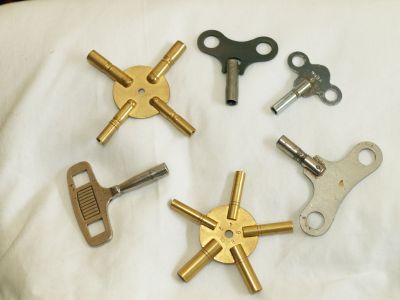
Keys come in all shapes and sizes. In the photo below are keys from German and American movements. The two-pronged keys (4 and 5 prongs) are available at any clock supply house such as Perrin or Timesavers and will fit many clock winding arbours. Many other sizes can also be ordered. eBay, online marketplaces and antique stores are other sources for clock keys.
In the photo below you can see two types of double-ended keys
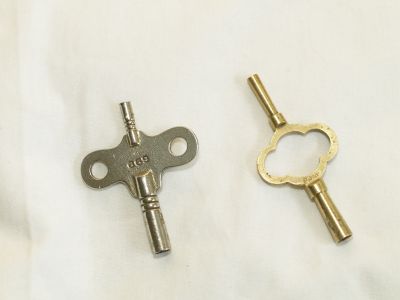
The one on the left is used for winding a typical American clock. The large end fits into the winding arbour while the small end is for adjusting the speed of your clock. Many clocks have a smaller arbour used for adjusting the speed of your clock and will have “S” and “F” (Slow/Fast) inscribed on the dial generally near the 12 o’clock position.
The key on the right is for a time-only carriage clock. The small end is used to advance the minute hand and the large end fits onto the mainspring arbour.

Grandfather and Ogee Clocks
30-hour weight-driven Ogee clocks typically require a #4, #5, or #6 crank key. Many grandfather clocks use a #10 or #11 winding crank, and it’s important not to wind them with a conventional clock key. For clocks with weight cables, the winding crank is essential for raising the weights. Insert the crank into the arbour and carefully wind the weights up until they reach the top of the clock, ensuring they remain fully visible.
Some clock keys will also have a number stamped on them indicating their size.
Storing Your Clock Key
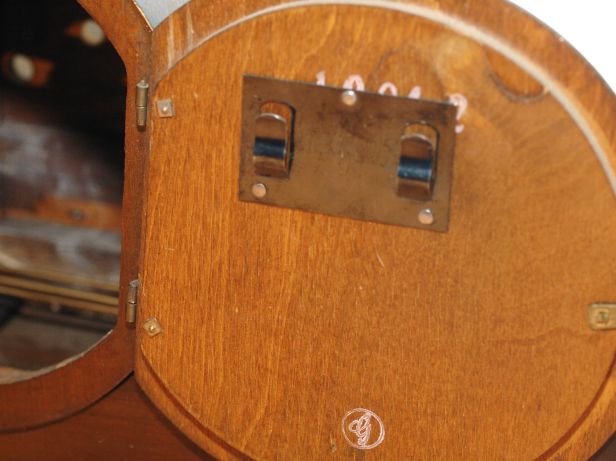
It’s important to keep your clock key in a safe, easily accessible place. Keys should be stored either beside the clock, within the front access door of a wall clock, or in a caddy inside the case. Mantel clocks with key caddies can be inconvenient, as you must move the clock to open the back door to access the key. However, for homes with small children, keeping the key in its caddy helps ensure it remains out of reach.
Key Size Chart
Here is a chart that lists key sizes in millimetres for both American and Swiss movements, from small to large:
| Key Size | American (mm) | Swiss (mm) |
|---|---|---|
| 5/0 | 1.6 | 1.25 |
| 4/0 | 1.8 | 1.5 |
| 3/0 | 2.0 | 1.75 |
| 2/0 | 2.2 | 2.0 |
| 0 | 2.4 | 2.25 |
| 1 | 2.6 | 2.5 |
| 2 | 2.8 | 2.75 |
| 3 | 3.0 | 3.0 |
| 4 | 3.2 | 3.25 |
| 5 | 3.4 | 3.5 |
| 6 | 3.6 | 3.75 |
| 7 | 3.8 | 4.0 |
| 8 | 4.0 | 4.25 |
| 9 | 4.2 | 4.5 |
| 10 | 4.4 | 4.75 |
| 11 | 4.6 | 5.0 |
| 12 | 4.8 | 5.25 |
| 13 | 5.0 | 5.5 |
| 14 | 5.2 | 5.75 |
| 15 | 5.4 | 6.0 |
| 16 | 5.6 | 6.25 |
| 17 | 5.8 | 6.5 |
| 18 | 6.0 | 6.75 |
| 19 | 6.2 | 7.0 |
| 20 | 6.4 | 7.25 |
| 21 | 6.6 | 7.5 |
| 22 | 6.8 | 7.75 |
| 23 | 7.0 | 8.0 |
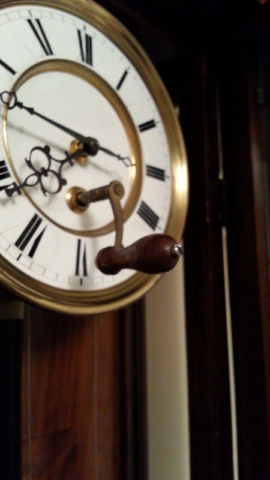
There is no key required for weight-driven clocks that have weight chains. Winding involves pulling the weight(s) to the top of the clock once each week.
Check out this article on How to Wind A Mechanical Clock
Choosing the correct clock key is essential for the proper functioning and longevity of your mechanical clock. Whether you’re winding an antique mantel clock, a grandfather clock, or a time-only carriage clock, using the right key size ensures smooth operation and prevents damage to the movement.
With a variety of key sizes available, understanding your clock’s requirements and keeping the key in a safe, accessible location will help you maintain your timepiece in excellent working condition. By following the guidelines and chart provided, you can confidently select the correct key and enjoy the reliable performance of your clock for many years to come.
Discover more from Antique and Vintage Mechanical Clocks
Subscribe to get the latest posts sent to your email.
 Antique and Vintage Mechanical Clocks
But wanna comment that you have a very decent website , I love the pattern it really stands out.
LikeLike
Thanks for coming to my blog.
LikeLike
I read your blog frequently and I just thought I’d say keep up the amazing work!
LikeLike
Thanks for coming to my blog.
LikeLike
I like this web site its a master peace ! .
LikeLike
Very interesting subject , thanks for posting.
LikeLike
I love clocks as a symbol, but also in real life!
LikeLike
Thanks for dropping by.
Ron
LikeLike