
In this age of everything electronic, it may surprise some people that a newly acquired mechanical clock bought at the local garage sale, flea market or antique store needs to be wound on a regular basis. Winding a mechanical clock takes a level of care but a few simple guidelines should have you on your way.
Here’s how to wind an antique or vintage mechanical clock correctly. By following these tips and guidance, you’ll gain the skill and confidence needed to wind your clock properly and maintain its functionality.
Let’s begin by discussing some basic terms.
Winding Arbours or Winding Points and Their Function
On your clock’s dial (excluding cable-driven tall case clocks or any clock that has pull-up weights), you will notice one, two, or three holes, known as “winding arbours” or winding points.

For example, a clock with one winding hole is a time-only clock. Two winding holes typically indicate a time-and-strike clock. These clocks strike the hour on the hour and may also strike on the half-hour, either on a bell or gong.
Each arbour serves a specific purpose, and the number of winding arbours indicates the number of gear trains (or sets of gears) in the clock.
Clocks with three winding arbours chime on the quarter-hour, producing a musical tone. On such clocks, the center arbour winds the time train, the left arbour winds the strike train, and the right arbour winds the chime train.
On some clocks, there is a smaller hole on the clock face near or above the 12 o’clock position. It is also an arbour, but a smaller one used for regulating the speed of your clock. If you have a double-ended key, the small end fits that arbour. Some clocks will have the regulating arbour located under the centre cannon where the hands are attached.
The Difference Between the Terms Strike and Chime
A strike or a chime is simply the clock sounding the time. An antique or vintage “time and strike” clock indicates the hour by striking once for each hour or using a two-tone strike, such as a Normandy or “Bim-Bam” strike.
On the other hand, a chime is a musical tone, and a typical musical tone found on most clocks with three winding points is the Westminster chime. Some clocks provide more choices, such as the Schatz W3 bracket clock, which has 3 musical tones: St Michael’s, Whittington, and Westminster.
On older clocks, there may or may not be an additional strike on the half-hour. Older antique clocks from the mid-1800s, for example, typically do not strike on the half-hour to preserve the wind on the strike side.
Typically, striking clocks have two winding points, while chiming clocks have three.
Where Winding Points Are Located
On this spring-driven, Seth Thomas mantel clock (photo below), the left arbour, indicated by an arrow, winds the strike side, and the right arbour, the right arrow winds the time side. The smaller hole just below the centre cannon is for regulating the clock using a double-ended key.

On the Ingraham clock (photo below), there is only one set (or train of gears) that indicates it is a time-only clock, hence the single arbour or winding point. The barely visible, smaller hole in the loop end of the “2” on the number 12 is for regulating the clock.

If the striking sound is bothersome or disruptive to guests, you can simply wind the time side only—the clock will continue to run normally without engaging the strike mechanism.
However, to ensure even wear and proper maintenance, it is advisable to wind both sides of a striking clock.
The Running Time or Cycle of a Clock
Most clocks are designed to run for eight days. Some older clocks run 30 hours, and others run as long as 30 days on a wind. Still others, such as anniversary clocks, will run 400 days on a wind.
For eight-day clocks, winding once a week ensures the clock continues running smoothly. Establishing a routine, such as winding your clock(s) on the same day each week (a Saturday, for example), is a helpful habit.
It’s also a good idea to make occasional adjustments to your clock, such as fine-tuning its speed to account for seasonal changes. You can find more details in an article I wrote about regulating your clock.
Clock Keys
It is common for a newly acquired clock to come without a key, but this is nothing to worry about. If it does have one, it is usually a replacement. Finding a clock with its original key is quite rare.
The key that accompanies the clock is likely to fit, but if your clock has a speed adjustment arbour (marked F-S) on the dial, typically located near the top, it should have a double-ended key.
If your clock has a one-ended winding key and a speed adjustment arbour is present, the key is not original to the clock. Double-ended keys are necessary because the speed adjustment arbour is considerably smaller than the winding arbour.
Key Size and Type
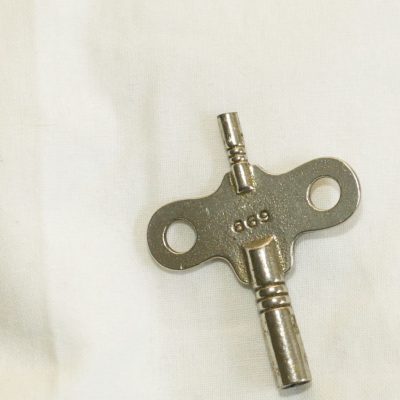
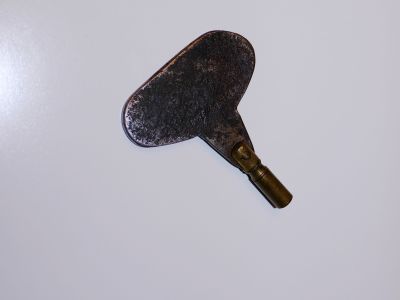
All mechanical clocks require a winding key, like the one shown below. For those clocks that have winding cables, a winding crank is required. Winding cranks will be covered later in this article. The exceptions are alarm clocks and some carriage clocks, which have built-in winding keys.
Keys come in various sizes, so it’s important to have the correct size for your clock’s arbour. The key should fit snugly without being too loose.
If your clock came without a key it can be purchased at any clock supply house, such as Perrin in Vancouver, Canada. Timesavers and Merritts are clock suppliers in the USA, where keys can be purchased.
Over-winding a clock is a common myth. A clock which “appears” to be over-wound seizes because of a buildup of old oil and dirt in the mainspring coil
Winding Your Mechanical Clock
If the dial is covered by a glass door, open it to access the clock face. Insert the key into one of the winding arbors, and use your non-dominant hand to steady the case while winding. To protect the finish, it’s a good idea to wear a cotton glove on your non-dominant hand.
Next, turn the key clockwise. If it doesn’t turn clockwise, try turning it counterclockwise. Some clocks wind differently, so this is normal. Avoid forcing the key; apply minimal pressure and continue winding until you feel resistance. Once you encounter resistance, stop winding and do not force the key further.
Below is a clear example of a previous owner using excessive force to wind the movement in the wrong direction. The right spring barrel has become unhooked from the main wheel, which only happens when significant force is applied while winding in the opposite direction.
If you lose the key, simply purchase a replacement. Never use pliers or any other hand tools to wind a clock, as the arbours can be easily stripped.

The “clicking” sound heard while winding the arbour is the click engaging the ratchet on the mainspring. The ratchet’s purpose is to secure the mainspring in place with each turn of the key.
An 8-day clock usually requires about 14 half turns of the key as the arbour does one complete turn per day.
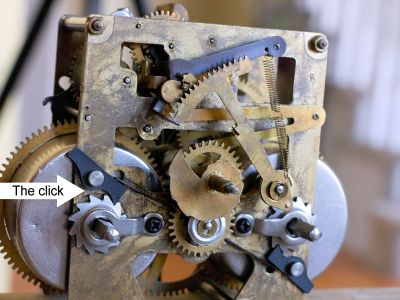
Allow the key to gently return to its click. On the rare occasion that the click slips or breaks, resist the urge to release it quickly. Instead, let the key slowly unwind in your hand to prevent potential damage to the teeth, gears, and even your hand.
Letting the key go free suddenly can cause collateral damage to other parts of the movement.
The myth of overwinding a clock is common, but a clock that “seems” overwound actually seizes due to a buildup of old oil and dirt in the mainspring coil, which causes the coil to lock or stick.
Regular servicing of a mechanical clock is an essential part of ownership and helps prevent future mainspring issues.
Clocks with Weights
Not all clocks use springs — for example, grandfather clocks and one-day ogee clocks are weight-driven. On these clocks, the weights must be raised to the top to begin the weekly time cycle. This can be done either by inserting a crank key into the winding arbor on the clock face or by manually pulling the chains to lift the weights.
For clocks with winding chains, gently pull down on the shorter side of the chain until the weight reaches the underside of the wooden seatboard, stopping at the weight stop bar. Repeat this process for the remaining two chains if it’s a chiming clock.
Allow the chains to do the work — do not assist by lifting the weights at the same time. Pushing up on the weights could cause the chain to slip over the winding gear teeth or become unhooked. To protect the brass finish on the weight shells, wear cotton gloves while steadying the weights as they are pulled up.
For tall case clocks with cable drives, use a crank key to wind them by inserting the key into each winding hole on the clock face. Turn the key slowly until the weights are raised to the top.
All three weights on a chiming grandfather clock descend more or less together through the week.
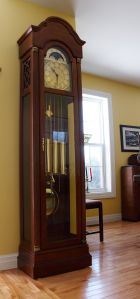
On older tall case clocks with weights hidden behind an access door, open the door to observe the weights as they rise when you wind the clock. As the weights near the top, slow down and stop when you feel resistance.
Thirty-hour time and strike or one-day clocks are typically wound with a winding crank inserted in the dial face winding points once per day. Wind the weights to the top of the case at approximately the same time each day.
Final thoughts
In conclusion, take pride in your mechanical clock and the craftsmanship it represents. Wind it regularly, care for it properly, and have it serviced when necessary. Even if you prefer not to keep it running, cherish it as a remarkable piece of horological heritage.
For visual learners who prefer to see the process in action, I’ve created a helpful video demonstration showing exactly how to wind a clock. You can watch it here:
Related Articles
Discover more from Antique and Vintage Mechanical Clocks
Subscribe to get the latest posts sent to your email.
 Antique and Vintage Mechanical Clocks
I have a Daniel Pratt ogee clock which has been sitting on a basement shelf for about 30 years. Recently I decided to see if it could be put in working order. The gentleman at a local clock repair service did a lot of work for me for a very nominal fee. I put it on our mantel shelf and enjoyed listening to it tick away and chime the hours for a day. But I discovered that something is not right–the second weight does not engage once the first one reaches the bottom of the case. (I think that’s what is supposed to happen, not sure.) I don’t know if I’m supposed to do something manually to make this happen–it’s very possible that the man who fixed it for me said something to that effect, but since I am/was completely ignorant of how the thing works I may have missed it. Can I get a mini tutorial? I am prepared, I think, to take it back to him and pay a bit more if necessary, but if it’s a simple fix I’d rather not bother him.
LikeLike
Thanks for your question.
First a couple of assumptions. I assume it is a 30-hour or 1-day clock. You mention the word “chime” so I take it it has not been striking on the hour as it should. If there are two winding points (arbours) on the front of your clock, the left side is the Strike side and the right side is the Time side. So, the weight on the left is for the hourly strike and the one on the right is for the time function. Both arbours must be wound each day so that both weights are wound or brought to the top of the case every day (again, I am assuming it is a 1-day clock).
If I am missing it completely, let me know. Also, a photo might help. Send the photo to ronjoiner@gmail.com.
Ron
LikeLike
very interesting info ! .
LikeLike
Have you ever considered writing an ebook or guest authoring on other blogs? I have a blog based upon on the same subjects you discuss and would love to have you share some stories/information. I know my visitors would enjoy your work. If you are even remotely interested, feel free to shoot me an e-mail.
LikeLiked by 1 person
Okay, how about you share stories first, but they have to be clock stories or do you not have the time?
Ron
LikeLike
Thanks, that’s very useful information. Our customers often ask about how to wind a grandfather clock, we will refer to this.
LikeLike
Thank you.
LikeLike
I have an eight day Bucherer clock that has three winding points (Westminister) that I don’t find instructions on how to adjust the speed and sequence for striking the hour. Can you help me here?
LikeLike
Please respond to ronjoiner@gmail.com with a photo or two concerning your clock. I will be able to give you a more concise response to your issue.
LikeLike