
Your Clock Has Stopped | Follow These First 5 Steps Before Calling A Clock Repairer
There are few things more frustrating for an antique or vintage clock owner than when a favorite clock suddenly stops. Mechanical clocks are intricate machines, but that doesn’t always mean the problem is complicated. In fact, many stoppages are caused by small, simple issues that can be corrected at home without tools or technical expertise.

Before you assume the worst or take your clock to a repair shop, here are 5 things you can do yourself to have your clock ticking again.


1. Is the Clock Wound?

It may sound obvious, but the most common reason a clock stops is simply that it has run down. Spring-driven clocks need their mainsprings wound fully with a key, while weight-driven clocks require the weights to be raised. All mechanical clocks require power to operate. Simply put, if the clock is not wound, it cannot run — so always begin here before moving on to more complex possibilities.

Winding arbors on a Seth Thomas mantel clock (arrows)

2. Is the Clock Level and in Beat?

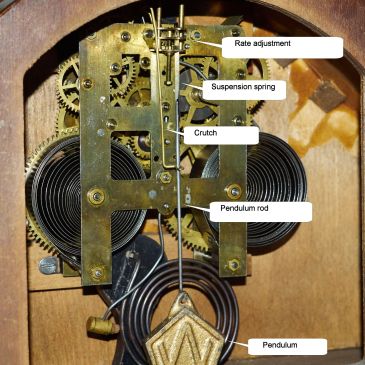
Pendulum clocks must be in beat to function properly. Being “in beat” means that the tick and tock are evenly spaced in time. If the case is leaning or the crutch (the arm that drives the pendulum) is out of position, the pendulum will quickly stall. Place the clock on a level surface and listen carefully: if the tick and tock sound uneven, adjust the clock slightly to the left or right until the beat evens out. Sometimes, fine adjustments to the crutch are necessary, but often leveling the case is all it takes.

Unless your wall clock is anchored, simply moving the case very slightly left or right and listening for an even beat is all that’s required.

Is your clock level on the wall?

3. Is the Pendulum Free to Swing?

The pendulum is the heart of your clock, and it must swing freely without interference. Check that the suspension spring is straight and properly seated, not twisted or bent. Make sure the pendulum bob is not rubbing against the backboard, striking the chime rods, or touching the bottom of the case. Any sort of rubbing will affect the swing of the pendulum, thereby robbing the clock of power. The smallest obstruction can rob the pendulum of momentum and bring the clock to a halt.

Clocks with a floating balance or a hairspring escapement are popular with some collectors since they continue running even when the surface isn’t perfectly level.

A mantel clock movement showing the pendulum

4. Are the Hands Binding?

Sometimes the problem lies not with the movement but with the clock hands. If the hour and minute hands are rubbing against each other, or if the minute hand is scraping against the dial or the glass, the train can be stopped entirely. If the clock stops at a specific time every 12 hours, hands that are interfering with each other are likely the culprit. Inspect the hands carefully and make sure there is a little clearance between them. A gentle outward bend is usually all that’s needed to free them.

Any one of the four hands on this clock can cause interference

5. Is the Movement Dirty or Dry?

Mechanical clocks rely on clean pivots and fresh oil. Over time, old oil becomes gummy and collects dust, creating friction that will eventually stop the clock. If you notice dry or blackened pivot holes, sticky residue, or an overall grimy look to the movement, then lack of servicing is likely the culprit. Gummed-up oil in the mainspring coils can also cause the springs to appear as if they are glued together. Some people incorrectly refer to this condition as a clock that is “over-wound”.

When I first examine a newly purchased clock that does not run, I carefully release the mainspring’s power and then attempt to run the movement. If it runs, that tells me the mainsprings require servicing. At this point, the clock will need a complete cleaning and oiling by a qualified repairer.

Very dirty movement
A very dirty movement

Conclusion: When Simple Fixes Aren’t Enough

If you have checked these five areas and your clock still refuses to run, the cause is almost certainly deeper and more complex. Worn pivot holes, tired mainsprings, bent teeth, or other mechanical issues may be at fault — problems that cannot be corrected with quick at-home adjustments. A clock movement may appear clean, yet still be quite worn — something you can’t always detect without disassembly.

The good news is that your clock is very likely repairable, but it will require the attention of an experienced clockmaker. By ruling out these simple issues first, you’ll know with confidence when it’s time to seek professional help, and you may just save yourself a service call.

Winding a mechanical clock – A How-To Guide

In this age of everything electronic, it may surprise some people that a newly acquired mechanical clock bought at the local garage sale, flea market or antique store needs to be wound on a regular basis. Winding a mechanical clock takes a level of care but a few simple guidelines should have you on your way.

Here’s how to wind an antique or vintage mechanical clock correctly. By following these tips and guidance, you’ll gain the skill and confidence needed to wind your clock properly and maintain its functionality.

Junghans Corner feet finished
A typical German mantel clock

Let’s begin by discussing some terms.

Winding Arbours or Winding Points and Their Function

On your clock’s dial (excluding cable-driven tall case clocks), you will notice one, two, or three holes, known as “winding arbours” or winding points. Each arbour serves a specific purpose, and the number of winding arbours indicates the number of gear trains (or sets of gears) in the clock.

For example, a clock with one winding hole is a time-only clock. Two winding holes typically indicate a time-and-strike clock. These clocks strike the hour on the hour and may also strike on the half-hour, either on a bell or gong. Clocks with three winding arbours chime on the quarter-hour, producing a musical tone. On such clocks, the center arbour winds the time train, the left arbour winds the strike train, and the right arbour winds the chime train.

On some clocks, there is a smaller hole on the clock face near or above the 12 o’clock position. It is also an arbour, but a smaller one used for regulating the speed of your clock. If you have a double-ended key, the small end fits that arbour. Some clocks will have the regulating arbour located under the centre cannon where the hands are attached.

The Difference Between Strike and Chime

A strike or a chime is simply the clock sounding the time. An antique or vintage “time and strike” clock indicates the hour by striking once for each hour or using a two-tone strike, such as a Normandy or “Bim-Bam” strike.

On the other hand, a chime is a musical tone and a typical musical tone found on most clocks with three winding points is the Westminster chime. Some clocks provide more choices such as the Schatz W3 bracket clock which has 3 musical tones, St Michael’s, Whittington and Westminster.

On older clocks, there may or may not be an additional strike on the half-hour. Older antique clocks from the mid-1800s, for example, typically do not strike on the half-hour to preserve the wind on the strike side.

Typically, striking clocks have two winding points, while chiming clocks have three.

Where Winding Points Are Located

On this spring-driven, Seth Thomas mantel clock (photo below) the left arbour, indicated by an arrow, winds the strike side and the right arbour, the right arrow winds the time side. The smaller hole just below the centre cannon is for regulating the clock using a double-ended key.

Winding arbors on a Seth Thomas mantel clock (arrows)
Winding arbours on an antique Seth Thomas mantel clock

On the Ingraham clock (photo below), there is only one set or train of gears that indicates it is a time-only clock, hence the single arbour or winding point. The barely visible, smaller hole in the loop end of the “2” on the number 12 is for regulating the clock.

Winding arbor on an Ingraham Nordic banjo clock
Winding arbour on an Ingraham Nordic banjo clock

If you find the sound of the strike unpleasant or it disturbs your guests, you can wind only the time side, and the clock will still run perfectly fine without winding the strike side.

However, to ensure even wear and proper maintenance, it is advisable to wind both sides of a striking clock.

The Running Time or Cycle of a Clock

Most clocks are designed to run for eight days. Some older clocks run 30 hours and others run as long as 30 days on a wind. Still others such as anniversary clocks will run 400 days on a wind.

Double-ended Key

For eight-day clocks, winding once a week ensures the clock continues running smoothly. Establishing a routine, such as winding your clock(s) on the same day each week, is a helpful habit. It’s also a good idea to make occasional adjustments to your clock, such as fine-tuning its speed to account for seasonal changes. You can find more details in an article I wrote about regulating your clock.

Clock Keys

It is common for a newly acquired clock to come without a key, and if it does have one, it is usually a replacement. Finding a clock with its original key is quite rare. The key that accompanies the clock is likely to fit, but if your clock has a speed adjustment arbour (marked F-S) on the dial, typically located near the top, it should have a double-ended key.

If your clock has a one-ended winding key and a speed adjustment arbour is present, the key is not original to the clock. Double-ended keys are necessary because the speed adjustment arbour is considerably smaller than the winding arbour.

Key Size and Type

All mechanical clocks require a winding key, like the one shown below. The exceptions are alarm clocks and some carriage clocks, which have built-in winding keys. Keys come in various sizes, so it’s important to have the correct size for your clock’s arbour. The key should fit snugly without being too loose.

If your clock came without a key it can be purchased at any clock supply house such as Perrin in Vancouver, Canada. Timesavers and Merritts are clock suppliers in the USA where keys can be purchased.

Here is an article on key sizes.

Ingraham Huron winding key
Ingraham Huron winding key. Home-made but functional and over 120 years old

Over-winding a clock is a common myth.  A clock which “appears” to be over-wound seizes because of a buildup of old oil and dirt in the mainspring coil

Winding Your Mechanical Clock

If the dial is covered by a glass door, open it to access the clock face. Insert the key into one of the winding arbours and use your non-dominant hand to steady the case while winding. To protect the finish of the case, it’s a good idea to wear a cotton glove on your non-dominant hand.

Next, turn the key clockwise. If it doesn’t turn clockwise, try turning it counterclockwise. Some clocks wind in either direction, so this is normal. Avoid forcing the key; apply minimal pressure and continue winding until you feel resistance. Once you encounter resistance, stop winding and do not force the key further.

Below is a clear example of a previous owner using excessive force to wind the movement in the wrong direction. The right spring barrel has become unhooked from the main wheel, which only happens when significant force is applied while winding in the opposite direction.

If you lose the key, simply purchase a replacement. Never use pliers or any other hand tools to wind a clock.

Daniel Dakota movement
Chinese clock movement

The “clicking” sound heard while winding the arbour is the click engaging the ratchet on the mainspring. The ratchet’s purpose is to secure the mainspring in place with each turn of the key.

An 8-day clock usually requires about 14 half turns of the key as the arbour does one complete turn per day.

Mainspring rachet and click
Mainspring ratchet and click. 


Allow the key to gently return to its click. On the rare occasion that the click slips or breaks, resist the urge to release it quickly. Instead, let the key slowly unwind in your hand to prevent potential damage to the teeth, gears, and even your hand. Letting the key go suddenly can cause collateral damage to other parts of the movement.

The myth of overwinding a clock is common, but a clock that “seems” overwound actually seizes due to a buildup of old oil and dirt in the mainspring coil, which causes the coil to stick. Regular servicing of a mechanical clock is an essential part of ownership and helps prevent future issues.

Clocks with Weights

Not all clocks use springs — for example, grandfather clocks and one-day ogee clocks are weight-driven. On these clocks, the weights must be raised to the top to begin the weekly time cycle. This can be done either by inserting a crank key into the winding arbor on the clock face or by manually pulling the chains to lift the weights.

For clocks with winding chains, gently pull down on the shorter side of the chain until the weight reaches the underside of the wooden seatboard, stopping at the weight stop bar. Repeat this process for the remaining two chains if it’s a chiming clock. Allow the chains to do the work — do not assist by lifting the weights at the same time. Pushing up on the weights could cause the chain to slip over the winding gear teeth or become unhooked. To protect the brass finish on the weight shells, wear cotton gloves while steadying the weights as they are pulled up.

For tall case clocks with cable drives, use a crank key to wind by inserting the key into each winding hole on the clock face. Turn the key slowly until the weights are raised to the top.

All three weights on a chiming grandfather clock descend more or less together through the week.

On older tall case clocks with weights hidden behind an access door, open the door to watch the weights rise as you wind the clock. As the weights near the top, slow down and stop when you feel resistance.

Thirty-hour time and strike or one-day clocks are typically wound with a winding crank inserted in the dial face winding points once per day. Wind the weights to the top of the case at approximately the same time each day.

Final thoughts

In conclusion, take pride in your mechanical clock and the craftsmanship it represents. Wind it regularly, care for it properly, and have it serviced when necessary. Even if you prefer not to keep it running, cherish it as a remarkable piece of horological heritage.

For visual learners who prefer to see the process in action, I’ve created a helpful video demonstration showing exactly how to wind a clock. You can watch it here:

Website Powered by WordPress.com.

Up ↑