
The Canadian Time clock was produced by the Arthur Pequegnat Clock Company, which holds a special place in Canadian horological history. Founded in 1904, the company became the longest-lasting Canadian-based clock manufacturer, operating until 1941. Pequegnat clocks are known for their solid craftsmanship and distinctive designs, contributing significantly to the Canadian clock-making industry during the early 20th century.
Arthur Pequegnat, originally from Switzerland, brought his expertise in clockmaking to Canada, where he established a reputation for high-quality clocks. The company manufactured a wide range of clocks, from wall clocks to mantel clocks, many of which are now highly prized by collectors for their durability and unique aesthetic. Despite the challenges of competing with larger international clock manufacturers, Pequegnat’s attention to detail and commitment to quality ensured the company’s success for several decades.
Today, Pequegnat clocks are considered a piece of Canadian history, and the company’s legacy endures through the ongoing interest of collectors and enthusiasts, like myself, who appreciate the skill and craftsmanship of these antique clocks.

This particular clock was made after 1916 in Kitchener, Ontario, Canada. Clocks made before 1917 were marked “Berlin” on the dial face. The town was known as Berlin from 1854 until 1912 and became the City of Berlin from 1912 until 1916. Due to the negative association with Germany during the First World War, the decision was made to change the name to Kitchener midway through the war. Today, Kitchener serves as the seat of the Regional Municipality of Waterloo, Ontario.

Unfortunately, the exact year my clock was manufactured is unknown as Pequegnat did not date-stamp their movements, but the Canadian Time series was produced up until 1941. By that year, the demand for brass from World War II armament makers, a crucial material for clock movements, forced the Arthur Pequegnat company to halt production. If the clock was made as late as 1941, it would be 72 years old.
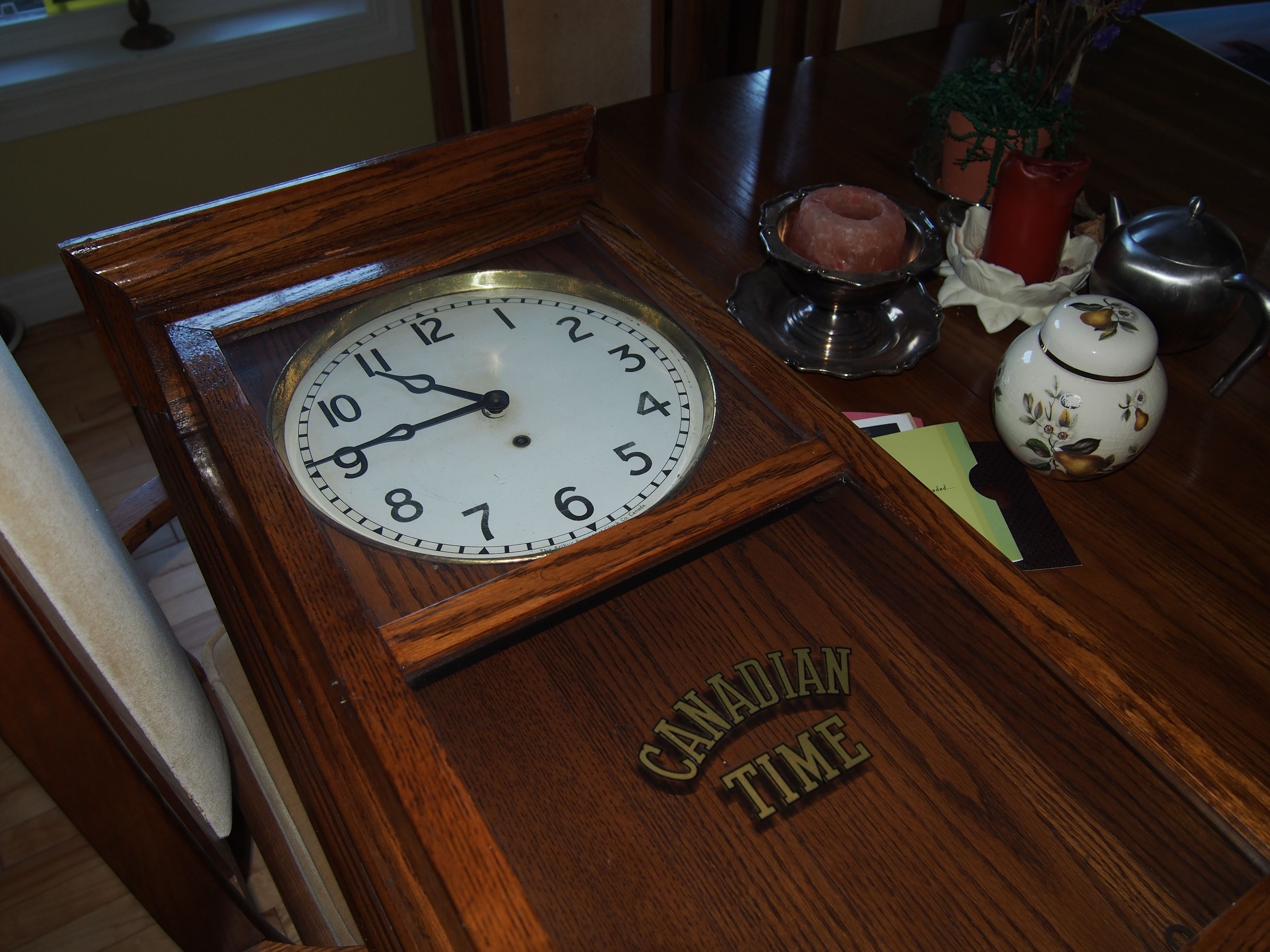
This clock features Arabic numerals, which was less common since most were ordered with Roman numerals. As a railway clock, the use of Arabic numbers would have made it easier to read for the general public in a train station. The manufacturer allowed customers to choose between Arabic or Roman numerals when ordering. Additionally, buyers could also opt for a version of this clock with time, strike, and calendar functions.

The crossed horseshoes on the base of a clock are often associated with good luck and protection. In many cultures, horseshoes are considered symbols of good fortune, particularly when they are displayed with the open end facing upward, which is thought to catch and hold luck. I have not seen another Canadian Time clock with crossed horseshoes.

I’m hoping to track down a photo of the clock from its time at the Pictou, Nova Scotia train station before it was decommissioned in the early 1990s, as that could really help narrow down the clock’s manufacturing date.
The clock itself is quite large, measuring 37 inches high, 5 inches deep, and 15 inches wide. It’s made of quarter-sawn oak, which results in boards with annual rings mostly perpendicular to the face, providing greater stability and minimizing warping.
The Canadian Time clock is a reliable timepiece, showcasing the quality and craftsmanship that went into its creation.
Discover more from Antique and Vintage Mechanical Clocks
Subscribe to get the latest posts sent to your email.
 Antique and Vintage Mechanical Clocks
I have the exact same clock. yours is the only other I’ve seen with Arabic numerals. I always thought it was a school clock for some reason.
LikeLike
Thanks for your email. They were found in offices, schools and rail stations and kept excellent time for a spring driven clock. In fact, they were most commonly used as an office clock. I don’t see many with Arabic numerals either but you could order one or the other from the factory at that time.
LikeLike