
Some clocks have a way of drawing you in immediately, and this Vienna-style wall clock made by Friedrich Mauthe was one of those pieces. The moment I saw it, I knew it had presence—it becomes part of the room.
With its rich walnut case, turned columns, and the distinctive horse finial crowning the top pediment, the clock reflects the late nineteenth-century taste for decorative wall regulators. These clocks borrowed heavily from the famous Vienna regulators but were produced by German makers for a wider market.
When I purchased the clock, I inspected it carefully enough, and everything appeared to be intact. It was not until I had it safely home and hanging on the wall that something seemed slightly off.
The clock didn’t quite look balanced.
At first glance, it was difficult to say exactly why, but the longer I looked at it, the more obvious it became. A closer inspection of the lower portion of the case revealed the problem: one of the decorative finials at the base was missing. There was clear evidence that a piece had once been there.
The likely explanation came from the seller when I contacted them later on. At some point in the clock’s journey from Germany to Canada, the lower finial had been snapped off so the case could fit inside a suitcase. Whether the piece was discarded or simply lost along the way remains a mystery.
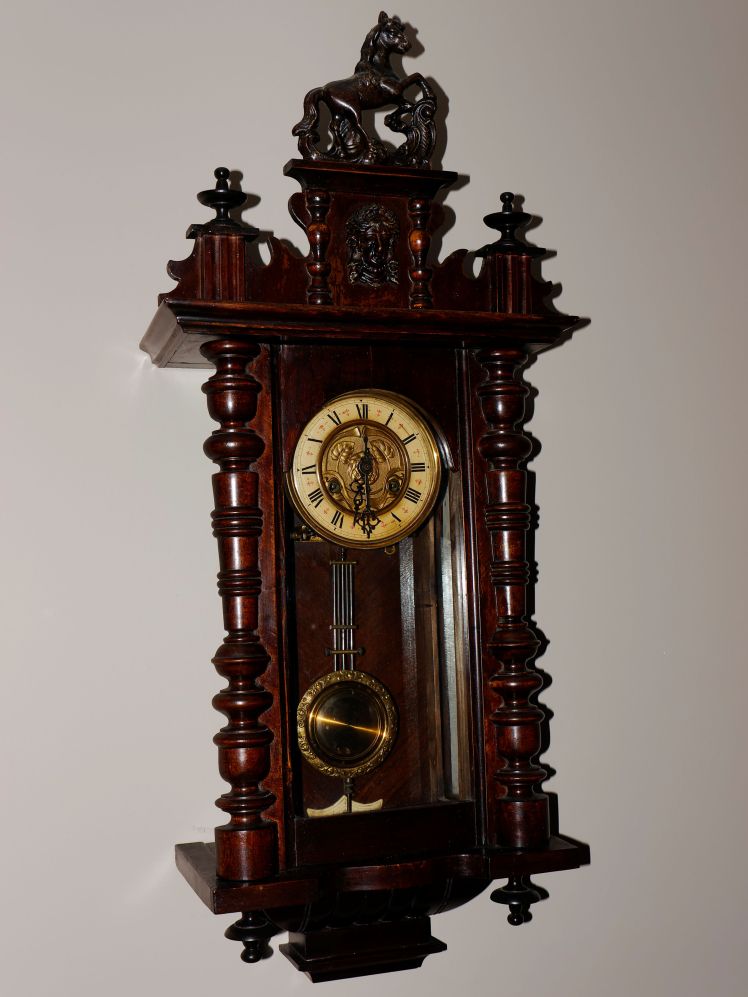
Fortunately, aside from this small detail, the clock remained remarkably original.
Still, once you notice something like that, it becomes impossible to ignore.
Finding a Suitable Replacement
My first thought was that replacing the missing trim piece should not be too difficult. There are a number of suppliers that specialize in clock case hardware and decorative parts, and I began browsing through the usual clock parts sites in search of something that would suit the design.
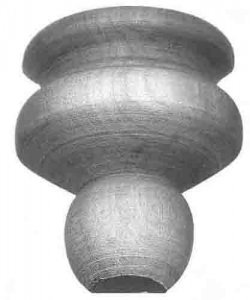
There were several options, but eventually I chose the finial you see here.
It is flat on one side and comes without a peg, making it adaptable for installation on a variety of cases. Most importantly, its shape complements the overall style of the clock without drawing attention to itself.
When restoring an antique clock, the goal is often to restore balance rather than create perfection. The replacement does not have to be an exact replica as long as it harmonizes with the original design.
In this case, I think it strikes the right balance. It may not be precisely what the factory installed over a century ago, but it looks convincing enough that even a careful observer might assume it has always been there.
Matching the Finish
The trim piece arrived unfinished, which meant it needed to be toned to match the rest of the case. Examining the clock more closely, it appeared to retain its original walnut finish.
With that in mind, I applied several coats of stain until the color blended naturally with the surrounding woodwork. Matching old finishes can be tricky, but patience—and a few test coats—usually brings things into alignment.
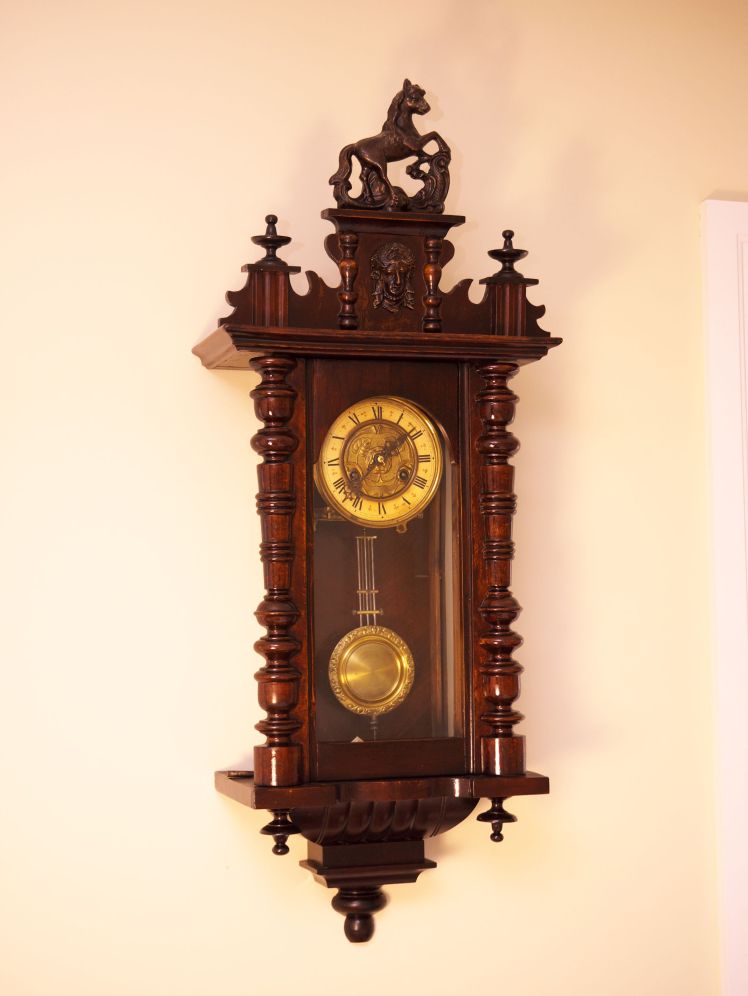
Once installed, the difference was immediately noticeable, and balance has been restored.
Restoring the Clock’s Symmetry
Seen from a couple of meters away, the clock now looks exactly as it should. The case once again has the visual symmetry that its original designers intended.
Small decorative elements like these finials may seem minor, but they play an important role in the overall composition of a clock case. Remove one piece and the entire design can feel subtly incomplete.
The “Horse Crown” Vienna Case Style
The decorative horse finial that crowns the pediment is what collectors often refer to as a “Horse Crown” Vienna-style case. While traditional Vienna regulators made in Austria tended to be somewhat restrained in their ornamentation, German makers frequently added dramatic sculptural elements to appeal to export markets.
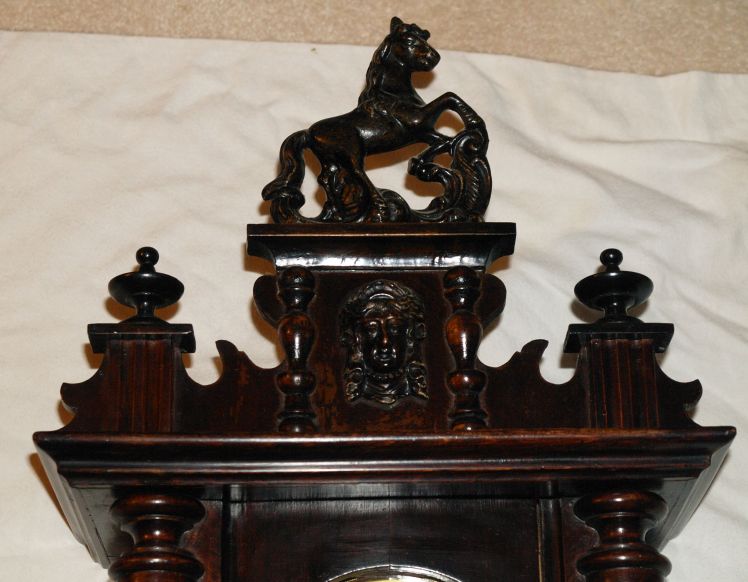
The rearing horse was a popular motif at the turn of the twentieth century and symbolized strength, motion, and vitality—fitting imagery for a mechanical clock. Mounted above the pediment, the figure gives the clock a distinctive silhouette and immediately draws the eye upward.
Combined with the turned columns, carved mask, and stepped base, the horse crown transforms what would otherwise be a fairly conventional wall regulator into a much more decorative statement piece. Often, you will find clocks offered for sale missing this critical decorative piece.
The movement inside the clock was produced by Friedrich Mauthe, one of the largest German clock manufacturers of the late nineteenth and early twentieth centuries. Founded in 1844 in Schwenningen in the Black Forest region, the company became known for producing reliable, well-engineered movements that were exported throughout Europe and North America.
The Mauthe Movement
Many Vienna-style clocks from German makers used spring-driven two-train movements with time and strike trains mounted between brass plates. These movements typically strike the hour and half-hour on a coiled gong and are known for their durability and relatively straightforward construction.
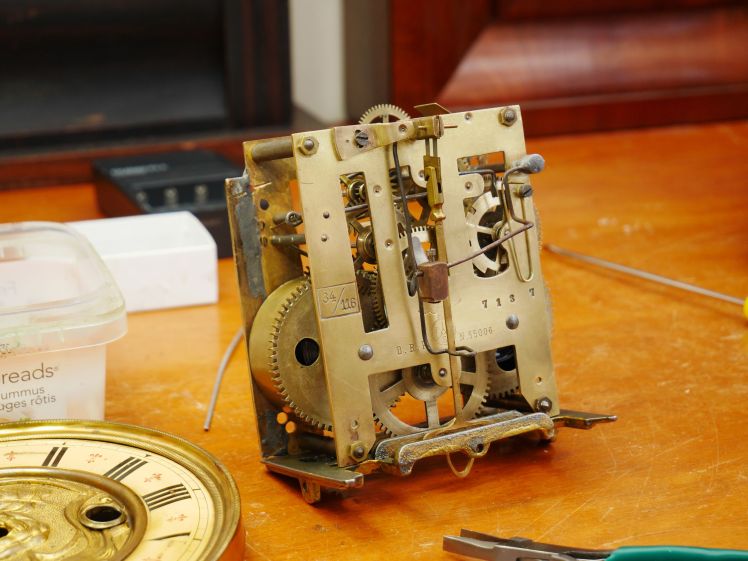
Clocks like this were produced in large numbers between about 1890 and the early 1920s, when Vienna-style regulators were still very popular in homes and offices.
A Small Piece, A Complete Clock
From a distance of a few meters, the clock now looks exactly as it should have all along. The case once again has the visual balance that its designer intended.
The replacement may not be identical to the original piece that once adorned the base, but it blends naturally with the rest of the case. Unless someone knows exactly where to look, they would likely never suspect that a small piece of trim once disappeared somewhere along the clock’s long journey from Germany to Canada.
And like many antique clocks, it carries with it not only the passage of time—but a bit of history and a story of its own.
Related Articles
- FMS Mauthe horse crown; servicing the movement; I have been putting off servicing this movement for a while, and a long time has passed since it was properly serviced. So, let’s get started.
- Mauthe century old wall clock; The clock was advertised locally in the Truro, Nova Scotia area. The seller knew little about it beyond its provenance, but what he did share was an interesting, albeit brief, story.
- Seven clocks in my collection that have family connections; not necessarily with my own family, but clocks that I am able to trace back through families, mostly in Nova Scotia (Canada). The stories are sad in some cases, but interesting nonetheless.
Discover more from Antique and Vintage Mechanical Clocks
Subscribe to get the latest posts sent to your email.
 Antique and Vintage Mechanical Clocks