
An antique clock stopping unexpectedly can be frustrating, especially if it has been running smoothly for years. However, a stopped clock doesn’t always signal a major problem. In many cases, the issue can be resolved with a little troubleshooting and basic maintenance. Whether it’s a cherished family heirloom or a recent addition to your collection, understanding the possible reasons behind its stoppage can help you decide on the best course of action to bring it back to life.
Perhaps you’ve recently acquired a mechanical clock—whether inherited, gifted, purchased at an antique store, bought online, or one you’ve had for a while—and, for no clear reason, it has stopped working.
Categories of Clocks
There are four general categories of clock movements; quartz, electro-mechanical, electric, and mechanical. This post focuses on mechanical clocks, whether antique or vintage and if your mechanical clock has stopped, I may be able to help you get it working again.
Running Time
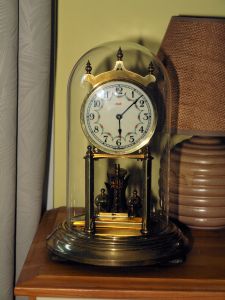
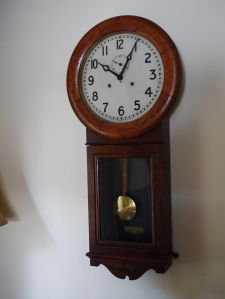
It may surprise some that mechanical clocks require regular winding. Eight-day clocks need to be wound once a week, while 30-hour clocks require daily winding. 31-day clocks only need winding once a month, and 400-day clocks, also known as anniversary clocks, are wound once a year. Additionally, many German and a small number of American clocks run for 14 days before needing a wind.
Winding a Clock Movement
What does winding a clock actually mean? It means providing enough power to a mechanism that will allow it to run for its designed cycle.
For example for clocks with mainsprings, winding a mainspring implies turning the key until the clock winds no further. Time and strike clocks will have two winding arbours, chiming clocks generally have 3 winding arbours.
Clocks with weights have one, two, or three winding points. Absent the odd exception, a time-only clock will have one winding point, a time-and-strike clock will have two, and a chiming clock will have three. If there are no winding holes on the clock face, it is a weight-driven clock and the weights must be pulled up by hand.
In the case of clocks with mainsprings that provide the motive power for the time, strike, and chimes, wind each arbour until resistance is met and you cannot wind any further.
One key will fit all the arbours except the regulator arbour (on clocks that have this feature) which requires a smaller key. Clocks that have a regulator arbour originally came with a double-ended key; the smaller key is for the regulator.
Clocks generally wind clockwise but it is also common to find winding arbours that must be wound counterclockwise.
Over-winding
The idea of overwinding a clock is a myth. If a clock stops after being fully wound, it typically indicates that dirt, old oil, or grime on the mainspring has caused it to seize. Even if the mainspring, once unseized, has enough power, it still needs cleaning, which requires disassembling the movement and checking for other potential issues.
A clock in good working condition should complete its full cycle, whether that’s 30 hours, 8 days, 14 days, 31 days, or any other duration.

Why Has My Clock Stopped
First and foremost, all clocks require motive power. Winding a clock stores potential energy in the mainspring, which is gradually released over a designed period of time. This energy is regulated by the escapement, a mechanism that controls the release of the energy in small, consistent increments, ensuring the clock keeps accurate time. Weights resting on the bottom of the baseboard will stop a clock and a completely unwound spring-driven clock will not run.
Is the clock in beat? Put your clock on a level surface. Listen to the tick and the tock of your clock. Try to minimize the sounds in the room you are in so that you can listen closely to its rhythm. It is in beat when its ticks and tocks are even….tick…tock…tick…tock…, and is out of beat when they are uneven, either, tick….. tock or tock tick…… Put another way, there must be an equal amount of time between the ticks and the tocks. When a clock is out of beat, it will not run, or it will run for a short time and stop. A clock’s beat must be regular to work properly.
Is the clock level? There are two ways to put a clock in beat. The first is to tilt the clock sideways, one way or the other, and listen for the beat to even out. When the beat is even, prop the clock to stay tilted that way. If it is a wall clock move the bottom section from side to side till you hear a steady beat. Now it will run in beat but it will obviously not look good.
Adjusting the crutch Adjust the crutch to one side or the other until the beat is even. The crutch is the rod that extends down from the pallets which rock back and forth on the escape wheel. The pendulum rod passes through either a loop (called a crutch loop) or a forked foot at the end of the crutch as indicated in the photo below. Incidentally, that rod needs to be in the middle of the crutch loop and can’t be tight inside the loop nor too loose. The crutch is attached to the pendulum leader which is then attached to a post with a suspension spring. Other mantel clocks require similar adjustment to the crutch and instructions may be provided on a label or a pamphlet that came with the clock. A clock with a balance wheel or lever-type escapement rather than a pendulum will operate on a non-level surface.

Have repairs been done recently? Unless you had a friend fix your clock most reputable clock-makers will offer a warranty, typically 6 months to a year. If your clock stops within that time frame, contact the clock-repairer who may offer a few suggestions in the form of adjustments, over the phone before taking it back to the shop. If it still does not work have that person take a look at the clock.
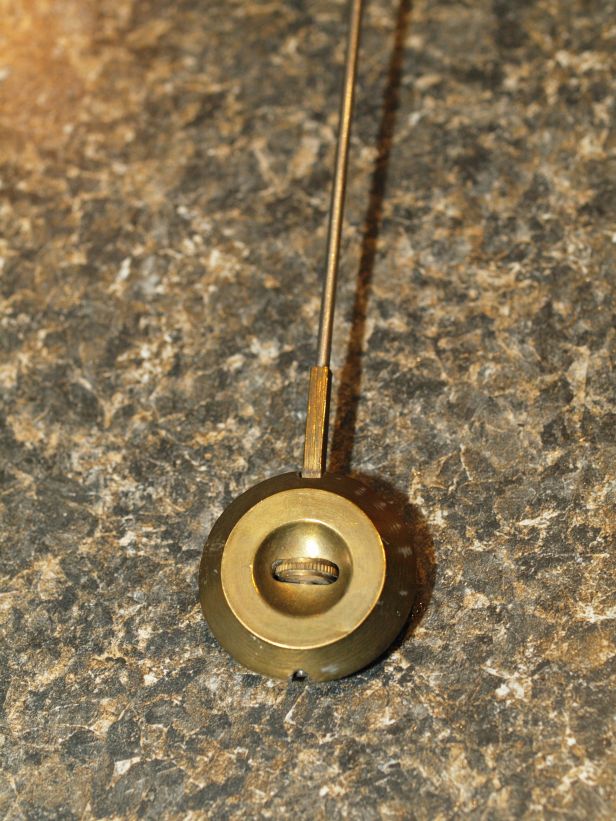
Do you have the correct pendulum? Other than the winding key, it seems to be the item that gets lost the most. If lost or misplaced, ensure you buy a pendulum that is correct for your clock. One too light may mean that it does not run at all, too heavy and the centre of gravity is lowered and the clock might run too slowly. Clock suppliers such as Perrin or Timesavers will have the correct pendulum for your clock.
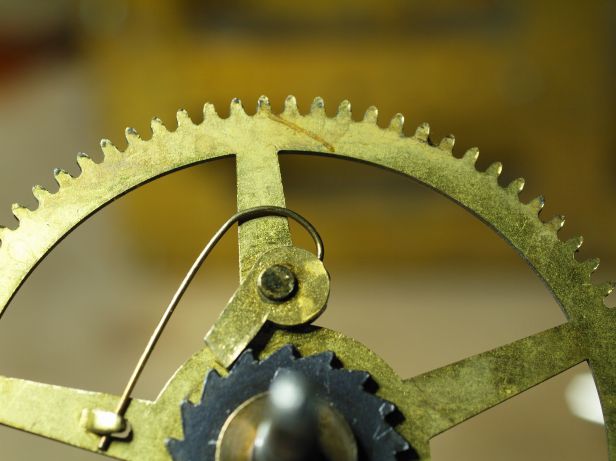
Something is broken? If there is no resistance when turning the winding key, the mainspring has broken or a click has let go. If the mainspring winds but releases in your hand, the most common cause is a broken or worn click spring. This is a repair that requires removing the movement from its case, taking it apart, and replacing the worn or damaged part. If you are skilled with that kind of repair, go ahead and fix it, if not, a specialist is required.
A loud BANG when you turn the key indicates the mainspring has broken or let go. It may not be as simple as replacing the mainspring. If the mainspring breaks it might have taken out other parts with it such as pinions and gear cogs. This is called collateral damage. An inspection and a full servicing of the movement is the only solution. Occasionally a broken mainspring is the only problem but the broken spring must come out of the barrel. Some movement designs allow the barrel to be removed without disassembling the mechanism. Whether the barrel is removable or not, a correct mainspring must be sourced to replace it and installed in the barrel which is a job for an expert.
The mainspring inside the barrel may also have become unhooked. This could occur if the clock was wound backward or if the hooked end of the mainspring is split or broken. To address this, the clock will need to be disassembled, the spring barrel opened, and the cause of the unhooking identified. In some cases, a replacement mainspring may be necessary.
For time and strike clocks with open mainsprings, the break may be on one mainspring or both. The clock must be completely disassembled, mainsprings replaced, the movement inspected for other issues, reassembled, and tested.
Why does my weight-driven clock stop? Ensure that the weights are in their correct location. If it is a new acquisition of a grandfather clock the three weights have a specific location. Look underneath the weight shells for marks indicating their location “L”, left side, “C”, center and “R”, right side. If there are no markings, use a scale to determine the one that is the lightest weight and put that on the left side.
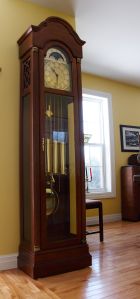
When bringing up the weights to the top of the clock be careful that they are not run past their stops. You should have a full view of the weights on a weight-driven clock once wound.
Antique Ogee clocks and other weight-driven shelf clocks often lack their original weights, as these have been lost or misplaced over time. Eight-day clocks typically have heavier 8 or 9 lb weights while 30-hour clocks have lighter 2 1/2 lb or 3 lb weights. Incorrect weights for these clocks will cause them to stop.
Is the weight cord or the brass cable binding in any way? The cord or cable should be just long enough to accommodate the weights. A cord or cable that is too long will bind while being wound and stop the clock.
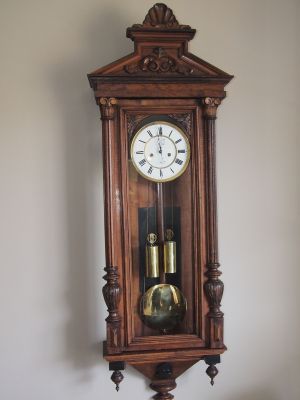
Some clocks like weight-driven Vienna Regulators can be adjusted by a transverse regulating screw assembly where the crutch inserts into a slot in the pendulum. Turning a screw in one direction or the other will correct the beat.
Final thoughts
In conclusion, if you encounter a unique issue not addressed here, it’s advisable to consult a professional clock repairer or someone with expertise in mechanical clock repairs. Working with mechanical clocks carries a certain level of risk, as the power stored in the mainsprings can cause injury if not handled carefully. On the other hand, weight-driven clocks generally present less risk.
Although this article may not cover every possible scenario, I hope it has provided you with a clearer understanding of your clock’s issue and how to approach its resolution.
Discover more from Antique and Vintage Mechanical Clocks
Subscribe to get the latest posts sent to your email.
 Antique and Vintage Mechanical Clocks
You must be logged in to post a comment.