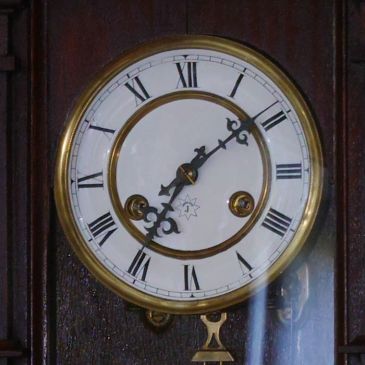
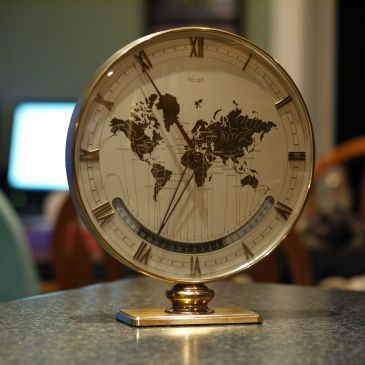
It’s time to change your clocks
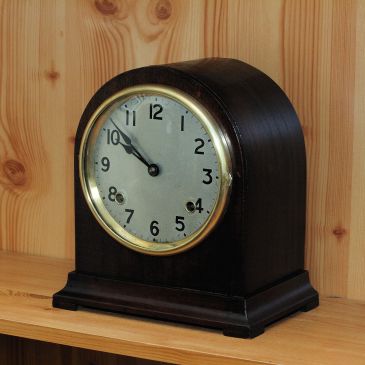
At 2:00am Sunday morning, the 4th of November, set your clock one hour behind. That is, if you live in Canada. Your time change date may vary according to the country you live in. Consider yourself lucky if your your country does not observe this archaic convention.

If your country uses Daylight Saving Time (DST), you must change your clocks twice a year.

Seth Thomas Regulator #2 wall clock

“Spring Forward – Fall Back” is a phrase most often heard in the USA and Canada. In North America the word “fall” is used to denote the season, while other English-speaking countries call it autumn. Set your clocks forward 1 hour in the spring at the start of DST (Daylight Saving Time), and 1 hour back in the fall when DST ends.

Records show that the phrase “spring forward, fall back” has been in use at least as far back as the early 20th century. It is the practice of advancing clocks during summer months so that evening daylight lasts longer, while sacrificing normal sunrise times.

Don’t like DST. Read this.

So…Fall behind!

Waterbury, New Haven or EN Welch – A true Frankenstein clock

E N Welch case

Is this attractive 30 hour weight driven Ogee a Waterbury, a New Haven or an E.N. Welch? All of the above, actually and perhaps more.

The older the clock and the greater the number of owners means there is an increased chance that there have been minor and even significant changes to the clock

Is it a marriage or a Frankenstein?

When horologists speak of a marriage they mean the clock in its entirety is not original. It generally means the movement is not original to the case but it can have other meanings as well. Various parts and components might have been added or changed over time. Over the life of a clock it has often been in the hands of many owners particularly if the clock is well over 100 years old. The older the clock and the greater the number of owners means there is an increased chance that there have been minor and even significant changes. Each owner may add or take away components in the interest of having a reliable clock while sacrificing authenticity. Functionality trumps aesthetics. When a clock goes well beyond the horologists definition of a marriage, it is called a Frankenstein.

A Frankenstein clock is made up of a mixture of clock parts from many makers. In this case, a previous owner acquired a number of non-working Ogee clocks, took what was salvageable from each one and constructed a working clock.

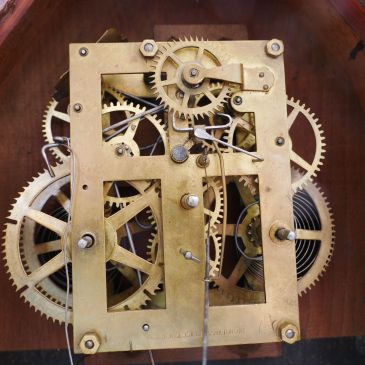
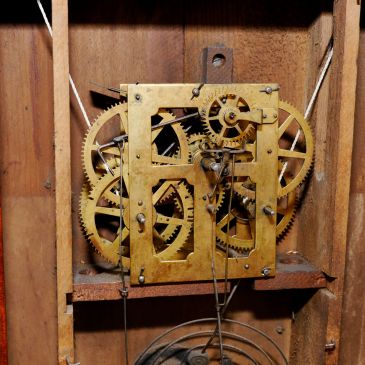
New Haven 30 hour movement

This clock was purchased at auction as a non-running example and cost the owner very little money. I was asked to take a look at it and perhaps “do something to make it run”. It came complete with weights for both sides missing only the pendulum bob and the correct key. The key that came with it was a #3 mantel clock key as the original would have been a crank style key. One weight was stuck in the right channel past its hook; the other was loose in the case; not a good way to transport a clock. Though difficult to tell if they are original to this clock, the weights are those typically found in a 30-hour brass time and strike movement.

The numbers have been repainted by the writer

The dial is not original to the case though it is correct for the period. There is a stamped impression in French on the back of the dial suggesting that the clock it was attached to was intended for export to France (Chauncey Jerome?).

Tablet design

The tablet is a nicely detailed floral design but has some loss as one would expect given its age. However, the tablet and the door do not appear to be original to the case. There are small blocks under each hinge suggesting the door was “made to fit” this case. Nails are used on one hinge and screws on the other.

Waterbury coil gong

The case is an E.N. Welch, the time and strike weight driven movement is New Haven and the coil gong is a Waterbury.

The aluminum spindle for the cable just above the movement on the right side is an curious touch.

Aluminum spindle

A wall hook at the top and back of the case suggests that it was hung rather than having sat on a shelf. Knowledgeable Ogee clock owners know that these clocks were never meant to be hung though many were displayed in that manner.

I took the movement out of the case, inspected it for wear and found it to be in very good condition with no obvious pivot, tooth, pinion or click wear. The verge and escape wheel similarly had little wear. The cables for the weights should be just long enough to bring the weight to the bottom of the case with a little to spare. On both sides the cables were twice as long as they should have been. The suspension spring and rod which is a later replacement, is too long as the bottom of the spring touches the crutch loop. The crutch loop had been incorrectly turned 90 degrees requiring a simple twist with pliers to correct it. How it ran is a puzzle since there was no impulse transmitted from the crutch to the pendulum rod. A previous owner, though well intentioned had little knowledge of how a movement functioned.

Incorrect grain direction on top piece

The rosewood veneer though dulled with age is in fair shape and had acceptable repairs with the exception of the flat horizontal strip on the top front, which upon closer inspection, is a replacement with simulated grain oriented in the wrong direction. Other issues are minor chips on the bottom edge of the case, two pieces of missing veneer on the right side and slight bubbling of veneer on the top left side panel.

Veneer issues

So, what is this clock exactly?

The answer is that it is a 30 hour Ogee clock. It is also an amalgam of many clock parts, a Frankenstein. From afar the entire clock looks very good, but closer examination immediately reveals it many sins. As they say, “Nice from afar but far from nice!”. A resourceful person took all the good parts from a variety of clocks and combined them to make a clock that actually runs and keeps good time.

Is it a keeper?

For discerning clock collectors this example is far from acceptable and certainly diminishes the value of a clock considerably even if it runs well. An expert looks for precisely these things prior to any decision and any serious collector of Ogee clocks would instantly walk away. For someone either interested in the history of clock production or those entering the world of clocks wanting a cheap clock to practice and learn with, it is certainly worth keeping.

The clock is running strongly and striking as it should following a cleaning and oiling. This 30 hour New Haven, Waterbury, E.N. Welch Ogee clock from the 19th century would fool most people.

It reminds me of that old expression….Caveat Emptor (Let the Buyer Beware)!

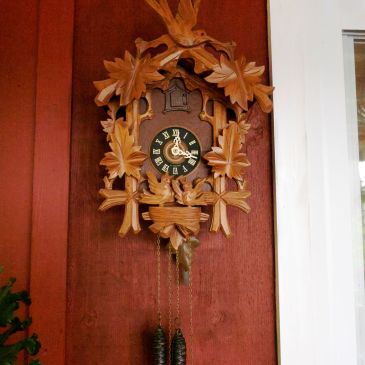
The first cuckoo clock in my collection – thank you Uncle Dave

When people ask about my clock collection their first comment is, “Do you have a cuckoo clock”. No, I say and their reply typically would be “You should have one!” I often wonder why folks think I should have one. I suppose many collectors have at least one in their collection. Now when they ask I can now say, “of course I do”.

sellers are interested in a sale and do not need to know anything about the clocks past

Thank you, Uncle Dave.

I have acquired most of my clocks at flea markets, auctions, word of mouth etc., even had a few given to me but I know little about their history. The sellers are interested in a sale and do not need to know anything about the clocks past; unfortunate but it is what it is.

On the other hand, I have several clocks which have a very interesting heritage; my Crispi wall clock by Junghans that survived the Halifax Explosion, my Ingraham Huron shelf clock that remained within in the same family for over 80 years or my Canadian Time wall clock by Arthur Pequegnat that hung in a railway station waiting room until 1993.

This is not any old cuckoo clock. This one is especially important……to me at least. This one can actually talk to me. I’ll explain.

My cousin Dave (we called him Uncle) died in 2017and his family knew that he loved his cuckoo clock. Rather than give or sell it to a stranger they decided to hand it over to the family clock guy…..me!  Dave was related through my father’s father and has a cottage next door to ours in the province of Quebec. Dave was a helluva a guy and he would do anything for you. He loved life and cherished it to the end.

From time to time you will find service dates written or stamped inside vintage or antique clock cases. These dates give you an indication of the age of the clock and how well it was cared for over the years

In the early 1970s, he and his wife went to Germany for a tour, returned to Canada and regretted not buying a German cuckoo clock. So, he promptly went to the Cuckoo Clock Shop in Ottawa (our nation’s capital) and bought one. He also wanted it in running order. Over the years whenever it stopped he had it promptly repaired.

Back of clock

he history of an object is a window to its past. This clock is a common 30-hour cuckoo clock made in West Germany in July of 1975 (photo below).) and thousands of these were made and sold all over the world. It has a Regula movement, still made to this day. Regula movements are made by SBS-Feintechnik, and are dated by a letter code. This one has the letter “V” which indicates that it was made in 2007.

German made 30-hour cuckoo clock

The clocks complete service history is recorded on the back panel. When I opened the back access door to inspect the movement and the condition of the bellows I found all the dates when the cock was brought in for repair. From time to time you will find service dates written or stamped inside vintage or antique clock cases. These dates give you an indication of the age of the clock and how well it was cared for over the years.

Detailed service history behind the access panel
  • Oct 10, 1978, clean oil adjust, major repair
  • Sept 22, 1988, CXO (clean and oil) adjusted by “AO”
  • October 30, 1990, new movement, repair by “AO”
  • Jan 1996, 5996 (job #) clean, oil & adjust
  • April 27, 2007, 9869 (job #) new movement and chains

From the service records, I observed that the clock is on its third movement. It is often simpler (and cheaper) to replace the movement in a cuckoo clock rather than to repair it. Attempting to repair a cuckoo clock is very time consuming, frustrating, and costly. In addition, if the entire clock had to be shipped, the case usually incurs extensive damage as it makes its travels. This is the reason most clockmakers no longer accept most cuckoo clocks for repair.

Regula 1-day movements typically cost less than CDN120. The cost of servicing a two-train clock locally is CDN225 and up, so, replacing the movement is a logical decision.

Cuckoo clock bellows on left and right.

I oiled the movement, installed the weights and now it is a lovely little 1-day clock that dutifully cuckoos on the hour.

We have a number of clocks in our summer cottage and my wife and decided that that is where it should hang. Everyone who visits marvels at the sound of the cuckoo clock, it is so distinctive. Now they say, “that’s a nice cuckoo clock, where did you get it?”.

It is not perfect. Sadly at some point in every cuckoo clock’s life, it needs the bellows replaced and these bellows are brittle and in poor condition. A cuckoo clock that does not cuckoo is, well, just another clock! The bellows is a cottage project for next summer.

And yes, provenance is important.

The Canada Clock Company (Hamilton Clock Co.) – a brief history

If one were to ask those with a keen interest in Canadian antique clocks, the word Pequegnat would immediately come to mind. Pequegnat produced clocks for close to 40 years and left an indelible mark on Canadian culture.

Predating Arthur Pequegnat is a lesser known clock maker (or clock-makers) that made clocks between 1872 and 1884. The Canada Clock Co, and the Hamilton Clock Co. struggled over a 12 year period to put Canada on the clock-making map. In 1872 the Canada Clock Co. established itself in Whitby, Ontario (Canada) but lasted just 4 years before failing, though largely due to a devastating factory fire.

Case is in fair condition, dial face has some flaking
Canada Clock Company cottage clock

Out of the ashes came another attempt in 1876 and key principles including manager John Collins moved to Hamilton and set up the Hamilton Clock Company. After 4 years this new company also failed and production halted in 1880. In late 1880 one more attempt was made to establish a new company called the Canada Clock Company resurrecting the old name. It is still based in Hamilton at the old Hamilton Clock Co. factory. Success was short-lived as the company declared bankruptcy in 1884 ending a dozen years producing clocks for the Canadian market.

Although both movements and cases were made in Canada they were copies American styles
Canada Clock Company, Prince of Wales parlour clock
Canada Clock Company, City of Hamilton parlour clock

I have grouped the clocks from the three companies and these are their characteristics. The most common clocks found today are the weight-driven, thirty-hour “Ogee” style, with colourful birds or flowers surrounded by a black background on the glass tablet. At least five different labels are known, four have a beaver on them. The large printed paper label was located inside the case on the lower back. Spring-driven mantel clocks with plain cases were also made with thirty-hour movements. Although both movements and cases were made in Canada they were obvious copies of American styles.

Hamilton Clock Co Gothic steeple clock
Hamilton Clock Co Gothic steeple clock with etched glass tablet
Loss on the clock label
Clock label showing the Hamilton Clock Company factory

Also produced was a spring-driven “school house” wall clock.

At least sixty models of spring-driven mantel clocks are known, with both thirty-hour and eight-day movements.  Most of the door tablets (Canada Clock Co.) have acid etched glass designs, unique to the two Hamilton-based companies and done in association with a local glass factory. Wall clocks are also found with the Canada Clock Company, Hamilton label.

The most desirable clocks are the ornate time and strike parlour clocks such as the City of Hamilton and Prince of Wales pictured above.

Unfortunately, a valiant attempt to grow a home-bred clock company failed miserably. However, the clocks of all three companies are highly sought after by Canadian collectors today.

Get it now before it’s gone – is this clock worth collecting?

Antique steeple clock. Battery operated. Has been refinished Very nice clock

Hmm, I wonder if they had batteries 100 years ago?

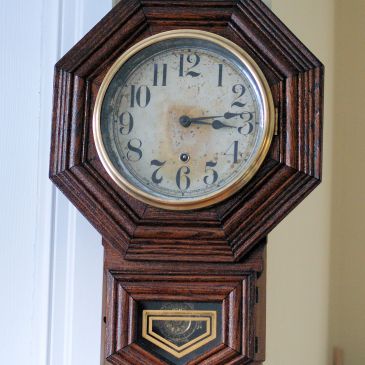
Sessions Drop Octagon – a pint-sized schoolhouse clock

A working clock for $25? You can’t go wrong.

Found this little schoolhouse clock not 10 minutes from where I live. It is a Sessions Drop Octagon. It was manufactured in Forestville Conn. USA in the early 1920s and spent most of it’s life hung in a one-room schoolhouse near Springhill, Nova Scotia (Canada). The seller said that he had taken it out of the schoolhouse when it was decommissioned in the 1970s and it has been in storage ever since.

It is small, measuring 21 inches high by 13 1/2 inches wide and with a 7 inch Arabic dial.

Foxing

“It’s not running” he said. “Fine” I said. I took it home and had it running within 10 minutes. Although it ran strongly it required a good cleaning. I took the movement out of its case, dis-assembled it, cleaned all the parts in an ultrasonic cleaner, polished the pivots, cleaned and oiled the mainspring, installed 2 bushings, reinstalled the movement, tested it and set about cleaning up the case.

Time-only movement

After a Murphy’s Soap clean-up to the case I let it thoroughly dry then applied 2 coats of shellac to bring back the natural luster of the wood which was in otherwise good condition. The clock face had some foxing, which, in clock circles, means that some of the tin byproduct had leached through to the paper label and discoloured it. A little unsightly but I decided to live with it.  I hung it up over my desk as one of a trio of time zone clocks to remind me of the time where my kids live.

Time zone clocks
Time zone clocks, Session clcok on right

The clock is a loud ticker but it runs well and should be reliable for years to come.

Perspective on Horological (clock) Development

Need a quick primer on developments and inventions in horology. You have come to the right place.

18th Century shelf clock Porto, Portugal

Though by no means a definitive guide the following are some important dates in the history of the clock as gathered through a number of sources. The difficultly in affixing some dates with precision results from discrepancies among sources.

Horological developments during the centuries before the mechanical clock are left out altogether. Water (Clepsydra) and sun clocks of the middle ages and astronomical clocks of ancient China deserve special mention but are the subject of a separate discourse and are not included here.

Important dates in Horological Development

  • CA. 1300 – First mechanical verge clock, Europe
  • 1364 – Astronomical clock conceived by Giovanni de Dondi, Italy
  • 1386 – Tower (turret) clock Salisbury Cathedral, England
Salisbury cathedral clock, photo by Dr. Meghan Joiner
  • CA. 1400 – Fusee invented by Jacobs, Czechoslovakia
  • CA. 1450 – Table clock with spring and fusee, Phillip the Good of Burgundy, France
  • CA. 1500 – Mainspring invented, Germany
  • CA. 1510 – Watch invented by Peter Henlein, Germany
  • CA. 1560 – Spring driven portable clock, Germany
  • CA. 1570 – Oldest known clock with a second hand, Orpheus clock, Germany
  • 1637 – Galileo, swinging temple lamp, pendulum control conceived, Italy
  • CA. 1650 – First tower clock appears in Colonies, America
  • 1656 – Pendulum clock devised by Huygens, Holland
  • 1657 – Verge and foliot gives way to pendulum control, Huygens, Holland
  • 1658 – Long-case prototype made by Fromanteel adapted from lantern clock, England
  • 1660 – Balance wheel conceived by Hooke, England
  • CA. 1675 – Richard Towneley invents the dead-beat escapement, England
  • 1675 – Balance wheel with spiral spring invented by Huygens, Holland
  • CA. 1675 – Recoil escapement and crutch invented by Hooke in collaboration with Clement, England
  • 1676 – Rack striking developed by Barlow, England
  • 1680 – 1700 – famous horologists of this era were Arnold, Earnshaw, East, Graham, Knibb, Compion and Windmills of England; Berthoud, Breguet and LeRoy of France
  • 1701 – St Sulpice seminary tower clock (imported from France), Montreal, Canada
  • 1713 – Harrison invents marine chronometer, England
  • CA. 1715 – Break-arch dial introduced
  • 1715 – Graham perfects deadbeat escapement, regarded as the “father” of the dead-beat escapement
  • 1717 – First tower clock of America, Benjamin Bagnall, Boston
  • 1726 – Mercurial pendulum invented (temperature compensating pendulum), Graham, England
  • 1726 – Wall clock by Thomas Bennett, 8 day brass, weight driven, America
  • 1736 – Harrison’s marine chronometer tested at sea (accurately ascertaining longitude), England
  • 1770 – White dials appear in English longcase clocks
  • 1776 – Independent seconds train invented for watch, Pouzait, Switzerland
  • 1790 – Vienna regulator style case emerges in Austria
  • 1790 – American woodworks clocks begin to be appear
  • 1802 – Willard patents his banjo clock, America
  • 1806 – Terry introduces Pillar and Scroll clock, America
  • 1809 – Martin Cheney leaves America to set up a clock-making shop in Montreal, Canada
  • 1810 – Carriage clock (Pendule De Voyage) introduced by Breguet of France
  • 1818 – Heman Clark makes wrought brass movement for Pillar and Scroll case, America
  • 1825 – Rolled brass production begins in America
  • 1837 – Noble Jerome 30-hour brass movement patent approved, America
  • 1840 – American brass movements in mass production
  • 1842 – American brass movement clocks exported to England by Chauncey Jerome
  • 1845 – Wood-works movement production ends, America
  • 1850 – Westminster tower clock designed by Lord Grimthorpe and made by Dent, England
  • CA. 1850 – Brocot (pin-wheel) escapement and pendulum suspension introduced, France
  • CA. 1850 – American mass production of watches begins
  • 1860 – Junghans (Germany) sent to America to study American mass production techniques
  • 1870 – Decline in English long-case clocks
  • 1874 – Mass production of mantel and wall clocks begin in Whitby, Canada,
  • 1900 – American clock production is at its height; makers are Ansonia, Ingraham, Gilbert, Howard, New Haven, Seth Thomas, Waterbury, and Welch
  • 1904 – Arthur Pequegnat begins clock production in Berlin, Canada
  • 1906 – Eureka electric clock introduced, America
  • CA. 1910 – Torsion pendulum clock (400-day) introduced, Germany
  • 1920-40 – Decline in American mechanical clock production
  • 1941 – Arthur Pequegnat ceases production, Canada
  • CA. 1960-70 – End of mass produced mechanical clocks, America (though cheaper Japanese, Korean & Chinese mechanical clocks flood North America)
  • Present day – Some movement and clockmakers remain; Howard Miller (Ridgeway), Keininger, Hermle, Chelsea, Jaeger LaCoultre among others

The clock is one of mans greatest achievements. The development of instruments to tell time is the unwavering toil of brilliant minds from many disciplines who, over 800 years, worked tirelessly to create, innovate and improve methods for telling the time.

Horology is not only the study of time but the synergy of art, joinery, fashion, design, décor, physics, engineering, metallurgy and mathematics. Indeed, the study of the mechanical clock is a microcosm of our society.

Time rules life – like it or not.

What is this clock thing for? #3 – the let-down key

Some folks collect clocks without actually working on them. Collecting clocks and repairing them are two very different things. I know people who would gladly send their clocks out for servicing and don’t seem to mind the extra cost. I like to do my own work.

If you work on your own clocks or service clocks for others you know how important it is to ensure safety at all times. Servicing a clock movement requires that you disassemble it completely and safely. There are specific tools designed not only to make life easier as a clock repair person but will ensure your safety at the same time.

Before taking the pins or nuts from the movement plates there are important steps you must follow to ensure your safety working with movements. There is a minimal threat of injury working with weight driven clocks (unless a weight drops on your foot) so the following information pertains to spring driven clocks be they open mainsprings or springs contained in a barrel. The let-down tool is designed specifically for spring driven clocks.

Click replaced
Click, click spring and ratchet
The letdown key
The letdown key is engaged prior to releasing the click

Some clock movements from French, English and German clocks, for example, contain mainsprings within a barrel, safer than open mainsprings. If the spring lets go in a barrel there is still a risk of damage to the gear teeth and wheels however the break will be contained within the barrel itself. The letdown key is used to release the power of the mainspring into its barrel.

The flat clamps (upper left in photo below) are for those open mainsprings which do not leave a lot of working room. Otherwise, the round clamps are good for most applications. Prior to working on a movement the mainsprings must be letdown or restrained in their clamps.

C-clamps used to contain the power of the mainspring

A flat C-clamp is wrapped around the mainspring as you can see in the next photo.

Mainspring contained in a clamp
Mainspring contained in a C-clamp

Once the mainspring is safely contained you can work on it with a spring winder, like this spring-winder from Olie Baker .

Mainspring servicing
Mainspring servicing using a Olie Baker spring winder

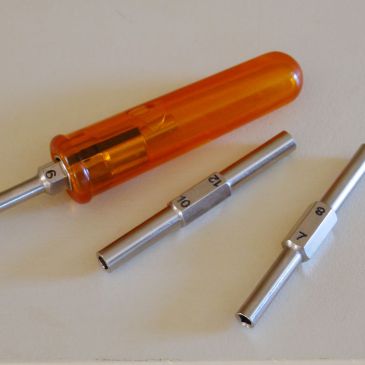
Here’s how it works. There are four pieces in the let-down set. There are 3 chucks in sizes #5-6, #7-8 and #10-12 plus the handle. Choose the size that fits the winding arbour of your movement. Then insert the let-down end with chuck into the winding arbour. Turn it until the mainspring is compressed. Fit a clamp around the mainspring. Once the clamp is secure around the mainspring release the click spring with a small screwdriver and push it out of the way. Once the click spring is out of the way move the click away from the ratchet while firmly holding the let-down key. The power of the spring will be transferred to the key. Allow the spring to gradually release its power by letting the key handle spin gently within your hand. There, the mainspring power has been restrained and you will be able to proceed with dis-assembly.

Your journey into the world of clock repair requires essential tools The let-down set should at the top of the list. Always minimize the risk of injury by restraining the power of the mainsprings. The letdown key is the safest method of letting down the mainsprings.

My antique clock stopped, what do I do?

An antique clock stopping unexpectedly can be frustrating, especially if it has been running smoothly for years. However, a stopped clock doesn’t always signal a major problem. In many cases, the issue can be resolved with a little troubleshooting and basic maintenance. Whether it’s a cherished family heirloom or a recent addition to your collection, understanding the possible reasons behind its stoppage can help you decide on the best course of action to bring it back to life.

Perhaps you’ve recently acquired a mechanical clock—whether inherited, gifted, purchased at an antique store, bought online, or one you’ve had for a while—and, for no clear reason, it has stopped working.

Categories of Clocks

There are four general categories of clock movements; quartz, electro-mechanical, electric, and mechanical. This post focuses on mechanical clocks, whether antique or vintage and if your mechanical clock has stopped, I may be able to help you get it working again.

Running Time

It may surprise some that mechanical clocks require regular winding. Eight-day clocks need to be wound once a week, while 30-hour clocks require daily winding. 31-day clocks only need winding once a month, and 400-day clocks, also known as anniversary clocks, are wound once a year. Additionally, many German and a small number of American clocks run for 14 days before needing a wind.

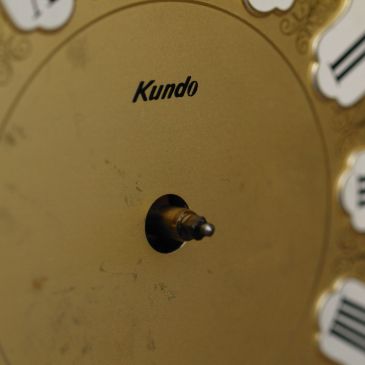
Kundo standard size 400 day clock
Kundo Standard 400-day clock winds with a key once per year
Arthur Pequegnat Moncton
Arthur Pequegnat Moncton, 14-day time-only clock

Winding a Clock Movement

What does winding a clock actually mean? It means providing enough power to a mechanism that will allow it to run for its designed cycle.

For example for clocks with mainsprings, winding a mainspring implies turning the key until the clock winds no further. Time and strike clocks will have two winding arbours, chiming clocks generally have 3 winding arbours.

Clocks with weights have one, two, or three winding points. Absent the odd exception, a time-only clock will have one winding point, a time-and-strike clock will have two, and a chiming clock will have three. If there are no winding holes on the clock face, it is a weight-driven clock and the weights must be pulled up by hand.

In the case of clocks with mainsprings that provide the motive power for the time, strike, and chimes, wind each arbour until resistance is met and you cannot wind any further.

One key will fit all the arbours except the regulator arbour (on clocks that have this feature) which requires a smaller key. Clocks that have a regulator arbour originally came with a double-ended key; the smaller key is for the regulator.

Clocks generally wind clockwise but it is also common to find winding arbours that must be wound counterclockwise.

Over-winding

The idea of overwinding a clock is a myth. If a clock stops after being fully wound, it typically indicates that dirt, old oil, or grime on the mainspring has caused it to seize. Even if the mainspring, once unseized, has enough power, it still needs cleaning, which requires disassembling the movement and checking for other potential issues.

A clock in good working condition should complete its full cycle, whether that’s 30 hours, 8 days, 14 days, 31 days, or any other duration.

Winding arbors on a Seth Thomas mantel clock (arrows)
Winding arbors on a Seth Thomas mantel clock (arrows). The arbour over the 6 requires a smaller key to regulate the clock

Why Has My Clock Stopped

First and foremost, all clocks require motive power. Winding a clock stores potential energy in the mainspring, which is gradually released over a designed period of time. This energy is regulated by the escapement, a mechanism that controls the release of the energy in small, consistent increments, ensuring the clock keeps accurate time. Weights resting on the bottom of the baseboard will stop a clock and a completely unwound spring-driven clock will not run.

Is the clock in beat?  Put your clock on a level surface. Listen to the tick and the tock of your clock. Try to minimize the sounds in the room you are in so that you can listen closely to its rhythm. It is in beat when its ticks and tocks are even….tick…tock…tick…tock…, and is out of beat when they are uneven, either, tick….. tock or tock tick…… Put another way, there must be an equal amount of time between the ticks and the tocks. When a clock is out of beat, it will not run, or it will run for a short time and stop. A clock’s beat must be regular to work properly.

Is the clock level? There are two ways to put a clock in beat. The first is to tilt the clock sideways, one way or the other, and listen for the beat to even out. When the beat is even, prop the clock to stay tilted that way. If it is a wall clock move the bottom section from side to side till you hear a steady beat. Now it will run in beat but it will obviously not look good.

Adjusting the crutch Adjust the crutch to one side or the other until the beat is even. The crutch is the rod that extends down from the pallets which rock back and forth on the escape wheel. The pendulum rod passes through either a loop (called a crutch loop) or a forked foot at the end of the crutch as indicated in the photo below. Incidentally, that rod needs to be in the middle of the crutch loop and can’t be tight inside the loop nor too loose. The crutch is attached to the pendulum leader which is then attached to a post with a suspension spring. Other mantel clocks require similar adjustment to the crutch and instructions may be provided on a label or a pamphlet that came with the clock. A clock with a balance wheel or lever-type escapement rather than a pendulum will operate on a non-level surface.

American made time and strike

Have repairs been done recently? Unless you had a friend fix your clock most reputable clock-makers will offer a warranty, typically 6 months to a year. If your clock stops within that time frame, contact the clock-repairer who may offer a few suggestions in the form of adjustments, over the phone before taking it back to the shop. If it still does not work have that person take a look at the clock.

Do you have the correct pendulum? Other than the winding key, it seems to be the item that gets lost the most. If lost or misplaced, ensure you buy a pendulum that is correct for your clock. One too light may mean that it does not run at all, too heavy and the centre of gravity is lowered and the clock might run too slowly. Clock suppliers such as Perrin or Timesavers will have the correct pendulum for your clock.

pendulum bob with adjuster
Pendulum bob with an adjuster for a French time and strike

Something is broken? If there is no resistance when turning the winding key, the mainspring has broken or a click has let go. If the mainspring winds but releases in your hand, the most common cause is a broken or worn click spring. This is a repair that requires removing the movement from its case, taking it apart, and replacing the worn or damaged part. If you are skilled with that kind of repair, go ahead and fix it, if not, a specialist is required.

A loud BANG when you turn the key indicates the mainspring has broken or let go. It may not be as simple as replacing the mainspring. If the mainspring breaks it might have taken out other parts with it such as pinions and gear cogs. This is called collateral damage. An inspection and a full servicing of the movement is the only solution. Occasionally a broken mainspring is the only problem but the broken spring must come out of the barrel. Some movement designs allow the barrel to be removed without disassembling the mechanism. Whether the barrel is removable or not, a correct mainspring must be sourced to replace it and installed in the barrel which is a job for an expert.

The mainspring inside the barrel may also have become unhooked. This could occur if the clock was wound backward or if the hooked end of the mainspring is split or broken. To address this, the clock will need to be disassembled, the spring barrel opened, and the cause of the unhooking identified. In some cases, a replacement mainspring may be necessary.

For time and strike clocks with open mainsprings, the break may be on one mainspring or both. The clock must be completely disassembled, mainsprings replaced, the movement inspected for other issues, reassembled, and tested.

Sessions click, brass spring, and ratchet

Why does my weight-driven clock stop? Ensure that the weights are in their correct location. If it is a new acquisition of a grandfather clock the three weights have a specific location. Look underneath the weight shells for marks indicating their location “L”, left side, “C”, center and “R”, right side. If there are no markings, use a scale to determine the one that is the lightest weight and put that on the left side.

Ridgway grandfather clock

When bringing up the weights to the top of the clock be careful that they are not run past their stops. You should have a full view of the weights on a weight-driven clock once wound.

Antique Ogee clocks and other weight-driven shelf clocks often lack their original weights, as these have been lost or misplaced over time. Eight-day clocks typically have heavier 8 or 9 lb weights while 30-hour clocks have lighter 2 1/2 lb or 3 lb weights. Incorrect weights for these clocks will cause them to stop.

Is the weight cord or the brass cable binding in any way? The cord or cable should be just long enough to accommodate the weights. A cord or cable that is too long will bind while being wound and stop the clock.

Gustav Becker two-weight wall clock requires a winding crank

Some clocks like weight-driven Vienna Regulators can be adjusted by a transverse regulating screw assembly where the crutch inserts into a slot in the pendulum. Turning a screw in one direction or the other will correct the beat.

Final thoughts

In conclusion, if you encounter a unique issue not addressed here, it’s advisable to consult a professional clock repairer or someone with expertise in mechanical clock repairs. Working with mechanical clocks carries a certain level of risk, as the power stored in the mainsprings can cause injury if not handled carefully. On the other hand, weight-driven clocks generally present less risk.

Although this article may not cover every possible scenario, I hope it has provided you with a clearer understanding of your clock’s issue and how to approach its resolution.

Arthur Pequegnat Bedford – bringing a handsome mantel clock back to life – Part II

This is Part II of a two part series in which I describe the final finishing of an Arthur Pequegnat Bedford clock case.

In Part I I described the challenges of repairing the clock case and the minor repairs to the movement.

In the first part of the series I also described how I acquired this Arthur Pequegnat mantel/shelf clock during my travels to Quebec this spring.

The red oak veneered clock is complete with pendulum bob, a good label on the inside back of the access panel, coil gong and of course, the signature time and strike Arthur Pequegnat movement with nickel-plated steel plates.

Nickle-plated plates with brass bushings

It is the “Bedford” model. Online research informs me that two Bedford models were produced. This one, which is the later version, measures 9 ¾ inches high by 8 ¾ inches wide by 5 ½ inches deep. It has a silvered 6 inch dial with Arabic numerals with no Pequegnat inscription on the bottom of the dial face, spade hands surrounded by a thick brass bezel and concave base moulding. It has a passing ½ hour strike on a coiled gong.

The earlier model has a 5 inch enameled dial with stylized Arabic numerals and Pequegnat inscription on the dial face, spade hands, oak veneered case, a thinner brass bezel and convex base moulding. The case measurements are identical. The time and strike movement differs from the later model by having a ½ hour passing strike on a bell.

If the dial is a replacement, it is a Pequegnat and someone took the trouble to install larger (and correct) spade hands

I initially thought that the larger dial might make this a one-of clock but after working on the case I am inclined to believe that the dial might be a replacement. I observed two sets of screw holes, one for the larger dial and one presumably for a smaller one. A factory switch or perhaps a clock-maker replaced the dial at a later time for whatever reason. After looking at a photo of the Bedford taken at the Canadian Clock Museum in Deep River, Ontario (Canada) you can easily see the smaller dial and thinner bezel.

Bedford clock on display at the Canadian Clock Museum

Arthur Pequegnat Bedford mantel clock, assembled, cleaned and working but before case refinishing

I do not think the larger dial overpowers the look of the clock, in fact, it gives it a more contemporary presence. If the dial is a replacement, it is a Pequegnat and someone took the trouble to install correctly sized spade hands. Unfortunately, the previous owner is unaware of the difference.

The task of clamping and gluing the case took several days as each section of the case required attention. And now to the final finish.

Gluing and clamping took time

Before the case restoration. Yes, the clock was in sad shape.

Dirty case
Very dirty case with years of grime and no grain visible

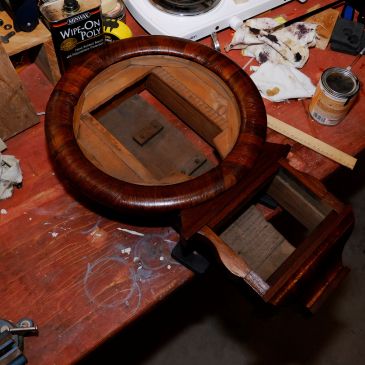
After giving the case a good cleaning I applied one thin coat of Minwax red oak stain to hide the bare areas and rough edges. I let the stain sit for 5 minutes and wiped off the excess with a cotton cloth. I allowed the case to thoroughly dry for 24 hours before the first sanding. For the final finish I chose Minwax PolyWipe for two reasons, one, it is simple to apply since it is easily wiped on and secondly, I wanted to avoid the amber tone of a lacquer which might result in concealing the grain. I applied six coats of PolyWipe and used 400 grit emery paper between each coat.

After cleaning, sanding and two coats of PolyWipe this is the result.

PolyWipe applications
After two PolyWipe applications

I am pleased that the grain came up very nicely, reminding me of what it must have looked like many years ago.

Finished clock
Finished clock, after 6 coats of PolyWipe

After six thin coats of PolyWipe the result is a revitalized finish that is durable, attractive and will last for years.

The brass door has me puzzled. What I thought was a broken hinge was actually folded into the bezel and soldered.

7/8 inch hinge is soldered back into the bezel

Why? I am reluctant to remove the solder because I risk breaking the glass by bending the retaining tabs. They are in very tight. As it stands the glass door will friction fit onto the dial bezel. Not the best but it will do for now. I will give it a second look, perhaps I can de-solder that hinge without removing the glass.

A project that is well worth the time and effort. It is always satisfying saving an old clock and bringing it back to life.

What does bushing a clock mean?

American Sessions time and strike clock showing a gear pivot and the build-up of dirt in the pivot hole

Is your mechanical clock not running as well as it should? Does it stop intermittently or not run at all? There may be a number of issues with the movement and among them pivot wear.

Pivots are the ends of the axles (the horological term is “arbours”) that spin in small holes drilled in the clock plates as the clock runs. They are reduced or turned down end of an arbour. These, along with the holes themselves, can become worn. The pivot hole must be perfectly round and the pivots must have a mirror-like polished surface in order to minimize friction within the train of gears. The two surfaces must be protected and the barrier between the pivot and the pivot hole is clock oil.

A badly worn pivot

A worn pivot or worn pivot hole causes the gear to slowly move away from the pinion and it will eventually stop when the gears no longer mesh properly. A clock that is in need of bushings runs erratically or stops altogether.

If a clock movement is not serviced (cleaned and oiled) routinely there will be wear in the plates of the movement where the pivots come through. If new oil is applied over the old il it will free up abrasive dirt and keep grinding away at the steel and the brass bushing hole. Worn pivots are typically found in clocks that have been oiled over and over again and not properly cleaned. The term “properly cleaned” implies disassembly of the movement, cleaning the parts, addressing wear issues, reassembly, and testing.

Occasionally you will see punch marks made to close the pivot hole. Though not an accepted practice today this was a common method of repair employed by past clock repairers

Pivots must be cleaned and polished periodically to ensure they can turn freely within the hole in the clock movement plate. A worn pivot hole is easy to observe as they are oval-shaped instead of round as you can see in the next photo.

Close-up of bushing wear
Close-up of oval-shaped bushing wear. The circle shows what the hole should look like

The process of bushing consists of replacing the worn brass around the pivot so that the hole is round again. A new hole is drilled into the plate. A new, properly sized, the bushing is punched or pushed into the plate using a bushing machine such as a Bergeon Bushing Machine.

Some clock-makers prefer to hand bush using reamers and smoothing broaches and the results are entirely acceptable but a machine simplifies the task.

Badly worn pivots which are made of steel must be replaced with new pivot. This is called re-pivoting in clock circles. A watch or clock lathe is used for re-pivoting which involves drilling into the end of the wheel arbour with a high-speed bit and installing a new pivot made from pivot wire.

Drilling a hole with Bergeon bushing machine
Drilling a hole with a cutting reamer

Punching the bushing home
Punching the bushing home using a Bergeon Bushing machine

Using a micrometer to check pivot
Using a micrometer to check pivot diameter

Minor wear is tolerable and expected over the life of a clock and can be addressed by careful filing, polishing, and burnishing.

X marks pivot holes that need to be bushed
X marks pivot holes that must be bushed

Clock pivot oil
Clock pivot oil

Looks like a large pivot hole but actally punched close to the hole
Punch marks near the pivot hole. This was a common practice of past clock repairers

Bushing is an integral part of movement servicing. Some clocks that have been well-cared for may have minimal wear and may not require new bushings while others, through neglect or improper servicing, may require many bushings.

Bushing a clock is one of the most fundamental tasks of the clock-maker. Pivot and bushing work performed correctly will extend the life of a clock movement while ensuring that a clock runs reliably for years.

Arthur Pequegnat Bedford – bringing a handsome mantel clock back to life – Part I

I acquired an Arthur Pequegnat mantel/shelf clock during my travels to Quebec this spring. The red oak veneered clock is complete with original hands, pendulum bob, a good label on the inside back of the access panel, coil gong and of course, the signature time and strike Arthur Pequegnat movement with nickel-plated steel plates.

Signature Pequegnat nickle-plated steel plates

It is known as the “Bedford” model. Online research tells me that two Bedford models were produced. This one, which I believe is the later edition, measures 9 ¾ inches high by 8 ¾ inches wide by 5 ½ inches deep. It has a silvered 6 inch dial with Arabic numerals with no Pequegnat inscription on the bottom of the dial face, spade hands surrounded by a thick brass bezel and concave base moulding. It has a passing ½ hour strike on a coiled gong. The earlier model has a 5 inch enameled dial with more stylized Arabic numerals and Pequegnat inscription on the dial face, spade hands, oak veneered case, a thinner brass bezel and convex base moulding. The case measurements are identical. The time and strike movement differs from the later model by having a ½ hour passing strike on a bell.

Bedford clock on display at the Canadian Clock Museum
Pequegnat “Bedford” clock on display at the Canadian Clock Museum

There is a good label on the inside of the access door which says, “Bedford, eight-day mantel clock, The Arthur Pequegnat Clock Co., Kitchener, Ontario, Canada”.

The label is in good condition

The movement is not marked. Though many Arthur Pequegnat movements were stamped with the maker’s mark it is not unusual to find one without one. This edition was likely manufactured in the Kitchener, Ontario (Canada) plant between 1925 and 1930.

With click fixed the clock is tested

The only issue with the movement is the time side mainspring function which, as the previous owner explained, could not be wound with a key. Damaged top veneer and split-open side trim pieces tell me that the clock had accidentally fallen. The impact point appears to be the very top front of the clock. As a result of the impact the front panel had separated from the main part of the case, leaving a gap of about 1/8th of an inch. It also had a broken access door catch.

Damaged veneer sustained during a fall
Damaged veneer sustained during a fall, veneer was later pushed back in place

At first I focused my attention on the movement and why the time side mainspring would not wind. It was, as I suspected, a missing click spring. The click is a pawl which engages the ratchet wheel to hold the power of the mainspring or the weight. It is moveable and connected to the mainspring by means of a rivet. The click spring is a piece of steel or brass wire which is connected to the click and seats the click in the ratchet wheel.

I had a supply of steel click springs and fashioned one to fit the click. The click, rivet and the ratchet wheel were in otherwise good condition. While the mainsprings was restrained with clamps I postioned the click spring in place applying a little solder to ensure that it remained fixed. An older similar repair occurred on the strike side with solder holding that click in place. A weak point of the movement, perhaps.

A little solder to keep the click spring in place

I inspected the movement for wear and discovered that it had been serviced previously. The solder on the strike side click was certainly a clue but I also noticed that some bushings had been replaced, not unusual given the age of the clock. Brass bushings were punched into the steel plates at the factory. I could see that newer bushings were installed in at least three locations.

There is no lateral movement in the gears as such lateral movement would indicate bushing or pivot wear. There is no evidence of ovalized, enlarged or mis-shapen bushing holes and the gears are meshing well. The movement is clean and free of dirt and debris and I do not feel that a full cleaning is warranted at this point. There is no excess blackened oil; the oil in the bushing holes had simply dried up. I applied clock oil to the bushings, wound both mainsprings and after days of running the movement is keeping excellent time.

With the movement out of the case, repaired and in the testing phase, I focused next on the condition of the oak veneered case. Many of the joints had separated due to the impact I mentioned earlier. Hide glue would have been used originally and could be used for case repair. I have medium strength pearl hide glue, not strong enough for this application. High strength is required to bring the trim pieces together to ensure a good long-lasting and tight fit. This is one of those occasions when a modern glue is an acceptable alternative. Yellow carpenters glue has a bonding power of two tons and I chose this type of glue for the repairs.

Each section had to be clamped for 24 hours and only one section could be worked on at a time. The result is a very time-consuming and complicated process lasting several days.

I used three clamps for one repair. Because the impact point was at the very top I had to push the sides in with a clamp while at the same time bring the front panel into the main part of the case using two clamps adjacent to each other. You can see the clamping method I employed in the next photo.

Using three clamps to bring the sides together and the front section into the case

The side base trim pieces were also split open and had to be clamped in place as you can see in the next photo.

Side trim pieces clamped

Bringing the sides of the case together resulted in raising the damaged veneer, consequently several small pieces of top veneer had to be pushed back into place. Using carpenters glue combined with an “elaborate” weight system I went about with the repair. Using a toothpick I applied carpenters glue under the veneer pieces, wiped off the excess with a wet cloth and used a block with a hole drilled to accommodate a toothpick employing enough pressure to push the small veneer pieces into place. It looks odd but it works.

Toothpick and wood piece to push the veneer in

A degreaser was used to strip years of blackened dirt/grease/grime on the case and once cleaned the original grain in the red oak veneer is now exposed to its former beauty. The case will either need a layer or two of lacquer or a more modern finish such as PolyWipe. I will cover this aspect of the restoration/repair in Part II.

Using Brasso I cleaned up years of tarnish on the brass bezel giving it a new life. I also polished the arbour grommets. The silvered dial face is in very good condition and I left that as-is.

Bezel cleaned up
Bezel cleaned up

I fashioned a new door catch out of a worn Sessions click.

A new door catch made from a worn Sessions click
Broken door catch was repaired using an old worn Sessions click

With the movement repaired and the successful clamping and gluing of the case the next phase is the final finishing. I am pleased that I am inching closer to bringing this clock back to life and can add it to my modest collection of Arthur Pequegnat clocks.

Stay tuned for Part II on July 30th.

Tick Talk Tuesday #15 -what size clock key do I need?

Tick-Talk Tuesday is about the letters and comments I have received from you, the reader, concerning your clock, issues you might have had, challenges you face or a clock you would like me to profile and my responses to your questions with advice on your particular clock concern. For those comments and questions that stump even me, I consult within my clock circles for the best possible answer.

CM writes,

4 and 5 prong keys and singles

“Hello, I just read your article about keys for wind-up clocks. I have a parlor clock that belonged to my parents. It is on the wall, has a pendulum & requires winding. I believe that it is from the early 1980’s. And made by The Time Mfg. Co. However, I do not have a key – seems that it was lost prior to my getting it. Can you tell me what kind of key I need to get for it? And do you have any that would fit my clock that I could purchase? Thank you so much & have a great day.”

My reply,

“Hi CM. Thanks for coming to my blog. If it is made in the 1980s it is likely Chinese or Korean but it is hard to tell unless I see a photo. If I am correct these are 31 day movements. You could measure the arbours which will tell you the size but it likely takes a #6 or a #8 key which you can find here.”

Sperry and Shaw 30 hour 4 column New York Style shelf clock circa 1846-47

4 column Sperry and Shaw 30 hour shelf clock

I have the 30-hour clock bug and my collection of them is steadily growing, but where to put them all? I have not decided where to put this one and for the moment it is on the floor of my work room.

Sperry and Shaw were not thought of as a high end clock company but some models like this 4 column New York style were quite attractive

This is a New York-styled Sperry and Shaw 30 hour time and strike, 4 column shelf hour strike clock, measuring 25 1/2 inches in height by 14 inches in width. The 4 free-standing turned columns first drew my attention as I had never seen anything quite like it. While researching the NAWCC site I discovered that this clock was made in or about 1846-47. The label, of which 98% is intact inside the backboard says 10 Courtlandt (not a misspell, there is a second”t”) Street, the company headquarters during the aforementioned period. Sperry and Shaw were business partners and were regarded as distributors and assemblers rather than clock-makers.


Sperry and Shaw's label showing 10 Cortlandt St.
Sperry and Shaw’s label showing 10 Cortlandt St.

They sourced cases and movements, affixed their own stamp on the movement and placed their labels (sometimes over other makers labels) inside the case, a common practice at the time as clocks for the home and workplace both locally and abroad were in great demand.

Not everyone in the clock business was happy with Sperry and Shaw. Consider this excerpt from Chauncey Jerome’s book, History of the American Clock Business.

“These New York men would say that they were agents for Jerome and that they would have a plenty in a few days, and make a sale to these merchants of Jerome clocks. They would then go to the Printers and have a lot of labels struck off and put into their cheap clocks, and palm them off as mine. This fraud carried on for several years. I finally sued some of these blackleg parties, Samuels & Dunn and Sperry & Shaw, and found out to my satisfaction that they had used more than two hundred thousand of my labels. They had probably sent about one hundred thousand to Europe.”

Chauncey Jerome had a few clock-makers/assemblers on his hit list that included Sperry and Shaw and at least managed to sue some successfully.

Sperry and Shaw were not thought of as a high-end clock company but some models like this 4 column New York style were quite attractive, sold well at the time and are sought after today by collectors.

The movement is Jerome-like (Counterfeit perhaps?) and stamped Sperry and Shaw, New Jersey. I measured the plate thickness and compared it to a Jerome in my collection and the plates in this clock are a little thinner.

The narrow brick-shaped weights (4  3/4 inches X 1 inch) fit neatly into channels on the left and right. When I first communicated with the seller, he was not sure if the weights were in the clock. He later emailed to say that it did indeed have weights. I would have passed on the clock had it not come with the weights because the narrow bricks are the only type that will fit into the channels and they would have been almost impossible to source. The weight cords, clearly not original, are old and frayed and will be replaced with simulated gut. How old, well on the first night I raised the strike weight up about halfway and about 20 minutes later I heard a loud BANG. I knew exactly what happened; the cord had snapped and the weight had dropped. Luckily there was no damage.

The open moon steel hands are original.

The upper glass appears original and has the waviness you would expect from a clock over 172 years old.

The lower tablet has a cropped image of the Bay of Quinte (Ontario, Canada) taped to the inside – not original but old. The original 18X12 cm steel engraving was drawn by W. H. Bartlett and engraved by J. C. Armytage in 1840; the image can be found here. Since the image is from 1840 and appropriate to the period of the clock, I might just leave it there. It also tells me that the clock likely spent most of its life in Ontario, Canada.

Sperry and Shaw clock showing dial and lower tablet
Sperry and Shaw clock showing dial and lower tablet print

The zinc dial is old though not as old as the clock itself since there is a patent stamp on the back of the dial dated Dec 1, 1863.

Dial patent date of 1863
Dial patent date of 1863, a later addition to the clock

There is also a clock-makers inscription that says, “cleaned by Felo Bros, March XX 1901”. Obviously this particular dial would not have been on the clock at the time it was made. A wood dial would have been appropriate for the period.

Clock-makers inscription in pencil

The case looks good…from a distance. The veneer looks like mahogany or walnut, I am really not sure. There are a few small pieces of veneer missing at various places and mostly on the corners, a common issue. It has a two-tone appearance though the case might have been all one colour when made (??). There is a lot of grime on the darker surfaces and I have to decide whether to leave as-is or take it down a little bit to see what’s there. Attending to the veneer issues should be a fairly straightforward process. The break in the right corner of the base is a crude repair and that will have to be redone.

One of several areas of minor veneer loss

The movement is dirty but should clean up nicely. There is not a lot of pivot wear on the front plate of the movement but I will learn more once it is out of its case.

There are a number of other clocks in the queue but I am eager to tackle this one.

Ansonia Extra Drop wall clock – moving ahead with repairs

Ansonia Extra short drop wall clock
Ansonia Extra short drop wall clock in as-found condition

The photos tell the story

Some time ago I wrote an article on an Ansonia barn find. It is an Ansonia Extra Drop time-only Rosewood veneered wall clock, circa 1880. I thought I would update readers on how this little project is progressing. I was able to find most of the parts but there are still some missing. I will let the photos tell the story.

It did not look like it would ever run again

Siezed time-only movement
Before shot of the seized time-only movement

Cleaned up time only movement
Cleaned and serviced one-train time-only movement

Ansonia movement in case
Ansonia movement in the case and running an 8-day full cycle

The movement was cleaned up with 4 bushings installed and is now able to run a full 8-day cycle. The case received attention with glue repairs, a new backboard, new right finial and a re-lacquering of the veneer surface. The veneer was in good condition and required very minor repairs.

Dial with minor losses, At this point is test fit with the wood bezel
Dial with minor losses

Touched up dial, mounted in case
The dial has been touched up and mounted in the case

Addressing the paint loss on the dial was a challenge. I played with various shades and mixed colours that were a close match to the original. The result is better than it was. The glass fits into a slot on the wood bezel and the fit was surprisingly tight. Had I known I would have glued the bezel pieces with the glass in place. Lesson learned!

I am still missing the drop access door plus its reverse painted glass and the brass bezel that surrounds the dial face. I will make the door but will leave that project for another day. My search for the brass bezel continues.

As I progress with this restoration project I will keep the reader up to date with changes.

Arthur Pequegnat Bedford mantel clock – an interesting find

As regular readers know I am a fan of Arthur Pequegnat clocks not just because they were made in Kitchener, Ontario, Canada but they are attractive, well made and hold their value well (in Canada!).

Eddy's photo of the clock
Eddy’s photo of the clock

I have had clocks given to me in the past but this was a rather unusual situation. As readers know I publish at least seven or eight articles a month in order to provide interesting content on all aspects of mechanical clocks. I publish a regular feature called Tick Talk Tuesday in which I profile the mail I receive from readers. The mail is private email and not comments after a blog article. I receive many emails you will not find on my blog. Some people prefer writing to me privately and that is perfectly fine.

I received one such email some time ago from Eddy who lives in the Quebec City area (Province of Quebec, Canada). Eddy was researching my blog and discovered that I admired and collected Canadian-made Arthur Pequegnat clocks. He wondered if I would have an Arthur Pequegnat clock added to my collection.

Because it was an Arthur Pequegnat I was immediately interested but I did not expect a reply. To my surprise Eddy answered with five photos of the clock from various angles. It was a mantel clock in pretty rough shape and after seeing his photos I was still curious even though it likely required a lot of work to restore it.

Top of the clock
Top of the clock

In his email Eddy explained that he was having serious health issues and was taking stock of his life. He had a number of antique and vintage items that his father and grandfather had left him and he felt they should be passed on to someone who would appreciate having them. As Eddy explained, “My father had that clock as a trade against work done for people he helps with their house and lawn chores. He gave it to me since he’s got too many, just like my grand-father did. He was okay with me parting with it.”

I wrote back and told him that a meeting was indeed possible. We would be passing through the Quebec City area in the next few days on our way to our cottage in Quebec to open it up for the summer. We (my wife and I) had even planned to stay in that area for the night. We could stop by to have a look at the clock. Eddy then provided me with his address and telephone number. A meeting day and time was set up.

After nine hours of driving we arrived at his door. He invited us in and we spent a very pleasant two hours getting to know each other, discussing my collection of clocks, talking about the clock in question, his fathers hobby of searching out old antiques and finally, matters related to his struggle with a serious illness.

broken brass hinge
broken brass hinge

I was a little confused. Was he was actually giving me the clock or did he expect money in return so I decided to ask him straight out. No, he said, you can have it. he then brought out three other clocks to the kitchen table, a cottage clock, a steeple clock and a swinger. He asked me if I wanted those as well and I thanked him for the offer but declined. While they were very nice clocks I felt awkward taking all of them for nothing. So, we left with just one clock.

We walked out the door with clock in hand and for the next hour of our drive we talked about Eddy and his gift of an Arthur Pequegnat clock.

The clock was complete with original hands, pendulum bob, coil gong and of course, the signature Arthur Pequegnat movement with nickel-plated steel plates. The only visible sign of an issue with the movement was the time side mainspring which, as Eddy explained, could not be wound with a key. Damaged veneer, side trim pieces splitting open was clear evidence that at some point the clock had been dropped or fallen hard. The impact point was the very top of the  clock. Yes, it was in rough shape!

A challenge to repair? Yes, but I graciously accepted the clock knowing that I would have to spend several hours putting it right.

The sides and front were coming apart
Both sides and the trim front were coming apart

Thanks to Eddy I am now the new owner of an Arthur Pequegnat, Bedford model that I will add to my collection of four other Pequegnat clocks. In a later post I will detail the repairs to this fine Canadian made clock.

Eddy suggested that instead of offering him money that we donate to a charity and so a cheque went to the Canadian Cancer Society. I have never given names to my clocks but this one will always be called Eddy in honour of a individual who felt strongly that a family treasure should go to an appreciative owner.

Looking for an antique Ogee clock? Now is the best time to buy

Ogee clock prices seem to be at their lowest level in years. If you have your heart set on an Ogee clock, there is probably no better time to buy than now.

Ogee clockclock design that originated in the United States in the 1830s, distinguished by a case (usually pine) the front outer edges of which are curved into an S-shape (ogee). This shape is formed by the union of a convex and a concave line. A mass-produced variant of the shelf clock, the ogee clock stands about 30 inches (75 cm) high and is usually weight-driven. The movements were usually made of brass and were made to run for 30 hours or eight days. (Brittanica.com)

Earlier this year (2018) I bought three Ogee clocks at an estate auction. There were about a dozen clocks up for bid, some gingerbreads, a couple of mantel clocks and a few Ogee clocks. Fearing that the auction would bring out collectors I surmised that the clocks would fetch somewhat higher prices. Though there were many clocks there were few aficionados. I scored three clocks, all were in very good condition though they were running poorly.

Daniel Pratt reverse ogee and splat clock

This Daniel Pratt Jr clock caught my eye. It is reverse ogee and splat, time and strike with wood movement made in the mid-1830s. My winning bid was a mere 30CDN. Ogee clocks with wood movements have sold for at least 200CDN in years past and eBay asking prices for Daniel Pratt Jr. clocks are typically between 60US and 200US. Although Ogee clocks have hit rock bottom in Canada the same may not be true elsewhere.

Wooden movement, time and strike

I have written about the decline in clock prices in a previous post. There is a legion of unwanted clocks out there. EBay and other online sites are flooded with ordinary antique clocks though special interest clocks still command higher prices. Many reasons are attributed to the decline though the poor economy in recent years is a major factor. Since 2008 clock prices have been dropping steadily and an upward direction in the near future looks dim. Prices are at or near the bottom. As the economy improves and antique buyers return to the marketplace we will see an uptick in values. In the meantime, now is certainly the time to buy.

Clocks, manufactured and warranted by Daniel Pratt Jr

I paid 60CDN each for the other two Ogee clocks, one a Chauncey Jerome 30 hour time and strike, circa 1857, the other, a George H. Clark 30 hour time and strike, circa 1860.

Chauncey Jerome 30 hoir Ogee clock
Chauncey Jerome 30 hour Ogee clock

George H Clark Ogee clock
George H Clark 30 hour Ogee clock

Sellers are posting inflated prices but a clock is only worth what the buyer will pay. Do your research and learn to shop with a critical eye and you be rewarded.


240 clock posts later and still ticking away

The other day I decided to explore my humble beginnings and realized that 240 posts ago was post number one. Three years ago I had recently retired and I decided to look into blogging, something I always wanted to do. I never considered myself a great writer. I do not have that natural flair that some people seem to have for writing but I wanted to give it a try. I had some thoughts and ideas that I wanted to communicate with an audience that was looking for something a little different.

I attended a WordPress session at my local college and was very impressed with how easy it was to set up a blogging site. Anyone can do it said the facilitator and I wasted no time getting started. WordPress impressed me as a very intuitive package then and after 3 years I am still impressed with the power of the product.

This year as some of you know I decided to buy a domain name which I think is a great name and says everything it needs to,  antiquevintageclock.com and a 1-year automatically renewable subscription. I won’t go into the additional benefits of the new package suffice to say the time was right for a change. The result has been a slight uptick in hits and exposure to more powerful options within WordPress.

Just a note about hits. In the first week or so of my new domain name my hits dropped dramatically, something to do with Google’s ranking analytics and not unusual for a brand new domain name. Of course, after I hit the migrate button and saw my hits drop I found an article that spoke directly to making preparations beforehand to avoid low hits after migration but too late for me. It would have been nice for a WordPress warning box to pop that would have read, “Oh, before you do that you may want to read this”

So, here is what I said three years ago. It was a short article and I remember at the time what a real struggle it was to put those first few words together.

I am no more than a clock collector and tinkerer. I am not a trained horologist nor do I have a great talent for clock repair or even getting a simple clock back to working order, but I find the world of horology to be quite fascinating.

It is a relatively new hobby for me which began with the purchase of a Daniel Dakota 2-train wall clock about 3 years ago.

The clock that started my collection, a humble Chinese clock that still ticks today.

Now I know what you are thinking. Why start with a Chinese made clock which most would consider inferior to almost any other clock in the world. Well, it was pretty cheap and it piqued my interest in collecting. From there I moved on to a Ridgeway grandfather clock and to my current collection of Mauthe, Seth Thomas, Hermle, Forestville, Sessions, Smiths Enfield, Muller and Pequegnat clocks.

I intend to profile my clocks both old and newly acquired on this blog and describe my attempts to repair and maintain my modest collection. I might even solicit a little help from my fellow clock enthusiasts.

Some of the nicer things about clock collecting are that is a great conversation starter and it allows me to combine my other passions, photography and traveling. Finding good clocks means traveling around the province of Nova Scotia, meeting interesting people along the way and is some cases getting fabulous deals. All the photos on this site are my own. I will try to capture the beauty of these old mechanical clocks and talk about the pedigree if I can learn anything about the history of any of these clocks..

Stay tuned. It is all a learning experience and as I bravely go further into the hobby I will be able to share my many experiences.

Well, I am still doing what I set out to do, profile my modest collection and pass on the clock repair techniques I have learned to the novice and intermediate clock repairer. Do I know more than I knew then? Sure, isn’t that what learning is all about? I am still tuned in and I hope you are too.

Kundo 400 day oval anniversary clock – let’s get this thing working!

Of the five anniversary clocks in my collection, none have cost me more than $30. It’s unfortunate because these clocks are truly fascinating devices. They are well-crafted, delicate, and ornamental, driven by spring mechanisms. While many thousands were produced, their abundance is reflected in their low value today. My focus is on collecting the older mechanical models, the last of which were manufactured over 35 years ago, and steer clear of the battery-operated anniversary clocks still being sold.

Among clock repair enthusiasts (horologists), opinions on anniversary clocks vary—some enjoy working on them, while others struggle to develop an affinity for them. I fall firmly into the former group, finding these clocks both intriguing and enjoyable to work on.

Kundo 400 day torsion clock

Gustav Becker, Haller, and Schatz 400-day clocks are certainly more desirable, better made, and fetch higher prices. While I don’t have any of these makes in my collection, I am always on the lookout for more desirable and collectible models.

Movement before cleaning
Movement prior to cleaning and showing verdigris on the spring barrel

I picked this up for $5 at a local antique store. When buying one of these clocks, regardless of the price, it’s crucial to check that all parts are present, as sourcing a missing part can be nearly impossible unless you purchase an identical clock for parts. Often, the only issue is a broken suspension spring.

Fortunately, this Kundo clock was complete and in generally good condition. However, the suspension spring had clearly been snapped off due to improper transport. Many people either forget about or are unaware that these clocks feature highly effective pendulum locking mechanisms.

These are called torsion clocks because there is a weighted disk or wheel, often a decorative wheel with 3 or 4 chrome or brass balls on ornate spokes, suspended by a thin wire or ribbon called a torsion spring (otherwise known as a suspension spring). The torsion pendulum rotates about the vertical axis of the wire, twisting it, instead of swinging like an ordinary pendulum.

These clocks operate very slowly—in the case of this Kundo Junior, just 10 beats per minute compared to 100 beats per minute or more for a typical pendulum mantel clock. Due to the slow movement of the gears, wear is minimal, and it’s quite common to find these clocks with a broken suspension spring as their only issue.

Front plate removed
Front plate removed

The movement was disassembled and cleaned in an ultrasonic cleaner. The mainspring was removed from the barrel, cleaned, and serviced. Otherwise, there was minimal wear to the pivot holes. In fact, I have never needed to install a bushing in an anniversary clock because their slow operation results in very little friction.

The old spring was very twisted

Now, it’s time to install the new suspension spring. The suspension spring is a very thin piece of steel running down the back of the clock, designed to twist back and forth while suspending the pendulum balls. It’s crucial not to kink or bend it, as a bent or crimped spring is the most common reason these clocks fail to function properly.

You can purchase pre-assembled suspension springs in kit form—springs already fitted with blocks and a fork—but I’ve found it far more cost-effective to buy the springs separately and re-use the blocks and fork. To ensure accuracy, I consulted my Horolovar manual (I eventually purchased one) to find the exact template—Kundo 5E, in this case. I then unscrew the blocks and fork to install the new spring. Here is an example of a suspension spring from a Kern 400-day clock.

suspension spring installed on a Kern
A new suspension spring was installed on a Kern

Installing the suspension spring requires a little patience. While it is a delicate process, it’s relatively easy to do. It’s best to work on a flat surface. There are screws on both the top and bottom blocks that must be loosened before the new spring can be inserted. The bottom block was a bit stubborn, and a jeweler’s screwdriver is essential—you don’t want to strip those tiny screws.

Use the template in the Horolovar manual as your guide. For the Kern clock mentioned earlier, I had to rely on some guesswork while waiting for the manual to arrive, but once it did, I was able to confirm the measurements. After positioning the blocks, attach the fork and secure it with screws.

Install the bottom block first. Attach the spring block to the 4 pendulum balls with the pin then lock the pendulum balls in place using the locking lever. Some 400-day clocks use a simpler bottom block solution that simply hooks the block into place. Because this one uses a pin it is a bit more frustrating. After the bottom block is secured and locked in place install the top block to the top mount by first slipping the fork over the verge post. In the case of this Kundo it is a small side screw that secures the top block to the mount (saddle?).

I then attached the dial face and the hands then gave the pendulum a gentle 360-degree spin. Not surprisingly the clock failed to maintain its spin. An adjustment was required.

Looking at the top of the clock, you’ll see a screw that can be loosened to adjust the fork in one direction or another. Be very careful not to kink the suspension spring when loosening this screw. Loosen it gently, just enough to allow movement, and make small, incremental adjustments when setting the beat. While you can buy a beat adjustment tool for 400-day clocks, with a bit of trial and error—observing the verge’s action and fine-tuning the beat setter—you’ll eventually find the correct beat. You’ll know it’s “in beat” when the time between the tick and tock is the same. At that point, the clock should run smoothly. Since the ticking is so quiet, it helps to turn off any background noise in the room while making adjustments. I have several loud-ticking clocks in my office, and I stop them to assist with the process.

If you work on enough torsion clocks, a Timetrax or similar beat amplifier will make the task much easier.

The clock has been running for several weeks and is in the process of being regulated. Above the pendulum balls in a regulating adjustment dial. You will see a “+” and a “-“.  Adjusting towards the plus side speeds up the clock and the minus slows it down. I recommend minute turns for either adjustment.

There’s some debate about whether or not to oil these clocks, given the slow movement of the gears. While polishing the pivots to reduce friction can certainly be beneficial, I believe a bit of pivot oil is never a bad idea.

As I mentioned earlier, I’m part of the group that enjoys working on 400-day clocks, appreciating their delicate mechanisms and the satisfaction that comes with restoring them to working condition.

Cast Iron Banjo Clock

When I saw this listed on an online for sale site and not seeing a picture of the clock I was very curious. Imagine my amusement when I opened up the ad and saw this.

Banjo clock
Banjo clock

THE AD: Vintage cast iron bango player clock beautiful piece Heavy 16 in tall great condition

Well, it IS a banjo clock or should I say “bango”!

Featured article on Chelsea Clock blog about my blog

The following is an article that was featured on the Chelsea Clock blog

I have always had a fascination with clocks. As a young boy I can remember the schoolhouse clock in my grandparents’ kitchen and the ticking sound it would make that echoed through the entire house.

Seth Thomas Adamantine time and strike mantel clock, circa 1913

We all have busy lives and despite my interest in clocks over the years it was not until the year 2000 that I started building my collection, first with a Seth Thomas Adamantine clock and later with more mantel clocks, wall clocks and finally a grandfather clock in 2012. My collection has expanded to include virtually every style of clock though my interest lies specifically with American and European wall and shelf clocks. As I write there are about 35 clocks ticking away in my home.

In my blog I stress that I am not a trained horologist but have accumulated enough knowledge over the years that I feel capable of addressing general clock issues

Clock repair came a little later. I began with general understanding of the cleaning and oiling of clock movements in order to keep my little collection running. As I acquired clock repair tools and equipment I progressed to servicing pinions, bushings, verge repairs, cleaning of mainsprings and case restoration.

In 2015 I decided to write a blog about collecting and servicing vintage and antique clocks. There are some excellent clock blogs but many are commercial sites or professional horologists selling their services. I decided to design a blog that would appeal to the amateur clock collector/repairer. In my blog I stress that I am not a trained horologist but have accumulated enough knowledge over the years that I feel capable of addressing general clock issues. Therefore, my blog is not aimed at the professional repairer or restoration expert but the individual looking for specific information about a certain clock, those who have a particular problem with their clock and finally those who have a general interest in clock collecting and repair.

Junghans Crispi wall clcok with compensating pendulum
Fully restored Junghans time and strike wall clock, circa 1899

Cleaned, bushings replaced and tested
Time and strike movement on a test stand after servicing

I publish an average of seven blog articles per month on a variety of clock topics. I appeal to a wide change of subjects; some articles have a philosophical perspective, some detail the challenges of working on a specific clock, some present simple repair techniques for the beginner, general maintenance tips as well as articles of general interest. As a history buff I try to include a background history or provenance of the specific clock I am profiling or information about its maker.

Using a micrometer to check pivot
A micrometer is used to size a bushing for an escape wheel pivot

Blogging has also allowed me to combine my other interests, that of photography and traveling. My wife and I have had many interesting adventures seeking out unique clocks for my collection.

I have good luck finding a great deal on a clock

I seem to be one of those people who manage to find a great clock deal. I don’t think it takes a special talent but patience, research, and timing are three key elements in finding a bargain.

I often cruise the online for-sale sites for interesting clocks. In Canada, we have something called Kijiji. In the States Craig’s List is quite popular and I am sure other countries have something very similar.

What makes Kijiji (and similar sites) interesting and fun is that you can connect with people locally or in my case our province of Nova Scotia. There are a wide variety of sellers. Some know what they are selling and price items accordingly. Some have really no idea and either price items clearly for much more than they are worth or conversely for far less than their actual value.

It is nice to be able to meet the seller, find out the history of the clock, learn something about the seller, and their motivation for selling, negotiate a price, and bring the item home. There is no post office or courier service to “screw” things up. No “oh crap” sigh when you open the package. With online auction sites, you often get a “pig in a poke” which means that something is sold or bought without the buyer knowing its true nature or value, especially when buying without inspecting the item beforehand. This does not happen with Kijiji. You find the item advertised, connect with the seller several times electronically or personally if necessary, see the item beforehand, ask questions about it, inspect it for any immediate issues or potential problems and you have the choice to walk away if you are not completely satisfied. All transactions are cash with no pesky sales tax.

Clocks are interesting items to collect and prices are all over the map as you would expect. However, I have found a few gems in the last few years. Let me tell you about my latest experience.

A few weeks ago I saw this clock advertised on Kijiji (photo below). Now, this looks like any ordinary Gothic steeple clock but what grabbed my attention was the unique tablet inscription. The acid-etched glass tablet says “Cling to the Cross”, a religious expression not often found on this style of clock. I knew immediately that this was a very special Canadian-made clock.

Seller's photo
Seller’s photo

Why, because several months ago I watched a video presentation by Jim Connell. Jim Connell is well known in Canadian clock circles. According to the introductory remarks found at the aforementioned site “He has amassed a large collection of clocks of all types with an emphasis on those with a Canadian origin. As his collection and knowledge grew, Jim prepared and presented numerous articles, talks, and displays on Canadian clocks and their history.  He is the respected author of the Charlton Standard Catalogue of Canadian Clocks and he co-authored Early Canadian Timekeepers and The Canada and Hamilton Clock Companies with Jane Varkaris.”

In his presentation, he described this exact clock and mentioned in his presentation that there were very few copies left, a very rare Canadian clock indeed.

I wanted to confirm that this was the clock I thought it was and asked the seller to photograph the label. He did so and sent this to me.

Seller's photo of the label affixed on the back of the clock
Seller’s photo of the label affixed on the back of the clock

I attempted to negotiate a price. The seller wanted 100CDN and I offered 80CDN. He replied that he would not accept anything less than 100CDN. In the meantime, I checked with the curator of The Canadian Clock Museum to confirm its authenticity. Upon discovering that this was a Hamilton Clock Co. clock made between 1876 and 1880 I decided that, yes, this was a good find and in my email reply to the seller I said, “100CDN it is”.

It is what I would consider one of those happy win-win situations. The seller got more than he thought the clock was worth and I got a clock that is worth much more than I paid for it. My motivation, however, was not to celebrate a great deal at a great price but to acquire a piece of significant Canadian horological history at an affordable price.

Hamilton Clock Co Gothic steeple clock
Hamilton Clock Co. Gothic steeple clock
30-hour time and strike movement with clock company inscription on the bottom of the front plate
30-hour time and strike movement with company inscription on the bottom of the front plate

We met and settled the deal. I am now the owner of a Canadian-made 30-hour time-and-strike Hamilton Clock Co. Gothic steeple clock.

In a later blog article, I will profile this clock and describe my strategy to address some of its issues.

Is clock collecting part of the counter-technology revolution?

Is clock collecting (and repair) part of the counter-technology revolution?

Many years ago, social scientists predicted with the onset of modern technology it would sap us of our knowledge. Our brains would simply melt away. Concentration and initiative would be sucked out of us. Why would you need to know anything if it is readily available at your fingertips? How often do you hear the phrase, “just google it”. Sadly, it has become an integral part of our lexicon.

People are embracing old technology and returning to the fulfillment of doing things for themselves

The term counter-technology is not a term I invented. I found it mentioned in a car magazine article some time ago. Many people are collecting and repairing antique cars more than ever. Why? Reliving past memories? Getting your hands dirty. Rejecting the modern world?

Has the analogue world returned? Yes and no. Wine and beer making has become a huge industry and there seem to be mom and pop microbreweries everywhere, antique furniture purchases have increased dramatically, backyard chicken coops are popping up everywhere, fountain pen collecting is a “new” thing, vinyl records are spinning back and stamp collecting is returning with renewed vigor.

Retro is in. But is is not just that! It is a statement. People are embracing old technology and returning to the fulfillment of doing things for themselves. We all know the value and satisfaction of pursuing a simpler way of life but at the same time we still want to feel connected to our busy modern world. We want both. This is our inevitable response to the new digital world. We are pushing back but just enough to satisfy our needs by remaining connected with the past but we still feel the need to be plugged in.

However, every now and then we feel the need to dis-engage. Digital detoxification. It’s a thing. Somehow we want to wash the digital world from our lives, however briefly. I spend summers at our family cottage in Quebec (Canada). There is no Internet and I am totally fine with that. But what’s the first thing I do when I return home? You got it!

You too can be saved

Simplicity breeds complexity

To truly embrace the analogue world the mechanical clock is my personal statement. Not only do I collect antique and vintage clocks I repair them as well. As readers know I am not a trained horologist but I love the challenge of repairing a clock and I love accumulating knowledge in the pursuit of my hobby. Needless to say I am not always successful and my office has a few notable failures. I am fine with that. Failure breeds learning. It is my response to the increasing pressures of the digital world. It is my response to our increasingly complicated world. Simplicity breeds complexity.

Like the juggler who can keep all the balls in the air at once

It took years to learn the skills necessary to repair this Sessions Westminster A Westminster chime clock
It took 2 years to learn the skills necessary to repair this Sessions Westminster A chime clock

Analogue verses digital. It is a question of balance, like the juggler who can keep all the balls in the air at once. I admire people who have “analogue” hobbies but I especially admire those who remain connected to our modern world by maintaining a delicate balance between both.


Clock therapy – it’s not a pill or counseling but it works!

I enjoy the ritual of winding my clocks once a week. It gives me a chance to “see how they are doing”. Each one is like a friend and my mission is to take care of them. As I go from clock to clock I listen carefully as I wind each one, adjust as necessary to speed it up or slow it down depending on the season of the year, humidity and so on and think about the last time it was serviced and what might need to be done.

Some keep very good time, especially the weight driven ones, because they release power at a steady rate while others, like the spring driven clocks either need adjustments often or only occasionally. Like friends, they are all quite different.

The grass is always greener....
The grass is always greener….

This is the energy I need to keep going by doing physical things

It is Saturday. I wind my clocks up and then decided to mow the lawn. But you know how it is, you can’t just go out to the lawn mower and start it up and mow the lawn. First I had to go buy gas. I buy 10 liters of gas and wouldn’t you know it I return from the gas station to find that I already had another half full 20 liter container tucked away in a corner of the garage.

Mowing a lawn is unnecessarily complicated. I have been mowing my lawn for 20 years and each time I mow it I look at it and decide, which pattern will I use this time? But I end up mowing it pretty much the same way every time. It is a tedious task; it is a mindless task but it needs to be done. But, you know, the lawn looks great after it is cut!

Clock collecting and repair is good for the mind and soul

Anyway, the point is that this is the energy I need to keep going by doing physical things. Even cutting the lawn allows me to think about life’s little problems and provides the exercise that I need. Winding clocks is great therapy because it gets me off the couch and off the internet which is a time-sucking monster. Repairing clocks takes less physical energy but much more mental energy that keeps the brain cells from drying up.

Looking for new clocks to acquire or repairing my clocks takes a certain level of both physical and mental energy. It is a good feeling. Unlike lawn cutting there is nothing about clock collecting and repair that is mindless or tedious, you have to think about everything you do, meet each challenge with the thought that I might even learn something new.

For example, faced with two identical Sessions time and strike movements each one might have very unique challenges like a worn escape wheel tooth on one or a broken mainspring on another. Or, faced with a decision to buy or not to buy I must weigh the cost against my desire to have that particular clock. These weighty decisions take a lot of mental energy.

Worn escape wheel tooth

Mainspring
Sessions mainspring

Clock collecting and repair is good for the mind and soul. One of the things I enjoy most is facing a difficult challenge and seeing it through to the very end, stepping back and saying….yeah, I did that. Take my Junghans Crispi wall clock for example.

This is what it looked like when I first got it

This is what it looks like now

I decided that I would do my best to fully restore this clock

My mission from the very beginning was to have a Victorian style showpiece. I imagined what it might eventually look like and decided that I would do my best to fully restore this clock. Yes, there were challenges working on the case and learning new ways to fashion complex pieces, stain, glue and so forth. There were also challenges addressing issues with the movement which had not been running in 100 years.

I made the difficult decision to bring the clock to a horologist that I have used in the past. Why, it had two issues that I could not fix because I do not have the proper tools. I decided that while it was in the shop instead of having those two issues addressed, why not have it serviced completely. The horologist who worked on the clock did a fantastic job. When I picked it up she was very curious about its history and remarked that it was the first style of clock she had ever worked on.

Was it worth the many hours and the money to bring this fine Victorian style clock back to its former glory? Absolutely, without question!  The before and after photos of this clock constantly remind me that when I put my mind to something I can achieve a fantastic result and every time I look at it I feel a sense of immense achievement. It gives me energy!

Yes, clock collecting and repair is good for the mind and soul. It is clock therapy and it works!


Junghans Crispi wall clock – from a clock-in-a-box to a clock that rocks!

This post describes the final detail work on my Junghans clock.

My winter (2017) project was an antique German Junghans Crispi time and strike spring driven wall clock made in the style of a Vienna Regulator. It was manufactured in Schwenningen, Germany in 1899. It came to me as a box of parts. To some a box of clock parts and pieces is discouraging but to me it was the challenge I was waiting for.

A clock in a box, how it came to me originally
A clock in a box, how it came

I wrote a multi-part series on the restoration of this clock. Use the search feature on this site to find past articles. I discovered this antique clock from a seller on an online for-sale site in January (2017) and was intrigued with its incredible history as a survivor of the Halifax Explosion on Dec 6, 1917.

On the morning of 6 December 1917 the SS Mont Blanc a French cargo ship laden with high explosives and Benzol collided with the Norwegian vessel SS Imo in the Narrows, a strait connecting the upper Halifax harbour to Bedford Basin. A fire on board the French ship ignited her cargo, causing a large explosion that devastated the Richmond District of Halifax. Approximately 2,000 people were killed by blast, debris, fires and collapsed buildings, and an estimated 9,000 others were injured……and a Junghans clock fell off the wall in a house on Princess court, North End Halifax

At first I was not sure how far I would go with this project but I decided I must go all the way towards restoring this clock to its former 19th century glory.

Most of the clock is original; the movement, the pendulum, coil gong and movement bracket as are the bottom base and top part of the case plus the crown, the backboard, the vertical columns and most of the decorative trim. What has been replaced is the box frame, the front piece that supports the right and left columns. I can only assume that parts of the clock were destroyed beyond repair on that fateful day.

Thirty years ago the previous owner used contemporary materials and techniques to reconstruct the frame and front piece. Although not authentic, I have no objection for two reasons; much of what he has done is unseen and care was taken to replicate period woodworking techniques to reconstruct the case except for the Robertson screws. During the restoration process I have added or in some cases made:

  • Front glass and 2 side glass panels,
  • 3 glass support rails,
  • 3 top replacement finals,
  • 2 newly constructed top finial bases,
  • 2 brass door hinges,
  • 2 brass door catches,
  • 2 brass case stabilizers,
  • 2 hardwood trim pieces and
  • 6 decorative buttons.

Original 1899 catalog image

I disassembled the movement and in the process made two errors. In my attempt to re-position the star wheel paddle by bending it just a little bit, I managed to snap it off. Although I might have been able to fix it I do not have the tools, yet! I also managed to snap off the paddle wheel arbor spring which is essentially a thin steel rod. Again, I could have fixed it if I had the tools. As a result the strike side did not function. I cleaned and re-assembled the movement, got the movement running and thought, what is my next move?

Very dirty movement
Very dirty movement; after all it had not been running in years

I might have been content with a time-only clock but I decided that my mission was to have it fully restored. I decided to bring the clock to a horologist that I have used in the past. While it was in the shop, why not have it serviced completely. The horologist did a great job and when I picked it up she remarked that it was the first style of clock she had ever worked on.

What remains? There are two trim item on the left side just below one of the buttons as you can see in the photo below and a corner piece on the right side of the case in the same area.

Let’s see if my skill with router can address these issues.

Missing trim piece
Missing trim piece, not quite finished!

I took out my vintage Black & Decker router and managed to find the correct bit. Since it is a very small trim piece birch rather than oak would do. I made the measurements using my micrometer. The dimensions had to be precise in order to duplicate the trim piece exactly. I am very pleased with the result. Now for the right side.

Last trim piece, left bottom side

matching trim pieces

I made a corner piece out of birch and glued it in place. In the next two photos you can see the very small piece that fits into the corner trim.

Corner piece is missing

Hardwood replacement piece

Corner piece is glued into place

I am very pleased with the repair.

I posted a reference to this clock in one of my blogs and received a curious letter from someone who thought it was a Chinese clock. I fully understand the comment because the clock is so “blingy”. The many brass buttons and trim items might make one think that it was made in China. It simply reflects the Victorian era, a grand excess of ornament and an eclectic revival of historic styles mixed with middle east and Asian influences in furniture design. A Chinese clock? No, but an understandable error.

Garish Victorian excess but I like it!

It is a clock that will be in our family for years to come

Was it worth the hours of toil and the money to bring this Victorian style clock back to its former glory? Absolutely, without question! The clock works perfectly. The coil gong on the hour and half hour sounds terrific and resonates throughout the house. Visitors to my home are immediately drawn to the clock because of its unique Victorian style. Indeed, it is a clock that will be in our family for years to come.

From a clock in a box to a clock that rocks.


Website Powered by WordPress.com.

Up ↑