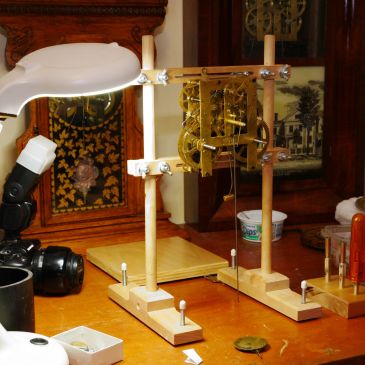
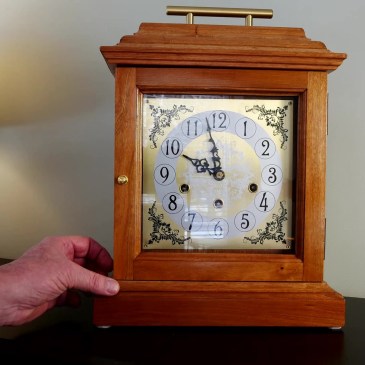
Schatz W3 – Installing an 8-rod chime block in a custom made clock case
Some time ago I bought this movement without a case.

Having a movement without a case is like a car engine without the body

I discovered this Aug Schatz & Sohne W3 (circa 1960) movement at a local antique store for under CAN$20. My wife said, “You should buy that, maybe you can make a case for it”. “Hmm”, I thought; that would be above my pay grade. The movement looked interesting and it was not expensive so, why not! But, having a movement without a case is like a car engine without the body but I was confident that one day I would have the solution.

This is a type W3 movement. “W3” refers to three chime tones, St Micheal, Whittington and Westminster.

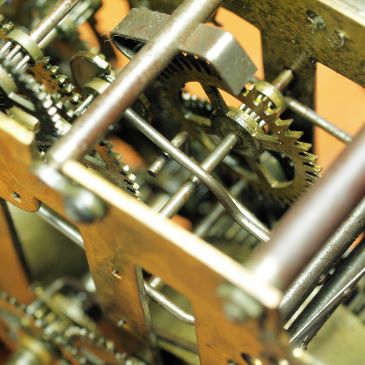
Rear plate
Rear plate of the W3 movement showing chime selector and chime/strike hammers

I put out a plea and two people contacted me to say they had a case that would fit. One lived in Australia and the cost of shipping the case was too high. Another corresponded twice but I sensed he realized that his case would not fit. So, I put the movement away. On a positive note it runs well.

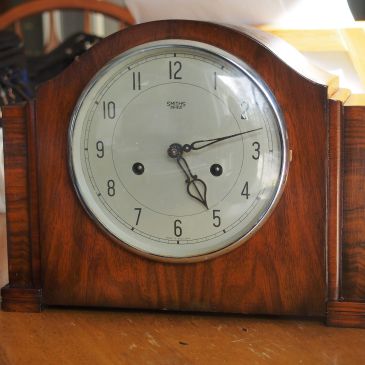
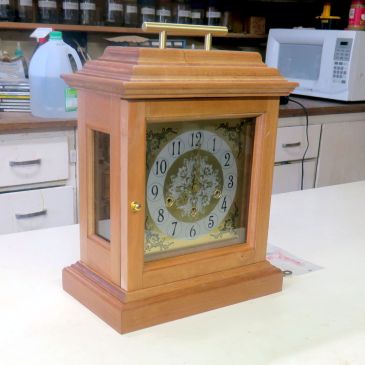
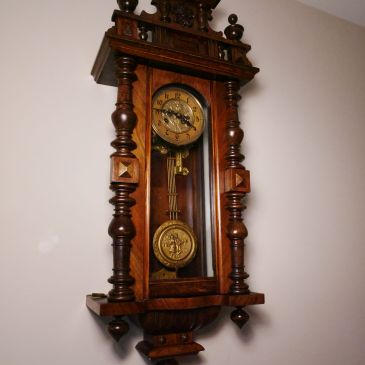
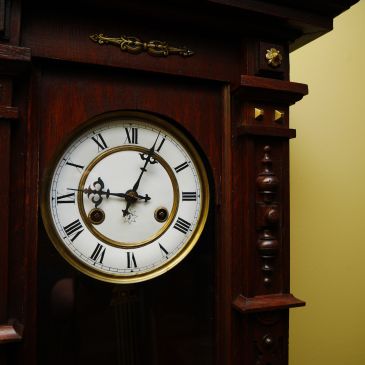
Schatz and Sohne W3 movement installed in a custom case

The pursuit of a custom made case

In the spring of 2018 my son’s girlfriend suggested that her grandfather could build the case. He loves doing this kind of work, she said. Although skeptical at first, I accepted her offer. Though a skilled craftsman her grandfather is over 90 years of age but spends as much time as he can in his woodworking shop in rural Virginia. He agreed to do the work. I sent the measurements to him but he preferred to have the movement in hand so it was sent to Virginia. He was able to use the movement as a guide in constructing the case. The clock was returned to me in December 2018 and it looked absolutely perfect.

Now to the installation of the chime block

The dimensions of the case allowed ample room to place a chime block. The block and rods are 7 1/2 inches long but even so there was not much room to spare on one end. The 8-rod chime block is from a Canadian clock supplier and is designed for a Hermle triple chime movement. There are not a lot of 8-rod chime blocks available through suppliers and given that I had little choice I had to assume that it would work for my clock and it does!

This video describes the placement of the chime block and some experimentation to achieve the optimum sound.

The tapered sections of the rods are an inch long and the hammers must be positioned to strike the wide point of the rods for best results. The oak base was trimmed to fit, allowing for about an eighth of an inch between the rods and the hammers. To close the distance to the rods the hammer wires are bent and centered on the rods. As they are brittle, chime rods should never be bent!

Chime block and oak piece forming the base

Once I was satisfied that the chime block was correctly positioned the block was secured. First I screwed the chime block to the hardwood base with 4 brass slotted screws. And finally, I secured the chime block through the base using two 1 1/4 inch slotted screws through pre-drilled holes.

I gave the case one more coat of shellac before putting it on display.

I am impressed with the outcome. Not all movements have such a happy ending.

Lessons learned restoring grandfather’s old clock

Photo of Waterbury time and strike wall clock sent to me by my cousin

I’ve thought about this clock, dreamt about it, wondered where it was all these years……and now I have it. I was confident that I could do something with this clock since I had just finished a major restoration project.

I had no idea that the clock I was getting was a movement in a homemade case

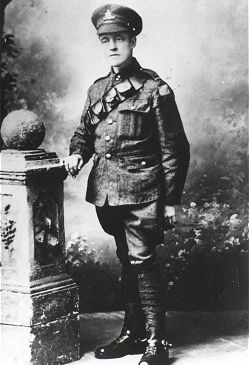
I have a vivid memory of this Waterbury octagon short drop time and strike schoolhouse clock that hung in my grandparent’s kitchen when I was a young boy. After church on Sundays, my father would take (drag?) us kids for a visit; it was a weekly ritual. The house was stone quiet except for the sound of a clock ticking loudly in the kitchen. My grandfather was a veteran of WWI and was bothered by noises, shell shock they called it, but he did not seem to mind the rhythmic sound of a mechanical clock.

When I was a kid in the 1950s it looked impressive.

So, I jumped on this project and have learned a few things along the way.

The following are lessons learned restoring grandfather’s old clock.

When it comes to family, lower your expectations

I made some inquiries within the family and when I first saw a photo of grandfather’s old kitchen clock and discovered that the case was homemade I was very disappointed. I had no idea that the clock I was getting was a movement in a homemade case. The original case, long gone is but a family mystery. Nevertheless, my cousin said, “You can have it”.  I wondered what I would do with it. I explored several options but at the end of the day I wanted a working clock no matter which direction I took.

Work with what you have rather than dream of significant changes

I could have radically altered the appearance of the clock completely but would it be the same? It is a philosophical dilemma. If too much is done to restore a clock it is not fundamentally the same and cannot be considered original. The homemade case is crude and made some 30-40 years ago but it is part of the clocks history. The chicken pecks on the clock face tell the story of a clock that likely sat in a barn for many years.

Envision what the final outcome should be before you begin and resolutely stick to your plan

Should I restore the clock or preserve what I have? It was an interesting dilemma.

My options:

  1. Do absolutely nothing.
  2. Take the movement out, find an appropriate period donor case or
  3. Make some minor changes but preserve the provenance

I chose #3 for several reasons:

  • To preserve the bygone times of a clock passed on through the family, despite its many warts
  • Labour aside, it was cost effective; my entire monetary outlay was less than $50
  • Ignoring aesthetics, the case was crude, heavy but very sturdy and should last forever

Be content that the clock tells a story no matter how ugly or homely it might look

It may not be the prettiest clock on the wall but it will be a great conversation piece and after 70 years (??) it is finally functional. I can only imagine my grandfather standing under the clock, comparing the time with his pocket watch and deciding if he should make just one small adjustment.

Retouched dial face

Changes I made

  • Sanded, stained and shellacked the case
  • Brass bezel was separated from the dial bezel (don’t ask me why the two were screwed together), new bezel hinge installed, and door catch
  • New convex glass dial installed
  • Brass was cleaned and polished
  • New clock hands
  • New pendulum, pendulum rod, verge and crutch
  • Movement completely serviced, several bushings installed
  • New hinged access door made from century old clock case wood

After servicing, a fully functional Waterbury time and strike movement

What I did not change

  • The overall “character” of the clock
  • The holes in the brass bezel were left as-is; it is what it is
  • Dial is original though touched up in some areas; I considered a new paper dial but decided to retain the original and came very close to matching the colour of the dial face
  • The case is made of thick plywood; it is utilitarian, very solid and will likely outlast the movement

Yes, it is ugly but it works and it tells a story

Final thoughts

I am actually very pleased with the outcome. The changes manage to preserve the provenance but not enough to radically alter the look of the clock such that it is. It is now worthy of being placed on a wall and it will certainly occupy a prominent spot in my home, plus, it tells a fascinating story.

Here is the story told by yours truly.

A Smiths Enfield mantel clock comes back to life

Smiths Enfield mantel clocks are highly regarded by beginning clock collectors due to their popularity, abundance, and durable movements. For amateur clock repairers, they offer relatively few challenges.

I acquired my Smiths Enfield time-and-strike clock in 2013 from a young clock tinkerer in Dartmouth, Nova Scotia, but it was never a reliable runner. It would only run for a few minutes before stopping. Eventually, the clock was set aside and left in a corner of my shop.

Post war English time and strike movement

While not an especially attractive clock it embodies the utilitarian design typical of post-war English clocks from the late 1940s and early 1950s.

After several months and armed with new knowledge of clock repair, it was time to take a second look.

About Smiths Enfield

The Enfield Clock Company (London) Ltd. was established in 1929, with its first clocks sold in 1932.

The company utilized modern assembly line techniques to manufacture and assemble its clock movements, inspired by the American system of automated factories. Initially, clocks were sold wholesale and for export, with the movements supplied to shops that would then assemble the cases themselves. Enfield took pride in producing “British-made” clocks. However, in 1933, facing difficulties competing on price, the company was sold to Smiths Industries, which led to the name change to “Smiths Enfield”.

In 1935-1936, they introduced a striking 14-day clock in a Jacobean Oak case, which helped solidify the company’s position in the market. With the outbreak of war in 1939, the factory shifted to wartime production. While clock production continued, material shortages became a significant challenge.

After the war, American machines were allowed to be kept and production of the 53mm movement re-commenced. Production was later moved to the Smiths factory at Cricklewood and then later to their Welsh factory in about 1955. Under Smith Industries the production line was changed to watches. Ultimately all clock production was phased out and the company closed shortly thereafter.

A New Suspension Spring?

I serviced the clock in 2015, and it needed bushing work. Since the wear wasn’t severe, I thought I could delay it for another two years. However, the clock has not been running since then. At the time, I knew little about the purpose and function of a suspension spring, and since I assumed the one that came with the clock was correct, I thought there must be another issue causing the clock to run poorly.

Suspension spring post

It’s time to revisit the suspension spring to determine if that’s the issue.

Suspension spring location

Over the past four years, I have accumulated an assortment of suspension springs and, through trial and error, found one that is either correct for the movement or very close.

The suspension spring has a mounting hole on one end and a small T-bar on the other where the pendulum hangs. I replaced the old spring with a shorter, more flexible one. As a result, the clock started running. In the first week, it lost about five minutes, but after making minor adjustments to the pendulum length, the timekeeping improved with each change.

The takeaway from this is that the correct suspension spring is crucial to whether a clock runs, and it should be considered as one of the potential reasons when a clock is not working.

A new & exciting direction in clock collecting & repair

I have been collecting clocks for over 8 years. In that time I have enjoyed my hobby immensely and I am constantly on the lookout for new and interesting acquisitions. It is more like a daily passion.

However, I now realize that as my collection steadily grows I have more than I need or want. I cherish some of my clocks and intend to keep them for years; my Arthur Pequegnats, selected Seth Thomas clocks, clocks made by the Hamilton Clock Co. and the Canada Clock Co., my Vienna regulators and some of my German wall clocks. I don’t mind parting with other clocks now or in the foreseeable future. Some I will miss and others I will not.

A house can only hold so many clocks

My daughter correctly pointed out that I should adopt a one clock comes in another goes out approach. “One-in, one-out”, she says and it makes perfect sense.

A house can only hold so many clocks. In my small office which is 10X12 I have a total of 15 clocks, 10 of which are running daily and the remainder in various states of repair. Outside my office, at any given time, there are 26 clocks in a number of rooms around the house. I am not one of those persons on YouTube who feel the need to cover their walls with clocks. I prefer to display them in a natural way, as an integral part of the decor of my home. The number is not all that important but I am trying to keep it manageable.

Kienzle clock on display with Ingraham Huron
Kienzle World Time clock and Ingraham Huron balloon style shelf clock

I have decided that now is the time to sell some of my clocks. My objective is not to make money but to recover the cost of the original purchase plus my labour on each clock that I sell. These are the clocks that have left my collection recently.

I am making more critical choices when adding pieces to my collection
Mauthe Westminster chime mantel clock, circa 1950
Juba Schatz Bim-Bam mantel clock, circa 1948
Four spandrels surrounding the chapter ring
Hermle Westminster chime with moon phase circa 1985

I have also gifted eight clocks over the last 3 years and most have been mantel clocks. Antique and vintage clocks make wonderful gifts to friends and family. It is cool to see them displayed and running in their homes when I visit though I know darn well that they are wound just hours before my arrival.

On a clock forum site recently someone said’ “How many clocks do you need”. The answer, “Just one more”

As my knowledge of the clock world grows and my experience repairing and restoring them expands I am making more critical choices when adding pieces to my collection. However, those critical choices often translate into spending more money. For example, recent acquisitions have been a Seth Thomas Regulator #2 and an Arthur Pequegnat Moncton, both wall clocks.

Seth Thomas Regulator #2, time-only, weight driven clock Circa 1922
Arthur Pequegnat Moncton, double spring time only clock, Circa 1930

I believe my new approach is a natural progression and perhaps I have been subconsciously heading down that path for a year or more. Unless a clock has an interesting provenance, is rare, uncommon, unique and/or is a challenge to restore I will now shy away from most of the garden variety clocks one sees on online for-sale sites and yes, I still have a few of those.

On a clock forum site recently someone said’ “How many clocks do you need”. The answer, “Just one more”.

I knew during the course of collecting antique and vintage clocks combined with increased knowledge/experience that my hobby would evolve and continuing my horological journey in a slightly different way is about time,

100,000 clock blog views – onward and upward

100,000 views, Wow!

In the late spring of 2015 I attended a workshop on WordPress blogging at the local community college. I was impressed with the power of blogging. I had already begun collecting antique and vintage clocks and so, it was a good time to begin a blog and share my horological interests and experiences. This was my very first post 3 1/2 years ago.

The first few months were very discouraging. I am sure that those of you who are bloggers know what I mean. It takes time and patience to build an audience and it also takes time to build a ranking on various search engines. I was getting very few page-views, I struggled with the content and tried to envision what my audience would like to see but more importantly what I wanted to convey in my blog articles. I never considered myself a stellar writer but I was enthusiastic and I wanted to give it my best shot. I observed what other bloggers were doing, what made their sites engaging, took some tips from WordPress and other online sources and adopted a style that suits me.

Learning to replace lantern pinions

In the fall of 2015 there was an encouraging uptick in daily page-views. I also began to realize that I had to not only appeal to those with a modest interest in antique clocks but those with a deeper knowledge. My blog was never intended to satisfy expert horologists and those in the clock trade though I don’t mind if they drop by from time to time.

I have received many comments. Some offer suggestions and advice on projects I am working on while others are looking for direction on their particular clock problem. I provide whatever assistance I can.

Installing a new clasp on a Pequegnat Bedford

I graciously accept any criticism because that is an important part of my growth as a clock repair person.

Stats – the lifeblood of a blog

Like it or not, statistics or analytics as Google calls it, are the lifeblood of a blog. The best day was in January 2019 when I hit 267 page-views. However, on average I receive 100 daily page-views and about 800-1000 page-views per week. I have been viewed in 100+ countries and the top 6 viewers are in USA, Canada, United Kingdom, Australia, South Africa and Germany. I am encouraged by the steady rise in interest from mechanical clock fans around the world and share their enthusiasm.

I also discovered that writing articles well in advance and scheduling specific publication dates really helped with planning particularity when I am vacationing and cannot find the time to write.

My work area in 2019

My basement shop where I work on clock case restoration

Yes, there are days and months when the stats dip a bit but that only encourages me to take a second look at article content, learn to explore new areas of interest and make the learning fun. My regular features, Tick Talk Tuesday, Crazy Clock Ads and What Is This Thing For look at the lighter side of clock collecting and repair.

If you are new to my blog, welcome. There is plenty to read. If you are a regular viewer please share your views and comments and if you have any ideas for future articles let me know.

In clock restoration circles small details can make a big difference

Small details added during clock restoration projects can change the appearance of clock in a positive way. In this article I will describe how adding a piece (actually two), that should have there in the first place, will make all the difference.

During the fall (2018) I spent a considerable amount of time restoring a Vienna styled time and strike German made FMS Mauthe spring driven wall clock. Restoration involved completely stripping and refinishing the case and fully servicing the movement. My wife commented that the transformation was dramatic and of course, I graciously accepted the compliment.

For some reason many wall clocks are missing their side stabilizers

Before

And….

After

Restoration included adding an arched door insert above the dial and a new centre top finial. Otherwise, the clock was complete except for one small item, the 2 wall stabilizers. Why would they be missing? A thumbscrew might go astray during a servicing and rather than find a replacement it is too easy to take both off and discard them.

Clock case stabilizers

Many wall clocks are missing their side stabilizers. Check the rear backboard of a wall clock without stabilizers. You might find two small holes on either side of the case near the bottom indicating it once had wall stabilizers. Otherwise if you do not find those holes, the clock was never meant to have them.

Once the beat is set, level the clock on the wall and set the stabilizers by screwing each one into the wall. The stabilizers will compensate for any wall vibrations and the movement of the case during the weekly winding.

Right side stabilizer

Some stabilizers are unique to brands such as Ansonia and Gustav Becker. This, however, does not mean that they are limited to these movements, they are interchangeable. The stabilizers you see here are advertised as Vienna stabilizers.

Left and right stabilizers are barely seen but preform an important function

All clock suppliers carry stabilizers. I ordered a pair and simply re-used the screw holes on either side on the backboard to attach the stabilizers.

Are they absolutely necessary? No! Can a clock run without them. Yes! Yet, it is an often overlooked detail that might make all the difference.

Crazy Clock ad – do you know what you are selling?

Advertised clock

Okay, here’s the description.

Carved pine antique mantle Grandmother clock circa 1900

“Pine”, “1900” and “antique” might be correct but what style is this clock? It is not a Grandmother clock but commonly known as a kitchen clock or a Gingerbread clock. It is not carved but steam pressed and tens of thousands of these were made.

If you are going to ask $125 you had better know what you are selling, who the maker is, what kind of clock it is, any issues and the overall condition.

Antique and vintage wall clock collection

It has taken me 6 years to assemble my collection of antique and vintage clocks. Although I have many clocks, wall clocks are my particular favorites. Check out my collection of antique and vintage wall clocks in this YouTube video I made in January 2019.

Feel free to comment.

What is this clock thing for? #4 – the Geneva stop

You will not see Geneva stops on many clocks but if you do here is an explanation of how they work and how to set up the stops.

EN Welch Whittier parlour clock circa 1895, time and strike movement with Geneva stops

Most American clock movements do not use the middle portion of a long & powerful spring but use most, if not all of the mainspring. Geneva stops address this power issue. They are found on better quality antique movements made by American manufacturers. They are set so that when winding the mainspring you can only wind so far and then no further. As we know, clocks can’t be “over-wound” and this lets you know where the definite stopping point is.

On weight drive clocks Geneva stops are used to prevent undue force coming on the pendulum by jamming the weight against the seat board.

Stop works are used as a compromise by utilizing only the middle portion of a long and powerful spring, which varies too much in the amount of its power in the fully wound and completely released positions to get a good rate on the clock if all the force of the spring were utilized in driving the movement.

Removing the stops will do no harm to the movement but it will not release power as originally intended

You will notice a long “finger” (long point of upper star) on one of the Geneva stop gears and a wider gap (shallow groove of lower star) on the other. You set these up so that when the proper number of turns are completed the long finger meshes with the wide gap, thus preventing any further turning.

Strike side stop in lock when long point of upper star is engaged in shallow groove of lower star

You will need a letdown set to release the springs

Setting up the Geneva stop

Wind up the spring and then let it down slowly until the stop work is locked, counting the number of turns and writing it down. Then, hold the spring with your let down key and remove the stop from the plate; then count the number of turns until the spring is down and also write that down. Alternatively, wind the mainspring until it winds no further, release the mainspring with your letdown key one complete turn and set the stop. It may take more than one try to set it up correctly.

Don’t worry if they have been removed

On many antique clocks these have been removed because the repair person did not know what to do about properly setting them up.

Geneva stops removed

Removing the stops will do no harm to the movement but it will not release power as originally intended.

FMS Mauthe “Horse Crown” wall clock – servicing the movement

Most refer to the name “Horse Crown” when describing this clock and it is easy to see why. Many would also consider it a Vienna Regulator style of clock. I have been putting off servicing this movement for a while and a long time has passed since it was properly serviced. So, let’s get started. First, some background.

Mauthe “Horse Crown”

The clcok was complete save for a missing bottom centre finial. I installed a new one shorty after I bought the clock

Clocks such as these are  often missing not only a  finial or two but the crown and other parts so this clock is in good condition.

Replacement middle finial

Year it was made and a history of the company

From my research, the trademark on the front plate tells me that the movement was made between 1895 and 1914 though the exact year of manufacture is unknown. Mauthe trademarks are very distinctive and from the trademark design, one can place the clock within a specific period of time. Unfortunately, the production number on the movement is a mystery as there is no known database for Mauthe clocks.

Trademark, production number, length of the pendulum (34cm), BPM (116) & patent number

Mauthe clocks have had a long and illustrious German history. In 1844 Friedrich Mauthe and his wife Marie founded the company in Schwenningen to produce watch parts. They were very successful through the years and diversified in several areas but after 1946 following the production of wrist watches the company gradually fell into decline.

This clock reminds me of what Forest Gump once said, “life is like a box of chocolates, you never know what you are going to get”

Now let’s open it up

The clock hung on my living room wall for three years. When I bought it I knew that it would eventually require servicing but there were so many other projects on the go, it could wait. The clock ran for several months at a stretch and there were months that the clock did not run at all. So, now that other projects have been completed the time is right for a thorough servicing.

Mauthe wall clock with new bottom centre finial

Forest Gump once said, “life is like a box of chocolates, you never know what you are going to get”. When inspecting any antique clock movement for the first time I have learned to expect just about anything.

As I move through any project my intent is not necessarily to correct mistakes of the past since they are an important part of the clock’s history but to ensure that past repairs do not cause me grief in the future. If it is a crude but functional and sturdy repair, I will generally leave it alone. I have learned that past repairs are part of the history of the clock.

When I took the movement out of the case I discovered something quite interesting. The dial is not original. Yes, it is a Mauthe dial but not for this clock. Two brass strips are fastened to each side of the front plate to accommodate a replacement dial. The added holes drilled into the side braces tell me that it once has a slightly smaller dial.

I am sure that those of you who are collectors have experienced the dilemma of identity

I am sure that those of you who are collectors have experienced the dilemma of identity. When I bought my first Vienna Regulator I began to realize that many parts were replaced over the years and it made me wonder what is original and what is not. It as an unwinnable argument and I have learned to accept the notion that it may not matter to me or to a casual observer who would not think of questioning whether a clock and its parts are original.

Two extensions, soldered to the sides to accommodate a replacement movement

But, let’s move on. A repair was made to the strike hammer which appears to have broken off at one point. Again, a rough but solid repair.

Hammer repair, you can see a pool of oil on the pivot to the left

The clock was coated in oil which was dripping down the plates. However, in terms of its general condition, there is surprisingly little wear. Perhaps the liberal application of oil had a hand in preserving the movement but I suspect that it did not run much over its life.

Mainspring servicing using the Olie Baker spring winder

The mainsprings are enclosed in barrels. I opened up the spring barrels to service the mainsprings. The mainsprings are in good shape with no evidence of rust. They cleaned up nicely. Broken mainsprings in German clocks can be problematic. Severe damage can result in missing mainspring barrel teeth and broken lantern pinions when the mainsprings let go, a challenge for any clock-maker.

Top plate removed

Strike side levers, escapement

The movement was disassembled and the parts were cleaned in my L&R ultrasonic cleaner. The springs and barrels were cleaned separately. All parts were washed in warm water and dried. Finally, the pivots were inspected and polished. Although this movement has a count wheel between the plates with levers much like an American time and strike there are no annoying helper springs to frustrate the re-assembly process.

After lubricating the mainsprings with Keystone Mainspring Lubricant, I put the movement together without the levers to check end-shake, meshing and the condition of the pivot holes. Two lantern pinions had some flat-spot wear but not enough to warrant replacement. Two pivot holes are slightly enlarged on the third and fourth wheel strike side but not so bad that they need immediate attention. If I were in the business of repairing clocks for a living I would bush those two and repair the lantern pinions.

Parts are cleaned & positioned, ready for the front plate

To reassemble the movement I secured the bottom front plate nuts to the back plate and then positioned the pivots into their holes working upwards. Once the pivots are in place on the strike side I attach the third nut loosely and continue guiding the pivots and the two lever assemblies in place. Unlike American movement which have larger pivots, care must be taken not to force the relatively small pivots into their holes.

Much like an American time and strike movement, the cam lever must be in the deep part of the cam while at the same time the count hook is in the deep slot on the count wheel. I made a note of the position of the stop wheel beforehand and in so doing managed to correctly position it on my first attempt.

I generally run a movement for an hour or so without lubricant to determine if everything is functioning properly. No point in oiling the movement repeatedly if it has the be dis-assembled to correct an issue. Once I am satisfied that the movement is running as it should, I apply oil to the pivot holes.

Having the movement out gave me an opportunity to clean up the case, paint the gong mount and movement rail and give the entire case two coats of shellac (traditional 1 lb cut). The movement is now reinstalled in the case.

With respect to my comments concerning the pivot holes and lantern pinions, putting the movement on a shorter 2-year cycle will enable me to monitor wear.

Crazy Clock Ads – would you buy this clock?

If you are going to sell a clock this is certainly not how to do it. The image (and there is only one image) is blurry and the person holding the clock looks like they are in their Pajamas. Plus, there are absolutely no details about this clock in the ad, just the price.

Great photos taken from many angles and a thoughtful description are fundamental to selling any clock.

George H. Clark 30-hour Ogee clock – in very nice shape

Wood dial removed

This George H. Clark 30-hour shelf clock is a very good example of Connecticut form. The case form is called and “og” or “ogee”. a mathematical term that describes the “S” curve shape in the primary molding that surrounds the door.

The clock has a brass time, strike, weight driven movement with original printed paper label on the interior reading in part “Made and Sold at/46 Courtlandt St/New York…. George H. Clark”. It measures 28 x 17 x 4.5”. This rectangular shaped case is decorated with nicely grained mahogany veneers. The veneer has very little if any losses. The one blemish on the top is auction label glue which took off some of finish but was later retouched with shellac.

The upper section of the door is fitted with clear glass. Through this one can view the painted wood dial. The wood dial tells us that it is an early pre-1850 clock. This dial is formatted with a Roman numeral time track. The lower section features a beehive painted tablet. The tablet is a replacement but fairly close to what would have been there at the time.

Wood dial in fair shape; the spade hands might not be original, veneer is stripped where an auction label was placed

An online search for “George H. Clark clocks” or “Clarke” turns up various references at 46 Courtlandt Street, anywhere from 1844 to 1847. They mention a George H. Clark (no “E”) in Bristol in the early 1840’s, and then in New York City in the late 1840’s. He is said to have sold Ogee clocks with 30-hour brass weight movements. Spittlers and Bailey, an important source for Ogee clocks of this period, mention George H. Clarke (with the “E”) and they indicate a label with the words “Made and Sold at 46 Courtlandt St.”

Good label and original pendulum bob

They say “No date” for this Clarke. Two different people? A name like Clark/Clarke, may be variants of the same basic name and the same person.

The pendulum bob is also 1840s in style.

Coil gong

The label is in good condition. In pencil below the address are the initials “GLD” plus the date “Dec 29” that may ether refer to a day in the month or the year 1929. A service date perhaps. The overall look of the label is 1840-50 in style.

There is a screw to the right of the gong. Screws in this location are used to anchor the clock to a wall and are common as clocks such as these are top heavy when the weights are wound fully to the top of the case.

George H. Clark 30 hour movement
George H. Clark type 2.411 30 hour movement, possibly Waterbury but unmarked

The movement looks like an early (but unmarked) Waterbury, ca. 1860 type 2.411. Waterbury movements have “quarter-round” corners, while most other ogee movements tend to have the “tombstones” or plain rectangles. The movement could have been swapped but It’s hard to tell because it appears original to the case.

Everything except the movement points to a period between 1840-50.

Aside from touching up the slight damage on the top part of the case there is nothing else to be done. The movement? That will have to be taken out and serviced but I will leave that to another day.

New Haven 30 hour Sharp Gothic (Steeple) – a curious fact

This is a recent acquisition bought at a local online estate auction site. It has a curious fact that I found quite intriguing.

My wife and I saw a very attractive colonial style Stickley writers desk and while browsing further through the online catalogue I noticed 2 clocks. One was an IBM style time clock and the other was this, a 30 hour New Haven Sharp Gothic (steeple) time and strike clock.

Sometimes we win and sometimes we lose but we do not get caught up in the fever of bidding

Early in the day we put a maximum bid of $60 on the Stickley desk and $40 on the steeple clock. As we often do, we let the bids stand while we go about our day. Our usual strategy is to apply the most we think we would pay. Sometimes we win and sometimes we lose but we do not get caught up in the fever of bidding. At the end of the bidding day, we discovered that we had won both items. Of course, as auction goers know there is a buyers premium and a tax on anything you “win” which adds to the price.

Stickley is an American maker of fine furniture and is best known for their timeless mission style designs. We are pleased to have won a well-made and attractive little desk that is a great addition to our sun-room. The fact that It is in exceptional condition is a plus.

Stickley writing desk
Stickley writing desk circa 1940

The New Haven Clock Company was founded in New Haven, Connecticut by Hiram Camp (1811‑1892) and other clock-makers

The other win was a $40 steeple clock. Steeple clocks, otherwise known at the time as Sharp Gothics, were made from about the 1830s to around 1900. This is a 30-hour clock which is easily recognizable from the front face by the close proximity of the winding holes to the centre arbour.

History of the New Haven Clock Co.

The New Haven clock Co. produced clocks for over 100 years. In 1853 the Haven Clock Company was founded in New Haven, Connecticut by Hiram Camp (1811‑1892) and other clock-makers. The company’s mission was to mass produce inexpensive brass clock movements for use in clocks. In April, 1856 The New Haven Clock Company eventually bought out the Jerome Clock Company. They moved their production to the former Jerome factory and New Haven began making clocks under their own trademark. In 1870 some of New Haven’s clocks were marketed under the Jerome & Co. brand. Early unmarked movements were Jerome designed.

In 1885 the company stopped selling clocks other than their own New Haven brand. In 1890 the company developed serious financial problems and efforts were made to keep it solvent until 1897 at which time the company emerged after reorganization. In 1902 Walter Chauncey Camp (1859-1925) began to turn the company around. In 1923 Walter Camp stepped down as head of the company and was succeeded by Edwin P. Root.

In 1929 Richard H. Whitehead replaced Root as president of the company but New Haven again faced financial difficulties compounded by the Great Depression in November, 1929. Whitehead was able to keep the company afloat during these troubled times and the firm regained profitability. From 1943 to 1945 the company turned to the war effort, producing products almost exclusively for military use. In March of 1946 The New Haven Clock and Watch Company became the new name of the firm after it reorganized once again. It returned to what it did best before the War, making clocks and watches.

The 1946 reorganization eventually leaves the company vulnerable to foreign investors and it lost control to a consortium of Swiss watchmakers. The man who had successfully shepherded the company through the hard times of the Depression years, resigned as president. In 1956 the New Haven Clock and Watch Company filed Chapter 10 bankruptcy in a U.S. court. Its fortunes had declined precipitously since Whitehead’s departure and it never recovered. In 1960 the company went out of business and the production lines closed. The facilities were sold through a combination of public auction and private negotiation in March of 1960. After over 100 years the company was no more.

My auction win

This New Haven clock is in very good condition apart from minor veneer issues on the base and the columns. The clock is also missing the very tip of the right finial although it might be hard to tell from the photo. It measures 20 1/2 inches tall with a 5-inch dial. The movement appears to be original to the case. The dial is original and has some loss that would be expected in a 148-year-old clock. What I thought was a photograph taped to the lower glass is the original tablet. The tablet is interesting because it features a sailboat against Greek (?) temples surrounded by gold foliage on a black background. The design of the tablet was used in other New Haven clocks of the time. Though likely intended for European export the clock found its way to Canada instead.

Eight-day clocks eventually replaced 30-hour clocks 1865 to 1870 seems about right

Lower tablet
Lower tablet

Now for a curious fact!

In my attempt to date the clock I found some information that narrows the time frame somewhat. It has an almost perfect label save for some staining on the bottom left. There is an over-pasted square blue coloured label on the bottom centre from a clock retailer in Halifax, Nova Scotia, Canada. As regular readers know, Halifax is only an hours drive from my home.

The small blue label says, “Thomas D. Spike, watchmaker and jeweler”. I accessed an online database and found that the business was listed in the 1869-70 City of Halifax business directory, however, I could not find how long the business was in operation. Logically, I can assume the clock came from his shop and is from that period.

Thomas D. Spike, watchmaker and jeweler, Halifax, Nova Scotia

According to one source the tapered escape wheel bridge was introduced around 1870. The tablet style is typical of the 1870s, so 1870 is very close to the date it was made.

Label in very good condition

The movement is a count wheel strike. The clock runs and keeps time but the strike side fails to stop. Once the clock starts striking it keeps on until the mainspring runs down. This is a common problem. In most cases, the warning wheel misses the locking lever even though the count lever in the deep notch and the maintenance lever is in the maintenance-cam notch. Bending a lever or two is a relatively easy fix but the clock must be dis-assembled in order to make this adjustment.

30 hour time and strike movement

However, I must put the clock aside for now as I have a Mauthe wall clock and a Jerome Ogee on the workbench. Once those projects are out of the way I can focus on repairing the veneer and servicing the movement of this fine example of an American sharp Gothic shelf clock from 1870.

My Schatz W3 movement finally has a brand new custom built clock case

What do you do when you find a movement without a case? Hope that one comes along? Make one?

I discovered an Aug Schatz & Sohne W3 movement at a local antique store for under CAN$20. My wife said, “You should buy that, maybe you can make a case for it”. “Hmm”, I thought; that would be above my pay grade.

W3 refers to three chimes, St Micheal, Whittington and Westminster. It looked interesting and it was not expensive so, why not! Having a movement without a case is like a car engine without the body. Maybe a case will come along someday, I thought.

Back in August of 2017 I appealed to my readers asking, “If you have a spare case that would fit this movement and it is lying around in your shop I’d be very happy to take it off your hands.”

Front plate
Triple chime Schatz movement

Aug. Schatz & Sohne are better known for 400-day clocks (including the 1000-day clock) and ships clocks. They are not typically known for shelf or mantel clocks but it is not too difficult to find them at antique stores and online auction and for-sale sites. The company is well regarded by German clock-makers.

Having a movement without a case is like a car engine without the body

This movement has a lever escapement though earlier versions of the W3 were pendulum driven. This particular escapement has 2 jewels; after came escapements with 7 and later still, 11 jewels.

2 jewelled escapement. Has escapement been serviced as well?

The front and back plates are thick and solid. Cut leaf pinions throughout suggest a robust movement design. There are eight chiming hammers and the chime drum can be switched to one of 4 positions; silent, St Micheal, Whittington and Westminster.

The movement is clean and in good shape though it has been serviced at least once in its life. I counted 13 new bushings and a newer click spring.

I now have a brand new custom built case

Having a movement without a case is like a having a car engine without the body.

Earlier this year my son’s girlfriend suggested that her grandfather could build the case. She said he loves doing this kind of work. Although skeptical at first, I considered her offer. Her grandfather is over 90 years of age but is a skilled craftsman and he continues to work in his woodworking shop in rural Virginia when he is able. She asked him and he agreed. I sent the measurements to him. Better if I brought the movement to him, her grandfather suggested. I gave the movement to her and she brought it to Virginia while on a visit. He was now able to use the movement as a guide to constructing the case.

We corresponded back and forth through email. I gave him complete latitude concerning the design of the case though he sought my approval during certain stages of construction. After a few months, the clock began to take shape. Below is a photo of the completed case taken in his rural Virginia shop.

The harsh lighting of the shop does not do the clock justice

The glass side panels give it an old world look. The hands are original but are lost in the detail of the new dial. I have since painted them a darker colour.

There is ample room for the chime block which I must supply. The chime block is bolted through the base of the case. The chime block is positioned as close to the chiming rods as possible and if the distance has to be closed the chime hammers are bent towards the rods allowing an eighth of an inch or so of space. It is a relatively simple procedure. As they are brittle, chime rods should never be bent!

The chime block will be mounted under the chime hammers

The clock finally arrives at Christmas time (2018)

My son brought the clock back from Virginia in a carry-on suitcase just after Christmas. He took special care not to damage it in any way.

Schatz W3 bracket clock

The detail and craftsmanship are impressive and reflects hours of meticulous work.

The detail work on the case is amazing

Image from H&W Perrin Co. Ltd

I put the final touches on the clock by painting the hands black, attaching four protective felt pads under the base and giving the case two coats of shellac (traditional 1 lb cut) to achieve an antique finish. With the chime block installed the project will be complete.

After writing the maker and expressing how pleased I was of the outcome, he replied;

“I’m glad you like the case and glad that a simple fix got it running. Painting the hands black was an excellent idea, for I worried that reading time would be difficult. I hope you are able to send me a video of clock with chimes.

Best wishes”

The chime block has arrived and is a perfect fit for the case. The installation and final adjustments should be interesting so, check back later.

Sperry and Shaw 30 hour four column New York Style shelf clock – servicing the movement

I decided that it was time to service this attractive New York-styled Sperry and Shaw 30 hour time and strike, four column hour-strike clock. The case measures 25 1/2 inches in height by 14 inches in width, very close to the dimensions of a typical ogee clock. This clock is an estate auction buy.

Sperry and Shaw clock showing dial and lower tablet

The 4 free-standing turned columns drew my attention. It reflects the decorative period of the Empire style popular in the mid 1850s. While researching the NAWCC site I discovered that this clock was probably made between 1846 and 1847. The label, 98% of which is intact, and affixed to the backboard says 10 Courtlandt Street, the company headquarters during the aforementioned period. Sperry and Shaw were not clock-makers but business partners and were regarded as distributors and assemblers.

They sourced cases and movements, affixed their own stamp on the movement and placed their labels (sometimes over other makers labels) inside the case, a common practice at the time as clocks for the home and workplace both locally and abroad were in great demand.

The movement is Jerome-like and stamped Sperry and Shaw, New Jersey. The plates are thinner than a Jerome evidently a cost cutting measure.

The narrow brick-shaped weights (4 3/4 inches X 1 inch) fit neatly into channels on the left and right with little to spare. When I first contacted the seller, he was unsure if the weights were in the clock. He later contacted me to say that the clock indeed had its weights. Had it not come with the weights I would have passed on it because the narrow weights are the only type that will fit into the channels and they would be difficult to source.

Movement needs a good cleaning, old weight cords shown
The weight channels are either side of the movement

The case

The weight cords, though not original, were old and frayed. On the first night I raised the strike weight to the halfway point. Twenty minutes later I heard a loud BANG. When I heard the sound I immediately knew. The cord had snapped and the weight had dropped. Fortunately, there was no damage. I promptly replaced the cords.

I am not sure how I will proceed with the case. The veneer appears to be either mahogany, walnut or rosewood. There are small sections of veneer missing here and there but mostly on the corners, a common issue. It has a two-tone appearance though it is hard to tell if it is the result of aging or the original intent of the maker. There is grime on the darker surfaces and I must decide whether to leave as-is or take it down a little to see what’s there. Attending to the veneer issues on the corners should be a straightforward matter. The break in the right corner of the base is a crude repair and that will have to be redone.

Veneer issues

Sperry and Shaw 30-hour movement

The movement

The movement was disassembled and placed in my L&R ultrasonic cleaner with DEOX-007 solution (7 to 1 ratio) for 30 minutes. The ultrasonic did an terrific job and I am always impressed at how well it cleans lantern pinions. Once the parts were washed in warm water and dried it gave me an opportunity to visually check the movement for obvious issues such as broken or worn teeth, bent arbours and so on. All the parts were in good condition.

The movement had punch marks around every single pivot hole which caused me some concern. However, after pegging the pivot holes and polishing the pivots I re-assembled the movement to check pivot wear and found there were three or four pivots holes that were slightly enlarged but not so much that they had to be done immediately. So, no bushing work this time.

The movement was re-assembled and tested. Unfortunately, my movement stand is not set up for weight driven clocks so testing had to be in the clock case.

Sperry and Shaw 30-hour movement tested in the case

I usually test the movement dry for an hour or so before oiling. Why waste clock oil if it must be taken apart again. Once I am satisfied that the movement is running smoothly I take the movement out of its case, oil the pivots and then run it for several days to regulate and to determine if there any minor issues that need to be addressed. Once I am satisfied, the dial and hands are re-attached. With the new weight cords and the movement fully serviced, I tested it for several days.

However, a week later I adjusted the time since it had stopped and the minute hand was disconnected and spinning freely. The main wheel was not communicating with the second wheel because the arbour washer was loose and the resulting wobble meant that the teeth did not engage properly. Out comes the movement to tighten the washer. Now, all is well.

Back to the case. I am still debating what I should do but I may give it a light refresh.

Sometimes working on clocks can be a pain – literally!

Mauthe Horse Crown

I had just completed servicing this German Mauthe time and strike wall clock and everything seemed to be going well. It was keeping good time,striking on the half hour as it should and maintaining a consistent an 8-day cycle.

During my regular Saturday clock winding ritual, I decided to begin with this clock. I inserted the key into the strike side arbour, began to turn the arbour and “bang” went the mainspring. The winding key almost took my thumb off.

I think I am going to lose that nail

Ignoring the excruciating pain I just had to investigate the problem. I took the movement out of the case and took the dial off. Of course, I feared the worst. A sound like that is never good. The barrel seemed undamaged, the teeth were intact, no bent arbours and there did not appear to be any collateral breakage.

Aha!, there it is, a loose click spring. The click released when there was not enough tension on the click to hold it firmly to the ratchet wheel.

My fault entirely. When I dis-assembled the movement I bent the click springs out of the way and did not recheck the spring’s tension. When I re-assembled the movement the click on the strike side was evidently loose but it looked tight enough. I wondered why the strike side ratchet sounded “tinny” but I thought nothing of it. Now I know.

Clicks on Mauthe movement

I increased the tension of the click spring. To be on the safe side I checked and tightened the time side one as well. Both sides now have that reassuring click-click sound. As you can see in the above photo It is not the best click spring design.

A reminder to anyone working on clocks that potential (or stored) energy in the form of powerful mainsprings can be dangerous. All is well, lesson learned. But my poor thumb!

Happy Birthday Sir Sanford Fleming, the inventor of Standard Time

Happy Birthday Sir Sanford Fleming, the inventor of Standard Time.

Sir Sanford Fleming (January 7, 1827 – July 22, 1915) was Canada’s foremost railway surveyor and construction engineer of the 19th century and a distinguished inventor and scientist.

CPR steam engine

Sir Sanford Fleming played a crucial role in developing a global system for setting time. Fleming advocated the adoption of a standard or mean time and hourly variations from that according to established time zones. He was instrumental in convening the 1884 International Prime Meridian Conference in Washington, at which the system of international standard time – still in use today – was adopted.

Pinwheel regulator designed for railroads, NAWCC museum

Many regions of Canada and the US observed local time and when coast to coast rail systems were constructed a unified time system was identified as a necessity. In the United States, the problems were severe, with one table showing over 100 local times in one region varying by more than 3 hours.

The first proposal for a consistent treatment of time worldwide was a memoir entitled “Terrestrial Time” by Fleming. Fleming was, at the time, the chief engineer of the Canadian Pacific Railroad, presented a proposal to the Canadian Institute in 1876. He produced modified proposals using the Greenwich meridian. Fleming’s two papers were considered so important that in June 1879 the British Government forwarded copies to eighteen foreign countries and to various scientific bodies in England.

Seth Thomas Regulator #2, a common railway clock

On 11 October 1883, two years after the invention of the toilet paper roll,

S. Wheeler and the toilet paper roll

a convention of railroad executives met in Chicago and agreed to the implementation of five time zones in North America, using as a basis, Greenwich Mean Time. Standard time was introduced at noon on 18 November 1883 across the nation though it was not legally established until 1918.

As we celebrate Sir Sanford Fleming’s birthday it is important to reflect on his contribution to the construct of organizing time; something all of us take for granted in our daily lives.

Best clock moments of 2018

2018 was a successful year for my horological hobby in many ways. I met interesting people with fascinating stories, discovered new antique clock sources and had fun along the way. The best clock moments, in no specific order, during 2018 were:

Arthur Pequegnat Moncton

Finding an Arthur Pequegnat Moncton double-spring time-only wall clock was a big plus. This clock has been on my wish list for 5 years and I finally found one in excellent condition and the price was within my budget. This brings to seven Arthur Pequegnat clocks in my collection.

Seth Thomas #2 Regulator

The Seth Thomas #2 has been on my wish list for 5 years as well. This single weight-driven, time-only wall clock is from the 1920s. It is Mahogany veneered and like the Moncton is in very good condition. It is now hung in my front entry way.

Seth Thomas Regulator #2

August Schatz & Sohne W3 shelf clock

In August 2017 I asked for help finding a case for my Schatz movement after locating it in an antique store. Little did I realize that I would eventually have that case.

Rear plate
Rear plate

This is the result when you ask a 90 year old cabinet maker and joiner from Virginia to make a case for an August Schatz & Sohne W3 triple chime movement.

August Schatz & Sohne W3 mantel clock

A special thanks to all those who commented on articles and those who send me letters concerning their particular clock problem

Selling clocks

I sold two clocks this year not because I did not like or appreciate them but I must pare down my collection to allow space for new acquisitions. The Juba Schatz “bim-bam” time and strike mantel clock was one

Juba Schatz time and strike clock

and the other, a Mauthe Westminster mantel clock.

Acquiring new tools

Aside from small hand tools acquired this year, the most significant purchase was an L&R Ultrasonic cleaner which does a terrific job of cleaning clock parts.

Ultrasonic cleaner by L&R

Setting up and organizing my workshop

I managed to create space in my basement for an area to work on clock cases and other related woodworking tasks. A new drill press is on the far bench to the left.

New work area in basement

Cuckoo clock

My first cuckoo clock was a gift from my cousin this past year. It is in good working order but it will need a new set of bellows which will be one of my summer projects in 2019.

Dave’s cuckoo clock

Antiquevintageclock.com

I am pleased that my blog has also been very successful with over 93,000+ total views. I would like to thank all those who commented on articles and those who sent me letters concerning their particular clock issue.

I look forward to this new year and I am sure that 2019 will be an equally successful year as I further my horological pursuits.

Happy New Year Everyone (and not just clock lovers)

The bad news is time flies. The good news is you’re the pilot

Ringing in the New Year is for reminiscing, reliving, looking back and looking forward.

As champagne corks pop, glasses are raised and fireworks explode into the sky, it is important to recognize the special symbolism this holiday brings with it. Amid promises of new beginnings and fresh starts comes a time of reflection and resolutions that more often than not tend to be short lived. Whether your goals consist of losing a little weight or improving your relationships with loved ones, it can make all the difference when hopes are transformed into words and actions.

Happy New Year clock lovers everywhere. Where will your horological journey take you in the months to come? Will it be finding that special clock, finally servicing mom’s favorite mantel clock or buying that unique clock repair tool?

Perhaps you have made resolutions that are not necessarily clock related and if so, avoid disappointment by making them specific, measurable, attainable, realistic and time-framed.

We all get the exact same 365 days. The only difference is what we do with them. There is an old Rolling Stones song called Time Waits For No-one and these two lines come to mind for this time of the year.

The dreams of the night time will vanish by dawn
And time waits for no one, and it won’t wait for me

The best to you and yours in 2019.

Seth Thomas Alarm Clock – big and ugly but I like it

My wife loves those little craft shops that seem to pop up everywhere. While shopping for Christmas presents in Truro, Nova Scotia, she spotted an attractive Seth Thomas balloon alarm clock. It is not working, said the vendor but my wife knew that her clock loving husband would likely get it running in no time.

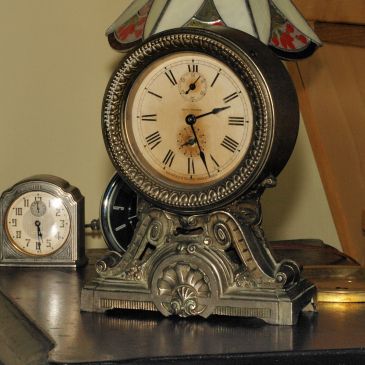
Art Nouveau styled Seth Thomas alarm clock

These clocks are not uncommon on online auction sites

Made around 1900, the clock features a metal case with openwork, scrolling details, a rectangular base with a central shell design. The dial is marked “Seth Thomas” to the center and “Manufactured in the United States of America” underneath the six. An alarm bell is housed in the base and yes, it is very loud. The clock measures 7.25″ W x 9.0″ H x 3.5″ D.

Made in US America

Not rare but interesting

These clocks are not uncommon on online auction sites. Though some describe the alarm clock case as cast iron or copper, it appears to be either plated cast brass or more likely spelter. Some would describe the style as Art Nouveau. Art Nouveau is an international style of art, especially the more decorative arts that were most popular between 1890 and 1910.

The dial features Roman numerals, a working inset sixty-second dial at the twelve, a twelve-hour alarm dial at the six and a cast metal bezel with a beaded pattern. The clock features two winding keys on the reverse (though one key is missing as well as one set screw) and is marked “Made in U.S. America.”

Back cover, with keys taken off

I took off the back cover, put it aside and cleaned it. The 30-hour movement with alarm was quite dirty, as expected. A thorough dismantling and cleaning is in order but for now, let’s see if it works.

Back cover removed

Let’s see if it runs

Using Keystone clock oil I applied oil to the pivots and those I could reach in the front without taking the movement out of the case. New oil introduced to old oil will eventually mix and cause an abrasive sludge that will hasten wear but I wanted to determine if the movement was capable of running. After the oiling, I gave the escapement a gentle push and the clock came to life and continued to run its 1-day cycle. The alarm feature works but I am missing the windup key and the time key does not fit properly. I am also missing the hands’ adjustment set key, so, a pair of pliers was used to set the time.

The clock looks great

I cleaned the case with a mild soap avoiding hard rubbing for fear of taking off the plating. The clock looks great and has a pleasant patina.

My wife paid $15 for the clock. Online auction and for-sale sites reveal realized prices all over the map, from $30 to $410. I am pleased that it is a working clock at a very reasonable price and a nice addition it to my modest alarm clock collection.

Ansonia Crystal Regulator clock

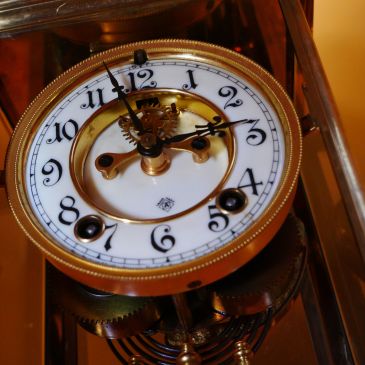
While browsing through an antique shop in Bloomfield, Ontario my wife spotted an antique glass cased brass time and strike American made Crystal Regulator with open Brocot escapement made by Ansonia. In the 1905 Ansonia Crystal Regulator catalogue it is listed as the Prism at a price of $29.00 which would have been a hefty sum at that time.

Ansonia four glass crystal regulator, after a cleaning

My wife has a good eye for these things. In the meantime, I was looking over the wide selection of Arthur Pequegnat wall and mantel clocks.

What is an American Crystal Regulator?

American crystal regulars were almost exact copies of French regulators complete with stylistic gong block, visible Brocot escapements, round movement plates and beveled glass panels. The French clocks were highly regarded at the time, often had mercury pendulums and were made by Japy, Marti, Vincenti and Mougin. American makers included Ansonia and Seth Thomas. American clocks often had faux pendulums which were commonly slugs of nickel. Though lesser in quality and price they are, nevertheless, quite collectable.

This is a faux pendulum; mercury flows, the metal in this pendulum does not flow

Clock condition

The four glass panels are in very good condition. There is a small corner chip on one glass panel that I noticed several days after purchasing the clock but it is not visible from the front of the clock.

Side view of the movement

The glass was likely damaged when the clock was serviced. Otherwise, the overall condition of the clock is good. The brass was tarnished as expected given its age (1910 or so) and with the help of Brasso cleaner it polished up nicely.

Dial showing Brocot escapement

However, a gentle push of the pendulum produces a few ticks and then it stops. I am not familiar with Brocot escapements and before I do anything I will research the movement before I disassemble it and give it a thorough cleaning.

I will detail the servicing of this movement in a future post.

Seth Thomas Regulator #2 wall clock

During my travels through Ontario, I acquired a Seth Thomas Regulator #2, one of my newest additions. I discovered this clock in Bloomfield, a quaint village just minutes from Picton, a major hub in Prince Edward County renowned for its many wineries.

I first spotted the clock during a summer visit to the local antique shop and deliberated over the purchase for quite some time before finally deciding to take the plunge in the fall. These clocks are a rare find, and with the price being right and the clock in excellent condition, it felt like an opportunity I couldn’t pass up.

Perhaps best known as one of the most common regulator clocks in America, the Seth Thomas Regulator #2 was a fixture in many railway stations across the country during the last century—a testament to its accuracy and dependability. Robust, precise, well-engineered, and reliable, this timepiece was manufactured by Seth Thomas from 1860 to 1950, an impressive production run of 90 years. Few clocks can boast such longevity. It is an iconic American clock, and every serious clock collector aspires to own one.

Seth Thomas Regulator #2, circa 1922

A classic style, the #2 changed very little over the years. However, certain design characteristics help date the clock. The following identification guide describes dial and case characteristics that will aid in identifying the approximate year the clock was made.

Click here for the larger guide;  http://www.clockguy.com

The most distinctive visible characteristic is the design of the base.

The base of the clock

Aside from the distinctive base, all but the earliest #2s had the pendulum mounted in the rear with “T” hands.

The chart also lists the limited run reissue in 1976. Most Seth Thomas aficionados would agree that while the reissue is a handsome and well-made clock that is a testament to the original it is not in the same realm as an authentic Regulator #2 and the prices for these versions reflect accordingly. However, those who have the reissue seem to be pleased with their acquisition.

ccording to the chart, my clock was made between 1922 and 1929 and features a base reminiscent of the earlier 1860 version of the #2. It has Arabic numerals with spade hands, and the bow-tie connecting the wooden dial bezel to the drop is a single piece (earlier versions featured a three-piece bow-tie). The clock includes a second hand positioned 2 inches above the center cannon; however, it is not a true second hand, as it runs off the escapement and takes 80 beats to complete a “minute.”

Measuring 36 ½ inches in height, the clock is veneered in mahogany. The movement is stamped with “77A” in the bottom right corner, with the letter “K” underneath, but it bears no other markings. While some versions of the 77 movement have lantern pinions, this one is equipped with cut pinions.

Are there issues with this clock? Certainly, it is over 90 years old!  There is minor loss on the dial, no label, a finish that has lost its luster and paint splatter on the top of the case not visible from the front. Is it really so hard removing a clock when painting a room!

Is it Perfect?

I brought this clock from Ontario to Nova Scotia by car. Removing the pendulum for transport is not a particularly simple process but if you are familiar with the pendulum arrangement on a typical weight-driven Vienna Regulator this one is no different. Like Viennas, the pendulum is hung behind the movement.

Both the weight and the pendulum must be removed for transport. There is many a story of broken glass when weight and pendulum are free to move around inside the case. To remove the weight, simply unhook it from the cable wheel.

There are minor issues with the dial-face

To remove the pendulum the movement must be taken out. First, the hands are taken off. In this version, the minute hand is held in place with a nut. Older ones have a pin. There are 8 small screws that hold the dial in place. Once the dial is removed, two larger screws on the wooden second-hand rail are removed. Four cylindrical column posts hold the movement in place. Unscrew these beginning with the bottom two and lift the movement out. Once the movement is out, the pendulum can be unhooked from its suspension spring. The entire process takes less than five minutes.

The trapezoid 77A movement with maintaining power in this clock looks clean. There is evidence of having been worked on in the past as there are 4 punch marks around the winding arbour to close the hole; a common practice in the past to close a pivot hole. Otherwise, the movement looks very good.

Trapezoid 77A movement

Getting the clock to run reliably was a challenge and it took a week or so to sort it out. The clock would run for a few minutes and stop.

Following a process of elimination, I removed the movement, inspected it for wear, found very little, oiled the pivots, and returned the movement to the case. I installed the dial, then the hands. The clock would run for a few minutes and stop. I removed the hands and dial; left the dial off but reinstalled the hands. Still, it would run only a few minutes. I then took the dial and hands off. I ran the movement for four days to eliminate any underlying issues and to convince myself that the problem lay in the positioning of the hands. The problem was definitely with the positioning of the hands.

On day five, I put the dial back on, then the second hand ensuring that there was sufficient clearance between the second hand and the face. Next, I put the hour hand on the pipe and pressed it in far enough to clear both the second hand and the minute hand. I attached the minute hand, inspected it for sufficient clearance, and screwed it in place. I started the clock.

Success at last! Regulating the clock is fairly simple and is achieved by turning the rating nut on the bottom of the pendulum. This clock must be level and in beat to function properly.

I used Murphy’s Soap to clean the grease and grime from the case. I chose to leave the paint splatter intact, as it adds a bit of character to the clock. Additionally, I polished the brass weight and pendulum bob to restore their shine.

The view from our front door

This clock boasts a striking appearance and a rich, illustrious history, making it a perfect addition to the front entrance of our home. Unfortunately, its journey over the past 90+ years remains a mystery.

The question of whether it qualifies as a “true regulator” is a debate for another time.

Mauthe (FMS) wall clock restoration – Part III – the case

This is Part III, the last of a three-part series on restoring this beautiful German FMS Mauthe wall clock. Part I can be found here. Part two can be found here.

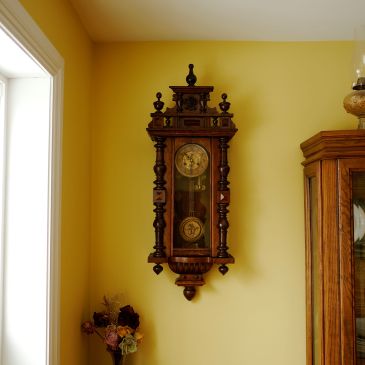
This antique Victorian style German time and strike FMS Mauthe wall clock was purchased from a family living in Truro Nova Scotia that once resided in the town of Parrsboro over 100 years ago.

I have covered movement servicing in a previous article and now for case restoration. The case is part walnut veneer with softwood turns, frame and backboard, likely pine or poplar. All original wood surfaces were stained or lacquered to resemble walnut.

Time and a harsh environment have not been kind to this once majestic clock as the finish was in very poor condition. Stripping the case was my only option.

Mauthe crown, missing right finial

Base of clock

Stripping and staining were quite straightforward but time-consuming. After rubbing with steel wool I applied stain called Special Walnut, a light stain by Minwax which had the effect of enriching the grains even further. After the case was sanded I then applied 5 coats of shellac making the shellac in the traditional way with flakes and alcohol. I found a 1 lb cut ideal for this project.

The finish was probably the worst aligorating I have seen

Turned door column

Refinished corner section

As mentioned in a previous post, the movement was cleaned and two bushings were installed on the time side and one on the strike side. It was mounted in its case and has completed a successful testing period.

Although I was pleased with my work on the top door crosspiece, I could not find one clock online with a crosspiece similar to it from that period. Back to the drawing board!

Ogee style crosspiece on top of the front access door, stained to match case (later removed)

An Internet search for clocks of that style and period revealed that every clock had an arched top trim piece much like this Junghans Crispi wall clock from 1899.

Junghans Crispi wall clock
Junghans Crispi wall clock, restored in 2017

Making the arched top

Walnut veneer is preferred but I had to make do with oak plywood. Oak has a more pronounced grain but the end result looks good. Using a router I cut 3/16 inch oak veneered plywood into 2 curved pieces. Making a turn on a router is not as easy as it looks and it took me several attempts to get it right. After the 2 sections were cut (left, right and joining in the middle) I applied a darker walnut stain to match the case. I then covered the pieces with several coats of shellac then glued the two sections onto the top door frame.

The arched trim piece is an improvement and more in keeping with the design of the clock at that time.

Arched trim

The top finial was purchased from a supplier and stained to match the two lower finials.

The top final is new and stained to match the other two

Unfortunately, there is not much I can do about the darkened celluloid dial. Celluloid dials are almost impossible to clean. Replacement is an option but it would look out of place.

Celluloid dial with brass centre piece

The clock is now finished. The last step is regulating the movement.

The following is a breakdown of the costs & work completed:

Costs:

  • Purchase price $100
  • Amber shellac flakes, alcohol, brushes, containers – $75 (this cost will be spread over future projects)
  • Razor scraper for glass cleaning, $5
  • Finial $3
  • Furniture stripper $10
  • Suspension spring $4
  • 3/16 inch plywood $12.95
  • Corner doweling for the crown (left side) $6

TOTAL: $212.95

Traditional shellac is the only way to go

Work done:

  • Case stripped down to bare wood with furniture stripper, all surfaces except side frames
  • Sanded case
  • 1 coat of Minwax “Special” walnut stain which is lighter than dark walnut
  • 5 coats of shellac, 1 lb cut, rubbed with fine steel wool between coats.
  • Crosspiece for top of door fashioned from kitchen cabinet moulding, stained to match case, shellacked (later removed)
  • Arched top door insert made from 3/16″ oak veneered plywood, stained and shellacked
  • Adler gong and rails, cleaned & repainted
  • Beat plate cleaned and made flat, as flat as possible without damaging it!
  • Centre pan of dial face cleaned
  • Hands painted with flat black acrylic metal paint (2 coats)
  • New top centre “curtain rod” finial from Lee Valley, stained and shellacked, hole drilled for support post
  • Crown support rail constructed of softwood
  • Movement disassembled & cleaned in ultrasonic. Unable to remove the spring barrels. 3 bushings installed
  • Glass removed, scraped of shellac residue, cleaned and reinstalled. The residue told me that the case had been shellacked at least once in the past

The finished product

A satisfying project that resulted in the transformation of a clock that had been ignored for too long. its underlying beauty can finally be appreciated. Would I do things differently in the future? For the most part, no but there are some minor things I would approach in a different way. Case restoration is a learning process and each new project presents an interesting and unique challenge.

The clock has now been returned to its former glory and will now occupy a prominent location in my home.

Arthur Pequegnat Moncton wall clock

Arthur Pequegnat Moncton time-only wall clock

I discovered this Arthur Pequegnat Moncton in an antique store in Bloomfield, Ontario. I had my eye on it during a visit to the antique shop this past summer (2018), thought about it before taking the plunge later in the fall to buy it. These clocks do not come up very often and the price was right.

The Arthur Pequegnat Clock Co. made clocks in Kitchener, Ontario (Canada) from 1904 until the company closed its doors in 1941. The clock firm was originally founded in 1903 by Saas & Ford but was purchased by Arthur Pequegnat the following year.

Canadian clock collectors are very familiar with the name and associate Arthur Pequegnat clocks with solid construction, robust movements, conservative designs and nationalism since many clocks were named after towns and cities in Canada. However, the use of city names began to decline in the late 1920s when models such as the Eclipse and Swan were introduced. Arthur Pequegnat also showed his patriotism to the Royal family and to Canada and therefore named a number of models, the Monarch, the King Edward, the Maple Leaf, the Dominion, the Canadian Time and so on.

Pendulum, beat plate & centre cut rounded bottom

Pequegnat made mantel, parlour clocks, as well as Mission, kitchen, gingerbread, tambour, wall, and floor models (hall clocks). In most households of the period, a clock was a decorative status symbol, not just a timepiece, and was displayed in a prominent place in the home—usually the parlour.

Prices increased over the period the Pequegnats were in business but ranged from four dollars for the Midget to seven dollars for the simple round Toronto model, to $112 for the Alberta floor model in mahogany. The wide variety of designs and relatively low prices appealed to many Canadians. Today, the appeal of these timepieces remains as Pequegnat clocks are sought after by Canadian collectors.

This, the Moncton, is the seventh Arthur Pequegnat clock in my collection. This clock is named after a city in the province of New Brunswick (Canada). It is only fitting that Pequegnat supplied clocks to the railway as Moncton was once a rail hub for the Canadian National Railway.

This clock is in good condition overall. It has a 12 inch Arabic dial with simple, bold numbers. The pierced spade hands are attractive and are a feature on many Pequegnat wall clocks. It has a fumed quarter-sawn oak case, is 35 inches high with a hinged 16 inch oak bezel door that swings to the right to reveal the dial. The drop door is 14 ½ inches high by 10 ¾ inches wide and also swings to the right. The clock is 5 inches deep with wall stabilizers on either side of the case. The pendulum bob is brass over iron with an oak pendulum rod. The dial glass appears to be original and has the “waviness” you would expect with glass that is over 80 years old.

View of lower case

Although the lower glass has the same waviness it appears to have been changed out early in the clocks life as the retaining rails look to be replacements. Unfortunately, it is missing the label. Other minor issues are a small scratch on the dial face that is visible when the light is right and a screw hole on the back panel just below the beat plate to secure the clock to the wall. Evidently the stabilizers were not used.

This clock was made after 1916. Those made prior to that date were inscribed “Berlin” (Ontario) on the dial. On 1 January 1917, anti-German sentiments in Canada during the First World War spurred residents of Berlin, Ontario to change the city’s name to Kitchener. This is the only definitive way of dating a Pequegnat clock so, this clock would be between 80 and 100 years old. The Moncton wall clock was manufactured almost as long as the company was in existence.

The Moncton is a 15-day time-only clock with two winding arbours on the dial face. This is achieved by means of two mainsprings both of which are wound at the beginning of the running cycle releasing their power together. Two other wall clocks, the Regina and the King Edward (variant) were also available with a 15-day double spring movement. However, unlike most spring driven clocks that have recoil escapements this movement has a Graham deadbeat escapement which contributes to its accuracy. The seconds hand is not a true second hand and runs off the escapement taking 80 beats to complete the “minute”. As a testament to its accuracy and dependability many of these clocks were ordered as train station clocks across Canada.

Two winding arbours for double spring time-only movement

The “Moncton” came in two basic styles. One was made for Canadian National Railways and was five centimeters (two inches) shorter than the regular model.  Some such as this one, were fitted with a seconds hand on a separate dial above the main hands. This feature is also found on the Regulator I which was Pequegnat’s most accurate model. The 1st Issue was 33 1/4 inches high by 15 1/2 inches wide with the  triangular bottom. The 2nd issue of the clock has a height of 33 1/4 inches and a width of 16 inches with a centre cut rounded bottom. The 2nd issue clock is also found with cases that measure 35 inches in height such as this one.

Moncton first issue, Roman Numeral dial

The “Moncton” was first featured in the 1913 catalogue and the again in the 1918, 1920 to 1925 Wall Clock catalogues and Pequegnat’s final catalogue put out in 1928.

The Moncton closely resembles the Seth Thomas #2 in size and shape down to the seconds hand, 80BPM and beat plate but unlike the #2, the Moncton is spring driven. The Moncton was an alternative to the #2 which was a well made American regulator but costlier and with a shorter running cycle.

Seth Thomas Regulator #2

The seller tells me that the clock came from the north of Toronto (Ontario) and apologized for not knowing more about its history. He has had it for about 1 ½ years.

I removed the dial to inspect the movement. As expected it is large and heavy with solid plates mounted to an iron frame. It is not difficult to see that it was designed to be rugged and dependable. I did not check the back plate but judging from what I see on the front plate there appears to be little wear. The first wheel on the right side is the only one that has a newer bushing. Given its condition it was well cared for and did not have a hard life.

Large and heavy time-only movement

This clock has been on my wish list for some time.”Monctons” are up for sale from time to time, but they are getting harder to find. I have seen examples come and go but this one is in great shape and the time was right to add it to my collection.


Gene’s Movement Test Stand extension for clock movements

Every horologist should have sturdy clock stand for testing clock movements.

If you have Gene’s movement test stand to test your clock movements you have chosen one of the best stands for clock repair. It is well-built, adjustable and simple to use. It is one of the best test stands I have ever used but it is not perfect.

While Gene’s test stand is excellent for mantel and shelf clock movement testing it is not ideal for most wall clock testing. I was tired of propping the movement stand up with books and pieces of wood to gain height so I decided to address the problem by constructing a cheap and effective extension for testing those movements with long pendulum rods which includes many wall clocks that I enjoy working on. I initially thought about building an entirely new stand for wall clock movements but building an extension to Gene’s stand made much more sense.

Although this extension addresses a shortcoming of Gene’s movement test stand, should you require something taller for grandfather clock movements you can easily modify this one to suit your needs. I do not work on grandfather clocks; the size is right for my purposes.

Frame constructed of plywood and spruce board

1/2 inch C shape platform

The extension consists of four legs, three of which are braced approximately midway on each side and the back with a lower brace along the bottom front. It has a plywood platform on the top where Gene’s stand rests.

Gene's stand is mounted atop the frame
Gene’s stand is mounted atop the extension

The extension has no adjustments although leveling can still be achieved on the Gene’s stand by means of the 4 adjustment bolts on the bottom part of the stand

A clamp (or 2) secures the stand to the extension

The extension has no adjustments although leveling can still be achieved on the Gene’s stand by means of the 4 adjustment bolts on the bottom part of the stand. The legs are 1/2″ by 1 1/4″ spruce. The extension measures 18 1/4″ high by 9″ deep by 9 1/4″ wide. I used carpenter’s glue and for extra rigidity and 1″ screws (pre-drilled holes) to secure all the pieces together. I sanded it and applied a clear topcoat to give it an attractive finish. This is a project that took me less than two hours.

Simply attach the extension when you need it. A clamp or two can be used to secure the stand to the extension but I might design something more effective later.

You need some form of stand to test movements and if you do not have one, I highly recommend Gene’s Movement stand. The extension makes it even better. Let me know what you think.

Website Powered by WordPress.com.

Up ↑