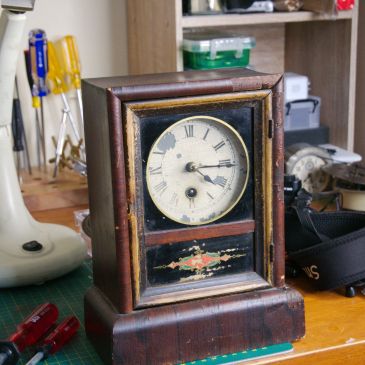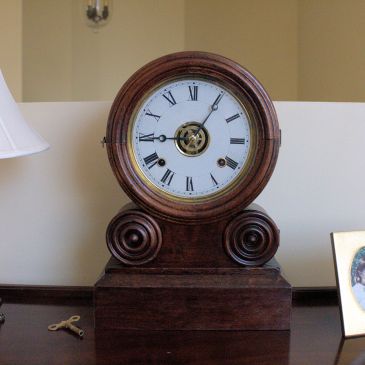
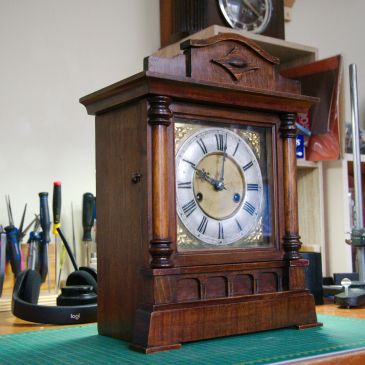
Jerome & Co., a marketing arm of the New Haven Clock Co. made this clock in the mid-1850s. It is a 1-day or 30-hour clock called the “Rose Cottage”. In the 1850s and later, cottage clocks could be purchased with a time and strike movement, time and strike with alarm but this one is a very simple clock that was made to do one thing, tell the time.
Jerome & Co. 1-day clock
It is a very small movement. In fact the smallest American clock movement I have ever worked on.
A very small movement
The most interesting features of this movement, besides the size, are the solid third wheel and the high mount escape wheel with the entry pallet just above the wheel itself.
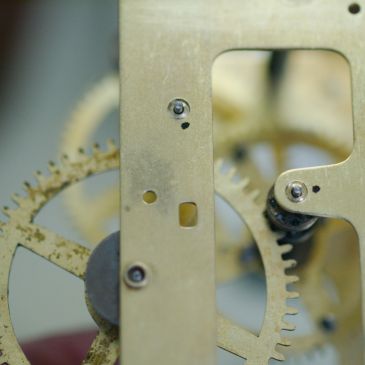
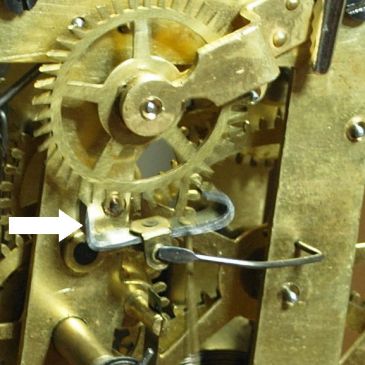
The photo below shows a very interesting “fix” for a worn pivot hole, certainly an add-on by a not-so-professional clock repairer. It consists of a piece of copper wire soldered to the plate. The copper wire then loops around the pivot and keeps it from moving in the worn hole. Many repairers at the time punched around a pivot hole to close it but this is an odd repair.
The movement in its case
Other issues included finishing nails instead of taper pins to secure the plates and the mainspring loop end attached to the bottom right post instead of the left. While on the right post (as found) the mainspring uncoils and pushes against the center cannon lantern pinion and stops the clock. I doubt that the movement could run a full day.
The movement
As a time-only movement, it is pretty simple in design. It takes all but a minute to disassemble and reassemble the movement.
My first task was to remove the ugly solder and copper wire. I pulled the wire away and using a soldering gun the solder dissolved easily, both front, and back since both ends had the same “fix”.
Wire and solder removed
Once the copper wire was removed I could see that the front bushing hole was elongated as I suspected.
New bushing, upper black dot, mainspring attached to the bottom left post
The only other bushing required was the escape wheel and back-plate. The bushing hole on the escape wheel bridge is a little worn but it should do for now as this clock will not be a daily runner.
The movement is on the test stand and running well. Now to see what I can do with a very worn and very tired case.
I have a number of cottage clocks and they all seem to have one thing in common, they have lived hard lives and this one is no exception. They had the cheapest of movements, the cheapest of cases, and could be purchased for almost nothing but many have not survived and that’s too bad.
This is a one-day or 30-hour time-only cottage clock made by Jerome & Co. Most cottage clocks come with a time and strike movement, some had alarms but this has just the movement.
Jerome & Co. cottage clock
Chauncey Jerome was a prolific clockmaker and a true pioneer of the early American clock. Despite his success in clock manufacturing from the late 1830s to the early 1850s a number of poor business decisions led to bankruptcy in 1856, and the assets of the bankrupt Jerome Manufacturing Co. were purchased by the New Haven Clock Co.
Time only movement
While Jerome was involved in numerous clock-making activities after his bankruptcy and marketed clocks under his name and label, Jerome & Co. is not one of those. “Jerome & Co.” was a tradename used by the New Haven clock company.
Label
The Jerome name obviously had some cache and it was a good marketing strategy on the part of New Haven.
The plan
The movement is very simple in design. However, it has had an odd repair. On the left side of the movement is a copper wire soldered to the brass plate. The copper wire wraps around the 3rd wheel pivot and acts as a bushing. There is a similar repair on the backplate. This will be removed and replaced by a brass bushing. There are one or two other bushings required as well.
As for the rosewood veneer case, I am not sure what I will do. There are veneer losses on the right side of the case, the bottom corners, and the top left. Most of the gilt around the front access door has worn off, there are significant losses on the dial, there is a large age split on the top-right and the reverse painted lower tablet has signifciant losses. I don’t want to go too far and ruin the clock but as it is, it looks quite bad.
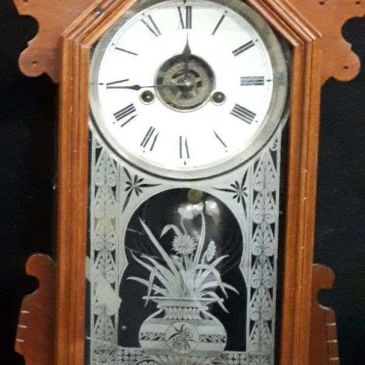
Can this gingerbread clock made by E. Ingraham be saved? Possibly, but this clock is destined to become a parts clock and I will explain why in this post. In the spring of this year (2022) 4 clocks were bought at auction. I can save three of them but not this one.
Gingerbread clock
Gingerbread clocks often called “kitchen clocks”, were introduced after the American Civil War and remained popular until the end of World War I.
The term is derived from the tradition of making decorated gingerbread houses which began in Germany in the early 1800s. The broad application of the gingerbread style applied to almost anything including clocks.
Auction photo
The gingerbread design is polarizing. Collectors either love them or hate them. I am not particularly fond of the design generally, with certain exceptions, but I can see how some collectors are attracted to the style.
The cases were steam-pressed oak and occasionally other hardwoods were used. Various designs were pressed by a heat-bond process which was quite advanced for the time. It was a time-saver, spectacular designs were pressed within seconds and it saved on labour costs. Hundreds of thousands of these steam-pressed oak-cased clocks were made and all are now well over 100+ years old.
So, what is off putting about this clock?
It came with no glass and to me that is the deciding factor. I do not have the time or inclination to look for an appropriate tablet for this clock and obtaining one will not increase its value appreciably will not make it more desirable.
Auction photo
The case may look good but the auction photo does not tell the entire story. There are newer screws and nails in various places in the rear of the case that were used to keep the case from falling apart and not a very professional job at that. It would have to be taken apart and re-glued.
On top of everything I don’t like this clock enough to spend any time on it.
I can use the dial for a Sessions clock I am working on and will keep the case, harvesting what wood I need for future projects.
I will inspect the movement and if things look good, service it and sell it separately.
Call this an obituary. The reality is this clock has been around for over 100 years, has served its purpose and has now come to the end of its life.
This is not the first Grand Assortment clock from the Sessions Clock Co. that I have worked on. In June 2019 I repaired a family member’s clock. It is exactly the same model.
Auction photo
The Grand Assortment was sold “six in a case” to retailers who then sold them separately. The name “assortment” seems appropriate and I am not surprised that some collectors refer to them simply as the Grand. Selling clocks in lots of 6 was a fairly common practice in the early part of the 20th century. An individual could probably order one of the clocks either directly from Sessions or working through a retailer but would normally select one from a retailer’s shelf.
Styles of Grand Assortment
Tran Duy Lyshows this Assortment model from the 1915 catalogue. It was likely made earlier but this style of clock was well on its way out by about 1915. This is Grand No. 3 and the price was $4.00, a day’s salary for a working man. All were eight-day runners but could be ordered with alarm (45 cents extra), cathedral bell (45 cents more), or standard wire bell.
This one was purchased at auction for $35 and listed as “not-tested”. “Not-tested” is an interesting auction term for “it may or may not work and it probably doesn’t”.
The note came with the clock(1903 is the year Sessions began making clocks)
Gingerbread clocks also called “kitchen clocks” were introduced after the American Civil War and remained popular until the end of World War I. The term is derived from the tradition of making decorated gingerbread houses which began in Germany in the early 1800s. The broad application of the gingerbread style applied to almost anything including clocks.
However, gingerbread clocks have polarizing designs. Collectors either love them or hate them. I am not particularly fond of the design of this one but I can see how many at the time were attracted to the style.
The clocks’ cases were steam-pressed oak and occasionally other hardwoods were used. Various designs were pressed by a heat-bond process which was quite advanced for the time. It was a time-saver, spectacular designs were pressed within seconds and it saved on labour costs. Hundreds of thousands of these steam-pressed oak-cased clocks were made and all are now well over 100+ years old.
The clock is 22 inches tall, ten inches wide with a 6-inch dial. It is a time-and-strike movement striking the hour and half-hour on a coiled wire gong.
I am not a huge fan of Sessions’ movements, particularly from this vintage. Too many helper springs, frustrating to re-assemble, and setting up the strike side is always finicky plus the poorly designed weak clicks are prone to failure (yet they’ve lasted this long!). Set up properly they will run reliably for years and are reasonably good time-keepers for a spring-driven clock.
Is it worth fixing? Certainly, there is nothing fundamentally wrong with the movement but the case is in rough shape and will require considerable intervention. The paper dial on tin is also in poor condition. Quite often the crown is broken, pieces missing or cracked which is the case for this one and unfortunately, it is not very well glued back together.
The Plan
The movement should be fairly easy to service. I don’t see a lot wrong with it upon initial inspection. As expected it is quite dirty but I don’t see a lot of wear. I won’t know conclusively until I take it apart. The plan is to put the movement in proper running order.
A dirty movement but there does not seem to be a lot of wear
The finish is badly aligorated and will need a lot of work. “Aligorated” means that over time the surface of the case was exposed to heat and high humidity causing the shellac to coagulate in clumps resulting in a mottled finish. I will attempt to renew the finish which might involve stripping the finish. That may sound extreme but it may be the only solution.
The dial is in poor condition
Rust has bled through the paper dial and as such it is beyond hope and will be impossible to restore. I may change out the Roman numeral dial with an Arabic dial from an E. Ingraham gingerbread clock from the same period. The dial size is exactly the same and the centre canon and winding arbours fit perfectly. Checking on the internet I note that there are several Grand Assortments with Arabic dials.
Once the movement is serviced and the case is redone, there should be a dramatic improvement. I have already decided that I will not be keeping it as it will be resold to offset equipment costs.
I am a bit of a sucker for cottage clocks, have several of them, most are 1 day but I find them interesting just the same. There are not many survivors for a good reason. They were the cheapest clocks one could buy and when they stopped working they were either thrown away or repaired by some local clock fellow to get a few more years out of them. I am not on a quest to obtain the most inexpensive clock possible but this little cottage clock was tacked onto several items bought on an online auction.
“You won the clock”, my wife said. “What clock?”. “You know, the cottage clock”. “Oh, that one!”
Well, here it is.
Jerome & Co cottage clock
Pretty rough! An initial inspection reveals losses on the dial, missing veneer here and there, losses on the reverse painted tablet on the lower section of the access door, gold trim that has long worn off, and a movement that has had strange things done to it.
1 Day movement
It is a time-only clock that runs for 30 hours, otherwise called a 1-day clock. It was made by Jerome & Co., a subsidiary of the New Haven Clock Co., and has no connection to Chauncey Jerome himself. Chauncey Jerome’s interests were sold off to New Haven by the mid-1850s.
The copper wire soldered to the brass plate next to the escape wheel (photo above) is an improvised bushing. I have seen a lot of interesting repairs over the years but this is different. A few other issues. The plate pins are finishing nails and one pin in the back of the movement is a toothpick! Plus, it has been sprayed with what looks like WD-40.
Like most mechanical clocks, they can be correctly repaired and brought back to life. As to the case? I will have to give it some thought.
Jerome & Co, Rose cottage
When this Jerome & Co 1-day clock was made is a mystery but the solid wheel in the upper right rear of the movement tells me that this clock may be from the 1850s or 1860s.
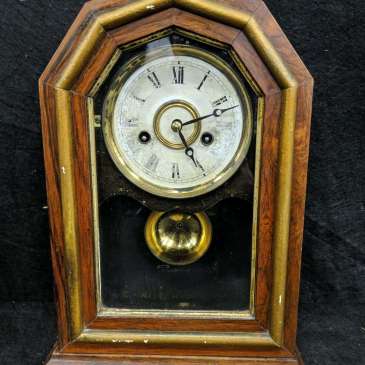
This attractive little clock was bought at auction earlier this spring.
The walnut case is actually in good shape and the tablet looks not only original but is in decent condition as well. I expected a well-cared-for movement but to my surprise, it was in deplorable condition, a prime example of a clock that saw little servicing and was destined to fail.
Thanks to reader JC who identified the clock as the “Canada” found in Ansonia’s 1886 catalogue.
Auction photo
After installing 7 bushings and two pivots it now running as it should.
The case
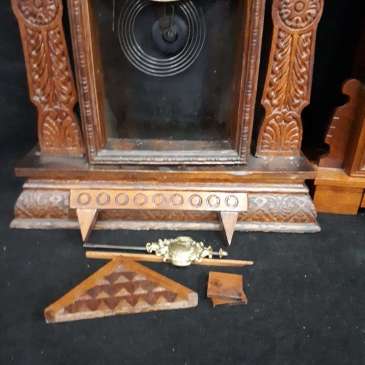
It is missing a few top pieces but surprisingly the pieces came with the clock. They are in front of the Sessions gingerbread clock in the photo below. The glue let go and of course, it is a matter of gluing them back in place.
I blame it on rough handling on the part of the auction house otherwise why would the parts come with it.
Sessions and Ansonia clocks were bought as a lot.The case after a coating of shellac
Once the parts were re-glued it was an opportunity to clean the case and apply one coat of traditional shellac.
The dial looks too new, though it looks great and was no doubt replaced at some point in the clock’s life. The spade hands look correct for the clock.
The case was surprisingly well preserved but it is unfortunate that the movement was in such poor condition but now has a new lease on life.
Here is the final result. The movement and alarm mechanism have been reinstalled back into its case. After several days it is running well and keeping good time.
A handsome clock that is even better after a refresh and minor repairs.
This 30-hour shelf clock (hour strike) was manufactured by American clock-maker E. Ingraham and Co. in the 1870s. There are various iterations of the name over the maker’s history but this was the one the company used from 1861 to 1880.
The clock was bought at auction in mid-March 2022 along with 3 other clocks. In this post, I will take the reader through the process of refreshing the case.
Auction photo
This is an excellent example of a tired case that needs attention. When I look at a clock case such as this I assume the movement is well worn but a pleasant surprise awaited.
The movement is in surprisingly good condition as a result of regular (somewhat) servicing over the years. It has been in the shop at least three times, 1879, 1916, and 1994 according to dates found on the back of the case and perhaps more occasions that are not recorded.
Analysis of the caseand plan of action
The gold banding on the front face of the “octagon top” and the inside frame of the access door has some losses and the goal is to hide the nicks with gold artist’s paint matched to the trim. First of all, it is not a true octagon but half of one, but that is how these clocks are described.
The overall finish is in fair condition. Numerous cosmetic issues such as scratches and nicks here and there over the rosewood case are evident, but a good cleaning with soap and water followed by a fresh coat of shellac should fill in the scratches and improve things dramatically.
Auction photo showing nicks and scratches
The dial shows considerable wear after years of daily use and this is a situation where a replacement paper dial might be considered but I am always hesitant because replacement dials take a certain something away from and antique clock.
However, I am going to see what I can do by attempting to bring the numbers back with black acrylic paint while retaining some of the patina.
The moon hands look correct for the period of the clock.
As a collector who has seen a good number of these styles of clocks, I first thought the access door glass was a replacement since many clocks from the early to late 19th century had reverse painted tablets.
Because of the decorative pendulum and the bright brass bell both meant to be seen, the stylized panel that serves as the base for the dial, the total absence of any paint remnants, the glass panel with its waviness and various imperfections plus the putty-like material that is used to mount the glass to the door, the glass appears to be original to the case. A pleasant surprise!
It is always a bit of a disappointment when something is lost or changed on an antique clock especially one that is close to 150 years old and when replacement parts are difficult to source.
No doubt some of the scratches on the case, dents, etc. (not all, of course) are the result of rough handling either when transporting the item to the auction house or during its stay.
Addressing issues with the case
The very first step is a good cleaning. Cleaning a clock will generally result in the removal of some of its protective finish but it is inevitable given that it has been on the clock a long time.
Auctionphoto
For old American clocks I generally use traditional shellac made by combining shellac lacquer with shellac flakes. Amber Shellac adds a certain hue to the case and the cut is light enough that it dries to the touch in less than a minute which is my preference.
When there are large flat surfaces I will use a “french polish” but for this project, a broad artist’s brush is best. I apply the shellac in long strokes completing each section at a time.
The decorative black wood panel that serves as the dial mount is also shellacked allowing for small scratches to fill in very nicely.
The original paper dial is well worn and presents significant challenges as all the numbers on the dial are either partially worn off or completely erased. This was a well-used clock!
Top and bottom lines of the numerals are filled in
Using an artist’s fine-tipped brush, black multi-surface acrylic paint, and a steady hand I filled in as much as I could. The numbers around the winding arbours were the worst because I had little to work with and they were the most difficult to reproduce.
Once all the Roman numerals were completed and thoroughly dry, I used a Sharpie fine-tip “artist’s permanent marker” and a straight edge to clean up the lines. I decided not to touch up the chapter ring other than the 5-minute markers. I am not entirely happy with the number 4 on the dial but that’s as far I am going.
Closer view of the dial
As for the gold trim on the face, I did not want to mess with the patina, nor did I wish to cover the gold which would have completely taken away from the antique look. I mixed acrylic multi-surface gold paint and a very small dab of black paint for an “aged” effect and used a fine-tipped artist’s brush to carefully dab the bare areas.
Finally, the brass bezel and inner ring were given a polishing.
The clock is complete
The clock has been transformed. The dial has been rejuvenated, the movement serviced and reinstalled, the bell gong attached, the case given its many touch-ups, and the decorative pendulum is attached. Now to regulate the clock.
In the final analysis, I believe that I have struck the balance every collector and restorer seeks and that is maintaining the original patina of the clock while not taking away its antique look. It is 145 year old antique that has seen good use over the years but applying modern techniques that are minimally invasive have brought it back to life.
I have one more decision to make. I acquired this and three other clocks to sell in order to offset the cost of new equipment but now that I have seen the final result I wonder!
The case might be a lost cause but I can certainly save the movement of this Ingraham Ocean series gingerbread clock. The clock came to me in fair condition but it was missing a key element, the glass tablet and for that reason, I am not inclined to source a replacement, the clock is just not worth it.
There were several shards of glass at the bottom of the case and I suspect the glass was broken during its journey to the auction house or at the auction house itself which is unfortunate. I could substitute with clear glass but that would diminish the value of a clock that is not worth much, to begin with.
Ingraham OceanLine, pieces of another clock in foreground of auction photo
However, I can save the movement and the dial as well as a door catch, perhaps use it for future projects or for spare parts.
It was dirty as one would expect and it has not seen the inside of a professional repair shop judging from a rather sloppy click repair. The repair appears to have held and I will tidy it up and leave it.
The movement is interesting and clearly late manufacture. The number 11 is stamped on the movement which might indicate that it was made or about in 1911. Regardless, it is from the pre-war period. I also see steel pieces such as the intermediate wheel, the centre cannon, the fly and the count-wheel hub.
All the parts were placed in the ultrasonic and cleaned following which I replaced the wheels between the plates to recheck for wear. It looks like 5 new bushings on the front plate, 2 on the strike side and on the time side, and all the upper wheels in the trains. On the back, the third wheel requires a new bushing as does the second wheel and the escape wheel.
Black dots mark where new bushings will go.
Eight bushings in all, which is fairly standard for a movement with this degree of wear.
Mainsprings are cleaned and oiled
I have not worked on an Ingraham movement in some time but recall that the strike side is set up quite differently.
The count wheel is mounted on the second arbour (unlike most which mount on the main wheel arbour) and advances by means of two pins that extend from the third wheel lantern pinion. The third wheel is a combined locking wheel and pin wheel. There is no cam on the arbour, instead, there is a space between two pins that allows the lever to drop at the same time the paddle drops into the deep slot on the count wheel. The fourth wheel is just used for warning and not for locking.
Reassembly and testing
All went well. A couple of adjustments had to be made but otherwise, it is running well. I will leave it on the test stand for a week or two.
The movement will go into a bag and be stored for a future project. I already have plans for the harvested clock parts but if I find another Ingraham gingerbread in the Ocean series, I might consider resurrecting this one if the tablet is intact.
I have had my eye a clock timing machine for a while but I was recently encouraged to accelerate my plan to buy one. My Timetrax model 50 beat amplifier stopped running for some reason. Okay, I dropped it and it made a strange rattling noise when I picked it up. Now it doesn’t work!
Model 50 beat amplifier, now broken
Do I need a timer? Up to now, I got along fine without it and generally speaking anyone repairing clocks can certainly get by without one. But I can now see that this little device can be quite practical and can save a lot of time and frustration.
Timetrax model 185
What does it do?
It is a Timetrax model 185 made by Adams Brown. It works by analyzing the mechanical vibration of a clock and converting the vibration or tick and tock to an electrical signal that is amplified within the timer producing a readout that is compared to an included clock train table.
It also has a beat amplifier and a balance control that will help determine the beat of a clock. It will certainly ease the process of regulating a clock, detect potential problem areas and perhaps eliminate or certainly reduce the lengthy time it takes to adjust a clock beyond a trial and error approach. I will learn more as I explore its many features.
It runs on batteries and unfortunately there is no way of hooking it up to an external power source. Don’t we have enough things that run on batteries in our homes!
I connected it to my Seth Thomas regulator #2, which is weight driven.
Seth Thomas #2
I checked the beat. It is roughly set by ear at first and fine-tuned by the machine. A clock is in beat when the time between ticks is even.
Switch the controller to BAL or “balance” to put the clock in beat.
The screen then displays a magnitude of numbers. I am over simplifying things a bit but a new number positive or negative is displayed as the movement ticks and a clock is in beat when the magnitude of numbers is minimized. The ideal reading is a succession of zeros which is almost impossible but the closer one gets to the zeros the better and the clock is now in beat or as close as possible to being in beat. Values under 20 are the goal.
Now for the beat timing. A Seth Thomas #2 runs at 80 beats per minute. So, 80bpm X 60 is 4800 beats per hour. The escape wheel has 40 teeth, so in this case the best numbers for a preset average is 80 (a doubling) and by clicking the beat cycle plus-minus button one arrives at the required number. The result for the ST2 was 4798 beats per hour. I am losing 2 beat per hour and compounded over one week it means a loss of mere seconds per week which in my view is very acceptable for a mechanical clock. It is not surprising that these clocks were originally designed for train stations.
I am sure I will discover other uses for this machine but for the moment I am pleased with its capabilities.
I acquired a number of clocks at auction this past winter (2022). All were antiques and all were in poor to fair condition but each one had potential. The auction notes simply said the movements were untested which can mean just about anything from a failed, irreparable movement to something that might have been serviced recently.
One of the four from the auction is an attractive clock with nice clean lines and from the look of the case, which is in decent shape, I would have expected a well-cared-for movement which turned out not to be the case when I removed it.
Those with a keen eye will notice something missing on the case – the topper or crown, but no worries, I have all the pieces, it is just a matter of gluing them back on.
Auction photo
I located a clock exactly like it online with a description that was no help at all other than the fact that it was made by the Ansonia Clock Co. However, the design of the base is identical to the “Alaska” found in the 1886 Ansonia catalog so, I would estimate the clock was made around that time, give or take a year or two.
Beyond a well-worn movement is that it has a 30-hour run time. A clock with a 30-hour movement is a tough sell based on my experiences these past 10 years. The alarm feature might attract some buyers or others might be simply looking for a decorative piece.
The movement
The one-day or 30-hour movement with alarm is made by the Ansonia Clock Co. The date June 13, 1882, is stamped on the front plate and refers to a patent date. Digging a little deeper I found Letters Patent No. 259,505 by W.D. Davies for a striking mechanism for clocks, registered in Brooklyn, New York January 31, 1882. Naturally, the clock could not have been made before that date.
Davies patent
The patent has a unique lifting lever, called a “turn back” (fig 4) that allows the hands to be turned back past the hours eliminating a second spindle that would otherwise be used by other manufacturers to allow the hands to be turned back.
The movement
It is a run-of-the-mill 30-hour movement. It is as small as one would expect for the run time. It has been worked on in the past as there are plenty of punch marks around the pivot holes, more so on the time side than the strike side which I will explain later.
I have spring retention clamps for all sizes of mainsprings but none that would fit this movement exactly. My smallest would not fit because there is a steel post in the way on the strike side but wire works just as well though I was able to get a clamp around the mainspring on the time side.
Strike side wheels, a wire holds the mainspring
As it is a 30-hour movement the mainsprings are not as powerful as one would find in an 8-day clock although I always use care when working with mainsprings and wear thick work gloves.
Every pivot on the strike side looked like the one below. Dirty yes, but very little wear.
Strike side pivot before polishing
The time side was an entirely different matter.
Every pivot was in very poor condition, the worst is shown below.
The escape wheel pivot is too thin to be salvageable
The worst pivots were both ends of the escape wheel and the third wheel. I was able to grind down most of the pivots, including the 3rd wheel since there was enough usable steel to carry the load through the train. Not so for the escape wheel.
New escape wheel pivot,front plate
It required re-pivoting.
The third wheel pivot on the time side,this one is salvageable
A sizable portion of the brass was chewed away on the escape wheel bushing, backplate. As wear accelerates over time, the clock would eventually “grind” to a halt.
Escape wheel pivot hole backplate
As for the difference in wear on both sides, there are two possible reasons. Some folks do not like the sound of a striking clock in a home. The clock will still run with only the time side wound but the result is disproportionate wear. The second is that the patented design does not allow room for error during setup and perhaps it was too frustrating getting the strike side to run reliably.
The new pivot
Using a mini lathe I began with a centering bit and then with high-speed bits drilled holes in both ends of the escape wheel to a sufficient depth to anchor the pivot wire. I have a good supply of pivot wire and it was a matter of selecting the correct size, which in this case is 1.35mm wire.
The shot above shows the new escape wheel pivot supported in place and it will remain on the lathe in this position until the Permatex Threadlocker Red has cured (24 hours).
Bushing the escape wheel bridge
With that kind of wear, I am surprised the clock ran as well as it did although American clocks will typically continue to run despite being well worn, wear that would certainly stop a German or French clock.
Assembly and testing
The strike side wheels are left out for testing (beat timer is attached)
Normally I would assemble the entire movement after completing the bushing work but since I installed two brand new pivots I realized that I would have to make minor escape wheel/pallet adjustments and having fewer wheels to deal with makes it less frustrating taking it apart again. A new suspension spring and leader also replaced the original one.
After 30 hours the movement continues to run strongly. I tested the movement a day or two more before installing the remaining wheels and levers.
The movement was pulled out of a 30-hour shelf clock made by American clock-maker E. Ingraham and Co. in the 1870s (the name the company used from 1861 to 1880). The clock was bought at auction in mid-March 2022 along with 3 other clocks.
E Ingraham 30-hour movement
This is one of those situations where the case looks distressed whereas the movement looks like it has been well cared for over the years. It has seen service at least three times.
The three dates, two on the back panel and one on the rear of the dial, are all presumably service dates. The inscription, Bridges Bros, Woodstock, New Brunswick, 1879 is the earliest and on the back panel are the dates January 31, 1916 (barely readable) and October 1994.
Auction photo
The case
The gold band on the front face of the “octagon top” has some losses. I intend to hide the nicks with gold artist paint matched to the case. There are a few scratches over the rosewood case which will be hidden by a fresh coat of shellac following cleaning with soap and water.
5% of a label remains on the back. The inside label is interesting since most of the back panel is covered in black paper with E Ingraham Co. inscribed in gilt on the bottom section.
Dull dark blue paper labelwith gilt lettering
The dial shows considerable wear following years of daily use and the plan is to enhance the numbers with multi-surface black acrylic paint.
Auction photo
As a collector who has seen many of these styles of clocks, I initially assumed the access door glass was a replacement since many from this period had reverse painted tablets. Due to the decorative pendulum, the bright brass bell, the stylized wood panel that is the base for the dial, the glass panel with its waviness and various imperfections plus the putty-like material that is used to mount the glass, the total absence of any sign that it was painted, the clear glass appears to be original to the case.
It is always a bit of a disappointment when something is lost or changed in a clock’s history but the case looks reasonably good despite the minor wear.
Some of the scratches, dents, etc. found on a case (not all of course) are no doubt the result of rough handling either when transporting the item to the auction house or during its stay.
This is certainly not an example of a case that requires refinishing. The minor touch-ups and enhancements will dramatically improve the appearance of this clock while not changing its character or value in any way (but may even increase it marginally).
The movement
Now to the movement. The movement looks surprisingly good for its age and from my first inspection, it does not need much to put it right.
The front plate and escape wheel removed
Every time-side pivot and bushing is in very good condition and there is an old replacement bushing, 3rd wheel back-plate.
The strike side requires a new bushing second wheel back-plate. There are two old replacement bushings on the front plate and two on the backplate, all on 3rd wheels. The bushings are nice to see but it is not encouraging when one pops out while pegging the movement. It will be replaced. Not the best of workmanship.
There are punch marks around four bushing holes, front, and back. All pivots on the strike side are in very good condition.
It also appears the time side mainspring has been shortened a bit, not a concern since these clocks when properly serviced will run well past 30 hours.
All in all, it should be a quick project. Now that I have a clear idea of what needs to be done I will get to work on the case. Expect a post on the case itself in the next few weeks.
Honestly, an entire book could be devoted to the topic of dating clocks. Some time ago, I published an article titled “How to Date an Antique or Vintage Clock – Part I,” in which I used specific examples from my own collection.
I’d like to explore this topic further, and this post will discuss additional methods for dating an antique or vintage mechanical clock. While there is no one definitive method for dating an antique or vintage clock, there are often clear clues in some cases and more subtle hints in others that can help pinpoint when a clock was made.
Occasionally, the exact month and year are displayed somewhere on the case, and in other instances, the clock by way of serial numbers, date stamps on the movement, style of hands, spandrels, dial design, case design, and so on, establishes the date to within a certain period.
After 1896 foreign clocks (Europe, England) were mandated to have the country of origin on the case, usually on the dial. Any clock made after that date will have the country of origin.
Duration of manufacture
A bit of research into the history of a clockmaker can help you narrow down the timeframe for dating your clock. For instance, the E.N. Welch Clock Company, an American manufacturer, produced clocks until 1903, when it was acquired by the Sessions Clock Company, which continued making clocks until 1970. The E.N. Welch Clock Company made clocks for a 50-year period until its acquisition by Sessions in 1903.
By 1903 German-based clock manufacturer Junghans was the largest clock maker in the world and continued in its quest to bring more companies into the fold. Gustav Becker, founded in the 1860s, and Hamburg American Clock Company, founded in 1883 were absorbed by Junghans in the late 1920s. Although those companies were folded into Junghans in 1926 the Gustav Becker name lived on for another 9 years.
Gustav Becker regulator C.1907, Braunau factory
Clocks with Steel vs Brass platesvs Woodworks movements
Smaller shelf clocks with 1-day (30-hour) wooden movements were produced in fairly large quantities from around 1810 to 1845, after which most clockmakers changed over to brass movements. Wood dials were also popular during this period.
Daniel Pratt woodworks movement with dial removedC.1832-38
By 1860 iron weights were being replaced by springs as the power source, and smaller clocks, many of them 8-day, were becoming increasingly popular. Early American spring-driven clocks used brass springs (late 1830s) until steel became cost-effective.
This information is important for dating a clock because it highlights key transitions in clockmaking technology and design, which can help pinpoint the era in which a clock was made. For example, the use of wooden movements and wood dials can indicate a clock was produced between 1810 and 1845. The shift from iron weights to springs by 1860 helps us understand why spring-driven clocks became popular, which is crucial for narrowing the period of manufacture. Additionally, the switch from brass springs to steel in the early 1840s can provide a more precise date range for early spring-driven clocks.
Understanding these technological changes allows you to make more informed judgments about a clock’s age based on its features.
Brass mainsprings from a Manross steeple clock C.1837
During periods when brass was in short supply such as the World Wars (WWI and WWII), makers often made steel plate movements with brass bushing inserts. However, some companies such as Arthur Pequegnat used either steel plates or brass-plated steel plates throughout their operating years (1902 to 1941).
Steel plates on a Pequegnat time and strike clock
Other clock companies switched to steel as a cost-cutting measure when brass prices were high, not necessarily during wartime.
Screws and nails, chime rods, coiled gongs
In older clocks, nails, and screws were made of iron and hand-forged, with screw heads being slotted. Hand-forged nails can be found in clock cases dating from the earliest examples up to the mid-19th century, after which machined screws and nails started to replace them.
An ogee clock, like this example made by George H. Clark in 1865, was constructed with hand-forged nails.
George H Clark 30-hour Ogee shelf clock
Robertson and Phillips head screws were introduced in the first part of the twentieth century. Since the Robertson head was invented in 1906 and Phillips screw heads only began to be widely used in the 1930s screws of these types found in older antique clocks are later additions.
Since these screw types were introduced in the early 20th century, their use in a clock that dates from an earlier period suggests that the screws were likely replaced or added during a later restoration or repair. Recognizing these screws helps refine the clock’s dating and can provide insight into its history and any modifications it may have undergone.
The first rod gong, a single striking rod, dates back to patent designation DRGM 108469, granted to Johann Obergfell on December 23rd, 1899. The introduction of the rod gong, as opposed to earlier bell or strike systems, represents a key development in the evolution of mechanical clocks, especially in terms of sound quality and the technology used.
Understanding when this innovation occurred can help date a clock more accurately, particularly those with rod gongs, as it indicates they were likely made after 1899. Rod gongs are typically made from a copper or nickel alloy and are press-fitted into a block.
Thick coiled gong
There are two types of coils: the thick coils, which spiral only a few times and produce a deep, rich tone, and the thinner coils, which spiral many times and often have a higher-pitched, tin-like sound. Thick coils were used well before the mid-1800s. These coils are typically mounted onto a fitting, which is then attached to an iron block. Smaller, thicker coils became more common towards the end of the 19th century.
On the American front, thin wire coils were very common. Some examples had the coil mounted to a dome-shaped base which was said to improve the tone considerately.
Commemorative plaques
Commemorative plaques which display dates are often a good indicator of the age of a clock. However, the clock may have been on a seller’s shelf for years before the date on the plaque. This nevertheless places the clock within a certain range of dates. This photo shows a plaque on a HAC (Hamburg American Clock Co.) time and strike shelf clock.
HAC shelf clock with the date 1926 on a plaque
Type of escapement
Recoil (anchor), half deadbeat, Graham deadbeat, pinwheel, Brocot types are found in older antique clocks while, hairspring, floating balance, lever type escapements are found in newer vintage (less than 100 years old) clocks.
For example, floating balance movementsbegan appearing in mechanical clocks in the early 1950s. The floating balance will tolerate being out of level, unlike pendulum clocks which must be on a level surface, an attractive marketing feature.
This is important because the type of escapement mechanism used in a clock can provide key insights into its age and technological development. Older clocks with recoil (anchor), half deadbeat, Graham deadbeat, pinwheel, or Brocot escapements reflect the horological practices of earlier periods, while newer clocks featuring hairspring, floating balance, or lever type escapements indicate a more modern design, typically found in clocks less than 70 years old.
For example, the introduction of the floating balance in the 1950s was a signifcant advance because it allows for clocks that are less sensitive to being off-level, a feature that made them more convenient for consumers. Recognizing these mechanisms helps in accurately dating a clock and understanding the technological shifts over time.
floating balance escapementC. 1950
Style of case
The style of the case, such as ogee, box clock, steeple, cottage, or gingerbread, can help date the clock to a specific period.
The style of a clock case can offer valuable clues about its age, as different case styles were popular during specific periods in history. Here’s a breakdown of some common clock case styles and their associated timeframes:
Ogee Clocks: These clocks, named for the distinctive curved, “S”-shaped design of their cases, were popular from the early 19th century, especially between 1825 and 1850 but continued to be made into the 1880s. They typically have a simple, symmetrical shape, often with a painted or paper dial, and were mostly made with wooden movements in the early years.
Box Clocks: This style features a simple, rectangular or square case, often with a hinged door or glass front. Box clocks were common in the early to mid-19th century (1920s to 1940s), with their plain, functional design making them relatively inexpensive to produce.
Steeple Clocks: Steeple clocks are characterized by their pointed, “steeple” shape at the top of the case. This design became particularly popular from the 1840s through the 1870s. Steeple clocks were typically more decorative and were often used in homes and churches, with some having more ornate carvings or decorative elements.
Cottage Clocks: Cottage clocks, with their simple and rustic designs, emerged in the mid-19th century, around the 1840s and 1850s. Often smaller in size, these inexpensive clocks were popular in rural homes. They are sometimes characterized by a more casual, handcrafted appearance, with wooden cases and floral or geometric motifs.
Gingerbread Clocks: This style, which features intricate carvings and decorative elements like scalloped edges, ornate moldings, and small, detailed pieces, gained popularity in the mid- to late-19th century (around 1860 to 1880). Gingerbread clocks are often associated with the Victorian era and were typically mass-produced.
The case style is a strong indicator of the clock’s approximate age because clockmakers and manufacturers often adapted their designs to reflect contemporary tastes. By identifying the specific features of a clock’s case—such as the materials used, shape, and any distinctive decorative elements—you can narrow down the period in which it was made, which can then aid in dating the clock more precisely.
E Ingraham Huron C.1878
Knowing the period when a case was made provides a reliable indicator of the clock’s age. Although there are earlier patent dates stamped on the movement of this E. Ingraham Huron time and strike 8-day shelf clock, this style of case was made for only 2 years, 1878 to 1880.
Date stamps on movements or cases& searchable databases
Some makers stamp date their movements or display the date elsewhere on the clock case. The Gilbert Clock Company often date-stamped their movements. Sessions put dates on the door labels.
Some makers such as Junghans stamp a date code on their movements. For example, B19 stamped on the back plate of a Junghans movement refers to a movement made in the latter half of 1919.
Serial numbers stamped on movements can be compared to a database to determine the exact year the clock was made. The Ridgeway clock company used 4-digit codes. For example, serial number 4981 refers to a Ridgeway clock made in 1981.
Gustav Becker clocks were made in both Silesia and Braunau factories, both of which produced clocks but each had a unique serial number convention. The serial number on a Gustav Becker clock will give the exact year of production assuming you know where it was made, Silesia or Braunau.
An online databases such as ClockHistory.com provides invaluable information on companies and models made by them, the years the clock company was in business, and how long the company was in operation.
Searchable databases like Mikrolisk, the horological trademark index help date a clock by comparing a trademark. Some companies revise or restyle their trademarks over the years allowing one to date a clock within a certain period.
At Antique-horology.org keywords or text can be used to search trademarks and identify years they were used.
Scottish tall case clock C.1848
The date 1848 is attributed to the clock above. I arrived at this date because it was made by William McLachlan of Newton Stewart, Scotland. According to an English clock database, Mr. McLachlan was a clock assembler and ran a clock-making business in Newton Stewart until his death in 1848. While the clock could have been assembled as early as 10 years prior, 1848 serves as a conservative estimate.
Other miscellaneous indicators
Plywood began to be used in clock cases starting in 1905. One of the clocks in my collection, a Junghans bracket clock, made around 1913, features a plywood back access door.
Seth Thomas made clocks in marble cases for a short time, from 1887 to about 1895. They also made clocks in iron cases finished in black enamel, from 1892 to about 1895.
Adamantine clocks were most popular through to 1915. Seth Thomas is best known for their “Adamantine” black mantel clocks, which were made starting in 1882. Adamantine is a celluloid veneer, glued to the wood case. Adamantine veneer was made in black and white, and in coloured patterns such as wood grain, onyx, and marble.
Seth ThomasAdamantine clock circa 1911
Final thoughts
My goal for this two-part article was to provide a broad, generalized overview. Each of the sub-topics mentioned above could be explored in much greater detail, and I hope this serves as a useful reference for some of you. I welcome any corrections to the dates, and if there’s anything I’ve missed or other information that should have been included, please feel free to leave a comment.
As I’ve outlined, there are many ways to date a clock—some methods are quite obvious, while others are more subtle and require a bit of research to pinpoint.
For some collectors and clock fans, dating a clock is crucial, as it adds historical context and value to the piece. For others, however, it may not be as important, especially if the clock serves primarily as a decorative item rather than a functional or collectible piece. In such cases, the aesthetic appeal might take precedence over its exact age.
Ten years have flown by very quickly. Just the other day I was cleaning a clock I serviced over 5 1/2 years ago and it struck me that I have been at this for over 10 years and loving it.
Three years into the hobby I decided to begin blogging and have been at it for close to 7 years. I love blogging and it helps me gauge my progress as I explore new avenues of clock collecting, repair, and restoration and it allows me to marry my photography hobby with writing.
It has been quite the journey, I have learned a lot in that time and have some thoughts I would like to share.
Managing my collection makes me a better collector
In the early days, I would collect just about anything I could get my hands on, the cheapest clocks imaginable, some for as little as $5, generally for practice working on cases and movements but the number of clocks began to build up at a fast rate.
80 clocks is a comfortable number for me. I have adopted a “one comes in, one goes out” rule to control the size of my collection.
I learned to become more discriminatory and concentrate on particular types of clocks rather than any clock at all, selling off or gifting those that did not fit my new criteria. Spring and weight driven wall clocks and American and Canadian shelf clocks from the 1860s and 1870s are my principle focus at this time.
Museum collection
Take your time, there is no rush
Rewards come in small increments. My last major project was an antique 1840s circa banjo clock. Acquired in the spring of 2021 it took me almost a year to complete the project, working on it in stages.
Sawin Banjo clock C.1840
Whether it is restoration or repair, I take my time investigating new (to me) techniques or wait for a tool that I feel would make the job simpler. For example, the bezel repair on the banjo clock above was made much easier by the purchase of a band clamp.
Buy only the tools you require and more if and when you need them
Tools can be expensive. As in any hobby requiring the assembly and disassembly of mechanical devices, I relied on the tools I had on hand to get started. Once committed to the hobby my next decision was to determine how I wanted to grow it.
Equipment such as a pivot cutter. lathe, a decent ultrasonic cleaner can amount to hundreds if not thousands of dollars.
Bergeon Bushing Machine
It took me four years to justify purchasing a pivot cutter, another year or two to buy a lathe and ultrasonic cleaner and over time I have managed to acquire most of the hand tools that I require. Spreading out the costs over time has also made it financially feasible.
There is always the option of buying used but I live in a distant part of Canada with a low population and there are just not as many people engaged in clock collecting and repair as would be elsewhere.
Antique and vintageclocks are cheap and there are plenty of them
Some clocks are well over 100 years old but are worth almost nothing. A glut of antique clocks offered on the internet have lowered their value. Ogee clocks that were once two and three hundred dollars years are worth a quarter of that today.
I have bought $40 clocks that are now worth, well…$40. There are a rarefied few in the world that are worth a fortune but I don’t have any of those in my collection.
A $5 barn find
Some clocks have crept up in price over the years but I do not have anything that I would call very valuable. Others, such as my collection of eight Arthur Pequegnats mantel and wall clocks are highly collectible in Canada.
At any given time there are literally hundreds of “antique” clocks offered on online for-sale sites. A majority of these clocks are trash and many are not antique though they are offered as such. Sellers often advertise clocks that are beyond repair and unfortunately clocks made in Asia are cheap, dangerous to work on, and were never meant to be repaired.
Choose repair advice wisely – not all advice is good advice
There are experts on clock repair out there, you just have to find them. It is too easy to get swept up by people who do not know what they are talking about and there are a number of well-meaning folk on YouTube that offer questionable clock repair advice. I follow a couple of well-respected YouTube repairers and have seen enough of their videos to convince me that they know what they are doing.
As I am a member of the NAWCC (National Association of Watch and Clock Collectors) and a member of the Ottawa Valley Watch and Clock Collectors Club, chapter 111 of the NAWCC. As such I have access to a wealth of information including online library resources and articles. NAWCC has an online forum presence that anyone can join for free. There are a number of well-respected people on the forum who contribute regularly. They have years of experience and offer excellent advice.
There are few clock Facebook groups but the advice is all over the map. Tinkerers and experts can be found but the expert soon loses patience and many are chased away by the know-it-all.
Collect clocks for profit? The margins are too small. However, I do sell the odd clock to offset equipment purchases. For me, I love the nostalgia, the design, and the fascination of a machine that may be over 150 years old that works perfectly today. Value is not important to me. Hobbies for profit? For some but not for me.
Be prepared to walk away
I have walked away from more than a few clocks over the past 10 years. Sometimes you have to let it go. Whether it is the price of a clock on an auction site that has risen beyond what I am prepared to pay or a clock offered as rare when it is, in fact, quite common.
E Ingraham Huron shelf clock made between 1878-1880
Some would have been perfect to have in my collection but they were priced just a little too high for my tastes. Others had too many things wrong and had suspicious repairs or parts missing that would have been impossible to source.
Just when I say, darn I missed that one, a better clock comes along.
Meeting like-minded peopleopens up a new world
As clock collectors and repairers we are a strange lot. Some of my clock colleagues are quite eccentric. Most are introverts and although they keep to themselves have no trouble sharing with like-minded people. One of the most fascinating things about this hobby is the people and their passion for mechanical clocks.
Final thoughts
These are some of my reflections over the past 10 years. I have learned a lot, met many fascinating people, acquired some very interesting clocks and look forward to more adventurers in the world of clock collecting and repair.
Those of you who work on mechanical clocks regularly must have run into this situation at least once. Everything went perfectly until the very end.
Sessions time and strike movements are very common and I have worked on quite a few over the years. They are reasonably well constructed with the exception of a well-documented poorly designed click.
Worn click on a Sessions movement
The other day I was working on a movement that I had originally serviced 5 1/2 years ago. Back in 2016, I installed 10 bushings, quite a number for any clock but it was very worn. It has run exceptionally well since then but now it was time for an inspection, cleaning, oiling, and correcting any possible issues.
Sessions movement in a wall clock
I took the movement apart, cleaned the plates, wheels, and levers in my ultrasonic cleaner (which I did not have back in 2016), and reassembled the movement. As expected the movement is much shinier than before and looks like it came off the factory floor.
During my inspection, I found minor wear but the only location where a bushing was required was the second wheel backplate. I could have left it but it was worn enough to need a new bushing.
Backward count wheel
It’s back together and being tested. Okay, I had to open up the strike side to reposition the stop wheel to correct warning but that’s about it.
It now runs perfectly and a nice pat on the back for me but oh! oh! wait…..it is not quite perfect, because I don’t think three o’clock follows four.
Dang, the count wheel is on backward. Why didn’t I see that?
You probably expected me to express a few choice words but I looked at it and said, ha, that’s too funny!
5 minutes was all it required to put it right and now it sounds great. Four o’clock now follows three o’clock. Yes!
This banjo clock project has been an ongoing challenge for nearly a year, a very enjoyable one that has taught me so much.
The movement has been serviced, 4 new bushings installed, the case has been cleaned, veneer issues addressed on the two bottom corners, a new post was made for the final, dial glass has been replaced, the hands rubbed down with steel wool to remove rust, the bottom section of the rails on both sides re-glued, some flat-head screws replaced (with smaller flat-head screws taken from old cases) and the old brass cable was removed and replaced. The dial was left untouched.
There is a simplicity about the case design that I really like.
Veneer missing on two bottom corners
The old and tired suspension spring should be replaced. I cannot source the spring alone but I am reluctant to pay for an entire pendulum assembly. It has been straightened and it works well for now.
The last step is addressing the crack in the wood dial bezel.
Cracked bezel
The age crack is just above the number eleven on the dial. It was likely cracked long before I bought it.
Hot hide glue was used to close the gap but the repair did not work. The hot hide glue has a low bonding strength and it separated after just a few weeks (a dry house in the winter does not help).
I had difficulty closing the gap with string and ecstatic bands so, I purchased a band clamp designed for furniture repair, so let’s see how that goes.
Clock sans dial bezel
A band clamp might just be the ticket but there is always the risk of the bezel splitting again, perhaps not in the same place. Option two, which I prefer not to exercise at this time, is to fill in the crack and simply live with a slightly larger bezel that may not fit the dial door catch exactly.
There were many choices on Amazon and I selected one of slightly better quality.
When the clamp arrived, rather than apply the glue immediately I clamped it unglued for about a week theorizing that memory in the wood would be retained when glued. Yep, just a theory! In addition, if it were to crack in a different place that would have been the time it would happen.
Since hot hide glue was simply not strong enough I used glue with a much higher bonding strength, Gorilla glue, because it will hold. Perhaps hide glue with a higher bonding strength might have worked but I just don’t have that on hand. I am usually a stickler for authentic methods but sometimes a more modern glue is the only option.
Wolfcraft band clamp
Wax paper is used to prevent any residual glue from sticking to the band and the surface the bezel rests on. The curing time is 24 to 36 hours, the reason for the sticky note. It cured for almost 48 hours. Enough time I would think.
Two large flat-head slotted screws for the hinge hold the wood bezel in place and on went the bezel.
Completed project
And the result after 10 months of working in stages, is a complete and functional banjo clock that, in my view, looks absolutely stunning.
Tick-Talk Tuesday is about the letters and comments I have received from readers concerning clock issues, challenges faced, a clock you would profiled or advice on your particular clock concern. For those comments and questions that stump even me, I consult within my clock circles for the best possible answer
S. writes;
This clock was in My grandparent’s home since the 30’s (I think). My dad (he’s 96) seems to recall my grandfather winding the clock every day, but I just want to make sure. Can you tell me anything about the clock? Thanks for any info you can provide.
My reply:
It looks like a Junghans 8-day Westminster chime bracket style clock, made in Germany. If you open up the back door do you see a trademark on the back of the movement. Take a photo if you can and send it to me. You do not have to take anything apart to see the trademark. Does the gong have a name on it?
Perhaps he wound it every day because it was part of his ritual but it only requires winding once per week.
S. writes back:
Wow! I didn’t see it before!
Junghans trademarkBack of Junghans movement
S. writes back:
How do I see when it was made?
My reply:
The number below the trademark is A20 which means that it was made in the first 6 months of 1920.
I am an avid collector of antique and vintage clocks which means I cruise the online auction sites regularly, about once or twice a week. This spring I checked out offerings from a local online auction site that deals with estate items, placed bids on 4 clocks (actually 5 since one lot had two clocks). The one I did not win was a 6 column Sessions mantel clock but no real loss there.
I won the bids on four clocks. CDN110 was the total though with buyers’ premium and taxes the price jumped to CDN147, still not bad for a small collection of antique clocks.
I do not have these clocks as of this writing since they are sitting at the auction house but I think can make a preliminary judgment based on what I see in the auction photos.
Although I am normally not in the business of selling clocks I will sell the odd one to keep my collection manageable. The plan is to fix these clocks and sell them to offset clock equipment purchases most notably an Adams Brown Timetrax 185, an electric clock timer, an amplifier that measures the rate of mechanical clocks by sensing escapement action and mechanical sounds of the escapement which I recently purchased. Here they are.
Unknown cottage clock
In no particular order of importance let’s start with an octagon cottage clock from the 1870s or 80s. It is a 30-hour clock judging from the placement of the winding points.
With pendulum and key
From the style of the pendulum bob and the case itself, I would say an E. Ingraham & Co. time and strike cottage clock. Some would have come with an alarm. This one does not.
Side view
It is in fair shape. The dial appears to have serious losses and there are nicks and scratches over a good portion of the case from what I see in the photos. I wonder if the tablet is a replacement and the original reverse painted?
It is difficult to tell with the harsh auction light but the case might be made of rosewood.
Decorative pendulum
It will be a good candidate for a mild refresh and should look very nice when completed.
Sessions Grand Assortment #3
Next is a Sessions Grand Assortment #3. I have worked on one in the past. There are three models in the Grand Assortment series and despite the fact that it is a lowly gingerbread clock and thousands of similarly styled clocks were sold by every major American clock manufacturer, this model is surprisingly collectible.
It is an 8-day clock with a steam-pressed oak case. The case looks very “aligorated” a term applied to a shellac finish that has coagulated as a result of being stored in a hot, humid environment such as an attic or a garage.
The dial is in poor condition
The tablet looks good but the dial is very degraded. This is a paper-on-metal dial and when the metal below the paper rusts the stain bleeds through to the front. This is called “foxing”. These stains are very difficult to remove and cost-prohibitive for most clocks. This is a cheap clock and a dial replacement is the only option and as such, I am not sure what to do about it.
A note is attached to the key and it says 1903. It is doubtful it was actually made in that year and I am sure the previous owner went by the year Sessions Clock Co. acquired clock-maker E.N. Welch Co. though the clock is certainly from around that period.
With a note from the previous owner
Reconditioning the case might be a challenge. Is it a candidate for stripping down to the bare wood? I suspect it is but we’ll see. I also see a small crack just above the top of the dial, so it might have been broken off at one point and re-glued.
I am not sure about the pendulum bob which does not look quite right for this clock. More research should provide me with the answer.
E Ingraham Ocean and Ansonia kitchen/parlour clock
Next is a two-for-one deal.
A duo of clocks
The one on the left is an E. Ingraham steam-pressed 8-day gingerbread possibly from the Ocean series. Unfortunately, it is missing its decorative tablet and that will certainly affect its resale value.
The pendulum looks right for the clock and the case itself looks to be in decent shape but as I said, it is very unfortunate that the tablet is missing.
Pieces of a clock
The pieces at the foot of the gingerbread clock belong to the clock on the right. Usually, when I see pieces like this it tells me that it was handled roughly by the auction house.
What I like about this clock is its timeless design, almost Art Deco but made long before the Art Deco period.
So who is the maker of the clock on the right?
Unknown parlour clock
The auction description simply says, “unknown clock”. I believe it is an Ansonia 30-hour (position of the winding arbours) kitchen clock in Walnut from about the early 1880s. The tablet is bright and vivid, not a design I have seen before but likely original. Attaching the top pieces should be a fairly simple process and thorough cleaning of the clock case clock and movement should make it an ideal candidate for resale.
Of the four, two are 30-hour clocks. I have found that 30-hour clocks are a tough sell. Most casual collectors are looking for an 8-day clock since 1-day clocks are a hassle to wind but I think I can make both presentable enough to attract some buyers.
The auction notes do not say whether any of these are in working order. They are all “untested” which is typical auction-speak for “they may or may not work – the risk is yours!”.
American clocks are very tough and often work well despite being very worn. I suspect with a little encouragement I can get all of these clocks working again.
Now, to pick them up from the auction house.
Check for upcoming articles on each of these clocks.
There is a thin line between restoring a clock case to its former glory and ruining it forever. While the intent is to make them look like the day they were made, many clocks get stripped and poorly refinished and the results are beyond sad.
Although there is much debate in the world of antique furniture about what is appropriate, in serious antique clock circles, it is never a good practice to remove a finish that has aged well. Original surfaces and their preservation is the concern of every serious clock collector and some clocks must be left untouched.
There are certainly clocks that must be refinished, but that is often a process that is not well understood or practiced.
Clocks that sometimes end up on my workbench suffer from extreme neglect. They are usually found in an attic or barn, covered in filth. My first decision is whether or not they are worth saving and if so, what steps should be taken, what additional parts are required, where can they be sourced and what is the expected outcome.
A $5 barn findwith a finish that is completely gone
Perhaps the best example is a $5 Ansonia Extra Drop wall clock saved from the trash heap.
The same clock, while not perfect, is a survivorand runs daily in my office
Even the movement, complete with rusty mainspring, has found a new lease on life.
A very rusty movement that most would throw out or harvest for parts
The intent was never to save it for re-sale purposes but as a test bed for case refinishing and movement repair.
The same movement,cleaned, wear issues addressed and on the test stand
My approach is to either leave it completely untouched (other than a soap and water cleaning) or go full on, there is no half measure. Some clocks require the full treatment whereas others can be left completely as-is.
This single-weight Vienna Regulator from about 1880 had the movement serviced and the brass polished. Otherwise, the original finish was preserved and that is to be expected of a clock that has been well cared for during its life. There is no requirement to refinish this clock.
Miniature one-weight Vienna wall clock
The value of a clock that has been poorly refinished is severely diminished. When destroyed by well-meaning folks they have little to no value. More is lost in so-called refinishing than many well meaning people realize. However, when the ravages of time, environment, and neglect have taken their toll refinishing is justified.
Another example of a complete restoration.
Literally a box of parts
Junghans Crispi spring driven wall clock circa 1895 .
The same clock, with new parts, refinished, movement serviced
Although some are faded now, many antiques had a near piano finish when new and the finish has simply aged. Like furniture, they are admired for their original finish and polishing brass, like silver, would have been practiced on a regular basis if the clock were still in a home. Antiques must be cleaned regularly and maintained properly so that they may last.
However, correct refinishing of a case is a long and involved process that includes the filling of all the pores in the wood, cleaning sharp edges on corners, the use of traditional glue, fashioning parts from similar wood material used at the time, cleaning the various recesses, staining wood when originally stained, artificially grained when done so originally, painted when originally painted, gessoed gold-leafed details when gold-leafed was present originally, sourcing authentic replacement parts to name a few considerations.
Too many clocks are ruined by well meaning people and that is sad.
Tick-Talk Tuesday is about the letters and comments I have received from readers concerning clock issues, challenges faced, a clock you would profiled or advice on your particular clock concern. For those comments and questions that stump even me, I consult within my clock circles for the best possible answer
GB writes:
Yesterday I pick up another strange clock and the dial has a monogram/mark: EJS, after searching it turns out to stand for E. J. Swigart but that company, from what I read, didn’t make clocks, just replacement parts so am I to assume the clock, images below, has a replacement dial/face? Does it diminish its esthetic value? I was told it is 1840 ogee. Miraculously enough it works!
Ogee clockSwigart replacement dial
My reply:
You are correct. E. J. Swigart made parts for jewelers and watchmakers but they are best known for their replacement dials. Their logo is often confused with the Sessions Clock Co. or Seth Thomas. Swigart are respected for their dials and their commitment to making them as original as possible. They operated into the 1970s (the trademark was registered in 1896). I don’t believe it would diminish the value of your clock, after all, the replacement dial might be over 100 years old!
GB writes back;
Splendid! Thank you again. Your help and advice are priceless.
Daylight saving time in Canada begins March 13th and ends on Nov. 6, 2022.
Do we need it! Daylight Savings Time has no place in our modern world. Of 195 countries in the world, approximately 70 countries observe Daylight Saving Time in at least a portion of the country. Japan, India, and China are the only major industrialized countries that do not observe any form of daylight saving.
At 2:00am Sunday, set your clocks ahead one hour if you live in an area where the convention is still followed.
Regions that typically use daylight saving time adjust clocks forward one hour close to the start of spring and adjust them backward in the autumn to standard time.
In Canada, we have a little aide-memoire, “Spring ahead, Fall behind” to make it easy to remember what to do twice a year. In Canada, it is the second Sunday in March and the first Sunday in November.
How to set your mechanical clock(s)
Stop the clock and wait for the correct time, then, restart or,
Move the minute hand slowly clockwise to the correct time, stopping briefly for the quarter-hour on chiming clocks and the half-hour for striking clocks. If you have a movement with a rack and snail you can move the minute hand quickly through the hours as a rack and snail movement is auto correcting.
Do not move the minute hand backward unless the instructions that come with the clock specifically say that it is safe to do so. Otherwise damage to the movement will result. As a general rule I always advocate moving the hands forward.
The time change is a scourge, it is very wasteful and unnecessary in our modern world.
I have written about this clock several times in the past 10 months but I am making good progress which I will detail in this article.
This is how it arrived at my house last spring, dull and lifeless but with good bones and most everything original.
Dirty and dusty and ready for restoration
First, some background information about the clock.
This federal-style banjo clock was made in the 1840s perhaps as early as 1840. I am reasonably certain it was made by John Sawin of Boston, by either himself or one of his apprentices or associates.
The movement and case construction bears a strong resemblance to a Willard timepiece and there is a good reason for this as John Sawin apprenticed under Simon Willard and was a journeyman under Aaron Willard, famous clockmakers of the day and makers of the original patent timepiece.
The movement which is based on the patent timepiece by S. Willard
Unfortunately, there are no identifying markings on the movement or the case but key indicators such as the placement of the movement mounting “ears” and the design of the door and bezel catches tell me that there is a very strong connection to John Sawin, enough to say that he is the clockmaker.
So far…
I have completed repairs on the case aside from the wood bezel mentioned later in this post. The repairs include new veneer pieces, harvested from an old mahogany ogee clock, a new post for the acorn finial, and two applications of traditionally prepared shellac.
The hands are attached to measure timekeeping
The movement has been cleaned, serviced and wear issues addressed.
The glass dial was broken and new flat glass was ordered and installed. The old weight cable was replaced.
The dial, with some stains and discoloring, will be left as-is.
Three issuesthat have slowed me down
The three issues are a weight cable that is too short, a twisted suspension spring, and a cracked wood bezel.
Weight cable that is too short: The clock stops when the weight is three inches from the bottom of the case and runs six days instead of the usual eight. I have run the clock several times and the clock consistently stops on the 6th day. I believe that the brass cable was frayed from wear and a previous owner shortened the cable rather than buy a new one. I have various sizes of cable and have chosen a slightly thicker brass cable with a nylon core. The nylon core prevents the cable from snarling and coiling plus the more robust cable is more than enough to carry the heavy iron weight.
However, a thicker cable results in a double layer. The cord will wind down from the top layer and the diameter of the drum has been increased due to the first layer. This means that with each turn more length of the cord will be removed from the top layer. Thus, the weight will reach the bottom of the case sooner than intended, reducing the runtime. A thicker cord makes it even worse. I believe I have struck the correct balance between thickness and length as the clock now runs its full 8-day cycle. Had the cable been any thicker the runtime would increase.
Since it had to be taken apart to install the new cable I cleaned the pivots, pegged out the pivot holes, and re-oiled the movement. Problem solved.
The Keystone
Twisted suspension spring: The keystone is the piece between the suspension spring and the pendulum leader. It very nearly hits the large wheel of the motion works on the left side as a result of a twist in the suspension spring. A bent spring is a consequence of leaving the pendulum assembly on the movement during transport.
A weight driven banjo clock must be partially disassembled when transporting and damage could result if the steps are ignored.
Unfortunately, I cannot source the suspension spring as a separate item and must purchase either the keystone and suspension spring together from an American supplier or the entire spring, leader, and stake for about $55.00 from a Canadian supplier. It does not make much sense but in the meantime, I have managed to straighten the suspension spring and it is functioning better than it was. Problem partially solved.
Cracked wood bezel: The crack is just above the number eleven on the dial. It was cracked initially and I used hide glue to close the gap. I now realize that hot hide glue I am using has a low bonding strength because it separated after a few weeks (a dry house in the winter does not help).
Cracked bezel
I have ordered a band clamp designed for furniture repair and will use stronger glue. However, I run the risk of the bezel splitting again and perhaps not in the same place. Another option is to fill it and simply live with a slightly larger bezel that may not fit the dial catch exactly. Problem not solved, yet.
There are three iron pin hooks that hold the dial in place. The hooks are twisted inward to secure the dial.
In the meantime, it is keeping perfect time.
Clock face is installed, missing is the wood door dial bezel
I am in no hurry for this clock. It is worth moving slowly with the repairs and ensuring that everything is completed correctly.
This morning I posted an article that was not quite ready for publication. Some of you might have seen it and it certainly looked like a lot of gibberish. I had been working on a number of other articles and just forgot to do my final edits for this one. My apologies. The article has been corrected and there will now be a Part II.
There is no single method of dating an antique or vintage clock but there are some strong clues in some cases and subtle inferences in others that help determine when a clock was manufactured. Occasionally, the exact month and year is displayed somewhere on the case, and in other instances the clock by way of serial numbers, date stamps on the movement, style of hands, spandrels, dial design, case design, and so on, establishes the date to within a certain period.
This is by no means an exhaustive reference but my thoughts on how to date a clock. I will therefore rely on various examples in my collection.
This is the first part of a two-part article. In the second part, I will explore additional clues for determining a clock’s age.
Elisha Manross steeple clock
This Elisha Manross clock is an attractive steeple design. Steeple clocks were made in the thousands from the early 1830s to the end of the century. A steeple clock is a type of mantel or shelf clock characterized by its pointed, spire-like top, which resembles the steeple of a church. These clocks were particularly popular in the mid-19th century and were produced by various American and Canadian clockmakers, including Seth Thomas, Chauncey Jerome, and others.
Elisha Manross steeple clock
Elisha Manross was an important pioneer of the Connecticut clock and lived from 1792 to 1856 and he was the maker of the steeple clock pictured above. A distinctive feature of this particular clock is brass mainsprings.
Brass mainsprings, Manross clock
From 1836 to 1850 brass mainsprings were used in clocks because steel was considered very expensive. It was not until 1847 that the tempered steel mainspring developed for everyday clocks was introduced and with it, the brass mainspring faded into clock history.
This provides an important clue when dating this clock, that it was made before 1850. The second clue is the label located inside the case. Elihu Gere, the printer was in business at 10 State Street Hartford Conn. The printer’s name and address are located on the bottom of the label And this tells us that the printer was at this location until 1847. Armed with these pieces of information one can date the clock from about 1845 to 1847.
Daniel Pratt Jr reverse ogee columns with splat top
Next, is a Daniel Pratt Jr. shelf clock. A distinctive feature of this clock is that it has a woodworks movement. A woodworks movement is a type of clock mechanism/movement made predominantly from wood rather than metal. These movements were commonly produced in the early 19th century, particularly in the United States, during a time when wood was more affordable and readily available than brass or steel. Woodworks movements were very common before 1840 and were considered the first mass-produced clocks.
Daniel Pratt Jr.
Daniel Pratt (1797-1871), Jr., clock-maker, banker, town clerk, and legislator, lived in the town of Reading, Massachusetts, in the 1800s. Pratt did not contribute much to clock-making and was widely regarded as an entrepreneur rather than an innovator.
This particular Daniel Pratt Jr. reverse Ogee shelf clock was made in Reading, Massachusetts, c. 1832-38, within that six-year period. It has a splat-top mahogany case with half reverse Ogee moldings flanking the door, painted wooden Roman numeral dial, mirrored lower tablet, and wood dial face. The mirrored tablet was considered a luxury at the time.
Woodworks movement
McLachlan tall case clock
It is a classic Scottish design from the mid-1800s. The removable bonnet is 23 inches at its widest point, the waist is 15 3/4 inches wide and the base is 20 inches wide. The bonnet has tapered columns on either side. The dial access door which covers the entire bonnet swings to the right. The solid wood access door on the waist measures 9 X 24.
McLachlan Scottish Clock
The well-preserved sheet iron white dial has painted spandrels, each one depicting an ewe with a lamb and a painted arch top showing a man resting on a rock with two working horses directly behind.
English Bell strike movement
The robust movement is made in the Guild style and movements contained in these clocks are commonly called “English bell strikes” with anchor escapements.
McLachlan was not a clock-maker in the true sense of the word but rather an assembler, bringing the dial, clock case, and movement together to assemble into a tall case clock for a particular customer. Signatures on a clock dial may or may not refer to someone other than the clock-maker. 19th-century retailers and distributors often put their own names on clocks in an attempt to ‘brand’ their products. The actual movement may have been made by someone else likely in Birmingham England. 19th-century clock cases were almost always made separately from the movement and are rarely signed.
The name Wm McLachlan, of Newton and Stewart, is inscribed on the dial. In his book, Clock-makers & Watchmakers of Scotland 1453 to 1900 David Whyte lists McLachlan, William, clock & watchmaker in Newton-Stewart, Wigtownshire as a business advertised for sale on 25 May 1852. McLachlan either retired or passed away before the sale date. Newton-Stewart is a former burgh town in the historical county of Wigtownshire in Dumfries and Galloway, southwest Scotland.
This clock was therefore made between 1848 and 1852. The painted dial which originated in or around 1810, the style of the hands, the style of spandrels, the shape of the arched dial, and the shape of the case are other clues that it was made within that period.
Sessions Beveled #2 tambour style mantel clock
This Sessions tambour style clock represents a very popular style of clock sold in the 1920s and 1930s in the USA.
Sessions Beveled #2
It is a fairly attractive mantel clock featuring a toned mahogany finish with faux inlay below the dial face. Faux inlay was an affordable way to enhance a clock’s decorative details and a common feature of clocks of this type in the 1920s.
Label on the inside of the access door
Sometimes, the exact date of manufacture can be pinpointed down to the year and month, making dating straightforward. In this instance, the clock was produced in September 1927.
Arthur Pequegnat kitchen clock
Dating a clock can sometimes be challenging, and unfortunately, this particular clock is difficult to date with precision.
Arthur Pequegnat kitchen clock
In Canada, the Arthur Pequegnat Clock Company produced clocks from 1903 to 1941. Before the First World War, the company operated in Berlin, Canada. During the war, the city’s name was changed to Kitchener in 1917 due to anti-German sentiment at the time. This small piece of information helps to approximate the date of a Pequegnat clock.
Below the six on the dial is the inscription “The Arthur Pequegnat Clock Co. Berlin, Canada,” but neither the case nor the movement provides any clues to narrow the date beyond the period between 1904 and 1917.
I hope the examples I’ve shared provide some helpful insights into dating a clock. This is the first part of a two-part article; in the second part, I will discuss additional clues for determining a clock’s age.
A mainspring’s purpose is to provide motive power for the wheels to move in a clock train. All mechanical clocks require a power source and the power source may be by weight or spring. Mechanical clocks that have mainsprings will have one, two, or three winding points which, once wound provide power for a clock’s designed cycle.
Each winding point or arbour is located on the dial face and requires a key (one key fits all arbours) to wind the clock. The mainspring is rated to provide power for a clock’s designed cycle, whether it be 1-day, 8-days, 15-days, and so on.
Sessions mainsprings cleaned and ready to be re-installed in the movement
Mechanical clocks are machines and over time machines wear out. When a clock will not wind up, it is time for a service. The service can be done if you have the skills and equipment otherwise you must depend on a professional clock repairer.
Should mainsprings be replaced during routine servicing?
Though not in the clock repair business I am aware that some repairers routinely replace mainsprings and, of course, the cost is passed on to the customer. Should they be replaced on a routinely or only when necessary?
As a general rule, I do not replace mainsprings when servicing a mechanical clock unless there is something fundamentally wrong with the spring(s). Obviously, there are situations where a mainspring must be replaced when it has failed in some catastrophic manner.
Broken mainspring which is not saveable
There may be occasions when there is too much surface rust or stress cracks on the mainsprings which will make them susceptible to failure and/or seizing and the prudent course of action is to replace them.
Ansonia time-only movement –Too rusted to save?
However, repairers reason that new mainspring(s) will extend the period between servicing and provide additional insurance for the repairer so that if the clock stops soon after servicing, issues other than the mainsprings are suspect.
Mainspring servicing
New quality mainsprings (American or German) also provide more power than the springs they replace and more power means they will continue to provide sufficient power for the clock through its rated cycle even if very worn.
Addressing wear by punching in a new bushing
The original mainsprings are often of better quality than a new spring. They may not have as much power as a new mainspring but many clocks, despite the fact that they are over 100 years old have springs that have more than sufficient power.
Once the movement is thoroughly cleaned, the pivots are polished and pivot wear is addressed there is less friction on the moving parts and therefore less power is required to drive the movement through it rated cycle.
Mainspring that is not salvageable
What if there are minor issues with the mainspring?
There are certain situations where a broken mainspring may be salvaged if the break is at the hook or loop end but not if it is broken in the middle. The mainspring can be shortened by two or three inches and after the repair, the spring will continue to provide sufficient power for the clock to run through its cycle.
What to do if your clock requires servicing by a professional
Should you bring your clock in to be professionally serviced ask plenty of questions. If it is recommended that the mainsprings be replaced, ask why, specifically. Once you receive a satisfactory explanation proceed with the repair.
New mainsprings, when the cost is upwards of $25 for each mainspring, will add substantially to the repair cost, something to be considered if the clock has little value. Of course, if it is to be repaired for sentimental reasons the cost is immaterial.
Mainsprings need not be replaced simply because they are old and “tired” and it does not require a lot of power to run a mechanical clock if serviced correctly.
A mechanical clock is more than just a sum of its parts; it is a remarkable machine designed to measure, verify, keep, and indicate time. These devices allow us to measure intervals shorter than the natural units of the day, the lunar month, or the year.
Pequegnat double spring time-only movement
How many machines can you name that run almost as well as they did the day they were built over 100 years ago and still operate exactly as designed? Not many! This enduring functionality is a testament to the ingenuity and vision of their inventors. Mechanical clocks are truly a marvel of engineering!
Clock mainsprings, one for the time side and one for the strike side
A True Story
Let me begin with a sad but true story. A few years ago, a friend of my son was visiting our home. He showed an interest in my clock collection, and I was more than happy to answer his questions.
At one point, he asked me how a clock worked. I picked up an American time-and-strike spring-driven movement and explained how the spring provides power, how the wheels transmit energy, and how that energy is released to keep time. He took the movement in his hands, examined it closely, and then, with a puzzled expression, asked, “Where do the batteries go?”
How A Clock Works
But how does this centuries-old invention actually work? Let’s take a closer look at the fascinating inner workings of mechanical clocks and discover how they keep time with such precision and elegance.
Let’s keep it simple by focusing on the Five elements that are required. They are Power, Gears, Escapement, Regulator, and Indicator. Let’s discuss each one.
Power
Double spring time-only movement with top plate removedrevealing the gears
The power is in your hands. The energy from you is transferred to the mechanical clock when winding it. As you insert the key into a winding point, energy is converted from your hand to the spring or weight.
The spring when fully wound or the weight pulled to its highest point provides the motive power or releases energy through the gears and allows the clock to run for a fixed period of time. Without a source of power, a mechanical clock will not run and a mechanical clock will stop when power is spent.
Gears or Wheels
Gears are also called wheels. The wheels have teeth. Each gear or wheel meshes or interacts with the next gear by way of pinions.
Energy is transferred to each wheel through what is called the train and in the process, the subsequent wheels turn faster. The time side gear train, for example, through a series of wheels leads to a wheel or gear called the escape wheel which turns much faster than the main wheel with the spring or weight. But the power that is released through the train must be controlled.
Escapement or Controlled Release Mechanism
The escapement is the last wheel in the time train. It is designed to release the power from the mainspring or weight in a controlled manner.
Escape wheel and verge
This is the tick and tock you hear when you are close to a mechanical clock. It is the sound of the verge catching and releasing the teeth of the escape wheel. The tick and tocks transmit an impulse to the pendulum to keep it swinging.
Similarly, the mainspring releases the energy through the gears or wheels on the strike side of a clock by means of a series of levers and pins.
The Regulator
Bracket clock showing pendulum leader and bob
A regulator controls the speed of the clock. An example of a regulator is a pendulum. Generally speaking, a pendulum with a longer rod will oscillate more slowly than one with a shorter rod.
Regulating or adjusting the length of a pendulum will speed or slow down a clock. On the same clock, lengthening the pendulum slows the clock, and shortening the pendulum makes the clock go faster.
Clocks without a pendulum have lever escapements, floating balances, and balance wheels that rely on a coiled spring and are regulated by means of an adjustment dial or lever on the escapement arbour.
Clock face showing the hour and minute hand
Indicator
The indicator is the hands on the dial face. Regardless of the size of the dial, the style of the hands, how numbers are displayed, they all do one thing, tell the time.
The indicator also points to the sound a clock makes at a certain part in the hour whether it is quarterly, the half-hour, or the hour on a bell(s) or chime rod(s).
Synergy
The five elements come together to create synergy—a harmonious interaction of parts that produces a result greater than the sum of their individual contributions. This controlled harnessing of energy is ingeniously designed to make the machine perform one task: tell the time.
I think my son’s friend still wondered where the batteries go.
You must be logged in to post a comment.