
Have you ever come across the term FrankenClock in the world of clock collecting? If not, let me explain.
Imagine purchasing a clock, hoping that every mechanical component, finial, and piece of trim is original, only to later discover—through experience, research, or sheer luck—that it isn’t. How would that make you feel? Disappointed? Cheated? Many collectors have faced this reality. A clock with non-original or mismatched parts is often referred to as a FrankenClock.
A Case in Point -A Gustav Becker Two-Weight Vienna Regulator
To illustrate, let me share the story of my own Vienna regulator clock that I purchased in 2016. At a glance, it presents very well, keeps excellent time, and has undergone necessary restoration, thorough cleaning, oiling, and case repairs. But is it original in every way? No, not by a long shot.

When I purchased this clock, it was sold as a “project clock,” with the seller making no claims about its originality—a fair and transparent transaction reflected in what I determined to be a fair price in 2016. Over time, I uncovered several details that revealed its true history.
The following is what I now know concerning my Gustav Becker 8-day time and strike wall clock
The Glass Panels
When the clock arrived, I had no way of knowing whether the glass panels—the front door glass and side lights—were original. It became a moot point when they shattered during shipping. The case also sustained damage, though not severe enough to require new parts—mostly just glue failing and pieces coming loose. When I took the case to a glass installer, they asked two key questions: Why is the side glass thicker than the front glass? And why were finishing nails used to secure the panels? These details cast doubt on whether the glass that came with the clock was original. In any event, the panels were replaced with new glass.
What I had assumed to be original was, in fact, another chapter in the clock’s long journey.
The Weights
At first glance, the clock’s two weights appeared identical. However, closer inspection revealed a subtle difference in their hook designs. Given Gustav Becker’s reputation for precision, it seems unlikely that the factory would have issued mismatched weights. This suggests that at least one weight is a replacement (and probably both, for that matter).
The Movement
The movement appears appropriate for the period and case, but is it original? The seller had disclosed missing parts, including the star wheel/snail, strike hammer, and rod. Additionally, the gathering pallet was bent, preventing the strike side from functioning. It was evidently harvested for parts.
Determined to restore the clock, I sourced what I thought was an exact donor movement from Poland—specifically from Gustav Becker’s Braunau factory (as opposed to the Silesia factory). However, despite being only 16 years newer, the donor movement had subtle differences: thinner plates, redesigned lever springs, a slightly thicker minute arbour shaft, and incompatible strike components. Unfortunately, the replacement parts were not interchangeable with the original movement.
Though disappointed, I decided to swap the entire movement, though I kept the original movement for transparency. If I ever sell the clock, I will disclose this change along with all other modifications.
It gets better (or worse).
Other Replacements and Repairs
- The spun brass dial bezel is a period-correct replacement which I sourced because the original was bent during shipment.
- Some trim pieces, such as the bottom finials may have been added later, though their exact origin remains uncertain.
- The bottom center finial is a replacement. Interestingly, it has wormwood holes, whereas the case itself has no traces of worm damage.
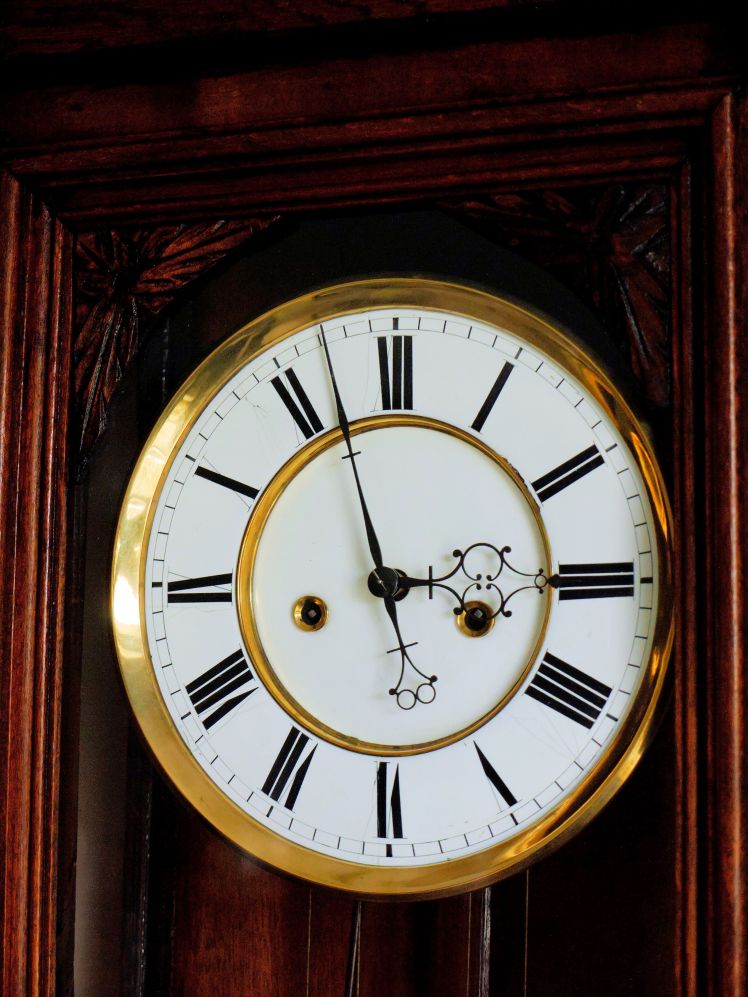
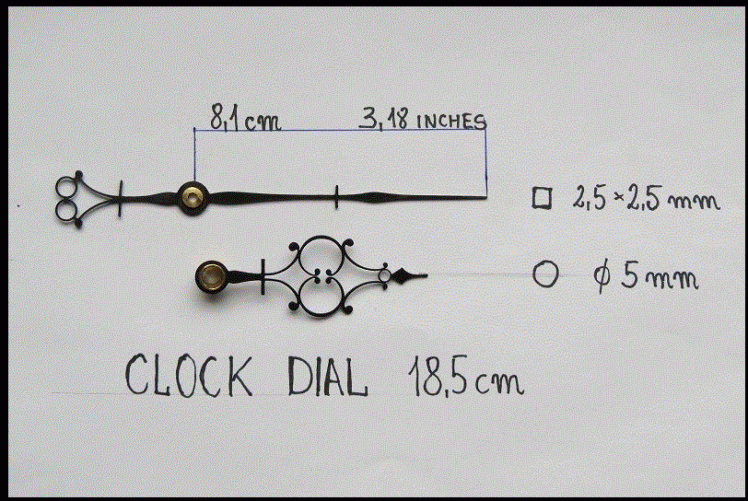
- The clock originally had Ogee clock hands rather than Vienna regulator hands. Ogee clock hands are not correct for this clock. After an extensive search through suppliers in Canada, the U.S., and Britain, I was surprised by the limited availability of Vienna regulator hands. Eventually, I sourced a set from Poland. Although they are not historically accurate and not the design that might have been on the clock face at the time, I eventually settled on sleeker hands that look appropriate and will suffice for now.
Lessons Learned
I hesitate to dig any deeper into this clock, fearing I will uncover even more shortcomings.
Despite its mix of original and replacement parts, this clock remains a valuable learning experience.
Many collectors unknowingly own FrankenClocks—clocks that have been altered with non-original or mismatched parts. While reputable auction houses often disclose repairs, replacements, or questionable components, online listings are far less reliable. Sellers on popular online marketplaces may not always be aware of a clock’s history or may choose to omit important details.
When buying a clock, especially online, approach with caution. Examine all available photos carefully, looking for inconsistencies in the case, dial, hands, movement, and other components. Ask the seller direct questions about originality, repairs, or missing parts, and request additional photos if something seems unclear. If possible, compare the clock to known examples from reference books, collector forums, online image searches, or auction archives.
Be particularly wary of listings that provide vague descriptions, low-quality images, or no mention of service history. A clock that looks pristine may have been heavily restored, while one advertised as “original” may contain replacement parts that significantly affect its value. If purchasing in person, inspect the clock thoroughly—check for signs of “over-restoration”, mismatched components, or modern hardware securing old parts. If I see a Robertson or Phillips screws on a 100+-year-old clock I immediately back away.
Ultimately, knowledge is your best defense. The more informed you are about a particular clock model, the better equipped you’ll be to recognize potential red flags before making a purchase.
Discover more from Antique and Vintage Mechanical Clocks
Subscribe to get the latest posts sent to your email.
 Antique and Vintage Mechanical Clocks
Good morning Ron.
I went through this dilema not too long ago with a schoolhouse short drop. The face indicates it is a time only clock with no evidence of a strike winding arbor. However the movement appeared to have been modified by cutting the strike side off. After much research I’m confident it came from the Hamilton clock works like this and currently is one of only 3 in existence. (One other in the Canadian clock museum in Deep River Ontario and the other in the city of Hamilton)
LikeLike
Several other American companies did exactly that. Easier to cut a T&S rather than designing a new time-only movement.
LikeLike
at least it did not have Seiko movement..
it also seems to me that when it comes time to inevitably in salary collection, you will have a list of qualified potential buyers. If you keep track of whom you purchase parts and clocks from
LikeLike