
The maker of the movement is HAU or HAC. The familiar cross arrows trademark of the maker is stamped on the movement, in the middle of the backplate.
HAC was formed in Germany in 1873 by Paul Landenberger and Phillipp Lang and was originally called Landenberger & Lang Uhrenfabrik. The company changed its name to Hamburg Amerikanische Uhrenfabrik (HAU)/Hamburg American Clock Company (HAC) in 1883. The famous crossed-arrows became their trademark in 1892. In 1926 the company went into a cooperative with Junghans and in 1930 they finally merged with Junghans.
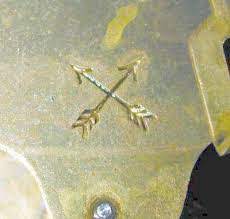
HAC/HAU clocks can be difficult to date prior to Junghans acquisition of HAC/HAU in 1930. Once Junghans and HAC began their collaboration in 1926 some of the movements were date coded.
Now on to the adjustment of the movement that is the subject of this article.
Strike Adjustment Required
Earlier in the fall this time and strike mantel clock was serviced. During the servicing six new bushings were installed, all components were cleaned, the mainsprings serviced and the clock reassembled and tested.

However, during testing, the movement did not strike correctly. While there can be several causes, the most common of which is a misalignment of the hammer tail with the star points on the star wheel. This issue frequently arises during the reassembly of this type of clock movement.
Taking the time to carefully double-check the placement of parts, and ensure everything is in its correct place will help ensure the reassembly is smooth and successful. Once the wheels are in place there is only one multi-arm ever that resides between the plates. Position it such that the long arm rests in one of the deep slots of the count wheel while a short arm is placed in the cut-out of the cam wheel.
My usual practice is to position all the wheels and the lever(s) on the plate that has the movement posts, first. Once the wheels are correctly located, I lower the front plate onto the back plate. I secure two nuts to the mainspring end which prevents the movement plates from moving around as I position the upper wheels and their pivots in the train.
Setting up the strike side can be tricky. The wheels and levers must be set up correctly or the strike will not function. For instance, the width of the slots on the count wheel tells us that there is no “passing strike” on this movement. In some count wheel movements, for example, in many American-made movements, the half-hour is actuated by a cam on the centre arbour.
The pin-wheel, which is uppermost and one wheel removed from the fly on the strike side, is placed in approximately the 10 to 12 o’clock position, called the “warning” position. This allows for a half-turn to set up the strike.
To make the adjustment of the star wheel there is no need to completely disassemble the movement. Loosen the nuts on the strike side and gently lift the plate taking care not to dislodge the wheels on the time side. Disengage the star wheel from the adjacent wheel and rotate it slightly so that the hammer tail is in the middle of two of the star tips.
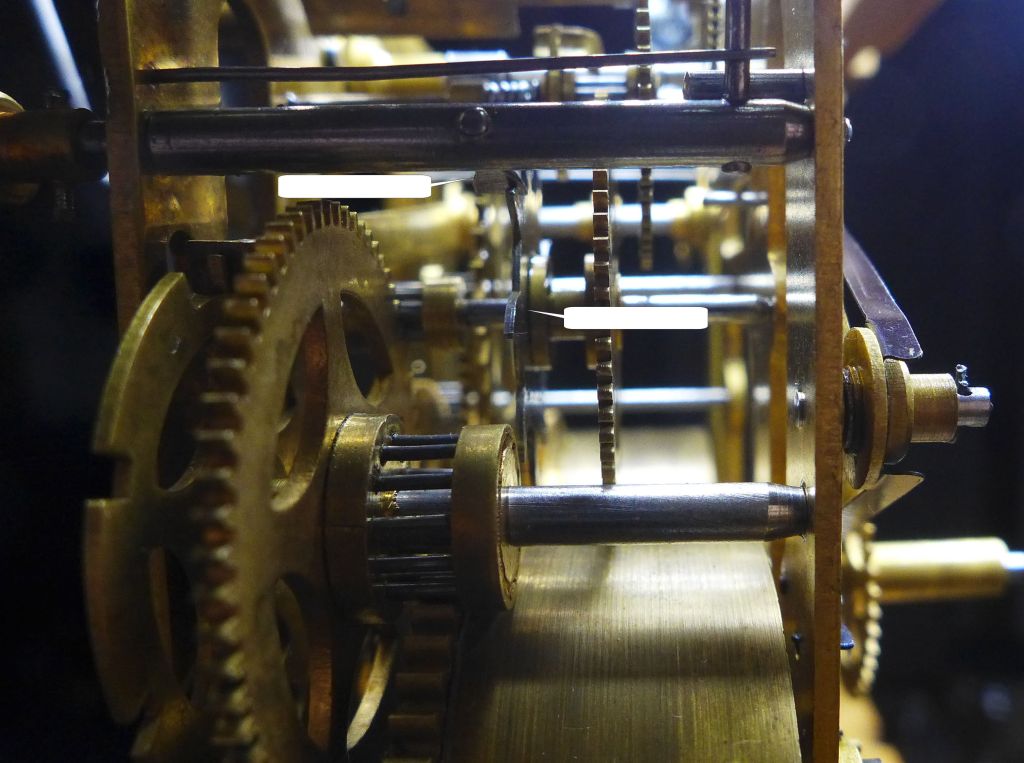
The adjustment was made. On the test stand, the hammer tail isn’t perfectly centered between two of the star points, but it should function adequately.
If the hammer tail is in contact with the star point at the end of the strike sequence, it will hold in the raised position and the strike may not function at all from that point onward. While you are making this adjustment, ensure that the strike lever spring (which is a straight wire) is on the outside of the strike arbour.
In Sum
Adjusting the strike mechanism on an HAC movement requires patience, precision, and attention to detail. By carefully aligning the hammer paddle, star wheel, and other components, you can restore the clock’s striking functionality and ensure reliable performance. While challenges such as this are common when reassembling these movements, a systematic approach and an understanding of the mechanism’s function can make the process smoother.
Discover more from Antique and Vintage Mechanical Clocks
Subscribe to get the latest posts sent to your email.
 Antique and Vintage Mechanical Clocks