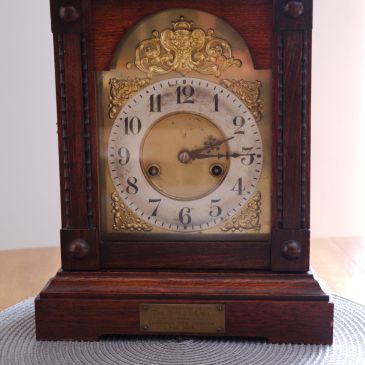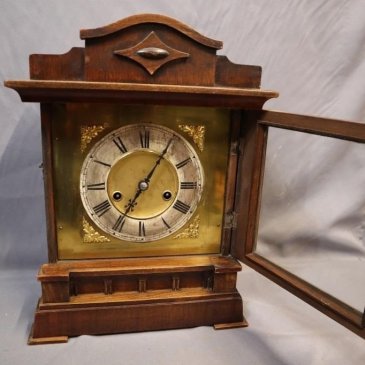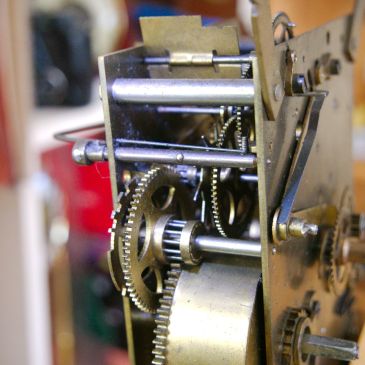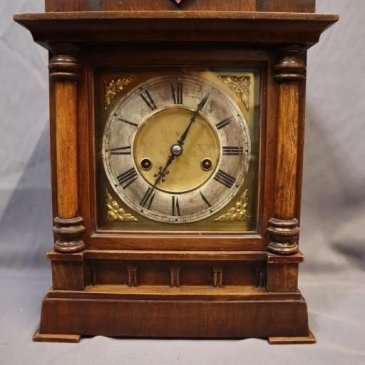
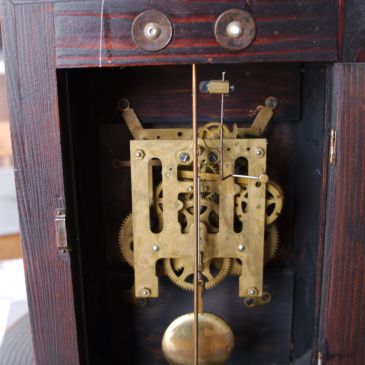
The maker of the movement is HAU or HAC. The familiar cross arrows trademark of the maker is stamped on the movement, in the middle of the backplate.
HAC was formed in Germany in 1873 by Paul Landenberger and Phillipp Lang and was originally called Landenberger & Lang Uhrenfabrik. The company changed its name to Hamburg Amerikanische Uhrenfabrik (HAU)/Hamburg American Clock Company (HAC) in 1883. The famous crossed-arrows became their trademark in 1892. In 1926 the company went into a cooperative with Junghans and in 1930 they finally merged with Junghans.
HAC trademark
HAC/HAU clocks can be difficult to date prior to Junghans acquisition of HAC/HAU in 1930. Once Junghans and HAC began their collaboration in 1926 some of the movements were date coded.
Now on to the adjustment of the movement that is the subject of this article.
Strike Adjustment Required
Earlier in the fall this time and strike mantel clock was serviced. During the servicing six new bushings were installed, all components were cleaned, the mainsprings serviced and the clock reassembled and tested.
The movement has been cleaned and serviced
However, during testing, the movement did not strike correctly. While there can be several causes, the most common of which is a misalignment of the hammer tail with the star points on the star wheel. This issue frequently arises during the reassembly of this type of clock movement.
Taking the time to carefully double-check the placement of parts, and ensure everything is in its correct place will help ensure the reassembly is smooth and successful. Once the wheels are in place there is only one multi-arm ever that resides between the plates. Position it such that the long arm rests in one of the deep slots of the count wheel while a short arm is placed in the cut-out of the cam wheel.
My usual practice is to position all the wheels and the lever(s) on the plate that has the movement posts, first. Once the wheels are correctly located, I lower the front plate onto the back plate. I secure two nuts to the mainspring end which prevents the movement plates from moving around as I position the upper wheels and their pivots in the train.
Setting up the strike side can be tricky. The wheels and levers must be set up correctly or the strike will not function. For instance, the width of the slots on the count wheel tells us that there is no “passing strike” on this movement. In some count wheel movements, for example, in many American-made movements, the half-hour is actuated by a cam on the centre arbour.
The pin-wheel, which is uppermost and one wheel removed from the fly on the strike side, is placed in approximately the 10 to 12 o’clock position, called the “warning” position. This allows for a half-turn to set up the strike.
To make the adjustment of the star wheel there is no need to completely disassemble the movement. Loosen the nuts on the strike side and gently lift the plate taking care not to dislodge the wheels on the time side. Disengage the star wheel from the adjacent wheel and rotate it slightly so that the hammer tail is in the middle of two of the star tips.
Tail and star point (arrows), in this photo, the tail is almost resting on the star point which is not the optimal position
The adjustment was made. On the test stand, the hammer tail isn’t perfectly centered between two of the star points, but it should function adequately.
If the hammer tail is in contact with the star point at the end of the strike sequence, it will hold in the raised position and the strike may not function at all from that point onward. While you are making this adjustment, ensure that the strike lever spring (which is a straight wire) is on the outside of the strike arbour.
In Sum
Adjusting the strike mechanism on an HAC movement requires patience, precision, and attention to detail. By carefully aligning the hammer paddle, star wheel, and other components, you can restore the clock’s striking functionality and ensure reliable performance. While challenges such as this are common when reassembling these movements, a systematic approach and an understanding of the mechanism’s function can make the process smoother.
As we enter a new year it is time to look back on the adventures and milestones I’ve experienced in the world of antique and vintage clock collecting and repair in the past year. 2024 has been one of discovery, growth, and deepening appreciation for the art of horology.
Over the past year, I have been shifting the focus of my collection. While I have acquired clocks from various countries, my interest has increasingly centered on Canadian clocks and those with a Canadian connection. This focus is evident in my acquisitions of the following clocks this year.
Adding to the Collection
My collection of Arthur Pequegnat clocks grew significantly this year with the addition of some standout pieces.
Arthur Pequegnat Hamilton Tall
The Dandyand Hamilton Tallmodels were particular highlights, each offering unique insights into the craftsmanship and history of the Pequegnat Clock Company.
Arthur Pequegnat Dandy
I also came across a rare find — a 30-hour Ogee clock by the Canada Clock Co., a true testament to Canadian clockmaking heritage. An interesting feature of this clock is the faux grain finish on the wood case, which was evidently a cost-saving measure by the company to make their prices competitive with American manufacturers at the time.
Canada Clock Co. Ogee
One of my most memorable acquisitions was an Arthur Pequegnat Simcoeclock (not pictured), purchased in 2018 from a shop in Victoria, British Columbia, for close to $200. This year, I added the Jewelmodel to my collection after spotting it on a high shelf at a local antique shop. Its price was surprisingly modest, coming in at less than a quarter the cost of the Simcoe making the find all the more satisfying. The addition of legs and side handles distinguishes it from the Simcoe.
Arthur Pequegnat Jewel
My most interesting acquisition was not a Canadian clock but a German-made Kienzle wall clock, which was given to me by a gentleman in Ontario (Canada).
Kienzle time and strike wall clock
The clock had been passed down from his grandfather, and the seller hoped to find someone who would truly appreciate it. He contacted me for advice and asked about its value. I offered some insights and mentioned that if he was unable to sell it, I would be happy to take it off his hands. Honestly, I never expected to hear back from him after that.
Several months later, he reached out to tell me that he would be gifting it to me. We arranged a hand-off in a small village in Quebec, and it has since become part of my collection. It is a handsome clock with a resonant two-tone strike that is one of the most “complete” clocks in my collection (for more on this clock go here).
Repairing and Restoring
In 2024, I spent less time repairing and servicing clock movements, instead focusing on my blog, researching clocks and clock companies and their histories, and maintaining my collection.
On the repair front, I tackled several challenging yet rewarding projects, including a Seth Thomas Type 89 time and strike and a HAC/HAU time and strike movement. These were standard servicing tasks that presented minimal issues.
Generally, my servicing philosophy is to avoid replacing original components as much as possible but I always test and ensure they meet the clock’s functional requirements. This year reinforced my belief that preserving original parts is vital to maintaining a clock’s authenticity.
HAC (Hamburg American Clock Co.) movement with plate removed
Among the repairs waiting their turn is the Danby model by Arthur Pequegnat which has been placed on the back burner due to other priorities. With three other movements to finish first, the servicing of those clocks plus the Danby will be projects for later in 2025.
Mauthe wall clock
Another project I’ll be tackling in 2025 is a family clock. This past year, I received my father-in-law’s clock for repair. It was passed down to my wife’s brother and has been out of service for over 25 years. I plan to return it fully serviced, and I hope that this stately Mauthe wall clock will take a prominent place in my brother-in-law’s home as a sentimental reminder of my wife’s father.
Sharing the Passion
This year celebrates seven years of blogging about clock collecting, repairs, and restoration. My blog has become a platform to share knowledge and stories, blending my love of writing, photography, and horology. Though I took a break for the holiday season, I look forward to returning this year with fresh content and inspiration.
One of the goals of this blog is to introduce antique and vintage clocks to younger generations and inspire an appreciation for these remarkable mechanical devices from the past. In today’s modern age of a throw-away culture, how many items can you think of that still function flawlessly after more than a century? It is a short list indeed!
A Special Milestone
In 2025, I will celebrate the remarkable milestone of reaching 1 million views, and I’ll be publishing a special article to mark the occasion. This achievement highlights the significant impact and reach of my content, demonstrating that my blog has resonated with a broad audience and built a dedicated following over time. Reaching this level of engagement is a testament to the value and quality of the information I share, making it an incredibly rewarding accomplishment as a creator.
A Broader Perspective
My collecting journey has always been intertwined with a sense of history and nostalgia. Yet, I’ve also faced the reality that interest in antique clocks is waning among younger generations. While my children may not share my passion, I find joy in preserving my clocks for future collectors or enthusiasts who might rediscover their charm. I hope that a younger generation will emerge and find value in collecting these old treasures.
My tastes and collecting habits are evolving, and I am increasingly focusing on Canadian-made clocks or those with a significant Canadian connection. This year, I may sell some of my more common clocks, which will reduce my collection to a more manageable size while still preserving my collection of 15 Canadian-made clocks.
Looking Ahead
As the New Year is upon us, I’m excited about the possibilities. My trip to the UK in 2024 provided opportunities to explore horological treasures, visit museums, and reconnect with my British heritage. Whether acquiring new clocks or deepening my understanding of their history, I’m eager to see where future journeys take me.
To all fellow enthusiasts and readers of my blog: thank you for your support and shared passion for these timeless pieces of history. Here’s to another year of celebrating the art and craft of clocks!
I am currently working on a mantel clock from the Hamburg American Clock Company. This is Part II in a two-part series. For Part I go here.
The Hamburg American Clock Company is otherwise known as Hamburg Amerikanische Uhrenfabrik or HAU and in many parts of the world, it is simply known as HAC.
HAC mantel clock circa 1926
In Part I, I described the steps taken so far which are disassembly, inspection, cleaning of the parts, and polishing of all pivots. The next steps are bushing work, reassembly, oiling (the mainsprings were oiled in a previous step), and finally, testing.
I believe this is the No. 36 movement by HAC.
HAC clock movement #36
The wheels that spin the fastest typically show the most bushing wear, but wear can also appear in other areas, such as the main wheels, which endure significant torque. For instance, I observed punch marks on the cap side of each mainspring barrel. While punching around any bushing hole is generally poor practice, it appears this was done at some point in the clock’s history and can’t be reversed. Nonetheless, the repair seems to have held up well.
Bushing Work
I have seen similar movements with much more wear than this one, but I felt that some bushing work was necessary to extend the clock’s lifespan.
Bergeon Bushing Machine
Six Bergeon brass bushings were installed in total. For the time side (T), bushings were placed at T1 (front and back) and T3 (back). For the strike side (S), bushings were installed at S3 (back), S2 (front), and S4 (front). The numbers indicate the wheel location in the train beginning from the bottom. A couple of pivot holes were borderline, but I decided to leave them as they are.
Reassembly
It pays to be patient and methodical during reassembly. Rushing can lead to mistakes, such as missing steps or improperly aligning parts, which could cause malfunctions or even damage later. Taking the time to carefully double-check the placement of parts, and ensure everything is in its correct place will help ensure the reassembly is smooth and successful.
An older HAC movement, without the barrel cutouts
Once the wheels are in place the lever and there is only one multi-arm ever that resides between the plates. Position it such that the long arm rests in one of the deep slots of the count wheel while a short arm is placed in the cut out of the cam wheel (as above).
Positioning the pivots is a delicate process, and any forceful handling can result in a bent or broken pivot. In this, as in all cases when aligning pivots, a pivot locator is your best tool.
Pivot locator
My usual practice is to position all the wheels and the lever(s) on the plate with the movement posts, first. Once the wheels are correctly located, I lower the front plate onto the back plate. I secure two nuts to the mainspring end which prevents the movement plates from coming apart as I position the upper wheels in the train.
The pin-wheel, which is uppermost and one wheel removed from the fly on the strike side, is placed in approximately the 12 o’clock position, the warning position. At the same time the hammer paddle is positioned between two of the points on the star wheel. More than once I have had to go back in to make minor adjustments when the paddle hangs up on one of the star points. It looks like this one is also a candidate for that very adjustment.
A Timetrax machine is used to adjust the beat and the rate of the movement.
The movement has been placed on a test stand and the time side Is in beat and running as it should according to my Timetrax machine. Curiously, the Timetrax manual lists only one HAU/HAC movement, a three-train one but this one is likely similar to Junghans bracket clock movements which runs at 164 bpm. Junghans is mentioned for comparison because, by 1930, the company had successfully taken full control of HAC.
Testing
The testing phase is crucial in the process of servicing a clock, often taking the most time because it ensures that the clock is functioning properly before it is reunited with its case.
During this phase, the clock is put through various operational checks to simulate real-time performance, which helps in identifying any issues that may not have been apparent during the initial servicing or cleaning process. Issues such over-tightened or loose components can present themselves as well as problems with the escapement mechanism.
The testing phase serves as an important diagnostic step to identify what further repairs or adjustments may be needed.
This concludes the servicing of an 8-day HAU/HAC movement. If you have any comments or feedback on any of the steps in the process, please feel free to share!
Among clock collectors and admirers, the Hamburg American Clock Company is a well-known German company. It is otherwise known as Hamburg Amerikanische Uhrenfabrik or HAU and in many parts of the world, it is simply known as HAC.
In this post, I will outline the procedures involved in servicing the movement of a HAC mantel clock produced circa 1925. It’s worth noting that HAC crafted clocks for international markets, and in the case of this particular clock, it spent a period in England after its initial manufacturing.
Time and strike mantel clock made by the Hamburg American Clock Co. known as HAC or HAU
Disassembling the movement
After removing the clock hands and releasing the six screws that attach the movement to the front dial board the movement can be maneuvered carefully around the bronze rod gong without having to remove the gong itself.
Front of type 36 HAC movement
Once out of its case, the first step is to remove the suspension spring and pendulum leader. A taper pin secures the spring onto the suspension post.
Next, safely let down the mainsprings using a letdown tool. On this movement, and I have not seen it elsewhere, there is a small pin on each rachet. Once the letdown tool is placed in the arbour, it is a simple matter of pushing the pin on the click with a small screwdriver and allowing the rachet to run freely, under control, of course.
The pin is indicated by an arrow
At this point, the two exterior wheels, both rachets with their retainers and the click springs can be removed as well as the “V” shaped stop lever.
On the front of the movement, two screws hold the pallet arbour plate, and with it comes the crutch. Note the position of the small pallet arbour plate for future reference. This is also a good time to remove the hammer from its arbour but the plates can be separated with the hammer still attached.
At this stage release the 4 nuts holding the movement and the back plate can be removed. There are two springs which look like stiff wire, one is for the count lever and the other for the hammer. Do not break these springs and be careful handling the plate once it is separated. The wire springs can be repaired if they break but it adds more work to servicing.
Plate is removed
Once the plate is lifted from the movement, the wheels and levers can be removed. Strike and time side wheels are then separated into containers. I like working from the top down and carefully removing each wheel one at a time. The centre cannon is the last wheel to be removed. The half-hour cam, a star wheel with two points, is on a tube which can be pulled off the arbour and the centre wheel easily lifts out. Once the centre cannon is removed the mainspring barrels can be extracted and put aside for servicing.
Assessing wear
Identifying whether a movement has undergone previous work can be challenging, but scratch marks around pivot holes typically suggest past work. An unmistakable sign of prior servicing is the presence of punch marks, as observed around the mainspring barrel on the time side. The aggressive punching suggests that the arbour hole was enlarged considerably. However, the arbour’s fit through the barrel appears sufficiently tight, indicating no immediate concern.
Time-side mainspring barrel showing punch marks
While it’s not approved today, punching pivot holes was a common practice in the past.
The movement is relatively clean but over-oiled the result of simply lubricating the clock over the years without actually checking to see if it required new oil.
There are very few issues with the movement with a potential need for two new bushings on the strike side and just one on the time side.
Cleaning the movement parts
Cleaning a clock movement’s parts is a fundamental step in the maintenance and restoration process. It not only improves the immediate performance of the clock but also contributes to its long-term durability and accuracy.
Cleaning a mechanical movement’s parts before reassembling a clock movement is crucial for several reasons, to remove dirt and debris, prevent wear and damage, optimize performance identify and any perfomance issues. Cleaning is often accompanied by the application of fresh lubrication to key components. Lubrication reduces friction between moving parts, minimizing wear and ensuring smoother operation. This step is vital for maintaining the health of the movement.
Antique clocks have been an integral part of human history, and they continue to be cherished by collectors and enthusiasts alike. However, in a world where digital timekeeping is more prevalent, what does the future hold for antique clocks?
Sawin banjo clock C. 1840
While it’s true that the digital age has brought about significant changes in the way we keep time, it’s important to note that antique clocks still hold a unique place in our culture. These clocks not only tell time but also serve as pieces of art, heirlooms, and historical artifacts. They offer us a glimpse into the past and provide a tangible connection to our ancestors.
Despite the rise of digital timekeeping, antique clocks are still with us, and their popularity continues to grow. The beauty and craftsmanship of these clocks are unmatched, and many people appreciate the time and effort that went into creating them. While there is a growing market for antique clocks, and collectors are willing to pay top dollar for the most unique pieces, prices for common antique clocks have stagnated over the past several years as many clocks have flooded the market.
Fusee gallery clock
However, a factor contributing to the future of antique clocks is the growing interest in vintage and retro styles. More and more people are seeking vintage and antique items to decorate their homes, and antique clocks fit perfectly into this trend. Antique clocks are not only functional but also add a touch of class and sophistication to any room.
In addition to their aesthetic appeal, antique clocks also offer a sense of nostalgia and tradition. They remind us of a time when life moved at a slower pace and things were simpler. For many people, owning an antique clock is a way to connect with the past and honour their family’s heritage.
Hamburg American Clock Co. C. 1910
So, what does the future hold for antique clocks? While it’s true that digital timekeeping will continue to be the norm, there will always be a place for antique clocks in our culture. These clocks offer something that digital clocks can’t: a physical connection to the past and they serve as a reminder of the rich history and traditions that have shaped our world.
With the constant advancement of technology, it is very likely that antique clocks will progressively increase in value and become even more highly desired by collectors and enthusiasts alike. As people feel more disconnected from the physical world, the value of tangible objects like antique clocks will only increase.
I believe the future of antique clocks is bright. Antique clocks offer us a tangible connection to the past and provide a way to honour our heritage. They are not just the marriage of brass and wood but also works of art, heirlooms, and historical artifacts. As long as people continue to appreciate the beauty and craftsmanship of antique clocks, their future is secure.
I knew when I first laid eyes on the clock that it was missing something, the crown.
It’s too bad because it is very attractive Hamburg American Company or HAC 8-day time and strike mantel or parlour clock.
HAC mantel clock
The little plaque on the base references 1926 the year it was presented to a pastor in England presumably for years of faithful service. I think the clock was made a few years earlier. Back in those days clocks like this might have sat on a Merchant’s shelf for years.
The chap I bought it from said it was an English clock but I knew right away that it was German. It has that distinctive German look and style of a clock made after 1900. Since he was a clock collector he should have known by looking at the trademark on the back of the movement. Oh well!
Time and strike movement
Okay, back to the crown. I have another HAC time and strike with a crown.
HAC mantel clock
I am willing to bet that the crown on my new acquisition was either very similar or exactly like the one on a HAC I bought a year ago. It fits exactly into the slot on the top.
Now with a crown
A crown makes a difference. You can see that adding a crown transforms the clock. It made be subtle but there is a difference. The problem I have now is, should I leave on this clock or the other?
Honestly, an entire book could be devoted to the topic of dating clocks. Some time ago, I published an article titled “How to Date an Antique or Vintage Clock – Part I,” in which I used specific examples from my own collection.
I’d like to explore this topic further, and this post will discuss additional methods for dating an antique or vintage mechanical clock. While there is no one definitive method for dating an antique or vintage clock, there are often clear clues in some cases and more subtle hints in others that can help pinpoint when a clock was made.
Occasionally, the exact month and year are displayed somewhere on the case, and in other instances, the clock by way of serial numbers, date stamps on the movement, style of hands, spandrels, dial design, case design, and so on, establishes the date to within a certain period.
After 1896 foreign clocks (Europe, England) were mandated to have the country of origin on the case, usually on the dial. Any clock made after that date will have the country of origin.
Duration of manufacture
A bit of research into the history of a clockmaker can help you narrow down the timeframe for dating your clock. For instance, the E.N. Welch Clock Company, an American manufacturer, produced clocks until 1903, when it was acquired by the Sessions Clock Company, which continued making clocks until 1970. The E.N. Welch Clock Company made clocks for a 50-year period until its acquisition by Sessions in 1903.
By 1903 German-based clock manufacturer Junghans was the largest clock maker in the world and continued in its quest to bring more companies into the fold. Gustav Becker, founded in the 1860s, and Hamburg American Clock Company, founded in 1883 were absorbed by Junghans in the late 1920s. Although those companies were folded into Junghans in 1926 the Gustav Becker name lived on for another 9 years.
Gustav Becker regulator C.1907, Braunau factory
Clocks with Steel vs Brass platesvs Woodworks movements
Smaller shelf clocks with 1-day (30-hour) wooden movements were produced in fairly large quantities from around 1810 to 1845, after which most clockmakers changed over to brass movements. Wood dials were also popular during this period.
Daniel Pratt woodworks movement with dial removedC.1832-38
By 1860 iron weights were being replaced by springs as the power source, and smaller clocks, many of them 8-day, were becoming increasingly popular. Early American spring-driven clocks used brass springs (late 1830s) until steel became cost-effective.
This information is important for dating a clock because it highlights key transitions in clockmaking technology and design, which can help pinpoint the era in which a clock was made. For example, the use of wooden movements and wood dials can indicate a clock was produced between 1810 and 1845. The shift from iron weights to springs by 1860 helps us understand why spring-driven clocks became popular, which is crucial for narrowing the period of manufacture. Additionally, the switch from brass springs to steel in the early 1840s can provide a more precise date range for early spring-driven clocks.
Understanding these technological changes allows you to make more informed judgments about a clock’s age based on its features.
Brass mainsprings from a Manross steeple clock C.1837
During periods when brass was in short supply such as the World Wars (WWI and WWII), makers often made steel plate movements with brass bushing inserts. However, some companies such as Arthur Pequegnat used either steel plates or brass-plated steel plates throughout their operating years (1902 to 1941).
Steel plates on a Pequegnat time and strike clock
Other clock companies switched to steel as a cost-cutting measure when brass prices were high, not necessarily during wartime.
Screws and nails, chime rods, coiled gongs
In older clocks, nails, and screws were made of iron and hand-forged, with screw heads being slotted. Hand-forged nails can be found in clock cases dating from the earliest examples up to the mid-19th century, after which machined screws and nails started to replace them.
An ogee clock, like this example made by George H. Clark in 1865, was constructed with hand-forged nails.
George H Clark 30-hour Ogee shelf clock
Robertson and Phillips head screws were introduced in the first part of the twentieth century. Since the Robertson head was invented in 1906 and Phillips screw heads only began to be widely used in the 1930s screws of these types found in older antique clocks are later additions.
Since these screw types were introduced in the early 20th century, their use in a clock that dates from an earlier period suggests that the screws were likely replaced or added during a later restoration or repair. Recognizing these screws helps refine the clock’s dating and can provide insight into its history and any modifications it may have undergone.
The first rod gong, a single striking rod, dates back to patent designation DRGM 108469, granted to Johann Obergfell on December 23rd, 1899. The introduction of the rod gong, as opposed to earlier bell or strike systems, represents a key development in the evolution of mechanical clocks, especially in terms of sound quality and the technology used.
Understanding when this innovation occurred can help date a clock more accurately, particularly those with rod gongs, as it indicates they were likely made after 1899. Rod gongs are typically made from a copper or nickel alloy and are press-fitted into a block.
Thick coiled gong
There are two types of coils: the thick coils, which spiral only a few times and produce a deep, rich tone, and the thinner coils, which spiral many times and often have a higher-pitched, tin-like sound. Thick coils were used well before the mid-1800s. These coils are typically mounted onto a fitting, which is then attached to an iron block. Smaller, thicker coils became more common towards the end of the 19th century.
On the American front, thin wire coils were very common. Some examples had the coil mounted to a dome-shaped base which was said to improve the tone considerately.
Commemorative plaques
Commemorative plaques which display dates are often a good indicator of the age of a clock. However, the clock may have been on a seller’s shelf for years before the date on the plaque. This nevertheless places the clock within a certain range of dates. This photo shows a plaque on a HAC (Hamburg American Clock Co.) time and strike shelf clock.
HAC shelf clock with the date 1926 on a plaque
Type of escapement
Recoil (anchor), half deadbeat, Graham deadbeat, pinwheel, Brocot types are found in older antique clocks while, hairspring, floating balance, lever type escapements are found in newer vintage (less than 100 years old) clocks.
For example, floating balance movementsbegan appearing in mechanical clocks in the early 1950s. The floating balance will tolerate being out of level, unlike pendulum clocks which must be on a level surface, an attractive marketing feature.
This is important because the type of escapement mechanism used in a clock can provide key insights into its age and technological development. Older clocks with recoil (anchor), half deadbeat, Graham deadbeat, pinwheel, or Brocot escapements reflect the horological practices of earlier periods, while newer clocks featuring hairspring, floating balance, or lever type escapements indicate a more modern design, typically found in clocks less than 70 years old.
For example, the introduction of the floating balance in the 1950s was a signifcant advance because it allows for clocks that are less sensitive to being off-level, a feature that made them more convenient for consumers. Recognizing these mechanisms helps in accurately dating a clock and understanding the technological shifts over time.
floating balance escapementC. 1950
Style of case
The style of the case, such as ogee, box clock, steeple, cottage, or gingerbread, can help date the clock to a specific period.
The style of a clock case can offer valuable clues about its age, as different case styles were popular during specific periods in history. Here’s a breakdown of some common clock case styles and their associated timeframes:
Ogee Clocks: These clocks, named for the distinctive curved, “S”-shaped design of their cases, were popular from the early 19th century, especially between 1825 and 1850 but continued to be made into the 1880s. They typically have a simple, symmetrical shape, often with a painted or paper dial, and were mostly made with wooden movements in the early years.
Box Clocks: This style features a simple, rectangular or square case, often with a hinged door or glass front. Box clocks were common in the early to mid-19th century (1920s to 1940s), with their plain, functional design making them relatively inexpensive to produce.
Steeple Clocks: Steeple clocks are characterized by their pointed, “steeple” shape at the top of the case. This design became particularly popular from the 1840s through the 1870s. Steeple clocks were typically more decorative and were often used in homes and churches, with some having more ornate carvings or decorative elements.
Cottage Clocks: Cottage clocks, with their simple and rustic designs, emerged in the mid-19th century, around the 1840s and 1850s. Often smaller in size, these inexpensive clocks were popular in rural homes. They are sometimes characterized by a more casual, handcrafted appearance, with wooden cases and floral or geometric motifs.
Gingerbread Clocks: This style, which features intricate carvings and decorative elements like scalloped edges, ornate moldings, and small, detailed pieces, gained popularity in the mid- to late-19th century (around 1860 to 1880). Gingerbread clocks are often associated with the Victorian era and were typically mass-produced.
The case style is a strong indicator of the clock’s approximate age because clockmakers and manufacturers often adapted their designs to reflect contemporary tastes. By identifying the specific features of a clock’s case—such as the materials used, shape, and any distinctive decorative elements—you can narrow down the period in which it was made, which can then aid in dating the clock more precisely.
E Ingraham Huron C.1878
Knowing the period when a case was made provides a reliable indicator of the clock’s age. Although there are earlier patent dates stamped on the movement of this E. Ingraham Huron time and strike 8-day shelf clock, this style of case was made for only 2 years, 1878 to 1880.
Date stamps on movements or cases& searchable databases
Some makers stamp date their movements or display the date elsewhere on the clock case. The Gilbert Clock Company often date-stamped their movements. Sessions put dates on the door labels.
Some makers such as Junghans stamp a date code on their movements. For example, B19 stamped on the back plate of a Junghans movement refers to a movement made in the latter half of 1919.
Serial numbers stamped on movements can be compared to a database to determine the exact year the clock was made. The Ridgeway clock company used 4-digit codes. For example, serial number 4981 refers to a Ridgeway clock made in 1981.
Gustav Becker clocks were made in both Silesia and Braunau factories, both of which produced clocks but each had a unique serial number convention. The serial number on a Gustav Becker clock will give the exact year of production assuming you know where it was made, Silesia or Braunau.
An online databases such as ClockHistory.com provides invaluable information on companies and models made by them, the years the clock company was in business, and how long the company was in operation.
Searchable databases like Mikrolisk, the horological trademark index help date a clock by comparing a trademark. Some companies revise or restyle their trademarks over the years allowing one to date a clock within a certain period.
At Antique-horology.org keywords or text can be used to search trademarks and identify years they were used.
Scottish tall case clock C.1848
The date 1848 is attributed to the clock above. I arrived at this date because it was made by William McLachlan of Newton Stewart, Scotland. According to an English clock database, Mr. McLachlan was a clock assembler and ran a clock-making business in Newton Stewart until his death in 1848. While the clock could have been assembled as early as 10 years prior, 1848 serves as a conservative estimate.
Other miscellaneous indicators
Plywood began to be used in clock cases starting in 1905. One of the clocks in my collection, a Junghans bracket clock, made around 1913, features a plywood back access door.
Seth Thomas made clocks in marble cases for a short time, from 1887 to about 1895. They also made clocks in iron cases finished in black enamel, from 1892 to about 1895.
Adamantine clocks were most popular through to 1915. Seth Thomas is best known for their “Adamantine” black mantel clocks, which were made starting in 1882. Adamantine is a celluloid veneer, glued to the wood case. Adamantine veneer was made in black and white, and in coloured patterns such as wood grain, onyx, and marble.
Seth ThomasAdamantine clock circa 1911
Final thoughts
My goal for this two-part article was to provide a broad, generalized overview. Each of the sub-topics mentioned above could be explored in much greater detail, and I hope this serves as a useful reference for some of you. I welcome any corrections to the dates, and if there’s anything I’ve missed or other information that should have been included, please feel free to leave a comment.
As I’ve outlined, there are many ways to date a clock—some methods are quite obvious, while others are more subtle and require a bit of research to pinpoint.
For some collectors and clock fans, dating a clock is crucial, as it adds historical context and value to the piece. For others, however, it may not be as important, especially if the clock serves primarily as a decorative item rather than a functional or collectible piece. In such cases, the aesthetic appeal might take precedence over its exact age.
During the Christmas season, we split our time between Calgary, Alberta, and Ottawa, Ontario to see our 2 daughters. While in Calgary my wife spotted an interesting item on an Ottawa Facebook Marketplace, an English time and strike clock.
HAU shelf clock
She showed me the photo and I said, “that does not look like any English clock I am familiar with. The style is definitely German”. There is a commemorative plaque on the front base section which references an English church so, I am assuming the seller thought it was English.
When we picked it up from his home outside Ottawa I was surprised to learn that the seller is a clock collector and had no idea the clock he was selling was German. Occasionally I sell clocks to manage my collection and when advertising one for sale I make it a point to know the maker.
But, no matter, it was in very good condition and in working order.
The movement showing the single strike rod and pendulum bob
The maker is HAU or HAC. The familiar cross arrows trademark of the maker is stamped on the movement, in the middle of the backplate.
HAC was formed in Germany in 1873 by Paul Landenberger and Phillipp Lang and was originally called Landenberger & Lang Uhrenfabrik. The company changed its name to Hamburg Amerikanische Uhrenfabrik (HAU)/Hamburg American Clock Company (HAC) in 1883. The famous crossed-arrows
Crossed arrows trademark
became their trademark in 1892. In 1926 the company went into a cooperative with Junghans and in 1930 they finally merged with Junghans.
The date on the plaque says 1926. However, HAC/HAU clocks are difficult to date prior to Junghans acquisition of HAC/HAU in 1930. Once Junghans and HAC began their collaboration in 1926 some of the movements were date coded.
Plaques are a good but not foolproof method of dating a clock. A clock purchased as a gift in 1926 could very well have been sitting on the retailer’s shelf for two or more years.
Catalogs are another good but hardly foolproof method of dating a clock. A catalog confirms that a model was made in a particular year, but that same model was probably offered 5 years +/- from the year of the catalog.
I will probably not determine a more reliable date for my new clock than circa 1926. The movement, compared to an earlier model (below), also has many cutouts and additional holes that indicate that it was a late production model and confirms that is closer to the 1926 date.
Solid plates of an early HAC clock movement CA. 1895
The clock runs for a while and stops. It is in need of a service but I expected to clean it as many of these old clocks have rarely seen the inside of a clockmakers’ shop.
The time has come to determine the best clock acquisition of the past year. As a clock hobbyist, I have had little difficulty locating interesting clocks over the years, and despite the seemingly never-ending pandemic, I have scored a few in 2021 though the past year has been leaner than most.
In the early days of collecting, simple time and strike vintage mantel clocks were my principal focus so that I could take them apart, repair them if necessary, and generally advance my learning. Many of those clocks have been either sold or gifted. For the past three years, I have shifted my focus toward collecting interesting clocks, rare clocks, or clocks that have a special provenance that even includes the odd mantel clock.
My wife is my best clock finder. Our discussions often go something like this; “did you see that wall clock on Facebook?”. “Let me see. Yeah, it looks good, what do you think? Make an offer?” and off we go. Sometimes I will accept the offer from the seller without negotiating because I feel it is a fair price and other times there is some wheeling and dealing prior to firming the sale.
At the end of the post, you will have an opportunity to vote on what you think is the best in 2021.
In no particular order, here are my finds for 2021.
Sawin banjo clock
This is a garage sale find and even though it was purchased in the spring of 2021 it is still a work in progress. The clock is over 180 years old and in pretty decent shape.
Sawin weight driven banjo clock
It is a weight-driven banjo but it has no markings. An educated guess is that it was made by John Sawin of Boston or one of his associates on or close to 1840. I have completed minor veneer work on the case and have replaced the broken glass dial. The movement has been serviced but I am now looking at clock parts supply sources to replace a badly bent suspension spring. I want to avoid paying an outrageous price for the complete assembly; suspension spring, leader and spike.
Gilbert mantel or Shawville clock
I call this the Shawville clock because it spent most of its life in Shawville, Quebec (Canada).
It was a family clock for many years and following a death in the family, all possessions were either sold off or given away, a very common practice today. It has a time-and-strike Gilbert movement in a mahogany tinted case that has led a kind life since its manufacture in 1917. It is simple and unadorned and that’s what I love about it. I serviced the movement, cleaned the case, replaced a broken hour hand and now it is on prominent display in our home.
Gilbert time and strike
New Haven tall-case clock
An interesting $90 acquisition is this New Haven tall-case clock with a secret. Wow, a tall-case clock for $90, you say. Despite the look of a weight-driven clock, it is, in fact, a spring-driven clock. I was unaware of this until I walked through the door of the seller. I bought it anyway.
New Haven tall case clock
The weight cans are empty shells and they are simply there for show. The movement is quite large, eight-day, of course, and looks to be very robust. Despite my best efforts to determine if it was originally weight driven it had to have been spring-driven from the start, in other words, no evidence of a seat board or any additional holes for mounting the movement to the case. This appears to be an early “kit clock”, i.e. movement, dial face, hands, pendulum, “weights”, and ladder chains bought from the New Haven Clock Company and fitted to a pre-made case.
The case was very dark from years of accumulated dirt and grime and vigorous scrubbing revealed a wonderful red oak finish.
Waterbury Wren mantel clock
Ansonia Syria
Another clock with a secret is actually a disappointment. I found it in an antique store and it reminded me of an Ansonia Syria I had worked on for a friend last year, so, I was drawn to it.
Waterbury Wren mantel clock
It has a Waterbury case and what I thought was a Waterbury movement, but no.
It is missing the brass bezel and glass which is easily replaced but what is most disappointing is the mismatched movement, a Seth Thomas time and strike, which obviously replaced the original movement presumably because it was worn out. The movement is well-made and runs well but at the end of the day, the clock is destined to be sold.
Schatz Schatz carriage clock
This is a Schatz carriage clock made by August Schatz and Sohne of Germany. Thousands of these were sold and given as gifts through the 60s and 70s. It has an interesting lower visible escapement and an exposed movement.
Schatz carriage clock
Although it is working and keeping time it runs for about 4 days and stops. A cleaning is called for (on my list). It has a wind-up key in the back much like a typical alarm clock. It says West Germany on the dial and made, I would say, in the 1970s. August Schatz and Sohne closed in 1985, a victim of slow sales and a shift to quartz clocks by other makers.
Chauncey Jerome ogee clock
This clock is original in many ways, with a nearly flawless case made of mahogany veneer over softwood, moon hands, a wood dial, and a movement that matches when the case was made. Even the pendulum bob looks original. It was missing the suspension spring and rod and a wooden movement block, all easily sourced.
Chauncey Jerome 30-hour ogee clock
It cleaned up nicely and was a good candidate for a fresh coat of traditionally prepared shellac. I have three other 30-hour ogee clocks and this one is the most original of the bunch.
E. Ingraham Grecian shelf clock
This is a very nice shelf clock from an estate auction. It is an Ingraham Grecian clock with an alarm feature. If you have ever used the alarm on an old antique clock your first impulse is to throw it through a window, it is so loud and it goes on and on till the spring winds down.
Ingraham Grecian 8-day shelf clock
It came with incorrect hands and I had the darnedest time sourcing them but searching various suppliers in Canada and the US paid off. The case has been cleaned and the movement serviced including the infuriating alarm.
Fleet Time Co. mantel clock
An inexpensive clock that had huge potential but left me frustrated. Fleet Time Co. of Montreal had a short life of 4 years before the Second World war when they lost their source of German movements.
Fleet Time clock
I stripped the case and re-glued some sections, applied a walnut stain and I was very pleased with the final result. I serviced the movement, wound the time side completely, and BAM, kerplunk! the sound of a mainspring exploding. Sometimes you can get away with just replacing a mainspring and other times, like this, it took out the barrel teeth and a leaf pinon on the second wheel. I placed it in a plastic bag and it is now on a shelf in the basement awaiting donor parts.
Hamburg American Clock Company. (HAC) mantel clock
This German-made mantel clock has an interesting 14-day movement, an early production type from HAC. HAC is short for the Hamburg American Clock Company, a German company which had a long history up to the time it was absorbed by Junghans in the late 1920s. This clock was made in or around 1895.
HAC 14-day mantel clock
It was another estate sale find. The case is nondescript and nothing special, but quite elegant.
So…..
Tell me what you think and I will reveal what I believe is my best acquisition this year in the next post. Let’s see if we agree.
Servicing the movement is complete. Next is the case.
For those unfamiliar with the HAC acronym, it stands for Hamburg American Clock Company, a well-known German company that was acquired by Junghans in the late 1920s. I have a number of German clocks including Junghans, Mauthe, Hermle, Jauch, Gufa, and Gustav Becker but this is the first HAC clock in my collection. This clock dates to somewhere between 1900 and 1908.
Here is the auction photo of the clock.
HAC mantel clock (reproduced with permission)
As you can see there is some wear as expected from a 100+-year-old clock. The dial is especially grimy.
I focused on the dial first, managing to remove most of the grime while retaining its patina. Plus I touched up the numbers and chapter ring. There were numerous scratch marks on the dial surround and I did my best to clean it up and make it more presentable but it is what it is. Check out this article for more information on cleaning the dial.
HAC clock is attractive but the dial required a lot of work
Stripping a case is always the last resort in my view. There is visible wear on the bottom corners, the lower part of the columns, and column capitals but not enough to justify removing the finish.
I cleaned the case with Murphy’s soap, applied 2 coats of shellac using 4X0 steel wool between coats followed by a coat of Minwax finishing wax.
HAC mantel clock
Better but not perfect but perfect was never my goal. Now, where to put it?
The movement has been serviced and the next step to bringing this clock back to life is cleaning a very grimy, tarnished and worn dial.
For those unfamiliar with HAC or, The Hamburg American Clock Company (Hamburg Amerikanische Uhrenfabrik), it is a well-known German company that was incorporated in 1876 as Landenburger and Lang, later with a name change to HAC in 1883 and was eventually acquired by Junghans in 1926.
Its best-known trademark is the “crossed arrows” symbol found on the movement plate and the coil gong. Unlike most HAC clocks there is no cross arrows trademark on the gong though there is one on the movement behind the pendulum rod. The name “Hamburg” was chosen at the insistence of one of its investors and “American” refers to similar American-style production methods.
I have a number of German clocks including Junghans, Mauthe, Hermle, Jauch, Gufa, and Gustav Becker but this is the first HAC clock in my collection.
HAC clock auction photo
I bought this clock online at an estate auction in February of 2021 and because of the pandemic I had it shipped to me. The only thing I had to go on were the auction photos but it is no different than taking a chance on an eBay or similar site. Once I opened the package it is what I excepted, no surprises.
While it is an attractive design it is dirty and likely has never been cleaned. There are no parts missing, a bonus, but the case and dial require attention.
The most distracting element is the dial. In short, it is a mess.
HAC dial closeup
Two options
One is to replace the dial from a donor clock but given the small amount of money put into it, the fix would have been pricey. Those I have found in my internet search are going for more than I paid for it. The second option is to clean it up and make it as presentable as possible.
Cleaning the dial
Normally I use a good water-based cleaner to remove grime from a dial but in this case, the blackish-grey tinge you see in the above photo is actually 100 years of built-up oil, grease and grime. I am sure an auto mechanic owned the clock and adjusted it before he washed his hands.
Drastic measures are called for. I knew that I would be stripping the remainder of the cream-coloured paint from the dial but as I discovered, there is so little paint left that it would not have made a difference. The numbers were also rubbed away after years of use.
HAC clock is attractive but the dial needs a lot of work
I took the dial out of the case and using Q-tips and a cleaning solution took away as much grime as possible. Some 50 Q-tips later I managed to remove most of the dirt. After rinsing with water and wiping the dial, I filled in the numbers using water-based acrylic black paint, a fine-tipped artist’s brush, and a fine-tipped .6mm permanent marker for the chapter ring.
HAC dial after cleaning and numbers touched up
The dial came out marginally better and the original patina has been somewhat retained. I am pleased with the result but that is as far as I will go.
From a distance, it is presentable and less distracting.
This clock was an estate auction buy in early 2021. Since my wife and I were unable to bid in person we placed an online bid. So many estate auction houses are taking this very route that the days of people packing an auction house and bidding feverishly may be behind us. It was described as an unknown clock but I’d seen enough photos online to know that I had likely won a Hamburg American Clock Co. shelf clock. And, for a small shipping fee the clock was delivered to us a few days later by courier.
HAC was a well-known German company that was founded in 1883 and made clocks for a number of years before they were acquired by Gebr Junghans Uhrenfabrik or Junghans for short, in the late 1920s. I have a number of German clocks but this is the first HAC clock in my collection.
Bracket clock, auction photo (with permission)
When I opened the box I inspected the clock for damage (there was none) and proceeded to look for the familiar cross arrows trademark on the backplate of the movement. I could see how it would have been easily missed by the auction house since the trademark was “hidden” behind the pendulum leader. Many HAC clocks have a trademark on the gong block, this one does not.
HAC trademark
The case is a little tired and worn, especially the dial, but there is nothing amiss, no parts missing. The movement works but I am not sure what to do with a very tired looking dial face.
I pulled the movement out of the case to examine it more closely, inspect for any immediate issues, and proceeded to photograph it from different angles.
HAC clock, tired but working
HAC clock movement, backplate
HAC clock movement, front plate
Like other German movements, it is robust, well-engineered and has a certain industrialized look, even crude in some respects. The front and backplates are solid indicating that it was probably an early version of this movement. There are no “extra” holes in the plates that are often found in many other German movements, holes that are made for various functions for other styles of cases. Compared this to the #36 movement (below right) from HAC. At 8.7 cms by 10.9 cms this one is almost the exact size.
HAC #36 clock movement
The plates are almost 2 mm thick, suggesting a well engineered movement.
Movements on German mantel and shelf clocks from other manufacturers are typically bolted to a seat-board. On this clock, brackets on all 4 corners attach the movement to the inside front panel which is very American!
Numbers in the top left corner of the backplate,164, 42, and 130 tell the beats per minute, the number of escape wheel teeth, and pendulum length.
I am anxious to take the movement apart and look at ways to revitalize the case and dial.
Although I have sold a few clocks locally in the past year to trim down my collection, I am always on the lookout for new acquisitions. One in, one out, has become the rule.
I am a frequent follower of online for-sale and estate auction sites and look for unique clocks like this E. Ingraham Grecian shelf clock (right) which I bought in early January 2021.
Ingraham Grecian shelf clock C.1871
There are two noteworthy estate auction houses in Nova Scotia, but only one offering premium items. As for what I term is “the better auction house”, art and Canadiana are their specialties but occasionally clocks are added to the auction offerings.
In February 2021 I took a chance on a second clock from the same auction house. Since one clock was offered I knew that the auction would not attract collectors. If there are several clocks offered for auction, I find that collectors are attracted and that tends to drive up the bidding.
The description of the clock according to the auction house is as follows:
Antique walnut bracket style mantel clock with polished brass outer dial. In running order but probably could use a clean, with mellow tone chime. Brass movement. No makers marks. Measures 14 inches tall by 10 1/4 wide and 5 3/4 inches deep.
So a “pig in a poke” as we would say locally. An unknown maker in a fairly attractive case. “Could use a clean” is a euphemism for “might have some issues”. From the auction photos, the case looks tired and the state of the movement is unknown, but, I am up for the challenge.
The dial looks intriguing. It could be one piece with a silvered chapter ring or spandrels added over the brass which is more likely. As of this writing, it remains at the auction house awaiting shipment.
The movement is certain to be German. However, it might have been made by any number of companies, Junghans, Mauthe, HAC but I am thinking it is HAC, the Hamburg American Clock Co. and made in the early part of the 20th century. I do not have any other HACs in my collection, so, this would be the first.
I suspect a well-built movement with solid plates front and back.
The reserve bid of $75 is what I paid. I am not a fan of reserve bids but at least I did not pay more than that. Of course, tax and the auction house buyer’s premium are always added to the final invoice.
You must be logged in to post a comment.