
If you are a collector or simply have a general interest in mechanical clocks and wish to sell antique and/or vintage clocks then, read on. I am not a seller but I purchase clocks to build my collection.
I occasionally sell clocks locally as a way to manage my collection. Most of the clocks I’ve sold have been serviced by me, and my main goal is to recover the time spent on cleaning and repairs, rather than promoting sales on my blog.
The Difference between Antique and Vintage
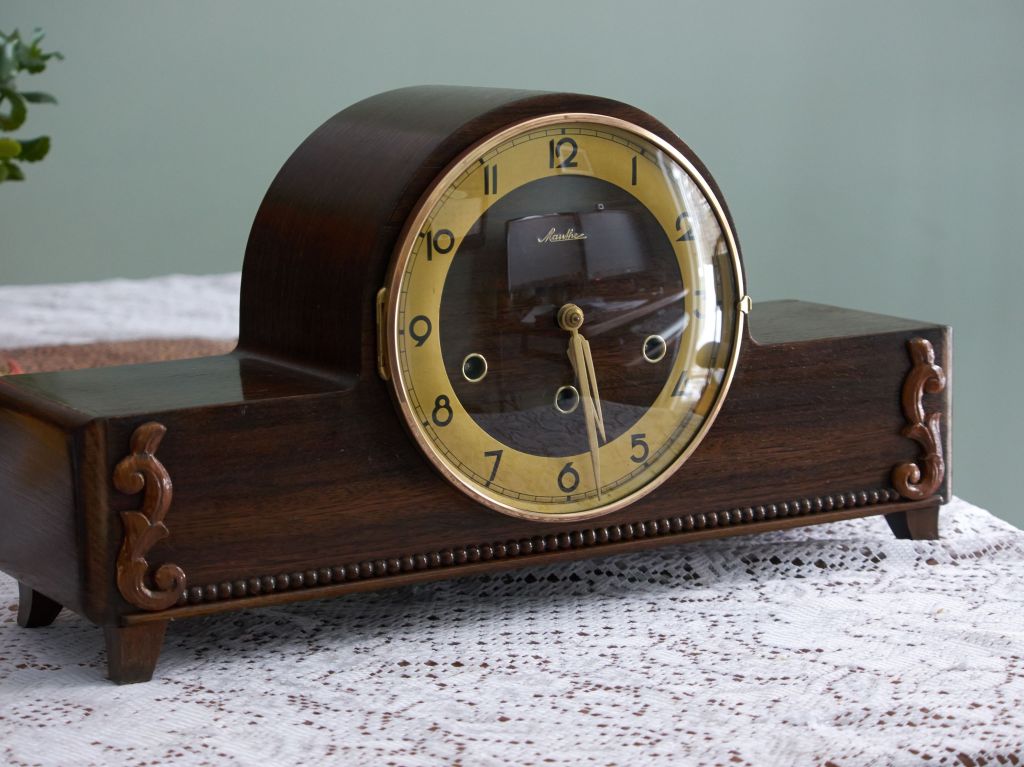
Let’s begin with definitions. Antique is anything over 100 years old and vintage is less than 100 years but more than 30 years old. Anything that is less than 30 years old may be considered vintage but more often it is called collectible. Try to pass off a 30-year-old clock as an antique and you will turn off a lot of prospective buyers.

Clock Terms
When selling a mantel clock, it’s important to use ‘mantel,’ not ‘mantle.’ A mantel refers to a shelf or structure, while a mantle is something one wears. Using the correct terminology also signals that you have a deeper knowledge of clocks than the average person.
A clock with two winding points (with some exceptions) is typically referred to as a striking clock, which strikes but does not ‘chime.’ A chiming clock usually plays a quarter-hour melody, such as Westminster or Whittington, and often has three winding points (though there are exceptions). There is no such thing as a ‘Tempus Fugit’ clock; ‘Tempus Fugit’ simply means ‘time flies in Latin.
A grandfather clock is a clock that stands 6 feet or taller and is not a wall clock. A grandmother clock is a floor clock that measures less than 6 feet in height. Grandfather clocks are also known as tall-case clocks, longcase clocks, or hall clocks.
Gingerbread and parlour clocks are distinct in design, but both are typically classified as kitchen clocks.
There are many other styles but let’s leave it at that.
Honesty and Disclosure
In my view, the most important element in selling a clock is honesty.
Inform the prospective buyer by describing as much detail as possible about the clock without getting too wordy. A clock that is a marriage, a case with a similar but replacement movement, should be stated as such. Replacement glass, newer dial, replacement crowns and finials, case repairs, or full case restoration should also be disclosed, perhaps not immediately in your ad but as a follow-up.
If the clock is running and was recently serviced by a competent repair person, state such in your ad. If the clock is running but the movement requires cleaning it should be stated as such. If it is not running explain why and what issues it might have such as a broken mainspring, missing pendulum bob, missing winding key, and so on. If you don’t know why it is not running, say so but be honest about it.
If you’re selling a clock and don’t know much about it, be honest and say so. Similarly, if you’re selling clocks in general but lack knowledge about them, it’s better to be transparent about that as well.
If your clock is rare, indicate why it is rare and support your claim with credible documentation including its provenance.

Establishing a Value
Research auction prices to get a feel for the value of similar clocks that are offered for sale and the price realized. Sources are Kijiji, Facebook Marketplace, eBay, and any number of respectable auction houses.
There will be a range of prices and something in the middle of the range is a good guide though its condition will determine what people expect to pay.
Determining the condition of a clock is an important factor in evaluating its value. The clock’s overall appearance, functionality, and any repairs or restorations it has undergone will all impact its worth. A clock in poor condition generally has a lower value than one in excellent condition, as potential buyers may factor in the cost and effort required to restore it.
Know that a clock is only worth as much as someone will pay. If you price your clock too high you will know it soon enough.
Rare and desirable clocks, as well as clocks with an interesting provenance, will command higher prices.
Clocks also vary in price according to the geographic location where they are sold. Generally, clocks that are made in the same location as the clock is sold will command higher prices. English and German bracket clocks are not as popular in America as they are in Europe and are priced accordingly.
Preparations for Sale
A clock in running condition will fetch a higher price than one that is not. A professionally serviced clock in excellent running order will command an even higher price. A clock case cleaned of grime will present better than a dirty one. Missing hands or dial glass will adversely affect the price. Items such as these can be replaced and parts are available from clock suppliers but it becomes an extra cost for the buyer and for many, it is a deal-breaker.
If you are handy at clock repair, servicing the movement or any case repairs will enhance the value of the clock you are selling. If you have serviced a clock, always be clear about the work you’ve done. Describe in detail the specific repairs, cleaning, or adjustments you’ve made to the movement, as well as any parts that were replaced or restored.
This transparency not only helps potential buyers understand the value of the clock but also assures them that the clock is in good working condition. Whether it’s oiling, replacing worn parts, or correcting any mechanical issues, providing this information builds trust and demonstrates your expertise.
The term servicing has many definitions. Be wary as sellers may claim a clock has been serviced if the only thing done to it is oiling. Among reputable clock repairers, servicing is defined as, taking the movement out of its case, disassembling the movement, cleaning the parts, addressing wear issues/repairs/parts replacement, reassembly, oiling, and testing before reinstalling it back into the case.

Visual Presentation
While few cell phones (though some are improving) can capture highly detailed images of a clock, they often suffice for many purposes. However, blurry or out-of-focus photos are unacceptable.

Several images from different angles as well as a photo of the inside of the clock case are much more helpful than one photo. During the daylight, place the clock near a window and position yourself between the window and the clock to take a series of photos in natural light. If there is damage or wear take close-up photos of those areas.
In general, a dedicated camera with artificial light will produce better results than a cell phone camera.
Clock Description
Crafting an ad is an art in itself. You must be concise and accurate and not overly wordy. There is a balance between too little and too much information. Less information means fewer inquiries from prospective buyers. Too much information with technical terms will turn off prospective buyers. Try to anticipate the questions prospective buyers might have in order to limit the number of follow-up queries.
State the clock’s maker if known, the model if possible, the year it was made, the type, (time-only, time and strike, chiming clock), the style of clock (mantel, wall, shelf, parlour, Ogee, tall-case, etc.). as well as any interesting features, for example, a steeple clock with an alarm function or a clock with a second’s hand. Along with your description state the approximate age. If you do not know, a picture of the maker’s mark on the dial or the movement will assist prospective buyers.
While it’s not necessary to give a reason for selling, doing so can sometimes enhance the ad.

Where to Advertize
There are a number of ways to sell a clock. Facebook Marketplace is very popular. Other local online for-sale sites, eBay, flea markets, consignment shops, and auction houses are popular places to sell a clock. Setting up an account for most online sites is a pre-requisite but there is usually no cost.

Example of a Poor Ad
Antique clock, comes with key, $250
Example of an Eye-catching Ad
Scaling down my collection. Antique German time and strike clock made by Friedrich Mauthe, circa 1899. Completely serviced in 2019 which includes disassembly and addressing worn parts. Original glass, mild refresh of the case, new wall stabilizers, and new arch piece. Ran for many years in a family home in Parsboro, Nova Scotia. Runs well and keeps good time, original key supplied. $250
Final Remarks
While selling a clock can be a frustrating experience, it can also be quite satisfying. I choose to sell locally to avoid shipping costs and the risk of items arriving damaged. Meeting the buyer in person allows me to answer any questions they may have and provide a more personal experience.
Though this is not a definitive guide to selling, I hope these pointers and ideas will help when you decide to sell (or buy) your antique or vintage mechanical clock.
Discover more from Antique and Vintage Mechanical Clocks
Subscribe to get the latest posts sent to your email.
 Antique and Vintage Mechanical Clocks
Thankyou for such a good demo of how to sell a clock and thanks for the honesty and accuracy of description. Jim from AUSTRALIA. Jimbana135@gmail.com.Sent from Samsung tablet.
LikeLike
Thank you. I have sold a few and as you say honesty is the key.
LikeLike