
Probably not a household name in its time, yet U. M. Müller produced clocks that could stand proudly beside the finest German makers of the early 20th century. Their box clocks, in particular, became strong competitors, capturing a market that was shifting away from the ornate Vienna regulator toward something more modern, practical, and affordable. By the 1930s, the sleek German box clock—with its simpler lines and middle-class appeal—had all but closed the Vienna regulator era.
This particular U. M. Müller is a striking example. The oak case features delicate carved inlays on the door, brass strip framing, and a fixed wood crown, giving it a stately presence. The brass bezel surrounds a metal dial with spade and spear hands, while beveled glass framed in brass completes the look. Wall stabilizers ensure a secure mount, reminding us that this was a clock built not just for beauty, but for reliability.

The case itself has aged beautifully, with no noticeable scratches or blemishes. The dial, however, tells a different story—its surface bears marks and abrasions, including one between the 6 and 7 where the paint is worn through to bare metal. It is not repairable, but it does speak to the long life and service this clock has seen.

Inside, the movement is a classic rack-and-snail time and strike. The clock chimes on a coiled gong—bold at the half hour, more resonant on the hour, but never harsh. As with most spring-driven movements, one should not expect chronometer precision. Still, this example proves steady and reliable, keeping “regular” time across its full 8-day cycle.

After a careful cleaning and waxing, the case now shows hints of what it must have looked like when new—over 90 years ago.
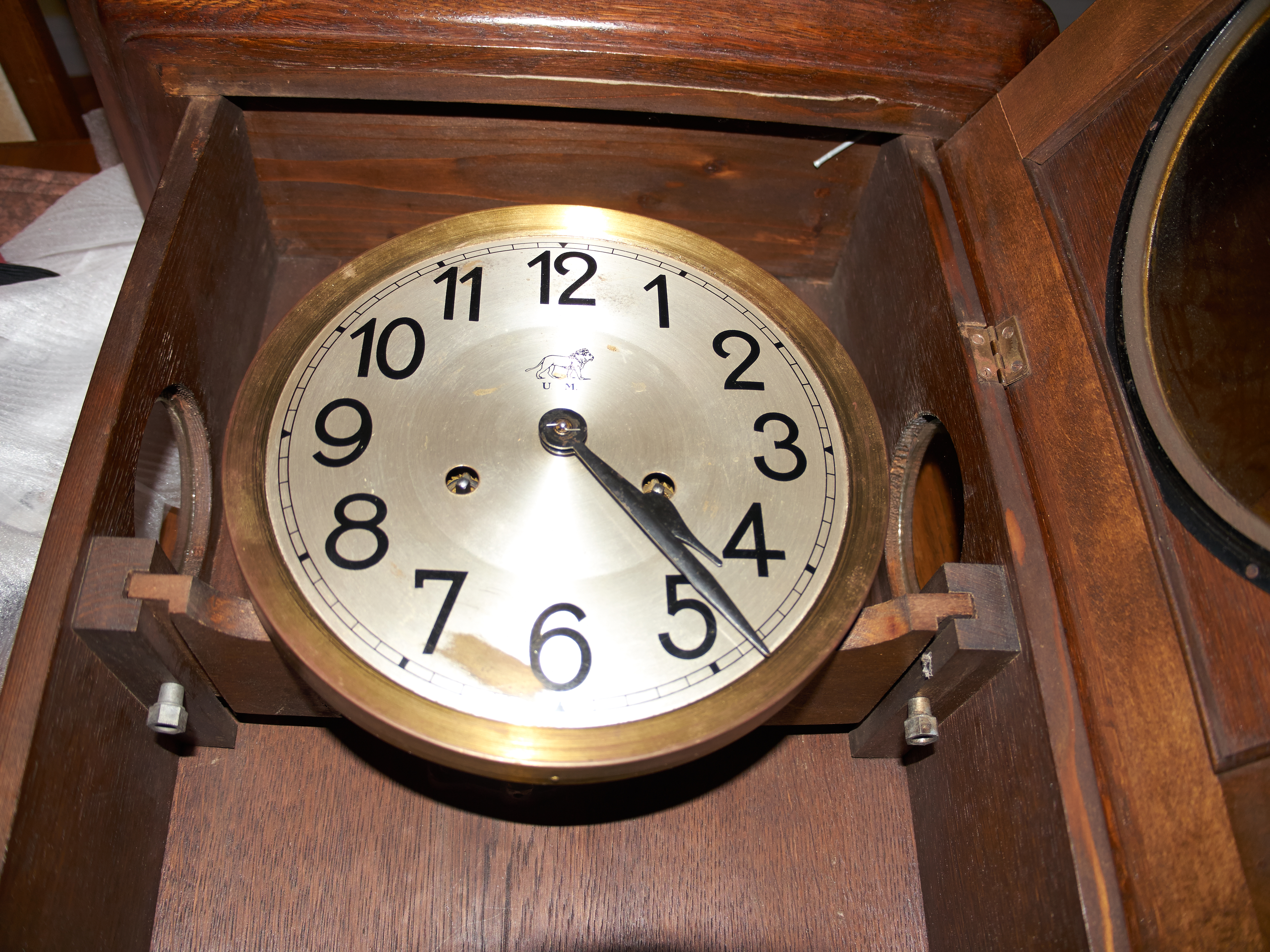
Collectors often date U. M. Müller clocks by the lion trademark on the dial. A raised tail indicates pre-1930 manufacture; a lowered tail, as on this example, places it in the mid to late 1930s.

According to Schmid’s Lexikon, the company’s roots trace back to 1867 in Mühlheim. After passing through several hands—including R. Schnekenburger around 1880 and later Gebrüder Müller—the brand built a legacy of solid, handsome clocks that still charm collectors today.
Discover more from Antique and Vintage Mechanical Clocks
Subscribe to get the latest posts sent to your email.
 Antique and Vintage Mechanical Clocks
You must be logged in to post a comment.