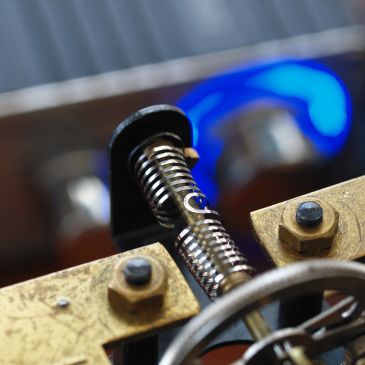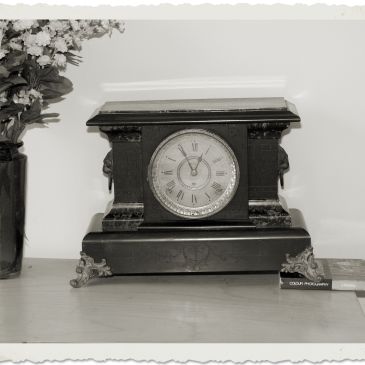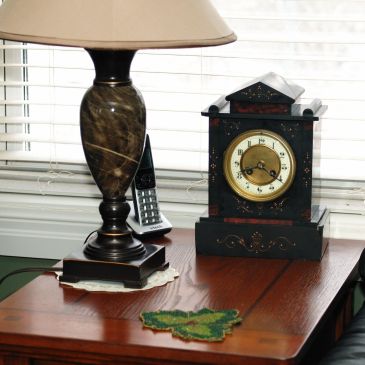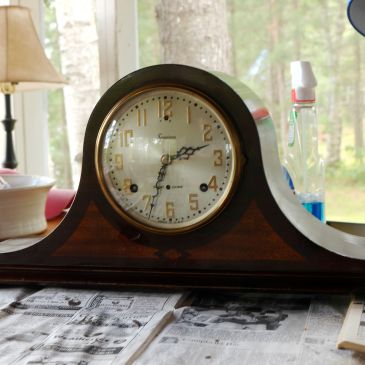
Sessions Westminster A mantel clock Part III – re-assembly and cursing the chime drive

Do you like the challenge of working on a mechanical clock? This one might have you ripping your hair out. These are not the best clocks to start on and can be a headache for the experienced clock-maker.

You will find Part I of this project here and Part II, here.

Refinishing the case
#1 Refinishing the case while movement is on the test bench

In August 2015 I wrote, “This a good project clock that is not for the inexperienced. As I gain more knowledge I will tackle this fascinating clock.” Well the time is now

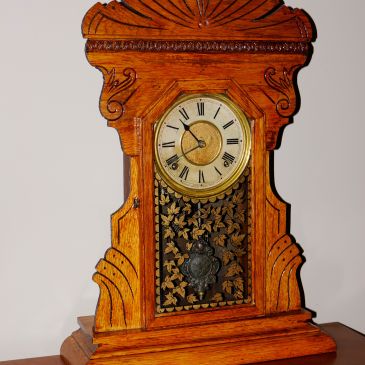
With a little experience under my belt it time to tackle this vintage circa 1931 Sessions Westminster A chiming clock.

I had removed the movement from it’s case in 2015 to replace a bad click since the mainsprings can be easily removed without dis-assembly. The click holds the tension or power of the mainspring and is identified by a clicking sound when the key is turned on the winding arbour. Although I have not run the clock much since then the click is holding up well.

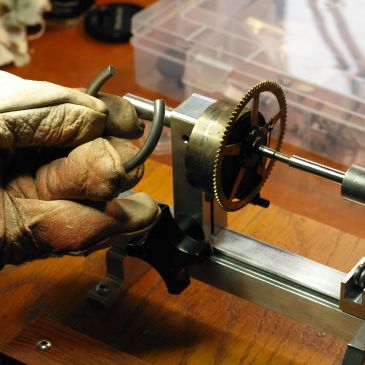
Six bushings on back plate
#2 Six bushings on back plate, 7 total (one not shown)

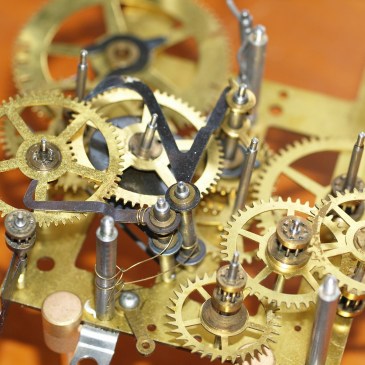
The movement required a total of 17 bushings. There was some movement of the pivots in the pallet arbour bushing holes, not enough to be overly concerning but they were addressed during servicing.

I was unable to pull the centre cam off because I do not have a puller which was unfortunate as the hole might have called for a bushing.

Centre shaft cam
#3 Centre shaft cam
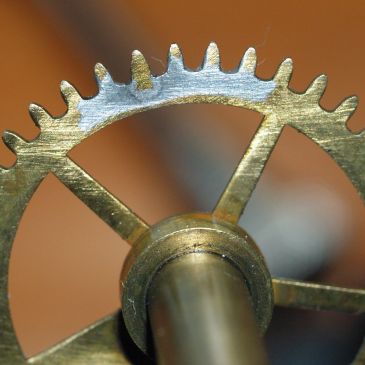
Gathering pallet pins
#4 Gathering pallet pins, also showing two racks

I was also unable to pull the arbour for the gathering pallet pins. It also might have needed a bushing though luckily I was able to bush one end. I mentioned in Part II that parts that are pressure fit on any movement are frustrating when said parts cannot be removed without special tools. Fortunately I was able to hand pull other chiming/striking parts off this movement.

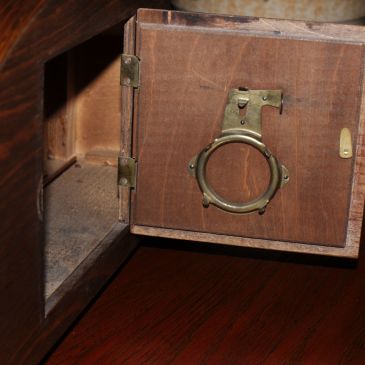
All parts in except the minute / hour canon
#5 All parts in except the minute / hour canon
Old and new brass spring
#6 Old spring on rack and new brass spring ready for the second rack.

There are two racks on this clock (see photo #4). One rack was missing it’s retaining spring.  I made a new one out of brass wire. The clock was not striking properly and this small, seemingly inconsequential part might be the reason.

It shows very well for a vintage 86 year old clock

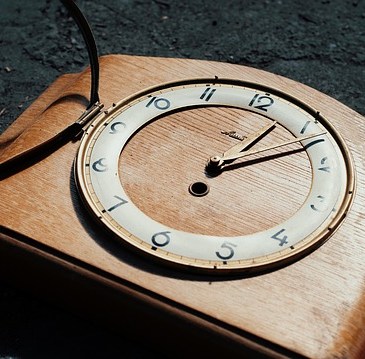
Between re-assembling the movement and testing of the time side I had an opportunity to address the finish on the case. I used a wood stain to hide scuffs and nicks, applied 5 coats of Minwax Satin Wipe-on Poly using 1500 grit emery cloth between coats to bring up the finish. Although not quite the deep luster of a clock coming out of the factory it shows very well for a vintage 86 year old clock. Purists might argue that I am using a modern finish on a classic clock but I don’t mind since the clock was found in a dusty old barn and cost me only $25.00.

Robert Croswell’s guide for the Sessions Westminster A clocks is excellent

The dial bezel was polished using Brasso.

Re-finished case
#7 Re-finished case

Five Days Later

The clock has been running for a few days and I am satisfied that the time side is functioning well. I can now proceed with the strike and chime side, following Robert Croswell’s excellent manual.

One Week Later

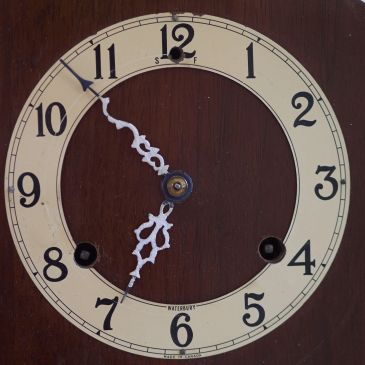
The time is running well and I am getting a full cycle (8 days+) however I am still having issues with the strike side. It manages the quarter hours as it should, 4 strikes on the quarter, 8 on the half, 12 on the three quarter and 16 on the top of the hour. However it is obvious (to me) that I do not have the hour strike sequence set up properly. Robert Croswell’s guide for the Sessions Westminster A clocks is excellent but I am having difficulty understanding how the racks, and there are two, and the snails, again two, are set up.

Stay tuned, I know I will solve this little annoyance eventually.

Tick-Talk Tuesday #7 – SP’s thoughts on dating a Kienzle Weltzeituhr clock

Hitler's clock
Kienzle Weltzeituhr clock presented to Adolf Hitler in 1939

Tick-Talk Tuesday is about the letters and comments I have received from you, the reader, concerning your clocks, issues you might have had and challenges you face and my responses to your questions with advice on your  particular clock concern(s). For those comments and questions that stump even me, I consult within my clock circles for the best possible answer.

On display in an antique store in Quebec Canada

Weltzeituhr is German for “World clock”.

The first Kienzle World Time clock was presented to Adolf Hitler on his 50th birthday in 1939 by the government of Würthemberg. The classical design with the world map in the “Mercator” style (cylindrical map projection presented by Gerardus Mercator in 1569) and the moving narrow scale with the time in the denoted cities came from the Heinrich Johannes Möller hired at age 27 and Kienzle’s principle designer from 1931 til about 1970.

The original clock had a bulky “foot” or base (first photo) and was decorated with swastika patterns on the edge. After the war, the decoration was necessarily altered, the base became smaller but the general layout of the dial was preserved through all permutations of the clock, from the early mechanical versions to the electro-mechanical versions and finally the quartz movements in the 80s. A unique feature of this clock is that it shows Germany to be the centre of the world.

Time sequencer
24 hour time sequencer

SP writes, “One way to narrow down date of one of these clocks is to look at the names of the cities. For example, mine has Jakarta, Indonesia as ‘Batavia’ which was the name given by the Dutch who ruled until the Japanese took over in WWII. The name was officially changed Dec. 27, 1949.”

Side view of World Time Clock showing substantial brass surround

Your clock says ‘Germany’ and has ‘Djakarta’. It could have been made between 1942 and 1949

SP wrote further, “I got to thinking and I suspect that further sleuthing may be in order. If you go to the Wikipedia article on ‘Batavia’, you’ll see that the name was changed when the Japanese took over in 1942. It also says that the name change from ‘Batavia’ to ‘Djakarta’ was ‘internationally recognized’ on Dec. 27, 1949 so that there was a seven year period when it was called ‘Djakarta’ by part of the world and ‘Batavia’ by another (Keep in mind that the Germans, allies with Japan, would have been partial to seeing things the Japanese way). Then, at the ‘West Germany’ Wikipedia, I see that ‘West Germany’ was declared on May 23, 1949. Your clock says ‘Germany’ and has ‘Djakarta’. It could have been made between 1942 and 1949 if the names on the dial were determined by Kienzle in strict conformity with official names. Of course, whether or not they were strict in that way would be hard to pin down but it seems to me that an earlier date for your clock’s manufacture seems just as plausible as a later one. It does seem to me, however, that, if it was made in 1950 or later, it would very likely say ‘West Germany’ given the 7-month lead time and the earth-shaking importance of the name change at the time.

Is it a clock or a work of art? Both it would seem

I replied that the clock was likely not produced during the war years when many German plants turned their attention to the war effort. My clock was either made in 1942 or close to 1949.

Kienzle World Time clock
Kienzle World Time clock, circa 1942-49

SP wrote back some time later and shared this with me, “I was also thinking that the war years are unlikely for the same reason. I was just doing a little exercise in marking rough parameters. Another rough parameter: mine has no country of origin as in ‘Made in Germany’ or ‘Made in West Germany’ — perhaps an indicator that it was made for the domestic market. I came here originally to learn how to calibrate the ‘world time zone’ scale. Then I took the clock to my local clock maker to have it serviced and he explained that, on my model at least, you have to take the back cover off and manipulate the metal disk inside with your finger. I see that some clocks, including yours, have a little button or knob on the back half-way down from the center knob that controls the hands and I assume that it controls the time zone scale. Anyway, if you are a visitor to this site looking for the same information, now you have my report.”

Winding crank
Winding crank

On my clock the tiny knob controls both the hands and the zone scale. As I rotate the knob the zone advances incrementally.

I am certainly on the lookout for more Art Deco styled Heinrich Johannes Möller clocks to add to my collection and when I come across another I will be sure to write about it.

Thank you, SP, for sharing your knowledge and experiences concerning this wonderful clock.

So, it seems that my Kienzle was made between 1942 and 1949.

Is it a clock or a work of art? The latter I would submit. Thanks to Heinrich Johannes Möller and his ability to turn a timepiece into a true work of art.

Unsigned French mantel clock – pretty but I wish I knew more about it

I acquired this elegant antique French mantel/shelf clock online in March of 2017 and it is the only French clock in my collection. Not many come up on Nova Scotia online for-sale sites.

French mantel clock
French time and strike mantel clock

I felt somewhat guilty leaving the home of the man I bought it from because he told me that he was selling off his possessions to provide for his wife after his passing as he was in the final stages of a terminal illness.

Clock face showing the two winding arbours

The elderly gentleman said that the low price reflected the fact that the strike side was not functioning and it had been like that since shortly after the last servicing. When inserting the key in the strike side arbour I immediately noticed that the spring had tension but it would not click. It could be a simple fix.

There was nothing on the inside of the case that would tell me anything about the maker

It is a time and strike clock of French origin from the turn of the 20th Century. The clock is 11 inches high by 8 1/4 inches wide by 5 1/4 inches deep, jet black, either slate or Belgian marble with lighter reddish brown rectangular accents and serpentine scrolling. It is quite heavy! The dial has a brass centre cup with enamel surround, delicate hands and painted Arabic numerals.

It is in the Grecian architectural style popular during the late 19th century both here and in France. But for a large chip on the bottom right of the case and a smaller chip on on the bottom left it is in very good condition. Unfortunately chips on the corners of these old French marble clocks are quite common. The movement is an exquisitely crafted French time and strike mechanism with a pleasant sounding but subdued coiled gong. It is unsigned.

The only markings are the word Brocot on the speed adjustment gear and another marking on the back plate. This patented Brocot speed adjustment was invented by French clock maker and inventor Louis-Gabriel Brocot in the 1800s.

Brocot patented speed adjsutment
Brocot patented speed adjustment

Stamped on the rear plate is Marque Deposee which means registered trademark in French. EBay sellers often mistakenly refer to it as the maker’s stamp. Careful examination of the movement revealed that there was nothing on the inside of the case or the movement that would give me a clue about the maker. A mystery, but not surprising as many French clocks are similarly unsigned.

Time and strike movement

The previous owner advised that the clock had been serviced but I decided to take the movement out of it’s case to inspect it more closely, re-oil if necessary and determine why the strike side was not functioning. The movement is relatively simple to remove. To extract it from it’s case undo the two slotted screws (rear) that hold the straps and pull the movement out from the front.

Side view of movement
Side view of movement showing brass straps

A very nice acquisition though I keep thinking about that old fellow

I discovered that for whatever reason the click screw was very loose, and not engaging the ratchet. After screwing it down tightly the click engaged the ratchet as it should. I can only assume that during it’s last servicing the click screw was not tightened securely.

The strike side click was loose
The strike side click screw was very loose
Numbers on bob correspond with the movement
Numbers on bob correspond with those on the movement
pendulum bob with adjuster
Pendulum bob with rate adjustment screw

I re-oiled the movement, returned it to its case and wound both sides. There are two speed adjustments on the clock, one on the bob and a finer speed adjustment arbour just above the number 12 on the dial. At the moment the clock is running a little slow and will take weeks to regulate. A one-ended key came with the clock, the original would have been double-ended.

It is a very quiet ticker with a pleasant strike and perhaps the perfect clock for those who might be bothered by the sound of a mechanical clock in any room.

A very nice acquisition though I keep thinking about that old fellow.


Dugena mantel clock revisited

In a precious article I wrote about my frustrations getting this clock to run reliably. No matter what adjustments I made it ran poorly.

“You’ve got to be very careful if you don’t know where you are going, because you might not get there”, Yogi Berra

This time and strike movement (Hermle?) has been out of its case and lying in drawer for the past year or so. When I met the seller in a parking lot some time ago as I handed him $20 for this Dugena mantel clock he climbed into his car he said, “I hope you don’t expect much for $20; it’s not perfect”. Well, it’s not perfect.

It was keeping poor time, losing an hour or so a day but I thought, what a great clock to practice on and practice I did.

Oiling the movement had no effect. Issues? A weak spiral spring, a worn jewel on the floating balance, a power issue associated with a weak mainspring or perhaps pivot wear. I disassembled the movement several times and serviced the mainsprings. I had an issue re-hooking the strike side mainspring and so, discouraged, I put it aside.

Dugena time and strike German made mantel clock

Dugena – is it a clock company?

Dugena was a German retail clock name only, a marketing name, not a maker of movements or cases. Dugena was a registered cooperative society, a “Genossenschaft”, that bought clocks from other makers to sell them under their own brand. A brand name for a retail chain more or less.

Dugena floating balance
The clock runs slow, this bent spiral spring does not help

Floating balance clocks are much more accurate and above all, they do not have have the disadvantage of the pendulum; these clocks work even when the case is at an oblique angle

A great invention – the floating balance

The floating balance movement in this clock could have been made by anyone; Urgos, Jauch or Hermle perhaps. Hermle is likely since it was one of the leading companies using the floating balance escapement. The floating balance was invented in the 1930s but it took till 1941 for the patent application to be registered. It took another 10 years after that for the patent to be granted slowed by the war years and the challenges of industry recovery following the Second World War.

The floating balance was a great invention. Floating balance clocks are generally more accurate and above all, they do not have have the main disadvantage of the pendulum; they will work even when the clock case is at an oblique angle.

Time and strike movement, maker unknown

Back to the the clock

Months passed. I took the movement out, looked at the strike side barrel a second time, popped the barrel cap off and using pliers gave the inner part of the mainspring a turn and it hooked onto the catch. Success at last. The mainspring barrels can be removed without dis-assembly of the movement, so, in it went. Despite my minor triumph with the strike-side mainspring, straightening the spiral spring and adjusting the balance wheel to its fastest set point, the clock ran only marginally better. The only consolation is that although it runs 5 minutes slower per day it runs a full eight day cycle.

Despite the minor disappointment it has been a productive learning experience but I am inclined to put it aside as I have other projects on the go. Every time I think about the issues I am having with this clock it always comes back to the balance wheel.

Some day the solution will pop into my head.


Tick-Talk Tuesday #6 – comments on online purchases

Tick-Talk Tuesday is all about the letters and comments I have received from you, the reader, concerning your clocks, issues you might have had and challenges you face and my responses to your questions with advice on your  particular clock concern(s). If I am stumped, I consult within my clock circles for the best possible answer.

I wrote a blog article offering advice for online purchases which you can see here.

Summarizing my advice for online shoppers;

  • Check the dates on the listings. The longer they are listed the more the seller is inclined to sell for a better price.
  • Meeting the same day is crucial; you do not want the seller to get cold feet and you do not want someone coming before you to buy the clock.
  • Cash is the rule. No cheques!
  • If you cannot negotiate a final price by email suggest talking it over on the phone
  • Be courteous and polite at all stages of the deal
Unknown French clock
Unmarked French clock, Kijiji purchase

JC writes, “Very good advice overall. I have only one small issue: I think asking about dates (how old is it?) is kind of pointless. I’ve seen clock-makers who have been in business for decades (30+ years) who can’t even correctly date a clock to within 100 years. I’m thinking of a specific example of a well known clock-maker who was explaining a repair on a comtoise clock “from the early 1700s”. The clock was actually from around 1840. I find that this sort of mis-dating happens often, and even with so called experts. Another example I can give you is a Black Forest clock specialist who had a particular clock he was demonstrating in a video, also apparently also “early 1700s” with wooden wheels, but it had an original coiled gong strike inside. The earliest evidence of coiled spiral gongs only date back to as early as maybe 1820-1830. Before this they simply just didn’t exist yet. This was from an EXPERT collector. Someone who specializes in Black Forest clocks. Some of his clocks are worth 5 figures.

That said, I would not trust the word of any eBay, Craigslist, Kijiji, or even auction house seller.

As far as your little clock goes, I think it was an absolute STEAL! True, the strike side could potentially have major problems, but even as a timepiece, the marble is gorgeous. With the price of shipping these days, it was an especially nice find. I haven’t been too lucky finding clocks locally. I think I’ve only bought a small handful, and they tend to be anniversary clocks, and mass produced American clocks (gingerbreads and mantle clocks) with a few German Art Deco style clocks.

I’ve bought a *LOT* of my clocks online (eBay) and for 95% of them, I just went with photos. If the photos were not good enough, I’d pass. It has largely worked out for me, but I ALWAYS assume they will not work. There is only ONE clock that arrived in pristine working condition.

Rare Ingraham Huron found on a local online for-sale site
Ansonia drop octagon
Ansonia drop octagon, Kijiji purchase

My response to JC . “A good point JC and one that I will consider. The answer I usually get when I ask about the age of the clock is how long the seller has had it. If they say they’ve had it for years or it was their mothers, uncles etc. I am naturally much more interested than someone who is just selling the clock for quick cash. I have acquired some great clocks that have been passed down through family (see photos on this blog). They are not without issues but sometimes the story is just as exciting as the clock itself.

I get most of my clocks from online local for-sale sites that I can pick up within an hour or two from where I live. I scour the sites everyday and will sometimes send out emails to sellers without seriously considering a purchase but occasionally their reply piques my interest. I have had one very bad experience with an EBay clock purchase so I try to stay away from them (not saying I wouldn’t in the future).

Read the article and tell me if you agree.


Seth Thomas Adamantine mantel clock – time to give it a little love

Seth Thomas Adamantine time and strike mantel clock

I am servicing the first antique clock I ever bought. After having serviced many others it is time to give this clock a little love.

Some years ago (2000) my wife and I were traveling around Nova Scotia and stopped in a little village called Blockhouse. We found an antique store, walked in and never intended to buy an antique clock that day but left with an American Seth Thomas Adamantine mantel clock. It looked like it was worth many  more times than we paid for it. We left the store thinking we had stolen it.

My research revealed that thousands were made and the price we paid at the time likely reflected its true value. The clock came home and sat on top of our piano and looked great. For a couple of years I wound it up religiously and marveled at its beautiful marbleized case and the sound of the gong on the hour and the bell on the half hour. I stopped winding it, let it sit on the piano and ignored it. About 5 years ago as I began to build my collection of vintage and antique clocks I wound it up and have kept it running ever since.

These clocks have become known to collectors as “Black Mantel Clocks”, and were popular from 1880 to 1931. Adamantine veneer was developed by the Celluloid Manufacturing Company of New York City, and was covered by U.S. Patent dated September 7, 1880. Seth Thomas Clock Company purchased the right to use the Adamantine veneer in 1881. At that time Seth Thomas stamped the year of manufacture on the bottom of each case. Though somewhat difficult to read the date on this particular clock is 1907.

Re-assembled and tested

Each clock I added to my collection needed some work and so I left the ST thinking that one day I would service it. Despite the fact that I kept it oiled, displayed it in a relatively dry dust free environment, it needed a good cleaning and a little bushing work.

Once you take a movement out of its case you begin to discover it’s little secrets. I immediately noticed a stripped speed regulating gear. The regulator arbour runs through the plates and is connected to the pendulum hanger to slow or speed up the clock. The rate adjustment is on the front of the clock and the smaller end of a double-sided key is used to speed and slow down the clock. I observed a rate adjustment screw on the pendulum bob. The “newer” bob had evidently been added at some point in the clock’s life to replace the stripped gear. The other possibility is that it might have had both. I have seen French clocks with both a front rate adjustment and an adjustable bob.

Regulating arbour
Regulating gear is stripped

The movement was taken apart and the parts were cleaned in an ultrasonic cleaner.

Back of movement
Back of movement showing

Bushing wear was not an excessive but enough to justify installing 4 bushings; S2 front, T2 front, and escape wheel, both front and back plates. Putting the movement back together is relatively easy though it is always frustrating positioning the helper springs and levers in place as you move the pivots into their holes. It takes me a few attempts to get the strike side gears and levers correctly aligned. The stop wheel, stop lever, maintenance lever and count wheel hook take a little trial and error and it not something I have managed to get right the first time.

Seth Thomas clock face

Once back together the movement was oiled and placed back into it’s case. It should  run reliably for years to come. Save for a slight aging of the clock face the clock is in excellent original condition.

Antique Seth Thomas Adamantine clocks look great on any mantel.

Is my clock in beat?

You bought a clock. It ran when you first saw it but you bring it home, display it in that very spot you imagined and now it won’t run. 99% of the time this is caused by a clock not being in beat. All mechanical clocks must be set in beat before they will run properly.

Sessions time and strike

I make no attempt to explore the idiosyncrasies of various designs of clock movements. Much of the following information can be found at the forum site of the National Association of Watch and Clock Collectors, NAWCC . At this site there are additional tips on adjusting the beat of 400 day clocks, weight driven Vienna style clocks and so on.

When a clock is out of beat, it will either not run at all, or it will run for a short time and then stop

What does the term “beat” mean?

Make sure your clock is on a level surface. Listen to the tick and the tock of your clock. Try to minimize the sounds in the room you are in so that you can listen closely to it’s rhythm. It is in beat when its ticks and tocks are even….tick…tock…tick…tock…, and is out of beat when they are uneven, either, ticktock…. or tocktick…… Put another way, there will be an equal amount of time between the ticks and the tocks. When a clock is out of beat, it will either not run at all, or it will run for a short time and then stop. It is worth repeating that a clock’s beat must be regular to work properly.

Gilbert calendar clock, the Admiral

There are two ways to put a clock in beat. The first is to tilt the clock sideways, one way or the other, and listen for the beat to even out. When the beat is even, prop the clock to stay tilted that way. Now it will run in beat but it will obviously not look good.

The second way is to adjust the crutch to one side or the other, until the beat is even. The crutch is the rod that extends down from the pallets which rock back and forth on the escape wheel. The pendulum rod passes through either a loop (called a crutch loop) or a forked foot at the end of the crutch as indicated in the photo below. Incidentally, that rod needs to be in the middle of the crutch loop and can’t be tight inside the loop nor too loose. The crutch is attached to the pendulum leader which is then attached to a post with a suspension spring.

Mantel clocks have rear access doors that allow you to adjust the crutch, however for wall clocks you will have to remove the hands (the minute hand is released by a screw or a pin, the hour hand simply pulls off) and the dial face, also attached by screws that come off to reveal the movement. However,minor adjustments to the beat of a wall clock can be preformed by simply moving the clock off-level. It may not be noticeable if the clock is not quite level.

There is no need to take the movement out of its case to perform this procedure.

OLYMPUS DIGITAL CAMERA
American New Haven time and strike movement taken out of its case

If the crutch is a simple rod or wire as in the photo, it is adjusted by bending it to one side or the other (left or right). The brass rod is quite pliable allowing you to re-adjust if necessary. Listen to the beat as you make the adjustments and when you have a steady tick-tock the clock is in beat.

There us nothing as pleasant or soothing as the sound of a ticking mechanical clock in a room.

If it attaches to the pallets with a friction joint, it is adjusted by holding the pallets still with one hand, and shifting (pushing) the crutch right or left on the friction joint. The adjustment may be very slight in either direction.

plate-clock-movement_6-labels
Time only German movement for a Blackforest shelf clock

You need only to do this once. Whether your clock is a wall clock, a mantel clock, time and strike, time-only or time, strike and chime, the principles are exactly the same. There is no need to take your clock to a professional to have it “fixed”. This is definitely a do-it-yourself procedure. It’s that simple!

There is nothing as pleasant or soothing as the sound of the rhythmic ticking of a mechanical clock in a room especially if it is in beat.

Tick-Talk Tuesday #4 – question about Sessions Westminster A clock

Tick-Talk Tuesday is about the letters and comments I have received from you, the reader, concerning your clocks, issues you might have had and challenges you face and my responses to your questions with advice on your  particular clock concern(s). For those comments and questions that stump even me, I consult within my clock circles for the best possible answer.

This is a Sessions Westminster A mantel clock made in Forestville Conn. The first year of production for this model was 1927. This particular clock was made in October of 1930 and features minor improvements to parts of the chime / strike train. Between 1903 and 1933 Sessions produced this and 51 other models of mechanical clocks, ranging from Advertisers, large and small clocks with logos of various businesses, to wall, or regulator clocks, and shelf or mantel clocks, designed for the home. Many of the Sessions clocks from this period are prized by collectors.

Everything seems to working very well with my clock except for the chimes which seem to have a rather peculiar problem

JD writes. “I stumbled across your WordPress blog about your Sessions Westminster clock and thought I’d reach out as I’m in the process of finally getting mine running.  Everything seems to working very well with my clock except for the chimes which seem to have a rather peculiar problem.  The hourly chimes work great. Full Westminster, then the correct number of hour strikes.  The half hour chimes are also correct.  The problem is that the quarter hour & three-quarter chimes are reversed.  The quarter hour has 12 notes and the three-quarter hour has only 4. I haven’t even taken the movement out of it’s case yet, and at this point I’m just trying to figure out what the problem might be, and how complicated it may be to resolve it. This is one of about a dozen old clocks that my father had in his collection when he passed away, all of which I had been led to believe were non-functional.  I’ve got ten of them running and would like to get an idea what I’m up against with this peculiar problem. Thanks in advance for any insight you may be able to offer.”

Sessions Westminster chime circa 1931

Co-incidentally I have been working on the same clock. Mine also had issues with the strike and chime sequence. I received JDs letter prior to working on my Westminster A mantel clock so I could not advise him on his specific issue but hope to share my experience with him once I have completed work on it.

The Sessions Westminster A mantel clock was made in Forestville Connecticut, USA. The first year of production for this model was 1927. Between 1903 and 1933 Sessions produced 52 models of mechanical clocks, ranging from advertisers, large and small clocks with logos of various businesses, to wall, or “Regulator” clocks, and shelf or mantel clocks, designed for the home. Many of the Sessions clocks from this period are prized by collectors. Having a unique and innovative design, the Westminster A is particularly sought after.

Westminster mainspring

My reply was. ” Thanks for your letter JD. I have yet to tackle this clock and know that it is not a good clock for the novice clock repair person to work on. If you have the skill-sets to have worked on other clocks then you are prepared for this one. I have attached a detailed guide which will help you through the servicing of this clock. It was prepared by Robert Croswell a member of NAWCC. One thing I should mention. The clicks are very weak on this clock and click failures are common. I need not remind you that when clicks fail they may also take parts of a clock with them. If you decide to tear it apart, do yourself a favour and replace the clicks. I have a number of clocks that I have to service before I get to the Westminster A. Let me know how you are progressing with the clock and any insights you can pass along to me.”

Drum and hammers
Drum and hammers on a unique two train chiming clock

I attached Robert Croswell’s excellent manual called Taming the Sessions 2-Train clock.

JD wrote back, “Thank you very much for the reply, and especially for the very helpful guide.  I also asked the question on JustAnswer.com and received a helpful response from a clock repairer who said that the chime correction cam that is behind the locking plate needs to be rotated 180 degrees after it chimes the 12 notes, to the 3/4 hour position.  As I said, I haven’t even removed it from the case yet so I just wanted to get an idea how involved the repair might be before I take any action. Now I have an idea where to focus my attention, and I can at least remove it from the case and examine it to fully understand the working of the chiming mechanism. Not sure if I’m up to tearing it apart quite yet, especially since it is running well for the most part.  The resource you provided will no doubt prove very helpful to my learning process.  I’ll let you know if I manage to resolve the issue and of course, anything I learn along the way. Thanks again.”

I will be sharing my experience with JD once I have the clcok running as it should. I have assembled the clock and in the process of testing the time side. Although the racks and snails (there are 2) are reinstalled I have not yet managed to have the time properly aligned. Once I have determined that the going train will run it’s full cycle I will focus on adjustments to the strike and chime side racks and snails.

A great learning experience.

Tick-Talk Tuesday #3 – question about Arthur Pequegnat clocks

Tick-Talk Tuesday is about the letters and comments I have received from you, the reader, concerning your clocks, issues you might have had and challenges you face and my responses to your questions with advice on your  particular clock concern(s). For those comments and questions that stump even me, I consult within my clock circles for the best possible answer.

Arthur Pequegnat clocks were made between 1908 and 1941 in Berlin (now Kitchener), Ontario. Those produced before 1917 had “Berlin” inscribed on the dial face. The town of Berlin from 1854 until 1912 became the City of Berlin from 1912 until 1916. The name Berlin was associated with the war against Germany consequently the decision was made by city officials to change the name to Kitchener midway through the First World War. Kitchener is the present seat of the Regional Municipality of Waterloo, Ontario (Canada). Arthur Pequegnat clocks were the only wholly made Canadian clocks (aside from a short run of clocks made by the Canada Clock Company and later the Hamilton Clock Company in the 1870s) and are particularly sought after by Canadian collectors.

AO from Ontario writes, “Good Morning Ron, I live in Ontario (Canada) and have two Pequegnat clocks I am thinking of selling. Could you give me an idea of how much they are worth? The mantel clock is an Oxford. Thank you.

The clocks she mentions in her email are the Arthur Pequegnat Oxford mantel clock (time and strike) and the King Edward time-only wall clock missing the King Edward lower drop decal.

Pequegnat Oxford mantel clock
Pequegnat Oxford mantel clock from the Canadian Clock Museum in Deep River, Ontario
King Edward with 15 day Moncton movement
King Edward with 15 day Moncton movement showing decal from the Canadian Clock Museum in Deep River, Ontario

I replied. “I looked at your photos and have some comments. The time-only wall clock is known as the King Edward. From the photo yours seems to look intact save for the missing decal in the lower drop. A King Edward decal should be in the middle of the glass panel. It appears to be replacement glass which will certainly affect the value. However you should be able to get in the $600 to $1000 range for your King Edward clock. If you are selling in Canada where collectors are attracted to Pequegnat clocks because they are wholly Canadian made you should do reasonably well. If the clock has been recently serviced you can expect to price it a little higher.

Mantel clocks always command lower prices but your Oxford should easily sell in the $400 range. I would price both slightly higher and see what responses you get.”

AOs reply, ” Hi again Ron, A dealer has offered me $750.00 for both clocks. Is that reasonable knowing that he has to resell them?”

I advised AO that they should dicker a bit and that the dealer certainly knows the value. I suggested that she could also try to sell it on an online for-sale site.

AO replied later and said they posted the clock on a for-sale site and the same dealer offered $650 for the King Edward.

I emailed her again asking how they made out with the sale. AO replied and said the dealer backed out and the clocks are still for sale.

UPDATE: AO wrote 1 week later and said she has sold them both for $350 more that the first offer. She is very pleased.


Jaeger LeCoultre musical alarm clock – not bought yet but I have questions

Jaeger LeCoultre clocks are a favorite among collectors

Jaeger Lecoultre alarm clock
Jaeger LeCoultre alarm clock

Jaeger LeCoultre clocks are a favorite among collectors of high-end luxury timepieces, often bringing in hundreds of thousands of dollars at auction. Jaeger LeCoultre to this day produces high quality desk clocks and watches in addition to their famous line of Atmos clocks.

I was in an antique shop in Victoria, BC recently and I must confess that I have never seen so many antique and vintage clocks in one place outside a museum. (I’ll cover those in a future blog article)

There were so many French and American mantel and wall clocks that I went by this diminutive clock twice before stopping to take a more careful look. On the clock face it says LeCoultre and underneath the base there is a label that says Faust Waltz, the musical tone of this alarm clock.

It is small but substantial in weight. It is an authentic 8-day gilt or lacquered bronze Swiss made clock from about the 1960s to 1970s though it may be earlier. There are no obvious dents or scratches on the case and no marks on the glazing although I did not have enough time to examine it more closely. I have no idea whether or not it is in complete working order but the fact that music box functions is encouraging.

Rear of clock showing winding key for the music box on the lower left

Unfortunately I was taking shots with low light and using a flash would have attracted too much attention from the owner. The quality is not up to my usual standards.

I am in the process of deciding whether or not to make the decision to buy this clock. In the meantime I have several questions:

  • The seller is asking CDN199; a fair price?
  • Is it collectible?
  • I would like to narrow the vintage, the year it was made, thoughts?

There are plenty of different styles of LeCoultre alarm clocks on the net but I could only find one photo of this particular clock. Either it is rare and desirable or uncommon and not worth considering. I hope it is the former.

Let me know what you think.

How to buy a clock on Craigslist, Kijiji, Gumtree and so on…..And this is what I bought

Unknown French clock

It is a French mantel or shelf clock. I have no idea of the maker but it is an antique (over 100 years old), possibly 1890 to 1900. It has “Marque Deposse” stamped on the back plate but that simply means “trademark” in French. It is not a maker’s name. The clock is 11 inches high by 8 inches wide by 5 inches deep.

Access door
Rear access door

It is a time and strike movement on a coil gong. Unfortunately, the strike side does not work though the seller disclosed that to me before I bought the clock. I can feel the tension of the spring when I turn the key in the arbor but the spring does not engage the click, so, a broken or disconnected click I presume. The previous owner described it as having a melodious sounding gong. I would love to hear it. I wondered if the spring barrels could be taken out without separating the plates but further research has revealed that the movement must be dis-assembled.

Clock face
Clock face

The clock dial face is in two sections. The brass inner pan is surrounded by a porcelain dial with painted numbers. The dial door is flat glazing in a brass bezel with a high quality “hidden” hinge. A taper pin holds the delicately crafted hands. There is a smaller arbor, a speed regulator above the 12, which allows more precise tuning in concert with a speed adjustment on the pendulum.

Pendulum back showing stamped numbers

Aside from numbers on the back plate, an identical batch number on the pendulum and the Marque Deposee stamping, there is no makers mark. There may be a mark on the gong block but I won’t know until I release the nut on the base panel to take it out from underneath the clock. The numbers on the back plate are 3851-55. The number 5 5 is the pendulum length as in 5 and 5/12 French inches.

Adjustable pendulum
Front side of pendulum
Time and Strike movement

The movement appears to be of superior quality though common in a number of higher end French clocks. From what I can determine, the movement can be taken out of the case by undoing the two screws that go through the back bezel into the brass straps that protrude through the case from the front bezel. The movement should come out through the front once the two screws are released. The movement looks clean and there is sufficient oil in the pivots (no black or green gunk). I have other projects on the go so it might take me some time to take the movement out for inspection but for the time being I will let it run to regulate it.

The Corinthian style case is very heavy and is quite possibly Dinant Belgian Black Marble. Aside from the non-functioning strike side there are other issues. One is a very noticeable chip on the bottom right corner of the base which you can see in the photo below and the other is a small chip in the top left corner which is less visible. Close-up that larger chunk out of the corner looks ugly; from a distance it is hardly visible.

The worst of two chips
The worst of two chips, bottom right corner

Despite the slight damage the overall look is impressive. Most of what I see is well preserved. Indeed, it is a very attractive and stately antique French mantel clock that now occupies a prominent place in our family room.

Who made it? Unless there is a maker’s mark on the gong block or somewhere else on the movement, I may never know.

Buying an antique or vintage clock on Craigslist, Kijiji, Gumtree etc. – a how to

“Life is a box of chocolates….you never know what you are going to get”, Forest Gump

Buying a clock without actually touching and inspecting it is always a gamble and making a judgement based on images, many of which are poor quality, complicates the decision-making even further. There are stories of people buying clocks online only to find that the clock they thought had a antique mechanical movement arrived with a quartz one.

There are many challenges facing the clock shopper in today’s online world. Once your interest is piqued you may ask yourself these questions:

  • Did I get my money’s worth? Will I be “ripped off”?
  • Will it work when I get it home?
  • What do I have to do to fix whatever might be wrong?
  • What did the seller not disclose?

There are accepted rules about buying clocks on online for-sale sites. Online for-sale sites are ubiquitous and in many countries in the world. Here is an example of rules that are found on a particular site that I frequent.

  • All transactions should take place in person with cash. Do not ship items and do not accept other payment methods.
  • Never click links in an email that ask you to sign in to xxxx. All “Your xxxx account has expired” emails are fakes.
  • xxxx, eBay and PayPal do not offer buyer or seller protection for xxxx items. Such emails are fakes.

But for more specific rules on how to buy that special clock you were always looking for, see Ron’s Rules at the end of this post.

Follow this exchange between myself and the seller and consider my thoughts on this and other online clock purchases later in the article.

The clock

Unknown mantel or shelf clock.

Ad photo
Actual Ad photo

The exact words of the ad

Wind up alabaster clock. Very heavy. $80.00

The email exchange between myself and the seller

NOTE: This particular online for-sale site has an encrypted email service, therefore in my exchange I do not know the seller’s actual email address. This is a necessary protection for both parties.

Me

Do you know the company that made the clock and how old it is? Thanks

From the wording of the ad I am assuming at this point that the seller knows very little about the clock

Seller

Sorry I don’t know who made or how old it is. I bought it in an auction a few years back. Thanks xxxx

Me

Since you do not know the maker and I would have to drive from xxxxx, would you accept $60 for the clock.

Seller

Before you decide to drive from xxxxxx I would like you to know that the chimes do not work. I know that the clock would be worth more but 60.00 is fine if you would like to have it. Thanks xxxx. Let me know .

Me

If the chimes don’t work it is not a huge problem. Does it look like all the parts are there or is anything missing? I am still interested if the parts are there.

Seller

Everything is in tact. It was last serviced a few years back and worked great, but went to wind the chimes and they seemed to slip on the spring… However the clock still works just had it put away for a couple of years.

Me

For $60 I will buy it. How does 2pm today sound?

Seller

Yes we will make sure we are at home. Will you find the place OK? If not we could meet you part ways.

Later

I provided the seller with my telephone number. He subsequently calls to give me his address. The call is important because I suspect he wants to get a feel for who he is dealing with and that is the correct way to approach sales such as this.

Thoughts

It is important to be ready to pick the item up ASAP. You do not want to allow too much time for the seller to have second thoughts or to have someone else move in ahead of you. I often suggest meeting that same day, in a neutral place or at their home but most suggest meeting at their home. A neutral place is an option and I had to do this only once in over 2 dozen purchases.

My preliminary analysis based on the limited information that I have is that it is an French or English made time and strike shelf clock and judging from the problem on the “chime” side it might just be a bad click although it is possible that parts of the movement have been damaged. It is impossible to know until I see it and bring it home.

You might suggest I ask more questions about the clock or have the seller send additional photos of the movement or even a closeup of the clock face. It is only a $60.00 clock! In my experience once you attempt to have the seller take extra steps to sell their clock especially a clock at this price, the chances of a loss of sale increases. Were I to shell out hundreds of dollars I would definitely ask for more information and detailed, higher resolution photos.

Ron’s Rules

  1. Locate the clock you are looking for online and try to avoid Chinese or Korean clocks often advertised as “31 day” clocks. (For some reason people think they are worth a lot of money and they are garbage – usually!)
  2. Communicate by email and ask questions but not too many as to scare the seller off. Suggested questions might be:
    • Does the clock run?
    • Who is the maker (manufacturer)?
    • If it does not run, are all the pieces intact?
    • How old is it?
    • How long have you had it?
    • Would you accept a lower price because…….(justify reason(s))?
  3. Arrange final meeting details by phone.
  4. Meet the same day if possible.
  5. Meet the seller in person.
  6. Meeting at their home is preferred but a neutral location such as in front of a public building or in a mall is an option
  7. Pay in cash.
  8. Thank him/her for the sale.

Final thoughts

  • Check the dates on the listings. The longer they are listed the more the seller is inclined to sell for a better price.
  • Once, I gave the seller a day or two to think about my offer. I took a chance but got the clock for a decent price. (see first image)
  • Meeting the same day is crucial; you don’t want the seller to get cold feet and you don’t want someone coming behind you to buy the clock.
  • Only once did the seller accept a cheque from me because of past dealings with him. Cash is the rule.
  • If you cannot negotiate a final price by email suggest talking it over on the phone
  • Be courteous and polite at all stages of the deal

My wife and I are in the mood for a road trip. Now, with cash in hand, let’s get into the car and go for a drive.

Check back in 3-4 days to see how we did.

Sessions Westminster A mantel clock Part II – Dis-assembly

This is Part II of a multi part series on the Sessions Westminster A chiming mantel clock.

Side view of Sessions Westminister A
Side view of Sessions Westminster A

Inside the plates they are a conventional Sessions clock. Outside the plates is an entirely different story

Sessions Westminster A clocks are true chiming clocks that play the Westminster chime sequences on the quarter hours and strike the hour count on the hour. The unique design combines the chiming and striking functions in one train powered by a single main spring. Between the movement plates these movements are very similar to other Sessions non-chime (strike only) movements. The going (time) train is controlled by a basic recoil escapement with the strip pallets or verge located between the plates. Inside the plates they are a conventional Sessions clock.

Outside the plates is an entirely different story. At the front of the movement one will notice that this is a rack and snail strike train but it has TWO racks and TWO snails. A look at the back of the movement reveals a small cam in the middle of the plate and a large “player drum” or pin drum. The two racks working together with the little cam and the player drum, which can shift outward to play chimes or inward to strike the hour, is what makes it all work. The chime sequence is self‐synchronizing and with so few working parts, once setup correctly this can be a relatively trouble free movement. (Source R. Croswell’s Taming the Sessions Two Train Clock)

This clock requires servicing for two reasons;

  1. It runs for several minutes or an hour or so and then stops
  2. The striking and chiming is very erratic. It might strike 4 o’clock one hour and 9 o’clock the next and the hammers “hang up” during the quarter hour chime.

There are a number of “exterior” parts that must be removed before separating the plates

Dis-assembly of the Westminster A is conventional however there are a number of “exterior” parts that must be removed before separating the plates. The regulator gearing, verge, drum assembly, hammers and racks as well as other parts are removed one after another. The additional parts add considerable complication to the movement and can lead to issues when servicing. I will describe two particular issues I have encountered in the process of working with this movement. I believe these issues, which I will describe later, are likely what frustrate most clock repair persons when working on the Westminster A.

Rear plate
Rear plate showing regulator, verge and chime drum. Clamp on mainspring

I chose to leave the mainsprings in while taking the movement apart though I contained the power using C-clamps. On this clock the mainsprings can be removed without dis-assembly. This allows the repair person to easily service the mainsprings or the clicks (which are notoriously bad on Sessions clocks generally).

Unfastening the drum and hammer assembly went without issue since there are only two bolts securing it to the plate.

The 2 racks, a unique feature, work together to produce the strike. They are located one on top of the other and are secured to a post.

Two racks stacked on top of each other
Two racks stacked on top of each other. The post on the right accommodates two springs

Taking them off requires releasing a pressure washer on the top of the post. They came out easily. However, one rack is missing a return spring which might partly explain the erratic striking of the clock. Such a simple thing that may make a big difference. I may have to buy or fashion a spring.

Rack with spring
Rack with spring

Rack without spring
Rack without spring. The spring clips into the hole on the rack arm

Specialized tools are needed to remove some parts. Those I don’t have

Two issues.

One, I could not remove the hub supporting the gathering pallet pins seen here. It’s unfortunate because there is more lateral movement of the arbour that I am comfortable with which tells me that a bushing is required. I did not want to risk damaging the arbour and I don’t have specialized tools to do the job. I may have to live with it. However, it may not be so bad once the other bushing work is completed.

Gathering pallet pins

Two, I could not remove the centre cam despite pulling and gently prying.

Centre shaft cam
Centre shaft cam

Again, I did not want to risk damaging the arbour. Specialized tools, such as a puller in this case, are required to remove it. That, I don’t have.

This clock has a unfortunate reputation for soft pivots

I will have to work around these two issues. Pressure fitted parts on any movement are very frustrating when said parts cannot be removed without special tools and this one is a challenge indeed. Re–assembly might be a little frustrating particularly with the centre arbour still attached to the rear plate which may effectively be “in the way” of positioning other wheels in place.

I inspected the pivots on the wheels and they all look good (no tapering) with expected wear for a clock of this period. I was worried because this clock has a reputation for soft pivots and perhaps because this is a later model, Sessions might have been introduced harder steel for the pivots. There is plenty of bushing work that needs to be done, however.

On to cleaning, bushing work, re-assembly and testing in Part III.

Sessions Westminster A mantel clock Part I – Let’s explore this clock a little further

This is Part I of a multi-part blog wherein I explore the challenges of repairing a Sessions Westminster A tambour style time, strike and chime mantel clock. This part is the introduction.

RS Sessions Westminster chime circa 1931 (12)
Th Vintage Sessions Westminster A mantel clock

In August 2015 I wrote, “This a good project clock that is not for the inexperienced. As I gain more knowledge I will tackle this most interesting clock.” Well the time is now.

Well, it’s been two years and I have looked at this clock often enough and wondered what it would be like to finally get it running. Time to take the plunge.

The Sessions Westminster A mantel clock was made in Forestville Connecticut, USA. The first year of production for this model was 1927. Between 1903 and 1933 Sessions produced 52 models of mechanical clocks, ranging from advertisers, large and small clocks with logos of various businesses, to wall, or “Regulator” clocks, and shelf or mantel clocks, designed for the home.

Some Sessions clocks from this period are prized by collectors. The Westminster A is particularly sought after though collectors prefer it to be serviced and in running condition.

RS Sessions Westminster chime circa 1931 (10)
Raised Roman numerals and faux inlay

The case is in exceptional condition

The clock is tricky to repair and most horologists prefer to stay clear of it

This clock is 21 inches long and 10 inches high, has a mahogany finish with faux wood inlay and raised metal gold-coloured numerals on the dial face. It is a quarter-hour 8-day Westminster chime clock operating on two trains, the going train (time) with the strike and chime train combined. It also has small arbour just below the hour cannon to turn off the chimes/strike and is called “Silent Chime”. Sessions was not alone in producing two-train clocks and other makers incorporated this design later in the 1930’s and 1940’s. However, Sessions was probably the best known for this feature. This clock was sold in 1931 (inscription on label, back of access door). The sale price was $29.95 which would have been substantial considering a working man’s salary in those days.

Sessions Westminster chime drum

The clock is tricky to repair and horologists will generally try to stay away from it. I will be going through a step-by-step process and relying heavily on Robert Croswell’s excellent instructional manual called Taming the Sessions Two Train Movement February 2016 edition.

In August 2015 I wrote, “This a good project clock that is not for the inexperienced. As I gain more knowledge I will tackle this most interesting clock.”

I have done some bushing work and from what I can see there is certainly bushing work to be done. I have removed the movement once before to replace a bad click which as easy fix since the mainsprings can be removed without dis-assembly. The click holds the tension or power of the mainspring and is identified by a clicking sound when the key is turned. But the real challenge will begin as I attempt to understand how the chime mechanism works and if I can re-assemble it successfully.

Follow me as I dis-assemble, clean and repair the movement in Part II.

Kienzle World Time Clock (Weltzeituhr) – more about this fascinating clock

Occasionally, I receive private email from readers.

One reader asked why I dated the clock to 1950

I received a couple such emails regarding my Kienzle World Time clock and it prompted me to dig a little deeper into the origin of this unique clock.

The clock is substantial, measuring 13 and 3/4″ high, 10″ wide  2 and 1/2″ deep. It is certainly a singular work of elegance, style and a genuine stand-out in any room.

Kienzle World Time clock
Vintage single train Kienzle World Time desk clock

One reader asked why I dated the clock to 1950.

I referred the reader to this article. The article suggested that the mechanical version of the World Time was introduced the late thirties. It had a healthy production run and there were several variations. Mine was “Made in Germany” (West Germany was created in 1949) and might have been manufactured on or before 1949 which would not have prevented it from selling in the 50s. For most of the ones advertised on Ebay, 1950 appears to be the most commonly cited year of manufacture though there are no specific markings regarding date of manufacture on my clock.

It was designed in 1939 and at least one clock was made that year

However, here is some additional information which suggests that although it was designed in 1939 at least one clock was made that year though it did not go into full production until much later.

Hitler's clock
Hitler’s clock

A birthday present for an infamous leader of Germany

The first Kienzle World Time clock was presented to Adolf Hitler on his 50th birthday in 1939 by the government of Würthemberg. The classical design with the world map in the “Mercator” (cylindrical map projection) style and the moving narrow scale with the time in the denoted cities came from the, at that time, Heinrich Johannes Möller, a famous designer who was working for Kienzle from 1931 onward til 1970. Möller was hired at age 27 and became Kienzle’s principle designer. The original clock had a bulky “foot” or base and was decorated with swastika patterns on the edge.  After the war, the decoration was altered, the base became smaller but the general layout of the dial was preserved through all permutations of the clock, from the early mechanical versions to the electro-mechanical version and finally the quartz movements in the 80s. A curious feature of the clock is that it shows Germany to be the centre of the world.

Time sequencer
Kienzle 24 hour time sequencer

Back of Kienzle clock
Back of Kienzle clock showing winder and speed adjustment

The World Time clock turned out to be a long standing model and was available to purchase up until the 1996 Kienzle bankruptcy. During the period that the World Time Clock was introduced (1939) Kienzle had more than 6500 employees and a production rate of 5 million clocks.

Through the later 50s and 60s Kienzle clocks lost their stylistic prominence and followed then current (international) stylistic influences but Heinrich Johannes Möller was a significant influence not only on the design of Kienzle clocks but in the clock world in general.

Hilarious and other interesting clock ads

I scour the online for-sale sites frequently and I am always amused by some of the clock ads that folks write. I wish I could post some pictures, some of the clocks are truly pathetic but copyright law prevents me from doing so but at least present the unique descriptions. None of the spelling errors are mine by the way.

Here we go:

“I have an old antique wined up clock works great runs real waits”

An ad for a Chinese wall clock similar to this Daniel Dakota

Converted quartz Daniel Dakota

“Original Carillon 1960-70 antique 31-day winding clock perfect condition. Elegant design with brass hands and pendulum. Comes with original key. Selling to people with taste $300”

No this clock does not look good!

“I made this clock myself, looks pretty good I think. $10.00”

An ad for what looks like a bracket clock:

“red color wood, in nice shape, not working, needs guts”

Not sure I’d take a chance on this one.

“Great look needs clock looked at and bulb. If I get to fixing it it will be more”

This ebony Adamantine Seth Thomas similar to this Sessions better be made of gold.

$1750.00 Good Investment, Great Gift, Excellent Condition, 8 Day, Chimes on the hour, bell on half hour, very accurate. I have owned this clock for 9 years with no problems. Circa 1890. This range of Adamantine Clocks, are known to collectors as “Black Mantel Clocks”

Session Raven time and strike mantel clock

Ad from Value-Village. I thought one could always get great deals there but not any more. And for $600 wouldn’t you want to know the maker of the clock?

“Foreign Granddaughter’s clock, Art Deco – Solid Oak -8 day, quarterly chime , Slight damage to dial and hinge, Dimensions: 55″H x 9,5″@ x 9.5″ D , Price: was $899.00 Now: $599.00!”

And another stellar Value Village ad. Are they serious at Value Village? It looks exactly like this Forestville time and strike that I own:

“Forestville German Art Deco Clock , Wood, Westminster Chimes (quarterly), Key wind in good working condition. Ca 1920. Has some damage at top of Dial. Key, Dimensions: 22″W X 5″H Price: was $499.00 NOW $349.00!”

Forestville time and strike mantel clock

More ads

“royal adult on carriage clock; never used by bulova”

“Coo Coo Clock in excellant condition!”

“Beautiful antique crank clock. Still works great”

“Clock antique, brand new. Made out of wood, heavy and durable. Japan movement powered by one AA battery. Beautiful, antique, decorative. High 9 inch, wide 7 inch.
I live Dufferin x Finch $60”

“Antique Citizen wall clock in working condition. Comes with key. Made in Korea. Asking $125 or make my an offer!”

Chinese or Koren clock perhaps. These quite often sell for less that $50. I might consider a Korean or Japanese clock but I would never pay $150 for a Chinese one. I wonder what might happen if I offered less, would they threaten me!

“Vintage Beacon regulator 31 day keywind wall clock. They don’t make em like this anymore! Solid wood (not veneers) The movements keep excellent time. This clock is over 50 years old and works like new! We do not know the exact age as father in law brought it to Canada from Germany in the early 50s. Its in mint condition and works like new. Seriously nice sounding chimes Dimensions: 28in h x 16in w (at round face) x 6in deep Key included Serious enquiries only please.  Price is NOT NEGOTIABLE! This means asking price of $150.00 is my final price.”

And others.

I have this clock but don’t have time to use it. Works fine.

Misfits clock works great from smoke free home

Jack Daniel’s promotional advertising wooden wall clock, would look great session room, rex room. Clock works $75 obo


Is my clock worth fixing?

It is a question many clock owners face when confronted with a nonfunctional antique or vintage clock. Whether it’s a handed-down family heirloom, a vintage find from a flea market, or a sentimental gift, deciding whether to invest in repairs can feel daunting. Beyond its monetary value, a clock’s worth often lies in its history, craftsmanship, or the memories it holds. In this article, we’ll explore key factors to consider—such as the clock’s condition, sentimental significance, and potential repair costs—to help you determine whether restoring your clock is the right choice for you.

1) Sentimental value:

An antique clock passed down through generations often carries more than just the weight of its years; it holds the stories, traditions, and memories of a family or a special person. Such a clock may be destined to continue its legacy with future generations.

Similarly, a clock might hold personal significance as a cherished anniversary present, a thoughtful retirement gift, or a token of friendship. In these cases, the emotional value far outweighs its replacement value, making the clock truly “one of a kind” and irreplaceable. Repairing a clock with this kind of sentimental importance is unquestionably worthwhile. When entrusted to a trusted, professionally certified repair person (horologist), the restoration ensures its continued presence in your life, regardless of its resale value.

For instance, my 114-year-old Gustav Becker two-weight Vienna Regulator, a retirement gift from my wife, holds immense sentimental value. Initially purchased as a project clock on eBay, it required substantial investment to function correctly. Today, it looks stunning and runs beautifully, but repairing it wasn’t about the cost; it was about preserving something irreplaceable. In such cases, the expense of repair becomes less of an investment and more of a necessary operating cost to keep a beloved treasure alive.

Gustav Becker two weight regulator
Gustav Becker two weight regulator, a retirement gift from my dear wife

I own a Ridgeway grandfather clock that I plan to pass down to my children. It holds deep sentimental value, reminding me of a clock my wife and I nearly purchased over 30 years ago. At the time, we decided not to proceed with the deal but made a promise that we would one day own a grandfather clock like it. That promise was fulfilled in 2012 when we found a Ridgeway Hamilton Country grandfather clock, made in 1996 and in pristine condition. If and when it eventually requires repair, the cost may equal its market value, but to me, the repair would be well worth it. Its sentimental significance far outweighs any monetary considerations.

RS Ridgeway clock_2
Ridgeway Hamilton Country Westminster chime tall clock

2) A decorative item: The second type of clock is one with no emotional value—purely a decorative piece that no longer works. Perhaps it was a flea market find you got running for a time, but now it has stopped. In this case, you have two options: let it sit as a decorative item or repair it. When considering repairs, the replacement value of the clock should play a key role in your decision. If the repair costs exceed the cost of replacing the clock, it may make more sense to simply replace it.

However, if you have the tools and skills to repair it yourself, weigh the cost of new parts against your time and effort. For quality clocks, even a full overhaul of the movement may cost less than the clock’s actual value. With common antique clocks, such as American mantel or wall clocks, repair costs often approach or even exceed their market value. For rare or unusual clocks, however, repairs are typically more economical relative to their value, making the investment worthwhile.

3) Collector value: The third category includes clocks with collector value.

If a clock has been purchased as an “investment,” for resale, or simply as part of a collection, the repair costs should not exceed its overall value. For high-grade clocks requiring repair, especially if parts are unavailable, it’s important to carefully consider whether repairing it is worthwhile. When selling a clock, remember that buyers almost always prefer one in working condition, and as original as possible, so minimal repairs may enhance its appeal and value.

For example, I recently acquired a miniature Vienna Regulator. Not only is it in good working order, but it is also in exceptional condition—an impressive feat for a clock that is 145 years old.

one-weight Vienna wall clock
One-weight Vienna miniature wall clock, circa 1870

For collectors, determining a clock’s value can be challenging, especially with the significant fluctuations in clock prices in recent years. However, certain types of clocks, such as high-quality French bracket clocks, English lantern clocks, carriage clocks, and jeweler’s regulators, have managed to retain their value. Clocks that are unique, exquisitely crafted, low-production, or one-of-a-kind are typically far more valuable than common, mass-produced examples.

4) Quick re-sale: The final category includes clocks purchased for quick resale.

Many individuals buy and sell antique and vintage clocks purely for profit, often through online marketplaces or specialized sales. When acquiring a clock with the intent to resell, it’s important to factor in both the time and cost of repairs or parts needed to make it marketable. Since buyers almost always prefer a functioning clock, a fully serviced clock is not only more desirable but can also command a higher price than one left unserviced.

OLYMPUS DIGITAL CAMERA

This Ingersoll-Waterbury mantel clock (photo above) was purchased at a flea market for a very reasonable price and has since been fully serviced. If I were to sell it, I would need to recover the initial purchase price along with the cost of my time and supplies.

It’s worth noting that many clocks sold on online marketplaces are marketed to unsuspecting buyers. Sellers often claim the clock is in “excellent running condition” while adding a caveat that it “may require adjustment after shipping.” If you’re involved in buying and selling, keep in mind that buyers are often looking for a bargain. Additionally, you may not always achieve the price you believe your clock is worth, so pricing realistically is essential.

Final thoughts

There are many reasons why people acquire antique and vintage clocks. Deciding whether they are worth keeping or repairing ultimately depends on your purpose—whether it’s for profit, sentimental value, or a passion for collecting, as it is for me. Each clock has its own story and value, and understanding your connection to it will guide your decision.

Antiquing on a Sunday afternoon

Carriage clock with Jeweler's inscription
Carriage clock with Jeweler’s inscription

Sadly the number of antique shops in Nova Scotia is dwindling. We were antiquing in the city of Halifax (Nova Scotia, Canada) this past spring and one of the store owners remarked that there used to be dozens of antique shops in the city, now only a few remain. There are still a few antique shops left in the rural areas and one of our favorites is located in Great Village, Nova Scotia. We decided on a little drive to Great village on a sunny fall Sunday. We were not disappointed in the variety of clocks we discovered. Although I saw all the following clocks during our day of antiquing I bought only one, the Kern “diamond face” 400 day clock (see photo below).

rs-great-village-antiques_3
Window display

Unknown French clock

I want to give readers a sense of what is out there if you are collector like myself  or you are new to collecting. Now is an excellent time to buy. There are certainly deals to be found and plenty of clocks in the shops. My personal experience is that the antique stores are great places to buy clocks but it can be bit of a gamble. For example, the Kern 400 day clock was advertised for a very fair price complete with glass dome. I asked the store owner if they knew anything about clocks and they said “no, nothing at all”. Sometimes that is a very good answer! The tag on the clock said “as is”. The owner evidently thought the pendulum balls were seized. Prior to the purchase I discovered, that they were, in fact, in their locked position. I got the clock home, unlocked it, gave a little push and it has been running for the past week.

Stamps for sale
Stamps for sale

You can get a “steal” of a deal, a clunker or something in between in an antique shop. In this same shop two years ago I bought an Arthur Pequegnat Brandon wall clock for under $200. The case is in excellent shape as is the dial but the movement, though barely running, required servicing. Even though I had to put a little more money into the clock I still consider it a great deal!

Having some knowledge of clock models, styles and types in particular is an advantage. Or, perhaps you might have a good sense that what you are looking at is a good deal. In the case of the Kern 400 day clock I inspected it beforehand and found that it was not only complete but in excellent condition. The $58 Garrard time and strike (photo below) might be a good deal but if it is missing the pendulum you are going to have to search long and hard for a replacement or buy one which adds to the cost. You might ask yourself, what else is missing and how much more money would I have to put into it? The Garrard was missing the front glass and I could not figure out how it was attached so I passed on it. Those are some of the factors to consider when you see something at an attractive price.

A doomed Ogee
A doomed Ogee

In the case of the carriage clock (first photo) the seller wants $120 but the day I was there they were offering a 20% discount which works out to $96. There is a jewelers inscription on the front which says Ryrie Bros. Toronto. Ryrie Bros was a jeweler in Toronto and was incorporated in 1905 with James Ryrie as president and W.M. Birks as vice president. In 1924 the firm changed it’s name to Ryrie Birks and finally in 1933 became Birks. As any Canadian knows Birks (Maison Birk) is one of the premier jewelers in this country. One could comfortably date this clock at between 1905 and 1924. Although the tag says that it is French it is likely American. It might be desirable however there are two bothersome issues that I could see right away with this carriage clock. One, the left side beveled glass panel has a chip in the lower back corner and two, there are noticeable hairline cracks in the upper two corners of the face. The tag said it was in working order. $96 may not be a bad price when you consider that comparable clocks fetch upwards of $130 or more + shipping on Ebay. If it is still there before Christmas I might take a second look.

Unknown "marble" desk clock
Unknown “marble” desk clock

This unknown “marble” desk clock was very interesting and quite heavy. It had an alarm clock style movement with a key wind and an adjustment for the time, and what appears to be brass bird (duck?) on it’s right side.

Kern diamond face 400 day clock

As I mentioned I bought this Kern 400 day “diamond face” clock. It is in excellent condition; unlocked the pendulum, oiled the movement, gave it a gentle push of the pendulum and now running very well.

Could be Session, Ingraham, Ansonia
Could be Sessions, Ingraham, Ansonia

In decent shape, 1873 it said on the label, but the seller wanted too much, $450 if I recall. The seller claims it is running, according the tag. Is it a Sessions, Ingraham, Ansonia or …..?

Sessions shelf clock
Sessions shelf clock in oak case

This clock looked to be in decent shape, the strike side appeared to be working properly. The case is oak but when I picked it up to examine it more closely, the construction, fit and finish had a cheap feel. There was a card inside describing a servicing performed in 1994. $68 – a little high, I thought but there may not be a lot wrong with it.

20161120_1451511416

I like this clock but know very little about crystal regulators. What I do know is that most American companies made them, from simple brass and glass cases to elaborate cases with cast and gilt ornaments. Equivalent French examples seem to be more valuable than American ones. They can be highly expensive. Generally, the more elaborate the case, the more expensive the clock, even though the simple cases could easily be considered more tasteful. I remember seeing a very ornate one on Antique Roadshow which was valued at $8000. Condition is very important with these clocks, including the condition of the beveled glass, dials, and original finish (generally gilt) on the case ornaments. Is the pendulum supposed to be filled with anything? Mercury? These cylinders looked empty. The seller claims the clock is running and wants $365. A fair price? I don’t know. It needs a thorough cleaning though.

Garrard mantel clock

This English Garrard clock had a well constructed case and appeared to have a well-made, robust movement but was missing its front glass. I have been to this particular shop several times and nobody seems to be interested in the clock though the price has not changed.

rs-great-village-antiques_6
Seth Thomas made by Talley Industries

I noticed a Seth Thomas mantel clock in a dark corner. This particular example is one that I would not recommend to anyone unless you are a fan of Talley Industries. It is a Seth Thomas Westminster chime mantel clock made by Talley Industries, Peterborough, Ontario in the early seventies with what appears to be an imported West German Hermle movement. This clock was cheaply constructed (corners were chipped), likely has the dreaded plated pivot problem and has absolutely no collector value. Those in the clock collecting world familiar with Seth Thomas know that it was a reputable clock maker for many years and produced many fine clocks but the Talley Industries era must have been a very dark period for the company!

rs-great-village-antiques_8
A unique clock design

I hope this blog article gives the reader some ideas when it comes to antique shop clock shopping. It certainly pays to do your research. Although I love browsing the shops I do not limit my shopping to them. I acquire many of my clocks from a variety of sources including Ebay, Kijiji, and word of mouth but I like browsing through antique shops because there are always other interesting items that catch the eye.

Ingersoll Waterbury mantel clock servicing and a little mystery thrown in for good measure

OLYMPUS DIGITAL CAMERA
Ingersoll-Waterbury time and strike mantel clock

When I bought my Ingersoll-Waterbury clock a year ago I knew that it had not been serviced but the price was reasonable and it was running. I  got a lot of other projects out of the way and have finally gotten around to giving this clock a little care and attention.

Ingersoll-Waterbury clocks were sold in Canada; had Canadian made cases using American made Waterbury movements and were sold in department stores across Canada. This clock was distributed by the G. R. L’Esperance Co. from Montreal, Quebec. The label on the inside of the back access door says “Ingersoll-Waterbury Co. a division of Waterbury Clock Co.”. Ingersoll-Waterbury was the Canadian arm of the Waterbury Clock Co. Year of manufacture, I am estimating was somewhere between 1940-1944 when brass was in short supply.

The case is in very good shape though it was likely inexpensive to make. Some cost savings are evident in the use of a paper dial, flimsy clock hands and a plastic bezel with flat glass. However, I was impressed with the well designed and sturdily built movement and surprised that it did not take much to service this clock.

OLYMPUS DIGITAL CAMERA
The front of the case has a swinging door

One unique feature is a swinging door with plastic bezel and flat glazing attached to the case by two hinges that open up to reveal the clock face and hands.

OLYMPUS DIGITAL CAMERA
Brass bushing punched into a steel plate

The clock has a steel frame with a brass electro-plating as a rust inhibitor and brass bushings punched into drilled holes in the steel. Steel plates are not unusual as there were a number of manufacturers which used steel as a cost savings measure, for additional strength or because brass was in short supply. The plates were often plated with nickle as in the case of Arthur Pequegnat clocks or brass as in the case of this clock. One of the first things I noticed when I dis-assembled the clock were the number of punch marks adjacent to the bushings an example of which can be seen in the next photo. It must have been difficult to achieve a tight fit for the brass bushings; factory punching ensured that the bushings remained in place.

punch mark next to a bushing

I have just completed the servicing. The clock required three new bushings. Punching new brass bushings into the factory bushings took a little more care and attention than usual as I did not want to loosen the existing bushings.

OLYMPUS DIGITAL CAMERA
8-day time and strike movement

Dis-assembly, cleaning, servicing the mainsprings, installing new bushings are no different than any other American movement. Re-assembly of the strike side requires the synchronizing of the strike side by aligning the levers and wheels correctly which usually takes several attempts for me.

The one real challenge I had was aligning the strike hammer so that it would actually strike the gong. I must have bent it when I took the clock apart. What was I thinking?  I could not see the solution so I put it aside until I came up with the fix. I ended up bending it back to its correct position.

While re-installing the movement into it’s case I noticed something strange on the bottom of the clock, a mysterious hatch. On the bottom right hand side of the clock (indicated by the arrow) there is a hatch that measures 2 3/8 inches by 2 3/8 inches. On it there is an inscription which reads

“FRONT, if you know what this hatch is for, you know more than I do” signed J.H.Ross May 24, 1967.

“Front” refers to the orientation of the hatch. What is it for? I posted this on the NAWCC discussion board site and so far no-one has come up with the answer.

Arrow showing where hatch is located

Why would anyone put a hatch on the bottom of this mantel clock?

Where hatch is located

Was the hatch added later on? There is a lighter colouring of the wood to the left of the green felt which seems to indicate that a hole was cut out later to accommodate the hatch.

The hatch is open
The hatch is open

A clasp on the other side of the hatch secures it in place and allows it to be removed.

Bottom left side
Bottom left side

Was the trap door a chamber to hide items? Why, when it simply opens up into the case interior.

View of bottom of case

And there’s more! Here is a view of the entire bottom showing a second cutout (see arrow) on the left side. Why go through all this trouble?

The clock is all back together and in the process of being regulated but I sure would like to solve this mystery. It has taught me one thing, always look at the bottom of a case.

Clocks I discovered on my summer travels (2016)

Once a year we travel to central Canada and since I am always on the lookout for clocks when I am on the road, they can show up in the strangest of places.

Snider clock
Snider starburst clock found in a boutique hotel in Quebec City

We stopped a a boutique hotel in downtown Quebec City and came across this Snider Starburst clock in the dining area. Many folks do not realize that Snider clocks are distinctively Canadian. According to the Canadian Clock Museum, “the Snider Clock Corporation, was set up in 1950 by Harry Snider, who operated a wholesale jeweler business on Yonge Street at the time.  The company name was changed in 1957 to the Snider Clock Mfg Co. Limited.  Over a period of more than twenty-five years until 1976 there were hundreds of models of Snider mantel, TV lamp, and wall clocks designed and manufactured in Toronto”.

In the same boutique hotel beside the Snider clock was a wine vending machine. How cool is that!

Wine vending machine

Hugh Gordon tall-case clock circa 1760

This fine looking Scottish Hugh Gordon tall-case clock located in a home near Montreal, was made somewhere between 1760 and 1770. The clock is majestic and certainly defines the room though I wish it were in my room! The cabinet is in excellent condition but the movement requires attention that can only be provided by professional horologist.

Smiths Enfield Art Deco style mantel clock
Smiths Enfield Art Deco style mantel clock circa 1949

I like the lines of this clock. In fact, I liked it so much that I bought it. This Smiths Enfield Art Deco clock was discovered at this antique shop in Haliburton, Ontario and it has become our newest cottage clock.

Haliburton antique shop

Smiths Enfield shelf clock
Smiths Enfield shelf clock, on a shelf

Sessions six pillar mantel clock

I am not a fan of pillar clocks although I do have a couple. This six pillar Sessions time and strike seems to be in good shape though the dial may need replacing or restoration. Some would leave it as-is. I am personally not a fan of replacing a dial but if the numbers are unreadable it can be an option.

Unknown mantel clock, possibly French

What is it? Is it French, is it British? Could even be American. There are no markings on the dial face. I am leaning towards French.

Kienzle World Time clock circa 1950

I saw this in an antique store and hummed and hawed over whether I should buy it or not. We were with friends and they loved it. I thought about it, went back a week later, made an offer and now it is sitting on a buffet at home. It works well, runs a full eight days but has a jeweled movement which concerns me. I am not comfortable having this clock run continuously until I know how to service it. Heck I can’t even find a way to open it up to inspect it. For the moment I will run it only on special occasions until my skill level improves enough to allow me to investigate further.

Possible Ansonia or French mantel clock
Possibly Ansonia or another French mantel clock

The above clock, another find in an antique store is possibly French or American. I believe Ansonia made clocks very similar to this. I am going to call it an Ansonia.

Collection of beehive, six pillar Seth Thomas and Waterbury wall clock

A Seth Thomas Beehive and a Waterbury time and strike wall clock. Both are in very good condition but a tad on the pricey side.

My wife took a quick cell phone shot of this clock in another antique shop. Not the best image.

Kienzle Weschester Chime
Kienzle Winchester Chime

It is a Kienzle 3-train German clock and no matter how hard I look I cannot find another like it. Could be a one-of. If you know anything about it please drop me a line.

That’s about it. I found another tall-case clock in a restaurant in Quebec City. It looked like a combination of several clocks although the cabinet was nice. So, somebody messed with it. Should have taken a photo!

Ingraham Huron – off to the shop for restoration!

RS April 12th
Ingraham Huron time and strike mantel clock

I have related the story of this most interesting Ingraham Huron mantel clock in an earlier blog which you can read about here. I purchased it at what I believe was a reasonable price from an older couple near Bridgewater, Nova Scotia who were in the midst of downsizing. It had been in their family for a very long time and although it was cherished for many years it was time to let it go.

Because it is such a unique design you don’t often see this style of clock in any of the antique stores and they rarely come up at the finer online auction houses. The last one I saw on EBay sold for US895.00 a year and a half ago.

The case is actually in very good condition for a 138 year old clock but the movement suffered at the hands of a butcher. The clock will run for about 2-3 days on a full wind and then stop. Nudging the pendulum will get it going again but only for about a couple of hours. To anyone who knows anything about clocks there is an serious power loss in the movement and it is not difficult to determine why once you see the photos. After taking the face off there is little to indicate that there are any issues with this clock.

Back of the movement
Front of the movement

However, as you can see in the next four photos there are some interesting issues with the movement which undoubtedly contribute to it’s poor running. In the first photo you can see that the escape wheel arbour is at an extreme angle relative to the other arbours. In the next three photos arrows are pointing to solder that was used to “correct” various problems with the movement. The result is that although the clock will operate for a period of time on a full wind, it cannot and will not run the full 8-day cycle.

rs-ingraham-movement-9
The escape wheel is at a precarious angle

rs-ingraham-movement-3
A new pivot hole has been made and a lantern gear “repaired”

rs-ingraham-movement-4
The first arrow shows an addition to the plate, the second a “new” pivot hole

rs-ingraham-movement-1
A solder “fix” for the fan

Is this a repair job or a restoration? I brought it in to a certified horologist nearby who said that in situations such as this if the movement is likely beyond repair he recommends to the customer that the movement be replaced with a period movement correct for the clock. He agrees with me that this movement must stay with the clock to preserve it’s provenance and it’s authenticity, therefore restoration for this antique clock is required.

Why am I not doing this myself? Many of the clocks I have worked on require minimal adjustment/repair to get them to run reliably again and I am still in a learning phase. I have disassembled many clocks, cleaned them and even installed/replaced bushings but this is a job that must be left to someone who is familiar with clocks that have had very poor repairs such as this one.

It will take two or three months but at the end of the day this will be a properly restored timepiece. Once I get it back I will report on the steps it took to restore this clock.

Juba Schatz bim-bam mantel clock

In the clock world Germany is well known for well engineered, precision clocks. Juba Schatz is not a name one comes across often but it has solid roots in the German clock making industry.

Juba bim-bam mantel clock

This a an antique shop find of a clock that dates from the mid to late 1940s. Its design is understated, and reflects the minimalist lines of style common during the post war period.

This clock is in excellent condition and has some intriguing features; first, a circular disk that one rotates on the crutch to put the clock in beat to compensate for a surface that is not level; second, 4 strike rods, 1 for the first strike of the bim-bam and 3 for the second; third, a storage cradle on the back door for the pendulum bob just below the key holder and fourth, a very effective and robust two-piece steel strike lock, a aid in transporting the clock. The original operating instructions in English and German were included.

Juba instructions
Juba clock  instructions

Bim-bam clocks are not unique. Many companies made bim-bam clocks. They appealed to the masses due to the distinctive strike. The mechanical strike mechanism is made up of two and sometimes up to four finely tuned copper rods (as in this clock) mounted to a cast iron block.

At one time clocks with unique tonal sounds were called Normandy chimes. Instead of one strike on the hour and half hour, there were two.  It was a musical dual tone, instead of a single, (often harsh sounding) single hourly or half hour strike. The  American Gilbert Clock Company made several mantel clocks in the 1920s that had what Gilbert termed a “Normandy Chime”. Gilbert explicitly called this the “Normandy Chime”, which was supposed to have been patterned off the old bells of Normandy, The Normandy chime is the precursor to the bim-bam.

Information on this clock company is scarce. Several YouTube videos demonstrate a chiming or a striking Juba clock but contain no description or history of the company.

Juba movement showing pendulum and strike hammers
Juba movement showing pendulum, strike hammers and circular level compensation disk

Pendulum cradle and key holder

The formal company name is  Jahresuhren-Fabrik August Schatz und Söhne gmbh. I discovered that the company was formed in 1881 and ceased production in 1981. It was started by August Schatz who was born in 1854 and died in 1927. Family members took over the company after his death.

Schatz are best known for anniversary and mariner clocks but made cottage clocks, bracket clocks, mantel clocks, kitchen clocks and watches as well.

I will continue my search for more information about this important German maker.

What the term a “fully serviced” clock really means

Everybody appreciates a serviced clock when they are making a purchase. However, there is no acceptable definition for the term “Fully Serviced”. Fully serviced may mean one thing for the amateur clock collector and repairer and another to a professional clock repair shop.

Juba Schatz mantel clock

The other day I was responding to a FaceBook post which offered a mantel clock for sale. The owner said that the clock, a 100+ year old antique, had been “fully serviced” so I asked him what he meant by that since I was curious. He said the clock was ultrasonically cleaned, the pivots were inspected, and the clock was oiled. He did not actually state that the clock was disassembled before cleaning but I assume that it was done properly although dunk and swish (or duncan swish) techniques are used more often that we realize. Dunk and swish involves immersing the entire unassembled movement into a cleaning solution and calling it “cleaned”. However, no reputable clock repair person (horologist) would employ this method. By using the term “fully serviced” the seller naturally expects to get several tens of dollars more for the clock.

No doubt who ever buys the clock will get a couple of years of service before it again needs attention. My concern is the state of the bushing holes and of course the pivots in a 100 year old clock and chances are it was not serviced properly in it’s past life.

I have disassembled and serviced a few clocks in my limited experience and my observation is that the older the clock the more the need for bushing and other repairs. My definition of servicing is this; disassemble and totally strip down, ultrasonically clean, springs unwound, inspected and oiled, pivots inspected and polished, pivot holes pegged and bushings installed / replaced if necessary, other parts inspected and addressed and the movement tested and regulated before re-installing in the case. My servicing also includes a case refresh. I serviced a 1920s Sessions Beveled No. 2 clock this spring (2016) that required 12 bushings.

Sessions Beveled No. 2 case
Sessions Beveled No. 2 time and strike in as-found condition

Fully serviced with case refresh

My Arthur Pequegnat Maple Leaf kitchen clock pictured here was professionally serviced in 2015 by a reputable clock shop and also required 12 bushings.

RS Pequegnat fan top (3)
Arthur Pequegnat kitchen clock in as-found condition

I am currently working on a 1940s Ingersoll Waterbury which was not too badly worn but still required 3 new bushings.

Ingersoll Waterbury clock
This American Ingersoll Waterbury clock, circa 1940, required 3 bushings,

If you poke around some of the clock for sale sites you will see a description that reads something like this, “all of our clocks are fully serviced and tested to ensure reliable running”. But if you bring up the profile on any one of the clocks offered for sale they generally do not describe how it was serviced and / or the actual service done on the clock.

I see plenty of antique and vintage clocks on the local online for-sale sites. Many have not been serviced as you would expect but some sellers claim that their clock has been fully serviced without providing any detail about what was actually done or whether it was a backyard tinkerer who did the servicing or a professional shop. The Juba Schatz mantel clock you see in the first photo might even be described as “serviced” but all I did was take the movement out of it’s case, inspect the pivots and other parts, oil the movement and return it to its case which took about 10 minutes.

“Fully serviced” to me means defining the term when selling a clock. A reputable for sale site should say something like this, ” has been fully serviced, having been totally stripped down, ultrasonically cleaned, reassembled, runs the full length of the wind and keeping excellent time, +/- 2 minutes per 7 day period”. A little more detail would be beneficial such as specific areas that needed to be addressed or particular repairs made if required but that is about as close as you will get and for those serious about a clock purchase it might be good enough.

Fully serviced means different things to different people. Always ask before you buy.

Ingersoll-Waterbury time and strike mantel clock

Ingersoll-Waterbury mantel clock

My next project is this vintage Ingersoll-Waterbury time and strike mantel clock. Ingersoll-Waterbury clocks were sold in Canada and had Canadian made cases using American made Waterbury movements. G.R. L’Esperance of Montreal were the sole distributors of Ingersoll-Waterbury clocks in Canada.

Waterbury has a long history going back to 1857. Like many American clock companies the Waterbury clock company had its boom periods (late 1800s) and its low period (1930s).  In 1942 a Norwegian company ended up buying the Ingersoll-Waterbury Company. They built a brand new factory in the nearby town of Middlebury, CT.  and in 1944 the company name was changed to United States Time Corporation; this clock was made prior to that year.

What makes this clock interesting is that it actually has a steel frame with a brass electro-plating. The plating was evidently used to stave off rust. It is very likely that this clock was made at some point through the war years (1941-44) when brass was in high demand hence the use of steel for the plates. To accommodate the pivots, brass bushings which were pressed into the steel pivot holes at the factory. My only other experience with steel plates is my Arthur Pequegnat Maple Leaf kitchen clock which has nickle-plated steel plates. The Maple Leaf by Arthur Pequegnat is shown in this next photo.

Arthur Pequegnat Maple Leaf kitchen clock
Arthur Pequegnat Maple Leaf kitchen clock with nickle-plated movement

Waterbury back plate

As you can see the movement is quite dirty and will require a thorough cleaning which can only be accomplished by a complete dis-assembly. Once disassembled comes the inspection and servicing.

Centre canon repair
Centre canon repair

Punch mark adjacent to bushing

Reverse side of punched bushing
Reverse side of punched bushing showing oil cup

This clock has never been bushed. The punch marks found adjacent to three of the bushings were likely factory made to set the bushings in place. There is one tooth repair (fourth photo) on the centre canon gear which appears to be the only evidence of work performed on this clock after it left the factory and the only indication that this clock was ever serviced.

The case is in very good condition requiring only a cleaning and polishing. I may touch up the clock hands with a little white paint.

I have determined that only 5 bushings need to be “replaced”, so time to get started. I will report on my progress with this clock in an upcoming article.

Copyright, what does it mean for you and me?

The other day, I was browsing through a local online for-sale site looking for antique and vintage clocks and saw a Mauthe Westminster chime mantel clock for sale. From the photo it looked great. But wait!

Here is one photo from the ad.

RS Mauthe mantle clock (11)
Mauthe mantel clock

Why would I post a photo from the ad? Simple. It is my photo. The seller had the identical clock for sale and thought he would use my image to promote the offering. In my view he committed two fundamental errors. First he used a protected image without permission and second he was misrepresenting the ad by using my image for a clock he was promoting.

I corresponded with the seller, told him that he could not use my photos because they are copyright protected. He argued that unless it expressly states that it is copy-protected he is free to use any image he wants. After I threatened to advise the site administrators of his use of my photos he took the photos down. Copyright law regarding photos can be vague though the simple rule of thumb is that it you have any doubts about the use of a photo don’t use it. Had the seller contacted me and asked for permission, that would have been a different story and at least I would have been able to exercise my right to grant permission or not.

From the time it is created, a photo or other image is automatically protected by copyright. Infringement can include the use of whole or part of a photo without permission as in this particular case. Just because an image is on the internet, it doesn’t mean the image is free to use. Many people do not fully realize this. If the image is free to use it will say “in the public domain”. The law is very clear on this.

Needless to say all images on this blog are owned by me and for good reason!

Website Powered by WordPress.com.

Up ↑