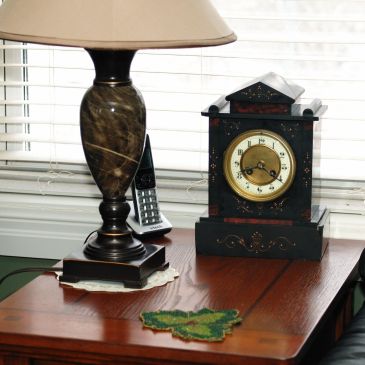
Arthur Pequegnat Bedford mantel clock – an interesting find

As regular readers know I am a fan of Arthur Pequegnat clocks not just because they were made in Kitchener, Ontario, Canada but they are attractive, well made and hold their value well (in Canada!).

Eddy's photo of the clock
Eddy’s photo of the clock

I have had clocks given to me in the past but this was a rather unusual situation. As readers know I publish at least seven or eight articles a month in order to provide interesting content on all aspects of mechanical clocks. I publish a regular feature called Tick Talk Tuesday in which I profile the mail I receive from readers. The mail is private email and not comments after a blog article. I receive many emails you will not find on my blog. Some people prefer writing to me privately and that is perfectly fine.

I received one such email some time ago from Eddy who lives in the Quebec City area (Province of Quebec, Canada). Eddy was researching my blog and discovered that I admired and collected Canadian-made Arthur Pequegnat clocks. He wondered if I would have an Arthur Pequegnat clock added to my collection.

Because it was an Arthur Pequegnat I was immediately interested but I did not expect a reply. To my surprise Eddy answered with five photos of the clock from various angles. It was a mantel clock in pretty rough shape and after seeing his photos I was still curious even though it likely required a lot of work to restore it.

Top of the clock
Top of the clock

In his email Eddy explained that he was having serious health issues and was taking stock of his life. He had a number of antique and vintage items that his father and grandfather had left him and he felt they should be passed on to someone who would appreciate having them. As Eddy explained, “My father had that clock as a trade against work done for people he helps with their house and lawn chores. He gave it to me since he’s got too many, just like my grand-father did. He was okay with me parting with it.”

I wrote back and told him that a meeting was indeed possible. We would be passing through the Quebec City area in the next few days on our way to our cottage in Quebec to open it up for the summer. We (my wife and I) had even planned to stay in that area for the night. We could stop by to have a look at the clock. Eddy then provided me with his address and telephone number. A meeting day and time was set up.

After nine hours of driving we arrived at his door. He invited us in and we spent a very pleasant two hours getting to know each other, discussing my collection of clocks, talking about the clock in question, his fathers hobby of searching out old antiques and finally, matters related to his struggle with a serious illness.

broken brass hinge
broken brass hinge

I was a little confused. Was he was actually giving me the clock or did he expect money in return so I decided to ask him straight out. No, he said, you can have it. he then brought out three other clocks to the kitchen table, a cottage clock, a steeple clock and a swinger. He asked me if I wanted those as well and I thanked him for the offer but declined. While they were very nice clocks I felt awkward taking all of them for nothing. So, we left with just one clock.

We walked out the door with clock in hand and for the next hour of our drive we talked about Eddy and his gift of an Arthur Pequegnat clock.

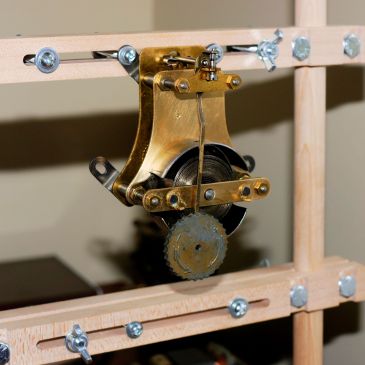
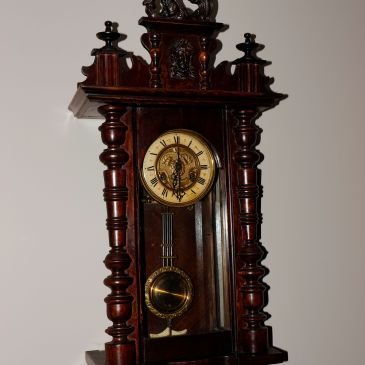
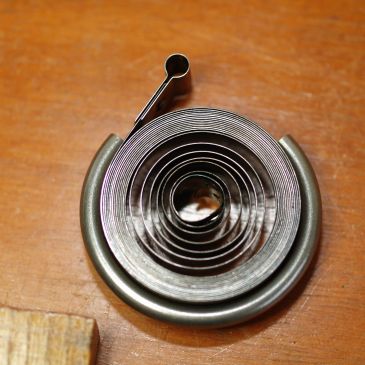
The clock was complete with original hands, pendulum bob, coil gong and of course, the signature Arthur Pequegnat movement with nickel-plated steel plates. The only visible sign of an issue with the movement was the time side mainspring which, as Eddy explained, could not be wound with a key. Damaged veneer, side trim pieces splitting open was clear evidence that at some point the clock had been dropped or fallen hard. The impact point was the very top of the  clock. Yes, it was in rough shape!

A challenge to repair? Yes, but I graciously accepted the clock knowing that I would have to spend several hours putting it right.

The sides and front were coming apart
Both sides and the trim front were coming apart

Thanks to Eddy I am now the new owner of an Arthur Pequegnat, Bedford model that I will add to my collection of four other Pequegnat clocks. In a later post I will detail the repairs to this fine Canadian made clock.

Eddy suggested that instead of offering him money that we donate to a charity and so a cheque went to the Canadian Cancer Society. I have never given names to my clocks but this one will always be called Eddy in honour of a individual who felt strongly that a family treasure should go to an appreciative owner.

Old Sessions shelf clock

Sessions American No. 2
Sessions American No. 2, my clock but exactly as in ad
Old Clock nice wood and brass good glass works great have both keys

Seller wants $60. Nice Sessions American time and strike mantel clock at a good price but really, 2 keys?

All American time and strike clocks require one key only.

Tick Talk Tuesday #14 – Can you tell me something about my Forestville clock

Tick-Talk Tuesday is about the letters and comments I have received from you, the reader, concerning your clock, issues you might have had, challenges you face or a clock you would like me to profile and my responses to your questions with advice on your particular clock concern. For those comments and questions that stump even me, I consult within my clock circles for the best possible answer.
GGs Forestville Mantel clock

GG writes: “Hello there,,,I was wondering if you know much about my mantle clock and maybe it’s value?

I have attached some photos!”

My reply: “Thanks for coming to my blog. That is one of the nicest mantel clock cases I have seen on a Forestville and it appears to be in good shape.

Forestville is a Canadian Company based out of Toronto. They went out of business in 1979. They did not make their own movements instead sourcing them from England, France, the US and Germany though they made their own clock cases.

GGs clock showing German made movement and pendulum bob

You may or may not know that Forestville was called the Blackforest Clock company prior to WWII. So, you have a post war clock made in the late 1940s or early 50s. Later on In the 1950s Forestville went from using pendulums in their clocks to balance wheels (no pendulum). Forestville also sourced German movements exclusively after the war. Your movement (the brass works) was likely made by Mauthe or Hermle, both well known and well respected German companies.

You have what is known as a time and strike Bim-Bam clock. It strikes the respective hour and once on the half hour but makes a distinctive “Bim-Bam” sound as a result of one hammer striking one rod while the other two strikes two rods simultaneously.

Unfortunately there are thousands of similar clocks and Forestville clocks are not particularly distinctive but a clock such as this in good running condition might fetch about $100.”

GG writes back to explain that the movement is an Enfield from England which stands to reason if it was made immediately after the Second War.

Blackforest shelf clock (Canadian made) gives me grief but decides to run again

Blackforest shelf clock

The clock is a 1937 Blackforest Royal Tour commemorative edition shelf clock with an 8-day time-only “plate” clock movement. Plate clock movements are so-called because they were typically used on kitchen clocks with Dutch Delft plates such as this one in the next photo.

Delft Clock from Forestville
Delft Plate Clock from Forestville

The movement is likely German and could have been made by a number of companies. There are no stamps or markings on the movement to give any indication of the maker. Canadian companies such as the Blackforest Clock Company of Toronto (the Forestville Clock Company after the war) imported German movements before the Second World War and installed them in Canadian made cases.

Grimy movement prior to cleaning

This clock had been happily running for about a year and then last week it suddenly stopped after a winding. I nudged the pendulum in an effort to make it go, checked to see if it was in beat and level but no luck. I nudged the pendulum a few more times, left it for a day or so, tried it again and still no luck. I was at the point of disassembling the movement to investigate the problem. Two days later I wound it tight and gave the pendulum a push and it sprang to life. I think I know what happened.

I thought I did a good job of servicing the movement including the mainspring over a year ago but apparently not well enough. You may have heard the expression, “you overwound the clock so that’s why it stopped”. There is a grain of truth in the expression because if you wind the spring till it winds no further the mainspring is at it tightest. If there are dirt, grime and rust on the mainspring the mainspring will actually cease in place, hence the clock stops. I believe this is what occurred in this case. Although it is running now it will need to be properly cleaned. In the meantime, I will let it run and see if it completes its full 8-day cycle.

Clocks we saw while on a visit to Spain and Portugal

In the early spring, my wife and I travelled to Portugal and Spain. We attended our daughter’s destination wedding in Sintra, Portugal and we decided to expand our stay, visit Spain and see the sights in Barcelona and Montserrat. Spain has always been on our bucket list and it did not disappoint.

Being a clock enthusiast I did a little research beforehand to find out if there were any clock museums along our travel route. Alas, we travelled to places that were very distant from the well know clock museums. Clocks in Europe were made in specific regions and that is where you will find clock museums. Here are a few clocks that I found in various places in Spain (Barcelona) and Portugal. I will let the photos tell the story.

Tall case clock in a cathedral
Tall case clock in a Barcelona cathedral

Little card on the side simply said "High box clock, school clock"
Little card on the side simply said “High box clock, school clock”, Barcelona

Marriage of movement and case found in a shop in Porto.
A marriage of movement and case found in a shop in Sintra, Portugal

Town clock in downtown Sintra, Portugal

Very ornate clock in poor condition, Pena Palace, Sintra, Portugal
A very ornate clock in poor condition, Pena Palace, Sintra, Portugal

Pena Palace, Sintra, Portugal

Tivoli Hotel, downtown Sintra. Unknown tall-case clock

The most ornate clcok is this working example at the Porto basilica
The most ornate clock I found is this working example at the Porto basilica

Unknown mantel clock, Tivoli Hotel, Sintra, Portugal

Unknown gallery clock. I could not find an opening on this clock. No arbor holes on the clock face.
Unknown gallery clock. I could not find an opening on this clock. No arbour holes on the clock face. Found on an estate in Sintra, Portugal

Flea market clock. Time and strike English or German clock, 1960s
Flea market clock. Time and strike English or German clock, the 1960s

Flea market clock. Time and strike French clock with matching candelabra

Used goods store, time and strike wall clock, possibly French

I was not specifically looking for these clocks but as we visited churches, museums, shops and public places I photographed any I discovered in our travels.

I have good luck finding a great deal on a clock

I seem to be one of those people who manage to find a great clock deal. I don’t think it takes a special talent but patience, research, and timing are three key elements in finding a bargain.

I often cruise the online for-sale sites for interesting clocks. In Canada, we have something called Kijiji. In the States Craig’s List is quite popular and I am sure other countries have something very similar.

What makes Kijiji (and similar sites) interesting and fun is that you can connect with people locally or in my case our province of Nova Scotia. There are a wide variety of sellers. Some know what they are selling and price items accordingly. Some have really no idea and either price items clearly for much more than they are worth or conversely for far less than their actual value.

It is nice to be able to meet the seller, find out the history of the clock, learn something about the seller, and their motivation for selling, negotiate a price, and bring the item home. There is no post office or courier service to “screw” things up. No “oh crap” sigh when you open the package. With online auction sites, you often get a “pig in a poke” which means that something is sold or bought without the buyer knowing its true nature or value, especially when buying without inspecting the item beforehand. This does not happen with Kijiji. You find the item advertised, connect with the seller several times electronically or personally if necessary, see the item beforehand, ask questions about it, inspect it for any immediate issues or potential problems and you have the choice to walk away if you are not completely satisfied. All transactions are cash with no pesky sales tax.

Clocks are interesting items to collect and prices are all over the map as you would expect. However, I have found a few gems in the last few years. Let me tell you about my latest experience.

A few weeks ago I saw this clock advertised on Kijiji (photo below). Now, this looks like any ordinary Gothic steeple clock but what grabbed my attention was the unique tablet inscription. The acid-etched glass tablet says “Cling to the Cross”, a religious expression not often found on this style of clock. I knew immediately that this was a very special Canadian-made clock.

Seller's photo
Seller’s photo

Why, because several months ago I watched a video presentation by Jim Connell. Jim Connell is well known in Canadian clock circles. According to the introductory remarks found at the aforementioned site “He has amassed a large collection of clocks of all types with an emphasis on those with a Canadian origin. As his collection and knowledge grew, Jim prepared and presented numerous articles, talks, and displays on Canadian clocks and their history.  He is the respected author of the Charlton Standard Catalogue of Canadian Clocks and he co-authored Early Canadian Timekeepers and The Canada and Hamilton Clock Companies with Jane Varkaris.”

In his presentation, he described this exact clock and mentioned in his presentation that there were very few copies left, a very rare Canadian clock indeed.

I wanted to confirm that this was the clock I thought it was and asked the seller to photograph the label. He did so and sent this to me.

Seller's photo of the label affixed on the back of the clock
Seller’s photo of the label affixed on the back of the clock

I attempted to negotiate a price. The seller wanted 100CDN and I offered 80CDN. He replied that he would not accept anything less than 100CDN. In the meantime, I checked with the curator of The Canadian Clock Museum to confirm its authenticity. Upon discovering that this was a Hamilton Clock Co. clock made between 1876 and 1880 I decided that, yes, this was a good find and in my email reply to the seller I said, “100CDN it is”.

It is what I would consider one of those happy win-win situations. The seller got more than he thought the clock was worth and I got a clock that is worth much more than I paid for it. My motivation, however, was not to celebrate a great deal at a great price but to acquire a piece of significant Canadian horological history at an affordable price.

Hamilton Clock Co Gothic steeple clock
Hamilton Clock Co. Gothic steeple clock
30-hour time and strike movement with clock company inscription on the bottom of the front plate
30-hour time and strike movement with company inscription on the bottom of the front plate

We met and settled the deal. I am now the owner of a Canadian-made 30-hour time-and-strike Hamilton Clock Co. Gothic steeple clock.

In a later blog article, I will profile this clock and describe my strategy to address some of its issues.

My Forestville mantel clock looks like yours

Forestville mantel clock
My Forestville mantel clock

Tick-Talk Tuesday is about the letters and comments I have received from you, the reader, concerning your clocks, issues you might have had and challenges you face and my responses to your questions with advice on your  particular clock concern(s). For those comments and questions that stump even me, I consult within my clock circles for the best possible response to your question

AM writes, “I am writing in hopes you can help me figure out how to safely set and wind my clock !

It looks pretty much identical to this one of yours I found online. Exactly same roman numerals. Forestville name in gold appliqué at top. GERMANY appliqué near the VI at bottom. Two key holes. Wing shaped box. Mine has darker brown wood glossy, and only one gold trim line. Same little feet. It has a silver colour key. I tentatively tried winding the left side clockwise, and it wound, but seemed tight. So I only wound it twice.  Scared to try the left side. Please let me know if you would – what each wind is for, and whether to go clockwise or counterclockwise. Thanks in advance for any clues you can give me.”

Roman numerals, Forestville name

Over winding a clock is a myth

My response, “Hi, These Forestville clocks have German movements. The movements are quite robust and will last for years. The left side is the strike side and the right side is the time side. You should be able to wind each side as tight as possible. Over winding a clock is a myth. If the clock does not run after you have wound each arbour to the limit, the springs are rusty and have seized the clock. However you should be able to safely wind each side several turns. The strike side will not function unless the time side is wound fully. You can get a feel for how the clock is wound. These clocks wind clockwise and the strike side might be a little tighter than the time side, I know mine is. The clock sounds like an old wristwatch because it has a hairspring or a floating balance wheel escapement not the usual pendulum ( I gather yours is the same). Anyway, do not be afraid of your clock. Wind it and enjoy it.

AM writes back and says, “Hello and thank-you for your reply. I took the plunge and wound each side about 4-5 X. No ticking as yet !  It must be seized at you said…Not sure what to do now cuz we live in the XXXXXXX and I doubt a clock expert nearby (within 300 km). Prince George is 3 hr drive west, and Grande Prairie Alberta 2.5 hr east. Will start asking around for sure. It is quite funky and reminds me of my Aunty Jane… so I will use as décor for the interim.”

My reply, “Open the access door. Locate the escapement at the top of the movement. If it is exposed give the wheel a little push. If it is in a plastic enclosure, tap on the plastic a few times. That might be enough to free the escapement. If it runs you have power through the clock. If it does not your power issue might be elsewhere i.e. seized springs, bent wheels etc. Unfortunately a repair would be far more than the clock is worth but that is a decision you will have to make.”

Hairspring escapement in my clock

AM managed to get the clock working but it will not strike despite plenty of whirring.

Balance wheel or floating balance escapement

Closer look at the floating balance escapement

AM says, “Well now I’m thinking maybe I can fix the chime myself ?  Particularly with your help.  So this one last attempt will show you how it sounds.  I also need to know:

  1. During the weekly wind, if I just do not wind the chime… will it stop the click and whirr without affecting the clock time?
  2. Here’s what I see at the back during non-chime time – one hammer is a ‘two in one’, and it was up, but the one at the back was down touching the rod.  So I tried lifting it, and realized that the little black metal stopper that holds the ‘two’ works well, but the front stopper wouldn’t hold the back hammer.  I gently bent that front black stopper (horrors? !) so it will hold it up. But still no chime.
  3. Then I decided to take a wee video of the strike during chime time.  At 11:00 that morning, this is what happened in the back of the clock:
  4. It seems to me by the length of whirring, that the chime is out of whack in that sense also.  Not sure tho how much whirr = one chime.”

I took a look at the video and the strike rods are way too high above the rods.

My reply, “There are three hammers. Your clock is not a chiming clock – it is a striking clock. A chiming clock makes a musical sound and typically the musical sound is the Westminster chime on the quarter hour. You have what is called a striking “Bim-bam” clock. The rear hammer hits first followed by the two front hammers to make that bim-bam sound. The hammers should be just above the strike rods. Yours are too high to strike the rods therefore you are not getting the sound of the strike. Lower the rods by slightly bending them past the rods to the side and bend them so that they are just barely above the rods leaving a gap of about 1/8 inch. They should now work as designed. I can only surmise that someone in the past bent the rods upwards to quiet the clock.”

AMs Forestville clock
AMs Forestville clock, a very attractive Art Deco clock

AM replies, “Ok!  Well that makes sense, and even the bending of the hammers.  I can hear and see my Uncle Bill … first swearing, then getting in there and bending those hammers!  He was dear soul really. Thanks for all your help”.

Crazy clock ads – needs guts

Red color wood, in nice shape, not working, needs guts. $5.

Maybe I’d get it just for the case!

Arthur Pequegnat Simcoe mantel clock

Canadian clock collectors are passionate about Arthur Pequegnat clocks. In private sales and online for-sale sites most sellers are knowledgeable enough to know that they are very desirable. A Pequegnat will sell for many times more than a comparable mantel clock, that is, in Canada.

Arthur Pequegnat Simcoe mantel clock
Arthur Pequegnat Simcoe model mantel clock


The Arthur Pequegnat clock company had an illustrious albeit short history

The Simcoe is my fourth Arthur Pequegnat clock. It is very similar in dimensions and style to the Jewel. Whereas the Jewel is basically a unadorned box the Simcoe has a piecrust dial bezel, claw feet on each corner and lions head handles on each side. It has a coil gong for the hour strike and a bell for the half-hour passing strike.

To collectors it is referred to as a”Berlin” clock. Although it is impossible to date Pequegnat clocks precisely the name Berlin distinguishes clocks made before 1917 and those made after and up to 1941 when the factory finally shut its doors. Clocks made prior to 1917 were inscribed “Berlin”, Ontario on the dial face since Kitchener was known as Berlin until midway through World War I. From 1854 until 1912 it was the town of Berlin and City of Berlin from 1912 until 1916. Because the name Berlin had a negative association with the war against Germany the city administration chose the name Kitchener. Kitchener is the present seat of the Regional Municipality of Waterloo, Ontario (Canada).

Time and strike movement with steel plates
Time and strike movement with steel plates, a common feature with Pequegnat clocks

The Arthur Pequegnat clock company had an illustrious albeit short history. Arthur Pequegnat, a watchmaker by training, was born in Switzerland in 1851. Arthur immigrated to Berlin, Ontario Canada in 1874 with his wife, parents, brothers and sisters; a grand total of 18 family members.

Arthur Pequegnat clocks such as a simple mantel clock you see here can command hundred of dollars in Canada

By the late 1870’s Arthur was operating a jewelry store and watch repair in Southern Ontario. By the middle 1880’s Arthur and his brother Paul were operating a shop in Berlin, Ontario. After ten years the brothers went their separate ways, both operating successful jewelry shops in Southern Ontario.

In 1897 Arthur expanded his Berlin jewelry shop to include the manufacture of Bicycles. However, by 1904, with the decrease in the demand for Bicycles, Arthur began to re-focus on the clock industry, by manufacturing his own clock movements at his Berlin Bicycle Manufacturing plant. Arthur obviously visualized a profit in clock making as many clocks at the time were imported from the United States. At first the wooden clock cases were made by local furniture makers, however in time he manufactured his own clock cases. Although the Arthur Pequegnat Clock Company was widely regarded as the only true Canadian clock company, lesser known companies such as the Hamilton Clock Company and the Canada Clock Company, though not as successful, predated it.

The Simcoe is a relatively nondescript clock. I passed by it in the antique store without realizing that it was a Pequegnat. My wife spotted it and I returned to take a second look. Sure enough, a Pequegnat!

The yellow oak case is in very good condition with one or two small scratches and a chip just above the top of the bezel. The dial pan has had an ugly repair, there are two brass tabs at 12 o’clock and 6 o’clock protruding though the front of the dial.

Piecrust bezel
Piecrust bezel

The dial face has some crackling but is otherwise in good condition. The piecrust bezel is in very nice shape as are the claw feet and lions heads.

Lions head on case side

The movement looks very clean with little evidence of wear. There is an inscription on the back dated Jan 10, 1970. It was likely serviced on that date. In any event it does not appear to have had much running since then. Unfortunately, there is no label.

Ornate front feet
Ornate front feet

The movement was taken out of its case, inspected for wear and found to be in very good condition. The movement was oiled, returned it to its case, the  beat was set and it is running strongly. The clock will be inspected in one years time to determine if servicing is required.

What! How does that work again??

This weeks goodwill find. It was 10.00 but it had a blue sticker on blue tag day so it cost 5.00
 

Unknown mantel clock

Clock owner posted his excellent find on a popular social media site. Here is the conversation.

  • Person 1, “ Can’t lose at that price. Hermle movement I presume.”
  • Clock owner, “Yes with a quartz battery operated time train. The gong and chime are wind up”.
  • Person 2, “ Cool. What do you mean ?? Pic of movement ?”
  • Person 3, “Yes, how does that work? very curious.”

No answer from clock owner and no photos of movement but there are two arbour holes.

In defense of the seller it could be electro-mechanical as Hermle made a few such clocks in the 1950-60s. Any thoughts or ideas? I think it has been converted.

What style of clock do I have?

Clocks have been more than just timekeepers throughout history; they are reflections of art, culture, and technological innovation. Whether for practical use or decorative appeal, clock styles have evolved to match the tastes, craftsmanship, and technologies of their times. Here’s a look at some of the most iconic and varied clock styles.

The clock is an instrument designed to keep and indicate time. It is one of the oldest human inventions. The clock has evolved through the ages from sundials in ancient times to early tower clocks of the 14th century weight-driven clocks and finally spring-driven clocks from the 1840s to the 1970s.

The world of mechanical clocks encompasses a wide variety of styles, and distinguishing between them can often be confusing—such as understanding the difference between a shelf clock and a mantel clock. In this article, I’ll navigate through these terms and highlight the most common styles or types, using examples from my own clock collection to illustrate them.

Mantel Clock

Many auction sites and even professional websites use the word mantle. The correct terminology is “mantel”. A mantle is a shawl or coat worn by women, an important role passed on from one person to another or the earth’s crust. A mantel is the top framing of a fireplace or a shelf above a fireplace opening.

A mantel clock is designed to fit on top of a fireplace or shelf. A mantel clock can be time only, time and strike, or a chiming clock. Generally, if there are 2 winding arbours it is a time and strike clock, if the clock has 3 winding arbours is it a chiming clock that is, it will play a tune on the quarter hours, the most common being the Westminster chime.

Mantel clocks might also be referred to as shelf clocks or buffet clocks.

Kitchen Clock

Arthur Pequegnat kichen clock
Arthur Pequegnat kitchen clock

Kitchen clocks are often referred to as gingerbread clocks or parlour clocks. At times, it can be difficult to differentiate between a kitchen clock and a parlour clock. Gingerbread clocks are distinctive because their designs are typically created by steam-pressing the wooden front face. However, some clocks, like the one above, are made using a powered cutting saw but are still classified as kitchen clocks. Additionally, some of these clocks included alarm mechanisms. The terms gingerbread, kitchen, and parlour are often used interchangeably.

Another type of kitchen clock is shown below. This is an 8-day time-only delft wall clock made by Forestville.

Delft Clock from Forestville
E. N. Welsh Whittier model
E. N. Welch Whittier model

A parlour clock is generally considered more ornate than a kitchen clock, although it may still be referred to as a kitchen clock. It is placed in front hallways, entryways, and so on. The designs are always cut and there may be finials, a mercury-filled pendulum or very ornate design, garish trim pieces, and a decorative tablet.

Vienna Regulator

Gustav Becker two-weight Vienna regulator

There are many styles but most are of the single-weight or two-weight variety. The definition of a Vienna regulator is always open to debate but the consensus among collectors is that they are weight-driven, made in Austria/Germany, ornate in design, have porcelain dials, decorative crowns, large pendulums, and finials on the top and bottom.

The broad definition of Vienna Regulator includes those that are spring-driven. Though not defined as “regulators” it is acceptable among collectors to refer to them as a Vienna style.

Cottage Clock

Canada Clock Co Hamilton Cottage Extra

Sometimes called a mantel clock or a shelf clock, they are usually diminutive in size to occupy a smaller space. They are found in bedrooms and kitchens and are sturdily built since they are often designed to be portable. They come in time only, time and strike, or may have an alarm function.

Carriage Clock

French Carriage Clock

Carriage clocks are portable and were very popular around the turn of the 20th century. French-made carriage clocks are more collectible and fetch generally higher prices although American ones can be quite desirable. Carriage clocks are designed to be portable and are time-only but some are time and strike (with a repeater function) while others may have an alarm function.

Crystal Regulator

Ansonia Crystal Regulator

Crystal Regulator clocks are identified by a brass case with 4 crystals or glass panels. Porcelain dials, Roman or Arabic numerals, ornate in design but sometimes quite garish. Most are 10-12 inches in height though some are smaller. Makers are American and French though French crystal regulators are called four-glass clocks and tend to have higher value. Distinctive by their mercury or faux mercury pendulums. Some have visible Brocot escapements and the time and strike movements are always visible.

Cuckoo Clock

Cuckoo clock
Cuckoo clock

These clocks are pendulum-regulated and make an automated sound like a cuckoo when it strikes the hours. Some can be very intricate with several animated characters. Desirable ones are antiques from the Black Forest region of Germany. Modern ones are generally frustrating to repair, cheaply built, and are poor timekeepers.

Lantern Clock

Converted lantern clock

A lantern clock is a type of antique weight-driven wall clock, shaped like a lantern. They were the first type of clock widely used in private homes. They probably originated before 1500 but only became common after 1600 and in Britain, around 1620. They became obsolete in the 19th century. The one pictured above has been converted into a fusee movement.

Alarm Clock

Baby Ben alarm clock with second hand
Baby Ben alarm clock with seconds hand

Alarm clocks are wound once per day and designed to do two things, wake you and display the time. They are cheap, and are average timekeepers but have long-lasting and reliable movements.

Desk Clock

Kienzle World Time clock

These sat on fancy office desks or credenzas in office locations. They are either time-only or time-and-strike. Most were time-only to minimize distractions in the office environment. Some are very attractive and have unique designs and are more decorative than utilitarian. This one above is called a World Time Clock by Kienzle.

Wall Clock

Box clock
German Mauthe Box clock

A wall clock is broadly defined as any clock designed to be hung on a wall, making it a practical and visible timekeeping solution. Wall clocks come in various styles, from simple and functional designs to highly decorative pieces. This one by Mauthe is often described as a German “box” clock which became popular after the First World War and made into the 1940s.

Schoolhouse Clock

Ansonia clock project is complete
Ansonia schoolhouse clock

They are known as schoolhouse clocks because they hung in many schoolrooms in North America. Usually distinctive by their octagon shape and short or long drop feature with a glass door displaying a swinging pendulum. Many thousands were made; they had cheap mass-produced softwood cases and robust movements. Most were time-only though some were time and strike and others even included a calendar function.

When they were marketed years ago they were not called “schoolhouse clocks” but rather, clocks made for the schoolroom.

Novelty Clock

Chairman Mao Zetong waving as the clock ticks

These clocks are designed for the tourist trade with interesting features. In the case of the above clock, a smiling Mao Zedong has his little red book in hand and is waving “to the masses” as the clock ticks.

Ogee Clock

Waterbury OG clock
Waterbury OG clock

It is so-called because of the curved molded wood case. It might also be referred to as an OG clock. The design originated in the United States in the 1830s, distinguished by a case (usually pine) the front outer edges of which are curved into an S-shape (Ogee). This shape is formed by the union of a convex and a concave line. A mass-produced variant of the shelf clock, the Ogee clock typically stands about 30 inches (75 cm) high and is usually weight-driven. The movements were generally made of brass (earlier ones were made of wood) and ran for 30 hours or eight days. This is a 30-hour weight-driven version from the 1870s.

Tall Case Clock

Ridgeway Hamilton Country, Westminster chime

Tall case clocks are known by various names depending on the region. They are referred to as tall-case clocks in American terminology, long-case clocks in British terminology, hall clocks in Canada, and sometimes as floor clocks. However, the most commonly used term is “grandfather clock.”

They are usually weight-driven, with the weights on chains or cables, and are distinctive by their obvious height. They are always 6 feet or over but can be as high as 8 feet high (1.8 to 2.4 meters). They often feature elaborately carved ornamentation on the hood (or bonnet), the frames, the throat, and the dial or clock face. Older ones have 30-hour movements but all modern grandfather clocks run on an 8-day cycle.

Smaller clocks are called grandmother and granddaughter clocks. They are under 6 feet.

Anniversary Clock

Kundo standard size 400 day clock
Kundo standard size 400-day clock

These clocks are also called torsion clocks or 400-day clocks. 400-day clocks are torsion driven having a long suspension spring to which a weight oscillates back and forth. Typically these clocks operate at 8 beats per minute and run for long cycles on a single wind, up to 400 days. These clocks were popular as wedding gifts or gifts to mark special occasions. They are relatively simple to repair but can be finicky to set up. The newer quartz clocks are very accurate but do not replace the charm and curiosity of the older mechanical ones.

Some might call them purely decorative.

Tower Clock

Tower clock
Tower clock in Holguin, Cuba

In the early 14th century large mechanical clocks began to appear in the towers of Italian cities. There is no record of any working models preceding these public clocks that were weight-driven and regulated by verge-and-foliot escapements. They are referred to as Turret clocks in the UK.

In conclusion, while there are sub-categories for some of the clocks described above, this overview provides a general understanding of the commonly used terms. Having this knowledge can be especially helpful when shopping for a special gift or identifying the style of clock you may have in your possession.

Mercedes clock – not made by the car folks

Mercedes makes a great car. Do they make clocks? No! Is this Mercedes novelty timepiece a great clock? Read on.

Attractive Porcelain clock
Attractive ceramic clock with time-only movement

This very attractive 30-hour Mercedes ceramic mechanical shelf clock of the Baroque Meissen style (debatable) from the 1970s is more of a novelty item than a clock.

It is a time-only alarm clock movement made by Gebrüder Hauser and marketed under several names one of which is Mercedes. Ceramic clocks on eBay or any other auction sites will reveal the Mercedes name as well as other retail names on similar-looking clocks. For example here is a similarly styled Alana clock. Same casting sans gold detailing.

The Alana, similar to Mercedes but without the gold coloured accents
The Alana, similar to Mercedes but without the gold-colored accents

This Mercedes novelty clock is in excellent condition with no chips, cracks or any sign of wear. But is it worth anything? Not a lot.

History of the company

The Gebrüder Hauser clock factory (Die Uhrenfabrik Gebrüder Hauser) was founded in 1923 by Otto and Josef Hauser in Weigheim, Germany. Josef Hauser resigned in 1926 and moved on to form his own company. The company name Gebrüder Hauser then received an additional owner, Otto Hauser. Aside from alarm clocks, clocks with pendulums and chess clock works were produced.

Winder and time set screw on rear of the clock
Spring winder, time set screw and speed lever on rear of the clock

In 1951, the son, Eduard Hauser joined the company. From 1955 onward small affordable alarm clocks and chess clockworks were manufactured. In 1965 Norbert Hauser joined the company and the company name was changed to KG.

The Gebrüder Hauser KG clock factory in Weigheim was eventually closed on 31 July 1998.

Are they common?

There are a number of variants of this clock, mechanical, electrical, and quartz. The mechanical version will command higher prices and is more desirable. Unfortunately, they are throwaway clocks and the cost of servicing would be far more than they are worth.

Nevertheless, it makes for an attractive mantelpiece and as a gift, it is likely the recipient will not keep it wound.

Letting a newly serviced clock sit without running


Box clock
Mauthe time and strike German box clock

What happens if you service a clock and let it sit without running it? What happens if the clock is not run and stored for a year, does the oil dry out? Is it better to run the clock once a month to get the oil moving?  If the clock is sitting for a year should I refresh the oil before running the clock? These are all good questions. I will attempt to answer each one.

Unfortunately, most people let their clocks run until they start to show signs of needing servicing

It largely depends on where the clock is located. Environment should always be a consideration in whether to run your clock constantly, or not. Is it in a smoke and dust free environment? Can the humidity be controlled? Are there pets? Pet hair can find its way into the strangest places.

Mauthe mantel clock with Westminster chime

I like to check all of my clocks on a 2 year schedule. If all looks well, I may not do anything except look it over and add oil where necessary. I might repeat this for 4, even 6 years before signs of wear show up. Or, there may be signs of wear at the first check at 2 years. If wear is evident, I might note it and monitor it several months later and address the wear at that time. This approach will keep your collection in good shape with a minimum amount of work. If there are pets in the home you may want to inspect your clocks at more regular intervals. If the clock is sitting for a year without running should I refresh the oil before running the clock? Yes, but only if there is no or very little evidence of oil in the pivot holes.

However, a clock that is allowed to sit dormant for one year should be essentially as you left it. If you used a good quality oil, an oil specifically designed for clocks, it should not break down over the course of one year. A thin coat of quality oil in an unused clock will disappear over about 4 years with little or no trace of residue and that is the time that it needs re-oiling. The buildup of sludge often seen is the end result of repeated over-oilings over the course of many years.

I know collectors who run a small number of their clocks daily but some intermittently, perhaps once or twice a month or a year, enough to keep the wheels and the oil moving. I have some specialized clocks that I will run only occasionally like my Kienzle World Clock in order to lessen the wear but keep the parts moving. Why? This a very frustrating clock to service and I want to extend the service interval as long as possible.

Kienzle World Time clock

Getting back to the home environment I should mention mention that concentrations of some indoor pollutants are often 2 to 5 times higher than typical outdoor concentrations. In environments with air born particulates, tobacco smoke and animal dander your clock should be sealed properly by making sure that access doors/panels are closed, that broken dial glass is replaced, large holes in the clock cases are  sealed and clocks are away from areas of the house that produce higher amounts of dust and humidity (kitchens and bathrooms).

Unfortunately, most people let their clocks run until they start to show signs of servicing and at that point repairs can be costly if you are not doing the work yourself.

Taking good care of your timely treasure will reward you with years of service.

2017 – Time to reflect, a year in summary

I am a retired educator living in Nova Scotia Canada. I collect vintage and antique clocks that I repair and maintain. I also write about horological areas of interest, interesting clocks and clock stories when I search for new acquisitions.

As most bloggers know the key to building a successful blog is not only attracting new visitors but keeping existing ones interested enough to come back

Baby Ben alarm clock with second hand
Baby Ben alarm clock with seconds hand

In the spring of 2015 I began my journey into blogging. The first few months of writing about clocks, clock collecting and repair were very challenging. How could I interest those who not only collect antique and vintage clocks but have just a passing interest? As time went by I began to realize that there was plenty to write about, that the world of clock collecting and repair is incredibly vast and that there is much to learn.

This blog has given me an opportunity to profile my own clock collection, walk the reader through the challenges of restoring and repairing my clocks and the knowledge gained from those experiences.

Cuckoo clock
Cuckoo clock

As I write this article my blog has over 49,000 total views, 33% from United States, 17% from Canada and the remainder from around the world including the United Kingdom, Australia, Romania, Germany, India, The Netherlands, South Africa, Malaysia and 80 other countries. The top 5 articles this year were:

  1. Mauthe Mantel Clock
  2. Daniel Dakota Wall Clock
  3. What is my clock worth?
  4. How to wind a mechanical clock
  5. U.M. Muller Box Clock

As most bloggers know the key to building a successful blog is not only attracting new visitors but keeping existing ones interested enough to come back. In the past year alone viewership has doubled. My visitors average 1.8 articles per visit with an average of 88 views on a typical day in 2017. November and December peaked at 100+ views per day.

Swiss made smoothing broaches

Providing enough stimulating content so that visitors want to return is always a challenge. I post 7 articles a month, sometimes one or two extra, usually spaced 4-5 days apart, on various topics of interest. I also attempt to appeal to all facets of clock collecting and repair from profiling my own acquisitions and experiences restoring and repairing my clocks to articles of general interest. I also inject historical horological context as much as possible.

I receive about 30+ comments per month on average. All comments and inquiries are welcomed. Interesting comments come from people who typically ask me how much their clock is worth, particular problems they have with their clock, strategies for repair and information about the history of their clock. All questions are answered to the best of my ability but I make no pretense that I am a trained professional.

one-weight Vienna wall clock
Miniature one-weight Vienna wall clock, circa 1870

In 2018 my intent is to continue to write interesting articles about clocks in general as well as profiling my modest but expanding collection of antique and vintage clocks. I also plan to explore special areas of interest.

Future articles include, “Letting a clock sit without running”, “Mercedes clock – not made by the car folks”, my 4th Arthur Pequegnat clock, a second installment of the Waterbury Ogee 30 hour clock, a mini New Haven Ogee that has some curious modifications, how to set up your grandfather clock, “What style clock do I have?” and more Crazy Clock Ads.

Ingraham Huron mantel clock circa 1878

Mauthe Westminster chime mantel clock

Stay tuned and if there is an area of interest you would like to see me to explore, drop me a quick note. If you like what you are reading express “Like” it at the end of each article.

Thanks for your comments, your encouragement and your continued support.


Crazy Clock Ads – would you buy this clock?

Here is an ad for a clock recently offered on an online for-sale site. Here is the description.

The clocks dose not work it needs some work 80 dollars or best offer

And here is the image that is attached. There is only one image.

Blurred image of a clock for sale
Blurred image of a mantel clock for sale. Photo not rotated, as seen on ad

Would you as the buyer even ask more questions about this clock?

Wouldn’t the seller put just a little extra effort into a good description and decent resolution images if they wanted to charge a fair price for their clock? I would be surprised if the seller gets any response from this ad.

E. N. Welch Whittier model parlor clock Part IV – final word

Clock displayed in antique shop
EN Welch time and strike parlour clock displayed in an antique shop

In a previous article I described some of the challenges I had with this E.N. Welch clock movement.

The clock ran for about 48 hours and suddenly stopped. It seems that every time I think everything is going well, something else crops up.  I dis-assembled the movement (again) and installed three more bushings, one of which is on the escape wheel bridge which I noticed had a fair amount of play. Perhaps the vertical motion of the EW was causing the clock to stop. The other two bushings were installed on the third wheel, back and front. I have decided to hold off addressing the EW teeth if the bushing work I have done has solved the stoppage issue.

I was hoping to wrap the servicing up fairly quickly but unanticipated problems continued to crop up. Having completed the work mentioned above I could see that things were beginning to change for the better.

Washer around centre cannon
Shortly after taken from the case. A very dirty movement with many issues

The time side ran strongly for eight days after which I reinstalled the strike train. Here is the movement running on a test stand.

Cleaned, bushings replaced and tested
Cleaned and free of rust, bushings installed and tested

Setting up the strike side required manipulating some of the lever wires which were moved out of position by the previous owner, for whatever reason. A previous repair/adjustment resulted in the lifting levers bent back into the case and the count lever pushed in an upwards orientation. As a result I had to bend the levers back into their original positions.

Levers
From left; hammer lever, count lever, lifting lever

Here is the movement installed back into its case.

E. N. Welsh Whittier model

It should now run reliably for years to come. A frustrating project with a satisfying ending.

Is clock collecting part of the counter-technology revolution?

Is clock collecting (and repair) part of the counter-technology revolution?

Many years ago, social scientists predicted with the onset of modern technology it would sap us of our knowledge. Our brains would simply melt away. Concentration and initiative would be sucked out of us. Why would you need to know anything if it is readily available at your fingertips? How often do you hear the phrase, “just google it”. Sadly, it has become an integral part of our lexicon.

People are embracing old technology and returning to the fulfillment of doing things for themselves

The term counter-technology is not a term I invented. I found it mentioned in a car magazine article some time ago. Many people are collecting and repairing antique cars more than ever. Why? Reliving past memories? Getting your hands dirty. Rejecting the modern world?

Has the analogue world returned? Yes and no. Wine and beer making has become a huge industry and there seem to be mom and pop microbreweries everywhere, antique furniture purchases have increased dramatically, backyard chicken coops are popping up everywhere, fountain pen collecting is a “new” thing, vinyl records are spinning back and stamp collecting is returning with renewed vigor.

Retro is in. But is is not just that! It is a statement. People are embracing old technology and returning to the fulfillment of doing things for themselves. We all know the value and satisfaction of pursuing a simpler way of life but at the same time we still want to feel connected to our busy modern world. We want both. This is our inevitable response to the new digital world. We are pushing back but just enough to satisfy our needs by remaining connected with the past but we still feel the need to be plugged in.

However, every now and then we feel the need to dis-engage. Digital detoxification. It’s a thing. Somehow we want to wash the digital world from our lives, however briefly. I spend summers at our family cottage in Quebec (Canada). There is no Internet and I am totally fine with that. But what’s the first thing I do when I return home? You got it!

You too can be saved

Simplicity breeds complexity

To truly embrace the analogue world the mechanical clock is my personal statement. Not only do I collect antique and vintage clocks I repair them as well. As readers know I am not a trained horologist but I love the challenge of repairing a clock and I love accumulating knowledge in the pursuit of my hobby. Needless to say I am not always successful and my office has a few notable failures. I am fine with that. Failure breeds learning. It is my response to the increasing pressures of the digital world. It is my response to our increasingly complicated world. Simplicity breeds complexity.

Like the juggler who can keep all the balls in the air at once

It took years to learn the skills necessary to repair this Sessions Westminster A Westminster chime clock
It took 2 years to learn the skills necessary to repair this Sessions Westminster A chime clock

Analogue verses digital. It is a question of balance, like the juggler who can keep all the balls in the air at once. I admire people who have “analogue” hobbies but I especially admire those who remain connected to our modern world by maintaining a delicate balance between both.


E. N. Welch Whittier model parlor clock Part II – a description

E. N. Welsh Whittier model

The Whittier Model

This is the Whittier model from Welch’s Authors series. Tran’s 2d ed. shows it from the 1893 catalogue. It is a half-hour strike clock. Though an alarm could be ordered this clock came without one.

It is solid walnut in construction, deep brown in colour and darkened by age.  It stands 22 inches tall by 14 ½ inches wide and 5 inches deep. The crown is an ornate machine-cut design with a single bulls-eye. The Roman numeral dial face with inner brass ring is original but has been covered with a clear varnish.

Clock face in good condition

The spade hands with circular cut-outs also appear to be original. The tablet is in remarkable condition and features an embossed gold colored scene of two female child warriors on each side presumably guarding an older female warrior (laurel and spear), reminiscent of Greek or Roman mythology.

Barely readable label

Bottom label with running instructions

There are two labels on the back panel, the top designates the model name which is barely readable; the bottom label has generic operating instructions for several types of clock models. Both labels appear to have been varnished over at some point. The upper area of the back panel has a hook for hanging the clock, added by a previous owner. However, this is a shelf or mantel clock, not meant to be hung on a wall. I doubt that the pendulum bob was this colour originally.

Though incorrectly termed a kitchen or gingerbread clock it is commonly referred to as a parlor or hall clock. Since the company last produced clocks in 1902 I would comfortably date this clock at between 1893-96 or perhaps a little later, 1901-02. The E. N. Welch Clock Company has a fascinating history (detailed in Part I of this series) and unfortunately not many of these well-made American clocks are still around.

Time and strike movement

In Part III I will describe the challenges of servicing the clock movement.


Lessons learned from antique mall clock buying

While touring through the United States we had an opportunity to explore the “magic” of antique malls. Antique malls are typically located in former department stores such as Macys or JC Penny found in commercial areas of a town or city. Antique malls are an American cultural experience. They are not a unique experience for me as I have been in much smaller antique malls in Canada but this one was very BIG!

Dozens of vendor stalls

A particular example I will use is the Maumee Antique Mall located north of Toledo, Ohio. For the antique shopper the first impression is of a giant smorgasbord of antiques. Could I find a bargain given the huge selection of antique items? The Maumee Mall would have about 200 vendors or more. Each vendor would occupy a small 12X12 stall though some might have more than one stall.

It was a weekday and we did not expect to see a lot of shoppers; that was certainly the case on that particular Thursday. The mall is organized into aisles with plenty of antiques with no particular organization. If one were looking for crystal, for example, some stalls would have crystal and others a slightly better selection but there is no specific area of the mall that would have a concentration of any particular item. Front end staff in a check out area handle all the transactions. The mall is filled with security cameras so you are being watched at all times. There are also security staff disguised as shoppers who are present throughout the complex. A small snack bar invites the shopper to have a bite while finding that special item.

Always and I mean always ask for a discount

There are no discounts on items below a certain fixed value ($20 for instance). Some malls are authorized to offer a %10 discount without contacting the seller. Any further negotiation on price requires the mall staff to contact the vendor who may or may not be immediately available. If contacted, the sellers normally do not offer much more than the standard 10% discount. A bit of advice; in malls such as Maumee or any antique store for that matter, always and I mean always ask for a discount.

On this particular Thursday I was shopping for antique clocks. I found nothing that I would consider a “deal” that day. A typical gingerbread clock was in the US$175 to US$200 range, a mantel clock US$100 or more.

Gingerbread needs work
Appears to be a deal  but this Gingerbread needs a lot of work

Interesting clocks
Interesting clocks but pricey

A Mauthe German box clock that was not in the best of shape was selling for US$299. In general, most clocks had serious issues such as missing hands, no pendulum, scuffed up or cracked cases and unreadable dials. Clock prices were 30% to 50% higher than you would find on eBay, any other auction site or your local mom and pop antique store. My wife was shopping for glassware & crystal and also found higher than average prices but managed to find a couple of nice items.

$299 Mauthe wall clock
US$299 Mauthe time and strike wall clock

Why? High overhead is most certainly a factor. Staffing, security, and steep rental rates force the vendor to charge higher than normal prices. Malls such as this most certainly attract a customer base though I suspect not many are highly educated antique shoppers.

For the bargain shopper there are much better options in my opinion. The best bargains for clocks can be found on local community online for-sale sites where you can negotiate directly with the seller electronically or in person.

Call it a cultural experience but in my view you will not find great bargains at an antique mall. Your mileage may differ!


Low antique clock prices – are they here to stay

There is a peculiar phenomena happening in the clock world today and that is tumbling clock prices. French cartelle clocks, American jewelers regulators, original E. Howard and Willard banjo clocks to name a few have retained their value but clocks that would have sold for hundreds of dollars a few short years ago can be had for almost nothing today. It is not a great sellers market.

Rare Ingraham Huron found on a local online for-sale site
Rare Ingraham Huron shelf clock was once sought after by collectors

Prices will not rise any time soon as modern generations have been conditioned to discarding old for new irrespective of merit and in contradiction to the ideology that recycling saves the planet

Why are clock prices so low?

I have acquired some very nice clocks for ridiculously low prices. While it is part luck there is ample evidence that recent clock prices have never been lower.

There are so many clocks that no one seems to want. Gingerbreads, school house clocks, mantel clocks, Ogees (30 hour or one-day especially), calendar clocks and most garden variety clocks go for very low prices. Good for collectors, not so good for sellers. Prices will not rise any time soon as modern generations have been conditioned to discarding old for new irrespective of merit and in contradiction to the ideology that recycling saves the planet.

Millennials are also facing a very different world than I and my contemporaries faced. Factory work or clerical positions are now considered a good job and young people are staying with mom and dad living in their old rooms as they try to pay off mortgage size student loans. Under those circumstances you will not consider buying a tall case clock or an 18th century French clock.

Thanks but I have no place to put one

My generation (I am in my 60s) did not typically have mechanical clocks in their homes (aside from Grandfather and cuckoo clocks), so younger people today do not have those kind of memories to inspire nostalgia. In my day mechanical clocks were thrown in the trash when they wore out to make way for the electric clock. For young people today the old clocks we loved are not in their sights for purchase. An offer to gift a clock to a millennial is often met with the reply, “Thanks but I have no place to put one” and of course, winding it is always a hassle. A visit to any antique store or clock fair says it all when observations show the average age of visitors and traders are often in their “senior” years.

Junghans Crispi wall clock, not rare but a fascinating history

Prices of clocks really did not begin their rise in value (at least in North America) until the mid to late ’50’s. Since then and up until the late nineties many ordinary clocks commanded high prices. Since the year 2000, the economy has been spiraling downward. Paralleling the declining economy is the decline of prices for antiques of all types. The at-times spectacular and troubling declines in real estate values, increasing unemployment and fewer discretionary dollars have all had an deleterious effect on dropping clock values. With the up-tick in the economy perhaps things will change

I collect clocks and other antiques for interest and history alone

I collect clocks and other antiques for interest alone and only those I can afford which often means that I will try to buy a clock for as little as possible. Collecting in this way allows me the comfort in knowing that there is no worry about future rises or drops in value. I acquire clocks simply because I want them, and pay a price that is worth it to me. If I see something that I do not have, it is unique or has some historical value and it is a reasonable price (to me), I will buy it.

However, many of us collectors are aging and downsizing. Few are in buying mode and many want to sell. The result is a glut of often lesser quality clocks that were once bought at higher prices.

French mantel clock
French mantel clock, a very nice clock at a ridiculously low price

Unless you are prepared to learn how to repair or somehow care for an old mechanical clock you are faced with the prospect that the cost of repair far exceeds the value of the clock. Sentimental reasons always trump repair costs but the message from the clock repair person with integrity is clear, “keep it, it is not worth the cost of repairing”.

Will prices get better? Prices for antiques and collectibles is cyclical and chances are that they will go up again.

Aug Schatz & Sohne W3 – help me find a case for this fine movement

W3 refers to the 3 chimes, St Micheal, Whittington and Westminster

This W3 Aug Schatz & Sohne movement is local antique store find for under CAN$20 though it came without a case and chime rods. W3 refers to the three chimes, St Micheal, Whittington and Westminster. The Whittington chime is my favorite.

Aug. Schatz, a German company, are known today for two types of clocks: the Schatz 400-day clock (including the 1000-day clock) and the ships clocks. They are not typically known for shelf or mantel clocks.

The movement has a platform escapement though earlier versions of the W3 came with a pendulum. I believe that this platform escapement has 2 jewels. Later platform escapement had up to 7 jewels. The front and back plates are solid. It has higher quality leaf pinions rather than lantern pinions and there are 8 chiming hammers, three for the hourly strike.

Rear plate
Rear plate

It has been worked on before, perhaps more than once, but it seems to be clean and in very good shape. There are at least 13 new bushings and a newer click spring.

Arrows show new bushings and a newer click spring
Arrows show new bushings and a newer click spring (bottom arrow)

Aug Schatz and Sohne trademark
Aug Schatz and Sohne German trademark showing W3 stamp

I oiled the movement and I wound all three arbors and it has been running happily for a week now, going through its quarter hour chime sequence flawlessly and hammer striking on the hour as it should. Well, at least the hammers moved.

Platform escapement
Platform escapement, jeweled or not

If you have a spare case lying around in your shop I’d be very happy to take it off your hands

If you have a spare case that would fit this movement lying around in your shop I’d be very happy to take it off your hands. It would have been a mantel, shelf or bracket styled clock. If a mantel clock it might look similar to this Juba Schatz bim-bam clock.

Juba Schatz time and strike clock

Having a movement without a case is like have a car engine without the body. If you have or know someone with a case that will fit this fine movement please drop me a line.

Doesn’t all that ticking drive you crazy?

No!

As a clock collector I have quite a few clocks in my home. Most are running daily. There are 34 clocks ticking away in my home as I write this blog article.

I have accepted them as normal sounds in my home

Some collectors have a dedicated clock room in their home but mine are scattered throughout the house. I try to arrange each one so that it fits more or less into the decor of the room. It is a big house and thankfully we have quite a few rooms in which I can display my clocks. I have all manner and styles of clocks including mantel, wall clocks, shelf clocks, carriage clocks, desk clocks, anniversary clocks but just one floor clock. My particular preference is wall clocks; I have 13 of them.

Kienzle clock on display with Ingraham Huron
Kienzle clock on display with Ingraham Huron balloon style shelf clock

Gustav Becker Vienna Regulator and Seth Thomas round top

Arthur Pequegnat Brandon in an upper hallway

Mauthe Westminster chime mantel clock atop a Stromberg Carlson radio

So how do I put up with the cacophony of clock noises in the house? One, I thoroughly enjoy the sound of a mechanical clock and two, I have accepted them as normal sounds in my house.

However, there are rules in our house.

  1. No striking or chiming clocks in or near the master bedroom.
  2. No clocks in the bathrooms.
  3. Clocks are stopped in those areas where guests are sleeping unless they do not object.

Are there clocks in the bedroom? Of course, three to be exact. Two are 400 day clocks like the one in the next photo and the third is a banjo clock.

9 inch 400 day Kundo clock
9 inch miniature 400 day Kundo clock

The Ingraham Nordic banjo clock has a front-wind lever escapement and I would challenge anyone to hear this clock across a room. Is is no louder than an old alarm clock. The 400 day clocks are, of course, virtually silent.

We have a Mauthe box clock in our family room that makes such a wonderful sound that I actually pause the TV to listen to it

Ingraham Nordic Banjo Clock

This is my advice to those of you who love mechanical clocks but are bothered by the “noise”:

  • Some clocks are loud tickers and some are not. As a general rule American clocks tend to be much louder tickers than German or French clocks. Loud clocks should be placed in noisy areas
  • Avoid clocks that have a striking or a chiming train. If you are not fond of the sound of an hourly or quarter hour strike clock, simply search for a time-only clock.
  • Most chiming clocks (Westminster chimes are the most common) have a shut-off feature located on the dial face.
  • For time and strike clocks simply wind the time side only. However, purists would say that this is not good for the clock.
  • Carriage clocks, clocks with lever escapements (like the Nordic above) and 400 day clocks are exceptionally quiet and do not normally strike or chime (however, some carriage clocks do strike).
  • Locate your clocks in an area where you will not be bothered by them, a dedicated room, for instance.
  • Stop your clock or never wind it. Perhaps you can appreciate your clock as a piece of art or furniture rather than as a timepiece.
  • For the nostalgic, run your clocks only at certain special times of the year.

Box clock
Mauthe Box clock

I rarely hear my clocks. Yes, I am aware of the ticking if I stop and listen. By and large I am not at all bothered by the sounds of my clocks. In fact, we have a Mauthe box clock in our family room that makes such a wonderful bim-bam sound that I actually pause the TV to listen to it.

Regulating your mechanical clock – its easier than you think

Regulating your clock is the process of making repeated, precise adjustments to its mechanism with the goal of enhancing its accuracy and ensuring it functions as a reliable timekeeper over an extended period.

The running of your mechanical clock is influenced by three key factors: neglect, friction, and the environment. These elements will determine whether your clock can maintain accurate timekeeping. The article ends with tips on regulating your clock and the effects of mainspring power on timekeeping.

Let’s look at each factor.

Neglect

Neglect is easy to understand: without proper care, a clock will lose its reliability as a timekeeper. Placing a clock in a sunny spot, especially in a hot window, can cause the case to age prematurely and dry out the movement. Setting a clock near a heat source, like a heating vent, can affect its performance. Transporting a weight-driven clock without securing the weights can result in broken case parts and shattered glass. Moving a pendulum clock without removing the pendulum can cause internal damage.

Additionally, turning the hands backward should be avoided unless the manufacturer specifically permits it in the clock’s instructions.

Preparing to wind a clcok using a winding crank
Using a winding crank

Friction

Each moving part of a clock must be in optimal condition. The gear train should move freely, but excess friction will negatively impact the clock’s performance. Regular lubrication is crucial to prevent this. Friction causes wear, and over time, wear can lead to costly and time-consuming repairs. As bushing wear accelerates, the clock’s functionality will deteriorate, eventually causing it to stop.

Close-up of bushing wear
Close-up of bushing wear; the pivot hole is oval when it should be circular

It’s good practice to inspect your clock’s movement every year or two and add oil if the pivots are dry. If you notice a buildup of thick, dirty oil around the pivot holes during your inspection, it’s time to service the clock’s movement. This can be done either by you, if you have the necessary skills, or by a clock specialist.

Six bushings on back plate
Six bushings installed on the back plate of a Sessions Westminster A mantel clock movement

Once the lubricating oil is used up or dries out the clock continues to run but the wheels are running without lubrication in their pivots holes. Once the pivot holes are enlarged (see above) the gears begin to run too deep into each other and the clock eventually stops. In clock circles the proper function of one gear operating with another, smoothly is referred to as “meshing”. Once wear becomes a factor, winding the springs no longer helps, as the springs lack sufficient power, or the gears fail to mesh properly, preventing them from overcoming friction in the gear train.

This leads some owners to think the clock is stopping due to being “over-wound,” when in reality, it’s simply worn out, or there is so much debris and dried oil in the mainspring that it sticks and refuses to unwind.

Preventative maintenance can help avoid costly repairs.

Servicing a clock is a separate topic altogether but black or green oil around or in the pivot holes is an indication that re-oiling will be ineffective; dis-assembly and cleaning of the movement is necessary.

Mixing old, dirty clock oil with new oil will speed up wear, and adding more oil won’t improve its performance.

Environment

Changes in the ambient temperature of your environment will affect it’s timekeeping rate. It is quite common to make seasonal adjustments to your clock. If you are in a temperate climate such as my part of the world, humidity, and temperature changes have a noticeable effect on the rate-keeping of any clock. Increasing the ambient temperature will slow it down, from the expansion and lengthening of the pendulum rod (unless it has a compensating type pendulum).

Clocks perform better in the more controlled environment of a home, but damp basements, window sills, bathrooms, areas above heating elements or vents, garages, and other humid spaces are unsuitable for mechanical clocks. Harsh environments can damage both the movement and the case, leading to issues like cracks, fading, and detached veneer in addition to a myriad of problems with the movement.

pendulum bob with adjuster
Pendulum bob with regulating adjustment

Regulating your Mechanical Clock

Regulating a clock often means making incremental changes to the length of the pendulum by means of a rate adjustment screw located at the end of the pendulum, or as in the case of a French clock pendulum (above) a rating screw inside the bob. Turning the rating screw clockwise shortens the pendulum (faster) and counterclockwise lengthens (slower) it.

Usually, one full turn of the screw means adding or subtracting a minute per week. To simplify the process some clocks have a rate adjustment arbour on the dial, typically at the 12 o’clock position. That way you do not have to open the access door at the back of the clock to adjust the rating nut on the pendulum.

Rate adjustment arbor

If you have a double-ended key, the smaller end is used for the rate adjustment arbour. The “S” (slow) and “F” (fast) settings correspond to adjusting the clock’s speed—slowing it down or speeding it up. Clocks may have either one of these adjustments, but sometimes both (adjustable pendulum and rate adjustment arbor), as on this French shelf clock.

French mantel clock
French mantel clock

Rate adjustment is a trial-and-error process and typically takes a week or longer. If you can adjust your mechanical clock within a minute or two per week you are doing well. You will gradually gain a feel for the kind of adjustment required to regulate your particular clock.

Clocks without pendulums are those that have lever escapements, floating balance escapements, or balance wheel escapements. Regulation is achieved by moving a lever from slow to fast (as indicated on a wheel for instance) or adjusting weights in one direction or another on the escape wheel. There are specific directions on how to this and it is best to consult the instruction manual on your clock or search for resources online.

Mainspring Power and Regulation

When winding a spring-driven clock you are winding a sturdy coiled metal spring. The mainspring is an energy storage system or a power source. When you turn the key the winding gets tighter until you cannot turn the key any further. This stored energy (or potential energy) is now ready to be released but because a clock has reduction gears and an escapement (method for energy to escape) the energy is designed to be released at a steady and controlled rate. The purpose of the gear train is to convert the slow rotation of the main wheel into the faster rotation needed to tell the time. Each wheel in the train turns faster than the previous one.

A spring-driven clock tends to release most of its energy at the beginning of a cycle and releases less energy towards the end of it’s winding cycle which is typically an 8-day period. Most clocks will run longer than eight days but will lose more time as the spring supplies less power.

Regulating some spring-driven clocks can be challenging due to the way they release their power, though this can vary depending on the clockmaker. If your vintage or antique spring-driven mantel or wall clock is accurate to within 1-2 minutes per week, it’s performing quite well.

Sessions Beveled No 2 tambour style clock and French carriage clock

My Sessions time and strike tambour-style clock typically runs about one minute fast at the start of the week and around one minute slow by the end of the week. This is normal.

one-weight Vienna wall clock
This one-weight Vienna wall clock is accurate to within 30 seconds a week

On the other hand, weight-driven clocks are more accurate since they release power at a constant rate through the winding cycle. Weight-driven clocks are generally more reliable timekeepers and are easier to regulate.

Junghans Crispi wall clcok with compensating pendulum
Junghans Crispi wall clock with compensating pendulum

Neglect, friction, and environmental factors play a significant role in a clock’s ability to keep accurate time. By ensuring proper maintenance, placing your clock in a location free from heat and humidity, and regularly checking for adequate lubrication, you can extend its lifespan, maintain its value, and enjoy dependable performance for years to come.

Clocks at the summer cottage

We have a seasonal cottage that is used primarily in the summer and at times during Thanksgiving in October. While I have a number of clocks at my residence in Nova Scotia the cottage is a great place for displaying a small selection of my clocks.

Our first clock at the cottage was a Danial Dakota time and strike that we had converted to a quartz movement. The clock is from the 1960s and reflected Chinese design elements copied from American clocks at the time. It requires very little maintenance and is as accurate as one would expect. It requires a “C” cell battery to operate. It is a chiming clock with Westminster and Whittington chimes and my wife and I much prefer the Whittington chime. I still have the original mechanical movement and may someday use it in another case.

Converted from a mechanical clock

The clocks do not run during the winter but oiling once per year addresses the issue of dried pivot holes

Last summer (2016) we were travelling through an Ontario town of Halliburton and stopped by an antique shop. The owner brought in a number of clocks from Ireland, all British made. They were in very good condition though some were a bit on the pricey side. My eye was drawn to this simple but attractive Smiths Enfield time and strike Art Deco style clock. It has a chromed square bezel and Roman Numerals on a slivered background. The ornate brass coloured hands compliment the square dial face. The squared off dark oak case with half height side shoulders is in excellent condition. I placed this clock on a shelf between our kitchen and family room.

Smiths Enfield time and strike, circa, 1950

Our kitchen has  a Delft style, triangle shaped front-wind 8-day time-only porcelain clock with a lever escapement similar to those found in marine movements. It is an estate auction purchase. On the dial is the name Forestville. The Forestville Clock Company of Toronto operated from 1928 to the late 1970s. Though wholly Canadian owned the company had cases made in its early days (from Kitchener, Ontario) but later imported cases and movements from Germany then France and England during the War years and Germany again, after the Second World War. The clock has a Dutch motif which reflected a popular trend in the 1950s and 1960s but also recognized Canada’s close relationship with the Dutch people since the war years.

Delft Clock from Forestville

The clocks do not run during the winter but oiling once per year addresses the issue of dried pivot holes. We also take the battery out of the quartz clock.

There is nothing like the sound of mechanical clocks at the cottage particularly on a cold, quiet night when the only other sound is the melancholic cry of the whippoorwill.


Tick talk Tuesday #8 – Mauthe mantel clocks

Tick-Talk Tuesday is about the letters and comments I have received from you, the reader, concerning your clocks, issues you might have had and challenges you face and my responses to your questions with advice on your  particular clock concern(s). For those comments and questions that stump even me, I consult within my clock circles for the best possible answer.

From JG.

“Hi, Ron ! I’m a clock lover (and small time collector) based in Gurgaon, just outside the capital city of New Delhi, India. My surname suggests that my ancestors were clock and watch sellers but the family lost it’s business due to a profligate great-grandfather, or so family lore says.

About four years ago I picked up a Mauthe wall clock with a quarterly self-correcting Westminster chime with an art deco exterior and it has given me trouble free service subsequently. Minor adjustments are needed to keep time, particularly since the climate in our part of India can get fiercely hot (usually dry heat but humid in monsoons) and bitterly cold in winter. A bit of tweaking on the pendulum bob keeps the clock going well. Like your mantel piece, the chime gets a bit sluggish after 5 days, so I need to wind it up twice a week.

The dial has the Mauthe trademark and name, but there’s another separate mark on the dial stating “Gani and Sons, Madras”. This firm still exists and they were formerly importers of quality watches and clocks into India. They still assemble German movement long-case clocks and install tower clocks to this day.

Last month, I picked up my second Mauthe from Zurich – again a Westminster quarterly chime wall clock – but this is a much larger clock. It travelled as checked-in luggage padded in bubble wrap and surrounded by clothes as further padding (I had no choice !), zipped into a rather large soft bag bought specially for the purpose – I couldnt find a hard bag large enough. Thankfully, it survived three flights and several baggage belts without any damage, and took up poisition immediately. It took about a week of pendulum adustments and now keeps great time.

This clock, too, has a Mauthe trademark, but it seems to be an older variant.

I am aware that Mauthe changed their trademark a few times (thrice ?) but I’m unable to gather accurate and authentic information on the years in which these were changed. I’d be able to date my clocks if could get get this, and I was wondering if you would be able to assist me in this.

I could email or “whatsapp” you pics of both these clocks and specifically the logos if you’re in a position to help.

For your information, some of the other clocks in my collection, some of which are heirlooms, are two Beaumonts (one is a mantel piece from around 1920, unfortunately this one has a crudely replaced dial and a new case, but retains the original movement, and the second is a wall clock, completely original, from 1915 or so); an Ansonia wall clock with a calendar (1905); another Ansonia (probably earlier than 1900) which stands on a low cabinet but can also be placed on a wall; a new grandfather cased in India and a couple of pocket watches.”

I was fascinated with JG and his family history as well as his appreciation for Mauthe clocks. He send me photos of his clocks with photos of trademarks. My reply.

“Not much success determining the trademark dates you are looking for but I wonder if you have tried http://www.antiqueclockspriceguide.com/identifytrademarks.php
There is also a forum (discussion board) connected with this site that might lead you to more information.

I posted on the http://mb.nawcc.org/forum.php discussion site but I gather there are not many Mauthe collectors however if anything comes up I will let you know.”


Website Powered by WordPress.com.

Up ↑