An 8-day clock – what does that mean?

There’s something deeply satisfying about winding a mechanical clock—feeling the tension build in the spring or watching the weights slowly rise as you turn the key. That simple ritual connects you to generations past, when timekeeping was both a science and a daily habit. Among the many types of mechanical clocks, the 8-day clock holds a special place. Wound just once a week, it blends convenience with craftsmanship, offering the perfect balance of tradition and practicality.

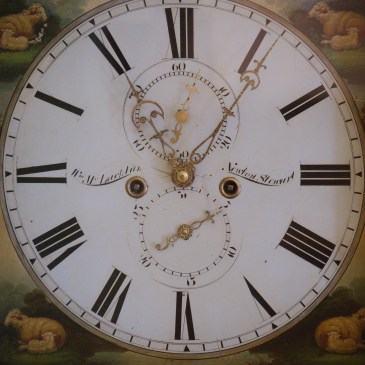
An 8-day clock is a mechanical clock that requires winding only once every seven days. While that may sound simple, there’s more to it than just the winding schedule.

Double-sided winding key

Types of Mechanical Clocks

Mechanical clocks vary in their run times. A 30-hour clock—often called a 1-day clock—needs daily winding. Many ogee weight-driven and alarm clocks fall into this category. Others, especially those with Chinese or Korean movements, can run up to 31 days. You’ll also find clocks rated for 14, 15, or even 60 days, and anniversary clocks, known as 400-day clocks, which run for more than a year on a single wind. The number of days simply refers to how long the clock will run before needing to be rewound.

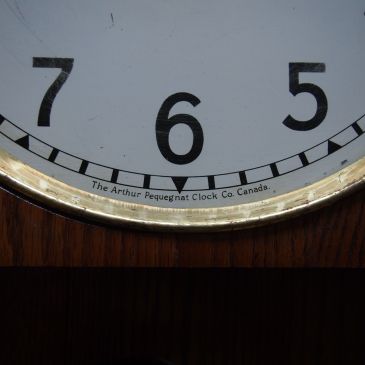
Arthur Pequegnat Moncton
Arthur Pequegnat Moncton 15-day clock

Why Regular Winding Matters

If you don’t wind a clock near the end of its run time, it will stop when the mainspring or weight no longer provides power. A serviced 8-day spring-driven clock might run a day or two beyond its rated cycle, but eventually, it will stop once the power is depleted.

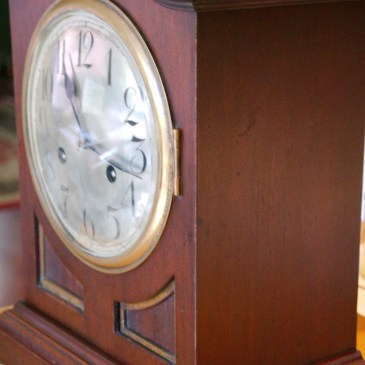
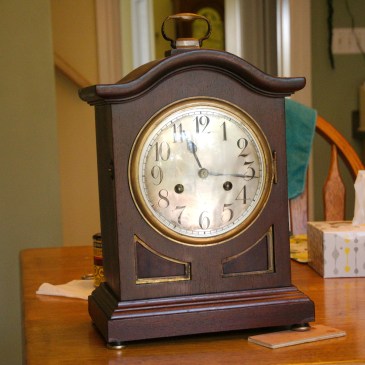
Junghans 14-day time and strike mantel clock

When an 8-day clock consistently fails to run its full cycle, it’s a clear sign that servicing is needed. Dirt, worn bushings, or tired pivots can all cause power loss. Fresh oil alone won’t solve the issue—mixing new oil with old, dirty oil can actually worsen wear.

Professional clock servicing involves fully disassembling and cleaning the movement, repairing worn areas, reassembling and lubricating it, and testing for accuracy. Though servicing can be costly—and sometimes exceed the clock’s market value—it’s well worth it for pieces with sentimental or historical importance.

It’s normal for an 8-day spring-driven clock to lose a bit of time toward the end of the week. As the mainspring unwinds, the stored energy gradually decreases, slightly slowing the movement.

Speed Variations and Clock Design

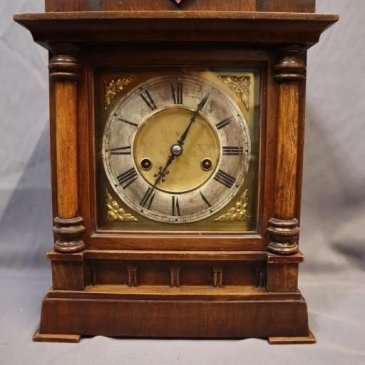
Seth Thomas round top
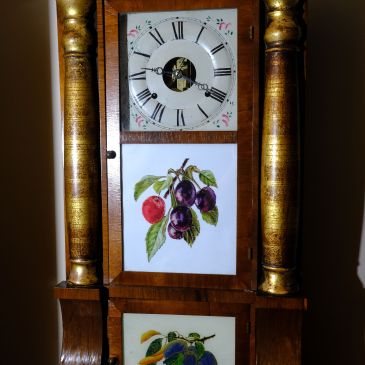
Seth Thomas round top 8-day clock

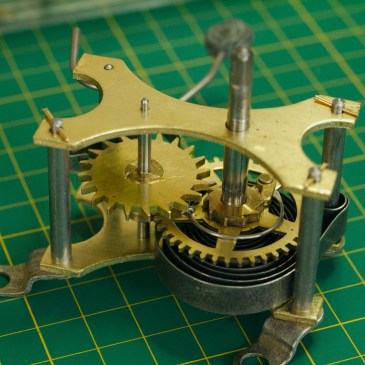
Some clocks include a device called a stopwork or Geneva stop, which limits the spring’s range to its most consistent section of power. This improves timekeeping but is relatively uncommon today—many clocks that once had stopworks have had them removed by repairers over the years.

Arrows showing Geneva stops or stop works

My Personnel Collection and the Variety of Run Times

Of the more than 80 clocks in my collection, about 30 are running at any given time. Five are 1-day ogee clocks, three have 14-day run times, and the remainder are 8-day models. Most antique and vintage clocks you find in shops or online are also 8-day clocks—the classic “once-a-week winders.”

Keeping a Regular Winding Schedule

Weight-driven 8-day clocks tend to be more accurate than spring-driven ones because their power source—a descending weight—delivers a constant force. They typically need only minor time corrections.

Final Thoughts

Winding your clock at the same time each week ensures steady performance. I make it a Sunday morning ritual to wind my clocks and make any necessary time adjustments.

Like any precision instrument, a clock rewards consistent care. With proper handling, regular maintenance, and timely servicing, an 8-day clock will live up to its name—keeping time faithfully, week after week.

Feel free to share your comments or questions below!

Related Articles

Experimenting with blog themes

I am sure some of you have noticed that I have been switching between theme templates for my blog. I recently upgraded to a better plan and with the plan comes more choices for themes. I had been using the Rosalie theme for the past few days and have discovered some things I like about it and some that I don’t.

I have therefore switched back to the Gateway theme.

This should not have affected readability and navigation as everything is where it is supposed to be and I apologize for the confusion.

I am still exploring the look of the blog and you may or may not see changes in the coming weeks.

Hamburg American Clock Co. – shelf clock, first look

This clock was an estate auction buy in early 2021. Since my wife and I were unable to bid in person we placed an online bid. So many estate auction houses are taking this very route that the days of people packing an auction house and bidding feverishly may be behind us. It was described as an unknown clock but I’d seen enough photos online to know that I had likely won a Hamburg American Clock Co. shelf clock. And, for a small shipping fee the clock was delivered to us a few days later by courier.

HAC was a well-known German company that was founded in 1883 and made clocks for a number of years before they were acquired by Gebr Junghans Uhrenfabrik or Junghans for short, in the late 1920s. I have a number of German clocks but this is the first HAC clock in my collection.

Bracket clock
Bracket clock, auction photo (with permission)

When I opened the box I inspected the clock for damage (there was none) and proceeded to look for the familiar cross arrows trademark on the backplate of the movement. I could see how it would have been easily missed by the auction house since the trademark was “hidden” behind the pendulum leader. Many HAC clocks have a trademark on the gong block, this one does not.

HAC trademark
HAC trademark

The case is a little tired and worn, especially the dial, but there is nothing amiss, no parts missing. The movement works but I am not sure what to do with a very tired looking dial face.

I pulled the movement out of the case to examine it more closely, inspect for any immediate issues, and proceeded to photograph it from different angles.

HAC clock
HAC clock, tired but working

HAC clock movement
HAC clock movement, backplate

HAC clock movement
HAC clock movement, front plate

Like other German movements, it is robust, well-engineered and has a certain industrialized look, even crude in some respects. The front and backplates are solid indicating that it was probably an early version of this movement. There are no “extra” holes in the plates that are often found in many other German movements, holes that are made for various functions for other styles of cases. Compared this to the #36 movement (below right) from HAC. At 8.7 cms by 10.9 cms this one is almost the exact size.

HAC clock movement
HAC #36 clock movement

The plates are almost 2 mm thick, suggesting a well engineered movement.

Movements on German mantel and shelf clocks from other manufacturers are typically bolted to a seat-board. On this clock, brackets on all 4 corners attach the movement to the inside front panel which is very American!

Numbers in the top left corner of the backplate,164, 42, and 130 tell the beats per minute, the number of escape wheel teeth, and pendulum length.

I am anxious to take the movement apart and look at ways to revitalize the case and dial.

This is an excellent winter project.

Auction clock bought on a whim

Although I have sold a few clocks locally in the past year to trim down my collection, I am always on the lookout for new acquisitions. One in, one out, has become the rule.

I am a frequent follower of online for-sale and estate auction sites and look for unique clocks like this E. Ingraham Grecian shelf clock (right) which I bought in early January 2021.

Ingraham Grecian
Ingraham Grecian shelf clock C.1871

There are two noteworthy estate auction houses in Nova Scotia, but only one offering premium items. As for what I term is “the better auction house”, art and Canadiana are their specialties but occasionally clocks are added to the auction offerings.

In February 2021 I took a chance on a second clock from the same auction house. Since one clock was offered I knew that the auction would not attract collectors. If there are several clocks offered for auction, I find that collectors are attracted and that tends to drive up the bidding.

Bracket clock
Bracket clock, photo used with permission Harris and Sons

The description of the clock according to the auction house is as follows:

Antique walnut bracket style mantel clock with polished brass outer
dial. In running order but probably could use a clean, with mellow
tone chime. Brass movement. No makers marks. Measures 14
inches tall by 10 1/4 wide and 5 3/4 inches deep.

So a “pig in a poke” as we would say locally. An unknown maker in a fairly attractive case. “Could use a clean” is a euphemism for “might have some issues”. From the auction photos, the case looks tired and the state of the movement is unknown, but, I am up for the challenge.

Bracket clock
Bracket clock, photo used with permission Harris and Sons

The dial looks intriguing. It could be one piece with a silvered chapter ring or spandrels added over the brass which is more likely. As of this writing, it remains at the auction house awaiting shipment.

The movement is certain to be German. However, it might have been made by any number of companies, Junghans, Mauthe, HAC but I am thinking it is HAC, the Hamburg American Clock Co. and made in the early part of the 20th century. I do not have any other HACs in my collection, so, this would be the first.

I suspect a well-built movement with solid plates front and back.

Bracket clock
Bracket clock, photo used with permission Harris and Sons

The reserve bid of $75 is what I paid. I am not a fan of reserve bids but at least I did not pay more than that. Of course, tax and the auction house buyer’s premium are always added to the final invoice.

I think I will be pleased with the purchase.

Replacing a suspension spring on a Seth Thomas #2 Regulator

It should have been an easy fix but often when working with clock movements unexpected issues occasionally crop up.

The clock was purchased in the fall of 2018. This Seth Thomas #2 Regulator has had little done to it except oiling the movement and cleaning up the case. It is one of the most accurate mechanical clocks in my collection which is no surprise since these clocks were originally designed for offices and railways.

According to an online database, the lower section of the case was redesigned in 1922. This allows me to date the clock somewhere between 1922 and 1929. 77 weight-driven movements are very common. They were made sometime after 1915 and well into the 1940s. Perhaps the letter “K” under the 77A stamp on the movement is a clue as to exactly when it was manufactured.

It has a very attractive mahogany finish and it is a real conversation piece. There are probably more oak regulators than any other type of wood, so, mahogany, although not rare, is uncommon.

Seth Thomas Regulator #2

The suspension spring

A suspension spring is a thin band of steel called a “spring” by horologists by which the pendulum of a clock is suspended. It separates the pendulum rod and bob from the mounting post. Its purpose is to assist in controlling the rate of the pendulum swing.

The suspension spring looked tired when I first inspected the clock in 2018 and it was time for a replacement, sourced from my go-to Canadian supplier, Perrins.

Seth Thomas Regulator #2
Seth Thomas Regulator #2 base design

What should have taken minutes stretched to an hour or more

Seth Thomas Regulator #2
Seth Thomas Regulator #2 (77A (K)), the iron bracket is just behind the movement

Removing the movement prior to replacing the spring

Removing the movement consists of first removing the hands. A screw secures the minute hand while the hour hand is a friction fit and pulls straight out. The second hand also pulls off. Eight screws hold the face in place; 6 outside the chapter ring and two on either side of the second hand. Once the face is removed there is a wood crossbar, held by two larger screws in front of and either side of the movement, that must be removed.

Then the weight, which is hooked onto the pulley, is removed. There are 4 posts on the front of the movement, inboard on the bottom and above the plate screws on the top. They do not come out entirely but once unscrewed, the movement is released from an iron mounting bracket.

Next, the pendulum/rod which is hooked onto the suspension spring on the bracket is lifted out and put aside.

bracket for Seth Thomas #2
The movement is mounted on a heavy cast iron bracket

Replacing the suspension spring

Once the bracket was exposed I thought it would be a simple matter of swapping out the old suspension spring for the new one. If it was not original, it is, nevertheless, quite old and likely weak with age. It probably can be done in place but it is much easier simply removing the cast iron mounting bracket which is held in place by 4 wood screws.

Seth Thomas #2 suspension spring
Seth Thomas #2 suspension spring, old on left, new on right

Laying the bracket out flat simplifies pushing out the pin holding the suspension spring.

bracket for Seth Thomas #2
Movement bracket for Seth Thomas #2

I have come to learn that replacement parts from a supplier often must be made to fit and the suspension spring I bought is no exception. Using a pair of pliers, the pin was pushed out of the block. Once out I reamed the hole so that I did not have to struggle to install it. Except that the new pin did not fit the smaller hole in the post. So, rather than use the old pin a tapered brass pin replaced it.

Re-installation and testing

The bracket is then screwed back into the case with the suspension spring in place. The pendulum attaches to the end of the horizontal pins of the suspension spring but it is important to ensure that the end of the crutch wire, which has a 90-degree bend and hangs down from the movement goes through the opening in the pendulum.

The movement, face, and hands go back onto the clock. Push the hour hand in far enough, otherwise, it will rub against the minute hand and stop the clock.

There is very little space between the hour hand and the second’s hand. This is by design, and if you do not push the second’s hand in far enough you will know soon enough when interference stops the clock.

Level the clock case on the wall and observe the action of the pendulum.

What should have taken minutes stretched to over an hour. Now that the new suspension spring is in place, I have had a chance to look over the movement and it will be scheduled for a full servicing in the next month or so.

In the meantime, the clock is running well; there is slightly more amplitude in the pendulum swing than previously and it is keeping excellent time.

Daylight Savings – it is time to end it!

Daylight Savings Time has no place in our modern world. Of 195 countries in the world, approximately 70 countries observe Daylight Saving Time in at least a portion of the country. Japan, India, and China are the only major industrialized countries that do not observe some form of daylight saving.

Top showing face and crown detail
Face of a Vienna Regulator clock C.1870

70 countries must live with it.

Clock face showing moon dial
Face of a Ridgeway grandfather clock C.1996

At 2:00am Sunday, set your clocks ahead one hour if you live in an area where the convention is still followed.

Typically, regions that use daylight saving time adjust clocks forward one hour close to the start of spring and adjust them backward in the autumn to standard time. In Canada, we have a little expression, “Spring ahead, Fall behind” to make it easy to remember what to do twice a year. In Canada, it is the second Sunday in March and the first Sunday in November.

Case is in fair condition, dial face has some flaking
Canada Clock Co. cottage clock C.1883

How to set your mechanical clock(s)

  • Move the minute hand slowly clockwise to the correct time, stopping briefly for the quarter-hour on chiming clocks and the half-hour for striking clocks.
  • Do not move the minute hand backward as it risks damage to the movement. This should be regarded as a general rule, exceptions are some clocks where it is safe to do so (read your owner’s manual).

There has been a push to scrap the time-switch in Canada.

It is stupid, needless, senseless, and confusing.

E. Ingraham Grecian shelf clock – first look and action plan

This article is the first look at one of my latest online auction finds, an E. Ingraham & Company shelf clock known as the Grecian.

The Ingraham Clock Company operated under a number of minor name variations over the years, E. Ingraham, E & A Ingraham, the E. Ingraham Company, E. Ingraham and Company from 1844 to 1885. Later The Ingraham Company made electric clocks and wristwatches. McGraw-Edison now owns the company and quartz clocks bearing the Ingraham name are still manufactured.

Ingraham Grecian shelf clock
Ingraham Grecian shelf clock, a day after the auction purchase

Although not rare the Grecian is quite collectible. Patent dates on the label date the clock to around 1871. The only other one I have seen is at the American Watch and Clock Museum in Bristol Connecticut, a mosaic maple and walnut version.

American Watch and Clock Museum in Bristol Connecticut

It is a handsome clock with clean lines. The E. Ingraham Grecian 8-day time and strike shelf clock is neoclassical in design. It is not only aesthetically pleasing to patrons of the nineteenth century but remains so today.

It is a distinctive clock. It has a moulded Rosewood bezel, carved volutes below the dial frame (or rosettes as Ingraham called them in his patent letters), and a Rosewood veneered case. The dial frame and bezel are one section that makes up the hinged front access door. There are walnut cased versions and mosaic as well but Rosewood has a certain exotic allure. Elias Ingraham was a case designer and no doubt had a hand not only in the design but the choice of woods used for case construction.

This clock was bought at an online auction in early January 2021. From the auction photos, I expected a clock that needed work and now, after having received it, I am pleasantly surprised that will not take much to service the movement and clean the case.

General condition 

The case is Rosewood but because of the buildup of dirt and grime over the years, the grain and texture of the wood are hidden. Upon closer examination, there are some small chips of veneer missing from the corner edges of the base, not surprising given the age of the clock. The rounded top and volutes are perfect.

There is some wear on the top part of the base under the door and that is to be expected. The curved wood bezel is in very nice condition. The backboard has age-related cracks in two places but will not require a repair. There is a slight corner separation on the left side of the base but everything else is tight. The door clasp looks good.

Ingraham Grecian shelf clock

The dial screws came out too easily and the screw holes are well worn. The dial has been taken off more than a few times to make adjustments. The dial is also misaligned as a result of the new screw holes. Both the minute and hour hands are incorrect. The moon hour hand is too short and the minute hand is a slender spade. Both will be replaced.

Ingraham Grecian shelf clock

The painted zinc dial face, which for some reason is detached from the brass bezel, appears to be original with some flaking on the edges. There is a missing time side grommet. The alarm dial is loose, not seemingly attached to anything, and came off easily once the hands were detached. The brass bezel needs a good cleaning.

Ingraham Grecian shelf clock
Ingraham Grecian shelf clock, fair label, cast brass bell

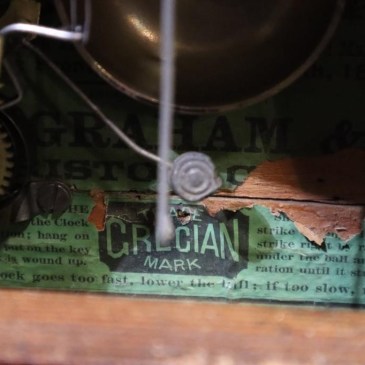
The unique green triangular label inside the case is in fair condition with pieces missing at the lower cracked section of the backboard. I found a loose 3cm piece at the bottom of the case which can easily be glued back in place. The alarm mechanism is in excellent condition. The spring on the alarm is typically broken on these old clocks; this one is fine. I doubt if it has seen much use. The bell is cast brass and there are two strike hammers; one on the inside, which is for the alarm, and one on the outside, the hour-strike hammer.

I was told by the seller that the clock would run for a few minutes, even strike but then it stops, which tells me that nothing is broken. The crutch loop is twisted around the pendulum rod and since there is no impulse it is not surprising the clock would stop. I doubt it ran more than a few seconds.

It is a pinned movement. Later movements have screws or bolts holding the plates together. The movement might have been worked on in the past although it is hard to tell. The two lower pins look original but the top pins look like replacements. If it was worked on it was done with care. There are no tell-tale signs such as marks, scratches, and punch marks that indicate past servicing. Since the mainsprings are wound tight I won’t know the extent of wear until I take the movement apart.

I can only guess that the butchered crutch and the detached dial are the results of someone who did not know what they were doing when making an attempt to get the clock to run.

The plan of action

The case: clean all wood surfaces thoroughly with Murphy’s Soap. Cleaning will no doubt remove remnants of the old shellac and new shellac prepared in the traditional manner (flakes and alcohol) will be applied to all the exterior surfaces. The finish will then be dulled with 4X0 steel wool.

The movement: The movement will be completely disassembled and inspected for wear, and cleaned. New bushings will be installed if needed. I made some adjustments to the crutch and ran the clock for two days and it was striking correctly during that period. The mainsprings look to be in good condition and provide plenty of power. The alarm mechanism which might never have been operational, will be taken apart and cleaned. The alarm dial is a friction fit and will be tightened up once the movement is reinstalled and should work as intended. The crutch loop will be repaired.

The dial: I will leave the dial as-is despite a little paint loss on the edges. Once the dial is aligned properly these should be hidden, for the most part. The dial pan has separated from the bezel. A past tinkerer used cellophane tape to secure the dial pan to the bezel and even attempted to solder two of the tabs, poorly I might add. These are fixable. More difficult is sourcing a 2 3/4 inch moon minute hand.

Well, that’s it for now. I plan to get started fairly soon. The only thing stopping me is a Seth Thomas #2 that has stopped and needs a look-see. There will be more on the Ingraham clock later.

Finding a repairperson for your mechanical clock

The past year will be remembered for many years. It was a very trying time for many of us but in the midst of the pandemic, there are positives. It was a time of reflection and a time that reminded folks of a past when life was simpler. More and more people have become interested in hobbies and perhaps collecting antiques in general or antique clocks in particular.

Seth Thomas adamantine mantel clock, C.1909

Perhaps you received a clock as a gift, inherited one, picked one up at an antique store, found a clock online that needs work or discovered that very rare clock that requires a little TLC to run perfectly and you want to have it running just like the good old days.

Junghans Corner feet finished
Junghans Sydney bracket clock C.1911

Two options

Basically, you have two options.

  1. Try to fix the clock yourself, or,
  2. Find someone to put the clock in working order.

Even if you bought a working clock, eventually it will stop running and it will require cleaning at the very least or major repairs if it is very worn.

You might attempt to fix a non-working clock yourself. With basic tools, you might get lucky with the repair of simple, cheap movements but eventually, you will require a professional. Working on clocks requires a certain skill set and plenty of patience. It takes years to attain a level of expertise not to mention the specialized equipment required to work on the mechanisms. For any high-quality or rare clock, you may not trust yourself to work on it yourself and will need a reputable clock repair person to make it right.

Scottish tall case clock
McLachlan tall case clock, C.1848

It may come as no surprise that there are not as many people involved in the clock repair business today as there were years ago. Clockmakers are a dying occupation. Clock repair businesses are closing when owners retire as there are not enough young people to carry on the tradition. Plus, in the digital age do analogue clocks make sense!

Kienzle World Time clock
Kienzle World Time clock, C.1951

With so few skilled professionals left, finding a person to repair your clock requires time, effort, and research. At one time in my home province of Nova Scotia, there were a dozen repair shops operating in or near every major town. Today there are two reputable repair shops left and both are hours away from where I live. They perform excellent work but they are expensive, and why not, they provide an exclusive service.

Reputable clock repair shops have repair persons who have the necessary credentials to work on a wide variety of clocks. However, some repair shops have questionable work practices. How would you know? The Better Business Bureau is a good source to determine whether or not a business is in good standing. If a business is in good standing and has no complaints it is considered reputable according to BBB standards.

Local jewellers might advertise mechanical clock repair but very few have a certified repair person on site.

one-weight Vienna wall clock
Miniature one-weight Vienna wall clock, C.1870

A second source is the American-based National Association of Watch Clock Collectors business directory which lists reputable repair services in Canada, the United States, Austria, Singapore, Switzerland, Ukraine, and the United Kingdom.

The National Association of Watch and Clock Collectors, or NAWCC, has over 175 chapters, mostly in the United States, that are devoted to the repair and restoration of clocks. Members of this organization range from interested beginners to dedicated horologists. Consumers and interested collectors can receive answers to many clock questions with a free registration on the NAWCC Forum site. Guidance and direction can be provided to those seeking a repair person in their local area.

Rare Ingraham Huron found on a local online for-sale site
Ingraham Huron shelf clock, C.1879

Those looking for a clock specialist in the UK should look for those individuals who have a membership in the Antiquarian Horological Society or AHS.

Contacting either of the above organizations or reading their publications will narrow down your choice of a clock repair specialist.

For those living in Germany, the Deutsche Gesellschaft für Chronometrie. is an excellent resource.

Ingraham Grecian
Ingraham Grecian, C.1872

And finally, word of mouth. Connect with someone you know who works on clocks and watches and they likely will tell you not only where you can have your clock repaired but who is reputable and if the repair cost is reasonable.

Once you find that special clock person to repair your clock you can rest assured that it will be given the love and attention it deserves and take comfort in the fact that someone is available to look after your mechanical antique or vintage clock needs.

Variables that affect antique and vintage clock prices?


Arthur Pequegnat Simcoe
Canadian made Arthur Pequegnat Simcoe mantel clock, circa 1916, $300 (in Canada)

There are many types and styles of clocks and dozens of manufacturers. If you are a collector you know exactly what you are looking for and have a good idea of its approximate value. If you are not an “expert”, selecting an antique clock can be a daunting task. But this article is not about helping you find that special clock. It is about the variables that affect clock prices in 2021.

Mantel clocks on display in a museum

Over the years I have learned the value of many antique and vintage clocks. When I come across an interesting clock on an online for sale site or in an antique store I have several questions in mind. Is there anything special about it? When was it made? Is it rare? Is it historically significant? Is the price too high or too low and why? How much work must I put into it if it clearly needs TLC and will the seller accept a lower price? That said, I am prepared to walk away at any point.

For example, E. Ingraham clocks are common and can be had for very little money but the more desirable Ingrahams of the 1860s and 70s are those that Elias Ingraham had a hand in designing. The Ingraham Grecian is an attractive example of a clock that was designed in a period of American clock manufacturing where dappearance and uniqueness mattered.

E. Ingraham Grecian shelf clock C. 1870

Condition is important. One look at the case will tell me how well it was cared for. In my experience, it is pretty rare to find a clock that has been professionally serviced and many where a previous owner applied their limited skills to get it running. However, if you have the skills to service the movement and are handy at restoration, there are certainly bargains to be found.

If acquiring antique and vintage clocks is something you enjoy but have no knowledge of clock repair, the cost of servicing must be factored into the price particularly if you want it to run reliably.

Let’s assume that you are looking for an authentic antique or vintage clock that has not been altered in any way save for minor cosmetic touch-ups. What factors influence the price you pay for a clock today?

one-weight Vienna wall clock
Miniature one-weight Vienna regulator wall clock, unsigned, circa 1870, in the $400 range

Here is a list of factors I would consider in making your next purchase and why you would pay more for some clocks and less for others.

Variables that affect clock prices today

  • Wall clocks generally command higher prices than mantel clocks, the exceptions are Asian wall clocks and the like that have little value.
  • Most mantel clocks less than 100 years old have little value.
  • Clocks that come from a prominent collection that are well cared for and in excellent condition are more desirable.
  • Demand in your local area affects price; Canadian-made clocks are sought after in Canada whereas the same clocks are almost worthless in the US.
  • Weight-driven clocks are more desirable than spring-driven clocks. The exception is the modern weight-driven grandfather clock whose value has plummeted in recent years.
  • Condition is key, a clock in excellent condition is worth more than one in poor condition or with parts missing.
  • Running clocks are worth (generally) more than non-running clocks.
  • A recently serviced clock is worth more than one that has either not been serviced in a long time or never serviced.
  • The same clock may be worth more than others that are the same or similar if it has special provenance i.e. a well-documented tall case clock that came from Grover Cleveland’s home.
  • A clock with a replacement movement is termed a marriage by collectors. Marriages are worth far less than an authentic clock but acceptable by some collectors.
  • Any clock that has had its mechanical movement replaced with a quartz one is worthless.
  • One of the largest factors in a clock’s value is the manufacturer. Many from Sessions Clock Co. are rather ordinary and relatively inexpensive but some Seth Thomas Sonora Chime clocks, for example, have good value.
  • Age does not always equate to a higher price. A clock that is 170 years old is not necessarily worth more than one that is 50 years old.
  • Mechanism type; double and triple fusee clocks and pinwheel regulators are worth more than open-spring-driven mantel clocks or modern tall-case weight-driven clocks.
  • Some clockmakers are more desirable than others; generally speaking a German-made Winterhalder and Hofmeier mantel clock is worth more than a similar American-made Gilbert mantel clock. Assuming both are in the same condition, an unsigned four-glass French clock has a greater value than a branded American crystal regulator.

Scottish tall case clock
Scottish tall case clock, circa 1848 for under $300

The Law of Supply and demand and the 30-hour ogee

The law of supply and demand is the theory that explains the interaction between the sellers of a resource and the buyers for that same resource. Generally, as price increases, people are willing to supply more and demand less and vice versa when the price falls. At the end of the day, the clock market is very unpredictable. Clocks on eBay that go for $400 one month are $100 the next.

An interesting example is a 30-hour ogee clock. Prior to the popularity of online auction sites 30-hour ogee clocks (below) were commanding prices in the hundreds of dollars. Antique stores had them in the $250-400 range and when the internet came along supply increased and prices dropped.

George H. Clark 30 hour Ogee
George H. Clark 30 hour Ogee, circa 1860

I have paid low prices for some of my clocks but higher for what I call special clocks that are not necessarily rare but are made with some level of precision or unique in design.

Seth Thomas Regulator #2
Seth Thomas Regulator #2, circa 1925, $800-1000 range

Closing thoughts

In commercial transactions, the principle that the buyer purchases at his own risk in the absence of an express warranty is termed Caveat Emptor, or let the buyer beware. In the clock world, buyers have little or no recourse if those goods turn out to be defective, misrepresented, or broken. The best of luck trying to get your money back if you are a successful bidder on an online auction site and your package arrives in pieces.

Selecting and purchasing an authentic antique mechanical clock can be a daunting task but it can also be a very rewarding experience.

Junghans Crispi wall clock and strike woes

Crispi clock back from the horologist
Antique Junghans Crispi wall clock

During the winter of 2017, I restored an antique Junghans Crispi time and strike wall clock, circa 1898.

It came to me as a box of parts. I sensed the seller fully intended to complete the project but never got around to it but at least he reconstructed the case. I saw a challenge in that collection of dusty and dirty parts.

Much of the clock is original; the movement, the pendulum, dial, hands, coil gong, and movement bracket, the bottom base and top section of the case, crown, backboard, vertical columns, and most of the decorative trim. I added glass, smaller trim features, upper finials, and their bases.

Replaced some 40 years ago is the box frame and the front section that supports the right and left columns. Parts of the clock were evidently destroyed beyond repair and the remainder salvaged for later restoration which was never completed.

Junghans clock in pieces
How the clock came to me

While much of the “newer pieces” are hidden, the previous owner took care to replicate woodworking techniques of the period aside from the use of Roberston screws on the back panel.

That aside, the movement was very dirty and had not been running for many years. Perhaps it last worked just before the Halifax Explosion of 1917. The previous owner informed me that the clock was in the family home in north-end Halifax (Nova Scotia, Canada) and the clock took a significant hit from that fateful blast on December 6th.

Very dirty movement
Very dirty movement, right out of the case

After completing work on the case, I set about working on the movement. During the course of disassembling/reassembling the movement, I not only broke the strike paddle but a retention spring as well. Back then (2017), my skills were not advanced enough to repair it so I had it professionally serviced.

Junghans movement
Junghans movement, broken strike paddle

Three months later I picked up the clock and hung it on my dining room wall. It ran perfectly for over two and a half years. Some months ago the strike became erratic. It would strike incorrectly, not at all, or incessantly till the mainspring ran down.

I had a number of other clock projects on the go so I kept the time side going and left it on the wall until December 2020.

Disassembly and Inspection

Once I took the movement apart I found a slightly bent strike side cam wheel arbor. There were no other bent pivots or worn pivot holes and everything else looked good. Back in 2017 during its stay in a clock shop it had had extensive bushing work done, 6 on the front plate and 6 on the rear plate. There was a small amount of dirty oil around the pivots and after 2 plus years that is to be expected.

During the course of manipulating the plates, I snapped the paddle arbor retention spring, again! This time I was able to repair it.

Junghans movement spring repair
Junghans movement spring repair upper center, Threadlocker Red at the base of the spring

There was enough of the spring to reuse. The wire is thin (0.5mm), very brittle and it does not take much pressure to break it. Using a micro drill with a 0.5mm HHS bit I drilled out the existing hole in the plate, reinstalled the spring, and applied Threadlocker Red to bond the spring to the plate.

Electric micro drill

Re-assembly

I cleaned the parts in the ultrasonic, pegged the pivot holes, polished the pivots, and re-assembled the movement.

Junghans movement work
Junghans movement work ready for the rear plate

I took a couple of attempts to line up everything on the strike side; paddle in the deep slot, cam lever in the low part of the cam, and strike paddle aligned between the points on the star wheel while ensuring that the stop wheel pin was in the 12 o’clock (approximately) position. If you have worked on German count-wheel strike movements, all this should sound familiar.

One is tempted to bend a lever or two to correct the strike side behave but in my experience, unless someone has messed with a lever in the past, it is best to leave them alone.

Junghans clock
Junghans movement on the test stand

And now for testing. After several days the movement is running well and the strike side is finally behaving itself. Since there is nothing amiss I will chalk this up to a strike side design that causes it to “wander” over time or that slightly bent cam wheel arbor. One or two cycles on the test stand should be sufficient before returning it to its case.

While it was on the test stand I decided to research this clock. I visited the Junghans archive catalogue site and discovered a few new-to-me details. The clock was available in the 1898 catalog as I suspected.

Four Junghans wall clocks in 1898 catalog; the Cripi second from left

The clock case is described as “old oak” with burnished brass trimmings. The Crispi, as it was called, was designated #1758 and was available with a white or ivory-colored celluloid dial or a white or ivory-colored 5 3/4 inch enamel dial (this clock). The length is forty and a third inches (103 cm) and it is a 14-day strike. Given the description of the length, in inches, the clock was likely marketed for the United Kingdom and Italy as you can see by the above catalog entry.

Overall, a successful servicing and if it “wanders” again, a simple disassembly, reassembly, and re-adjustment at some point in the future should put it right. Let’s hope that is more than two years away this time.

Auction find – E. Ingraham & Co. Grecian shelf clock

I was the successful online bidder for an E. Ingraham Grecian time and strike shelf clock in early January 2021. My wife and I had to travel 3 hours, from one part of Nova Scotia to another, to pick the clock up but since we were taking a small staycation in the nearby area the antique shop was on our way.

It is a very interesting design and I researched not only this clock but the period that influenced its design.

Let’s travel back in time to Duncan Phyfe, a prominent American furniture designer (1768-1854). His interpretation of fashionable European trends made him a major influence in the Neoclassical movement in the United States impacting an entire generation of cabinet-makers. The era of Greek furniture design quickly came to the clock world in the form of “Grecian” clocks made by a number of clock manufacturers including Joseph Ives, E. N. Welch, Seth Thomas, and Ingraham.

This is the E. Ingraham & Co.’s interpretation of the Grecian clock, called appropriately enough, the “Grecian”.

Ingraham Grecian Harris and Sons auction photo
Ingraham Grecian, auction photo (with permission Harris & Sons)

The design is a classical influence and it is not only aesthetically pleasing to patrons of the nineteenth century but remains so today. It has a molded Rosewood bezel with carved volutes below the dial frame. The dial frame and bezel are one section that makes up the hinged front access door. I have seen walnut-cased versions and mosaic maple and walnut as well. The mosaic versions are probably the most desirable.

Elias Ingraham was a case designer and no doubt had a hand not only in the design but the choice of woods used for case construction.

Ingraham Grecian Harris and Sons auction photo
Ingraham Grecian auction photo (with permission Harris & Sons)

It has a paint-on-zinc dial, moon-shaped hands, and Roman chapters. The Grecian model was available as a 30-hour spring-driven, time and strike, 30-hour time and strike with alarm, 8-day time and strike, and 8-day time and strike with alarm. This one is the 8-day time and hour-strike alarm version. All models strike on a cast bell made of iron, or in this case, brass. Features such as exotic/mixed woods, alarm, and 8-day function would have been an extra charge at the time. The clocks were made between the years 1868 and 1883 with an 1880 catalog price of $5.25 for the 30-hour clock with alarm.

Ingraham Grecian Harris and Sons auction photo
Ingraham Grecian auction photo (with permission Harris & Sons)

It has a green triangular-shaped paper label inside the back panel of the case which is in fair condition. There are 3 patent dates on the label, September 30, 1862, March 31, 1868, and June 6th, 1871. The newest clocks of this model would have had October 8, 1878, and still newer, November 11, 1879 patent dates so, this clock was made after 1871 and before 1878. The fact that the clock can be dated within a 5 year period is a plus.

Ingraham Grecian alarm dial
Ingraham Grecian alarm dial auction photo (with permission Harris & Sons)

Once I receive the clock and look it over more carefully I will post my first impressions and the work that must be done to restore both the clock movement and the case to its former glory. Stay tuned.

Tick Talk Tuesday #29 – A bob for a Pequegnat wall clock

DBs friend’s clock is similar to this one, an Arthur Pequegnat Brandon (2nd edition)

Tick-Talk Tuesday is about the letters and comments I have received from you, the reader, concerning your clock, issues you might have had, challenges you face or a clock you would like me to profile or my responses to your questions with advice on your particular clock concern. For those comments and questions that stump even me, I consult within my clock circles for the best possible answer

DB wrtes,

“Good morning, I stumbled across your site this morning while looking around for parts for what I think is a Pequegnat Brandon. It belongs to a friend and is missing the pendulum bob and key, but she thinks it works otherwise. I found parts that seem to be appropriate, but I’d like to find originals (or close to it) if I could.

Any advice?”

Pendulum bob
Pendulum bob

My reply,

Hi DB,

Thanks for your email. There is no known source for original Pequegnat parts although you might get lucky on eBay when clocks are parted out. It must be as close to 4.3 oz. or 125 grams, 62mm or 2.5 inches as possible, and it must be adjustable. I don’t see anything at Perrins, a Canadian supplier and the closest I could find is this one at Timesavers in the US. This one at Ronell looks to be the same but cheaper.

https://www.ronellclock.com/Adjustable-Pendulum-225-Bob-PM-63.htm?categoryId=-1

Ron

DB reply,

“Wow Ron, that’s very helpful, thank you very much.”

Antiquevintageclock.com find of the year

What is my best clock find of 2020?

2020 was a very trying year for us all and I suppose that applies to clock collectors generally when it comes to acquisitions. Despite the pandemic, I managed to purchase a few clocks though obviously, not as many as in other years.

The contenders for the year are clocks from Solar, Junghans, Sessions, Arthur Pequegnat, and Fleet, leading up to the big winner of the year, a Scottish tall case clock.

Solar

First on the list is an attractive German-made Solar time and strike mantel clock, sold by the Eatons Department store chain in Canada during the 1960s and 70s.

Solar mantel clock
Solar mantel clock, 1965

It has a Hermle type 141 movement and strikes the half-hour on a bell. It was a non-working clock when I bought it for $20 but it was simple enough to service and now runs like a charm. I will likely sell it locally for a few dollars more.

Junghans bracket clock

For $40 I could not possibly go wrong with this bracket clock even though it was a non-working clock and need some serious TLC. I serviced the movement, refreshed the case, polished the brass, added new feet and the clock now occupies a prominent location in my family room.

Junghans Corner feet finished
Junghans time and strike bracket clock, 1911

Sessions 3W electric clock

The diminutive Sessions desk clock has a Synchron motor (60 cycles per second) and the only repair is to replace the plug. I like the simplicity and style. It has some issues consistent with an 87-year-old electric clock but it is in pretty good shape for its age.

Sessions desk clock, 1934

Arthur Pequegnat

Next is an Arthur Pequegnat Canuck time and strike gingerbread or kitchen clock as it is otherwise known. This was another inexpensive find, $50 on an online for-sale site, and for $10 more, another clock completed the deal.

Arthur Pequegnat canuck, inset shows the dial before restoration, 1918

I spent a considerable amount of time on this clock, refreshing the case, inpainting the dial, and refurbishing the movement. I was very satisfied with the results and this clock will join my collection of 7 other Arthur Pequegnat clocks. A nice find for a very good price.

Fleet Time Company

Next is a Fleet Westminster chime mantel clock from the late 1930s, made by the Fleet Time Company of Montreal. Fleet assembled clocks for 4 short years before World War II sourcing movements from Germany with locally made cases. It is the $10 clock that was combined with the deal above.

Fleet Westminster time mantel clock, 1937

The clock as received

I refurbished the case and replaced the time side mainspring but did nothing to the movement except re-oil it. The case was completely stripped down to the bare wood followed by the application of a medium oak stain and a clear satin topcoat. This is a lovely mantel clock with a rich Westminster chime and I will probably keep this one in my collection since it was assembled in Montreal and represents a small but important piece of Canadian horological history.

McLachlan tall case clock

Finally, let’s come to my prize for the year, bought at a live auction in February 2020, a Scottish tall case clock assembled by William McLachlan of Newton, Steward in 1848. Completely restored were the dial, movement, and the case, which required extensive structural repairs.

Scottish tall case clock
Scottish tall case clock, 1848

With an English bell strike movement, tall, stately mahogany case, beautiful hand-painted dial and heavy 13 lb weights, this clock has a commanding presence in my home. If you have ever heard the sound of an antique bell strike clock you will understand that is it as loud as it is because it was designed to echo through a stately Scottish manor. It is a conversation piece and those who have seen it marvel at its condition and age.

Despite a difficult year, I was pleased with my purchases. I am confident that 2021 will be a better year for me as a clock collector and a better year for us all.

Happy New Year clock lovers everywhere

Ringing in the New Year is for reminiscing, reliving, looking back, and looking forward.

midnight

However, I’ll be brutally honest; let’s hope that 2021 is a better year. Indeed, 2020 will be a year that will live in infamy. It was tough but most of us got through it. However, the Antiquevintageclock.com family wish to convey our sympathy and condolences to those deeply affected by Covid 19.

At last, a New Year begins!

As champagne corks pop, glasses are raised and fireworks explode into the sky, it is important to recognize the special symbolism this holiday brings with it. Amid promises of new beginnings and fresh starts comes a time of reflection and resolutions that more often than not tend to be short-lived.


Be SMART!

Whether your goals consist of just getting out more, or renewing your relationships with loved ones, it can make all the difference when hopes are transformed into words and deeds. Be good to yourself and be good to others.

Perhaps you have made resolutions that are not necessarily clock-related and if so, avoid disappointment by making them SMART;

  • Specific,
  • Measurable,
  • Attainable,
  • Realistic and
  • Time-framed.

This poor broken Westclox LaSalle will never see midnight, reminds me of 2020

For those of you who are clock lovers, where will your horological journey take you this year? Will it be finding that special clock, finally servicing mom’s prized mantel clock, buying that unique clock repair tool, or reading that special clock book?

May the New Year bring you prosperity and happiness. Happy New Year everyone!

Junghans bracket clock – a small detail makes a big difference

A small change makes a big difference on a Junghans mantel clock from 1911. Let me explain.

Back in September 2020, I bought a German-made Junghans bracket style clock. It is 14 inches high by 10 inches wide by 6 inches deep, mahogany veneered, attractive brass accents, and a carrying handle on a curved domed top.

Junghans clock
Junghans bracket clock

I just love the way it looks.

Junghans bracket clock handle

What about those chrome feet

The clock is original in almost every way; the quality time and strike movement is original to the clock, the spiral gong is correct; latches, bezels, and so on look good and work perfectly but for some strange reason it has replacement chrome feet and they bug the heck out of me.

Why should a small detail mar the classic lines of this clock!

Junghans bracket clock
Junghans bracket clock, chrome foot

After searching various online auction sites, I discovered that the original corner feet would have looked like the ones in the below photographs. I can only surmise that many years ago one fell off, got lost and the repairer simply found what would work and tossed the other three feet out.

Junghans bracket clock online
Clock feet (Online photo, Fair Use: used informatively for the public good)

Bracket clock feet
Clock feet (Online photo, Fair Use: used informatively for the public good)

So, where to find corner feet. There are a number of suppliers worldwide but my usual go-to supplier here in Canada, Perrins who are otherwise excellent, has a very limited selection of clock case corner feet and not in the style or size I was looking for.

US suppliers similarly have a limited supply as bracket clocks are not as popular there as overseas. England is the logical place to look since it is the land of the bracket clock.

Interestingly, the term bracket clock first appeared in 19th century England and is commonly referred to as a spring-driven pendulum table clock with a carrying handle (and often with subsidiary dials) so that it could be moved from room to room in the owner’s home. Of course, true bracket clocks had a strike silencer so as not to disturb the owner’s beauty sleep.

Using the search term “brass bracket feet” I searched the two largest suppliers in England, Cousins and Meadows and Passmore.

I found exactly what I was looking for at Cousins UK. Cousins calls the part a ridged carriage clock corner foot made of polished brass, sourced from Spain or India. They come in three sizes and for this clock, I chose the smallest one.

It took two weeks from the order date to arrival on my doorstep. I am very impressed!

Bracket clock feet Cousins
Bracket clock feet from CousinsUK (Online photo, Fair Use: used informatively for the public good)

The feet are made of brass and look to be of decent quality.

Installation was simple. Rather than risk splitting the base so near to the edge I pre-drilled the holes. Using a mini electric drill I first marked the holes with each foot in place and drilled a deep enough hole.

Two slotted brass screws are required per foot. As I screwed one screw of each foot I checked for correct orientation and made a small adjustment as necessary.

Perfect!


Corner foot for Junghans bracket clock
Corner foot for Junghans bracket clock, the screw holes are pre-drilled

Corner foot for Junghans bracket clock
Left front corner foot

The feet are very sturdy and look exactly what the manufacturer would have used at the time.

Junghans Corner feet finished
Junghans bracket clock with new corner feet

Compare this last photo with the first to see the difference the new feet make on this clock.

This is an example of a subtle but important change that is very inexpensive (less than $24) and I am sure you will agree that it makes a dramatic difference.

Junghans Sydney
Junghans Sydney

While I was working on this clock I visited the Junghans site and discovered a 1912 Catalogue which informs me that this clock was called the Sydney.

It was available in fumed oak or mahogany, 14 1/2 inches tall “with brass handle, inlaid polished brass designs, polished brass feet, and plain silver dial”. Both finishes were available with an 8 day or 14-day movement. The quarter strike 8-day clock had 2 gongs while the 14-day movement had 1 gong.

This then is a 14-day movement with a mahogany case and is referred to as model 7020. Judging by the name and the style, this clock was made for the English market.

It seems my research concerning the new polished brass feet paid off very nicely.

Junghans bracket clock – cleaning a silvered dial and brass accents

Lately, I have been working on a stately bracket clock by Junghans from the latter part of 1911. I love the look of this clock though some would say it is quite plain.

Junghans mantel clock on display on the day it was bought

The Regency style veneered mahogany case of this time and strike bracket clock is in reasonably good condition save for a small piece of veneer missing on the right side of the base and replacement chrome feet which look decidedly out of place.

I had completed servicing the movement a while back but also planned to address both the case and the dial as part of the rejuvenation of this clock.

After a thorough cleaning (and scrubbing) with Murphy’s soap, I freshened up the case followed by three coats of shellac.

The top of the clock looked good after a cleaning

Cleaning the dial

Silvered dials present a somewhat more challenging problem than zinc painted or paper dials. The silvering is very thin and can be rubbed off easily through over-aggressive cleaning resulting in a damaged finish so, it pays to be cautious.

Here is a prime example of a German U.M. Muller wall clock dial where someone used a strong cleaner resulting in a serious blemish. The dial must be completely restored. I have no plan to fix it.

U M Muller clock dial
U M Muller clock dial, damage between the numbers 6 and 7

Of course, there is the option of leaving this dial as-is but why not attempt a cleaning. As this is a non-porous dial, dirt is surfaced based.

Junghans clock dial
Junghans clock dial and the extent of the dirt and grime

From my research, many methods of dirt removal seemed dubious and any kind of chemical on a silvered dial is plain wrong. I chose to use mild (diluted) liquid soap and Q-tips to lift off the grime. While it took dozens of Q-Tips dipped in soapy water and gentle scrubbing in the direction of the spun dial most of the dirt was removed and none of the silvering was damaged. It is difficult to see any improvement as one proceeds so, it pays to be patient. After a couple of hour’s work of gentle rubbing, this is the end result.

Junghans clock dial after cleaning

While not perfect it is much improved. The aged look remains, with a patina that most would consider acceptable. Following the cleaning, where there was missing paint on the numerals, they were filled in with black acrylic paint. No further restoration is necessary.

Junghans clock project is finished
Junghans clock project is almost finished but for the lower brass features

Brass features

Next are brass features above the base section. Q-tips (many of them) and Brasso (Simichrome works well too) are perfect for bringing up the shine. Following the polishing, everything is wiped clean with soap and water and the inset panels are given a fresh coat of shellac.

The carrying handle on top was also cleaned with Brasso.

Junghans Corner feet finished
Junghans Cbracket style clock

Dial work and case cleaning are options when bringing any clock back to life but it boils down to personal choice. Some choose to leave things as they are to retain the original patina but I am in the camp that a little cleaning goes a long way. Cleaning takes time and patience, however. You may not see the results immediately but work carefully and you will be amply rewarded.

You may have noticed that the feet are different in the last photo but I will save that story for another day.

Tick Talk Tuesday #28 – What’s it for? The double ended key

Tick-Talk Tuesday is about the letters and comments I have received from you, the reader, concerning your clock, issues you might have had, challenges you face or a clock you would like me to profile or my responses to your questions with advice on your particular clock concern. For those comments and questions that stump even me, I consult within my clock circles for the best possible answer

Double-ended keys
Double-ended keys

TD says,

“Hi Ron,  I’m TD.  I purchased a Gilbert Clock from an antique store in xxxxxxx, Wis.  It’s a Gilbert Tambour style mantel clock model 2041. It’s marked “Normandy Chime 2041.”  The question I have is what is the keyhole under number 12 for?  The clock sat in the store for a long time, that is till it found ME.  I have a thing for old clocks. I feel they’re a living thing and it’s a shame if they’re not ticking away as long as they’re able to. Just like Us!”

Gilbert mantel clock 1925, small arbour below the 12 is for regulating the clock

Gilbert movement
Gilbert movement, the top centre is the regulating mechanism

My response,

Hi TD,

I have a Gilbert tambour 2038 with Normandy Chime which is similar in some ways. Look at the key that came with your clock. It should be doubled ended one like this one.

The small end fits into an arbor just below the “12”. This is for regulating the speed of your clock. You might see an “S” and an  ”F” above the 12. Turning the key clockwise speeds up the clock and counterclockwise slows it down. If you have only a single-ended key, it is the wrong type for your clock although it will wind it up.

I also have a thing for old clocks. Be careful it is addictive.

Hope this helps.”

Whoops! Should have been published on Tuesday. My wife caught the error this morning.

Junghans bracket clock – servicing the movement

Junghans bracket style clock, tilted to adjust the beat

I posted the first look at this clock a while back.

The Regency style veneered mahogany case of this Junghans time and strike bracket clock is in reasonably good shape save for a small piece of veneer missing on the front right corner and replacement chrome feet which look decidedly out of place.

The movement ran briefly after I got it home but after a short while refused to run despite adjustments. The seller says he had had the clock for two years and never had it running so I was sure it needed a good cleaning. In any event, my plan was to service the movement.

The movement is has a maker’s mark with B11 just below it. This refers to the approximate date of manufacture, the latter part of 1911.

Removing the movement

To remove the movement remove the hands, first the minute and then the hour hand. Open the rear access door to release two thumbscrews screws underneath the movement seat board. Move the gong assembly aside (or take it out completely by releasing a screw on the bottom of the case) and remove the works.

Junghans time and strike movement, B11 is under the Junghans trademark

Assessing the movement

This is a well-made movement. Early Junghans movements were robust and strong runners. I have heard stories of Junghans clocks from this era running well despite being very worn. Junghans’s movements are a cut above Mauthe, Hermle, HAC, and other mass-produced German clocks made during this period, in my view. The movement exudes quality with solid front and back plates though lantern pinions are favoured over cut pinions.

The movement has been serviced at least once, so far as I can determine. There is an “S” mark on the strike side barrel cap, helpful when returning the barrels to their correct location. I did not measure the mainsprings but the strike side spring is notably longer than the time side. There are two possible reasons, one that the strike side mainspring was replaced at some point in the clock’s life, or two, there is more load on the strike side requiring a stronger spring.

Junghans movement top view, strike side

The mainsprings are in good condition and there is plenty of power though there is more oil than necessary within the barrels. After assessing the movement I could see that there had been no significant repairs in the past. The crutch has been bent in several places in an attempt to adjust the beat but otherwise, everything looks reasonably good for the age of the clock.

Junghans movement, plate removed

Disassembly

Separating the plates was more difficult than it should have been. I had to remove all four pillars (secured by screws on both ends) to determine what was sticking. I discovered that the motion works centre arbour pivot was “stuck” in the backplate. By “stuck” I mean that although the wheel was moving freely the end of the pivot had been flattened. Why I don’t know. Had the pivot been punched in an attempt to enlarge it, had someone hammered the pivot end for whatever reason, had the pivot been replaced or it is possible that the plates had never been separated and that is how it came from the factory? Once the pivot was pried from the plate I rounded the end with a file and it now fits perfectly.

Junghans B11 movement
I use a screwdriver to point out any washer I find on a movement

All parts were cleaned in the ultrasonic cleaner which removed a considerable amount of accumulated grime. As always the ultrasonic cleaner does a great job with lantern pinions and the lantern pinions, on all 6 wheels, are in excellent condition.

There has been no bushing work done on the movement. The only punch mark I observed was just below the escape wheel outside the plate where an attempt was made to close the hole.

To bush or not to bush

After cleaning the movement, pegging the holes, and polishing the pivots the next step is deciding whether or not to bush the movement.

I could see that some bushings may be required, 4 on the backplate where there is more load on the wheels and 2 on the front plate for a total of 6, 2 on the strike side, and 4 on the time side but I will make a final decision once I have checked the entire movement further.

I installed all the wheels and checked for pivot movement within their respective pivot holes. The wear was not excessive. However, after much thought, I decided there is enough lateral movement of the pivots in their holes to affect its running. Besides, I wanted to place the clock in a prominent area of the house and by addressing wear issues now the clock would run well for some time without another servicing.

Seven bushings were installed, 3 on the time side, and 4 on the strike side. The largest one, which I did not include in my initial assessment, was a 4.5mm (OD) bushing for the count wheel.

Junghans front plate count wheel bushing
Junghans front plate new count wheel bushing

Re-assembly and testing

Once all the pivot work is complete and the holes pegged out again it is time for re-assembly. Setting up the strike side of the count wheel strike means ensuring that the warning pin is sitting just off the locking lever (12 o’clock position), the drop lever is sitting on the flat section of the cam wheel, and the count lever is in one of the deep slots of the count wheel.

Testing the Junghans movement; beat amplifier attached

Only this time it was not all roses. The strike train consistently missed the half-hour strike because the count lever would drop in the middle part, not the beginning of the deep slot, occasionally missing the half-hour strike. Plus, the count lever did not completely rest on the cam. I cannot remember spending as much time correcting the strike side on a German movement as I did on this one. On one occasion I had everything together to discover that the paddle was hanging off one of the points of the star wheel. Having too much load at the beginning of the strike either will stop the strike or add one more strike to the indicated hour.

I must have taken the movement apart 5 times, and of course, each time I reassembled the movement I was wary of damaging those tiny pivots. Eventually, everything worked out. Sometimes when working with German countwheel strikes everything falls into place the first time. Not so much this time.

While on the workbench, I replaced the old tired suspension spring with a new one.

Junghans clock dial
Junghans clock dial numbers have been retouched

So, after a long-overdue cleaning and a few new bushings, the movement is oiled and is on the test stand. After several small adjustments to the beat, it is now running and striking as it should.

Now to see how we can address a grimy silvered dial. Join me in a couple of weeks as I take you through cleaning the dial face.

Junghans bracket clock – first look

Junghans mantel clock on display

I found this German mantel clock on a local online buy and sell site. The seller had two clocks, one, a generic German-made Westminster chime and this, a Junghans bracket-style clock. I knew right away that this was the better deal. It appeared to be a higher quality clock compared to the other one. I offered a slightly lower price and the seller quickly accepted. He said he never had it running in the two years he owned it and added, “I got to get rid of it, I’m moving”.

Junghans bracket clock handle

During my search to find the model name or number I came across one listed on eBay at the time of writing and two others while browsing similar auction sites. None had the model name or number but prices are all over the map, ranging from $50 to $300. I still do not know the model name or number.

Although it has a carrying handle on the domed top and would be termed a bracket clock, let’s just call it a rather plain-looking mantel clock with a handle. When I envision a classic bracket clock I picture a clock with verge escapement, subsidiary dials over a signed dial housed in a gaudy case. Let’s call this a poor relation.

Junghans clock side view, not cleaned yet

The Regency style veneered mahogany case is in reasonably good condition save for a small piece of veneer missing on the bottom side front and replacement chrome feet which look decidedly out of place. It has not been cleaned in ages and scrubbing with soap and water removed a considerable amount of built-up dirt revealing a very attractive case.

The silvered dial shows some aging consistent with wear and caused when advancing the hands many times combined with the simple act of winding the movement arbors. The hands are original judging from other clocks like it. I may touch up the numbers and the hands in addition to giving the dial a cleaning to spruce things up a bit but we’ll see when I look at it further.

The dial catch, back access catch, and hinges work well. These often break from constant use.

Judging from scratch marks on the backplate, the movement has been worked on in the past. I won’t know the extent or quality of past servicing until I take the movement out of its case and examine it more closely. The movement has a maker’s stamp with B11 just below the mark. This refers to the approximate date of manufacture, the latter part of 1911.

Junghans time and strike movement

When I brought it home the clock ran briefly, stopped, and failed to proceed. It will need a thorough servicing and a few adjustments to get it running again.

Choosing a mechanical clock as a gift

It is that time of the year when you begin searching for that unique gift. Of course, there are a multitude of choices but have you considered a mechanical clock as a gift? Let me provide you with a few tips.

Gilbert mantel clock

Mechanical clocks harken back to the old days when life was simpler; no mobile telephones, no internet, and no streaming TV. Ah, those were the days!

Okay, so you are reasonably sure that a mechanical clock would be appreciated by the receiver. What to buy? There are a plethora of choices out there and certainly, clocks that would fit every budget from the simple and cheap American kitchen clock to a rare 19th century Boulle figural French mantel clock. Let me attempt to narrow your choices, not with a specific clock but a buying strategy.

Mechanical clocks appeal to those who enjoy the sound, the strike of a clock, or those who merely appreciate it as part of their decor. These factors will influence your choice as a gift.

Here are two examples of clocks I have gifted to my family. My son and his partner have a German Schatz W3 bracket clock in a custom case. It is in excellent mechanical in running condition but it stays quiet on their shelf. Nevertheless, it is the centrepiece for their fireplace mantel.

Schatz W3 in a custom made case

My daughter has a Sessions Raven 8-day mantel clock which sits atop a bookcase in their family room. It only runs when my wife and I visit.

Sessions Raven clock

But they love their clocks.

The following two categories might assist you in your decision to buy a clock for your loved one, a friend, or a business associate.

Category 1 – Those recipients who appreciate a running clock

You will want to avoid a non-working clock. Unless you have the skills in clock repair or know someone who can work on it, it is best to steer away from those. Many sellers use the phrase, “may need some adjustment” which is almost always a red flag for a clock that has issues. These are the cheapest clocks, and for good reason, they are simply worn out.

You may also get lucky and find that special mechanical clock that has been recently serviced and is in good running order but you will pay more because the seller is interested in recouping their investment in the clock.

Buying a clock from a reputable clock repair retailer is a good bet if the clock has been serviced and a warranty is provided but expect to pay significantly more.

Otherwise, there are many buy and sell online sites. I would shop locally and avoid eBay or other online auction sites. Auction sites are a real crapshoot complicated by high shipping costs and the risk that the clock might arrive broken. Yes, that has happened to me!

Arthur Pequegnat Moncton
Arthur Pequegnat Moncton, 15-day, double spring time-only

The sound of a ticking and striking clock in a room is very soothing for some. For others., not so much

Most clocks are 8-day running which means that they must be wound once per week. There are some quality 15-day and 30-day clocks but they are few and far between.

Daniel Dakota wall clock, one of Tempus Fugits more popular models
Daniel Dakota wall clock, made in China

Of the 30-day clocks avoid anything made in China. While 1-day clocks such as Cuckoo clocks and antique Ogees are plentiful and look terrific, winding a clock every day wears thin after a while.

George H Clark 30-hour ogee clock
George H Clark 30-hour or 1-day ogee clock

Check out this post on how to buy an antique clock.

Category 2 – Those recipients who want a mechanical clock as a decoration

Then, there are the folks who are not really that interested if the clock runs or not but want something that fits their decor and is a good conversation piece. A non-working clock with a good case is perfect. If it has the original movement but it is not working there is always the option of fixing it later. Personally, I would shy away from any clock that has its mechanical movement replaced with a quartz one.

Focus on the condition of the case. Is it missing any parts, has recent work been done it, does it look authentic? Does it catch people’s attention?

For example, here is a very attractive Seth Thomas 8-day round top in a bold Rosewood case that has had only one minor veneer repair and a replacement dial face, but it looks great!

Seth Thomas round top

You bought the clock but the case is very dirty. Clean it! Some folks might argue that one should not clean a clock case so as to maintain it’s original patina. But, isn’t patina just another word for dirt? Soap and water with gentle scrubbing will make a huge difference. Check out this before and after photo of the cleaning of a clock face.

Junghans clock dial
Junghans clock dial before cleaning

Junghans clock dial after cleaning
Junghans clock dial after cleaning with soap, water, and Q-tips

And this before and after photo of a gingerbread clock. You need not want to go the extra distance in retouching the dial but soap and water is an easy and non-invasive method of improving the look of the case itself.

Very grimy clock case especially the base section

After photo showing a clean case and a retouched dial
After, showing a clean case and a retouched dial

Final words

A mechanical clock makes an excellent gift and it is something that can be passed down from one generation to the next. My kids appreciate a mechanical clock from their dad and I will gift them one that is in excellent mechanical condition but I am not bothered if they use it merely as a decoration.

Approaching 200,000 views and 58,000+views so far this year

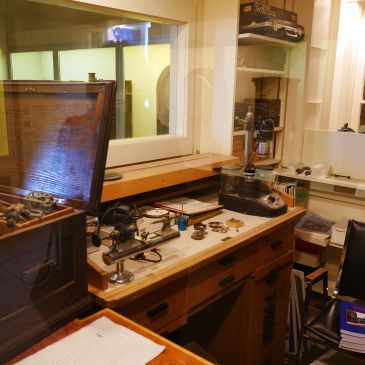
In my home, I have a dedicated room to work on my clocks

Five years ago I attended a workshop on WordPress at our local community college. It taught me more about blogging than I ever knew. The idea of a clock blog intrigued me but it is a lot of work, there is much learning and it was not something I wanted to design from the ground up but WordPress came to the rescue. It has an easy-to-do template approach and the only task was providing the content. So, I began the journey of documenting my horological interests and experiences.

The first few months were discouraging. I had very few views and likes which seem to be the lifeblood of many blogs. There is a strong blogger community out there and once connected to that community you get a feel for those sites that are quite successful and offer terrific content and those that quickly run out of steam.

A computer is not only essential for clockwork but it is the tool I use to compose my blogs

It takes time and patience to build a strong audience. It is also a healthy practice in blogging to follow other blogs and support their content and I am seeing a lot of excellent content.

Clock collecting and repair is a passion but I struggle with my writing and try to envision what my audience would like to see in my posts. Writing is not my forte but years working in academia had taught me to convey my thoughts on paper for my students in an effective way. I took notes on what other bloggers were doing, what made their sites engaging so as to improve my writing.

Contentwise, my intention was never to satisfy expert horologists and those in the clock repair business though I certainly don’t mind if they drop by from time to time, make comments, and offer their perspective. I consider myself a clock repair generalist and judging from my mail I seem to appeal to those who are amateurs like myself and those who have stumbled onto my site looking for advice and guidance on clock collecting and repair.

As a self-taught horologist and over the last 11 years, I have gained knowledge and experience working on a wide variety of mechanical clocks. Cabinet or case restoration is also an interest. I do not operate a clockmaking business and I am not a clock vendor though I will sell the odd clock locally to manage my collection.

I have received many comments. Some offer suggestions and advice on projects I am working on while others are looking for direction on their particular clock problem. I provide whatever assistance I can and within my scope of expertise.

Testing in the clock case rather than on a stand
Testing an ogee movement

Stats – the lifeblood of a blog

Like it or not, statistics are the lifeblood of a blog. I receive over 200+ views per day. The top 6 viewers are in the USA, Canada, United Kingdom, Australia, South Africa, and Germany.

Writing articles well in advance and scheduling publication dates help with blog planning particularity when I am vacationing and cannot find the time to write.

Time and strike parts
Time and strike parts separated

My regular features, Tick Talk TuesdayCrazy Clock Ads, and What Is This Thing For look at the lighter side of clock collecting and repair.

If you are new to my blog, welcome, there is plenty to read. If you are a regular viewer, thank you for supporting me and if you have any ideas for future articles let me know.

The essential clock repair library according to Antiquevintageclock.com

Whether you are working on your first clock movement or have repaired dozens, instructional resources, I believe, are essential. There is only so much information gained from a YouTube video (sadly some information is plain wrong) or how-to instructions online and there comes a point in time when you simply must have more detailed information.

An example of a Canadian made gingerbread-style clock

Opinions vary as to what constitutes an essential clock repair library but in this post, I will present those resources for the novice in the clock repair world and for those of you who have taken further steps in your journey.

Most of my work is with American and Canadian clocks, though some are German, some French, and of course, some British. Here are my go-to books starting with the Steven G. Conover series.

My Four Conover books (or manuals) are:

  • Clock Repair Basics
  • Striking Clock Repair Guide
  • Chime Clock Repair
  • Clock Repair Skills

Conover is very hands-on with plenty of diagrams and detailed step-by-step instructions. He will walk you through the repair of a broad range of clocks while discussing trouble areas, repair how-tos and challenges.

I am always on the lookout for clock repair books but sadly most of what I have has gone out of publication years ago although some can be found in the sections of used books on Amazon


Next are my Laurie Penman books.

They are;

  • The Clock Repairer’s Handbook
  • Common Clock Escapement

While some of his descriptions are quite technical and more targeted towards advanced clock repair he explores the basics as well.

Working with Anniversary or 400-day clocks requires the Horolvar 400-day Clock Repair Guide. 400-day clocks can be quite finicky and you are asking for trouble if you do not have this resource. The perfect companion is Mervyn Passmore’s book entitled Anniversary Clock Adjusting. It is a little short on depth but simple and to the point.

Horolovar 400 Day Clock Repair Guide

Next are three books by Philip E. Balcome

  • The Clock Repair First Reader – Second Steps for the Beginner
  • The Clock Book – An Overview of Heirloom and Contemporary Clocks in the American Home (not a repair book per se but a guide to identifying clock parts, types, styles, and trends)
  • The Clock Repair Primer – The Beginners Handbook

Balcome books are easy reads and are targeted for beginners and more advanced repairers as well.

Canadian John Plewes’s Repairing and Restoring Pendulum Clocks is an excellent resource for Canadian homegrown clocks. He explores specific clocks, describes repair challenges as well as provide tips and tricks on a number of clocks from not only Canada but all over the world.

Extreme Restoration By T. E. Temple should be in everyone’s library. Temple explores everything from evaluating a project, clock case refinishing, restoring glass, and tablet renewal. His how-to step-by-step instructions are easy to follow. Although the photos in his book are black and white to reduce cost, a companion website provides colour photos.

Though not directly related to clock repair the Home Machinist’s Handbook by Doug Briney explores bench tools, home lathes, Milling machines, treating and finishing the final product.

Temple and Briney books

I am always on the lookout for clock repair books but sadly most of what I have has gone out of publication years ago although some can be found in the sections of used books on Amazon. I  scour used book stores and flea markets to grab pretty much anything I can find.

Although I do not have any of Tran Duy Ly’s excellent reference books I am always on the lookout for them. Of course, they are not about clock repair specifically but they are great resources for identifying the many models and types of clocks from dozens of makers over the years.

A typical reference in Tran Duy ly’s Ansonia clock book

Well, there it is, my essential library of clock repair resources. Of course, there are many other resources and if there is anything else you feel should be on this list, let me know.

Tick Talk Tuesday #28 – How do I fix my Waterbury ogee?

Tick-Talk Tuesday is about the letters and comments I receive from you, the reader, concerning your clock, issues you might have had, challenges you face or a clock you would like me to profile. I give my responses to your question(s) and provide advice on your particular clock concern. For those comments and questions that stump even me, I consult within my clock circles for the best possible answer

8-day Waterbury ogee clock

It’s an 1870 Waterbury clock, it’s not in the best shape but it seems so sad to see family heirloom that’s was passed down over the years just tossed aside

AS writes,

I have been interested in old clocks and have 4. My maternal great grandparents were all watchmakers in England and I wished they were still alive to teach me the trade.  The other day I found this old clock in a second-hand store and I fell in love with,  It’s an 1870 Waterbury clock, it’s not in the best shape but it seems so sad to see family heirloom that’s was passed down over the years just tossed aside,  I loved it so I bought, It needs some repair and would love to repair it myself, do you have any advice on where I can get it to fix or how to fix it myself I have tried online to find a diagram of the inside so I have an idea on how to fix but found nothing.

Waterbury 8-day ogee clock movement – side view

My reply,

Hi and thanks for coming to my blog.

I have no doubt that the clock you bought is from the 1870s. The style is called “Ogee” because of the curved veneer molding. Yours is unusual in that it has two front doors rather than the typical one door. You are correct; it needs love and attention.

I have several suggestions for you. One, you can learn about servicing clocks by taking courses online. Dave LeBounty is one source. They are not free, however.

Two, there is a clock forum site operated by the National Association of Watch and Clock Collectors (NAWCC). It is free to post, you do not need a paid membership and you can ask questions about your clock and get some guidance on how to repair it.

Waterbury 8-day ogee clock movement

Three, Steven Conover has several excellent books on clock repair. He has one that focuses on time and strike movements, like yours. It is an excellent guide and easy to follow.

Fourth, You can get your hands dirty by taking out the movement and taking it apart yourself. I can walk you through the process.

Hope this helps.

Waterbury 8-day ogee clock movement – backplate

AS replies,

Thank you for your reply, and advice.  I will look into the NAWCC, Would love to try and fix it myself, as it would be a joy to learn the craft and maybe save other old clocks.  The only clock repair here in New Glasgow closed years ago, so there is no one here to do repairs which is a shame as these old clocks are a part of history and should be saved.  I have managed to get the gearbox out, it is in need of a good cleaning and does need some parts, It doesn’t have a spring but 2 ropes that wrap around 2 gears and spindles on either side then attach to 2 weights. The ropes need replacing as well as new weights, If you could walk me through it that would be wonderful. It is a grand old piece and I would love to see it working again.

Note: There are far more 30-hour ogees than there is the 8-day type. I have not come across one in quite some time. In my collection, my 4 ogees are all 30-hour clocks.

Organize your clock collection with a spreadsheet

“How do you keep track of the work you do on your clocks?”, asked a reader. Read on and I will explain the method I use and one that may work for you.

With over 100 clocks in my collection, it is hard to remember what service I performed on a particular clock, when a repair was completed, where I bought the clock, the original purchase price, and the date acquired. I had to have a method of organizing that type of information that was both easy to access and gave me data at a glance.

Don’t have MS Office or refuse to pay for it, try LibreOffice and its spreadsheet called “Calc Spreadsheet”. It’s free!

My practice is to check the condition of every clock in my collection every 3-4 years and some more often. During the inspection process, I note any issues to be addressed, remediate at that time, or plan a time to service the movement/make a repair. If there are no issues I simply apply clock oil to the movement (assuming it requires lubrication) and record the date the work was done.

clock oiler

Without a method of tracking inspections, repairs, and other pertinent information I would have to rely on my memory or notes I may have taken at the time. At first, I used a notebook but I would forget where I put it, could not read my own writing, or simply forgot to record data. I am sure that some of you rely on notes or scribblers to record information and find that method to be reliable but it doesn’t work for me.

I had used Microsoft’s productivity software, Excel in my former work life, was comfortable with it, understood its power, its ease of use, its ability to be customizable, and found that it is an excellent method of organizing information in a form that is readily accessible. And so I went about setting up a spreadsheet for my clock collection.

A computer is an integral part of my workspace

Spreadsheets can be intimidating because they seem complex and there is a bit of leg work setting one up. You need only master the very basics of the program and there is no need for intricate formulas unless they are required. Excel and similar productivity programs are powerful products and are an excellent method of tracking and recording information. When combined with cloud storage I can access my spreadsheet from any computer, phone, tablet, etc. at any time. If I am on an extended vacation where I acquire, sell, or service new clocks I can access my spreadsheet and update information on the fly.

So here it is.

My file, “Clock collection valuation and service schedule” contains the following information for each clock in my collection as well as clocks that I have said goodbye to.

  • Maker,
  • Model or type,
  • Country of Origin,
  • Motion type (time-only, time and strike, time strike and chime),
  • Original purchase price,
  • Current Value,
  • Year of manufacture (or approximate),
  • Date acquired,
  • Sold or gifted (I try to cover my original purchase as much as possible)
  • Service date,
  • Date oiled,
  • Notes (general state of movement, problem areas (case or movement), repairs required, bushings installed, new parts, etc.)

This is an example of a small section of the spreadsheet.

A spreadsheet has worked well for me for the past several years and it is a great way to record the required information on each clock in my collection. It is both quick and easy to see at a glance what work I have done on a particular clock and meets all of my data recording needs.

Don’t have MS Office or refuse to pay for it, try LibreOffice and its spreadsheet called “Calc Spreadsheet”. It’s free!

The antique clock and the dilemma of identity

The antique clock and the dilemma of identity. Some may feel this is much ado about nothing but discussion on identity and antique clocks tends to prompt a lot of debate. Let me explain.

Let’s say you are looking for that particular antique clock and you think you have finally found it. The photos look great and the description hits all of the boxes on your list. Let’s assume you found it locally and are meeting the seller soon to close the deal. You arrive, they present the clock and you notice things that are not quite right with the clock. The clock you thought was an authentic antique has been changed over the years and the seller may or may not even be aware of the changes. If the clock has been changed is it an antique in the truest sense of the word. You walk away feeling that too much has been done to the clock and continue your search.

A clock collector might have the opinion that if too much is done to restore a clock it is not fundamentally the same and cannot be considered original even though the new parts were made from the same materials using similar methods when the clock was first made. An antique shopper who knows little about clocks might not be bothered by the changes if the clock “looks” original.

Another might have the opinion that changes or alterations to the clock that bring it back to its original look and function including the making of new parts make it more “original” and therefore more desirable. But has the clock changed its identity during the change process and is it less original if it has undergone restoration?

Here are some examples.

From This.

Ansonia Extra short drop wall clock
Ansonia Extra Drop wall clock that some would have thrown out

To this.

Not perfect but saved from the trash heap

From this.

Junghans clock in pieces
Junghans Crispi wall clock in a parts box

To this.

Junghans Crispi wall clcok with compensating pendulum
Junghans Crispi wall clock resurrected from the grave

If one replaces one part at a time on a clock so that at some point all parts are replaced, at what point does a clock no longer become the same clock? It follows that if you take all of those parts and make a “new” clock which of the two clocks is original? What is the nature of the clock’s identity since no two objects can occupy the same identity? This is an example of a thought argument that raises the question of whether an object that has had all of its components replaced remains fundamentally the same object.

I was working on a clock recently that was said by its owner to be an antique. At first glance, it looked original. The case was a little tired, the movement looked like it was cared for or at least properly serviced at some point in its life. As I began to examine it more closely I discovered several anomalies. Although the movement was the “correct” maker as the case, the movement was taken from a kitchen clock and slightly modified to fit the case. Is this clock still an antique or has it strayed too far away from the definition of an antique because it is a “marriage”

People pay for originality. For my money, I prefer a well-cared-for clock in original condition. I will take a second look if it has been tastefully restored or repaired and know that it is better than having it trashed or perhaps parted out. However, I would not expect to pay as much for a “changed” clock”

If a clock is overly restored how should it be valued? I am not against conservation or restoration but if a clock was two steps away from a garbage can is it less valuable if restored?

There are no clear answers. There will always be buyers who demand originality and those who overlook certain changes. Is this much ado about nothing?

Website Powered by WordPress.com.

Up ↑