
In light of current world events the antiquevintageclock.com family wish to convey our sympathy and condolences to those effected by Covid 19
Tick Talk Tuesday #24 – key required for family clock.
Tick-Talk Tuesday is about the letters and comments I have received from you, the reader, concerning your clock, issues you might have had, challenges you face or a clock you would like me to profile and my responses to your questions with advice on your particular clock concern. For those comments and questions that stump even me, I consult within my clock circles for the best possible answer
DM from Colorado writes.
“Dear Ron,
I hope you can help me. I have become in possession of our old family clock that my great grandfather brought for the old farmhouse. The clock is working but I do not have a key. I was hoping that you could sell me the right key to fit the clock. What I can read from the back sticker is ” Regulator H” and there may be another letter after that. “The sessions clock company of Forestville Connecticut.” Attached is the photo, any help would be great.
In light of current world events the antiquevintageclock.com family wish to convey our sympathy and condolences to those effected by Covid 19
The only exception to my collection of mechanical clocks is this vintage Sessions electric auto-start table clock, model 3W, made by the Sessions Clock Co. Forestville, Connecticut in 1934 and sold throughout Canada (Canadian Standards Approval sticker on the back).
I wrote about this clock at the beginning of this year (2020) and have time to focus on the case.
Sessions 3W electric table or shelf clock
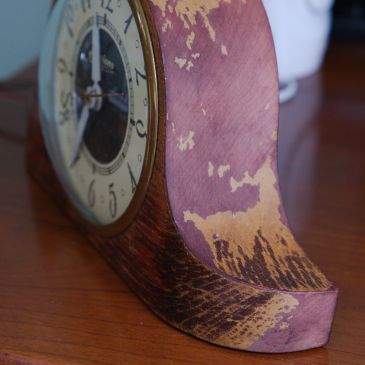
From the front, it doesn’t look too bad but the side view reveals much of the finish has worn off over the years
On the back, it states that it consumes 2.5 watts of electricity. I suppose the manufacturer could not call it model 2.5. it was a very affordable clock in its day and available almost anywhere.
At 4 1/2 inches tall and 8 1/4 inches wide it would fit on any countertop, bookcase, desk or bedside table though it does not have an alarm. It is time-only with an Arabic dial and a sweep second hand. Having a sweep second-hand means that at a glance you can see that the clock is running. There is only one control in the rear, a spring-loaded push-and-twist-in knob to adjust the time.
Hi readers, in light of current world events the antiquevintageclock.com family wish to convey our sympathy and condolences to those effected by Covid 19
Dating a clock can be a challenge and often an estimate within a range of dates is the best that can be accomplished. Dating some clocks can be relatively easy as in the case of this Sessions Beveled Number 2 tambour style time and strike. Inside the back access door, it is stamped Sept 1927, the date of manufacture.
Further research about the clockmaker, the movement design and the label will reveal a date within a narrow range
Inside access door of Sessions tambour clockSessions Beveled No. 2
This Gilbert time and strike movement has a die-stamped year but the month of manufacture is unknown. Other markings in the case might narrow it down.
Gilbert movement made in 1906
Research concerning the maker, the clock design, the model name or number and the label may reveal the exact date or something within a narrow range of years. Books on the identification of American clocks such as those by Tran Duy Lycan be very helpful.
Let’s look at this Elisha Manross Gothic Steeple clock.
Elisha Manross (1792-1856) was an important pioneer of the Connecticut clock and made a variety of clock styles, one of which is the gothic steeple pictured below.
Elisha Manross Gothic Steeple clock. Hands are incorrect; it would have had spade hour and spear minute hands
Although Elisha Manross had been active in Bristol clock-making since 1812 and earlier he shows in the Bristol tax records as making clocks from 1842-1851. His business was dissolved in 1854 and the factory was purchased in 1855 by E.N. Welch.
Manross made two steeple clocks. One is 20″ high and 10″ wide, the other is 19 1/2 inches high by 9 1/2 inches wide. The larger case would have made for other labels but the smaller size such as this one was manufactured in the Manross factory.
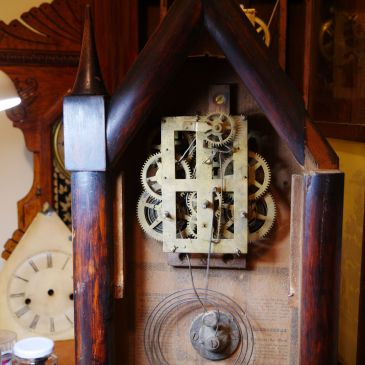
A very dirty Elisha Manross 30 hour movement, just out of the case
This 30-hour clock by Elisha Manross has some distinctive features that help in its dating. Let’s narrow down the date by looking at the design of the movement and case. Three features make this clock interesting. One, it has very rare brass mainsprings; two, the count-wheel is located in the middle on the backplate and three, the veneer on the front columns and door is in a vertical orientation.
Brass mainsprings
Brass mainsprings were invented, patented and first used in 1836 by Joseph Shaylor Ives. Brass was cheaper and more accessible than steel in the mid-1830s and 1840s. Silas B. Terry developed steel springs for clock use in the Bristol area circa 1847, and as steel improved and became cheaper, brass springs quickly disappeared.
In the history of the American clockmaking, brass mainsprings had a very short life, between 1836 and 1850. The brass mainsprings on this movement have survived for a very long time and most clocks of this age have had replacement steel mainsprings.
Count-wheel
Many American time and strike movements have the count wheel located on the left side of the front plate just above the mainspring (or winding arbour for a weight-driven clock). Placing the count wheel in the rear of this movement adds complexity to the lever arrangement. Also absent is a strike-side cam wheel typically found on later American time and strike movements.
Manross backplate showing location of count-wheel
Veneer and vertical orientation
Exotic woods were used to cover the pine case. Elisha Manross clocks were either clad in Rosewood veneer or Mahogany. Manross clocks were produced with the Mahogany veneer in a vertical orientation, such as this clock, and Rosewood veneer in a horizontal orientation. American clockmakers did not normally orient the veneer in this manner.
Left front column
Dating this clock – let’s see what the data tells us
Records also show that steeple cases were made by Manross between 1847 and 1853. The label on the clock is in remarkable condition for a 168-year-old clock and is extremely helpful in dating this clock. On the back of the door, the left side of the upper tablet is the inscription 8/43, not once but twice. Is this the date the case was made? The door is clearly original to the case since it has the same vertical orientation as the veneer.
Records also show the sale of 705 cases (unknown as to type) to “E. Manross” during the months July-November, 1843. It is very possible the case was constructed in 1843, stored until later when the movements were placed in the case and readied for sale.
The date of August 1843 is inconsistent with the label, located on the inside backboard, which was printed by Elihu Geer at his shop on 10 State Street, Hartford Conn on or about 1850. The label was likely added to the case just prior to the sale of the clock.
We can conclude that the clock was made no earlier than 1843 and no later than 1850 and we can safely date this clock within a 5-7 year period.
Dating aside, it is truly remarkable that a mechanical device that is 173 years old is still operating to this day.
Why does a mechanical clock movement require servicing? The answer is fairly straight forward.
Keeping your clock in good running condition requires maintaining the movement’s working parts and maintaining the working parts reduces wear. Ideally, most clocks should be serviced every three to five years to maximize longevity and ensure proper functioning.
This article describes the 7 steps that I typically follow when servicing an antique or vintage clock movement. A common American 8-day time and strike, pendulum-driven movement is used as an example.
During our recent trip to the southern part of Ireland including the capital city of Dublin, I expected to see antique mechanical clocks in some of the pubs and I was not disappointed. I tried to visit as many pubs as possible to search for clocks, of course, and while there I sampled the local ales and lagers though no Irish visit is complete without a pint or two of Guinness stout.
This rather plain, box-like 8-day hour strike Rosewood veneered shelf clock is up for servicing. This is Part II of a two-part series. Go to Part I to read my notes and observations while disassembling the movement and the initial steps required to bring the clock to running condition.
The movement is in reasonably good condition but not without issues. It was running prior to cleaning (though not a full 8-day cycle) so I did not expect any further running issues after servicing and my principal goal was that it would run the full 8-day cycle.
I always take a number of photographs when I disassemble a movement. It is much easier than making diagrams and notes and best for future reference particularly when photos are archived.
This rather plain, box-like 8-day hour strike shelf clock is up for servicing. I wrote about first impressions in Sept 2019 and said at that time that the clock is in reasonably good condition, runs well, but needs a good cleaning.
Among the most respected and prolific American clockmakers is the Seth Thomas Clock Co. of America. Every collector I know has at least one Seth Thomas clock in their collection.
My modest collection consists of six Seth Thomas clocks representing several styles, all unique and from the period 1865 to 1930.
This is a Seth Thomas time and hour strike large round top (model name or number unknown) made in the 1870s. For first impressions of this clock, go here.
Seth Thomas round top shelf clock, veneer missing top left of the door frame
This shelf clock was purchased at the National Association of Watch and Clock Collectors conference in Springfield Ma. in June of 2019.
The clock case is in such remarkable condition it would be a shame to ignore that one small blemish and once you see the missing veneer the eye is always drawn to it
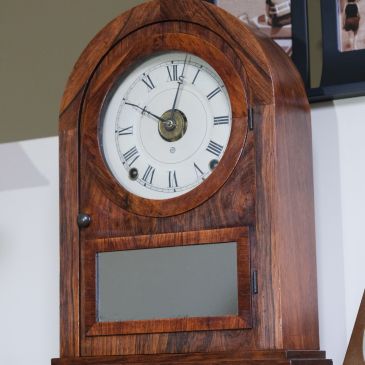
The clock measures 15 inches in height, 10 inches wide at the base and 4 inches deep. The attractive Rosewood veneered case has a mirrored rectangular lower tablet. The grain of the Brazilian Rosewood is bold and nicely textured. However, a sliver of the veneer is missing between the 9 and 12 o’clock position of the dial bezel which, in my view, is repairable. My wife did not notice this until I pointed it out.
A previous owner attempted to hide the missing veneer by tinting the exposed area.
I am a big fan of weight driven clocks and will add them to my collection when time, opportunity and finances allow.
There are generally 2 categories of motive power for mechanical clocks. The energy required to run a clock is provided either by a spring or a weight. Most of my collection is spring-driven but 10 clocks are driven by weights and they represent the broad period from 1835 to 1996.
here are some interesting facts about my ten weight driven clocks:
Eight are American,
Two are Austro-German,
Three are Ogee style,
Five are thirty-hour or one-day,
Two are column style
One is woodworks, and
Three have deadbeat escapements with maintaining power
Rather than describe each one I will let the photos (with captions) speak for themselves.
Though my collection consists of mechanical clocks exclusively, now there is an exception, a vintage Sessions electric table clock, model 3W with sweep second hand, made, of course, by the Sessions Clock Co. Forestville, Connecticut in 1936 and sold in Canada (a Canadian Standards Approval sticker is on the back).
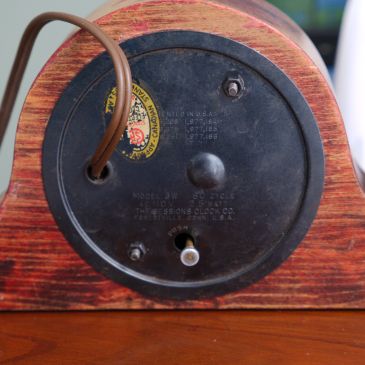
Also on the back, it states that it consumes 2.5 watts, They couldn’t call it model 2.5! It was probably a very affordable clock in its day and available almost anywhere.
At 4 1/2 inches tall and 8 1/4 inches wide, it would fit on any countertop, bookcase etc. although because it lacks an alarm it would not be a bedside table clock. There is only one control in the rear, a push-and-twist-in knob that sets the time. Pretty simple!
Back of clock showing patent dates, CSA decal, adjustment knob and cord
It arrived with a missing plug, a detached minute hand and a finish that was almost completely worn off but the convex glass, face, brass bezel and motor are all in very good condition.
How you ever wondered what keeps antique mechanical clocks going? It’s a miracle they work at all when they are as worn as this one.
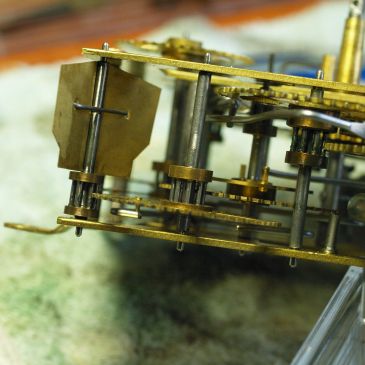
Jerome & Co. time and strike movement with front plate removed, minus the escape wheel
Most old clocks I come across have common issues, dirty, oily movements and worn pivot holes here and there. Generally, all they need is a bushing or two and a good cleaning to put right.
Last week I wrote about a Jerome & Co. time and strike mantel clock I bought in Springfield Mass. during the annual convention of the National Association of Watch and Clock Collectors in June 2019. However, no amount of encouragement would make it run reliably.
Jerome (left) and Seth Thomas (right) round top clocks side by side
How you ever wondered what keeps mechanical clocks going? It’s a miracle they work at all when they are so worn as this one.
Most old clocks I come across have common issues, dirty, oily movements such as worn pivot holes here and there. Generally all they need is a good cleaning to put right.
Vendors mart at the NAWCC convention, June 2019
I bought this Jerome & Co. time and strike mantel clock in Springfield Mass. during the annual convention of the National Association of Watch and Clock Collectors in June 2019 and I have only just got around to having a good look at it. It was purchased as part of a small package deal with other mantel clocks. All the clocks had very good cases but movement maintenance was largely ignored by the previous owner.
While the Jerome & Co mantel clock case was in exceptional condition, the movement was in pretty bad shape. No amount of encouraging would make it run.
In terms of style it is referred to as a round top, from the mid to late 1870s
Chauncey Jerome along with his brother Noble introduced the first mass-produced brass movement in 1839 two years after the depression of 1837 knocked out 90% of factories in the Northeast (New England States). The 30-hour brass movement was rugged, cheap to repair and not subject to swelling found in wood movement clocks. Despite business ups and downs Chauncey able was able to maintain a viable clock business until 1868 but later died penniless. This 8-day clock was made well after Chauncey’s death under the New Haven banner.
A distinctive feature of this Seth Thomas round top is the lyre shaped 8-day Plymouth time and strike spring-driven movement with a hour strike on an iron bell. Not all of these models have the alarm but this one does. The movement is die-stamped “S. Thomas, Plymouth Conn.” and fitted with Geneva stops (stop-works) to improve timekeeping. It is a large movement squeezed into a relatively compact space.
I wrote two previous articles, one on first impressions and the other on sprucing up the case and a future article (December 24, 2019) addressing a small veneer issue on the front access door but this post concerns the alarm mechanism.
A simple job, less than half an hour in total and the only difficulty was waiting for the part
The alarm mechanism is located just below the movement and to the left and connected by wire to the alarm adjustment wheel mounted on the centre cannon. Both the alarm and the movement strike on the iron bell.
When I bought this clock I was not sure what I had. There is no label, no makers name on the dial and an unsigned movement. I thought, Gilbert, Sessions?
This clock was hanging on the wall of a local antique shop with no price. When I inquired the shop owner said that he just picked it up and had not decided on a price but he knew the clock had issues. The hands did not turn otherwise he said the clock ran fine. Something wrong in the motion works, I thought. It could be a simple fix or something more challenging. The brass dial bezel was secured with Robertson screws which told me that the clock had been messed with.
My wife said go for it, it’s about time for another clock project. I offered a price and he agreed but I walked away wondering what surprises awaited me.
Junghans Crispi time and strike wall clock; my oldest daughter has her name on this one
“I have a sterling silver collection”, she said, “that my son will melt down and sell for cash” once I am gone
My sister, who is a couple of years younger and “was” an avid antique collector, remarked the other day that she has stopped collecting antiques. Why, I asked. There is no one to leave them to and no one to appreciate them, she replied. “I have a sterling silver collection”, she said, “that my son will melt down and sell for cash once I am gone”.
Once the Sessions Clock Co acquired E. N. Welch assets in 1902 (for the history of E. N. Welch go here) the company was well on its way to becoming one of the biggest clock producers in America. Production began in 1903 and between that time and 1933 Sessions produced 52 models of mechanical clocks, ranging from Advertisers, large and small clocks with logos of various businesses, to wall, or regulator clocks, and shelf or mantel clocks, designed for the home. Some Session clocks from this period are prized by collectors but most others are of the generic kind that have limited value today.
During our stay in Springfield Ma. to attend a NAWCC annual clock convention in June 2019 we stopped in Bristol, Connecticut about 45 minutes drive south of Springfield. In Bristol, Connecticut is the American Clock and Watch Museum. The non-descript white clapboard New England styled salt-box is what first greets the visitor.
Although the museum is dedicated to American clock and watch makers it is a must see for any clock enthusiast
I admit I was a little disappointed after visiting the stately edifice of the NAWCC museum in Columbia, Pennsylvania but once I entered the side entrance door my disappointment evaporated. I was immediately impressed with the friendly and knowledgeable staff, the quality of the displays and the vast, well-organized collection of American clocks and watches. The following photos tell the story.
Visiting any clock museum is always an interesting and engaging experience.
On our way from Boston to Springfield Ma. to attend the NAWCC (National Association of Watch and Clock Collectors) Convention 2019 we stopped in a small community called Grafton and in that community is the Willard House and Clock Museum one of the foremost museums of its kind in America. The unassuming location on a quiet country road in a pastoral setting of fields and forest was a pleasant surprise. The museum was the home of Benjamin and then, Simon Willard, celebrated clockmaker and inventor. Born in 1753 Simon Willard spent his formative years in Grafton, later moving to Boston.
The Willard name may not be immediately recognizable outside the United States but he is regarded as important source of innovative design in the American clock industry.
The vast collection of clocks housed inside is surprising for the size of the museum. The collection ranges from Massachusetts shelf clocks, to tall-case and Willard’s famous banjo clocks.
You must be logged in to post a comment.