
If you’ve been around antique or vintage clocks for any length of time, as I have, you’ve probably heard a few “truths” that get passed along like family recipes. Some have a sprinkle of fact in them, others are pure folklore, and a few can actually cause more harm than good. So, let’s sit down, pour a cup of coffee on this fine Monday morning, and bust a few of the most common myths I hear all the time.
Myth #1 – Overwinding A Clock
Let’s start with the big one: the infamous “over-winding” myth. I can’t tell you how many times I’ve heard, “It was running fine until I over-wound it!” Here’s the reality — you can’t hurt a healthy clock just by winding it all the way. If it stops when fully wound, the culprit is likely dried oil, dirt, or worn parts. Old, dried-up oil can turn into a sticky glue that causes the mainspring coils to cling to each other, thereby stopping a clock.
When I bring home an old spring-wound clock, the very first thing I do is let the springs down completely, give them just a small wind, and then see if the movement runs. If it does, that’s my cue that the springs need a proper cleaning and lubrication, right along with the rest of the movement.
Myth #2 – More Oil Is Better
Then there’s the advice some give to oil a clock every single year. I get it — we want our clocks to run smoothly. But adding fresh oil without cleaning first is like pouring new motor oil into an engine without changing the filter. You’re just mixing clean oil with grime and making an abrasive paste that speeds up wear. Most clocks are perfectly happy with a proper cleaning and oiling every four to five years. The only exception is that, after an inspection at the two-year mark, if it’s clear the pivots are dry and there is no residue around the pivot holes, a light oiling is a prudent step, provided only a small amount of clock oil is applied.
Myth #3 – A pendulum Clock “Adjusted for level” Will Work On Any Surface
Placement is another overlooked detail. I’ve seen pendulum clocks happily ticking away on a sturdy wall, and I’ve seen others struggle just because they’re sitting on a wobbly shelf. Uneven or unstable surfaces throw the clock out of beat and mess with its timing.
When someone says a pendulum clock was “adjusted for level,” it means that during servicing, the clock was placed on a level surface and its beat was adjusted accordingly. If the clock is later moved to an uneven or non-level surface, the beat will need to be readjusted to match the new position.
Get a clock with a floating balance escapement; it will work nicely on just about any uneven surface.

Myth # 4 – A loud Ticking Clock Is An Unhealthy Clock
And while we’re on the topic of how a clock sounds — louder doesn’t always mean healthier. A good clock doesn’t need to shout; an even, crisp tick is a much better sign than a booming one.
However, keep in mind that some clocks are loud because of case acoustics, or they are located in areas where the sound is amplified, a hallway or a small room with hard surfaces, perhaps. Some surfaces can even act like acoustic amplifiers.
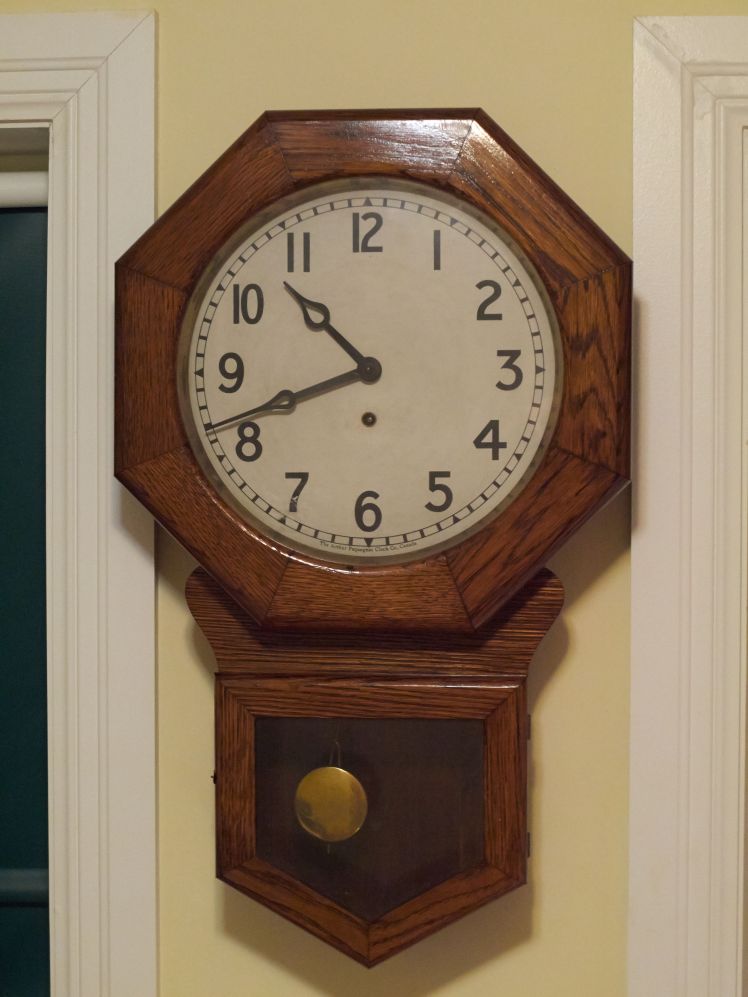
I also believe that the type of escapement is a factor. Due to their mechanics, recoil escapements are always louder than all others. I have an Arthur Pequegnat Brandon wall clock with a recoil escapement in a room with six other clocks — and which one is the loudest? The Brandon, of course! It’s almost as if it’s saying, “Look at me, I’m the loudest in this room.”
Myth # 5 – WD-40 Works Well As A lubricant
One myth that makes clock repairers wince? WD-40. Yes, it might make a sticky clock run for a little while. But it also strips away proper lubrication and leaves a sticky film that attracts dust like a magnet. It’s the short-term fix that leads to long-term headaches.
What does the WD in WD-40 stand for? WD in WD-40 stands for “Water Displacement.” The product was originally designed to repel water and prevent rust, and the “40” refers to it being the 40th formula the chemists tried before they found one that worked effectively. Who knew?
Now, please don’t tell me it worked for you!
Myth # 6 – The Older the Clock, The More Valuable It Is
And while we’re setting the record straight, let’s talk value. Not every old clock is a gold mine. Age is only part of the story — rarity, maker, originality, and condition matter much more. Old is not gold, as they say. An 1850 Ogee clock might have stood the test of time, but it was made in the thousands, so it’s actually not all that rare.

Of course, there are always exceptions. Well-preserved French clocks, such as a Louis XIV cartel clock of the 17th century, prized for their exquisite craftsmanship, ornate gilt bronze (ormolu) cases, and fine enamel dials, can be quite valuable.
However, many are often surprised to find out that their 100-plus-year-old clock is worth next to nothing.
Myth # 7 – Don’t Assume Black Forest Means “Made in Germany“
Also, don’t assume the words “Black Forest” mean German-made. Some Canadian and American makers used the name simply because it sounded exotic and marketable. For example, the Blackforest Clock Company of Toronto (which became the Forestville Clock Company in 1941) produced reliable clocks for the home. While the cases were made in Canada, the movements were sourced from England, France, and, more typically, Germany.
Myth # 8 – It’s Running Fine, So It Doesn’t Need A Service
Another one I hear often: “It’s running fine, so it doesn’t need service.” The truth? Even a clock that’s keeping time can be quietly wearing itself out if it’s running on dry bushings or worn pivots. A thorough inspection should reveal any issues with the clock’s movement.
Myth # 9 – An Antique Clock Should Always Look “Like New”
And please, don’t feel you have to polish away every bit of patina. That gentle wear tells the story of your clock’s journey through the decades.
When we think of antiques, there’s often a temptation to restore them until they look spotless and brand new. But with antique clocks, that shiny, polished look isn’t always the goal, and here’s why.
Patina is the natural aging and mellowing of a clock’s surfaces over time. It’s the soft glow on wood, the subtle tarnish on brass, and the gentle wear marks that tell a story. This “aged finish” is like a fingerprint of the clock’s life, showing decades, sometimes centuries, of use, handling, and care.
Stripping away that patina by over-polishing or refinishing can actually damage the clock’s historical value. Collectors and experts often prize original finishes because they preserve the clock’s authenticity and character. A well-preserved patina connects us directly to the past, making the clock not just a timekeeper but a piece of living history.
Having said all that, I’ll admit I’m certainly guilty of refinishing the odd old clock now and then. After all, I keep many of them for my personal collection, and refinishing is a great way to learn new restoration techniques.
It also allows me to bring out the original beauty that may have been hidden under years of dirt and wear, which I believe is a good thing in certain situations. Plus, sometimes a carefully done refinishing can help stabilize fragile wood or finishes, ensuring the clock can be enjoyed for many more years.
And I will throw in two bonus myths.
Bonus Myth #1 – Serial Numbers Always Tell A Clock’s Date of Manufacture
Lastly, serial numbers. While they can sometimes pinpoint a clock’s date of manufacture, this only works for certain makers with complete records. Unless you can match the serial number to a verified database or understand the dating system the maker used during production, it’s merely an educated guess as to when the clock was made.
Clock company catalogs are an excellent resource for dating an antique clock—if you can find them! For example, if you have a clock made by Junghans of Germany, they offer an excellent catalog archive on their website.
Many of the serial number charts floating around online are best taken as educated guesses, not hard facts.
That said, many movements have no numerical markings beyond the trademark.
Bonus Myth #2 – A Quick Bath Is All A Movement Needs To Run Properly
One common myth I come across is that you can clean a clock simply by dunking the whole movement into a cleaning solution without taking it apart first. It sounds like a quick fix, but in reality, this can cause more harm than good. Clock movements are made up of delicate parts that need to be carefully disassembled, cleaned individually, and then properly lubricated.
Dunking the entire mechanism risks damaging pivots, bushings, and other components, not to mention leaving grime trapped in places you can’t see or reach. Proper cleaning takes time and patience, but it’s the only way to ensure your clock runs smoothly.
Duncan Swish was NOT a famous clockmaker!
At the end of the day, part of the joy of collecting clocks is hearing the stories — and sometimes, debunking them. Myths may be fun to repeat, but knowing the truth will help you keep your clocks in good health and their history intact. After all, a well-cared-for clock doesn’t just tell the time… it tells its own story.
If you know of any other clock myths or stories that deserve a closer look, I’d love to hear them—drop a comment below and let’s keep the conversation ticking!
Discover more from Antique and Vintage Mechanical Clocks
Subscribe to get the latest posts sent to your email.
 Antique and Vintage Mechanical Clocks
Excellent…. Lots of informati
LikeLike
Thanks
LikeLike
my mother-in-law told me the other day “see if you can fix my mantel clock, my son over winded”. You hear that one the most often.
A. Olmo
LikeLike
Absolutely true, a very common one.
LikeLike
Hello,I have a Gilbert mantle clock that is running one hour fast. How do I adjust it ? Thanks
LikeLike
There are lot of factors involved. It depends how fast, over a day, a week, a month. What type of clock, pendulum, type of escapement, recoil, balance wheel. Is it spring or weight driven? Bottom line more information is required to offer an opinion.
LikeLike
Hi
Is it true or not when you stop your clock, it is bad for the clock work, or must you keep it running all the time.
LikeLike
There is no real need to run your clock all the time but occasionally you should wind it to keep the movement from developing any running issues.
LikeLike