
After working on my brother-in-law’s clock earlier this year, I was so taken with it that I decided I wanted the same—or at least a similar—clock in my collection. I nearly succeeded when I found a comparable clock in Ottawa, Ontario, this summer.
I had been monitoring the sale of the clock for about two weeks. I assumed the seller was eager to sell, as the price dropped in $10 increments several times. When it hit my sweet spot, I contacted the seller.
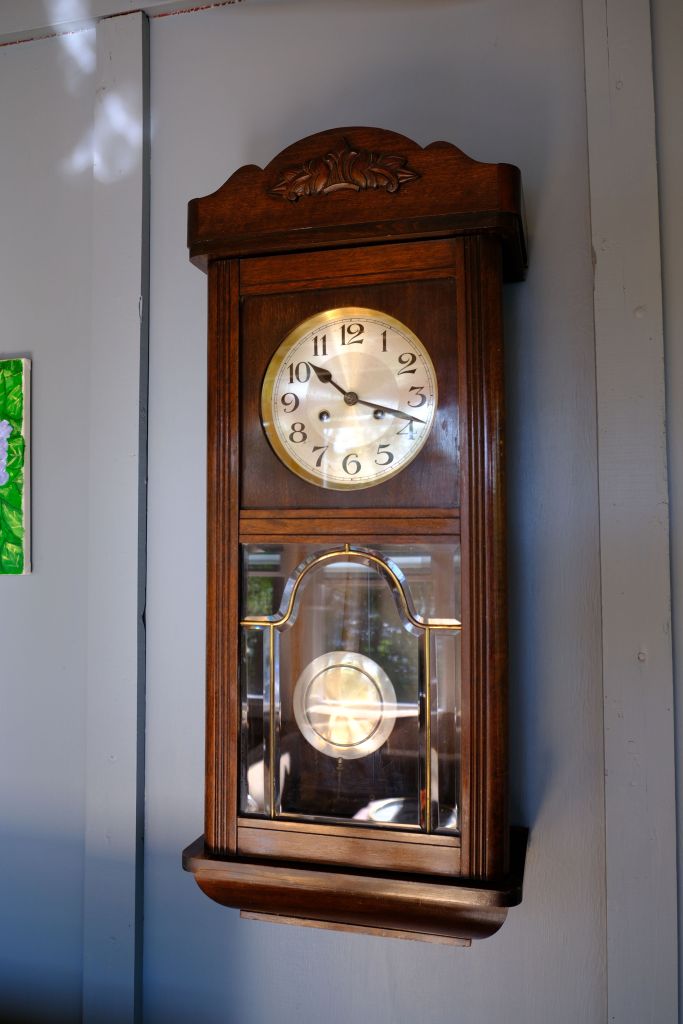
But first, let’s talk about the style of this clock—the box clock. By the early 1900s, Vienna Regulators were starting to fall out of fashion. Even before World War I, people began favouring the cleaner, less ornate look of the box clock. Its modern style fit the mood of the time, and before long, these practical yet stylish clocks had taken the place of the traditional Vienna Regulators.
The box clock design stood the test of time, enduring for over 40 years. Key features and characteristics of German box clocks are their appearance, since the box clock represents a departure from the designs of the Vienna Regulator clocks. Instead, box clocks embraced a more minimalist and utilitarian design.
They typically feature a simple rectangular or square wooden case with clean lines, a modest crown, and glazed elements, often without the intricate carvings and embellishments seen in earlier clock styles. The access door is large and swings open to the right. In the upper section of the door is a glazed panel protecting the dial, while the lower section usually contains five clear beveled glass panels. Sometimes the design is understated, as in the photo below, while other examples show a more ornate treatment.

The absence of markings other than pendulum length (45 cms) and the beat (100 bpm) stamp on the movement might suggest uncertainty, but the Divina gong confirms that the maker was Mauthe (pronounced maw-tay).
Divina was a trade name and subsidiary brand of Mauthe, used particularly for their gongs and striking mechanisms. When you see a gong stamped Divina, it’s essentially a Mauthe product, and it helps confirm the maker when the movement itself is unmarked.
My new clock has the same dimensions, dial face, spade and spear hands, and crown applique as my brother-in-law’s example, but there are two key differences and some minor ones. My clock strikes on three rods, while the other strikes on four. Is there a difference in sound between three and four rods? The answer is yes—the four-rod strike produces a noticeably richer and more sonorous tone.
Secondly, the glazed panel treatment on my clock is, in my opinion, more attractive, featuring a Napoleon-hat-style curve in the center glass panel.
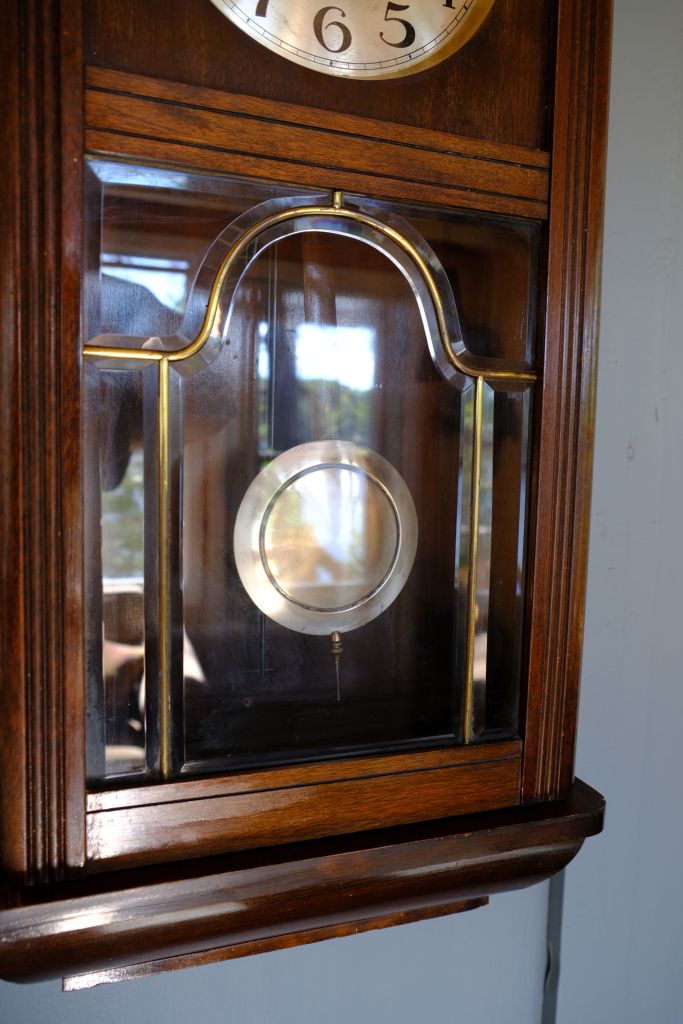
Next, mine is missing the rod lock, removed for some unknown reason. The rod lock is important when transporting the clock, as it prevents the rods from banging together and potentially snapping off. Otherwise, I had to stuff napkins between the rods when transporting the clock.
The other clock has no standoffs, while mine does. Standoffs help keep the clock vertically aligned on the wall and prevent it from shifting from side to side and putting it out of beat. In my experience, some came with standoffs while others did not.
Both clocks have a 45 cm pendulum and run at 100 beats per minute. My clock lacks a maker’s trademark, whereas the other one displays it on the movement. Regarding pendulum length and beats per minute, I’ve seen other similar Mauthe box clocks with 42 cm pendulums running at 105 beats per minute. Why the difference, I don’t know?
It’s difficult to pin down a manufacturing date, but judging from others I have seen, I would estimate that it was made in the early 1930s.
Unfortunately, little is known about this handsome, well-preserved German wall clock, other than that it was purchased at an antique shop in Cornwall, Ontario, (Canada) about four years ago by a lovely elderly couple. After the husband passed away, his wife began downsizing and was evidently not concerned with getting top dollar for the clock.
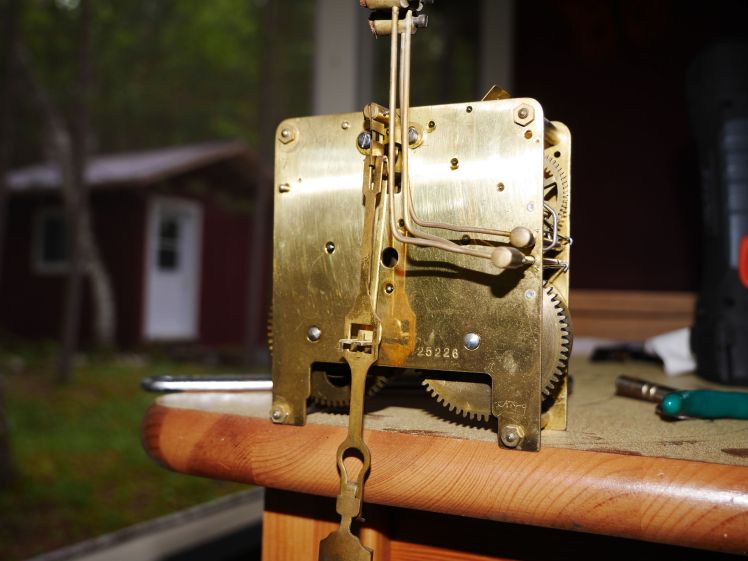
The clock runs and strikes, though two minor adjustment issues became apparent. First, when the first hammer struck the rod, it produced more of a thud than a clear tone. Bending the hammer back about a centimeter or so resolved the problem. Second, the pendulum bob wobbled slightly, which was corrected by gently squeezing the suspension post closed with pliers. A clean, even swing transfers energy efficiently. A wobble wastes some of that energy, which can potentially cause the clock to stop.
The plan is to display the clock, run it for a short period, then remove the movement to inspect it for signs of wear. If the pivots are dry, I’ll apply oil, run it a bit longer, and ultimately proceed with a full servicing of the movement.
Discover more from Antique and Vintage Mechanical Clocks
Subscribe to get the latest posts sent to your email.
 Antique and Vintage Mechanical Clocks
Ron, pleased to hear you found it. Sure it will give you years of pleasure soon proudly added to collection.
LikeLike
After shopping for this clock, I realized how far prices have tumbled. There are now plenty of bargains available for this style, and the prices are very good for what is essentially a well-engineered German clock.
LikeLike