
The Seth Thomas Type 89 movement is a robust and well-regarded mechanical clock movement widely used in many of Seth Thomas’ mantel and shelf clocks from the early 20th century to 1938.
The movement was introduced in 1900 and became one of Seth Thomas’ most popular and enduring movements.
There are several variants (89A, 89C, 89D, etc.), each tailored to specific clock models. The differences often involve small design adjustments like the escapement, strike train, or gearing. For example, some had solid back plates, some cut out, and some had a passing bell on the half-hour.
All Type 89 movements are time and strike and eight-day running and most use a strip pallet deadbeat escapement or according to Seth Thomas’s literature a “half deadbeat” escapement which is reliable and relatively easy to service. The most striking difference between the half-deadbeat and a recoil escapement is that the escape wheel teeth slant forward into the direction of rotation. Advantages: it was cheap to produce and still has fairly decent time-keeping ability. This video (no sound) shows the action of the escapement.
I consulted a chart (below) describing all the variations of the 89 and from what I can deduce this one is a type 89C movement.

Two Important strike-side Issues
The movement was in good condition overall. It was cleaned up and three new bushings were installed. The escape wheel bushings front and back were the most worn. The next was the fourth wheel front plate, adjacent to the escape wheel.
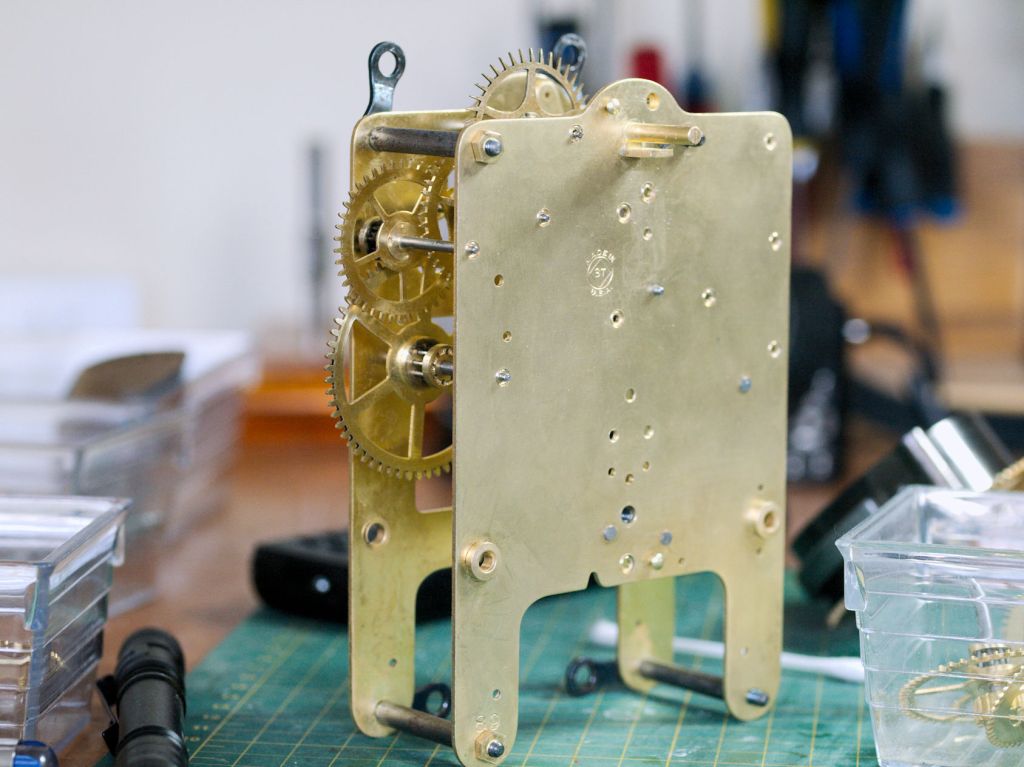
One minor hiccup when reassembling was dealing with a broken helper spring on the lifting lever. Shortening the spring by taking one coil off the arbour did not pose any running issues.

However, once the cleaning and wear issues were addressed two other problems remained. The strike would not go into warning and the hammer did not move when the strike side was pushed to run.
It seems that whoever previously worked on it did not properly set up the strike side, likely neglecting to position the stop wheel correctly to ensure the strike mechanism would go into warning. Warning refers to a brief preparatory phase in the strike mechanism. This occurs just before the clock strikes. When the time approaches a strike point (such as the hour or half-hour), the movement enters the warning phase to prepare for the strike sequence. The warning phase is essential for ensuring the clock strikes consistently and on time. Improper setup of the warning phase can lead to the strike train failing to run.
While reassembling the movement, position the paddle lever in one of the indents on the cam while ensuring the paddle itself rests in a deep slot of the count wheel. The paddle should be straight into the deep slot without touching either side and pointed directly at the main wheel arbour.
The warning wheel can be adjusted after reassembly. Once all the wheels and levers are in their respective locations, carefully separate the plates slightly at the flywheel corner, ensuring no other components shift out of place. Then, when the pivot is out of its hole and the lantern pinion is disengaged from the adjacent gear, rotate the stop wheel until its pin meets the stop lever. If the levers are correctly positioned, the movement will enter the warning phase.

The second issue involved the hammer strike. A previous repairer had over-bent the strike rod, creating alignment problems. On the opposite side of the strike cam wheel are two striking pins, which the strike rod must reach to activate the hammer and sound the coiled gong. In this case, the rod had been positioned too close to the center, preventing it from contacting the strike pins. After some trial and error and careful bending of the strike rod, the movement is now properly aligned and able to sound the strike.
The final step is thorough testing. Placed on the test stand, the movement will be carefully monitored over the next several days to ensure everything functions smoothly and reliably.
A Special Note
I would also like to recognize Saint Valentine’s Day (February 14th) and I hope that everyone takes the time to cherish those around them, whether through a kind word, thoughtful gesture, or simply appreciating the moments that make life special. Happy Valentine’s Day!
Discover more from Antique and Vintage Mechanical Clocks
Subscribe to get the latest posts sent to your email.
 Antique and Vintage Mechanical Clocks
great write up on servicing an 89 movement with very useful tips and pointers.
LikeLike
Thank you.
LikeLike