
Clocks historically have numbers on the dial to help people accurately tell time and organize their daily activities. Early mechanical clocks were developed to standardize timekeeping. Adding numbers made it easier for people to read and interpret the time at a glance, particularly as public clocks were placed in town squares and churches for communal use.
Early clockmakers borrowed design elements from sundials, which often had marked divisions for hours. Numbered dials mirrored this system, making mechanical clocks intuitive for users transitioning from sundials.
Roman numerals were commonly used on early clock dials because they were familiar to people during the Middle Ages and Renaissance. Adding numbers also balanced the clock’s aesthetic appeal with its functional purpose.
So, let’s look at a specific difference concerning Roma Numerals. Some clocks with Roman numerals have ‘4’ as ‘IV,’ while most use ‘IIII‘. Why?
There is no definitive answer. There are a handful of competing theories and one of the following seven might just be the correct one.
Possible Scenarios
Theory 1: When Roman numerals were used by the Roman Empire, the name of the Romans’ supreme deity, Jupiter, was spelled as IVPPITER in Latin. Reluctant to put a god’s name on a sundial, IIII became the preferred representation of four.

Theory 2: IV, instead of IIII, which represents four didn’t become the standard until well after the fall of the Roman Empire. It’s likely, then, that IIII was used on sundials (and everywhere else) simply because that was accepted convention at the time, and not for fear of divine retribution.

In the years to follow every clock-maker had to decide whether to adopt IV because it was the new standard, or hang onto the traditional IIII.
Theory 3: IIII might have stuck around because it’s easily recognizable as four. IV involves a little math. it’s a simple subtraction operation. Though subtractive notations really caught on in the Middle Ages, the majority of people were not literate or numerate and IIII was simply easier to visualize. Subtraction involves conscious thought. IV and VI might also have been easily confused by the uneducated.

Theory 5: Using IIII may have also made work a little easier for certain clockmakers. If you’re making a clock where the numerals are cut from metal and affixed to the face, using IIII means you’ll need twenty I‘s, four V‘s, and four X‘s. That’s one mold with a V, five I‘s, and an X cast four times. With an IV, you’d need seventeen I’s, five V‘s, and four X‘s, requiring several molds in different configurations. Or, did they really think in those terms?
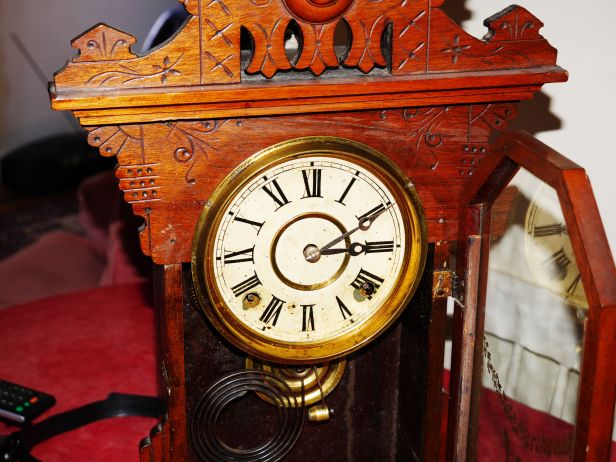
Theory 6: King Louis XIV of France preferred IIII over IV, perhaps for the same reasons Jupiter would not want two letters from his name on a sundial, and so ordered his clock-makers to use the former. Some later clock-makers followed the tradition, and others did not. Other monarchs might have felt the same way, and IIII was used also in areas where there was no king with an IV in his title to object to the subtractive notation.
Theory 7: Lastly, IIII creates more visual symmetry with VIII on the opposite side of the clock face than IV does. Using IIII also means that only I is seen in the first four hour markings, V is only seen in the next four markings, and X is seen only in the last four markings, creating radial symmetry.
The tradition of numbered dials persists today because of its practicality and historical significance, even as digital timekeeping has become the norm,
Which theory do you prefer?
Discover more from Antique and Vintage Mechanical Clocks
Subscribe to get the latest posts sent to your email.
 Antique and Vintage Mechanical Clocks
You must be logged in to post a comment.