Service intervals for antique and vintage mechanical clocks?

It is not uncommon for a mechanical clock to run 25, 30 years or more with nothing more done to it other than the occasional oiling.

How often should a mechanical clock be serviced? It is not as simple an answer as it seems.

In this post, I will discuss what it means to service a mechanical clock and explore some of the factors that influence how long a clock’s movement will last and how to prolong its life. Those factors will help you decide the best service interval for your antique or vintage clock.

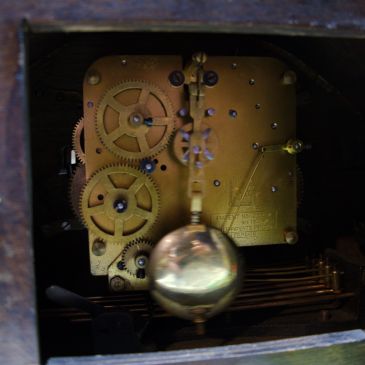
Elisha Manross 30 hour movement
A very dirty 30-hour movement from the 1850s

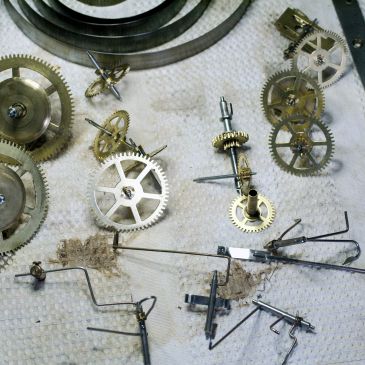
If your clock does not work, cleaning it is the first step in determining the problem. Cleaning is just another word for servicing and the term “servicing” in the realm of professional clock repair implies a complete disassembly of the movement.

Though a common practice in the past, dunking a movement in a solvent and hoping for the best is not a substitute for servicing. Servicing a clock means that it is taken apart, inspected, assessed, cleaned, wear issues noted and damage due to abuse or failed parts is addressed.

What to look for

Normally clocks in my collection are inspected on a 3-4 year cycle. I will open them up and check the condition of the movement and if dry, re-oil. If I notice a particular clock stops occasionally and I find need to investigate, I will service it simply as a prudent measure. Clocks that stop occasionally are sending a clear message they require servicing.

If I notice that I am not getting full power during the clock’s designed running cycle I will investigate. For example, if a clock consistently stops at day 4 or 5 of its eight-day cycle this tells me that the movement might be very dirty or that there are worn parts causing the clock to stop prematurely.

I generally take the movement out of the case for inspection. As I inspect the movement I look for green or black residue around the pivots which indicate a more serious problem. It is at that point that dirt and other contaminants are mixing with the clock oil and producing an abrasive paste. This paste plays havoc with bushing holes and pivots.

The movement must be inspected closely and at a minimum, disassembled and cleaned. Once disassembled I will inspect parts for wear and determine if the wear should be addressed immediately or at some point in the future.

one-weight Vienna wall clock
Miniature one-weight Vienna wall clock stopped and after a cleaning runs much better

Let’s look at some factors that affect wear on a movement.

The clock’s environment

The local environment is the greatest factor affecting the life of a mechanical clock. In today’s homes, humidity and temperature can be controlled very effectively. However, there are always occasions in the year when the windows are open causing humidity to rise in a home. A clock may run faster or slower if there are changes in the home’s humidity as wood and metal expand and contract. Constant temperature and humidity in the home environment will definitely improve a clock’s performance.

Older homes with poor insulation have environments that are more difficult to control especially in kitchen areas where clocks are exposed to higher humidity and particulates from cooking. Clocks in homes with a wood heat stove tend to attract dust (though most modern wood stoves are well sealed) and the presence of pets will shorten the lifespan of clock pivots.

Dog and cat hair in suspension will get into the workings of a mechanical clock by wrapping around the pivots. Eventually, it is the reason the clock requires servicing.

I use an Excel spreadsheet and record any changes I make to a clock in my collection

The amount of dirt and dust (and animal hair) entering the movement is determined by how well the clock case is sealed. There is a very good reason why you should have an access door on the back of your mantel clock and if it is missing it should be replaced. Movements in high quality, well-sealed cases will run many years with minimum maintenance.

U M Muller box clock, and example of high-quality case construction

What are the signs that something is amiss

Spring driven time and strike clocks typically exhibit more wear on strike side pivots due to the hourly striking action. Yet clocks, especially American time and strike ones, will tolerate pivot wear and still run reasonably well if very worn.

It is very common to install many new bushings on an American clock. But sometimes I come across a movement where one side is much more worn than the other. I recently worked on a movement that required six bushings on the time side but none on the strike side. Evidently, a previous owner was bothered by the noise and the strike side was rarely wound.

With chiming clocks, the chime train is first to respond to additional friction caused by dried oils and dirt. The additional complexity of the chime side means that more parts are subject to wear. The chime will eventually slow down then stop altogether.

Fleet Time Westminster chime mantel clock circa the 1940s

If your weight-driven clock stops before its designed cycle, check for twisted cables around the winding drum and ensure that it is correctly in beat. Otherwise, a weight-driven clock does not tolerate pivot wear well and will need to be taken apart to investigate for that and other possible issues.

Sits without running

What happens when a mechanical clock sits without running? Time and environment are the biggest enemy – not operation. The only deterioration on an unused clockwork would be the oil as the oil will thicken and break down over time. Many clockmakers claim that synthetic oil is less prone to breaking down, something to consider for your prized mechanical clock if you do not plan to run it regularly.

Parts that are not moving for extended periods of time tend to fuse, and rust builds up faster particularly in high humidity environments. All mechanical things age better when running occasionally and so my advice is to let parts move from time to time. Run your valued mantel clock at least once per month to give it the exercise it needs.

This Schatz triple chime clock is “exercised” once per month

The environment in my home is controlled, the temperature is constant, the humidity is low and we do not have pets much like a museum environment. Having said that, I continue to schedule a health check on my clocks as a preventative measure.

I use an Excel spreadsheet to track and record any changes I make to a clock including information on service intervals and issues regarding the servicing of each clock in my collection. I want my clocks to last and some I would like to pass on to my children.

Restoring an 1850s Scottish tall clock case – Part II

Restoring the case of an 1850s period Scottish tall case clock with an English bell strike is the subject of this blog. This is Part II of a two-part series. Check out Part I here.

While the case was made in Scotland, the movement, dial and weights are all from Birmingham, England made at or before 1850. The clock was in fair condition when I bought it from an estate auction early in 2020, though I knew almost immediately that structural repairs and cosmetic fixes were necessary. My work was cut out for me.

It is rare to find a clock from this period that has not been subject to minor or even major repairs/changes over the years, some acceptable, others questionable

In Part I, I addressed age cracks, a cracked backboard and attaching a backboard to the waist section. In this, Part II, I will continue with installing new door pins, fashioning a missing right rear foot, cleaning the case and overall case refinishing.

New door pins

Both upper and lower door pins were missing. I considered what I would use as pins. Wood screws could work.

I cut the heads off two 3/4 inch steel wood screws and threaded each screw into the existing holes at the top and bottom of the frame. They are more than strong enough to hold the bonnet access door and appear authentic.

I learned that the poured cement on my basement floor is not level. It took me a 1/2 hour of crawling on the basement floor to find a perfectly level area

Continue reading “Restoring an 1850s Scottish tall clock case – Part II”

Restoring an 1850s Scottish tall clock case – Part I

This is my first experience with a tall case clock from the 1850s and my first venture into English bell strike movement servicing.

Let me explain. Although the case was made in Scotland, the movement, dial and weights are all from Birmingham, England made at or before 1850. The clock was in fair condition when I bought it from an estate auction early in 2020, though I knew almost immediately that structural repairs and cosmetic fixes were necessary.

In this Part I, I will address case age cracks, a cracked backboard and attaching the backboard to the waist.

In Part II, I will continue with new door pins, replacing a missing right rear foot, cleaning the case, overall finishing & attending to various trim pieces.

Although modern adhesives were used for the main structural repairs, some trim pieces were attached using traditional hot hide glue

The first question is how to address present structural issues. Should I utilize materials and techniques that would have been available at the time or select a modern method that would ensure that the part(s) will continue to provide strength, rigidity and service for many years to come? I used both approaches and my apologies to the purists.

As found, standing in a corner of the auction hall

Continue reading “Restoring an 1850s Scottish tall clock case – Part I”

Waterbury York parlour clock – a fresh approach to addressing a non-functioning strike side

Back in December 2019, I wrote about the challenges of adjusting the strike side of this attractive parlour clock, a Waterbury York, circa 1900. Despite many attempts the strike side refused to work. Though I was close to a solution but I did not realize it at the time. I put it aside to think about it.

Attempt #2. Will I be successful? Read on.

A shot of the clock the day I brought it home.

The time side functioned perfectly but the strike side did not run at all when I first brought the clock home. Typically a good cleaning or a simple lever adjustment is all that is required though once I opened the movement up I saw it true colours. I detailed these surprises in my December post.

Continue reading “Waterbury York parlour clock – a fresh approach to addressing a non-functioning strike side”

Tick Talk Tuesday #24 – key required for family clock

In light of current world events the antiquevintageclock.com family wish to convey our sympathy and condolences to those effected by Covid 19

Tick Talk Tuesday #24 – key required for family clock.

Tick-Talk Tuesday is about the letters and comments I have received from you, the reader, concerning your clock, issues you might have had, challenges you face or a clock you would like me to profile and my responses to your questions with advice on your particular clock concern. For those comments and questions that stump even me, I consult within my clock circles for the best possible answer

DM from Colorado writes.

“Dear Ron,

I hope you can help me. I have become in possession of our old family clock that my great grandfather brought for the old farmhouse. The clock is working but I do not have a key. I was hoping that you could sell me the right key to fit the clock. What I can read from the back sticker is ” Regulator H” and there may be another letter after that. “The sessions clock company of Forestville Connecticut.”  Attached is the photo, any help would be great.

Continue reading “Tick Talk Tuesday #24 – key required for family clock”

Canada Clock Co. – a frustrating movement

In light of current world events the antiquevintageclock.com family wish to convey our sympathy and condolences to those effected by Covid 19

Original time and strike 30 hour movement

The movement in this Canada Clock Co. time and (hour) strike cottage clock from the late 1880s is a mess but fixable. Some past repairs are acceptable while other leave a lot to be desired.

I’ll begin with the issues. “Repaired” mainsprings, nuts on a copper wire fashioned as a gong hammer and string “helping” the helper springs are things you really don’t want to see on a movement. The time side runs reasonably well but the strike side does not function, likely the result of fiddling with levers too many times.

clever, but dangerosu way of repairing the mainspring

The second mainspring, another “iffy” repair

Home-made copper wire and two nuts serve as the gong

String used to connect a broken helper spring

In the clock business you must always expect the unexpected. While I awaited parts, I went about cleaning the parts and bushing work .

This is perhaps the most frustrating 30-hour movement I have ever worked on

The parts arrived and included a new gong hammer, two new mainsprings and brass wire for new helper springs.

New 30 hour mainspring

New hammer gong and lever with helper springs installed

I began by installing the new hammer. Using my mini lathe I drilled a new access hole in the hammer arbour. I measured the diameter of the hammer rod and used a HSS bit to drill through the centre of the arbour. It was a reasonably good fit but to ensure a permanent hold I applied a drop of thread-locker.

The levers look like a twisting mess but there is a logic to the arrangement

This is the first 30-hour shelf clock I have worked on without a discernible warning action and it made for tricky lever positioning. Perhaps there is warning but I just could not see it. Though the levers look like a twisted mess there must be some logic to the arrangement.

The above photo shows the left side lifting lever that must be precisely adjusted and curved for the centre cam to push the drop lever over the count wheel cam to actuate the strike. The count lever blade must also line up exactly with the centre of the count wheel and precisely in the middle of the deep slot. As far as I can determine the lifting lever is the only one of the two levers that require a helper spring but I will know more after further testing.

All in all, this is one of the most frustrating 30-hour movements I have ever worked on. The movement was taken apart several times for various adjustments. I worked at for a while, left it, thought about the next steps but despite my best efforts, that strike side continues to elude me. The time side, however, works perfectly.

Some day I will have it working but for now it is on display.

Is this a German box clock?

In light of current world events the antiquevintageclock.com family wish to convey our sympathy and condolences to those effected by Covid 19

A different looking box clock

Is this a German box clock? It certainly appears to be a typical time and strike German box clock with the addition of finials. I discovered it behind a bar at a resort in Varadero, Cuba before Covid19 scared us all into our homes.

I have two box clocks in my collection, one is this Mauthe clock from the 1930s but most box clocks I have seen are relatively plain-looking and unadorned. Finding one with finials is a bit unusual.

German "box" clock by Mauthe
German “box” clock by Mauthe

It might have been made by a number of German companies, Mauthe, Kienzle, Gustav Becker, or HAC but definitely German. I cannot see any markings on the dial or anywhere that might tell me what it might be. But those finials. Were they added later on? Who knows.

I am always on the lookout for interesting clocks during my travels and hopefully, in the months to come, my wife and I can resume our travelling once the current world health crisis subsides.

Pequegnat gingerbread clock and dial inpainting

In light of current world events the antiquevintageclock.com family wish to convey our sympathy and condolences to those effected by Covid 19

In this article, I will describe the steps taken to inpaint and restore the dial of an Arthur Pequegnat time and strike gingerbread clock.

But first, what is inpainting? And what does it have to do with clock dials?

Inpainting is a dial restoration or conservation process where damaged, deteriorating, or missing parts of a dial are filled in to present a complete image.

And what does the term dial restoration mean?

Dial restoration includes adhering loose flakes, filling areas of loss, cleaning, colour matching, repairing graphics, inpainting of decorative artwork and sealing. Some dials are easier to work on than others but generally speaking American antique clocks dials are good candidates. Dial inpainting can be hit and miss, and the final results can range from fair to excellent.

Here is an earlier project. The before photo shows the significant losses on the dial of an 1850s Seth Thomas column and cornice clock.

Before inpainting

And, after inpainting. In this example, restoring the floral spandrels and the chapter ring was the most challenging part of the project.

Working on a clock dial

I was pleased with the final result though these dials are among the easiest to work on.

After: Seth Thomas dial, column and cornice clock

Now let’s turn to a circa 1918 Arthur Pequegnat Canuck time and strike gingerbread clock. There was considerable paint loss, numerals in a script that is a challenge to reproduce and a chapter ring consisting of small dashes with a 4-dot pattern every 5 minutes. To make matters worse, a previous owner had made an attempt to paint in larger sections of the dial.

Given its poor condition, I was initially tempted to buy a replacement dial; $50.00 for paper-on-tin and $4.00 for a paper dial plus tax and shipping. However, I decided to attempt inpainting.

My supplies, which I have on-hand, consisted of:

  • Level 3 – 10/0 spotter artist’s paintbrush
  • #2 artist’s paintbrush
  • A selection of satin finish water-based acrylic paints; white, yellow, red, and blue
  • Black paint for numerals
  • Pitt artist’s pen, fine tip
  • Pencil eraser
  • Toothpicks for mixing paint
  • Q-Tips to remove over painted areas and polish brass bezel
  • Woodblock

Supplies

Occasionally I use a pencil eraser to remove dirt around the centre and winding arbour hole holes. It is very effective at removing years of dirt and grime.

White is the base paint. Others colours are mixed to replicate the aged finish. There is no magic to this. It takes trial and error to match the dial colour which had yellowed considerably over the years. An exact match is more luck than skill and there are a thousand shades of off-white. I suggest painting in warm light or natural light for best results. Arriving as close as possible to the aged finish was my objective.

The numbers were in reasonably good shape and it takes a steady hand to fill in the missing sections especially the dashes on the chapter ring. For very thin lines, I use a black artist’s pen with a fine tip.

Before and after

Of course, upon close examination, you can see the infilled areas and the touched-up numbers but from average viewing distance, it is difficult to tell.

About 1/2 meter away (the case had been cleaned earlier).

While I was working in the dial I cleaned the brass bezel with Q-Tips and Brasso.

Before (inset) and after

There are some dials I leave as-is since the age and patina of the dial is an important part of the character of the clock but if it is too far gone, as in these examples, inpainting is certainly an option.

All in all a very satisfying project. Now on to servicing the movement.

Arthur Pequegnat Canuck gingerbread clock first look

Hi readers, in light of current world events the antiquevintageclock.com family wish to convey our sympathy and condolences to those effected by Covid 19

I have a total of eight Arthur Pequegnat clocks in my collection. The newest, an Arthur Pequegnat Canuck is not exactly my favorite though it is not unattractive for a gingerbread clock. The company made a range of kitchen clocks but I have seen very few in the true gingerbread style, such as this one.

The clock runs well though it will certainly need servicing

Few are offered on online for-sale sites so it is quite possible that not many of them have survived over the years. Collectors would often pass them up as most other Pequegnat clocks are considered more desirable and valuable.

Label located under the base of the clock

Continue reading “Arthur Pequegnat Canuck gingerbread clock first look”

Disassembling an antique tall case clock

The disassembly of an antique tall case clock need not be a daunting task. When I bought this clock at auction at the beginning of 2020 I put into practice some of the things I had learned when transporting a Ridgeway grandfather clock in 2013. My advice is to work slowly and methodically but think about what you are doing at each step of the process.

Why disassemble? A move across town, across the country, or even redecorating are three of many reasons. Even if you wish to move the clock from one area of your home to another disassembly is required. Yes, moving it a few inches requires disassembly.

Scottish tall case clock from the 1850s

An antique tall case clock, such as this weight-driven Scottish tall case clock from the 1850s with an English brass bell strike, can be easily disassembled by one person. In this blog, I will walk you through the steps required to safely disassemble an antique tall case clock.

Similar American tall case clocks from the same period are disassembled in the same manner.

Continue reading “Disassembling an antique tall case clock”

Scottish tall case clock circa 1850s

For the past several years my wife and I have been searching for an authentic antique tall case clock. I finally found one at an estate auction an hour down the road from where I live and seized the opportunity to purchase a clock I knew practically nothing about. In this blog article, I will describe first impressions and the results of my preliminary research.

I have had only one tall clock in my collection, a Ridgeway Westminster chime clock from the mid-1990s. It is stately with handsome lines but it is a modern clock with a contemporary German-made movement and certainly not an antique.

Continue reading “Scottish tall case clock circa 1850s”

Canada Clock Co. – 30 hour time and strike needs some love

Servicing this clock from the Canada Clock Company was a real challenge as I encountered many issues that conspired to slow my progress.

I found this clock in an antique shop in downtown Truro, Nova Scotia at basically a give-away price. The seller knew nothing about the Canada Clock Co. and that was fine with me.

So, what happens when amateurs and backyard mechanics get their hands on a movement. Read on.

But first, a little about the short-lived Canada Clock Co.

Canada Clock Co Hamilton Cottage Extra

The Canada Clock Company in its three iterations made clocks in Ontario, Canada between 1872 and 1884. The Canada Clock Co, the Hamilton Clock Co. and then Canada Clock Co. (redux) struggled over a 12 year period to put Canada on the clock-making map. Ultimately their efforts failed. Nonetheless, there are a number of fine examples that have survived to this day

Description 

The clock is a 30-hour time and strike movement on a bell. It is the “Hamilton Cottage Extra”, one of the least expensive in their line of cottage clocks.

Back label in good condition for the age of the clock
The label is in fair condition but identifies the model name and yes I paid far less than the sticker price

The case, which is in fair condition, reflects the age of the clock, grimy with numerous chips and scuff marks. Constructed of pine with a walnut stain finish the case has a minimum of decorative features and reflects the muted Victorian style of the times. The label is in fair condition and there is a stamp on the top of the label which says, “…A Hill &Co.”.

The lower part of the tablet has an etched glass floral design common on Canada Clock Company clocks. The dial face is flaked in places, has been “touched up” and will need attention.

The Maltese hands are original.

Original time and strike 30 hour movement
Original time and strike 30-hour movement

I tested the movement while in the case. The time side runs with a little encouragement while the strike side has the typical run-on strike when things fall out of adjustment.

Assessment of the Movement

When I disassembled the movement there were a few unexpected surprises. I now have answers for a movement that is running poorly.

Strike side mainspring riveted together

Both mainsprings had been modified, a very old repair. I try not to be judgemental when I see this and respect the folks that made every effort to keep their clocks running as best they could often with limited means. However, these look dangerous and must be replaced.

Time side mainspring with a nail holding parts of the mainspring together

Now on to other issues.

Levers bent in all directions

This is the strike side. What are the correct positions for the levers? Bent so many times it will take trial and error to find precisely where the levers should go.

The “hammer”

The hammer is actually a copper wire wound around 2 nuts and it is loose in the arbour.

Helper “string” or helper spring

There is enough helper spring to wrap around the pillar but someone thought the string was necessary. It will be replaced with a new spring.

Nuts for a hammer and the bell has been repositioned

While the bell may be original, Judging from the number of holes, it has been relocated and raised to work with the home-made hammer.

The movement is a disappointing mess but not unfixable. In the clock business, you must expect the unexpected. In the meantime, I can clean the parts and perform pivot polishing and bushing work while I await parts.

I am determined to get this clock running so, stay tuned for the movement servicing and dial painting!

Seth Thomas round top in for servicing-Part II

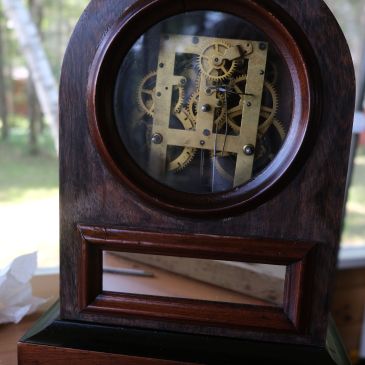
8-day Lyre movement in its case

In this, Part II of my Seth Thomas time and strike shelf clock servicing I discuss bushing work, cleaning, final assembly and testing.

Seth Thomas round top shelf clock, days after it was purchased

In Part I, my observations (and preliminary repairs) concerning my Seth Thomas round top shelf clock were as follows.

Continue reading “Seth Thomas round top in for servicing-Part II”

Seth Thomas round top in for servicing -Part I

This is a Seth Thomas round top mantel clock in for servicing. This is Part I of two parts.

Among the most respected American clockmakers is the Seth Thomas Clock Co. My collection consists of six Seth Thomas clocks representing several styles made between 1865 and 1930.

Seth Thomas time and strike 8-day alarm clock

I purchased this particular mantel clock at the National Association of Watch and Clock Collectors conference in Springfield Ma. in June of 2019.

Continue reading “Seth Thomas round top in for servicing -Part I”

Dealing with antique stores – a rant

Let me begin by saying that I love antique stores and I spend a considerable amount of time in them. While I don’t always buy, if I  see something I try to get a fair price. Browsing through the aisles looking for that unique, one of a kind item can be a very satisfying experience.

I was in a local antique shop the other day and I was impressed at the number of antique clocks offered for sale but the prices were, in my view, way out of line.

For example, a Gilbert Admiral time-only wall clock, that I bought in the fall of 2019 for a fraction of the $300 the store wanted was missing its decorative pendulum and was not running. $150 is a fair price with the original pendulum but at $300 it will stay on the wall of this shop for a long time. So, naturally, I passed on it.

Continue reading “Dealing with antique stores – a rant”

A veneer repair can make a difference on a Seth Thomas shelf clock

Among the most respected and prolific American clockmakers is the Seth Thomas Clock Co. of America. Every collector I know has at least one Seth Thomas clock in their collection.

My modest collection consists of six Seth Thomas clocks representing several styles, all unique and from the period 1865 to 1930.

This is a Seth Thomas time and hour strike large round top (model name or number unknown) made in the 1870s. For first impressions of this clock, go here.

Seth Thomas round top shelf clock, veneer missing top left of the door frame

This shelf clock was purchased at the National Association of Watch and Clock Collectors conference in Springfield Ma. in June of 2019.

The clock case is in such remarkable condition it would be a shame to ignore that one small blemish and once you see the missing veneer the eye is always drawn to it

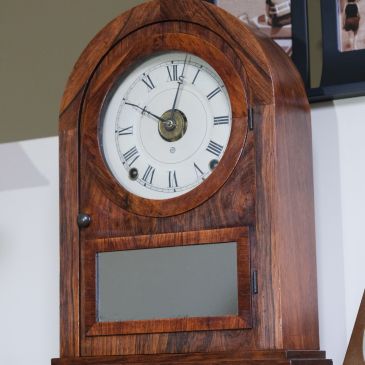
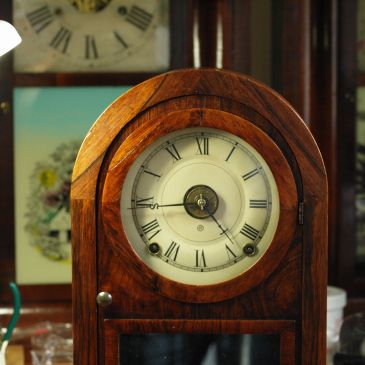
The clock measures 15 inches in height, 10 inches wide at the base and 4 inches deep. The attractive Rosewood veneered case has a mirrored rectangular lower tablet. The grain of the Brazilian Rosewood is bold and nicely textured. However, a sliver of the veneer is missing between the 9 and 12 o’clock position of the dial bezel which, in my view, is repairable. My wife did not notice this until I pointed it out.

A previous owner attempted to hide the missing veneer by tinting the exposed area.

Continue reading “A veneer repair can make a difference on a Seth Thomas shelf clock”

Is it a Jerome & Co. clock or something else entirely?

This interesting Rosewood veneered round top, mirrored tablet shelf clock appears to be a Jerome in name only. It is not a fake or marriage but a curious product of early to mid-1870s marketing.

But first, a little Jerome history.

Jerome & Co. shelf clock

One might be tempted to assume that this clock is associated with Chauncey Jerome, one of America’s most noted clockmakers who died in 1868.

Chauncey was well out of the clock business at the time of his death which poses two possibilities; 1) the Jerome in this instance may be Samuel B. Jerome of New Haven, Connecticut or 2) it is the New Haven Clock Company that was selling clocks using the trade name Jerome & Co. It would seem that New Haven and S.B. Jerome would be in conflict with each other. It’s all a bit confusing and perhaps more research is need to find those answers. In any event the Jerome name had strong marketing power.

Continue reading “Is it a Jerome & Co. clock or something else entirely?”

Jerome & Co. mantel clock – many issues, it wants to run but not today

Jerome and Seth Thomas round top clocks side by side
Jerome (left) and Seth Thomas (right) round top clocks side by side

How you ever wondered what keeps mechanical clocks going? It’s a miracle they work at all when they are so worn as this one.

Most old clocks I come across have common issues, dirty, oily movements such as worn pivot holes here and there. Generally all they need is a good cleaning to put right.

Vendors mart at the NAWCC convention, June 2019

I bought this  Jerome & Co. time and strike mantel clock in Springfield Mass. during the annual convention of the National Association of Watch and Clock Collectors in June 2019 and I have only just got around to having a good look at it. It was purchased as part of a small package deal with other mantel clocks. All the clocks had very good cases but movement maintenance was largely ignored by the previous owner.

While the Jerome & Co mantel clock case was in exceptional condition, the movement was in pretty bad shape. No amount of encouraging would make it run.

In terms of style it is referred to as a round top, from the mid to late 1870s

Chauncey Jerome along with his brother Noble introduced the first mass-produced brass movement in 1839 two years after the depression of 1837 knocked out 90% of factories in the Northeast (New England States). The 30-hour brass movement was rugged, cheap to repair and not subject to swelling found in wood movement clocks. Despite business ups and downs Chauncey able was able to maintain a viable clock business until 1868 but later died penniless. This 8-day clock was made well after Chauncey’s death under the New Haven banner.

Continue reading “Jerome & Co. mantel clock – many issues, it wants to run but not today”

Waterbury York parlour clock servicing – a few surprises but ultimately a disappointment

This attractive parlour clock, a Waterbury York, circa 1900, was bought at auction in the spring of 2019. Though inexpensive it is certainly worth servicing which is the subject of this article.

The time side was running but the strike side did not function at all. Usually these sorts of problems amount to simple lever adjustment issues but there were other surprises awaiting me.

The auction tag is still on the clock, the day I bought it

The Waterbury Clock Company was incorporated in the city of Waterbury, Connecticut, on March 5, 1857. Until the Great Depression, Waterbury had been quite prosperous, but like so many companies, most of the profits lined the pockets of its Directors instead of being reinvested in new equipment and updated facilities. In 1932 the company was bought and re-organized under the name Ingersoll-Waterbury.and in later years the company morphed into the Timex Corporation. If you peruse the Timex site today you will see a line of Timex watches called the Waterbury collection.

Continue reading “Waterbury York parlour clock servicing – a few surprises but ultimately a disappointment”

A simple Seth Thomas round top alarm repair

Seth Thomas 8-day lyre movement with alarm

A distinctive feature of this Seth Thomas round top is the lyre shaped 8-day Plymouth time and strike spring-driven movement with a hour strike on an iron bell. Not all of these models have the alarm but this one does. The movement is die-stamped “S. Thomas, Plymouth Conn.” and fitted with Geneva stops (stop-works) to improve timekeeping. It is a large movement squeezed into a relatively compact space.

I wrote two previous articles, one on first impressions and the other on sprucing up the case and a future article (December 24, 2019) addressing a small veneer issue on the front access door but this post concerns the alarm mechanism.

A simple job, less than half an hour in total and the only difficulty was waiting for the part

The alarm mechanism is located just below the movement and to the left and connected by wire to the alarm adjustment wheel mounted on the centre cannon. Both the alarm and the movement strike on the iron bell.

Continue reading “A simple Seth Thomas round top alarm repair”

Aunt Theresa’s mantel clock

Hamburg American Clock Company time and strike

My wife’s aunt lives in a quaint home near a small town in the south of Ireland. During our recent visit to Ireland we were invited to her home, had tea and cake and had a long talk about family history.

While there I was asked to take a look at the family clock which had not been running for a number of years. Aunt Theresa and her husband (now deceased) received the clock from his brother, an amateur antique collector, many years ago.

HAC’s are good quality movements with well-made cases

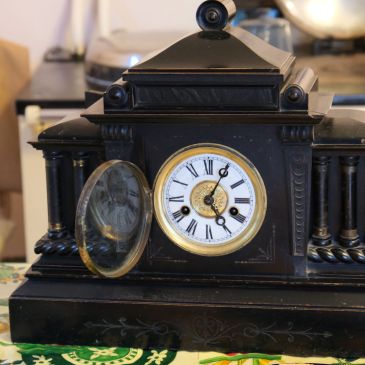
The clock is an attractive and somewhat large 6-column Victorian-style 14-day time and strike mantel clock with Roman Numeral dial made by the Hamburg American Clock Company. It is model #1902 probably made on or about that date. Hamburg American clocks are known for good quality movements with well-made cases.

I will take a look at it, I said, but without my tools, there is not much I could do. I wound both arbours and determined that the mainsprings had plenty of power. I gave the pendulum a push and immediately observed that there was power going to the escapement but there was an uneven tick-tock, so, the clock was out of beat. I propped up one side of the clock sufficiently to find the correct beat and it not only ran but dutifully struck on the half-hour. It works!

In the clock case was a note.

A note found inside the case

The note said,

Tried getting the clock to go on 22nd Sept ’92- worked at pendulum for a long time. I think the clock was too tightly wound. On morning of 23rd Sept, started pendulum again and it’s going since. The clock has not chimed yet. 6th Oct 92 gave the clock a small wind up as it had stopped

I admire aunt Theresa’s tenacity but the clock refused to run after the second winding way back in 1992, 27 years ago.

Time and strike movement with coiled gong

Here is what I discovered about the Hamburg American Clock Company.

In 1875, Paul Landenberger together with his partner, Philipp Lang, founded the Landenberger & Lang clock factory and although he had taken some know-how with him from Junghans (a noted German clockmaker), the company was bankrupt by 1882/1883. It was converted to a stockholding firm and with new investors, the company was re-named Hamburg-Amerikanische Uhrenfabrik (Hamburg-American clock factory).

The name might suggest that they had American made movements but that is far from the case. Hamburg is in the name because that is where the investors came from and “Amerikanische” referred to the movements which were made according to the “new” American mass-production methods.

Among clocks circles, the company is simply known as HAC.

Nice label with model number above

The familiar crossed arrows trademark mark found on the coiled gong was registered in 1891. The “Lux” trademark, which this clock does not have, was added in 1905 so, it places this clock between those years. Model #1902 might even suggest the year it was made. Junghans eventually gained influence over the company and by 1930 was able to take over HAC completely.

The good news is that the clock runs and that there is nothing fundamentally wrong with it but after all these years it needs a good servicing and that means disassembly and cleaning by a qualified clock repair person.

Jerome & Co. round top shelf clock – first impressions

Jerome and Co. round top shelf clock

Chauncey Jerome along with his brother Noble introduced the first mass-produced brass movement in 1839 two years after the depression of 1837 knocked out 90% of factories in the Northeast (New England States). The 30-hour brass movement was rugged, cheap to repair and not subject to swelling found in wood movement clocks. Despite business ups and downs Chauncey able was able to maintain a viable clock business until 1868 but later died penniless.

Continue reading “Jerome & Co. round top shelf clock – first impressions”

Antique clock shopping experience

Although I did not buy any clocks during my trip to the west here are examples of what you might find in some of the better quality antique shops. The three shops these clocks are from are located on Vancouver Island, British Columbia, Canada.

Let the photos speak for themselves. captions identify some of the clocks.

Trio of clocks, the middle one is a Grand Assortment by Sessions

Continue reading “Antique clock shopping experience”

Gilbert 6 column mantel clock

I have worked on several Gilbert clocks in the past few months which is unusual for me. Certain makes of clocks seem to come in bunches. This clock is a 6 column time and strike antique Gilbert mantel clock made in 1913, and reflects a period when every American maker had a similar style. Some parts of the case have an Adamantine finish but those particular areas are not in good shape.

A family relation asked me if I could get it running. Sure, I said.

Gilbert 6 column mantel clock,1913

History of the Gilbert Clock Company

The Gilbert Clock Company began making clocks in December of 1828 and produced clocks over a span of 130 years.

In 1837, John Birge joined the firm, and the name was changed to Birge, Gilbert, & Company. Shortly thereafter, Chauncey and Nobel Jerome and Zelotus Grant became partners with Gilbert, and in 1837 the company was know as Jerome, Grant, Gilbert, & Company. This company manufactured Jerome’s cheap brass-movement clocks.

Continue reading “Gilbert 6 column mantel clock”

New Haven Sharp Gothic (Steeple) clock – Part II – a poor solder repair is the culprit

This is Part II of a two Part series on a New Haven Sharp Gothic (Steeple) clock. This blog-post is about servicing the movement.

My recently acquired New Haven Gothic Steeple 30-hour clock is an online auction win.

New haven Gothic Steeple clock
New Haven Gothic Steeple clock

The case is in very good condition apart from minor veneer issues on the base and the columns. The clock is missing the tip of the right finial although it might be hard to tell from the photo. It measures 20 1/2 inches tall with a 5-inch dial. The movement appears to be original to the case.

The dial is original and has some loss that would be expected in a 135-year-old clock. The tablet, likely original, features a sailboat against Greek (?) temples surrounded by gold foliage on a black background. The design of the tablet was used in other New Haven clocks of the time. Though intended for European export the clock found its way to Canada.

Servicing the movement

Continue reading “New Haven Sharp Gothic (Steeple) clock – Part II – a poor solder repair is the culprit”

Website Powered by WordPress.com.

Up ↑