
The time-only clock – simplicity without the noise

People often tell me that they could never have an old-fashioned antique clock in their home because of the noise. And by noise, they are not so much disturbed by the ticking sound as they are about the sound a clock makes on the quarter, half, or on the hour, in other words, a striking or a chiming clock.

But, the ticking sound might also be bothersome. Some of my clocks are loud tickers, they can easily be heard in the next room. Some, on the other hand, are silent tickers, and the only way to determine if they are running is to approach them or observe the movement of the minute hand.

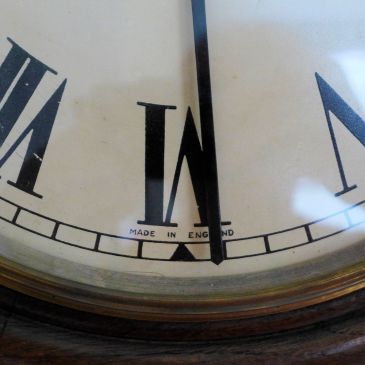
I completed work on a German Jauch time-only clock the other day and could not believe how quiet it was. This is not an expensive clock by any means. So cheap in fact that I only paid $1.65 for it, but that’s another story. It is not rare either, thousands were made but it was engineered to be very quiet.

Jauch calendar clock CA.1979

Of the 90+ clocks I have in my collection, 20 are time-only, that is they are not striking or chiming clocks, they simply tell the time. And it is their simplicity that intrigues me. Many are wall clocks, a couple are calendar clocks, most are antiques and some are vintage. Clocks in and around bedrooms are time-only and all 4 kitchen clocks are time-only as well.

Three clocks located in our kitchen that are set to 3 time zones

Here are eight of my time-only clocks (starting with the Jauch above) and a story behind each one.

This is probably one of the more expensive wall clocks in my collection. It is an unnamed Vienna-style regulator.

Miniature Vienna Regulator
Miniature Vienna Regulator CA.1880

It is in its original finish. The finials on top might have been added but it is difficult to tell. Otherwise, the clock is complete. It was found on a local online for-sale site and the seller did not budge much from his asking price but it is one of my favorite clocks. Sadly, I do not know anything about its history.

Lexington banjo clock CA. 1927

I picked up this clock while on vacation in the USA. It was found in an antique mall in Michigan. A very simple clock, cheap and it runs very well though because it is spring driven it is not one of my better timekeepers. The ticking is just soft enough to be soothing which is why it is the only clock running in our bedroom.

Federal-style banjo clock, possibly John Sawin CA.1840

This Federal-style weight-driven banjo clock was discovered at a yard sale near my home. The seller was trying to steer me toward a 30-hour clock for an outrageous price that I knew was worthless but they obviously did not know the value of this Federal-style banjo clock so I bought it instead for a ridiculously low price.

It was a family clock held by a collector in Wolfville, Nova Scotia (Canada) for a number of years until he passed away. It is a weight-driven clock, very accurate, very well constructed, and very well preserved. The dial glass was broken and other than that, it came as you see it in the photo.

Seth Thomas #2
Seth Thomas #2 CA.1920

This 8-day time-only clock came from a business establishment in Toronto, Ontario (Canada). It was well cared for, serviced regularly, and very accurate. The Seth Thomas Regulator #2 was also a popular choice for train stations across North America.

Arthur Pequegnat Moncton
Arthur Pequegnat Moncton; 15-day clock CA.1930

This mahogany-cased gem is an Arthur Pegugant Moncton 15-day double spring time-only clock that was a popular choice for business establishments. It is also from the Toronto area.

Gilbert Admiral with calendar CA.1895

Found in a local antique shop locally this Gilbert Admiral calendar clock looks great on any wall. Unfortunately, I know nothing about it. It could have been either an office or a schoolhouse clock.

Kienzle World Time clock
Kienzle World Time clock; CA.1949

Highly sought after this Kienzle World Time clock commands high prices on auction sites. This example is in pristine condition and runs but has not been serviced. It was found in an antique shop in Kazabaszua, Quebec. The clock was designed by Heinrich Möller, chief designer for Kienzle Clock Co. of Germany, and it was considered a higher-end big desk office clock that displays world time zones. I can only imagine an important import-export dealer with this on their desk barking orders to send things here and there.

From a repairer’s point of view, time-only clocks are the simplest clocks to work on since there is not much to them. There is only one train and any repairs are straightforward and far less complicated than clocks with two or three trains. On the whole, they are more accurate, particularly weight-driven varieties because they lack the complexity of all those additional wheels and levers which only serve to add friction to any movement. Perhaps its simplicity is its greatest attraction.

My advice. If you are looking for an antique clock and plan to run it but might be bothered by the noise, consider a time-only clock. You will thank me.

Simplicity without the noise.

Gustav Becker 2-weight Vienna Regulator – 6 years later

One of my retirement gifts in 2016 was a 2-weight time and strike Gustav Becker wall clock. My wife had thoroughly searched eBay and picked what she determined to be the best gift for me considering a Gustav Becker wall clock had always been on my wish list. It was everything I had hoped for but the clock came with one hiccup and a pretty big one at that.

It was badly damaged in shipment. Finials snapped off, all glass was broken, weights were dented, trim pieces fell off, the brass dial bezel was bent, a bent gathering pallet and the movement was missing critical strike side rack and snail parts. I managed to obtain a few pieces from the seller which was not everything I required and also put in a damage claim with the postal service but received nothing from them.

The main case was largely untouched at least

It was a good learning experience that taught me that one should avoid shipping a clock unless the shipper knows exactly what they are doing.

Where to start? At the time I was not sure how to approach rebuilding the clock. Do I set it aside for a later project or just dive into the deep end and learn as I go?

The original movement from 1902 is missing strike-side parts

I decided to have a go at it. After gluing the parts back on, replacing the glass, sprucing up the case, and sourcing a new movement (the original 1902 movement was replaced with a 1917 movement made in the same Braunau factory) the clock was finally coming together and at the end of the three-month project, it taught me a few things about movement servicing, sourcing of parts and case repair.

My wife took a look at this clock the other day and suggested I write an update. She said that it still looked impressive years after. I put a lot of work into this clock and it appears to have paid off as it still looks great on my living room wall.

Gustav Becker: taken October 2022

So, here it is, six years later.

Seth Thomas Regulator #2 wall clock

During my travels through Ontario, I acquired a Seth Thomas Regulator #2, one of my newest additions. I discovered this clock in Bloomfield, a quaint village just minutes from Picton, a major hub in Prince Edward County renowned for its many wineries.

I first spotted the clock during a summer visit to the local antique shop and deliberated over the purchase for quite some time before finally deciding to take the plunge in the fall. These clocks are a rare find, and with the price being right and the clock in excellent condition, it felt like an opportunity I couldn’t pass up.

Perhaps best known as one of the most common regulator clocks in America, the Seth Thomas Regulator #2 was a fixture in many railway stations across the country during the last century—a testament to its accuracy and dependability. Robust, precise, well-engineered, and reliable, this timepiece was manufactured by Seth Thomas from 1860 to 1950, an impressive production run of 90 years. Few clocks can boast such longevity. It is an iconic American clock, and every serious clock collector aspires to own one.

Seth Thomas Regulator #2, circa 1922

A classic style, the #2 changed very little over the years. However, certain design characteristics help date the clock. The following identification guide describes dial and case characteristics that will aid in identifying the approximate year the clock was made.

Click here for the larger guide;  http://www.clockguy.com

The most distinctive visible characteristic is the design of the base.

The base of the clock

Aside from the distinctive base, all but the earliest #2s had the pendulum mounted in the rear with “T” hands.

The chart also lists the limited run reissue in 1976. Most Seth Thomas aficionados would agree that while the reissue is a handsome and well-made clock that is a testament to the original it is not in the same realm as an authentic Regulator #2 and the prices for these versions reflect accordingly. However, those who have the reissue seem to be pleased with their acquisition.

ccording to the chart, my clock was made between 1922 and 1929 and features a base reminiscent of the earlier 1860 version of the #2. It has Arabic numerals with spade hands, and the bow-tie connecting the wooden dial bezel to the drop is a single piece (earlier versions featured a three-piece bow-tie). The clock includes a second hand positioned 2 inches above the center cannon; however, it is not a true second hand, as it runs off the escapement and takes 80 beats to complete a “minute.”

Measuring 36 ½ inches in height, the clock is veneered in mahogany. The movement is stamped with “77A” in the bottom right corner, with the letter “K” underneath, but it bears no other markings. While some versions of the 77 movement have lantern pinions, this one is equipped with cut pinions.

Are there issues with this clock? Certainly, it is over 90 years old!  There is minor loss on the dial, no label, a finish that has lost its luster and paint splatter on the top of the case not visible from the front. Is it really so hard removing a clock when painting a room!

Is it Perfect?

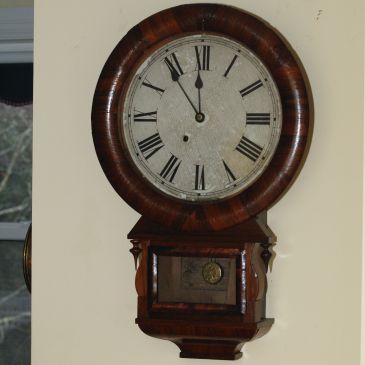
I brought this clock from Ontario to Nova Scotia by car. Removing the pendulum for transport is not a particularly simple process but if you are familiar with the pendulum arrangement on a typical weight-driven Vienna Regulator this one is no different. Like Viennas, the pendulum is hung behind the movement.

Both the weight and the pendulum must be removed for transport. There is many a story of broken glass when weight and pendulum are free to move around inside the case. To remove the weight, simply unhook it from the cable wheel.

There are minor issues with the dial-face

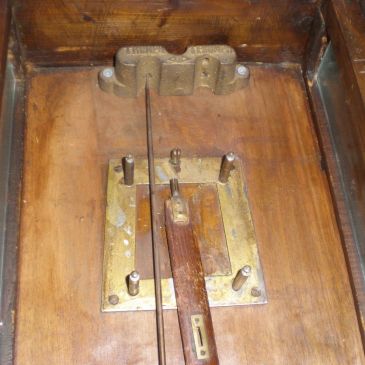
To remove the pendulum the movement must be taken out. First, the hands are taken off. In this version, the minute hand is held in place with a nut. Older ones have a pin. There are 8 small screws that hold the dial in place. Once the dial is removed, two larger screws on the wooden second-hand rail are removed. Four cylindrical column posts hold the movement in place. Unscrew these beginning with the bottom two and lift the movement out. Once the movement is out, the pendulum can be unhooked from its suspension spring. The entire process takes less than five minutes.

The trapezoid 77A movement with maintaining power in this clock looks clean. There is evidence of having been worked on in the past as there are 4 punch marks around the winding arbour to close the hole; a common practice in the past to close a pivot hole. Otherwise, the movement looks very good.

Trapezoid 77A movement

Getting the clock to run reliably was a challenge and it took a week or so to sort it out. The clock would run for a few minutes and stop.

Following a process of elimination, I removed the movement, inspected it for wear, found very little, oiled the pivots, and returned the movement to the case. I installed the dial, then the hands. The clock would run for a few minutes and stop. I removed the hands and dial; left the dial off but reinstalled the hands. Still, it would run only a few minutes. I then took the dial and hands off. I ran the movement for four days to eliminate any underlying issues and to convince myself that the problem lay in the positioning of the hands. The problem was definitely with the positioning of the hands.

On day five, I put the dial back on, then the second hand ensuring that there was sufficient clearance between the second hand and the face. Next, I put the hour hand on the pipe and pressed it in far enough to clear both the second hand and the minute hand. I attached the minute hand, inspected it for sufficient clearance, and screwed it in place. I started the clock.

Success at last! Regulating the clock is fairly simple and is achieved by turning the rating nut on the bottom of the pendulum. This clock must be level and in beat to function properly.

I used Murphy’s Soap to clean the grease and grime from the case. I chose to leave the paint splatter intact, as it adds a bit of character to the clock. Additionally, I polished the brass weight and pendulum bob to restore their shine.

The view from our front door

This clock boasts a striking appearance and a rich, illustrious history, making it a perfect addition to the front entrance of our home. Unfortunately, its journey over the past 90+ years remains a mystery.

The question of whether it qualifies as a “true regulator” is a debate for another time.

Mauthe Horse Crown Century-old Wall Clock

Another wall clock has joined my collection, so let’s take a closer look at what I’ve acquired and whether it was worth the price I paid.

Time and strike movement, 116 BPM

The clock was advertised locally in the Truro, Nova Scotia area. The seller knew little about it beyond its provenance, but what he did share was an interesting, albeit brief, story.

In the early 1980s, his wife brought the clock over from Holland, where it had been in her family for several generations. Sadly, his wife passed away three years ago. Had she been alive, I’m sure I would have learned much more about the clock’s history. The seller was understandably hesitant to part with it, as it served as a happy reminder of his past life. However, he was entering a new phase of his life with a new partner, which meant letting go of furniture and other possessions. Like him, I also view life as a series of phases. The clock was priced at $100, firm and non-negotiable.

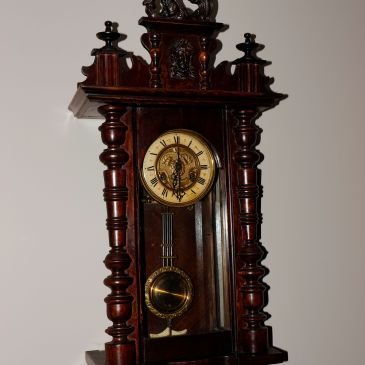
This two-train (time and strike) spring-wound clock could be described as being in the style of a Vienna Regulator. As expected, the movement is quite dirty—a common issue for clocks like this that have often never been serviced. However, there are signs that adjustments were made at some point, evidenced by marks on several screws in the movement.

The clock is largely intact, except for a missing finial at the center of the bottom base. Why this particular part? According to the seller, the clock was brought over in a suitcase, and to make it fit, the bottom finial was snapped off and lost forever.

OLYMPUS DIGITAL CAMERA
Movement showing FMS Mauthe trademark

The clock is over 100 years old, with my research indicating it was made between 1895 and 1914, though the exact year of manufacture remains uncertain. The trademark—a Friedrich Mauthe of Schwenningen (FMS) emblem featuring three spokes with an eagle on top—is distinctive, as Mauthe trademarks are known to reflect the specific period during which the clock was produced.

Despite some benign neglect, the case is in good condition, and everything appears to be original, including the winding key.

OLYMPUS DIGITAL CAMERA
The crown

The crown fits into a slot at the top of the clock and can be easily removed if the clock needs to be relocated. The crown is made of wood, while the horse appears to be crafted from a casting material of some kind.

OLYMPUS DIGITAL CAMERA
The face

The dial is made of celluloid and has darkened with age. Inside the dial surround, there is a leaf-like emblem, a common design feature from this period.

OLYMPUS DIGITAL CAMERA
The base and bottom finials

The base is fairly plain, though the bottom center finial is missing. I plan to replace it.

OLYMPUS DIGITAL CAMERA
The coil gong

The coil gong and block with attached movement rails are characteristic of the period.

History of FMS Mauthe

Mauthe clocks have a long and distinguished history in Germany. In 1844, Friedrich Mauthe and his wife Marie founded the company in Schwenningen to produce watch parts. By the late 1860s, Mauthe began manufacturing its own wall clocks and movements. In 1876, Friedrich’s sons Christian (1845-1909) and James (1847-1915) took over the company. In 1886, Mauthe began producing its own springs. Around 1900, the company expanded its offerings to include alarm clocks, pendulum wall clocks, grandfather clocks, office clocks, and the so-called “Buffet Uhren” or “Buffet clocks.” In 1904, the third generation took charge: Eugene Schreiber (1877-1939), son of Christian Mauthe; Dr. Fritz Mauthe (1875-1951), son of Jacob Mauthe; and Alfred Mauthe (1879-1911), son of Jacob Mauthe, helped build upon the foundation of the company.

In 1925, Mauthe introduced a new trademark featuring a right-facing eagle with outstretched wings, clutching a three-part round plate inscribed with the letters F, M, and S. By the 1930s, the company was producing around 45,000 clocks per week, with approximately 60% destined for export markets like England. In the mid-1930s, Mauthe began manufacturing its first wristwatches, some of which were supplied to the German Army (“Wehrmacht”). After 1946, Mauthe resumed wristwatch production, but the company eventually entered a period of decline.

Was it worth $100? I would say yes, but it’s on the higher end of what I would typically pay for a clock like this.

Now, it’s time to clean the clock, install a new bottom middle finial, and add it to the queue for servicing.

Website Powered by WordPress.com.

Up ↑