Tick Talk Tuesday #53 – A stolen Ansonia wall clock

Tick-Talk Tuesday is a special time when I respond to readers’ letters and comments about clock issues, challenges, and recommendations for specific clocks. When the comments and questions are especially complex, I consult with fellow clock enthusiasts within my circle to ensure I offer the most precise and helpful answers possible.

LS writes:

I ran across your web page searching for a particular clock and I’m hoping you might have the connections of which I don’t… in order to help me locate one.

The clock I’m looking to replace a clock that belonged to my parents and was stolen along with a lot of other treasures. It’s an Ansonia “Reminiscence” Model #647. Heavy solid oak, beveled glass with Westminster chimes/key.

If you happen to have one in a private collection you’d be willing to part with, OR if you have any clue where I might be able to locate one… I’d be forever grateful for your assistance.

Thank you so much, and with warmest regards.

My response:

Thank you for your email LS. Would you happen to have a photo of the clock? What style of clock are you referring to, shelf, wall, mantel, or tall case?

LS write back:
This was a wall clock, which I amazingly… still have all of the original paperwork on, that came with the clock when my moms mother, my grandmother, bought it for them back in 1989. (four pictures enclosed). The clock catalog I have displays 26 of their clocks produced from 1986-1989. I also included a neat little story that came with the packet, and some directions my mother transcribed, which were undoubtedly given by my father. This clock HAD to be taken care of just right; as nothing else would ever, EVER do! Just shows how attached they were to this clock.


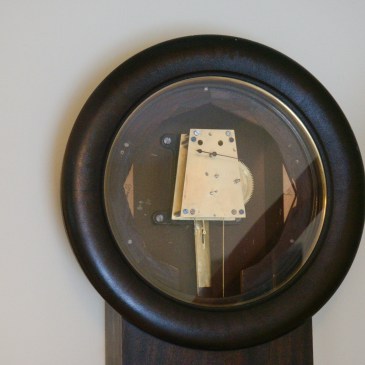
Photo of Ansonia wall clock
Ansonia clock not made in the USA

My father was stationed at Hickam Field when the attack on Pearl Harbour happened. He was an instrument shop manager in the United States Air Corps. He also spent a good portion of his life in clock and watch repair, including working for a couple of local shops in the St Louis metro area after the war, and discharge. Until the day he died he still had many of the original springs, gears, tools, oil, eye magnifier pieces, etc… stored lovingly in a very nice, old humidor box that he custom built four removable shelves for… so as you can likely assume… this clock, was his “baby.” (I still have that humidor box and several of the pieces from it).
I am just heartsick that it was stolen, and when my mother was still alive (she passed in 2012, and dad in 1997), if I didn’t know any better… I might assume that this could’ve been part of what led to her ultimate demise. Truly, it hit extremely hard! Especially since her mother was also gone by that time.

I appreciate any help you can offer in trying to find a replacement for myself and MY family today. It would mean the world to me if I could happen across one. Even though not the original, don’t we all just need a little bit of comfort in our world today, and the warm memories that can sometimes be solely responsible for bringing that comfort? I certainly have all of the care instructions at my disposal! 😉

I’ve about exhausted all avenues in my search for this elusive clock, and unfortunately… Ansonia closed up shop in 2006; ironically, the same year my parent’s clock was taken.

My reply:

Hi, and thanks for the additional information.

Ansonia was a well-known maker of American clocks. The original company, which operated in Connecticut and New York ended operations in 1929.

The trademark was then sold off, more than once, I believe. In 1969 the Nofziger family of Lynnwood, Washington, re-registered the Ansonia trademark and issued clocks with the Ansonia name.

When the Ansonia Clock Co. was “making” clocks in Washington the company was a mere shadow of its former glory.

I say “making” because the company was likely assembling clocks sourced from West Germany with cases also sourced abroad. So, they were either importing the clocks fully assembled or in pieces to be assembled. Since they owned the Ansonia trademark, they simply added it to the dial face. So, not a made-in-America clock.

However, you probably know all this. It is the sentimental value that is most important, and finding the same clock or one similar is your present quest.

While I come across many Ansonia clocks, I have never come across one from the re-registered company. A search of eBay will bring up dozens of New York-made clocks but few if any of ones similar to yours. You will just have to keep looking. However, if one comes up I will certainly let you know.

Tick-talk Tuesday #52 – My father’s Forestville advertising clock

Tick-Talk Tuesday is a special time when I respond to readers’ letters and comments about clock issues, challenges, and recommendations for specific clocks. When the comments and questions are especially complex, I consult with fellow clock enthusiasts within my circle to ensure I offer the most precise and helpful answers possible.

GF writes:

I inherited a custom-made Forestville Electric Wall Clock from my father. He owned a restaurant business on Manitoulin Island for 55 years. (Editors note: Manitoulin Island is an island in Lake Huron, located within the borders of the Canadian province of Ontario). When he decided to sell the restaurant he gave me this Clock that had been in the restaurant for 30+ years. He knew I had always loved that clock and one day hoped it would be mine. 

Forestville advertising clcok showing Conlon's Men's Wear on the dial

How he attained it was given to him by a friend who closed a men’s clothing store in the same town. After the closure of that store, my father proudly hung it in the dining lounge of the restaurant for many years until the closure. 

Forestville advertising clcok showing Conlon's Men's Wear on the dial illuminated

I am now in my 60s and have a member of the family who gave it to my father interested in buying it from me. I don’t know what price to tell him. It still lights up and movements work very smoothly and keeps good time. The cord was replaced about 25 years ago and very minimal rust on it. 

Forestville advertising clock back of clock

I am attaching a few photos of it and would like to know if you would be kind enough to provide a dollar value of what it might be worth. 

Forestville advertising clock showing maker's name

My response:

Hi GF and thanks for your email. There was a time when clocks such as yours were plentiful and not worth a great deal but there seems to have been a resurgence of interest lately in electric clocks of this era, especially advertising clocks.

Many of these clocks would be valued in the $300 to $500 range. Your clock appears to be in especially good condition. The maker or more correctly, the distributor of your clock is the Forestville Clock Company of Toronto. Your clock appears to have been made in the 1960s shortly before Forestville ceased production.

An ordinary schoolhouse clock that had an ordinary life in an ordinary shoolhouse continues its ordinary life

Eight years ago I came across an intriguing find not far from where I reside—an antique Ansonia octagonal short drop, commonly referred to as a schoolhouse clock. While I estimate its manufacturing date to be around the turn of the 20th century, pinpointing the exact year eluded me.

Ansonia time only schoolhouse clock
Ansonia Schoolhouse Clock

The movement bears the stamped number “12,” which could denote the year “1912” or possibly the month of a particular year. Additionally, the letters “TT” are inscribed on the movement. 1912 would sound just about right.

Although not my only Ansonia clock I encounter the Ansonia name less frequently compared to other American clock manufacturers.

Ansonia clock face showing the name of the maker
Ansonia Clock Co., Made in the U.S.A.

To retreive the clock, my wife and I travelled to the small town of Berwick, nestled in the Annapolis Valley region of Nova Scotia. Berwick is best known as the centre of the province’s apple industry. We set out for a day trip eager to soak in the local scenery and make various stops at roadside stands/gardens along the way, fully aware that the clock we were about to acquire would come with no surprises. Well, it was not perfect!

The gentleman from whom I purchased the clock shared that it had been in his family for over 50 years, yet he had never seen it run. He parted with it during the estate liquidation process following his mother’s passing, as it held sentimental value for her but evidently not for him.

Number 12 and TT on the movement plate
The number 12 and TT stamped on the movement

It originated from a schoolhouse in Ontario, Canada, although the specific location eluded the seller. Despite minor issues, such as paint applied around the minute/hour pipe to conceal stains from years of handling, the softwood case remains in very good condition.

However, it was missing a bushing for the hour hand, an easy fix. Remarkably, I discovered remnants of rotted elastic banding on the pendulum rod just below the suspension spring, though its purpose remains a mystery to me.

Nevertheless, following several adjustments, including bending the crutch to ensure proper alignment, the clock functioned but a servicing was necessary. I found the need for 3 new bushings in the spring-driven time-only movement. While the wear wasn’t severe, it warranted attention. A new hour and minute hand, sourced from a supplier completed the servicing.

bushing wear on an Ansonia movement
The most worn bushing hole, highlighted to illustrate the wear

The Ansonia Clock Company’s storied history adds an intriguing layer to this find. Unfortunately, the company, formed in 1851, had a long history of supplying clocks to the masses but its demise prior to the 1929 stock market crash serves as a poignant reminder of shifting economic tides.

The clock is now gone but to a good home. Approximately three years ago, when my daughter was setting up an office in her new home, she expressed interest in acquiring the clock, which she considered the perfect decoration for her new workspace. “Certainly,” I replied, and now it proudly occupies a prominent spot in her office.

The homeliest clock in my collection is also one of my favorites

My collection boasts more than 90 clocks, with 51 on display throughout my home, 6 at our summer cottage, and 19 running non-stop. The majority of my 90 clocks are operational, although I periodically switch out some of them to maintain the 19 that run continuously.

One clock remains in its place in an upper hallway. One might assume that the clock is the priciest, rarest, most intricately designed, or possesses highly unique features. However, it’s quite the opposite—it is very plain, unremarkable in appearance, and a clock that some would consider unworthy of repair. Opinions may differ but I leave it up to you, the reader.

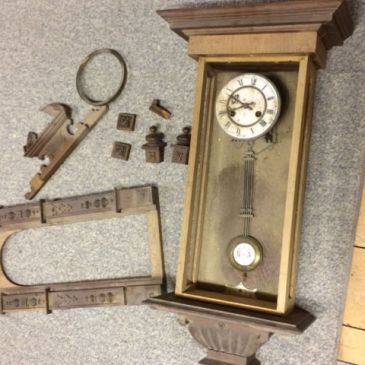
It is a circa 1895 Ansonia Extra Drop wall clock made by the Ansonia Brass and Copper Co. but is missing two essential features, the brass bezel for the clock dial and the lower access door (more on the door later). Otherwise, the clock came with most of its parts.

This clock has seemingly journeyed through life with its smile turned upside down. It’s a genuine barn discovery, and one can only speculate about the years it had spent scattered in pieces gathering dust and rust without knowing that it would be resurrected one day.

Ansonia Extra short drop wall clock on a bench in pieces
I brought the clock home wondering what to do

After bringing the clock home, I found myself considering its future. At first, I debated whether to salvage the movement, the veneer, the finials, or the frame, or simply discard the clock altogether since its cost was negligible.

Then it dawned on me that despite missing some components, the clock could be revived. The idea of the clock languishing unused and neglected evoked feelings of sympathy, which I admit is a strange feeling for an inanimate object. In our throw-away world today perhaps the value in reviving and cherishing something that had been forgotten or overlooked, restoring its purpose and significance, led me to appreciate it even more.

Eight years ago, I was enthusiastic and eager to acquire clocks to work on them, and given my beginner status in movement servicing and case repair, I entertained the idea of using it as a learning platform for restoration. Repairing a broken clock always provides a valuable learning experience, allowing one to develop new skills in mechanics, craftsmanship, and problem-solving, which can be applied to future projects.

Let’s go through the steps I followed for this project.

The Movement

The time-only movement was encrusted with rust, presenting a significant challenge to restore it to working order. I spent considerable time scrubbing, cleaning, and meticulously sanding away the rust from the pivots and other steel parts.

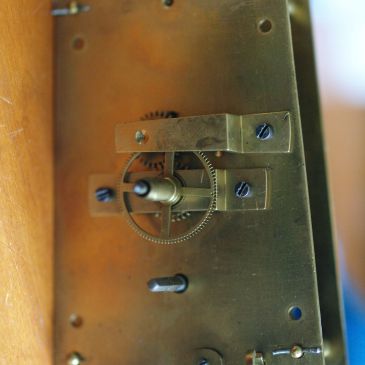
The time only movement of an Ansonia wall clock
The movement was seized and coated in rust

While I initially considered replacing a severely rusted mainspring, upon closer inspection, I realized that much of the rust was superficial, leading me to reconsider the need for replacement.

Ansonia time-only movement on a test stand
On the test stand

Eventually, my efforts paid off, and I succeeded in getting the movement to run smoothly once again.

The case

Next, attention turned to the case. While a significant portion of the original label remained intact on the backboard, a section had broken off and was lost forever.

Ansonia backboard with partial label and a piece of backboard glued to an original piece of backboard
Ansonia backboard with partial label and glued piece

To remedy this, I found a suitable backboard piece from an old ogee clock cut a piece to fit, and glued it in place. The backboard is attached to the clock case in the photo below.

The clock came with no drop door
The clock came without an access door

The case was also missing its access door, and rather than leaving the clock without one, I built a door frame using pieces of softwood. I then applied salvaged veneer from another project, gluing it onto the frame. Shaping old veneer over doweling is a challenging task, but I did my utmost to accomplish it as well as I could.

Veneer glued to the softwood frame and Knob and hinges ready to be attached
Not a perfect veneer job but good practice nonetheless

The rest of the case repair involved bringing the pieces together with glue and then applying traditional shellac to enhance the intricate, fine-grained characteristics of the rosewood veneer. To complete the project the dial required some paint touchups and suitable hands were sourced from a clock parts supplier.

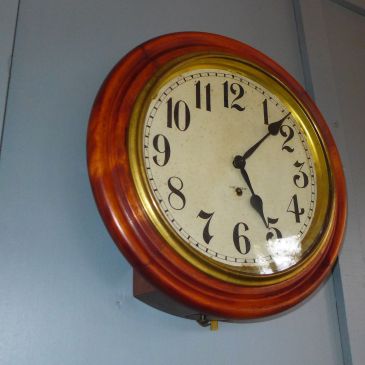
Ansonia Drop Extra wall clock hanging on a wall
Ansonia Extra Drop wall clock

While not the most aesthetically pleasing clock by any measure, it symbolizes the trials of restoring a seemingly hopeless clock, transforming it into a functional piece that serves its purpose reliably every day.

However, its greatest achievement lies in offering me a valuable learning platform that I can apply to future projects. Every time I pass by the clock It reminds me not only of the work I put into the clock but moreover, that not all is lost and that certain things are indeed worth preserving.

The American double-dial clock

American clocks with double dials, often referred to as “double dial” or “two-dial” clocks, were common in the 19th century.

There are two categories of double-dial clocks but first, let’s talk about the calendar clock. These clocks typically have one dial for the time and another for the calendar. The reason for this design was to provide both timekeeping and a calendar function in a single device.

Seth Thomas 8-day office calendar 1895

By integrating both time and calendar functions into a single clock, manufacturers provided a practical solution for the needs of households and businesses.

Welch 5-day calendar clock 1880

Moreover, before the widespread adoption of standardized timekeeping systems, local time could vary significantly from one place to another. Having a clock that displayed both local time and the date helped people coordinate activities and synchronize their schedules more effectively.

Fashion (Southern Calendar Clock Co.) and Ithaca were well-known makers of quality shelf and wall calendar clocks. Seth Thomas was a significant producer of office calendar clocks.

Ithaca 30-day calendar clock 1866

Less common are double-dial clocks that exhibit two separate times. A typical two-dial clock of this type would display railroad time and local time or railroad time and city time.

Seth Thomas double time #17 special order clock

When the two major US railway companies adopted Standard Time in 1883 the Seth Thomas Company began the manufacture of 8-day weight-driven clocks with two time dials. The clocks would come with an upper and lower plaque depicting local time and railroad time. Some clocks were production clocks while others like the #17 were special order clocks.

Seth Thomas double time clock #6, a production clock

Both dials are run by one movement with a connecting drive shaft between the upper and lower units. Once the upper movement is set up, the lower unit will display the relative difference. Moving the hands on the upper unit moves the hands on the lower unit accordingly.

Upper movement and the lower unit are connected by a drive shaft

Examples of the more prevalent #6 can be readily found, whereas the specialized #17 is exceptionally rare. Regardless, acquiring either double-time model would entail a significant investment of thousands of dollars.

Thrift Shop Treasure for $1.65 – will it sell for more!

Jauch had ties to one of the oldest clock-maker families in the Black Forest. The Gerbrueder Jauch company, known for manufacturing hall, wall, and mantel clocks, faced challenges in late 1979 due to export restrictions, ultimately leading to bankruptcy in 1986.

Jauch schoolhouse-style clock

Renowned for providing affordable yet attractive clocks for average households, Gerbrueder Jauch GmbH produced clocks like the drop octagon schoolhouse-style clock, reminiscent of classic American designs. However, within the realm of German clockmakers, I would not place this particular maker among the elite. In terms of comparison to American counterparts, it aligns more closely with companies like the Sessions Clock Company, the company that provided clocks for the average home.

Measuring 23 inches in height, 15 inches in width, and nearly 5 inches in depth, this clock very closely resembles the dimensions of schoolhouse clocks from over a century ago. Unlike antique American clocks with oak cases, this one features a more cost-effective pine case.

Jauch wall with calendar clock with flip-up dial bezel
Jauch clock with flip-up dial bezel

Its bezel adopts a flip-up design for winding, distinguishing it from clocks with right-swinging dial bezel doors.

The clock bears the inscription “Western Germany” on the dial and movement, with the movement stamped with a production date of July 1979. For history enthusiasts, it’s noteworthy that German reunification took place in 1989, simplifying the dating of clocks from this era.

Jauch wall clock with a faux regulator case
Another Jauch wall clock with a faux regulator case, a customer’s clock

This clock requires a very long #7 key for winding, which may pose a challenge even for some collectors that have an abundance of spare keys.

The clock’s issues, suspected to be related to the anchor escapement or potential bushing wear in the top part of the train, present an interesting repair challenge.

Despite being a non-functional find, purchased for a mere $1.65 at a local thrift shop, the clock has some potential for restoration. Thrift shops often price items low for quick turnover, and this vintage mechanical clock, though uncommon among donated goods, offers promise. While the case may show signs of wear, a thorough cleaning and a fresh clear-coat finish can easily revive its appearance.

Given the absence of basic issues, apart from a scuffed-up case, restoring this Jauch clock to working order should be a manageable task, making it worthy of a price of more than $1.65, I would think.

While clock sales aren’t my usual trade, occasionally, I part with clocks to cover supplies and fund additions to my growing collection.

A Close Look at the Arthur Pequegnat Moncton Wall Clock

I stumbled upon this Arthur Pequegnat Moncton in an antique store located in Bloomfield, Ontario, Canada during a visit in 2018. Certain wall clocks from the Arthur Pequegnat Clock Co., which operated in Kitchener, Ontario, Canada, between 1904 and 1941, are rare finds, making this particular piece appealing. The company, initially founded as Saas & Ford in 1903, was later acquired by Arthur Pequegnat in the following year.

Arthur Pequegnat 15-day time-only wall clock
The most recent photo, Jan 2024

Arthur Pequegnat clocks are renowned among Canadian collectors for their sturdy construction, robust movements, conservative designs, and patriotic nomenclature, often named after towns and cities in Canada. The Moncton, named after a city in New Brunswick, Canada is a testament to this tradition. Pequegnat produced a variety of clocks, ranging from mantel and parlour clocks to Mission, kitchen, gingerbread, tambour, wall, and floor models. The wall and hall clocks are the most desirable.

Arthur Pequegnat wall clock beat scale and pendulum bob
Beat scale

This Moncton clock, the seventh in my collection, is in fine condition. It features a 12-inch Arabic dial with bold numbers, attractive pierced spade hands, and a fumed quarter-sawn oak case. The clock stands at 35 inches high, with a hinged 16-inch oak bezel door revealing the dial and a 14 ½-inch glazed drop door. The clock’s patriotic ties are evident in its association with the Canadian National Railway hub in Moncton and so, some of the specially designed Monctons found their way into rail stations across Canada.

Arthur Pequegnat 15-day double-spring movement in the Moncton wall clock
Two mainsprings power the 15-day movement

Based on the design of the lower valance this clock is a series II Monction which was produced from 1917 to 1941.

Despite its age, the clock maintains its charm, with the original dial glass displaying the expected “waviness.” However, some elements, such as the lower glass and retaining rails, appear to have to have been replaced early in the clock’s life. Unfortunately, the original label is missing. Minor imperfections include a scratch on the dial face (not visible from a distance) and a screw hole on the back panel. Screw holes are fairly common, as many of these clocks were firmly affixed to walls to ensure they remained in beat and functioned accurately.

Expose view of the 15-day time only movement in the Arthur Pequegnat wall clock
The train showing the deadbeat escapement

The Moncton is a 15-day time-only clock with a unique double spring time-only movement and a Graham deadbeat escapement, highlighting its accuracy. The second hand is a particularly attractive feature. The clock runs at 84 beats per minute or 5040 beats per hour.

The clock closely resembles the Seth Thomas #2 in size and shape, offering an alternative with a spring-driven mechanism and a longer running cycle.

Obtaining this Moncton clock marked the culmination of an extensive search, as these timepieces are progressively harder to come by. The seller, having possessed it for around 1 ½ years, had no insights into its history, yet my speculation is that it might have served as an office clock for a good portion of its life.

The lower portion of the Arthur Pequegnat Moncton 15-day wall clock
The lower valance

Although the clock ran well when I received it I serviced it as a precautionary measure.

Moncton wall clock located in the kitchen area of our home
The kitchen area of our home

This clock occupies a prominent spot in the kitchen area of our home, serving as a daily reminder of the grandeur of wall clocks of the 1920s era.

For visual learners, this YouTube video provides a helpful summary of this post.

Honouring History, One Tick at a Time – the Halifax Explosion Dec 6, 1917

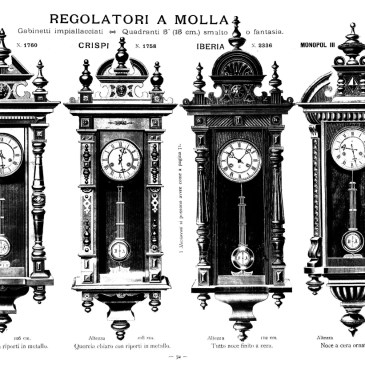
In the heart of North End Halifax, on December 6, 1917, a Junghans Crispi clock fell off a wall in a house on Princess Court. Unbeknownst to it, this simple clock would become a silent witness to one of the worst man-made disasters in Canadian history – the Halifax Explosion.

The cloud produced by the explosion

As the Belgian relief ship Imo collided with the French munitions vessel Mont-Blanc, a catastrophic event unfolded in Halifax’s harbour. The explosion at 9:04:35 a.m. reshaped the landscape, claiming 2,000 lives with 9,000 injured, and left an indelible mark on Halifax’s history.

Since some case parts were missing, a catalog image of the clock served as a helpful reference
How the clock was received

Fast forward to 2017, a century later, and the remnants of that clock found their way into my hands. The following journey is about a box of clock parts, carefully preserved by a family for generations, passing through to a new owner to be revived and displayed as a connection to history.

Very dirty movement
The movement was very dirty but intact

The task of reviving the clock, and turning it into a connection to history is a process that took over two months.

The restoration unfolded step by step. The clock parts were carefully cleaned, new parts were fashioned, and the correct materials were found to restore the Junghans Crispi wall clock to renewed glory. The hands, frozen since that fateful day, started moving again – a symbol of human resilience.

The restored Junghans Crispi wall clock was finally unveiled in late 2017 and has been ticking away and gracing the wall of our dining room ever since then. Its polished wooden frame, bold brass accents, and rhythmic ticking resonated with the shared history of a city and a clock that refused to succumb to the ravages of time.

As we mark the 107th anniversary of the Halifax Explosion, my Junghans Crispi wall clock stands as a symbol of resilience, remembrance, and the power of restoration.

In the quiet corners of North End Halifax, it tells a story that transcends time – a tale of survival, renewal, and the enduring spirit of a community that rebuilt itself from that terrible moment.

The Quirky Charm of a Vienna Regulator Clock

In this post, I describe an unusual issue when relocating my mini Vienna Regulator clock. Out of all my clocks, this one tends to be the most sensitive when I move it to a different location in my home. I’ve previously shared my experiences with this clock because it’s not the first time I’ve encountered issues.

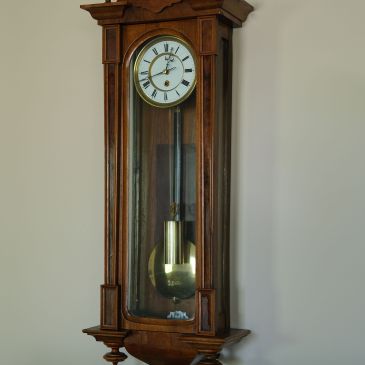
Medium-sized Vienna Regulator C.1870

Exploring a brief history of Vienna Regulators provides insight into why this clock is a significant milestone in horological evolution.

The Vienna Regulator clock, also known as the Vienna wall clock, is a type of precision pendulum clock that originated in Vienna, Austria.

The style and craftsmanship of Vienna Regulator clocks are often associated with exceptional quality and precision.

The development of the Vienna Regulator clock was influenced by several factors. One of the key factors was the rising demand for accurate timekeeping during the Industrial Revolution. Vienna, as a center of craftsmanship and technological innovation, played a vital role in meeting this demand.

Vienna regulators are distinctive and typically have a slender wooden case, which houses the pendulum and the clock mechanism. This design allowed for a longer pendulum, resulting in greater accuracy. The movement was typically attached to a frame on the backboard of the case by a keyhole design which allowed the movement to be lifted and removed from the case for servicing. The pendulum was often enclosed in a glass door or window, allowing the movement to be admired from the front and side panels while protecting it from dust.

Vienna Regulator dial

The cases, made of various types of wood such as walnut, oak, or mahogany, were often finely crafted with decorative inlays, carvings, or veneers. The clocks featured a white enamel or porcelain dial, usually adorned with Roman numerals and ornate hands.

The movement of the Vienna Regulator clock was powered by weights suspended on cables or cords. The weights (up to three) were typically wound up once a week, providing the necessary power for the clock to run accurately. While the majority of these clocks were designed to operate as 8-day runners, some were specifically engineered to run for 30 days and longer.

During the 19th century, the Vienna Regulator clock underwent several design changes. The earlier models, known as “Vienna Regulators of the Biedermeier period,” were characterized by a simpler and more classical style. Later models, influenced by the emerging Victorian and Rococo revival styles, featured more elaborate ornamentation and decorative elements.

While the popularity of the Vienna Regulator clock declined in the early 20th century with the advent of more modern clocks, it remains valued by collectors and enthusiasts today.

It’s also worth noting that the term “Vienna Regulator” typically denotes a clock style commonly manufactured in Germany and Austria from approximately 1804 to the end of the 19th century, even if it wasn’t necessarily crafted in Vienna.

But let’s go on.

What is making this clock stop?


During an unusually cold winter day, a substantial plumbing problem caused significant leakage from a ceiling pipe in our family room. To address the damage, we had to replace the pipes and patch the ceiling. During the repairs, we decided to refresh the room’s decor, taking the opportunity to make a few changes. As part of the update, we moved our Vienna Regulator clock from upstairs to the family room to showcase its elegance.

After running flawlessly for a few days, the clock stopped. I checked the clock’s beat, adjusted it, and confirmed its proper vertical orientation. This resulted in the clock running for a few hours before encountering another stoppage.

Suspecting a tangled cable issue which could cause a loss of power to the movement, I took the movement out of its case and carefully rewound the cable onto its take-up reel but this did not resolve the issue.

Could the problem be related to wear? I removed the movement from its case and disassembled it, inspecting for any signs of wear including bent arbors, or damaged or worn teeth. However, I found no such issues. In fact, the movement looked very clean, and the oil in the pivots appeared to be in excellent condition.

Vienna regulator movement
Vienna regulator movement, very clean with no issues

After reinstalling the movement into its case and reattaching the weight and pendulum, I noticed a slight wobble in the pendulum, that was not visible from afar.

Out comes the movement which consisted of removing the weight and unhooking it from the frame posts. Upon reexamining the movement, everything appeared to be in proper order. In most clock movements the suspension spring is physically attached to the movement. In clocks of this type, the pendulum rod is attached by the suspension spring to the backboard frame, and there could be a tendency to overlook inspecting the suspension spring as the cause of the stoppage.

This time, the problem was identified as a slightly kinked suspension spring. Lacking a spare, instead of replacing it, I removed the pendulum assembly from its case and used the shaft section of a small screwdriver to smooth out the kink. A temporary fix, to be sure, till I source the correct spring for this clock.

Some clocks can be temperamental and a clock that works fine in one location may not work in another. However, it would appear that moving the clock from one location to another caused a deformity in the suspension spring. So, the fault was mine.

After smoothing out the suspension spring it runs better

My other Vienna Regulator keeps ticking without a hitch, unlike this clock which tends to act up when moved. It’s running fine now and will stay at its new location which is back upstairs.

Time to service a Classic Sessions Schoolhouse Clock – cleaning & testing the movement

In the first segment of this two-part series, I detailed the assessment process of this Sessions time-only movement, which can be accessed here. This article explores the next steps in the servicing of this clock movement. I will also offer in-depth observations regarding the case’s condition and comment on any additional issues that have emerged subsequent to the assessment phase.

Sessions Schoolhouse clock

Two years ago, I acquired this Sessions schoolhouse clock at an auction with the intention of adding it to my collection of similar 19-inch clocks. The purpose behind this acquisition was to create a set of “time zone” clocks, as my children are scattered across the country. This setup allows me to easily glance up and determine the time in their respective areas.

The back of the movement


In the initial assessment of the movement, I anticipated no significant surprises or wear due to the prior work done on it.

To disassemble for inspection, I removed the movement from the case. Using a let-down key, I restrained the mainspring with a C-clamp and then removed the 4 bolts holding the movement together. After taking out the mainspring, I inspected the remaining parts for wear. I observed slight elongated wear on the second wheel bushing hole but found no major issues requiring remediation. Further examination revealed minimal grime in the pivot holes and a lack of lubricating oil. Overall, the movement showed little wear.

And now, on to servicing the movement.

Using an emery board to polish the pivots

Using my Taig lathe I polished each of the pivots. Polishing methods may differ but I prefer to use a fine-grain emery board. Emery boards are affordable and ideal for the task at hand.
I slide the emery board horizontally while the pivot rotates within the lathe and clean off any residue on the pivots with a soft cloth.

All components are immersed in the ultrasonic cleaner, and after approximately 15 minutes in the cleaning solution, the parts are removed and thoroughly dried using a gentle cloth and a hairdryer to eliminate any remaining water within the lantern pinions.

Since there’s no requirement for bushing work, the procedure remains straightforward, and the components are reassembled after the drying is completed.

Once all the parts are together the pivots, entrance & exit pallets, saddle pin, mainspring arbour, and crutch loop are oiled using Keystone clock oil.

After assembly, the movement undergoes a testing period, which may extend for days or even weeks. However, for this particular time-only movement, because of its simplicity, the testing duration is shorter.

The case and dial

The case is very well-preserved, devoid of the typical dents and marks often encountered on clocks from this time period. Cleaning with soap and water will suffice.

I only realized that the entire dial face, except for the chapter ring, had been repainted after I started loosening the screws for the dial bezel. I hadn’t noticed this previously and had assumed it was a replacement dial because it appeared to be in such good condition. Achieving this required a steady hand, and as a result, it looks very well done.

Repainted dial face

Despite the care and attention given to preserving the movement and case, it is noteworthy that the hands are incorrect. Sessions would have originally used solid spade hands instead of pierced ones, and, naturally, both the hour and minute hands are too short.

On the test stand

The test stand

While on the test stand, I had to make two adjustments to the recoil escapement. The entry and exit pallets were too far from the escape wheel which necessitated moving the saddle slightly in towards the escape wheel. This is the drop most often referred to and it can be visualized as the airspace between the leading corner of a tooth point and the part of the pallet it is about to fall on. The other is a crutch adjustment to bring the movement to the correct beat.

Two days on the testing stand prove to be adequate, and the final step involves reinstalling the movement back into its case.

Time to service a Classic Sessions Schoolhouse Clock – initial assessment

Two years ago, I acquired this Sessions schoolhouse clock at an auction with the intention of adding it to my collection of similar 19-inch clocks. The purpose behind this acquisition was to create a set of “time zone” clocks, as my children are scattered across the country. This setup allows me to easily glance up and determine the time in their respective areas.

Three time zone clocks. The centre clock is the subject of this article

In this blog series, I will first guide readers through the assessment process, providing a detailed account of my findings. In the second part, the next blog article, I will walk you through the movement’s servicing and testing phase.

This clock belongs to the schoolhouse clock style. The origin of the name “schoolhouse clock” is not well-documented, and it appears that the term was not used during the time these clocks were made. Instead, it was later coined by collectors to describe a particular style of clock commonly found in school settings.

Sessions Drop Octagon bob

Schoolhouse clocks were the standard design for early North American schoolhouses due to their larger, easy-to-read dials. They were widely hung in schoolrooms across Canada and often had simple time-only movements, although some versions included a calendar function or time and strike movements. These clocks had a utilitarian look and were known for their durability.

The design of schoolhouse clocks is believed to be influenced by English drop dial fusee clocks, which were produced in the late 18th and 19th centuries. Drop dials closely resembled schoolhouse clocks and featured conical constructions with a chain or gut line pulled by a mainspring barrel, providing even power release for improved accuracy. Complicated movements such as these did not find their way into inexpensive mass-produced American and Canadian schoolhouse clocks.

Label on the back of the clock

However, not all of these clocks spent their lives in schoolhouses. The back label bears the stamp “Office,” indicating that in addition to school settings, these clocks were also used by small businesses in retail areas or in office settings.

Assessing the condition of the movement

The clock was in working order when I received it. When I removed the dial which is held by 4 brass screws I was delighted to find the movement to be very clean and in very good condition overall.

The movement has been worked on in the past as there are 2 new bushings on the back plate, the number 3 wheel, and the escape wheel bushing. On the front, one bushing on the escape wheel bridge was replaced.

In addition the click spring, both click and wire have been replaced. A note to those working on Sessions time-only and Sessions time and strike clocks from this era: it’s important to be aware of the company’s history of poorly designed click springs. Therefore, it’s not unexpected to find this one replaced.

Back of movement

The suspension spring and pendulum leader have also been replaced. The mainspring has the letters MB stamped on the arbour loop which leads me to believe that it may be a replacement. In all, the work was completed by a competent repairer, in my view.

There is no oil remaining in the pivot holes as the oil has dried up completely. Further running of this movement as-is is a recipe for accelerated wear. Finding the right balance is crucial when applying oil. Excessive oil can attract dust and dirt, transforming it into grinding paste, whereas too little can lead to premature drying of the pivots. In general, however, the old adage holds true: less is more!

Disassembly

In view of the work done on this movement in the past, I am not expecting any further surprises or appreciable wear as I disassemble the movement.

To disassemble the movement, first remove the movement from its case. There are 4 screws holding the movement to the backboard and once released the movement easily comes out. Using a let-down key, the mainspring is restrained by a C-clamp and the 4 bolts holding the movement together can be easily removed with a slotted screwdriver. The mainspring is then taken out after which a further inspection takes place.

Next, I check for wear by removing the mainspring and reattaching the top plate with all wheels, including the escape wheel, in place. By spinning the wheels I can visualize how each wheel interacts with the adjacent one. There were no surprises but there is very slight elongated wear on the second wheel bushing hole, back plate but not enough to be concerned about at this point.

Before cleaning the movement in the ultrasonic machine I begin by pegging the holes using toothpicks. My objective at this point is to determine how much dirt and grime are present in the pivot holes. Not surprisingly there was very little grime but again the absence of any lubricating oil. I then checked each pivot for unusual signs of wear and in the case of this movement, there was little, if any, wear.

Well, that is all for now.

An upcoming article will delve deeper into the ongoing process of servicing this clock movement. Additionally, I will provide insights into the condition of the case and address any other issues that might have surfaced during the assessment stage.

A Gilbert Clock joins two other gallery clocks in my collection

Recently, I acquired a gallery clock in exchange for another clock. I favour wall clocks over other types due to their convenient wall placement, eliminating the need for a shelf or mantel. Additionally, they tend to draw more attention compared to other clock varieties.

The clock I traded, a rare Canadian cottage clock, held significant value, but overall, I am content with the exchange.

Gilbert gallery clock

Gallery clocks are often called pub clocks, canteen clocks, or office clocks.

Gallery clocks are often found in public galleries and exhibition spaces, where they serve both functional and decorative purposes. They are usually placed on prominent walls and are designed to be easily visible to visitors. These clocks can vary in style, ranging from antique designs with Roman numerals to more modern and contemporary styles with sleek, minimalist features.

This time-only gallery-style clock made by the Gilbert Company of USA is nondescript and quite ordinary looking. There is nothing special or distinctive about it.

The casing of the clock is relatively light in weight and based on the wood’s coloration, it seems to be made of cherry wood. A previous owner meticulously refinished the case, and while the result is impressive, it appears almost too flawless.

The clock has a 12″ Arabic dial and is 16 1/2″ across with spade hour hand and minute hand with a heavy brass dial bezel. The dial is constructed from paper and lacks a metal backing, clearly indicating a cost-saving measure.

A 12-inch dial is considered the standard size for a gallery clock and a 12-inch dial would have been the maximum size for a domestic environment. I own a smaller 10″ gallery clock, crafted in England, equipped with a conventional spring-driven movement, specifically designed for placement in a compact office setting. Larger 14″ and 16″-inch” gallery clocks on the other hand would have been found in public areas, factories, and post offices.

At first glance, it’s easy to mistake this conventional spring-driven pendulum clock for a fusee clock. Upon closer inspection, however, its features set it apart from the traditional fusee clock, revealing its true identity as an ordinary mass-produced spring-driven time-only American-made clock.

Movement as seen from the trap door

The winding arbour sits just below the central cannon, and above the centre cannon, you’ll find the Gilbert trademark. Interestingly, the winding arbour is positioned in the same location as that of a typical fusee gallery clock.

This specific movement is present in other Gilbert time-only clocks and is almost identical to the one used in the Gilbert Admiral calendar clock.

Time-only movement
Gilbert Admiral with calendar

A trap door on the bottom provides access to the pendulum. When the clock is hung on the wall, attaching the pendulum to the pendulum rod is nearly impossible. I discovered that laying the clock on its back, attaching the pendulum bob to the hook, and then carefully mounting the clock on the wall is a slightly easier method.

The trap door opens to reveal the pendulum bob

The previous owner found the clock in Virginia and brought it to Canada. The clock was lacking its original glass, but a replacement was included as part of the exchange deal. In addition, the clock was completely serviced, one bushing hole was found to be enlarged and a new bushing was installed.

Two other gallery clocks

The two other gallery clocks in my collection are a clock with a 10″ dial made by a British maker, Empire, and a 12-inch (dial) fusee clock, maker unknown but likely British.

12 ” Fusee clock
10″ gallery clock made in England by Empire

Given that the Gilbert clock underwent a thorough servicing and the missing glass was replaced, my only task remained to find a suitable spot to display it.

My Seth Thomas Regulator #2 Clock five years later

In 2018, while exploring Ontario (Canada), I came across a Seth Thomas Regulator #2 in an antique shop in Bloomfield, just a short drive from Picton, a prominent center in Prince Edward County known for its numerous wineries.

I had my eye on this clock when I viewed it online over the summer and carefully contemplated the purchase before finally acquiring it in the fall of 2018. These clocks are somewhat rare to find, but the price was reasonable, and the clock itself was in very good condition.

Seth Thomas #2
Seth Thomas Regulator #2

The Seth Thomas Regulator #2 was recognizable at one time as one of the most commonly seen regulator clocks in America. It graced many railway stations across both the US and Canada throughout the last century, a testament to its accuracy and reliability. It is a sturdy, precise, well-crafted timepiece that Seth Thomas produced from 1860 to 1950, an impressive 90-year production run. Few clocks can boast such longevity, making it an iconic American clock that every serious clock collector desires.

The design of the #2 remained largely unchanged over the years, but certain design characteristics can help in dating a specific clock. The identification guide below outlines characteristics of the dial and case that assist in estimating the year of manufacture. A clock colleague cautioned me against placing excessive trust in the chart, but I am satisfied with using rough estimates.

Seth Thomas Regulator #2
Seth Thomas Regulator #2 ID chart

With the exception of its distinctive base, most #2s produced after the earliest versions had the pendulum mounted in the rear. The chart also mentions a limited reissue in 1976. While the reissue is well-crafted and aesthetically pleasing, most Seth Thomas enthusiasts would argue that it doesn’t quite compare to an authentic Regulator #2, and the prices for these versions reflect that sentiment. Nevertheless, those who own the reissue appear to be satisfied with their acquisition.

According to the chart, my clock was likely made between 1922 and 1929. It features a base reminiscent of the earlier 1860 version of the #2, Arabic numerals, and spade hands. The bow tie connecting the wood dial bezel and the drop is a single piece (earlier versions had a three-piece bow tie). The clock has a second hand positioned 2 inches above the center cannon, but it’s not a true second hand; it runs off the escapement, taking 80 beats to complete a “minute.” Standing at 36 ½ inches tall, it’s veneered in mahogany.

The bottom right of the movement bears the stamp “77A” with the letter “K” beneath it, although it lacks other distinctive markings. Unlike some versions of the 77 movement that have lantern pinions, this one has cut pinions. Whether one type of pinion is better than the other is open to debate.

Seth Thomas Regulator #2
Seth Thomas Regulator #2 showing some marks on the face

As with any item nearly 100 years old, there were some issues with the clock. There is minor scuffing on the dial, no label, a finish that has lost its luster, and paint splatter on the top of the case (though not visible from most any angle). Taking down a clock while painting a room is a simple decision in my view, but some individuals prefer painting around it.

I transported this clock from Ontario to Nova Scotia by car, and removing the pendulum for transportation is not a straightforward process. If you are familiar with the pendulum arrangement on a typical weight-driven Vienna Regulator clock, this one is similar. Removing the weight is as simple as unhooking it from the cable wheel. Like Viennas, the pendulum is hung behind the movement, and both the weight and movement must be removed to access the pendulum since the pendulum must be removed for transport.

Seth Thomas #2
Seth Thomas #2 movement in place

The steps to remove the pendulum are as follows. First, the clock hands are removed. The minute hand is secured with a nut, which must be released. The second hand is a friction fit and can be pulled straight off.

There are eight small screws holding the dial in place. Once the dial is off, two larger screws on the wooden second-hand rail can be removed to access the movement. Four cylindrical column posts secure the movement in place; unscrewing them, starting with the bottom two, allows the movement to be lifted/pulled out. Once the movement is out, the pendulum can be unhooked from its suspension spring. The entire process takes less than five minutes.

The trapezoid 77A movement in this clock appeared clean when I first opened the case. There were signs of previous work, such as punch marks around some pivot holes, a common practice frowned upon today. The deadbeat escapement was in good condition and did not require adjustment. Otherwise, the movement looked to be in very good condition.

Seth Thomas #2
Seth Thomas #2 with escapement removed. Observe the numerous punch marks

Getting the clock to run reliably presented a challenge, and it took about a week to troubleshoot and resolve the issue. It eventually became clear that the issue lay in the positioning of the hands with the second hand obstructing the hour hand. I remounted the dial ensuring there was sufficient clearance between the second hand and the hour hand and it ran smoothly thereafter.

Regulating the clock is a relatively straightforward process, achieved by adjusting the rating nut on the bottom of the pendulum. This clock must be level and properly aligned to function correctly.

Time for servicing

In the spring of 2021, the clock began to stop intermittently. It would operate for 5-10 minutes before coming to a halt. I had replaced the suspension spring two weeks earlier and thought I had addressed the issue but clearly, I had not.

Seth Thomas #2 suspension spring

The clock’s apparent simplicity masks the tight tolerances it requires, and any signs of wear have the potential to cause the clock to cease functioning. Despite being a time-only movement with few gears I do not believe this is a good movement for the novice clock repairer.

I installed three bushings on the back plate; the second, and third wheels, and the escape wheel, and two on the front; third wheel, the escape wheel, and the verge pivot hole front plate.

Seth Thomas #2
Seth Thomas #2 movement

At the time I also discovered a slightly bent third-wheel arbour that did not take much effort to straighten.

While the movement was out of the case I replaced the maintaining power spring. I’m unsure if I’ve resolved the clunking sound the clock produced when I wound it previously because I now must turn the key crank in the opposite direction for a quarter turn to adjust the maintaining spring to avoid the clunk.

I also replaced the old cable with a 3/64-inch brass-weight cable. One aspect of the brass cable that I particularly appreciate is its nylon core, which prevents it from coiling. Polishing the pendulum bob and weight enhanced its overall appearance.

Since 2021 it has been running very well and keeping accurate time.

While these clocks were constructed robustly and designed for demanding environments, running for extended periods without the need for maintenance, there is still a requirement for periodic servicing. When I obtained the clock, it quite likely had gone without servicing for a considerable duration, and the maintenance performed in 2021 was certainly long overdue.

Seth Thomas Regulator #2

Still, I am happy with the purchase of this clock. At present, it adorns the front hallway of our home, adding a touch of elegance to the entrance.

This clock is a splendid addition to our home’s front entrance, with a rich and storied history. While its exact whereabouts over the past 100 years remains a mystery, it remains a remarkable clock.

The Philosophical Conundrum of Antique Clocks: When is a Clock No Longer Itself?

In the world of horology, antique clocks stand as both timekeeping devices and exquisite works of art, bearing witness to the craftsmanship and design sensibilities of bygone eras.

Yet, beneath their exteriors lies a profound philosophical conundrum—one that questions the very essence of their identity. As we dive into the realm of antique clocks, we find ourselves pondering a perplexing thought experiment: When is a clock no longer the same clock?

This article embarks on a journey through the intricacies of restoration, originality, and the identity of antique clocks.

When gradually replacing every part of a clock, a fascinating philosophical question arises: at what point does it cease to be the same clock? This conundrum extends to the creation of a “new” clock from those original parts.

This brings to mind the Ship of Theseus thought experiment which raises the intriguing question of identity and continuity. If all the components of a ship are gradually replaced over time, at what point does it cease to be the same ship?

Theseus, Photo by Heinz Klier on Pexels.com

The dilemma lies in determining which of the two clocks can rightfully claim to be the original. This thought experiment delves into the complex nature of an object’s identity, as no two objects can occupy the exact same identity. It challenges us to consider whether an object with all its components replaced can still be fundamentally regarded as the same object.

Several years ago, I had the opportunity to work on a antique clock that was essentially a box of parts.

Junghans clock in pieces
Junghans clock pieces

At first glance, it seemed to be in its original state, but upon closer inspection, discrepancies emerged. Contrary to the initial impression that all components were intact within the box, I soon realized that numerous intricate elements, such as case embellishments and finials, were absent. What’s more, a substantial portion of the case had been reconstructed using contemporary materials, and both front and side glass panels were notably absent.

Centre crown support post
Crown support made from new oak

This prompts the question of whether a clock in such a state can still be categorized as original, or if it has strayed too far from the essence of originality due to the incorporation of modern elements and the absence of vital components.

Oak spindle
Fashioning finial bases from an oak spindle
Junghans Crispi dial face

Despite its captivating visual appeal, my Junghans Crispi does not command the same market value as an authentic, original Crispi clock.

Junghans Crispi wall clock C.1899 (??)

People often place a premium on originality, and I, for one, appreciate a well-preserved clock in its original condition. I may reconsider if it has been tastefully restored or repaired, recognizing that it’s a better fate than being discarded or stripped for parts. However, I wouldn’t expect to pay as much for a clock that has undergone significant alterations.

Valuing an excessively restored clock can be challenging. While conservation and restoration have their merits, the question arises: does a clock that was two steps away from the trash bin become less valuable when restored?

In reality, there are no definitive answers to these questions. Collectors will always exist who prioritize originality and others who are more forgiving of certain changes. So, is this debate a significant concern, or simply a matter of personal preference?

German Box Clocks: A Journey into Clockmaking History

The popularity of Vienna Regulator clocks began to wane towards the early part of the 20th century. The more modern and less ornate design of the box clock appealed to changing tastes and preferences after World War I, leading to the gradual replacement of Vienna Regulators with box clocks. The box clock design stood the test of time, enduring for over 30 years.

Gustav Becker weight-driven Vienna Regulator

The German “box clock” is a type of antique clock that became popular in the early 20th century, particularly in the period following World War I. These clocks are sometimes also referred to as “box wall clocks” or “wall box clocks” due to their design and placement on walls.

German "box" clock by Mauthe
German box clock by Mauthe

Key features and characteristics of German box clocks are its design and appearance since the box clock represents a departure from the designs of the Vienna Regulator clocks. Instead, box clocks embraced a more minimalist and utilitarian design. They typically have a simple rectangular or square wooden case with clean lines, a simple crown, glazed features and often lack the intricate carvings and embellishments seen in earlier clock styles.

Numerous German manufacturers, such as Mauthe, Gustav Becker, The Hamburg American Clock Company, Muller, Hermle, and Kienzle, were involved in the design and construction of box clocks.

U M Muller box clock

Box clocks employ a weight-driven mechanical movement or a spring-driven movement. For the cost conscious, spring-driven box clocks were within the budget of most households.

Whether the movements use weights or springs to power the clock’s operation, they require periodic winding to keep accurate time. The run times were typically 8 days though some were made to run for 14 days. The movement is always housed within a wooden case and is typically viewable through glazed side ports.

Kienzle time and strike box with round top

The clock dials on box clocks are typically white or silvered dials with either Arabic or Roman numerals to indicate the hours. Most box clocks have simple black spear or spade hands for better contrast and easy readability.

$299 Mauthe wall clock
Mauthe box clock

A prominent feature of box clocks is the pendulum, which might be quite plain or ornate, which swings beneath the clock’s dial and is visible thorough a bevelled glass panel. The pendulum’s length is adjusted to regulate the clock’s timekeeping accuracy.

Some box clocks include a chime feature that makes a musical tone on the quarter hour while other have a strike feature that rings the hour or half-hour. A clock face with three winding arbours signifies a chiming clock, whereas a clock with two winding points indicates a striking clock. This adds a pleasant sound to mark the passing of time.

The vast majority of box clocks were produced in Germany. German clock-makers were renowned for their precision and craftsmanship, making Germany a hub for clock manufacturing during that era.

Box clocks were widely used in homes, offices, schools, and other public spaces. Their minimalist design made them versatile and suitable for various interior styles.

Daniel Dakota box clock from the 1960s

Caution should be exercised against copies. In the 1960s, the Chinese reintroduced the box clock design and inundated the market with numerous 31-day clocks, sold under various names, with Daniel Dakota being the most widely recognized brand. However, these clocks did not match the quality and craftsmanship of the traditional German box clocks. During the same vintage period, certain Korean and Japanese clocks demonstrated acceptable quality standards but most are to be avoided.

Today, German box clocks are sought after by collectors and antique enthusiasts for their historical significance, craftsmanship, and unique design. They serve as reminders of a bygone era and continue to captivate people with their appeal.

If you are interested in acquiring a box clock, it’s essential to verify its authenticity and condition, as well as consult with experts or appraisers to ensure its value and authenticity.

A gifted clock is always appreciated

During my visit to a fellow enthusiast of antique and vintage clocks, I was graciously presented with a complimentary schoolhouse clock.

New Haven time-only schoolhouse clock

Although I wasn’t anticipating it to be in pristine condition, I gladly accepted the schoolhouse clock as a project, knowing that it would require some restoration work.

I own multiple wall clocks, among them are several schoolhouse clocks, and am amazed that they run so well after many decades. These clocks, known for their durability, continue to function reliably even in well-worn condition.

The clock’s manufacturer is New Haven, and it is a time-only clock featuring a twelve-inch Roman Numeral dial and a short drop design. What makes it particularly interesting is the reverse painted glass that allows the moving pendulum bob to be visible.

As for the construction, the clock’s case is crafted from softwood, elegantly adorned with Rosewood veneer on all the visible sections.

A robust time-only movement

During my holiday, I had limited time to work on the clock, but I did take the opportunity to inspect its movement and clean the case. I found the movement to be in very good condition with minimal wear. However, I did notice that there was an absence of lubricating oil. To ensure the clock’s optimal performance and to minimize further wear, I took the necessary step of re-oiling it before placing it back into its case.

The clock does have some veneer issues, especially noticeable in the bottom section of the short drop. I plan to address and repair these veneer problems when I have both the time and the necessary resources to do so properly.

Additionally, there are minor losses on the dial face, but I’ve decided to leave them as they are for now. While they may be imperfections, they also add character and a sense of history to the clock, so I believe preserving them in their current state will maintain the clock’s unique charm.

As my holiday schedule didn’t allow for a comprehensive repair, I made a mental note of wear issues that require attention. Upon my return when I have more time available, I intend to address these wear issues, particularly focusing on one or two bushings that need immediate attention. This approach will help maintain the clock’s accuracy and prevent any further damage.

Once I have the opportunity and means to address these repairs and restorations, I will ensure the clock regains its original beauty and functionality while retaining the traces of its past that make it special.

An unusual issue with a Vienna Regulator time-only clock

In this post, I describe an unusual issue when relocating my mini Vienna Regulator clock. But first some background information on Vienna Regulators.

The Vienna Regulator clock, also known as the Vienna wall clock, is a type of precision pendulum clock that originated in Vienna, Austria, in the late 18th century.

One-weight Vienna Regulator, unknown maker, C.1875

The development of the Vienna Regulator clock was influenced by several factors. One of the key factors was the rising demand for accurate timekeeping during the Industrial Revolution. Vienna, as a center of craftsmanship and technological innovation, played a vital role in meeting this demand.

They typically had a slender wooden case, which housed the pendulum and the clock mechanism. This design allowed for a longer pendulum, resulting in greater accuracy. The pendulum was often enclosed in a glass door or window, allowing the movement to be admired from the side panels while protecting it from dust.

The cases, made of various types of wood such as walnut, oak, or mahogany, were often finely crafted with decorative inlays, carvings, or veneers. The clocks featured a white enamel or porcelain dial, usually adorned with Roman numerals and ornate hands.

Vienna regulator movement

The movement of the Vienna Regulator clock was powered by weights suspended on cables or cords. The weights (up to three) were typically wound up once a week, providing the necessary power for the clock to run accurately.

During the 19th century, the Vienna Regulator clock underwent several design changes. The earlier models, known as “Vienna Regulators of the Biedermeier period,” were characterized by a simpler and more classical style. Later models, influenced by the emerging Victorian and Rococo revival styles, featured more elaborate ornamentation and decorative elements.

Vienna Regulator dial
A well-preserved Vienna Regulator dial

The style and craftsmanship of Vienna Regulator clocks are often associated with exceptional quality and precision.

While the popularity of the Vienna Regulator clock declined in the early 20th century with the advent of more modern timekeeping devices, it remains highly valued by collectors and enthusiasts today.

The issue

During an unseasonably warm winter, we unexpectedly experienced a sudden drop in temperature, causing a significant plumbing issue that led to a major leak of the pipes in the ceiling of our family room on the first floor of our two-story home. The extent of the damage necessitated replacing the pipes and removing and replacing the gyprock ceiling. While the repairs were underway, we took the opportunity to revamp the room’s decor and make a few changes, including relocating some clocks to that area.

Some clocks can be temperamental and a clock that works fine in one location may not work at all in another. Such was the case of a miniature Vienna Regulator that once moved from an upstairs bedroom refused to run in the family room.

Suspecting a tangled cable issue the result of which would rob power to the movement, I took the movement out of its case and carefully rewound the cable onto its take-up reel. No change.

Could it be a wear issue? I proceeded to carefully remove the movement from its case and meticulously disassembled it, thoroughly inspecting for any signs of bent arbors, or damaged or worn teeth. However, to my surprise, I found no such issues. In fact, the movement was remarkably well-preserved, and the oil in the pivots appeared to be in excellent condition.

After carefully reinstalling the movement into its case and reattaching the weight and pendulum, I observed an interesting issue. I noticed that the bottom of the case protruded farther out than the top, indicating that the wall was not perfectly vertical. Suspecting a connection between this misalignment and the movement’s inability to run, I decided to investigate further.

Left Stabilizer

I adjusted the stabilizers, one on each side, stepping them back slightly, and to my surprise, I discovered the root cause. The escapement pallets, responsible for regulating the movement, were not engaging with the escape wheel correctly. This misalignment was likely the reason for the movement’s previous failure to function properly. It also made me realize that the wall where the clock was previously located was not vertically level.

While achieving horizontal leveling is undoubtedly crucial, it is important that vertical leveling can make a significant difference when it comes to the functionality of a clock. In fact, proper vertical alignment can be the determining factor between a clock that runs smoothly and one that fails to operate at all.

At the end of the day the exercise was worthwhile as it allowed me the clean the movement, reoil the pivots, and polish the brass pendulum and weight.

My most recent Hunsruck Clock evokes memories of my first Junghans clock

While working on one of my latest acquisitions, a Junghans Hunsruck mantel clock, memories flooded back to the first Junghans clock I ever owned, a Junghans Crispi wall clock, that I still have to this day.

Junghans Hunsruck C. 1913

It was a humble box of parts when it first came to me, but I was determined to bring it back to life.

Junghans clock in pieces
Junghans clock in pieces, not unlike a jigsaw puzzle

The restoration process was a hands-on experience where I had to fashion new parts, source missing pieces, and master the art of staining and gluing. Through this ground-up restoration process, I developed a deeper understanding of the craftsmanship and artistry that went into creating these old clocks.

Piece by piece, I painstakingly assembled the clock, learning about the inner workings and mechanics along the way. It required both patience and dedication, but in the end, it was worth it. The clock not only became a functional piece, but a treasured symbol of my passion for antique wall clocks.

A first examination of the movement

As I worked on my latest Junghans mantel clock refreshing the case and servicing the movement, I couldn’t help but reflect on the journey that led me to this point. Each clock I restore holds a special place in my heart, but that first Junghans clock will always hold a particularly special place. It was an affirmation of a lifelong passion for the timeless elegance of antique clocks.

The fascinating story behind the Crispi wall clock

The story behind the Junghans Crispi clock is the enduring power of objects that connect us to the past.

Junghans Crispi time and strike wall clock

In the midst of tragedy, there can be glimmers of hope and resilience. Such was the case with a Junghans Crispi wall clock that fell off a wall on Princess Court in North End Halifax on the fateful day of December 6, 1917. Despite the chaos and destruction caused by the Halifax Explosion, this clock managed to survive, albeit in a state of disrepair.

Following its century-long journey, the clock that had been treasured by the Halifax family for generations finally found its way into the hands of an avid antique clock collector.

Over the course of two months, I worked tirelessly to piece together the various components and restore the clock to working condition. It was no easy feat, but the end result was a stunning tribute to both the clock’s history and the resilience of the people of Halifax.

In a series of articles documenting the restoration process, I shared not only the technical details of the restoration but also the personal connection to this piece of history.

Understanding the Function and Importance of Beat Scales in Clocks

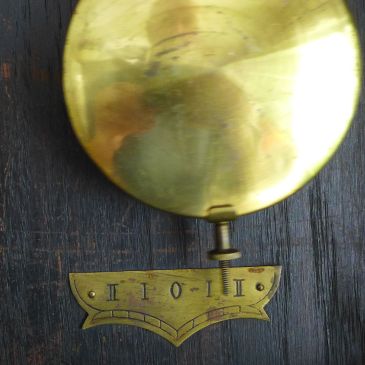
If you’ve ever examined a pendulum-driven wall clock, you might have noticed a small plaque affixed to the back panel just below the pendulum. This plaque is commonly known as a beat plaque or beat scale indicator. Although the presence of a beat scale on a clock does not always indicate its value, it does perform a significant role.

Seth Thomas #2
Seth Thomas #2 beat scale below pendulum bob

Most beat scales have I and II markers on either side and when the pendulum swings, it should swing beyond the indicator I marker and close to the II.

The amplitude of the pendulum swing can reveal the health of the clock’s movement.

If there is very little amplitude in the pendulum’s swing, it could indicate wear or issues with the movement. In such cases, it may be necessary to investigate the movement, make pallet adjustments, or mitigate any wear issues.

Mauthe wall clock

When the pendulum swing is too large or excessive, it may indicate an issue with the clock’s movement. Swinging too far beyond the II marker on the beat scale could suggest that the clock’s mechanism has a problem, which could include a loose pallet or an escapement that has worn out. In this case, it may be necessary to make adjustments or repairs to the clock’s mechanism to address this issue.

Mauthe wall clock circa 1895

Ideally, the pendulum of the clock should align with the center of the beat scale when the pendulum is stopped. It may not align correctly because of several reasons, such as wear and tear in the clock’s movement, changes in the environment that affect the clock’s components, improper installation, or adjustments made to the clock’s pendulum or beat scale.

If the beat scale appears off-center when the clock is stopped, it may also indicate that the clock is not squared correctly on the wall.

Arthur Pequegnat Moncton 15 day wall clock

The presence of a beat scale does not necessarily imply that a clock is of high quality. Certain high-quality clocks were produced without a beat scale, while others were designed with a beat scale as a guide or an ornamental feature. In some cases, beat scales may have been added to clocks after their manufacture for decorative purposes.

If a clock has a beat scale, it assumes several conditions.

These include;

  • the assumption that the beat scale is original to the clock and was applied dead center,
  • that the scale has never been removed,
  • that the clock’s case has not undergone any environmental changes such as warping or high humidity,
  • that the pendulum rod and bob have not experienced similar environmental changes.
  • and that the clock’s movement, pendulum, and bob have not required any repairs or maintenance that could adversely affect the dead center between the beat scale and the pendulum.
Vienna regulator beat scale

The beat scale was originally designed and manufactured as a high-tech object and while they do serve a practical purpose in some clocks in many cases beat scales are purely decorative.

However, as noted above, the presence of a beat scale alone is not necessarily indicative of a clock’s value or quality.

Restoring an Antique Sessions Schoolhouse Clock: Repairing Bushing Wear and Overcoming Common Issues

Bushing wear is a common issue that can occur on antique brass clock movements. A bushing is a small hole drilled into the plate that is used to support the pivots and reduce friction between the pivots and the clock’s plates. Over time, the bushings can become worn down or damaged due to friction, which can cause a clock to malfunction or stop. Other factors such as the environment the clock is in, the lack of periodic lubrication, and the build-up of dirt and grime combine to exacerbate wear over the years.

When bushing wear occurs, the clock’s pivots may become loose or wobbly, which can lead to the gears not meshing properly or becoming stuck. This can result in the clock losing accuracy or stopping altogether.

To repair bushing wear on an antique brass clock movement, the bushings or the holes must be drilled out and a new bushing inserted in its place. The new bushings must be precisely fitted to ensure that the clock’s pivots are properly supported and that the clock runs smoothly.

On my bench is a Sessions time-only schoolhouse clock made in the early 1920s. According to the label on the back, it is called the Office.

At only 21 inches high it is diminutive in size, unfortunately, the hands are incorrect

Factors at play when a clock stops

The clock stops when fully wound. There are essentially two factors at play when a clock stops. When the mainspring is fully compressed dirt and grime act like sandpaper and prevent the power of the mainspring from releasing. Some erroneously call this “overwinding” a term that has stubbornly persisted over the years. Worn bushing holes add to the problem when the holes are so worn the gears do not mesh correctly.

Curious, why is the trademark stamped on the INSIDE of the back plate?

Sessions movements are not new to me and I have worked on identical movements in the past. Compared to the others I have worked on, this one has minimal wear with one peculiarity detailed below.

Even before servicing, it looks clean

There is no doubt this movement has been worked on previously judging from pivot scratch marks around the bushing holes and a replacement click spring. The leader and suspension spring have also been replaced at some point in the clock’s life and judging from the condition of the suspension spring, it may need to be replaced in this servicing.

While there is some movement in all the bushing holes the worst is the 3rd wheel rear plate and the escape wheel front and rear plate. The holes in those three locations were drilled out and new bushings were installed in their place.

Despite slight wear on all other bushing holes, there is not enough to warrant new bushings at this time. Naturally, if I were in the clock repair business I would consider bushing the entire movement.

Using support to steady the escape wheel bridge

In this case, replacing bushings in the entire movement is not necessary as the clock will remain in my collection and as such will be inspected every 2-3 years for wear.

One of the unique features of clocks such as this is their ability to be hung and forgotten and continue to run quite well while very worn, a testament to their rugged design.

Plates on the left and gears on the right, a pretty simple movement

And now the eccentric repair. The click spring retaining tab/hook was snapped off for whatever reason. As a result, the replacement click spring winds its way through to the outside of the wheel by hooking into a hole drilled in the spoke. It is a little odd but as it works well there is no requirement for remediation. Aesthetics aside, some repairs do not need to be reversed if the part functions well.

Odd but it works

The mainspring has plenty of “spring” left in it which makes me wonder if it is a replacement.

On the test stand

During servicing the mainspring was unhooked from the main wheel arbour and using my Olie Baker spring winder, it was extended and thoroughly scrubbed with a Scotch-Brite heavy-duty scouring pad, and lubricated with Keystone clock spring oil. There was certainly enough dirt and grime to stop the clock in the spring’s fully wound position and a good cleaning solved the problem.

After a brief testing period, the movement was remounted and it is now on display on my kitchen wall where it rejoins its cousins.

As the tiny hands look rather silly, the correct clock hands will be added to my next clock supply order.

A diminutive schoolhouse clock by Sessions

The Sessions Clock Company of America was one of the leading clock manufacturers in the United States in the early 20th century. Founded in 1903 by William E. Sessions and Aaron Lufkin Dennison in Forestville, Connecticut, the company quickly gained a reputation for producing clocks that were both reliable and affordable.

Over the years, the Sessions Clock Company produced a wide range of clocks, including mantle clocks, and wall clocks, and became known for their innovative designs.

A very popular model was the schoolhouse clock. Schoolhouse wall clocks have a rich history dating back to the late 19th century. Originally used in schools, and other public places, these clocks were designed to be reasonably accurate and reliable timekeepers, with large, easy-to-read dials and distinctive wooden cases with glass-paneled lower access doors showing a moving pendulum.

A comparatively small schoolhouse showing incorrect hands

Over time, schoolhouse clocks became popular in homes and offices, with various manufacturers producing their own versions of the classic design. Today, schoolhouse wall clocks remain a popular choice for those seeking a traditional timepiece and are often seen as a symbol of American craftsmanship and design.

Diminutive clocks were popular in their day because of the lower cost compared to a larger wall clock. This clock is 21 inches high by 13 1/2 inches wide with a 7-inch dial and it is difficult to envision how it could be seen clearly in a large classroom setting but for some school regions, the cost was an important factor. Standard schoolhouse clocks are typically seven to eight inches longer and have 12-inch dials.

Most schoolhouse clocks were designed to display only the time, with no additional features such as a striking mechanism or date displays. This simplicity allowed for a greater focus on reliability, which was essential in public spaces such as schools where good timekeeping and long periods between servicing were crucial.

Shown in the middle with a Waterbury on the right and Sessions on the left, all are time-only clocks

I have had this particular Sessions clock for over a year and it stops from time to time. It likely requires a good cleaning and it is time to put it on the workbench. The case is in excellent condition and I see no need for intervention aside from cleaning with soap and water.

We’ll see what we shall find. I’ll report back in a week or two but this should be a standard servicing job and I am not expecting any surprises.

Vienna Regulator – the pinnacle of clock artistry

Vienna regulator weight-driven wall clocks are a type of mechanical clock that originated in Austria in the mid-19th century. These clocks are named after the city of Vienna, where they were first produced and gained popularity throughout Europe. They are known for their unique design, which features a long, slender case with a glass door that allows the pendulum and weights to be seen.

Miniature one-weight Vienna wall clock, circa 1880

Vienna regulators are often considered the pinnacle of European clockmaking artistry, and they continue to be cherished by collectors and clock enthusiasts around the world for their precision, elegance, and timeless beauty.

The Crown or topper

The simple lines of the Vienna Regulator are exemplified in this unmarked mini version found on a local online for-sale site some 5 years ago. Simplicity is exemplified in its job of performing one function – telling the time.

Weight-driven clocks with comparatively large pendulum bobs give a very visual display of the clock’s activity. In my view, it is the weight-driven ones that have greater appeal than spring-driven clocks.

Time only movement

Nothing has been done to the clock save disassembling and cleaning the movement and polishing the pendulum and brass-encased weight.

Another is a two-weight Vienna Regulator by Gustav Becker which required extensive repair and restoration.

Gustav Becker 2-weight Vienna Regulator

Vienna regulator weight-driven clocks are a testament to the precision and artistry of clock-making, showcasing the intricate mechanisms and stunning designs that make them highly sought after by collectors and enthusiasts alike.

What is truly fascinating is the accuracy of a clock that is almost 150 years old.

A very special Waterbury wall clock – my grandfather’s kitchen clock (a personal journey)

The Waterbury clock hanging in my office brings back memories of my grandfather, a man I wish I had known better. Call it one of life’s regrets.

Now, I didn’t know my grandfather all that well and I’m not sure that many people did. He was shy and a man of few words. I don’t think many people really knew him. In fact, I don’t recall having a meaningful conversation with him.

Rank listed as driver although he was a private in the First World War

He passed in 1962 at age 82 when I was only 12.

My grandfather and his brother came to Canada in 1906. There were many British immigrants at the time as Canada offered new and exciting opportunities for young men. Grandfather came from Shoreham, England where most of his family originated, and was employed with the Postal Service but evidently, postal work was not for him and an adventure to the colonies was a better option.

When he arrived in Canada, he chose Ottawa as a place to live. At the time his future wife lived with her parents. Her mother operated a boarding house where grandfather stayed when he first arrived in Ottawa. You might say that my great-grandmother was a matchmaker of sorts, as she encouraged my grandfather and grandmother to spend time together. She must have thought that since he came from the old country he was quite a catch.

My grandfather spoke only English, and his bride spoke only French. So, how they communicated throughout their engagement and the first few married years is a mystery to this day. Perhaps words are not important after all!

When the First World War broke out in 1914 my grandfather did not sign up immediately but waited until 1916 at which time both grandfather and his brother made the decision to join the war effort. Grandfather was not particularly patriotic, and the purpose of joining was to take advantage of an all-expenses paid trip to Europe and more specifically England where he could reconnect with his family in the Shoreham area. At that point, he had been away from his home country for 10 years.

Imagine my disappointment when I saw this

Neither he nor his brother had any idea that the war would go on for two more years. In fact, they thought, and a lot of people shared the same feeling, that the war would end by Christmas, and they would be home in two or three months. Little did they realize how much longer the war would last and the impact the war would have on two young men.

Waterbury grandfather's clock
The movement had been neglected for many years

My grandfather was a military driver during the First World War and was in Europe between 1916 and 1918. He witnessed horrific things and retained many of those memories. Today people would use the term Post Traumatic Stress Disorder but, in those days they called it “shell shock”. Post Traumatic Stress Disorder would stay with him throughout his entire life.

My grandparent’s home was very quiet but for the sound of the Waterbury time and strike wall clock. Grandfather suffered from anxiety/depression and it didn’t take much to bother him, most likely due to his experiences in the First World War.

The brass bezel was in poor shape and screwed to the case?

After the war grandfather worked for the Ottawa Transportation Commission for a number of years. He was a conductor on a streetcar and when the OTC switched from streetcars to buses, they eliminated the conductor position. Grandfather was told that he had to drive a bus and since he was unable to drive for anxiety reasons that stemmed from his experiences in the Great War, he left work at the age of 50 and never worked again. But he and my grandmother managed with the help of family.

Touch-ups were required and dirt was removed from the brass

My grandfather painted that old Waterbury clock case the color yellow to match the walls in the kitchen. I guess he thought it would blend in with the surroundings and the ticking of the clock would somehow subside into the walls. When they sold their home in Ottawa the clock was passed on to one of my cousins.

Waterbury grandfather's clock
The clock case had no drop door so, a new one had to be made

The clock was tucked in an old barn for many years and when my cousin downsized and moved into a smaller home he wondered if I would have it. In 2018 he contacted me by email and suggested I retrieve the clock. At the time I imagined it was a complete clock with movement, case, and all the important bits but when I picked it up I was disappointed that it had suffered so much through the years.

Waterbury grandfather's clock
Cleaned and ready for the next 100 years

I wish I knew what the clock looked like in its day because what I have left is not the clock I envisioned on my grandfather’s kitchen wall many years ago. I have the movement, dial face, and brass bezel. The case and a few other important parts are long gone. The case my cousin made some 40 or 50 years ago is a heavy homemade plywood concoction. He did the best he could but it was clear that he had little understanding of clock case construction and he got a few things wrong.

However, I was determined to do something with it. It now has new dial glass, a pendulum rod and bob, a verge and crutch, a winding key, and a new drop door. I cleaned up the dial as best I could, refreshed the case, and addressed wear issues on the movement.

Grandfather’s clock, plywood case and all

That old kitchen clock is in my office right beside my desk and ticking away and striking as it should. Although I remember it ticking loudly as a child in the back kitchen the truth of the matter is that it is not a loud ticker at all; it is very soothing.

I contemplated ditching the crudely constructed case and finding a period correct one but the clock with all its warts is what it is. The plywood case, as ugly as it is, is part of the history of the clock. So it will stay as it is and it will always be a reminder of a man I wish I had known.

Tick Talk Tuesday #43 – Is this a Simon Willard banjo clock?

Tick-Talk Tuesday is about the letters and comments I have received from readers concerning clock issues, challenges faced, a clock you would profiled or advice on your particular clock concern. For those comments and questions that stump even me, I consult within my clock circles for the best possible answer

TM writes, “We have had a banjo clock in our family for multiple generations, and knowing my family’s history it would not surprise me if it was a Simon Willard original. I understand that is a long shot but it is so hard to find information about banjo clocks or reputable people to deal with. It is in relatively good condition, not knowing when my family acquired it exactly, but it is original to us. I am attaching a picture and would greatly appreciate your opinion.”

The family banjo clock

I am not an expert on Willard banjo clocks but have seen and read enough to inform me that Simon Willard clocks have distinctive features that separate his clocks from others.

My reply was, “Hi, and thanks for your email.

It may or may not be a Willard patent banjo. It would have to go through a process of authentication. An expert would identify the classic hallmarks of a Willard clock which would include movement design and construction, distinctive case features, door catch characteristics, construction of the dial, how the movement is mounted, design of the throat and lower tablets, and so on.

However, two things immediately strike me as odd. First, I have never seen a Willard patented timepiece (banjo clock) with an Arabic dial. Secondly, Willard banjo clocks have simple barbed spear hands, none as ornate as the ones on your banjo clock. Your clock could be a variant or the dial and hands could be replacements or the clock could have been crafted by another maker altogether.

Again, an expert in Willard clocks would provide the answer you are looking for.”

Simon Willard Patented Timepiece, C.1810; photo taken at the Simon Willard Clock museum in 2019

Simon Willard did little to protect his patent and as a result, many copies were made during the Federal period in Boston and in New England. Associates of Willard and apprentices to Simon and his brother Aaron produced clocks by the hundreds. Some of the copies were of high quality though they did not have the desired cache of a Simon Willard clock. And of course, many are fakes.

Willard clock; photo was taken at the American Watch and Clock Museum 2019

According to Robert C. Cheney, executive director and curator of the Willard House and Clock Museum proclaimed that the timepiece is “probably the most faked American clock found today.” Is TM’s clock an original, another maker, or a fake? An expert would immediately determine if it is real.

The photo at the beginning of the article is the only one sent to me and one photo is really not enough to make any kind of definitive judgment but I don’t believe TM has a Simon Willard Patented Timepiece.

Fusee gallery clock – finally on the wall but who made it?

This unnamed fusee clock was acquired from a friend this past summer and after a few months, I am finally able to hang it on the wall. Unfortunately, after having been involved in the extensive cleanup following the devastating hurricane Fiona here in Nova Scotia, there was little time for clock repair. But, now that the dust has settled it’s time to get back to clock collecting and repair.

Unknown fusee time-only gallery clock

It is the first fusee clock in my collection. I have waited a while but this is an excellent acquisition.

This time-only gallery-style clock with a fusee movement is non-descript and quite ordinary and there is nothing special or distinctive about it. It has a 12″ dial and is 15 1/2″ across with a spade hour hand and spear minute hand with a heavy brass dial bezel.

A 12-inch dial is considered the standard size for a gallery clock and a 12-inch dial would have been the maximum size for a domestic environment. Larger 14″ and 16″-inch” gallery clocks would have been found in public areas, factories, and post offices.

Side view showing the rear box

I am not an expert when it comes to identifying wood types but I would say a solid mahogany bezel surround with veneers on the rear access box.

Although fairly heavy it is designed to be quickly removed from the wall by pulling out 4 wooden pegs (two on each side of the back box), very handy for periodic inspection/maintenance. The pendulum leader literally hangs on a notch on top of the escapement bridge so, disconnecting by means of opening up a side door on the right and reaching in is pretty simple.

It has a conventional anchor escapement, a robust bridge, and a sturdy crutch. The plates are held together with screws but pinned to the back of the dial.

There is a trademark on the movement which I cannot identify. Perhaps a reader might identify this English company. I can make out T, an S, an O, and something else. Atson, AT & Son or something with a “z”?

I posted the question on a popular antique clock forum site and expected a response but got nothing.

A trademark that I cannot identify

Is it an antique (over 100 years old)? Perhaps, but it could be as late as the 1920s. The plates are thick, the gears are machine cut, cut pinions throughout, a hefty pendulum bob, thick but plain movement pillars, and a generally robust feel all around. It was certainly designed for longevity and reliability. The screwed pillars are a good sign that it was made after 1900.

This fusee has a cable drive. It is unknown whether it originally had a chain as most did many years ago or if it was converted to cable as many were when taken in for servicing. Chains are difficult to source and wire/cable is much more cost-effective.

An advantage of a brass cable is that if it should snap there would be less collateral damage than a chain flailing all over the place. When a chain releases very suddenly the potential for taking out gear teeth and other parts is much higher.

The cable is wrapped around the large spring barrel

Fusee advantages

Constant torque and in theory, more accurate timekeeping are its chief advantages. It works like this. As the spring begins to uncoil the cable is on the smallest diameter of the fusee. The pull on the spring drum becomes less as the diameter of the fusee increases. The diameter of the fusee becomes larger giving greater leverage.

The larger radius at the fusee compensates for the weaker force of the spring, keeping the drive torque constant which is why fusee clocks are better timekeepers than conventional spring clocks.

Accuracy cannot be compared to a quartz clock today but keeping time within a minute or two a week in an industrial/office/domestic setting was perfectly acceptable in an age when the exact time was unimportant.

View of fusee cone

The plan

I am not going to tackle this project just yet but fortunately, it has seen servicing. I can identify at least three newer bushings. There does not appear to be significant play in the movement which is always a good sign so, there should not be a problem if the servicing is delayed for a while.

The rear of the movement shows an escapement bridge and crutch

The movement is not particularly dirty so, I oiled the movement, mounted it on the wall, attached the pendulum, and put it in beat.

Taking the movement apart and addressing any wear issues does not concern me but I must learn more about how to set the preload on the mainspring, which has its own winding arbour (not accessible through the dial) before I dive deeper into servicing this movement.

The clock came without a key and I had to order one, a very large #11 key.

In the meantime, the clock is happily ticking away on my office wall.

Website Powered by WordPress.com.

Up ↑