
I wrote recently about a two-weight Gustav Becker regulator wall clock that my wife bought for me in 2016. It was sold as a “project clock.” While the case presented its own challenges, the real difficulties lay in the movement.

At the time, I was unfamiliar with Gustav Becker movements and only gradually realized that several key components were missing, likely harvested by a previous owner. One such part was the star wheel—an early lesson in the fact that Gustav Becker made design changes over time, and that parts are not always interchangeable.
After unsuccessfully attempting to source correct replacement parts, I ultimately replaced the original 1902 movement with a complete 1918 P27 movement. That movement has run reliably for more than nine years, making the recent strike failure described here not unexpected.
The clock began stopping intermittently during the warning phase, with the warning lever appearing to bind at the stop-wheel pin. Given the movement’s long service interval and the absence of obvious damage, the symptoms point toward accumulated wear rather than a sudden component failure.
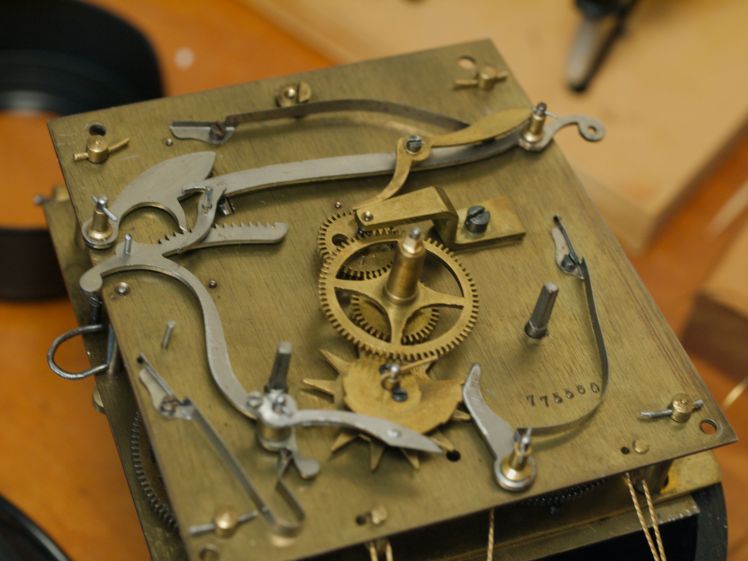
The movement is now fully disassembled and awaiting the next steps. In this blog article, the focus will be on cleaning and initial inspection for wear. In a post to follow, I will document bushing work, reassembly, and testing required to restore reliable strike operation before returning the movement to the case.
When I first received the replacement movement, I inspected it and found everything to be in good order, with no appreciable wear. I cleaned the parts in my ultrasonic cleaner; however, at the time, I did not completely disassemble the winding drums, as I believed there was no need to do so. On this occasion, the winding drums must be disassembled, as the cables are becoming frayed just outside the drum, requiring access to the knotted ends.
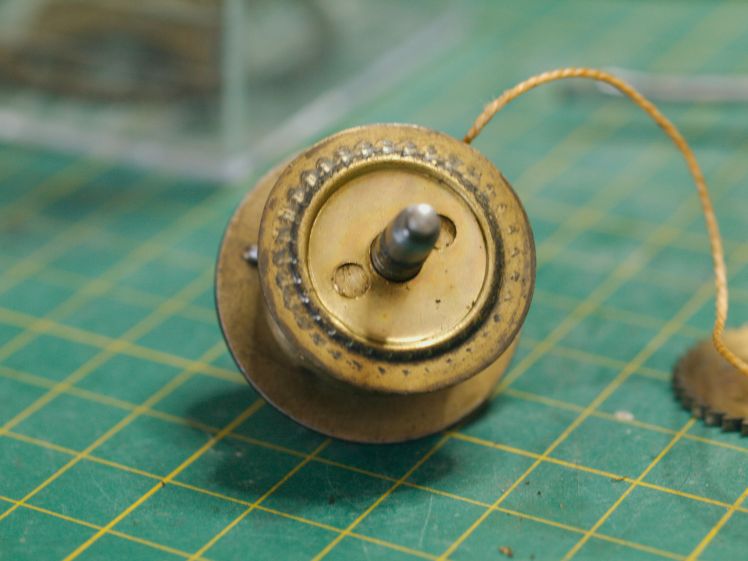
I inspected the braided cables and, rather than replace them, decided to reuse them. Although cutting off the knot at the barrel end will shorten the cables slightly, re-knotting the hook ends (the bottom of the movement) will restore them to their original length, so the run time should not be affected.
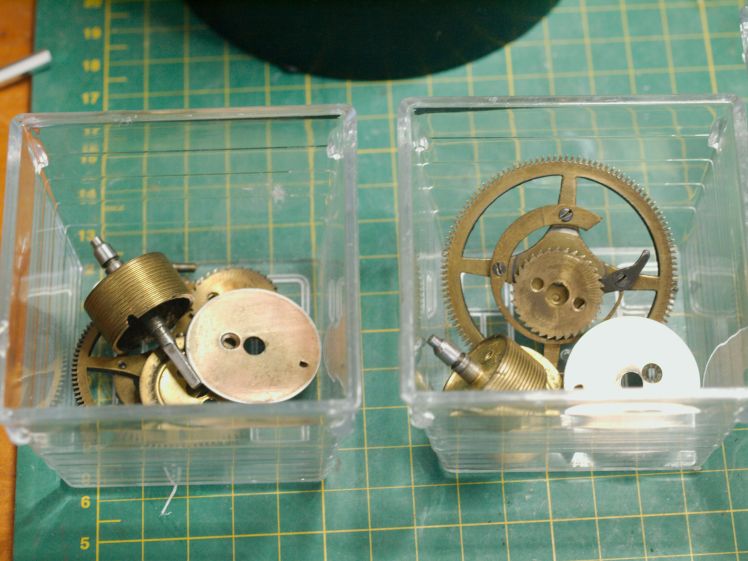
In the ultrasonic, I kept the winding drum parts separate. They may be interchangeable, but at this point, I’m not taking any chances. Interestingly, over a dozen parts make up each drum, most of which were taken apart for cleaning. I saw no need to disassemble the click spring, however. Once all the parts are out of the ultrasonic and dried thoroughly, the first step is to reassemble the winding drums and their cables, and set them aside for now.
Now that the movement is clean and the pivot holes have been pegged, it is time to turn our attention to the action of the gears. I first assembled and tested the time side and could find no perceptible wear. It’s a pretty simple setup with only 3 wheels: the second larger wheel, the third wheel, and the escape wheel. There are also 3 wheels on the strike side ending with the fly/governor. On the strike side, I can find some lateral movement of the pivots on the count wheel front and back plate, and the stop wheel, back, and possibly the front plate.
With the inspection complete, attention turned to the strike side, where the expected story revealed itself. Wear at several pivot holes was evident, the kind of wear you expect to find in a P27 movement that has been doing its job for well over a century. So, there is work to be done.
Did I wait too long? Yes, perhaps 9 years is a bit too long an interval between servicing points. None of it was alarming, but it does help explain some of the strike-related issues observed earlier. Addressing these worn areas will be an important next step, not only to improve performance but to give the strike train the freedom and reliability it needs for years to come.
Related Links
- Gustav Becker 2-weight Vienna Regulator -6 years later; writing about the clock in 2022 and how pleased I was with the purchase.
- Gustav Becker regulator Braunau factory 1902; A 2016 article describing the first issues with the clock.
Discover more from Antique and Vintage Mechanical Clocks
Subscribe to get the latest posts sent to your email.
 Antique and Vintage Mechanical Clocks
One thought on “A Return to the Bench: Wear-Related Strike Problems in a Gustav Becker P27”