
The American Banjo clock — often just called a banjo clock — got its name from the shape of its case, which resembles a banjo musical instrument. Although the design was patented in 1802 by Simon Willard, a renowned clockmaker from Roxbury, Massachusetts, Willard referred to his invention as the “Improved Timepiece,” not a banjo clock.
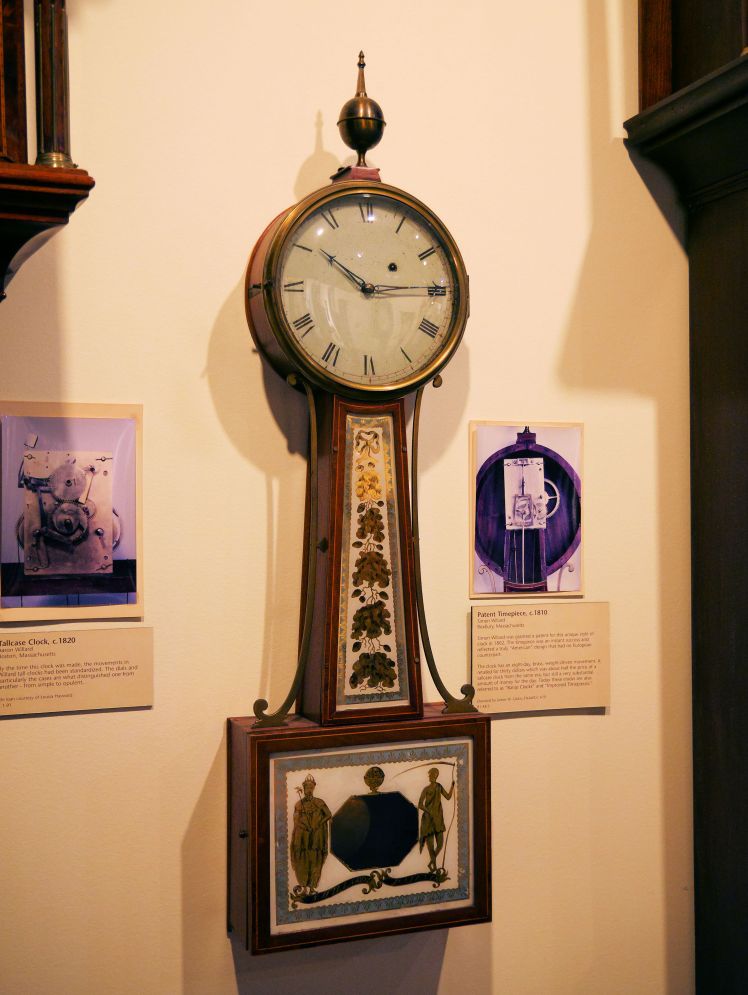
There are essentially three types of mechanical banjo clocks. Those with lever escapements are usually in the lower price range, spring-driven examples occupy the middle ground, and weight-driven banjo clocks represent the higher end, typically costing several hundred dollars in fair condition to several thousand for authenticated examples from reputable makers.
My wife spotted the clock on Facebook Marketplace one evening. It was listed for $100, and the photo immediately caught my attention. I had a feeling it might be a diamond in the rough. I suggested she offer the seller $75, and to our surprise, the offer was accepted almost immediately. It seemed they just wanted it gone.
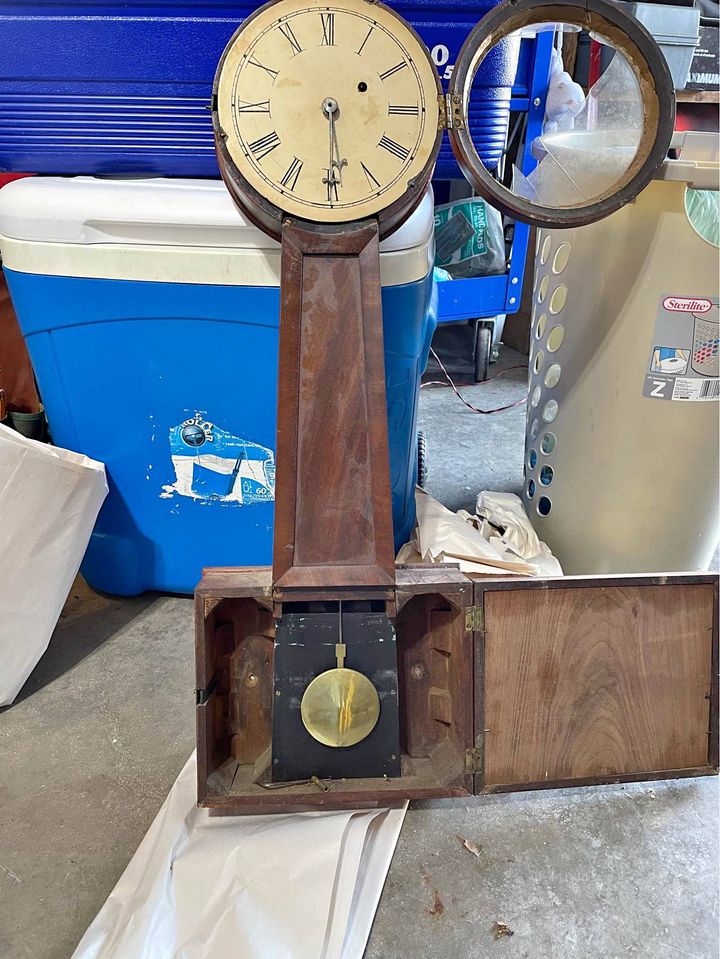
The clock was one of several items the seller had for sale as part of a community-wide garage sale. So, a day later, we made the drive out to the rural part of Nova Scotia where the sale was taking place. When we arrived, we found the house and asked to see the clock. It was sitting there among other odds and ends, looking a little tired but full of promise.

As we examined it, I asked a few questions about its history. The seller explained that it had belonged to an uncle in Wolfville, Nova Scotia—a man who had once owned a large collection of antique clocks and had been in the family for over 60 years. That was all I needed to hear.
Before we left, the seller asked if I might be interested in another clock—a 30-hour mantel clock. “It’s worth a lot more than that one,” they insisted, nodding toward the banjo clock. I smiled and politely declined. Something told me the first clock was the one worth keeping.
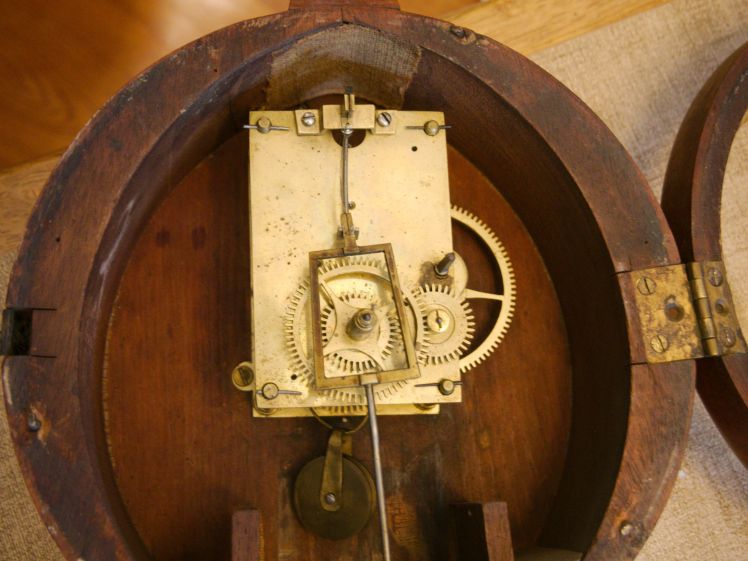
And I was right. Once we brought it home, cleaned it up, and did a little research, we discovered that it was indeed something special—a genuine, 1830s timepiece, a true diamond in the rough.
The clock was surprisingly heavy when I first lifted it, which told me right away that the weight was still inside the case. That was a good sign. Had it been missing, finding a proper replacement would have been a challenge—and there’s really nothing quite like having the original weight that once powered the movement so many decades ago.
It turned out to be a Federal-style banjo clock, housed in a rich mahogany case that bore the quiet dignity of age. The movement was intact, a promising start. At the top sat a graceful acorn finial, original to the clock—a small but telling detail. At first glance, I thought the carved reverse-scrolled side arms and lower base section were missing, but later learned that not all examples from this period included those features; In fact, simplicity was a defining feature of early timepieces.
The original steel hands, shaped in that classic banjo style, were still in place, and the dial face, though worn, retained much of its character. The glass bezel was broken but easily replaced. The case itself was dusty and a bit tired, with a few areas needing veneer work, a split wood bezel, but nothing beyond repair. As I examined it more closely, I discovered the winding crank tucked neatly into the bottom of the case—perhaps placed there by its last owner many years ago.
After some careful study and comparison with other examples online, and with help from a few knowledgeable members of a clock forum, I came to believe that the clock was made in the late 1830s in Boston—possibly by John Sawin. Sawin had apprenticed under Simon Willard and later worked as a journeyman for Aaron Willard, two of the most respected clockmakers of their day and inventors of the original patent timepiece. Unfortunately, there are no identifying marks on the case or movement, leaving its true maker a mystery—but a fascinating one all the same.
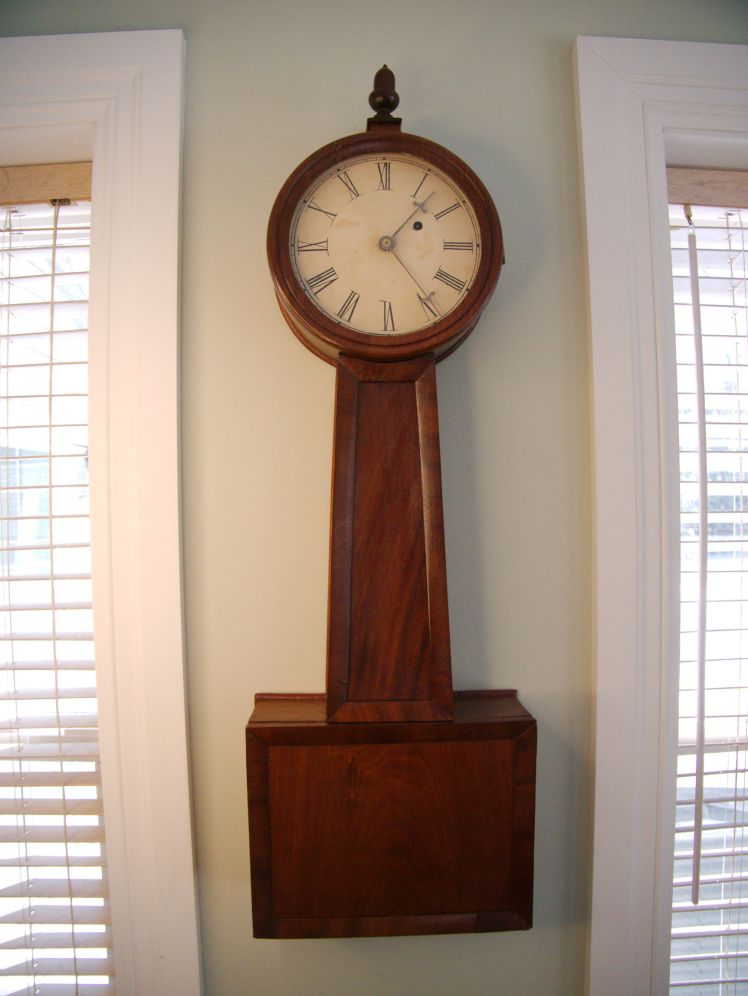
With that in mind, I decided to give the old clock the attention it deserved. What followed was a careful cleaning, a bit of veneer work, minor repairs, glass bezel replacement, and the satisfaction of seeing history come back to life.
Discover more from Antique and Vintage Mechanical Clocks
Subscribe to get the latest posts sent to your email.
 Antique and Vintage Mechanical Clocks
Another good one…happy ending…..hope you are having a wonderful holiday….🌞
LikeLike
Thank you, Ila.
LikeLike
Ron, I think, to bring to life a clock from the 1830’s was a noble undertaking, and that you’ve honored the unknown clockmaker. Your clock looks very much like this one (especially the movement): https://www.delaneyantiqueclocks.com/clocks/clock/john-sawin-boston-massachusetts-wall-timepiece-or-banjo-clock-mm-172#photo-51555 Is this the oldest clock you have restored? Thanks for the blog!Kevin
Yahoo Mail: Search, Organize, Conquer
LikeLike
As much as I would like to say it’s a Sawin timepiece, and it has all the features that a banjo made by him would have, there is nothing on the movement or the case that confirms it.
LikeLike
Great story. Especially love the Nova Scotia reference. My dad was from Parrsboro NS.
Sent from my T-Mobile 5G Device
LikeLike
Thank you.
LikeLiked by 1 person
hi Ron, thanks for your emails. Very informative very detailed. I have a tall mantle clock the type with three pains of glass in it like the one you showed repairing the top trim, which is why I’m writing this message. Mine does not have the trim and I cannot find any. I was wondering if you could make a pattern of it and get it to me someway. Thanks in advance.
LikeLike
hello, I’ve been receiving your emails for 45 months now and they are fantastic. I have a clock in possession that I cannot find the top trim for and was wondering if you could send me the profile off of one of your clocks. The clock I’m referring to is the tall mantle clock with three pains of glass in it and columns on each side that you showed repairing the top trim and veneer. Thank you in advance.
LikeLike
Send me a photo or two to ronjoiner@antiquevintageclock.com
LikeLiked by 1 person