
Echoes of an Unknown Maker: A Banjo Clock’s Journey Through Time

The American Banjo clock — often just called a banjo clock — got its name from the shape of its case, which resembles a banjo musical instrument. Although the design was patented in 1802 by Simon Willard, a renowned clockmaker from Roxbury, Massachusetts, Willard referred to his invention as the “Improved Timepiece,” not a banjo clock.

Willard-style banjo clock, c. 1810

There are essentially three types of mechanical banjo clocks. Those with lever escapements are usually in the lower price range, spring-driven examples occupy the middle ground, and weight-driven banjo clocks represent the higher end, typically costing several hundred dollars in fair condition to several thousand for authenticated examples from reputable makers.

My wife spotted the clock on Facebook Marketplace one evening. It was listed for $100, and the photo immediately caught my attention. I had a feeling it might be a diamond in the rough. I suggested she offer the seller $75, and to our surprise, the offer was accepted almost immediately. It seemed they just wanted it gone.

Seller’s photo, looking a little tired

The clock was one of several items the seller had for sale as part of a community-wide garage sale. So, a day later, we made the drive out to the rural part of Nova Scotia where the sale was taking place. When we arrived, we found the house and asked to see the clock. It was sitting there among other odds and ends, looking a little tired but full of promise.

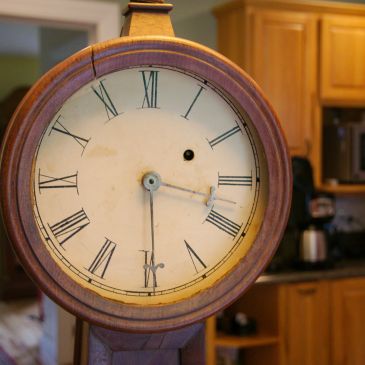
Broken dial glass, original hands

As we examined it, I asked a few questions about its history. The seller explained that it had belonged to an uncle in Wolfville, Nova Scotia—a man who had once owned a large collection of antique clocks and had been in the family for over 60 years. That was all I needed to hear.

Before we left, the seller asked if I might be interested in another clock—a 30-hour mantel clock. “It’s worth a lot more than that one,” they insisted, nodding toward the banjo clock. I smiled and politely declined. Something told me the first clock was the one worth keeping.

Classic time-only movement

And I was right. Once we brought it home, cleaned it up, and did a little research, we discovered that it was indeed something special—a genuine, 1830s timepiece, a true diamond in the rough.

The clock was surprisingly heavy when I first lifted it, which told me right away that the weight was still inside the case. That was a good sign. Had it been missing, finding a proper replacement would have been a challenge—and there’s really nothing quite like having the original weight that once powered the movement so many decades ago.

It turned out to be a Federal-style banjo clock, housed in a rich mahogany case that bore the quiet dignity of age. The movement was intact, a promising start. At the top sat a graceful acorn finial, original to the clock—a small but telling detail. At first glance, I thought the carved reverse-scrolled side arms and lower base section were missing, but later learned that not all examples from this period included those features; In fact, simplicity was a defining feature of early timepieces.

The original steel hands, shaped in that classic banjo style, were still in place, and the dial face, though worn, retained much of its character. The glass bezel was broken but easily replaced. The case itself was dusty and a bit tired, with a few areas needing veneer work, a split wood bezel, but nothing beyond repair. As I examined it more closely, I discovered the winding crank tucked neatly into the bottom of the case—perhaps placed there by its last owner many years ago.

After some careful study and comparison with other examples online, and with help from a few knowledgeable members of a clock forum, I came to believe that the clock was made in the late 1830s in Boston—possibly by John Sawin. Sawin had apprenticed under Simon Willard and later worked as a journeyman for Aaron Willard, two of the most respected clockmakers of their day and inventors of the original patent timepiece. Unfortunately, there are no identifying marks on the case or movement, leaving its true maker a mystery—but a fascinating one all the same.

Fully restored clock on display in my home

With that in mind, I decided to give the old clock the attention it deserved. What followed was a careful cleaning, a bit of veneer work, minor repairs, glass bezel replacement, and the satisfaction of seeing history come back to life.

The Willard House and Clock Museum

Simon Willard Museum, Grafton Mass.
Willard House and Clock Museum, Grafton Mass.

Visiting any clock museum is always an interesting and engaging experience.

On our way from Boston to Springfield Ma. to attend the NAWCC (National Association of Watch and Clock Collectors) Convention 2019 we stopped in a small community called Grafton and in that community is the Willard House and Clock Museum one of the foremost museums of its kind in America. The unassuming location on a quiet country road in a pastoral setting of fields and forest was a pleasant surprise. The museum was the home of Benjamin and then, Simon Willard, celebrated clockmaker and inventor. Born in 1753 Simon Willard spent his formative years in Grafton, later moving to Boston.

The Willard name may not be immediately recognizable outside the United States but he is regarded as important source of innovative design in the American clock industry.

The vast collection of clocks housed inside is surprising for the size of the museum. The collection ranges from Massachusetts shelf clocks, to tall-case and Willard’s famous banjo clocks.

Viewing room of the museum

Continue reading “The Willard House and Clock Museum”

Website Powered by WordPress.com.

Up ↑