
Some time ago, I came across an ad on Facebook Marketplace for a clock owned by an older couple who lived about forty-five minutes from our home on the East Coast. When I first saw the photo, something about the clock caught my eye—it had character, a quiet dignity, and I had a feeling it might be special. I reached out to the seller through Facebook, and after a brief phone conversation, we agreed on a price that he felt was fair.

Finding their home wasn’t straightforward. We took a few wrong turns, but eventually found our way to a modest single-wide house nestled in the woods about twenty minutes from a larger coastal town. It was the kind of home that had clearly been lived in for decades.
A man in his early seventies greeted us at the door with a polite smile tinged with sadness. As we stepped inside, he excused himself and disappeared for a moment, returning with the clock in his hands. I asked him why he had decided to sell it, especially since he mentioned it had belonged to his grandmother and had been in his family for as long as he could remember.
He paused before answering, his eyes drifting toward the window. “My wife and I have decided to go our separate ways,” he said softly. “She wants to live in town, but I can’t bring myself to leave this place. Everything I care about is here—my shop (which was larger than his house!), my tools, my memories, but we have to get rid of some stuff”.
As he spoke, it became clear that the clock was more than just an heirloom—it was a piece of his past, a witness to the life he had built in that home. Letting it go wasn’t just about making space; it was about closing a chapter.
I examined the clock carefully, noting that it was complete and in good condition. “I’ll take it,” I said with a smile. Just inside the case, I noticed a penciled marking that read “Hebb and 1944.” The seller recalled a Hebb family who once lived in the Bridgewater area of Nova Scotia, near where I purchased the clock — perhaps a clock tinkerer.
“Okay,” he replied, then hesitated for a moment before adding, “Would you happen to be interested in Elvis Presley memorabilia?”
I glanced over at my wife, who was already trying not to laugh. The question caught us both off guard—we couldn’t have been less interested in that sort of thing, but his earnestness made the moment oddly endearing.
Huron shelf clock by E. Ingraham & Co.
It is a rosewood-veneered Huron shelf clock by E. Ingraham & Co., Bristol, Connecticut. It features a paper-on-zinc dial with a round glazed door and a lower glass access panel. The Huron is one of the less commonly found Ingraham models of the period, having been manufactured briefly between 1878 and 1880. The maker’s label remains intact on the inside of the backboard. The clock has a brass, eight-day, spring-powered movement and stands 16 inches tall.
The veneers are in excellent condition, with no splitting or cracking. The clock face shows a build-up of grime, which I chose to leave as is. The base corner pieces show slight wear, but both door catches are sound. The glass is perfect, the door hinges are in excellent condition, and both the upper and lower doors still fit with precision. The pendulum retains its original lacquer and presents well. Before examining the movement, a gentle push of the pendulum suggested that something was amiss.
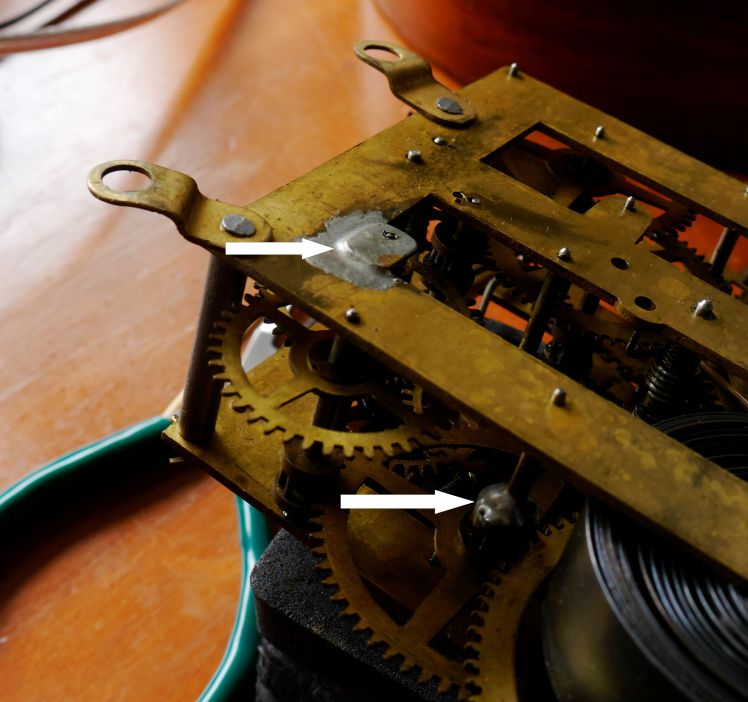
Once I extracted the movement from its case, it was certainly not without its issues. There was plenty of solder applied here and there—evidently, a past repairer believed that the more solder, the better. During restoration, all traces of it were carefully removed, and the movement was thoroughly cleaned and brought back to full working order.
I’ve often said that if the day ever comes when I’m compelled to downsize my collection, this would be one I’d keep. Not for its rarity or provenance, but because it embodies everything I admire in a clock—the craftsmanship, the quiet dignity, and the enduring beauty of something well made and lovingly preserved, and the story that became part of it.
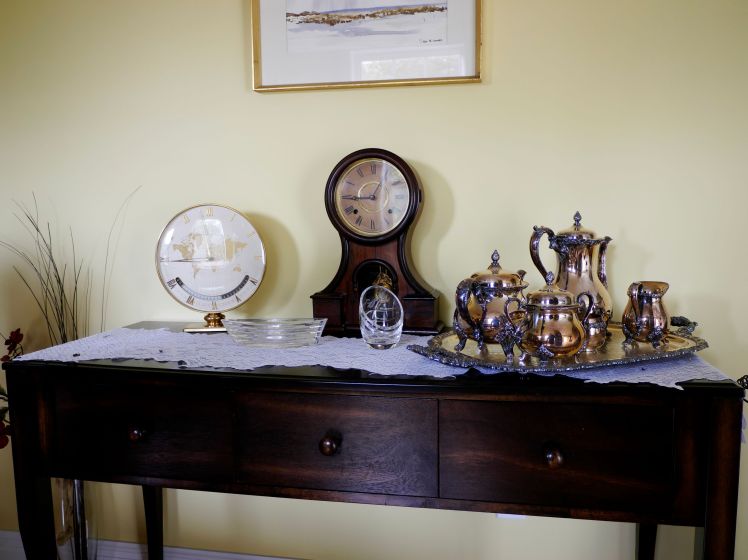
In the end, it’s pieces like this that remind me why I collect—not to own more clocks, but to honour the skill and spirit of those who built them, one tick at a time.
Discover more from Antique and Vintage Mechanical Clocks
Subscribe to get the latest posts sent to your email.
 Antique and Vintage Mechanical Clocks
Happy …..sad….downsizing is hard……glad you have th
LikeLike
Getting rid of stuff is always a challenge when making major life decisions.
LikeLike