
It is uncommon for a mechanical clock to run 25, 30 years or more with nothing more done to it other than the occasional oiling. I recently received a letter from someone who had taken his clock to a repair shop, where he was quoted a high price (in my view) for the repair and told that the clock would be guaranteed for 30 years. I wonder if the repair shop would be prepared to honour that guarantee after all those years, assuming they were still in business. In any event, most reputable repair shops would not offer more than a year’s warranty.

In this post, I will discuss what it means to service a mechanical clock and explore some of the factors that influence how long a clock’s movement will last and how to prolong its life. Those factors will help you decide the best service interval for your antique or vintage clock.
Key Things I Look For
Normally, the clocks in my collection are inspected on a 3-4 year cycle. I remove the movement from its case, check its condition, and if dry, re-oil it. If I notice a particular clock stops occasionally and I find the need to investigate, I will service it simply as a prudent measure. Clocks that stop occasionally are sending a clear message that they require your attention.

While the movement is out of the case, I inspect it closely, paying particular attention to the condition of the oil around the pivot holes. If there is no oil in a pivot hole, I may simply re-oil the movement. However, if I observe green or black residue around the pivots, it indicates a more serious problem. At that point, dirt and other contaminants have mixed with the clock oil to form an abrasive paste. This paste acts like a fine grinding compound, gradually wearing away the brass in the pivot holes and scoring the steel pivots themselves. In the early stages of residue buildup, there may be little wear, and the movement, once disassembled, may not require re-bushing.
Left unchecked, friction can lead to oval-shaped holes and eventually, a clock that stops running altogether.
A Clock’s Environment
I have addressed this subject in a previous article, which you can find here.
Common Reasons Why Clocks Stop—and How to Diagnose Them
Spring-driven time and strike clocks typically exhibit more wear on the strike side pivots due to the stop-and-start action of the hourly striking action.
Occasionally, I come across a movement where one side is much more worn than the other. I recently worked on a movement that required six bushings on the time side but none on the strike side. A previous owner was evidently bothered by the striking sound, leaving the strike side unwound. The sound of a striking clock is bothersome to some, especially in the early hours of the morning during a restless night. Getting used to a clock chiming or striking through the night can take time.

Here, we’ll distinguish between striking and chiming clocks. A striking clock simply strikes—always on the hour to indicate the time, and often once on the half hour. A chiming clock, on the other hand, plays a musical sequence on each quarter hour and strikes the time on the hour. Quite often, people describe a clock as chiming when, in fact, it only strikes.
With chiming clocks, the chime train is first to respond to additional friction caused by dried oils and dirt. The additional complexity of the chime side means that more parts are subject to wear. The chime will eventually slow down and then stop altogether.
If I notice that I am not getting full power during the clock’s designed running cycle, I will investigate. For example, if a clock consistently stops at day 4 or 5 of its eight-day cycle, this tells me that the movement is either very dirty or there are very worn parts causing the clock to stop prematurely. Beyond that, another culprit is a weak mainspring. I do not routinely replace mainsprings, but it is a common practice among professional clock repair persons.
If your weight-driven clock stops before its designed cycle, check for twisted cables around the winding drum. Another issue is sympathetic vibration when the clock stops as the weights descend. As the weights descended to the level of the pendulum, a harmonic phenomenon occurred that is defined as “a formerly passive string or vibratory body responding to external vibrations to which it has a harmonic likeness”. Simply put; the power that drives the pendulum is now also being used to swing the weights; the pendulum doesn’t receive its full share of energy and eventually stops.
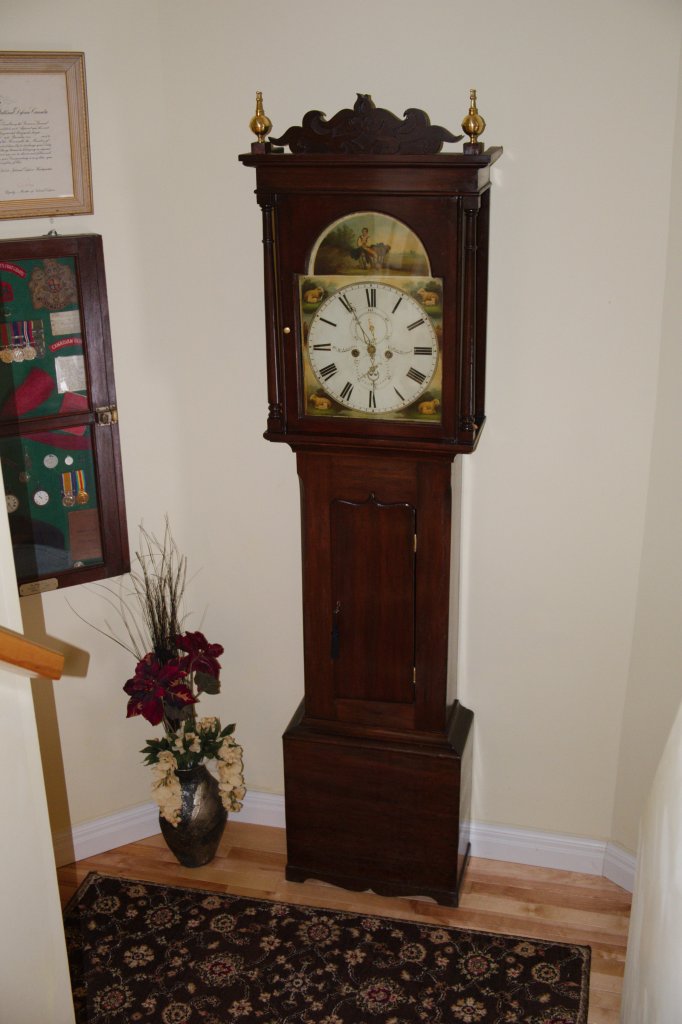
Otherwise, a weight-driven clock does not tolerate pivot wear well and will need to be taken apart to investigate for that and other possible issues.
Is the clock in beat? An out-of-beat clock will struggle to run or not run at all. Check that you can hear a steady tick-tock when winding your clock, and level the case as necessary.
I have found that different clocks have different levels of wear tolerance. It doesn’t take much wear to stop a German movement, whereas American time-and-strike clocks will tolerate pivot wear and still run reasonably well, even when very worn.
A kinked suspension spring, or one that is too stiff or the wrong size, can affect the oscillation of the pendulum.
A clock that will not run when the mainsprings are fully wound is often thought to be ‘overwound.’ The term ‘overwound’ is a myth, although it’s true that a tightly coiled spring, fused by old oil and dirt, might give the appearance of being overwound. Again, the clock must be taken apart, and while the mainsprings are being thoroughly cleaned, the entire movement must be seen to as well.
Quite often, I encounter clocks whose movements have been removed so many times that the mounting screws have become loose. This can be addressed by using slightly larger screws or by filling the screw holes before reusing the original screws. If left unaddressed, however, the movement can become unstable. A movement that is not properly secured in the case may shift, become misaligned, and put the movement out of beat.
Sometimes, an unusual problem may occur when the clock stops at the exact time every 12 hours. Check that the minute and hour hands are not interfering with each other.
Servicing a Movement – What Does It Mean?
How often should a mechanical clock be serviced? It is not as simple an answer as it seems.
If your clock does not work, cleaning it is the first step in determining the problem. Cleaning is just another word for servicing, and the term “servicing” in the realm of professional clock repair implies a complete tear-down of the movement.
Though it was a common practice in the past, dunking a movement in solvent and hoping for the best is not a substitute for proper servicing, nor is spraying the clock all over with lubricant. WD-40 is a favorite among novices, but it is not a true lubricant—it’s a water-dispersing agent.
Servicing a clock involves the following 13 steps:
- Removing the movement from its case,
- Let down the mainsprings (if present),
- Assessing the movement,
- Disassembling the movement, taking photos, or making notes,
- inspecting the parts carefully,
- Cleaning the movement either with an ultrasonic cleaner or by hand,
- Addressing any wear issues and repairing damage caused by abuse or failed parts.
- Reassembling,
- Oiling selected components,
- Running the movement on a test stand,
- Readjusting if necessary,
- Reinstalling into the case and,
- Re-adjust if necessary
There is no substitute for a complete tear-down of the movement.
Caring for a mechanical clock means more than just winding it and hoping it keeps time. Regular inspection, proper servicing, and attention to signs of wear can go a long way in keeping your clock running well for years to come. Understanding what your clock needs—and when—will help you preserve both its function and its value.
Discover more from Antique and Vintage Mechanical Clocks
Subscribe to get the latest posts sent to your email.
 Antique and Vintage Mechanical Clocks
Gre
LikeLike