
Have you ever wondered where the terms “half past the hour,” “a quarter past,” and “a quarter to the hour” originate from? At one time these terms were practical and necessary for understanding time when precise minute readings were unavailable.
Stepping Back In Time
The practice of dividing an hour into quarters comes from the way timekeeping developed in medieval Europe. The concept of dividing an hour into halves and quarters predates mechanical clocks and can be observed in the use of sundials.

The shadow’s movement was tracked relative to hour lines and intermediate markings, reinforcing the habit of describing time in fractions of an hour.
Mechanical clocks, first appearing in the 13th century, used gears to divide the hour into equal parts: halves and quarters. Early tower clocks for example often lacked dials entirely. Since most people could not read a clock face, bells were a way of indicating the time.
The addition of dials in the 14th and 15th centuries made it possible for people to see the time visually, along with the auditory cues of the bells.

Clocks with a Single Hand
Early mechanical clocks, which emerged in the late Middle Ages (around the 13th and 14th centuries), typically had only an hour hand. Minute hands were not introduced until the 16th century, and even then, they weren’t common until the 18th century.
The origins of phrases like “half past,” “quarter past,” and “quarter to” are connected to the period when early clocks had only one hand—the hour hand. These terms were practical and necessary for understanding time when precise minute readings were unavailable.

These one-handed clocks divided the clock face into 12 hours, with each hour subdivided into 4 quarters. The divisions on the dial were marked to indicate these fractions, making it possible to estimate time to the nearest quarter-hour.
Standardized Terms
Terms became standardized as clocks became widespread and people needed a common language to express specific points in time.
The term “quarter” derives from the Latin quartus, meaning “fourth,” reflecting the division of an hour into four 15-minute segments.
“Half past” signifies that half of the current hour has passed. This phrasing likely became popular in English because it is concise and intuitive. “Quarter past” means 15 minutes past the hour, while “quarter to” indicates 15 minutes remaining until the next hour. This usage reflects a practical way of describing time, based on the idea of dividing the hour into quarters.
Reading Time with One Hand
Since these clocks could only approximate time, people described it in terms of the fractions visible on the clock face. Some common phrasings including some mentioned above are:
| “Half past” meant the hour hand was halfway between two hour marks. | “Quarter to” referred to the hour hand being three-fourths of the way toward the next hour. |
| It’s six, without the o’clock | It’s half-five, referring to 5:30 for example |
| “Quarter past” indicated the hour hand had moved one-fourth of the way between two hour marks. | Some cultures use after rather than past, or to rather than till |
| Non-specific times such as around five or around 11 | Or specifically, it’s exactly eight |

Cultural Impact Then and Now
This method of time-telling became ingrained in the language long before the widespread use of minute hands. Even after clocks with two hands became standard, the traditional phrases persisted because they were convenient and widely understood.
But today the phrases are beginning to leave our vocabulary.
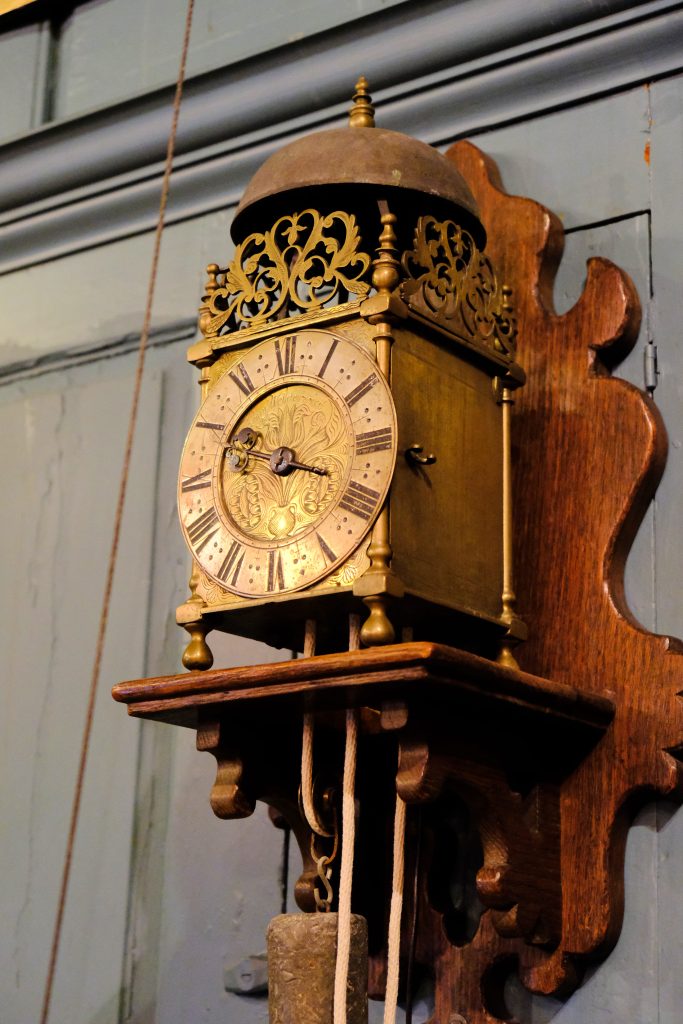
These expressions seem to be fading from modern use reflecting changes in how we interact with time and the use of precise numbers when we communicate. As analog clocks become less prevalent in homes, schools, and workplaces, fewer people are exposed to the visual representation of quarters and halves on a clock face.
Despite this decline, these phrases still hold cultural and historical significance and are likely to persist in certain contexts, such as storytelling, or traditions involving analog clocks.
Indeed, many young people today struggle to read an analog clock or have difficulty understanding the meaning of the hands.
While writing this article, my wife asked me for the time. ‘It’s 5:47,’ I replied.
Discover more from Antique and Vintage Mechanical Clocks
Subscribe to get the latest posts sent to your email.
 Antique and Vintage Mechanical Clocks
good morning Ron and thanks for another great article. As I wind a couple 30 hour movements this morning I wonder how did people keep their clocks on the correct time in the 1800’s ? A time before wrist watches, or a phone to call the rail station for the current correct time, and many people living in remote areas couldn’t see the town hall clock. So how did they determine the exact time in order to set their clocks ?
LikeLike
There were several ways people adjusted their clocks. Many communities and individuals relied on sundials to get an approximate idea of the time during daylight hours. Sundials could be fairly accurate if they were well-maintained and properly positioned.
In areas near a church, people often relied on the church bell as the local time standard, adjusting their clocks accordingly. Many churches did not even have clock dials. I have also read that “timekeepers” sometimes traveled through rural areas with a reliable pocket watch or marine chronometer, offering to set or adjust household clocks for a small fee.
Ron
LikeLiked by 2 people
….and will get even more obtuse as physicists convince us that dark matter (or is it dark energy?) Stretch time via the gravitational pull of thier unseen Mass.
LikeLike
Interesting sentiment.
LikeLike