
Transporting antique clocks requires meticulous care due to their delicate mechanisms and fragile components, including glass panels and chime or strike rods. Whether you’re moving a clock across the house, across town, or shipping it across the country, proper packing and handling are essential to avoid damage.
However, this guide focuses on the steps needed to safely relocate your antique clock from one room to another.
Although we are only moving a tall case clock, often referred to as a grandfather clock, a few meters to another room in our house, it’s important to follow several key steps to prevent damaging the clock.

The Clock
This Ridgeway tall case clock was made in the mid-1990s by the Pulaski Furniture Company, which is still in operation today as part of HF Hooker Furnishings in Virginia, USA. We acquired the clock in 2013 from a collector in Halifax, Nova Scotia.
The closest match to its model name appears to be “Hamilton Country.” The Ridgeway line was eventually absorbed by the Howard Miller group about 20 years ago. New Ridgeway clocks feature Howard Miller-owned Keininger movements but in the 1980s and 90s, Hermle movements were typically found in Ridgeway grandfather clocks. This Hermle 451-033 movement in this clock has Westminster chimes and a midnight blue moon phase dial.
The clock is being moved to create more space between our main entryway and dining room. It is much better suited for display in our living room, which recently had its carpet replaced with hardwood.
Although one person can move the clock it is best left to two people.
Supplies
Before you begin, collect the necessary materials to ensure a safe process. This is a simple move so, other than a method of moving it to the new room the only supplies you will need are cotton gloves, twist ties, and padding (Styrofoam/sponge) for the chime rods. A moving dolly is optional, as the clock case is surprisingly light once the weights are removed from the case.
Remove Weights and Pendulum
Antique clocks often have fragile or loose parts that can potentially be damaged. Safely removing these components before moving is the key.
Since this is a weight-driven clock, I first remove the weights, label them left, right, centre, and place them away from the clock in a safe location. Check the underside of the weights as they might have a small sticker with a letter indicating their location. “L” for left, and so on. Mine are already labeled.
Next, carefully remove the pendulum and place it in a safe area. I use cotton gloves to protect against tarnishing the brass components. In this case, the pendulum is hooked onto a leader. To access the leader a side vent is removed so that you can observe the leader coming off the hook and the pendulum is then lifted out of the case.

The glass is often the most vulnerable component and can be challenging to protect completely. Simply be mindful of the glass when moving the clock a short distance.
Secure the Chains and Chime Rods
My Ridgeway clock features pull-up weights. After removing and setting the weights aside, it’s essential to secure the chains. Use a twist tie to secure each chain, preventing them from becoming unhooked or tangled.
The clock’s delicate movement is securely anchored on the seat board and protection is not needed since the clock is moved only a short distance.

Chime rods produce a wonderful sound but are brittle, and even slight movement can cause them to collide and potentially break. If your clock has chime rods, they can be protected with Styrofoam blocks or pieces cut from a sponge placed between the rods.
If your clock is cable-wound, I recommend running the cables fully onto their respective drums. Before removing the weights, tie a string around each weight hook, run the string, and secure it tautly to a hook at the bottom of the case (most tall case clocks have a transport hook on the inside bottom of the case). By carefully securing and protecting the cables, you can help ensure they remain tangle-free and in good condition during the move.
Flooring Type
Since this clock was being moved to a new location which also had a hardwood floor I was not concerned about flooring issues. Hardwood flooring eliminates concerns about potential issues like uneven surfaces, leveling difficulties or thick carpeting, which could affect the clock’s stability or leveling once it is relocated. To reiterate, tall case clocks should not be placed on carpeted flooring.
Moving the Clock to a New Location
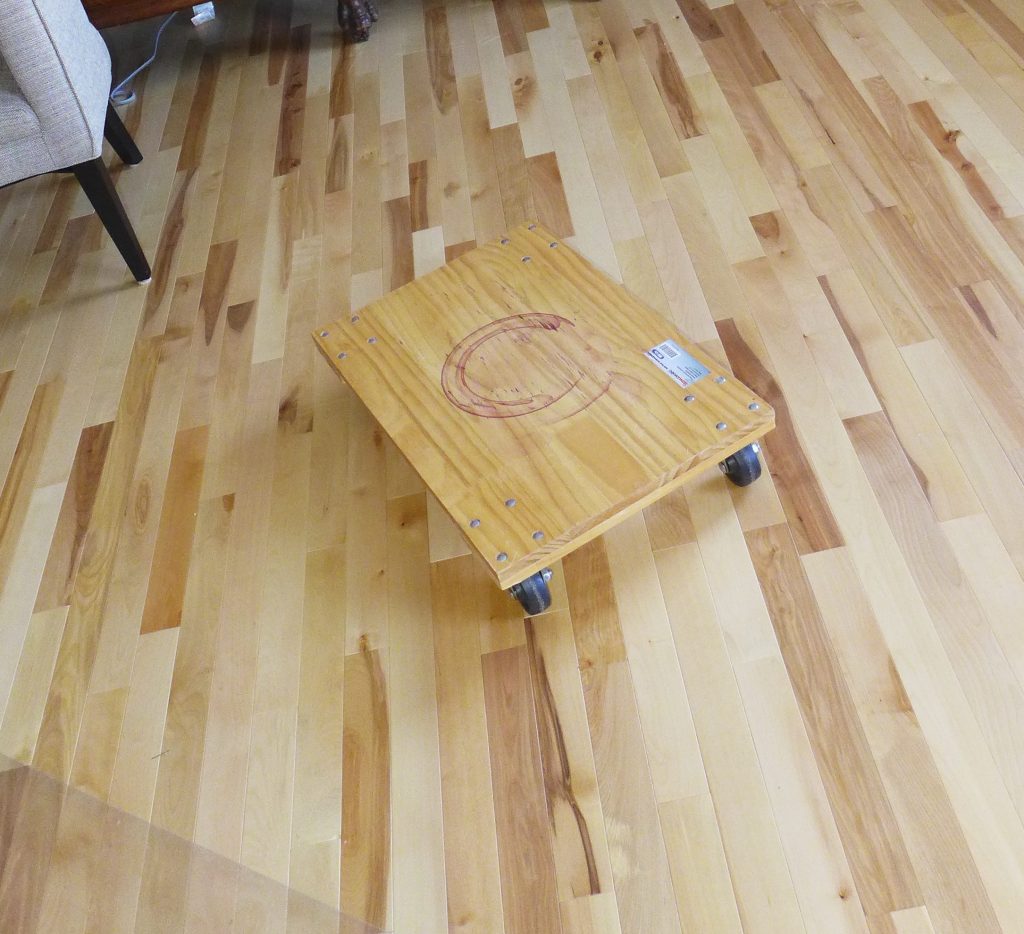
We used a dolly to move the clock most of the way but when it could not fit under a doorway we carried it the last meter.
Leveling
Don’t assume the floor in the new room is level, so be prepared to make some adjustments. The final step before re-attaching the pendulum and weights is leveling the clock. On modern tall case clocks, there are adjustment screws at each corner that turn clockwise to raise the clock and counterclockwise to lower it. Adjust both axes as needed until the clock is level.

Once the weights are reattached and the pendulum is returned to the case, verify that the clock is running properly.
Proper handling and preparation are crucial to prevent unnecessary damage to tall case clocks, even when moving them just a few meters.
NOTE: Please refer to this article if you are transporting your clock from one location (across a city for example) to another.
Discover more from Antique and Vintage Mechanical Clocks
Subscribe to get the latest posts sent to your email.
 Antique and Vintage Mechanical Clocks
Good morning Ron and thanks again for a great morning read. I can confirm that securing the chains so they don’t become disengaged from their respective drive hub is key. I recently acquired a shorter version of your grandfather and one of the chains was disengaged. Rethreading the chain onto the drum was a bit big a challenge as I had to dismantle much of the clock (face and case) to access it.
On another note I’m curious how long this short move took from beginning to end ?
LikeLike
It took about an hour, as I was slowed down by a repair to the inside bottom shelf. The shelf had been tenuously stapled together and had fallen down about a year ago and need to be screwed back into place.
LikeLike