
The origin of the name “schoolhouse clock” is not well-documented, and it appears that the term was not used during the time these clocks were made. Instead, it was later coined by collectors to describe a particular style of clock commonly found in school settings.
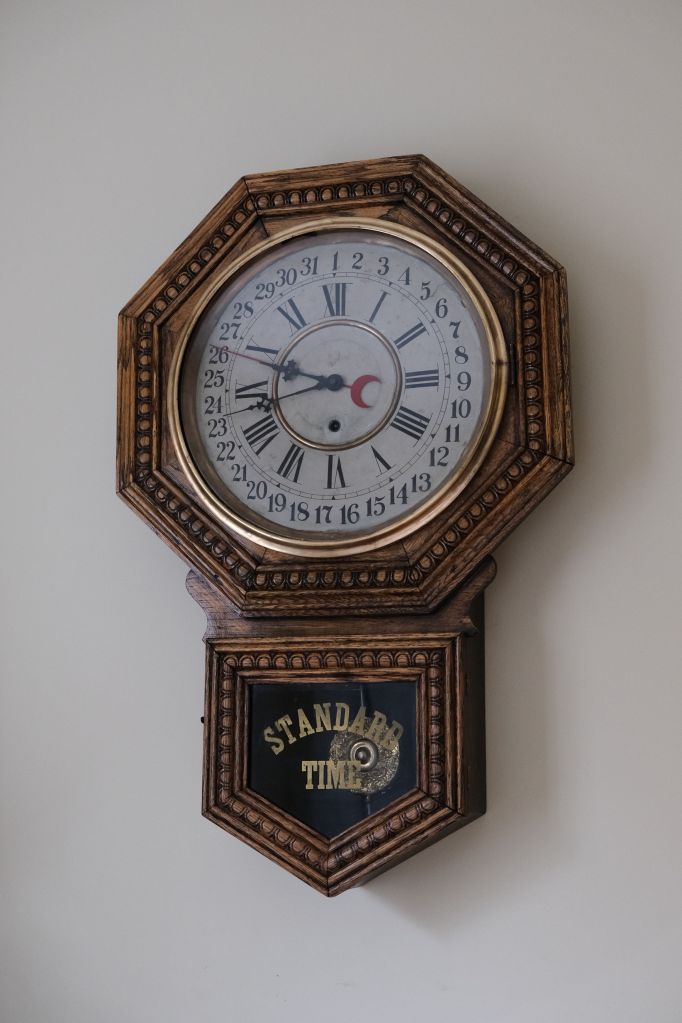
Schoolhouse clocks were the standard design for early North American schoolhouses due to their larger, easy-to-read dials. They were widely hung in schoolrooms across Canada and often had simple time-only movements, although some versions included a calendar function or time and strike movements. These clocks had a utilitarian look and were known for their durability.

The design of schoolhouse clocks is believed to be influenced by English drop dial fusee clocks, which were produced in the late 18th and 19th centuries. Drop dials closely resembled schoolhouse clocks and featured conical constructions with a chain or gut line pulled by a mainspring barrel, providing even power release for improved accuracy. Complicated movements such as these did not find their way into inexpensive mass-produced American and Canadian schoolhouse clocks.
When purchasing a clock, the author always asks the seller about its history and provenance.

In the case of the Sessions Drop Octagon wall clock pictured above, the seller had acquired it from a decommissioned one-room schoolhouse in Springhill, Nova Scotia. The clock, dating back to the 1920s, features a solid oak case, original hands, a pressed brass pendulum bob, a solid brass bezel, and a tin dial pan with stenciled lower glazing. While the paper dial showed signs of discoloration and wear, the clock was in reasonably good condition for its age.
Upon bringing the clock home, the author discovered that it ran for only a short time before stopping. A rubbing sound around the pendulum area indicated that the pendulum bob was hitting the inside of the case. After correcting a bent crutch rod, cleaning the movement, and making some adjustments, the clock started running properly. The author considered replacing the paper dial, which had brownish spots from prolonged exposure to moisture but decided to keep it as part of its history.
Time-only movements, like the one in this schoolhouse clock, are relatively easy to work on, making them suitable for beginners in clock collecting and repair.
While the exact origin of the term “schoolhouse clock” remains uncertain, it has become a permanent part of the clock collector language. These clocks, with their distinct style and large dials, were commonly found in early North American schoolhouses and have since gained sentimental value and recognition among collectors.
Discover more from Antique and Vintage Mechanical Clocks
Subscribe to get the latest posts sent to your email.
 Antique and Vintage Mechanical Clocks
You must be logged in to post a comment.