
In the 1960s, T. Eaton & Co., one of Canada’s most iconic department stores, offered a variety of home goods to suit the tastes of the era. Among their diverse range of products was a charming collection of clocks, including the small but striking mantel clock that continues to capture the attention of collectors today. Its distinctive style and craftsmanship represented a unique intersection of mass-market appeal and decorative elegance.
In this article, we take a closer look at this somewhat ordinary-looking clock, exploring its design, history, and place within the broader context of mid-century Canadian home décor.
A changing economic and retail environment in the late 1990s, along with mismanagement, culminated in the chain’s dissolution in 1999. As a young child, I remember pouring through the Eatons “Christmas Wish Book” trying to decide on that perfect gift….for me!
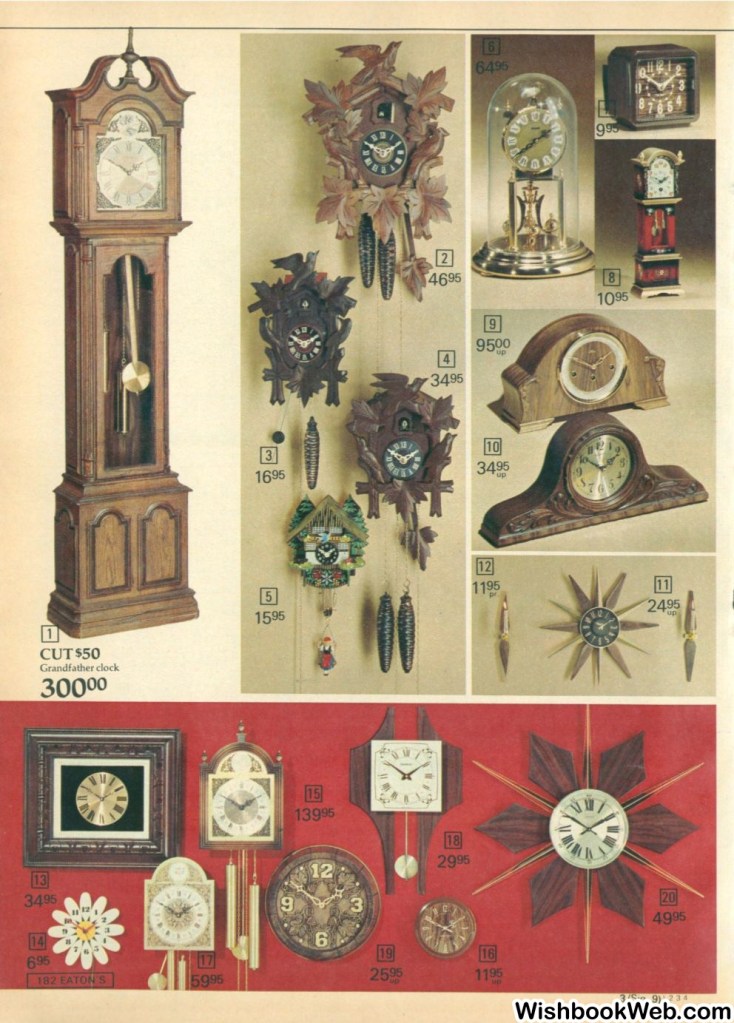
Eaton’s catalogue, as well as department stores spread across Canada, sold a variety of clocks including this mantel clock with a German-made Hermle movement under their house brand, Solar. Many of the Solar clocks sold from the 1950s through to the 1980s survive in Canadian homes to this day more as decorations rather than functional pieces.
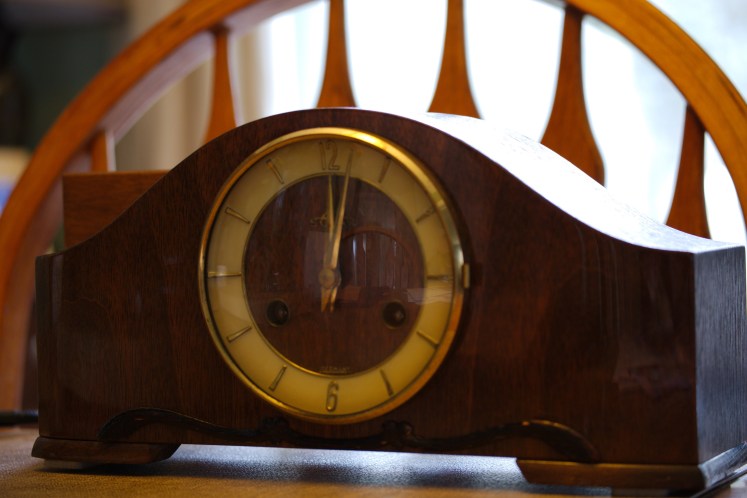
This particular example is a time and strike mantel clock featuring a 6″ dial and a dark walnut case. Priced at approximately $50 or $60 when it was first sold, it measures around 13″ wide, 7″ high, and 4″ deep. Its compact size makes it an ideal choice for homes where space is limited, fitting comfortably in nearly any room without overwhelming the space.
Equipped with a Type 141 German movement from Hermle, this clock features a recoil escapement, an 11cm pendulum, and operates at a rate of 200.8 beats per minute. It strikes on the half-hour with a bell, though its chime isn’t particularly melodious. As a testament to its design and durability, the type 141 is still being produced by Hermle GmbH & Co. KG today.
It also came with instructions and a product card from Eatons.
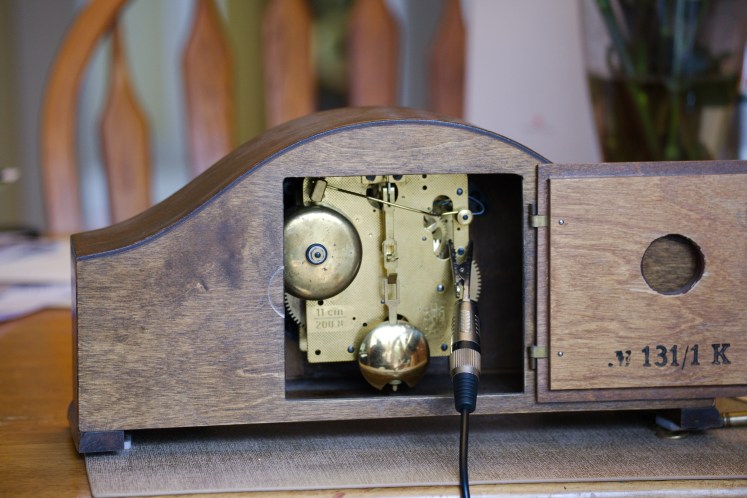
When I purchased the clock, it wasn’t running, and I hoped that a thorough cleaning would restore its function. The scratches and gouges on the backplate of the movement suggest that it has been serviced before. However, I won’t know the full extent of any previous repairs until I remove the movement from its case for a closer inspection. My main concern is the possibility of plated pivots, which were a common issue with Hermle clocks from the late 1970s to the late 1980s. Fortunately, I have a strong feeling that this clock predates that troublesome period.
The case, on the other hand, is in near-perfect condition.
It will be serviced and put up for sale. I am not normally in the business of selling clocks but will sell the odd one locally to trim my collection and cover clock supplies.
Look for an upcoming blog article on the servicing of the Hermle movement.
Discover more from Antique and Vintage Mechanical Clocks
Subscribe to get the latest posts sent to your email.
 Antique and Vintage Mechanical Clocks
You must be logged in to post a comment.