
On many German antique pendulum-driven clocks, including those made by manufacturers like Mauthe, you’ll often find various numbers stamped or engraved on the back plate of the movement. These numbers serve different purposes and provide valuable information about the clock’s origin, design, and specifications.
In this article, we will explore some of these numbers and explain their purposes.
In the lower portion of the backplate of the movement in question, there are a series of numbers. Some of these numbers have a clear explanation while others are somewhat of a mystery. For example, one number, the beats per minute number, helps a clockmaker regulate the movement during servicing.
Let’s begin with the number 34. The number 34 refers to the measurement in centimeters from the top of the suspension spring post to the bottom of the pendulum regulating nut.

The 34 cm measurement includes the following: the top of the suspension spring post, the suspension spring, the pendulum hanger, and the pendulum rod and bob. Within this total length, the suspension spring measures 2 centimeters. The pendulum rod, from the hook to the bottom, measures 26.5 centimeters
The number 116, located next to the number 34 on the movement, refers to beats per minute (BPM). Clock train tables typically express the timing of a movement in beats per hour (BPH). A movement running at 116 beats per minute will have 6,960 beats per hour. This information is invaluable for a clockmaker when regulating a movement during servicing.

On the movement pictured above is a peculiar number that does not relate to the running of the trains themselves.
The number 55006 is a patent number, issued to Heinrich Kielmann (Ruhrort/Rhein) in 1890 or 1891. The patent concerned the hanging of the pendulum. Kielmann not only manufactured loose movements for other makers but also allowed them to produce their own movements using his patented pendulum hanging system. This is why movements from various manufacturers may bear this patent number.
You might also come across another number.
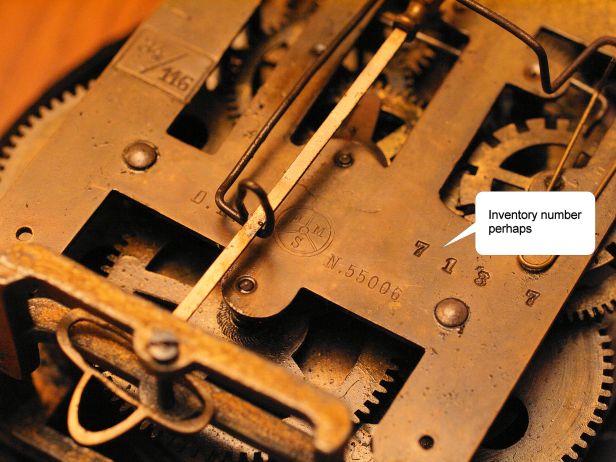
In the example above, the number 7137 could indicate a production number or a coded method of expressing the date, known only to the manufacturer. Occasionally, numbers may be reversed, as seen in earlier Junghans clocks, or they could represent a production number, where 7137 might correspond to the specific number of this clock within the range of movements produced that year. Without access to the database of Mauthe clocks, the last number remains a mystery.
Should you receive a movement without a pendulum rod, or a bob, these measurements can be invaluable for sourcing replacement parts. Knowing the precise length of the pendulum, the type of suspension spring, and the size of the movement can help you find or fabricate compatible components, ensuring the clock can be properly restored to working condition.
Alternatively, understanding these numbers will undoubtedly deepen your knowledge of clock collecting and repair.
Discover more from Antique and Vintage Mechanical Clocks
Subscribe to get the latest posts sent to your email.
 Antique and Vintage Mechanical Clocks
I would like to know where I could find a value for my wall clock That is very similar to the Antique German wall clock Old style Junghans, Horse top Vienna Regulator 1880’s. The difference is mine has two more horses flanking the larger center horse and the “glass” in the door is beveled and leaded. Where could I find info on the manufacturer and maybe value of this clock?
LikeLike
Hard to determine vale. I paid $150 for mine and have seen them as much a $300. Condition and completeness (are case pieces missing?) are factors influencing value.
LikeLike