
Another wall clock has joined my collection, so let’s take a closer look at what I’ve acquired and whether it was worth the price I paid.
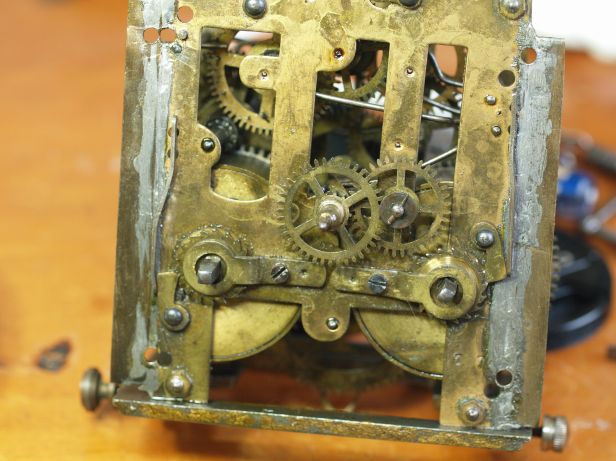
The clock was advertised locally in the Truro, Nova Scotia area. The seller knew little about it beyond its provenance, but what he did share was an interesting, albeit brief, story.
In the early 1980s, his wife brought the clock over from Holland, where it had been in her family for several generations. Sadly, his wife passed away three years ago. Had she been alive, I’m sure I would have learned much more about the clock’s history. The seller was understandably hesitant to part with it, as it served as a happy reminder of his past life. However, he was entering a new phase of his life with a new partner, which meant letting go of furniture and other possessions. Like him, I also view life as a series of phases. The clock was priced at $100, firm and non-negotiable.
This two-train (time and strike) spring-wound clock could be described as being in the style of a Vienna Regulator. As expected, the movement is quite dirty—a common issue for clocks like this that have often never been serviced. However, there are signs that adjustments were made at some point, evidenced by marks on several screws in the movement.
The clock is largely intact, except for a missing finial at the center of the bottom base. Why this particular part? According to the seller, the clock was brought over in a suitcase, and to make it fit, the bottom finial was snapped off and lost forever.
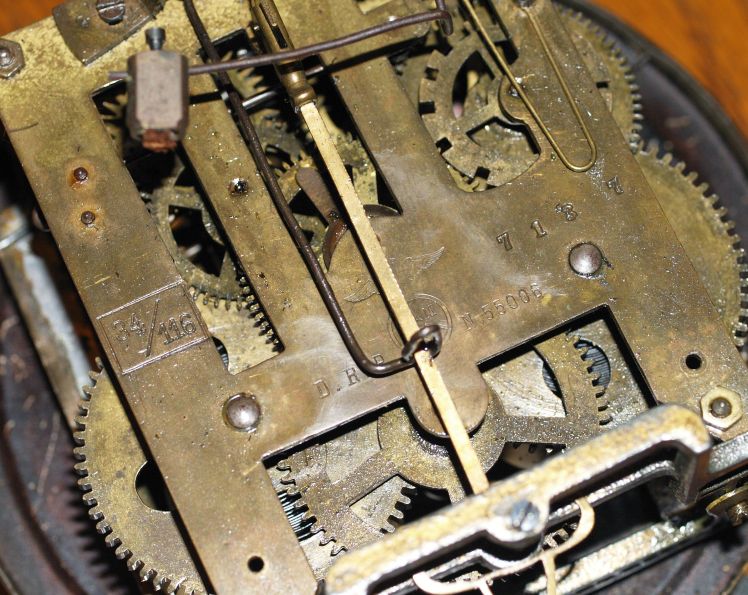
The clock is over 100 years old, with my research indicating it was made between 1895 and 1914, though the exact year of manufacture remains uncertain. The trademark—a Friedrich Mauthe of Schwenningen (FMS) emblem featuring three spokes with an eagle on top—is distinctive, as Mauthe trademarks are known to reflect the specific period during which the clock was produced.
Despite some benign neglect, the case is in good condition, and everything appears to be original, including the winding key.
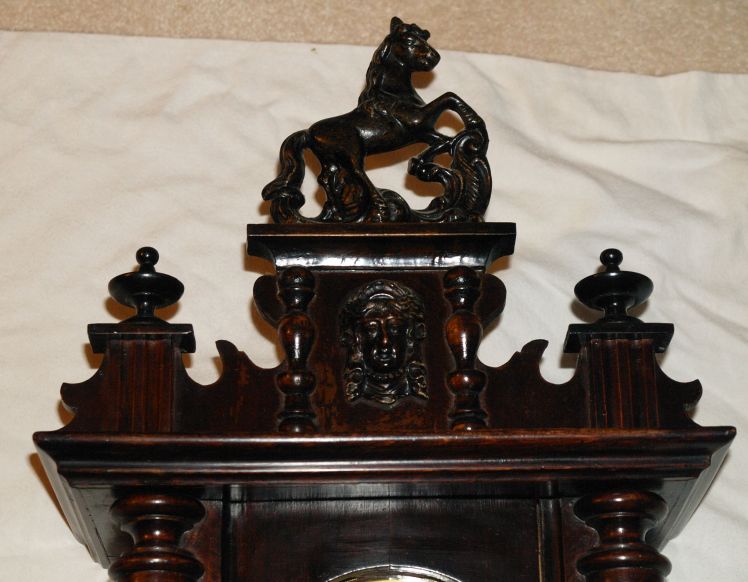
The crown fits into a slot at the top of the clock and can be easily removed if the clock needs to be relocated. The crown is made of wood, while the horse appears to be crafted from a casting material of some kind.
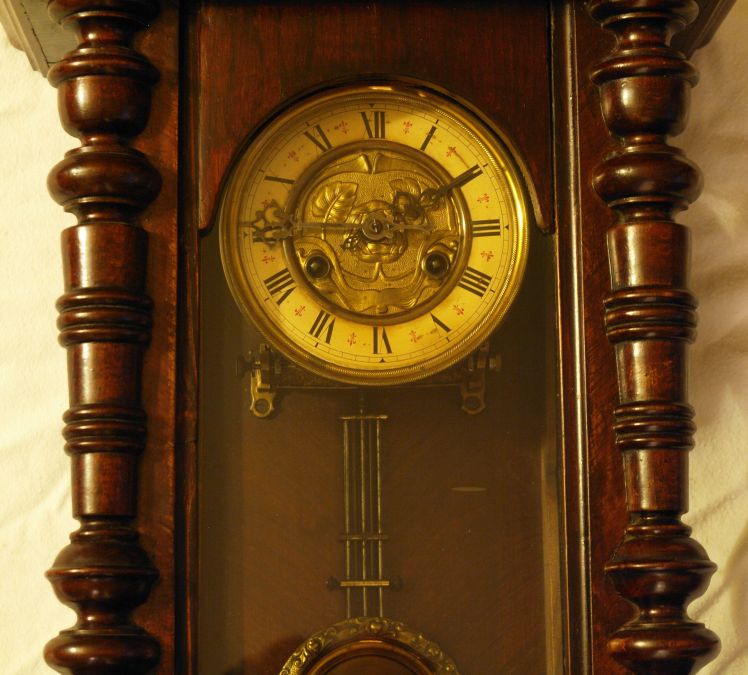
The dial is made of celluloid and has darkened with age. Inside the dial surround, there is a leaf-like emblem, a common design feature from this period.
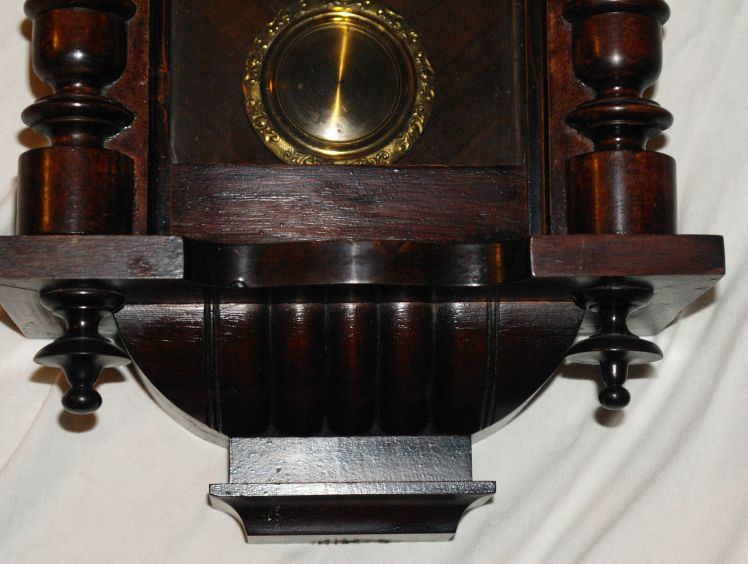
The base is fairly plain, though the bottom center finial is missing. I plan to replace it.
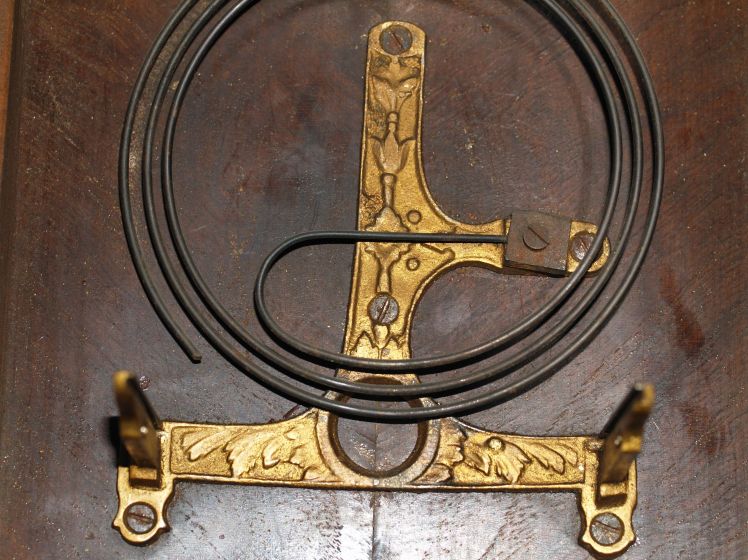
The coil gong and block with attached movement rails are characteristic of the period.
History of FMS Mauthe
Mauthe clocks have a long and distinguished history in Germany. In 1844, Friedrich Mauthe and his wife Marie founded the company in Schwenningen to produce watch parts. By the late 1860s, Mauthe began manufacturing its own wall clocks and movements. In 1876, Friedrich’s sons Christian (1845-1909) and James (1847-1915) took over the company. In 1886, Mauthe began producing its own springs. Around 1900, the company expanded its offerings to include alarm clocks, pendulum wall clocks, grandfather clocks, office clocks, and the so-called “Buffet Uhren” or “Buffet clocks.” In 1904, the third generation took charge: Eugene Schreiber (1877-1939), son of Christian Mauthe; Dr. Fritz Mauthe (1875-1951), son of Jacob Mauthe; and Alfred Mauthe (1879-1911), son of Jacob Mauthe, helped build upon the foundation of the company.
In 1925, Mauthe introduced a new trademark featuring a right-facing eagle with outstretched wings, clutching a three-part round plate inscribed with the letters F, M, and S. By the 1930s, the company was producing around 45,000 clocks per week, with approximately 60% destined for export markets like England. In the mid-1930s, Mauthe began manufacturing its first wristwatches, some of which were supplied to the German Army (“Wehrmacht”). After 1946, Mauthe resumed wristwatch production, but the company eventually entered a period of decline.
Was it worth $100? I would say yes, but it’s on the higher end of what I would typically pay for a clock like this.
Now, it’s time to clean the clock, install a new bottom middle finial, and add it to the queue for servicing.
Discover more from Antique and Vintage Mechanical Clocks
Subscribe to get the latest posts sent to your email.
 Antique and Vintage Mechanical Clocks
Happy to see this – my parents in law had exactly the same clock ! The wood was brighter and the horse stood (a bit loose) on the roof directly, so most likely a part was missing. We have destroyed (yes! yes!) the wooden case – quite a tough job, German quality. We found it sooo ugly, sooo old-fashioned! We left the the metal parts alive, though. The clock needs maintenance, because it does not continue to tick.
I could send it for free to a clock-lover for a build-in somewhere. Any hints?
Greetings from Brussels, Belgium
LikeLike
Beauty is in the eye of the beholder. I think it is a good looking clock but it is only my opinion. If it has the same movement as my Mauthe you could send it to me for use as parts should my Mauthe decide to stop.
Ron
LikeLike
I really liked reading through this blog. Sometimes I come across blog posts that makes me want to get started on bloggin myself. All the best!
LikeLike
It is easier than you think.
Ron
LikeLike
I’ve recently started a blog, the info you provide on this website has helped me tremendously. Thank you for all of your time & work.
LikeLike
You are welocme.
LikeLike