
This clock wasn’t one I set out to find. My wife and I were wandering through a sprawling antique shop in Almonte, Ontario—the kind of place where time itself seems to stand still. She drifted upstairs while I lingered below, each of us lost in our own quiet hunt. A few minutes later, she appeared at the top of the stairs and called down, “Take a look at this!” I climbed up, curious, and there it was—a clock that neither of us had expected to see, yet somehow felt right. We looked it over, exchanged a knowing glance, and decided the price was fair. A few moments later, it was ours.
For a while, I admired the clock just as it was—until a small detail caught my attention and led me down another path of discovery.
I initially thought the clock was complete until I posted a query on an online clock forum site and discovered that it was missing two trim pieces.
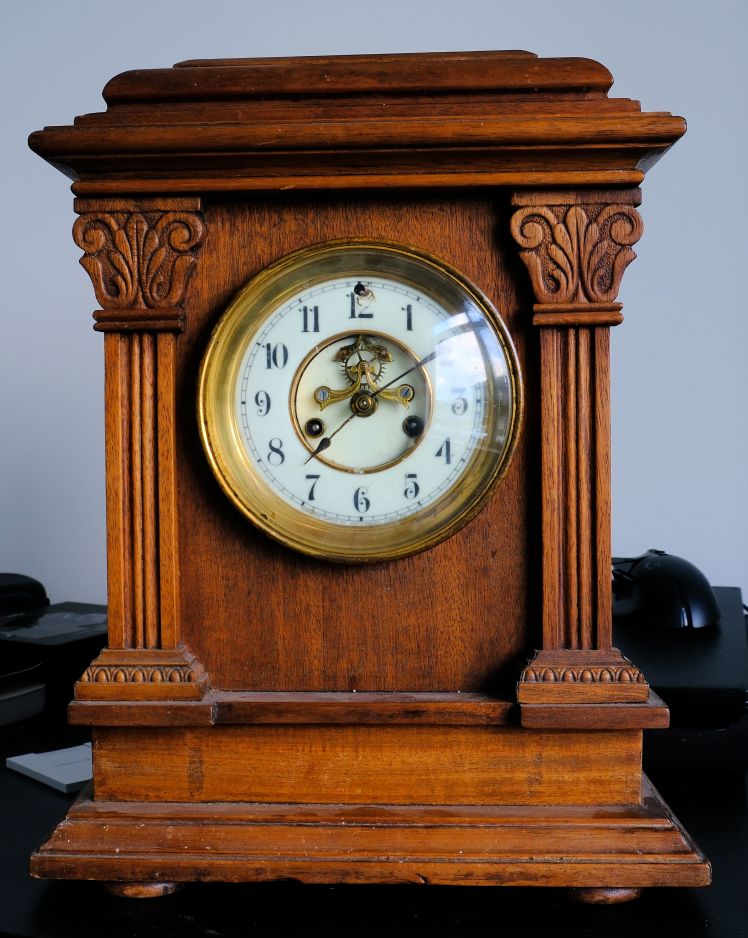
However, I also learned that the clock was named the Suffolk and was offered for sale by Waterbury from about 1907 to 1915. The clock is shown in Tran Duy Ly’s Waterbury Clocks book on page 270, which includes an image.
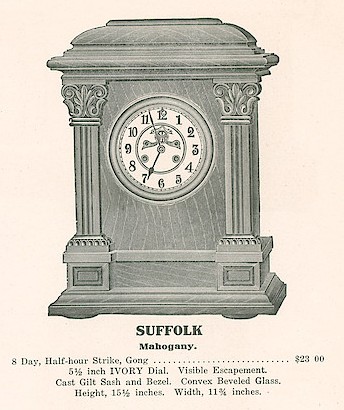
It is cased in mahogany, has an eight-day movement, and features a half-hour strike with a coiled gong. The six-inch “ivory” (porcelain?) dial has spade and spear hands and a visible or open escapement. It includes a cast gilt sash and bezel with convex beveled glass. The clock is tall at 15½ inches and 11¾ inches wide, with wooden biscuit feet.
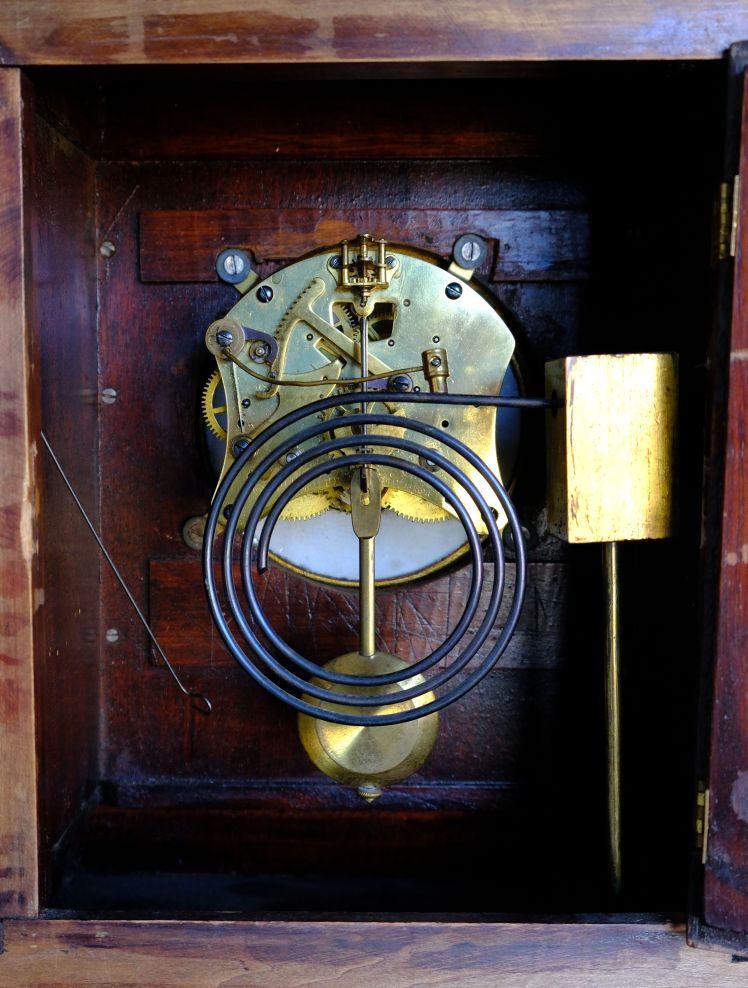
I asked myself what I should do about the missing trim pieces. I also wondered how they had fallen off, but it appears they were glued on at the factory and may have been vulnerable to coming loose if struck. In my experience, once a piece comes off and becomes separated from the clock, it is unfortunately lost forever.
The original pieces were carved mahogany blocks with a center cut-out. Since I don’t have the tools to duplicate that process, and the router bits I have are far too large for this type of work, I decided to come up with what I felt was an acceptable alternative.
I didn’t have any mahogany among my scrap wood selection, but then I remembered some trim pieces I’d received from a friend’s old pump organ about a year ago. At the time, I had no idea how I would use them, and as I suspected, they turned out to be made of mahogany.
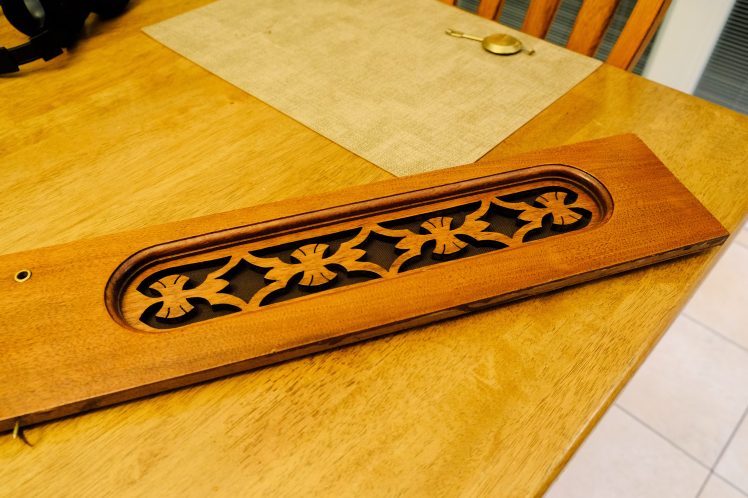
Using a table saw, I cut out two test pieces to determine if the repair would work. They looked acceptable, even if not quite sized correctly, and since I had enough mahogany, I set about carefully measuring the final pieces. I decided to stack thinner sections in a relief style—quite the opposite of the original design.
Because the clock’s case parts varied slightly in tone, I knew the new pieces would end up a shade darker.
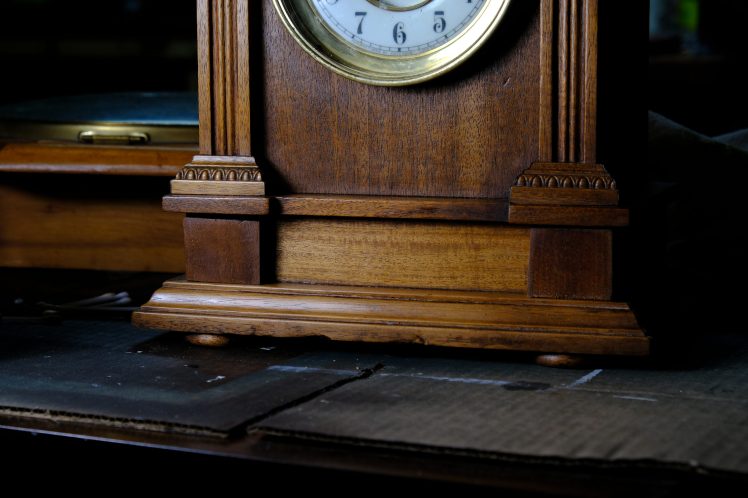
I then cut the final pieces, sanded off the finish, glued the sections together, and attached them to the base of the clock using carpenter’s wood glue. The final step was applying two coats of finishing paste wax. The clock now looks more complete, and unless one is familiar with the original design of the missing pieces, they would be hard-pressed to notice the difference.
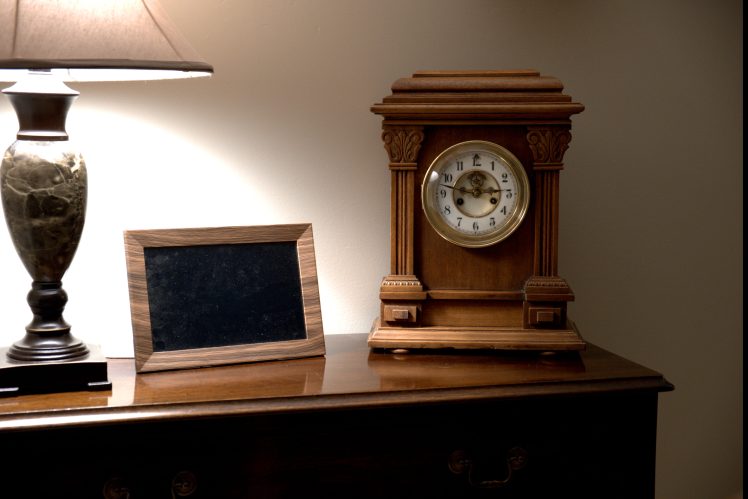
Making changes to a clock’s case is never easy, for each alteration risks straying from what once was. Yet restoration is, by nature, a communication between the past and the present—to reconcile what time has taken and what care can restore. Though the change departs slightly from the original, it brings balance to the design in my view, and renews the clock’s quiet dignity. In that sense, I am content with the outcome.
Restoring the Suffolk reminded me that even small imperfections can lead to creative solutions. While my replacement trim pieces differ from the factory originals, they complement the clock’s character and preserve its charm—proof that restoration is as much about craftsmanship and ingenuity as it is about authenticity.
For those who appreciate a visual commentary, check out a 3 1/2 minute video I made during the project:
Discover more from Antique and Vintage Mechanical Clocks
Subscribe to get the latest posts sent to your email.
 Antique and Vintage Mechanical Clocks
gre
LikeLike
Your addition of the blocks look good , nothing missing now.
LikeLike
Thank you.
LikeLike
looks very nice to me.
A beautiful clock!
LikeLike
Looks perfect to me. A really nice clock
LikeLike
Thanks.
LikeLike