
Every so often, a clock turns up that makes you stop and think, “Well, that’s something you don’t see every day.” That was certainly the case when WT of Peterborough, Ontario, sent me pictures of an interesting find—a Hamilton Clock Co., rather ordinary-looking short-drop schoolhouse-style wall clock with an unusual twist.

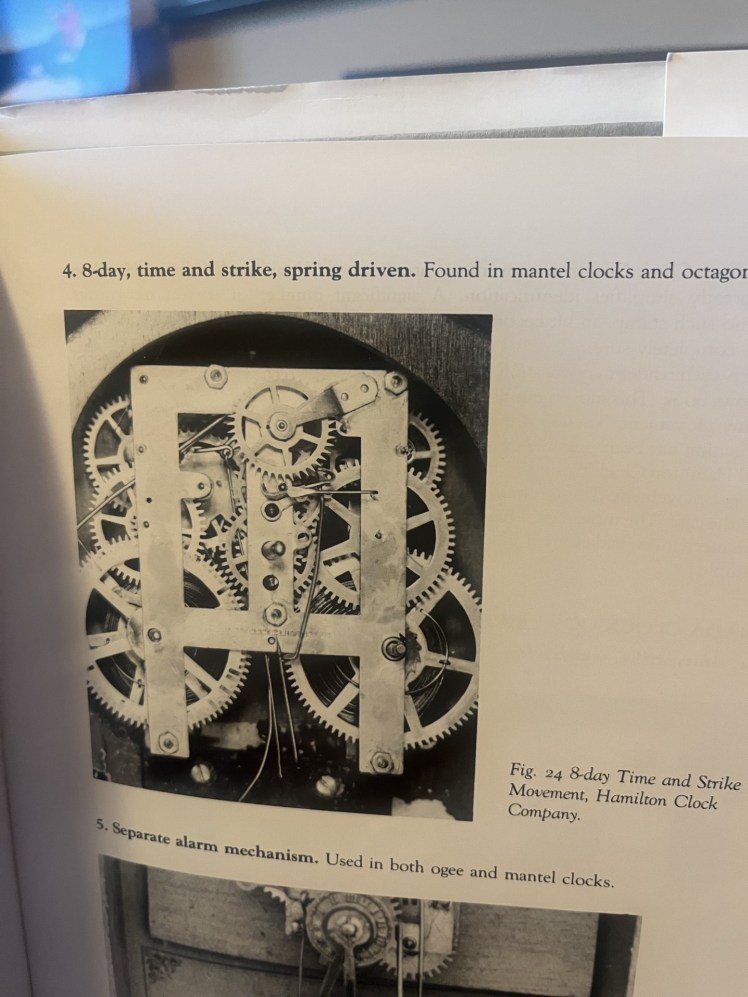
At first glance, the case is exactly what you’d expect: a classic Canadian-made schoolhouse clock, sturdy and handsome, dating to the late 1870s. But it’s the movement inside that tells the real story. Instead of a standard 8-day time and strike mechanism, this one is—quite literally—cut in half. The strike side has been sawed off, leaving only the time side to keep things running.
Other manufacturers at the time would have designed a proper time-only movement, but Hamilton seemed to have taken the practical (and perhaps cost-saving) approach of simply chopping an existing one down. Efficient, if a bit unorthodox!

I asked WT how he came across it, and his story adds another layer of charm.
“I was at a garage sale hosted by a fellow horologist about a year ago (summer of 2024) and bought up a mess of stuff. This clock was in rough shape. I told him when I discovered it that it was a Hamilton. ‘I’ve always wanted a Hamilton.’, I said. He said, ‘No, you take it.’”
And just like that, WT became the caretaker of a rare and quirky piece of Canadian clockmaking history.
A Little About the Hamilton Clock Company
For those less familiar with Canadian clockmaking, the Hamilton Clock Company has an interesting—if brief—story. Founded in 1876 in Hamilton, Ontario, the company was part of Canada’s early attempts to establish a domestic clock industry that could compete with American imports.

In those days, American clockmakers like Seth Thomas and Ansonia dominated the market. Canadian firms had to be creative, and sometimes that meant cutting corners (in this case, quite literally!).
By taking an existing 8-day strike movement and sawing off the strike train, Hamilton avoided the cost of designing and tooling a new movement just for time-only models. The clock movement was evidently tailor-made for customers who just wanted a time-only movement in their clock. It was a practical solution, but one that makes today’s collectors raise their eyebrows when they see it.
WT says that one can literally see the saw blade marks on the movement where it was cut.

Unfortunately, the Hamilton Clock Company was short-lived. By the early 1880s, it had folded, and its assets were eventually acquired by the Canada Clock Company. Later (1904), the Arthur Pequegnat Clock Company of Berlin (renamed Kitchener in June 1916), Ontario, was formed to become Canada’s best-known domestic clockmaker.
That makes these surviving Hamilton clocks something special. They’re scarce, they often have quirks, and they represent the scrappy beginnings of Canadian horology.
A Clock with Character
WT’s schoolhouse clock is more than just a timekeeper. It’s a piece of Hamilton, Ontario’s industrial past, a testament to Canadian ingenuity, and a reminder that sometimes the most unusual solutions are the most memorable.
From its industrial beginnings in the late 1870s, through more than a century of ticking, to a garage sale in Peterborough where it found WT, who truly appreciates it—this clock has lived a life. It may not strike the hours, but it certainly strikes a chord with anyone who loves Canadian horology.
Discover more from Antique and Vintage Mechanical Clocks
Subscribe to get the latest posts sent to your email.
 Antique and Vintage Mechanical Clocks