Over the years, I’ve explored countless stories tied to the world of horology, but few carry the prestige, legacy, and craftsmanship of A.G.U. Lenzkirch, one of the oldest and most respected German clockmaking brands. While there is much more to say about this iconic name, I’ve prepared a brief summary—based on information provided by brand owner Jens of the Jens German Company—highlighting its rich history and significance in the world of fine clockmaking.
In an era when heritage brands are being revived and newly appreciated, the A.G.U. Lenzkirch trademark is now available for purchase. For those with vision—whether launching a new line of precision clocks or watches, honoring the legacy of Black Forest clockmakers, or building a collection rooted in history—this is a rare opportunity to own a name synonymous with excellence.

Serious offers are welcome. While past estimates placed the brand’s value between EUR 50,000 and EUR 80,000, Jens believes a more reasonable and fair offer can be negotiated. Naturally, any transfer of ownership must be completed formally through a lawyer or notary.
If you’re interested in acquiring this historic trademark, feel free to reach out with your offer. You can contact Jens through me. Perhaps, like me, you’ll recognize the potential to breathe new life into a name that once set the standard for German clockmaking.
This is a unique opportunity—one that doesn’t come around often.
The Lenzkirch Story
Aktiengesellschaft für Uhrenfabrikation Lenzkirch (Public Company for Lenzkirch) was founded in 1851 in the village of Lenzkirch in Baden by Eduard Hauser, who had trained in France and Switzerland. The company carried on the tradition of Black Forest clockmakers. Hauser, the son of a teacher, was born on August 21, 1825, and gained experience building music boxes under Johann George Schopperle. During this period, he developed skills in metalworking, precision mechanics, musical instrument design, and even music composition.

The firm became renowned for producing exceptionally fine regulators. Well into the 1920s, Lenzkirch was still crafting precision movements with compensated pendulums. Junghans eventually acquired the company, and the factory closed in 1932, a casualty of the collapsed wall regulator market.
Company History
The Beginning of a Clock Empire
Aktiengesellschaft für Uhrenfabrikation in Lenzkirch was the oldest clock factory among the Black Forest manufacturers. Founded by clockmaker Eduard Hauser and Ignaz Schopperle, a mechanical organ maker, the company began in 1849 in a modest workshop producing clock parts. These were sent to clockmakers for final assembly, a shift from the traditional practice where clockmakers produced every part by hand.
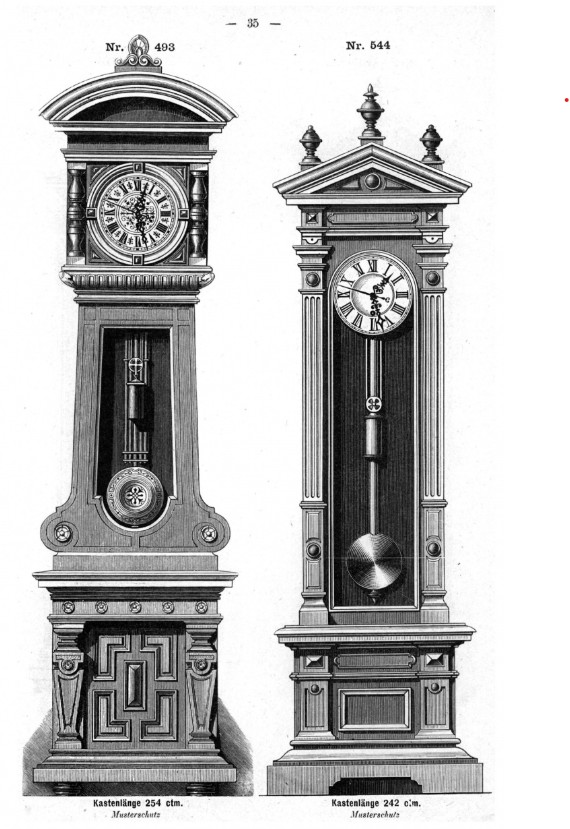
Hauser and Schopperle aimed to introduce “serial assembly,” delivering compact, machined, and pre-assembled clock movements to clockmakers. This innovation marked a turning point in horological manufacturing.
The Growth of the Company
Hauser soon employed 14 workers using hand-driven flywheel lathes and other tools. He invested heavily in machinery, draining much of his capital, and faced payroll and operational expenses without a robust marketing network or distribution plan. Growth was slow.

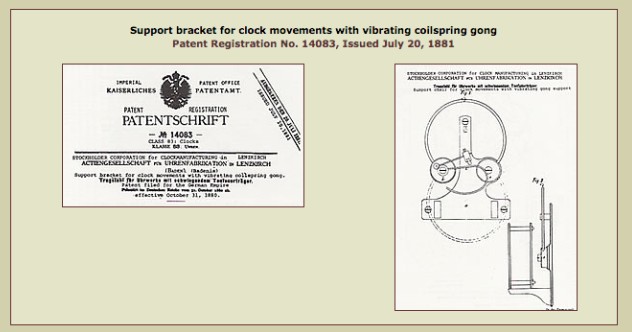
On August 31, 1851, Hauser approached Franz Joseph Faller, Joseph Wiest, Nikolaus Rogg, and the brothers Johann Nikolaus and Paul Tritscheller. Together, they officially formed Aktiengesellschaft für Uhrenfabrikation in Lenzkirch. In 1865, their brother Albert Tritscheller joined to study international clockmaking practices. With new financial support and strong management, Lenzkirch flourished. Powered by two steam engines and equipped with a gold and silver plating shop and a tool-and-die workshop, the company achieved remarkable technical excellence. Secrecy was paramount—Hauser famously covered machinery with linen sheets to protect trade secrets from visitors.
Delivering Clocks Becomes a Challenge
Eventually, Lenzkirch began full in-house movement assembly, with wooden cases imported and finished at the factory. The company’s reputation soared with the introduction of its German regulator, which won numerous awards in 1860–61. The Viennese-style wall regulator also gained popularity. The firm invested in R&D to develop durable mainsprings, both for its own clocks and others.

However, transporting the growing volume of finished clocks became a major obstacle. Franz Joseph Faller, fluent in several languages, launched an aggressive marketing and distribution campaign. He circulated catalogs, sent representatives to international expos, and opened offices in Florence and Venice. But operations remained based in the Black Forest.
After years of lobbying, Faller secured a railway extension to Lenzkirch, and on May 21, 1887, the first train arrived. Tragically, during the celebration, Faller suffered a fatal stroke moments after delivering the welcoming speech.
The Rise and Fall of Lenzkirch
For over 80 years, the Lenzkirch Clock Factory employed thousands who took pride in its renowned craftsmanship. At its peak, the factory had over 600 workers and contributed to making Lenzkirch a wealthy town synonymous with high-quality Black Forest clocks.
Lenzkirch was also a pioneer in employee benefits. In 1858, it began offering medical insurance and a disaster relief fund. Despite economic downturns and the Franco-Prussian War of 1870, the company maintained its commitment to quality.
Yet competition grew. New firms with modern equipment and better capital reserves began to outpace Lenzkirch. The company, still operating with mid-19th-century equipment, struggled to adapt. In 1928, the Junghans brothers proposed a merger. The factory was dissolved in August 1929 and functioned as a Junghans satellite until 1932, before being sold to a beauty salon equipment manufacturer in 1933.

Even today, Lenzkirch clocks remain highly collectible. Many are listed on eBay and through antique dealers and auction houses worldwide. Known for their quality and precision, Lenzkirch clocks continue to capture the attention of horology enthusiasts. The company ultimately sold over 1,000,000 clocks, with each movement stamped on the back as a testament to its legacy.
Disclaimer | My Role in the Sale
If you have further questions concerning the sale, I can pass them on to Jens.
As I mentioned, if you’re interested in acquiring this historic trademark, feel free to reach out with your offer.
However, I want to make it clear that I have no personal interest in profiting from the sale of this brand. As I’ve mentioned to Jens, my role here is simply to help him amplify this information and share it with readers of this blog. There may be someone among you, or someone you know, who would be genuinely interested in acquiring and preserving this prestigious and historic clock brand.
Discover more from Antique and Vintage Mechanical Clocks
Subscribe to get the latest posts sent to your email.
 Antique and Vintage Mechanical Clocks
I would love to have the chance to own this piece of history. But, Like many others that walk the earth, I like to breath also. that said; My would kill me…
To whomever has the chance and the means, DO NOT Hesitate… and God Bless you for your chance and ability to do so.
LikeLike