
As a clock enthusiast, collector, or someone simply looking to purchase a dependable antique or vintage clock, it’s natural to consider all your options. Chinese-made mechanical clocks are often attractively priced and readily available through online marketplaces like Facebook Marketplace and eBay, but before clicking “Buy Now,” it’s worth understanding why many horologists and repair professionals caution against these clocks—and why you may want to steer clear of them.
Inferior Craftsmanship and Materials
The most common criticism of Chinese-made mechanical clocks lies in their construction. Many are made using low-grade materials—cheap metals for gears, soft brass for plates, and low-tolerance machining. This results in movements that may run erratically, wear quickly, or fail outright after only a short period.
Chinese companies were producing them by the thousands.
Some of the most frequent problems reported include:
- Misaligned pivots and poorly cut gears
- Escapements are prone to failure
- Strong mainsprings (31-day clocks) that are dangerous to work on
- Inaccurate timekeeping, even after careful regulation
- Unreliable striking or chiming mechanisms
These issues aren’t just frustrating—they often make the clock uneconomical to repair, since the labor involved exceeds the clock’s value.

Lack of Longevity and Serviceability
High-quality mechanical clocks from North America, Europe, or Japan can run for decades with proper care. By contrast, many Chinese-made mechanical clocks barely survive beyond a few years. The movements are often designed without repair in mind. In some cases, they’re riveted instead of screwed together, making disassembly and servicing impossible or impractical.
If you’re knowledgeable about clock repair, these clocks can be serviced; however, if the parts are excessively worn, replacement parts are virtually impossible to find.
You won’t find service manuals or replacement parts for most Chinese-made movements, and the quality is often so inconsistent that even parts from the same model can’t be interchanged reliably.
Few professional clock repairers will touch these clocks. Those who do will often try to convince you to replace the movement with a quartz one, and to be honest, that’s not a bad option, particularly if the case is in good condition.
Knock-Off Designs and Deceptive Marketing
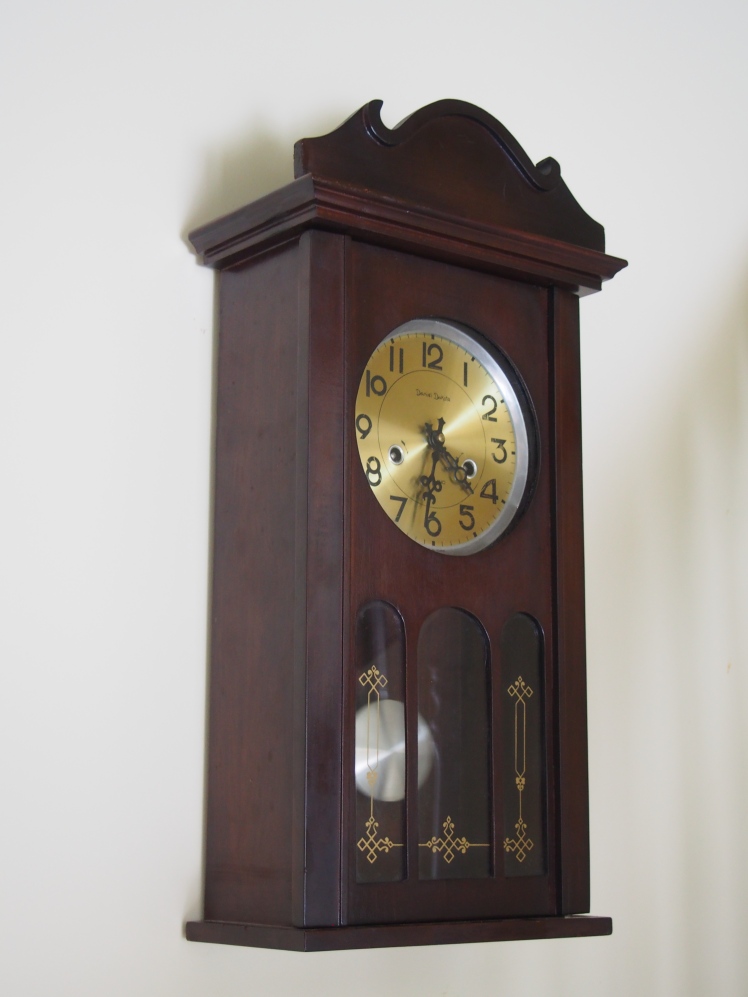
Many Chinese mechanical clocks mimic the outward appearance of high-end brands or antique designs. You’ll find skeleton clocks that resemble Hermle or Kieninger movements, regulator wall clocks styled like Vienna regulators, or “box” clocks with none of the refinement of the originals.
Some listings may even use phrases like “German-style movement” or “vintage design” to evoke a sense of quality or authenticity. Don’t be fooled—these are marketing tactics that mask low-grade manufacturing.
They Undermine the Clockmaking Tradition
Purchasing cheaply made mechanical clocks can inadvertently support an industry that values mass production over tradition, quality, and craftsmanship. When you buy from reputable makers or antique sources, you’re helping preserve centuries of horological heritage.

Brands and Labels to Approach with Caution
Western-sounding brand names were created specifically for export to make the products more appealing to North American consumers. While not every clock with a Chinese movement is inherently bad, the following brands and sellers are widely reported in horological forums and repair circles as problematic:
- Citizen
- Any clock that has “31 day” inscribed on the clock face
- Any clock with directional winding arrows
- Bulova
- Daniel Dakota, the most well-known export brand, sold at big-box stores
- Style House
- Emperor Clock Company
- Kingston
- Andover
- Tempus Fugit, not an actual brand, but commonly printed on dials of Chinese clocks
- Regulator, like “Tempus Fugit,” many wall clocks were simply labeled “Regulator” with no brand
- Alaron
- Mirado
- Elgin, pendulum wall clocks with faux weights or decorative fronts
- Westclox / Ingraham (rebranded)
There are many other brands, of course. Many of these are rebranded or unbranded mechanical clocks that look appealing in photos but have disappointing performance.
What to Buy Instead
If you’re seeking a mechanical clock that’s beautiful, functional, and serviceable, consider these alternatives:
- Antique or vintage clocks: Seth Thomas, Ansonia, Sessions, Gilbert, Waterbury, Arthur Pequegnat, Gustav Becker, HAC, Mauthe, Junghans, or Kienzle
- Modern German makers: Hermle, Kieninger (now part of Howard Miller), Schneider
- Japanese movements: Seiko, Rhythm (mostly quartz, but quality nonetheless)
- North American producers: Howard Miller (uses German Kieninger movements), older Ridgeway clocks used Hermle and Urgos), Chelsea Clock (USA)
These makers have established reputations, better quality control, and are backed by communities of repair professionals and collectors.
Final Thoughts
The allure of a budget-friendly mechanical clock is understandable. But as with many things, you get what you pay for. A $40 box clock with a Chinese movement may seem like a deal, but when it fails in six months and can’t be fixed, the true cost becomes clear.
I must admit that in my early days of clock collecting and repair, when I was still on the learning curve, I dabbled in these inexpensive clocks, knowing that if the movement wasn’t repairable, I could simply throw it away without feeling guilty, given how little I had paid for it. I had two, one I gave away, and the other was converted to a quartz movement.
If you’re new to collecting or looking for your first mechanical clock, invest in something that has stood the test of time or comes from a manufacturer with a reputation for quality.
Discover more from Antique and Vintage Mechanical Clocks
Subscribe to get the latest posts sent to your email.
 Antique and Vintage Mechanical Clocks
I have repaired about 4 of the chinese 31 day clocks with mainspring barrels , cheap and cheerful.
And about 3 Korean 31 day open mainspring clocks.
LikeLike
Like yourself I have repaired them as well but I am aware of the dangers they potentially pose.
LikeLike
Caveat Emptor. Applies to seasoned collectors. All the more so for those just starting out. Speak from experience.
LikeLike
Absolutely correct.
LikeLiked by 1 person
Absolutely agreed, and the caveat applies to much more than just clocks, especially tools!
I don’t know how to correctly ask a question, so: Can you help in setting the movable pallets on the anchors of a Henry Coehler 400-day clock (exact model unknown)? I tried setting them using Figure 6 of the Horolovar book, but it only runs for a couple of days before stopping.
LikeLike
If you followed the instructions, you should have a working clock. These clocks must be perfectly level to operate and must be in beat. An out of beat clock will eventually stop. I assume there or no kinks or twists in the suspension spring and the suspension spring is correct for the clock?
LikeLike
I hope I’m not usurping the name “scentedsupernaturally0f33dc0094:“. I’m dickwarner@me.com, and am replying re the 400 day clock. I don’t use facebook or any other social media, but surprisingly, was able to log in on WordPress.
I actually added leveling screws to the bottom of the clock so it could be placed on a less-than-prefectly-level surface, and level it by centering the tip of the ball assembly in the retaining ring on the base. I measured the thickness of the original suspension spring with a micrometer (0.0030″), and ordered Horolovar springs of that thickness, but found that the Horolovar springs are much softer than the original, so the clock ran very slow when I installed the Horolovar springs, even with the balls at their innermost positions. Thus I had to re-install the original spring, and it definitely has bends that I couldn’t remove entirely.
Since the pallet positions on the anchor, as shown in the Horolovar book, didn’t work, I’ve been attempting to adjust them so the anchor moves close to equal angles both sides of center, but it is difficult to make precise adjustments. I have a small machine shop in my garage, and made a fixture to hold the suspension spring while attaching the ends and fork. I am considering making another fixture to hold the anchor, with micrometer screws to help adjusting the pallets.
Thanks for helping! Dick
LikeLike
I have one Chinese 31 day clock that’s about 40 years old that I wind to run 7 days and a Korean made that I replaced the 31 day time-side spring with a “left over” 8 day spring. Not heirlooms but decent time keepers and not unattractive.
I have to point out that the Chinese are capable of excellent work, but the clocks (and many other items) made for export are generally built to the specifications of US or multinational firms. Not the fault of the Chinese!
LikeLike
Good point. Profitability was obviously the key factor.
LikeLike