
Back in 2017, I took on the restoration of a Junghans Crispi wall clock—a project that began with enthusiasm but has since tested my patience more than once. While the case restoration went smoothly, the movement has been another story. Despite professional servicing, bushing work, and later my own repair attempts, the strike side has never been entirely reliable.

Over the years, the clock ran well for a while, then faltered, especially in the strike train. A broken lever spring, a bent arbor, erratic striking, and a few close calls with delicate repairs have all played a part. In late 2024, the clock began stalling just before the warning phase, prompting me to extract the movement from its case to determine the cause of the stoppage.
Now, in Spring 2025, I’ve returned to the movement with a fresh perspective. The time side still runs fine, but the strike side remains unreliable. Based on my experience with similar movements, I suspect a combination of issues: a weak strike mainspring, one or more bent pivots, and poor alignment between the paddle and star wheel.
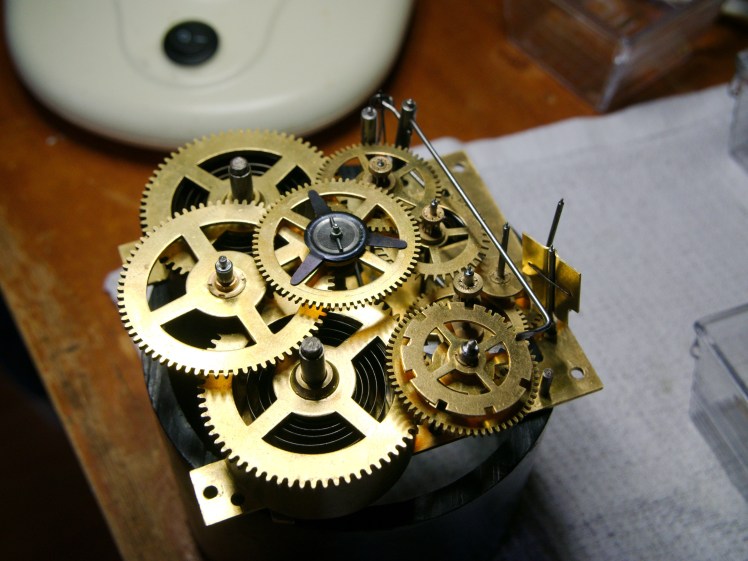
In this post, I’ll walk through the next phase of troubleshooting—cleaning the movement, inspecting the spring, inspecting pivots, and adjusting the star wheel—to see if this clock, stubborn as it is, can finally be brought into reliable service.

The first part of this two-part series can be found here.
Minor issues, But Nothing Too Troubling
After having disassembled the movement, cleaning it thoroughly, and inspecting for pivot and bushing wear as well as the possibility of a broken lever spring and a bent pivot, I am now satisfied that there is nothing mechanically wrong with the movement.
I assembled it and ran the time side for several days. The time train ran smoothly. I then wound the strike side and discovered two issues. One, the stop wheel was not in the correct position. For warning to take place, it should rotate about half a turn, which will set up the strike. The locking pin should be in the 10 to 12 o’clock position. The photo below shows it in the 2 o’clock position.
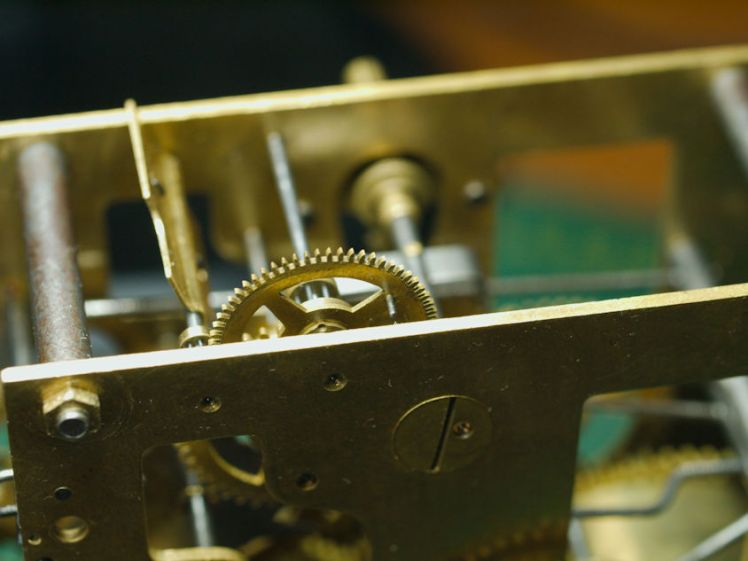
To make this adjustment, there is no need to take the movement apart; simply loosen the movement nut nearest the fan as well as slightly loosen the nut on the time side. Of course, if in the process of testing the strike side, it is important to double-check that both mainsprings are let down before opening up the plate. Once the fly and the locking wheel are free, they can be positioned correctly. The locking point is also determined by the cam, and the lever must be in its slot while the adjustments are taking place.
The Strike Hammer Tail
The other issue is the strike hammer tail.
Once reassembled, I also discovered that the hammer tail was resting on one of the star points. At rest, the strike paddle must sit between two star points. When the hammer tail rests on a star point, it impedes the action of the strike train. The hammer tail must be clear of the lifting star at the end of each strike sequence.

I believe I have found the problem with the strike side. However, there are two more adjustments that are needed before I put the movement on a test stand. One, the hammer lever spring is not providing any tension. I know that if I risk bending it, it will snap, but I will take that chance. I have repaired lever springs in the past, and it should be an easy fix if I break it. The other issue is a loose click on the strike side, which will require completely disassembling the movement to access the rivet from the inside. Once these two items are attended to, I can test the movement.
It’s still a work in progress, but I feel I’m very close to achieving a successful resolution to issues regarding the movement.
Discover more from Antique and Vintage Mechanical Clocks
Subscribe to get the latest posts sent to your email.
 Antique and Vintage Mechanical Clocks