
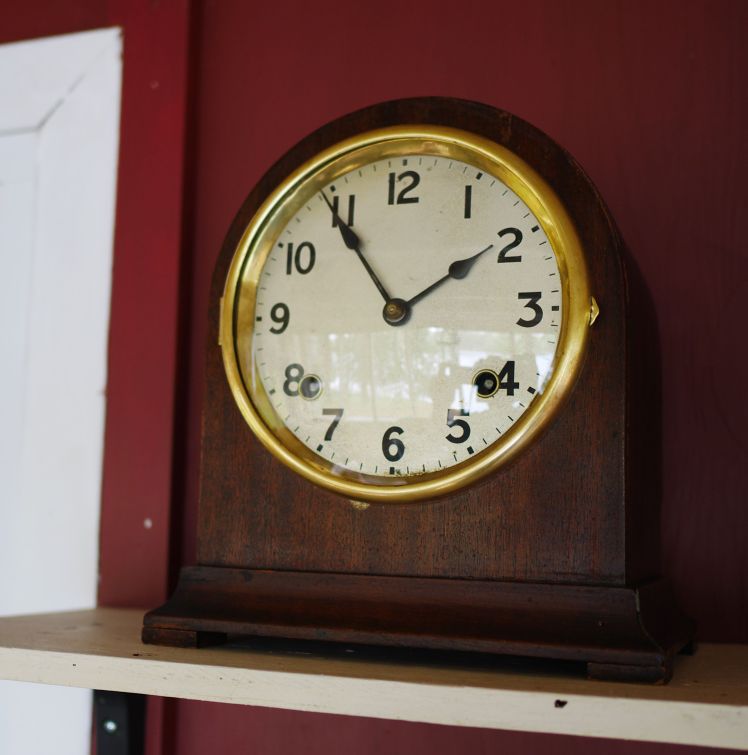
While working on my Pequegnat Bedford mantel clock recently, I made an unexpected discovery about the dial and bezel. I had always assumed the six-inch dial was original to the clock, believing it to be an anomaly or a one-off, as every other Bedford I’ve seen features a five-inch dial.

Adding to the intrigue, I noticed for the first time that the dial lacks the Arthur Pequegnat inscription on the bottom part of the dial—a detail I had previously overlooked. Every Pequegnat clock I have ever seen has the manufacturer’s inscription on the dial.
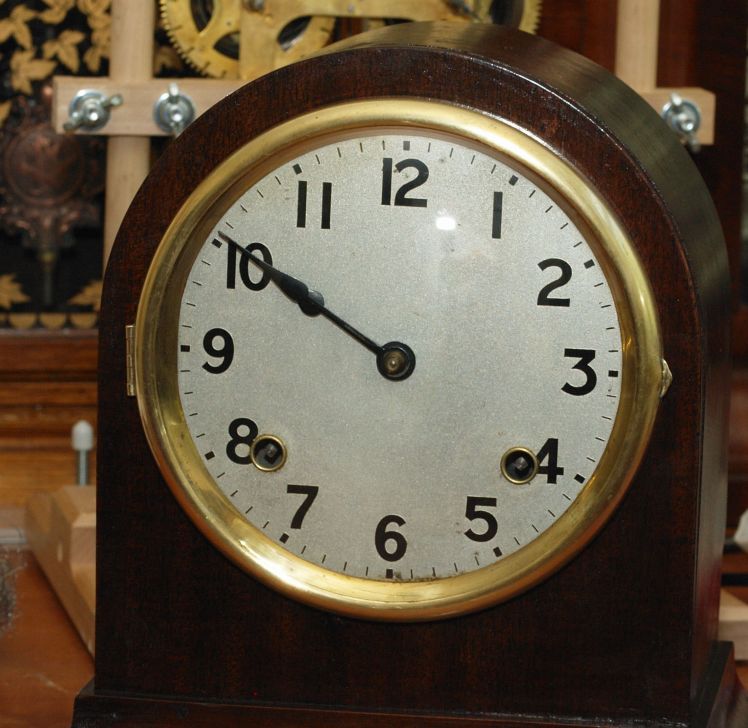
When I acquired the clock some years ago, the bezel door was broken, and as a result, the glass dial bezel was push-fitted into the brass bezel base. The hinge had broken off at some point in its history.
I always intended to fix it, but it just never made it to the top of my to-do list. Recently, I decided to wind the clock and check if it was still running properly. I grabbed the catch to open it, and—whoops!—the dial fell right off. Apparently, I had forgotten it was broken. Well, perhaps this was the day to fix it.
I’d always wondered why the hinge wasn’t working, and sure enough when I inspected the dial and bezel, applied a little heat to the soldered hinge, and pried it loose, I found that only half of the hinge was actually there. Classic!
What is equally amusing is that I completely restored the case four or five years ago and did not notice the replacement dial at the time.
I removed the dial bezel to repair the broken hinge, and I discovered there were no screw holes for the hinge on the clock case itself. Instead, I found three smaller diameter holes, which would have been used to mount a 5-inch dial. This confirmed that the current dial is a replacement. The original design featured an integrated assembly of the dial, bezel, hinge, and glass. This version, however, uses a two-piece dial and bezel, with a hinge that was supposed to be attached to the case.
When Parts Are Not Original
Finding non-original parts on an antique clock is not uncommon, as many clocks have undergone repairs or alterations over the years. These changes may include replacement dials, bezels, hands, or other components that were damaged or lost. While such modifications can affect the clock’s originality and value, they are often part of its history and serve as evidence of its use and care over time.
Whether or not to replace non-original parts depends on your goals as a collector. If preserving originality is a priority, you might seek authentic replacement parts from the same era. However, if functionality and appearance are your main concerns, modern replacements or custom solutions can be a practical choice.
There are times, like this one, when the discovery comes long after you’ve acquired the clock.
In any event, it is essential to document any changes for future reference, especially if the clock is sold, to ensure its history is transparent.
The Hinge Repair
I plan to reuse the bezel but will attach a new hinge. I went through my collection of hinges to find the one that would be the best fit and while not exact I found one that was close.
The first step is to remove the hinge from the glass/brass bezel. It came off easily with a solder gun. I am the first to admit that my soldering skills are not top notch but I am eager to do my best.
The next step is to attach the new hinge to the dial/brass bezel. Once attached, it is test-fitted with the glass/bezel to ensure there is sufficient clearance for the door to close. In this case, there is not enough clearance, so I will need to grind down a section of the dial bezel. What initially seemed like a simple job has now become more complicated.
Discover more from Antique and Vintage Mechanical Clocks
Subscribe to get the latest posts sent to your email.
 Antique and Vintage Mechanical Clocks