
The term minimal invasive intervention refers to the delicate decision-making process regarding how much work should be done to repair, restore, or conserve a clock without significantly altering its original character. It encapsulates a challenge many collectors face: balancing preservation with functionality.
Some argue that any work performed on an antique clock detracts from its value, much like installing new fenders on an antique car. While it may improve appearance or functionality, it might make the piece less desirable to purists. So, at what point does intervention—however well-intentioned—compromise a clock’s value?
When original parts, particularly the movement or key aesthetic features, are replaced with non-original or modern components, the clock often loses collector value. Authenticity is a cornerstone of desirability for collectors. Replacing a worn movement with a reproduction or modern equivalent significantly reduces value, even if it restores functionality.
Excessive restoration, such as refinishing to a like-new condition, can erase the patina, wear, or other marks of age that contribute to the clock’s historical character. Collectors value the evidence of a clock’s journey through time.
Alterations that cannot be undone, such as resizing a case, changing its design, or permanently altering the movement, reduce value. Reversibility is crucial in maintaining collector interest.
Intervention may not compromise value if the repair restores function without altering original materials or craftsmanship. Rebushing and cleaning are interventions but are generally considered acceptable practices.
I always maintain that there should be Respect for Provenance, that is, preserving historical repairs, markings, documentation, and patina when they tell the clock’s story through the ages. In addition, using methods and materials appropriate to the clock’s era maintain authenticity.
Let’s look at some definitions.
Repair, Restoration, and Conservation Defined
- Repair involves correcting faults or addressing prior poor repairs, often resulting in changes to a clock’s form or function. Repair in a museum context typically addresses specific problems to restore mechanical function or structural integrity while still respecting the clock’s historical value and authenticity.
- Restoration seeks to return the clock to an “as new” condition, sometimes requiring reconstruction of parts of the movement or case. Restoration in a museum context involves returning an antique clock to a state that reflects its original appearance or function, often as close as possible to how it was when first made.
- Conservation focuses on preserving the clock in its current state while protecting it from further deterioration. This approach aims to maintain the clock as close to its original condition as possible for as long as possible. Conservation in this context prioritizes maintaining the clock’s historical authenticity and ensuring it can be studied and appreciated by future generations. This approach is guided by principles of reversibility, documentation, and respect for the original materials and craftsmanship. A reversible repair means future conservators can undo them if needed.
Some amount of intervention is often necessary and even desired by collectors, but how much is always a delicate balance.
A Case in Point: 1878 E. Ingraham Huron Clock
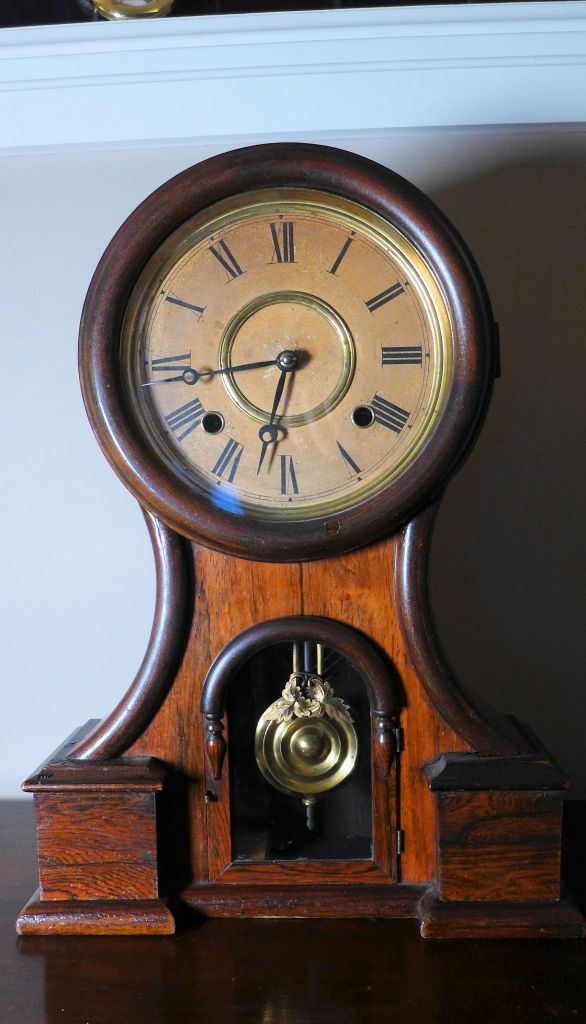
Take, for example, an 1878 E. Ingraham Huron time-and-strike balloon clock from my collection. The 16-inch high rosewood case is remarkably well-preserved for its 146 years, with no breaks, cracks, or missing pieces. The hands, pendulum bob, sash, and bezel hardware are all original, as is the movement. The case has been gently cleaned with soap and water and given a light coat of shellac for protection.
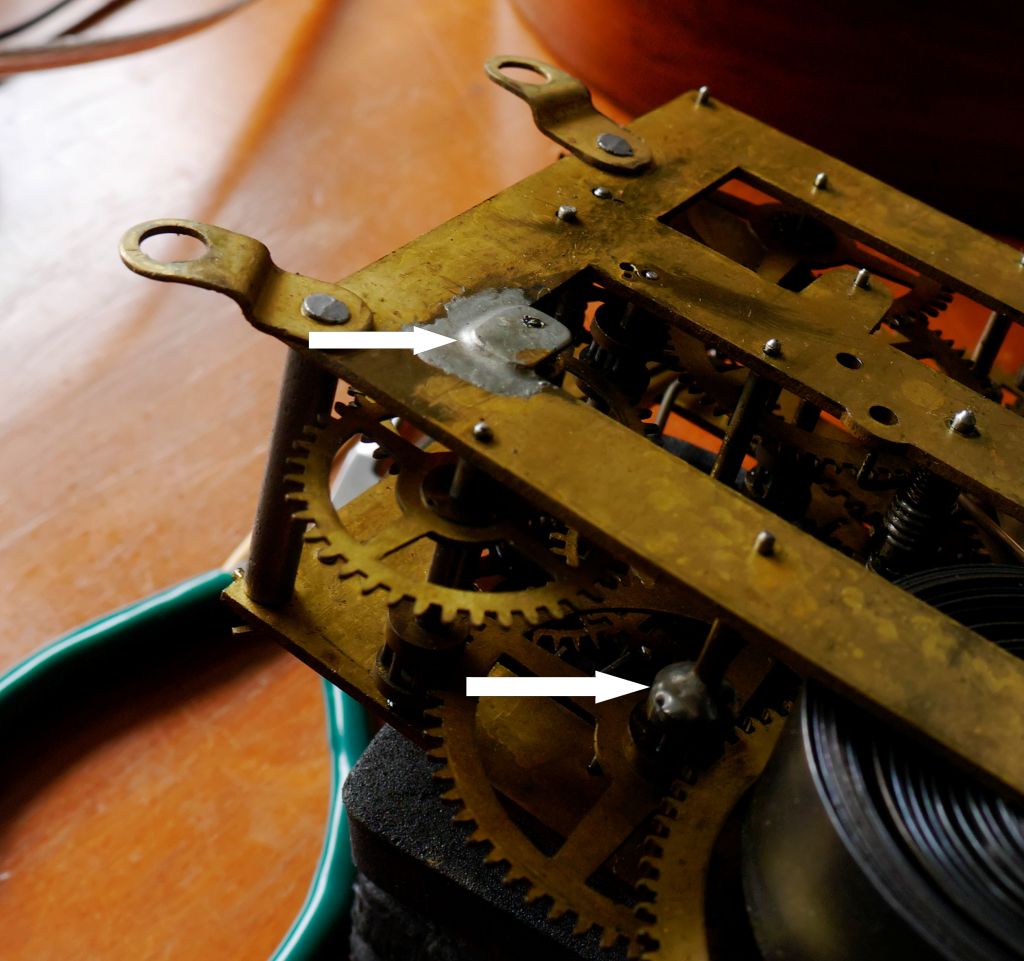
The clock face retains a layer of grime that contributes to its aged character, which I chose to leave untouched. However, the movement has suffered from less-than-professional repairs, likely due to the lack of skilled clockmakers in small-town Nova Scotia (Canada) during the clock’s early life. These repairs include soldered joints and realigned gears with pivot holes drilled directly into the plates—techniques probably applied in the 1940s, when soldering guns became more accessible.
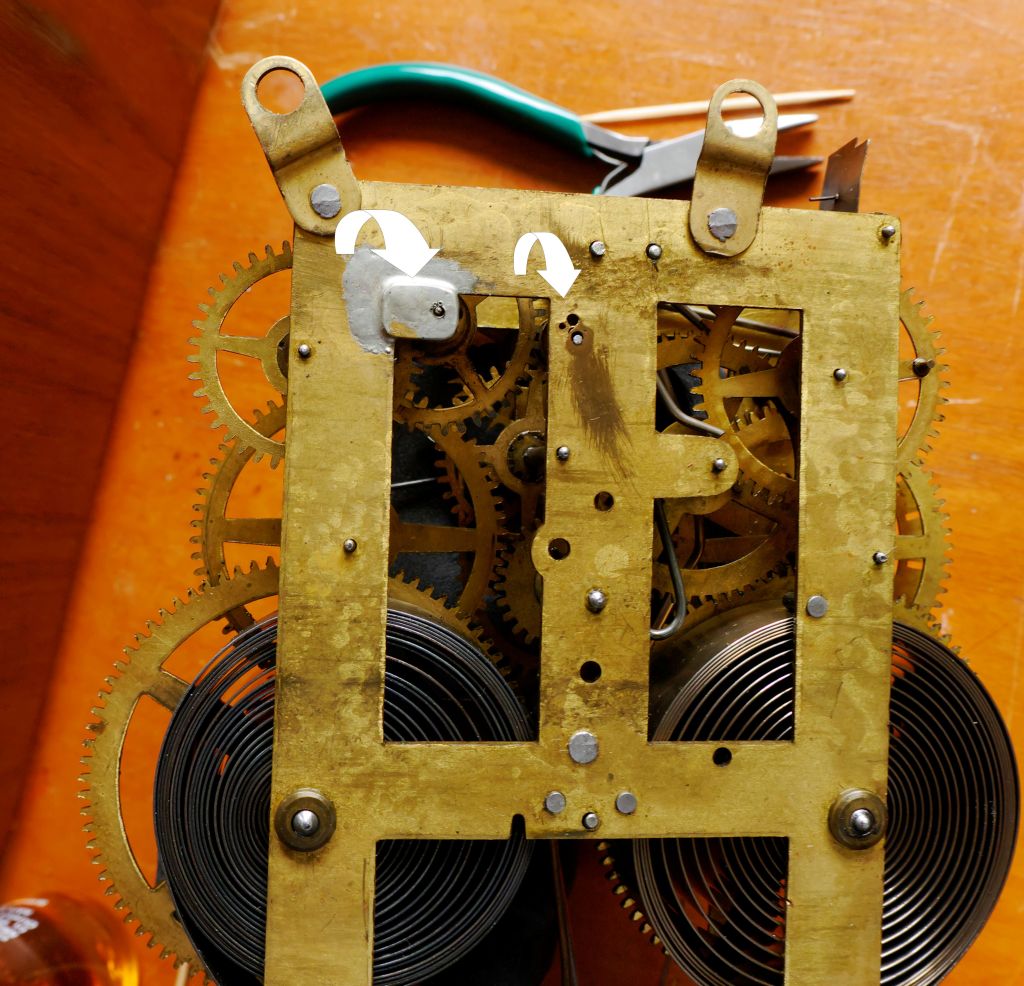
The clock ran for two or three days before stopping, and even nudging the pendulum provides only a temporary fix. On removing the movement from its case, the extent of these invasive repairs becomes more apparent. Even more apparent was the need for a full servicing.
Deciding on the Right Approach
After consulting a certified horologist, we discussed the options: repair, restore, or conserve? He shared an example of a customer’s kitchen clock (or “Gingerbread clock”), a common family heirloom. While these clocks are rarely of high monetary value, they often hold deep sentimental significance.
He typically repairs such clocks but occasionally replaces irreparable movements with period-correct ones—an option acceptable to many owners, but one that collectors generally frown upon and approach I did not care for.
In the case of my Huron, replacing the movement would significantly reduce its value as a collector’s item. Restoring the original movement, however, would maintain its authenticity and desirability. That is the route we took.
Guiding Questions for Intervention
When deciding how to proceed with any antique or vintage clock, I consider the following:
- Does undoing damage from a previous poor repair qualify as overly invasive?
- If the repair was performed soon after the clock was made and is historically documented (e.g., markings inside the case), should it remain untouched?
- Does the poor repair add or subtract from the clock’s historical provenance, making it part of its story?
- Would restoring the movement to its original state be considered a repair or a restoration?
- Does removing all solder work qualify as a minimally invasive intervention?
- Will the repair enhance or detract from the clock’s value?
- Would leaving the clock unrestored qualify as conservation?
The poor repair needed to be addressed. I believe that correcting a subpar repair will always restore the clock’s functionality without diminishing its value. Since only minimal work was done on the case and nothing was done to the dial, I would classify this approach as a repair plus conservation.
The Collector’s Dilemma
Collectors often value clocks that remain as untouched as possible. A pristine, unaltered antique clock that runs is exceedingly rare. However, some intervention is inevitable if the goal is to preserve function, as long as it respects the clock’s historical and aesthetic integrity.
In my view, conservation and repair align most closely with minimal invasive intervention and restoration is inherently more intrusive. Deciding how far to go with a clock involves weighing its historical significance, its condition, and your goals as a collector or caretaker.
When I acquire a clock, the first question I ask is: what outcome am I aiming for based on the price I paid? For inexpensive mantel clocks, I’m willing to undertake extensive case repairs, recognizing that a clock purchased cheaply likely won’t gain significant value. However, for more desirable clocks, I adopt a more cautious approach, carefully determining the minimal work needed to restore functionality and enhance the case’s appearance.
I’d like to hear your views on this subject and how you approach this delicate balance!
Discover more from Antique and Vintage Mechanical Clocks
Subscribe to get the latest posts sent to your email.
 Antique and Vintage Mechanical Clocks
Thanks, Ron. When up against a repair or a job, unsure how to go about it, try to apply the expression attributed to Hippocrates; “First, do no harm”. A Judgement call comes with the territory. Sometimes its a black and white choice. Lots of times its a grey area.
LikeLike
Well said, Marty.
LikeLike